

Professional Service Robots Market Size and Forecast – 2026 to 2033
The Professional Service Robots Market is anticipated to grow at a CAGR of 7.1% with USD 11.8 Bn share in 2026 and is expected to reach USD 15.4 Bn in 2033. Companies and organizations drive the Professional Service Robots market by addressing labor shortages and accelerating automation across healthcare, logistics, agriculture, and hospitality. According to the OECD, labour shortages have reached historic highs over the past decade.
Key Takeaways
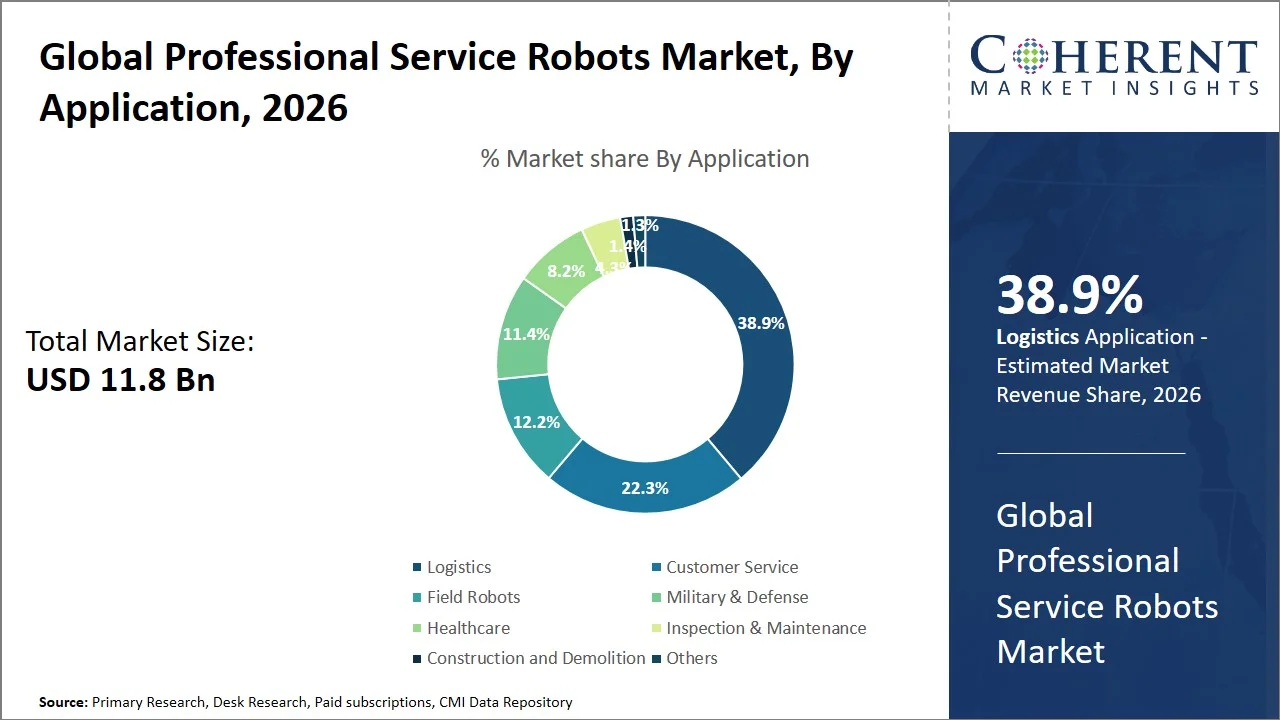
- Logistics hold the largest market share of 38.9% in 2026 owing to the growth of E-commerce. According to our research, the Global Retail E-Commerce industry is estimated to surpass USD 15 trillion by 2033.
- By Type, UAV expected to hold largest market share of 41.7% in 2026 owing to its growing demand for aerial inspection.
- By Region, North America is expected to acquire the dominant share of 39.2% in 2026 owing to its strong adoption of automation. According to the International Federation of Robotics, robot installations in Canada increased 37% to 4,311 units. Source: IFR
Current Events and Their Impact on the Professional Service Robots Market
Current Event | Description and its Impact |
European Union AI Act Implementation (2025–2026) |
|
Japan's National Robotics and Digital Transformation Policies |
|
Segmental Insights
- Current Industry Events of 2026
- Market Size Estimation
- Regional Breakdown
- Competitive Landscape
- Customer Intelligence
- Segmental Analysis
- Pricing Analysis
- Key Market Drivers, Challenges & Future Trends
- Customized Insights Section
Why is Logistics Acquiring the Largest Market Share?
Logistics hold the largest market share of 38.9% in 2026. Companies are driving the logistics segment of the Professional Service Robots Market by expanding e-commerce operations, increasing warehouse automation, and prioritizing faster order fulfillment. They are adopting autonomous mobile robots, automated guided vehicles, and robotic sorting systems to address labor shortages and reduce operational costs. Advances in artificial intelligence, machine vision, and navigation technologies enable businesses to improve material handling efficiency and accuracy. Organizations also integrate robots with warehouse management systems, expand third-party logistics capabilities, and enhance safer, continuous operations across modern supply chains. For instance, BMW Group introduced Physical AI to Europe through a pilot project at its Leipzig plant. The company has established a new “Center of Competence for Physical AI in Production” to accelerate the global adoption of artificial intelligence and robotics across its manufacturing operations.
UAV expected to hold largest market share
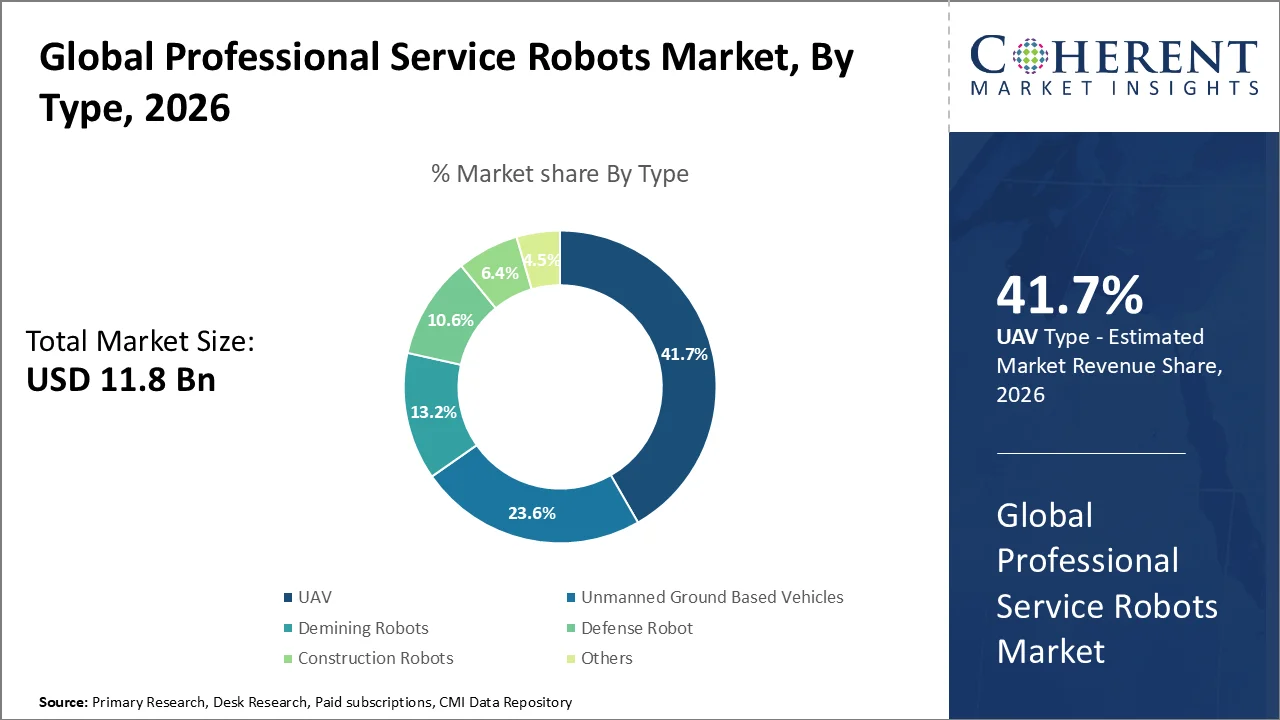
UAV expected to hold largest market share of 41.7% in 2026 owing to its increasing adoption in logistics and delivery. Organizations are driving the UAV segment of the Professional Service Robots Market by adopting unmanned aerial vehicles for aerial inspections, precision agriculture, infrastructure monitoring, and public safety applications. They use UAVs to improve operational efficiency, shorten inspection times, and enhance worker safety in hazardous environments. As of 2025, the U.S. Unmanned Aerial Vehicle (UAV) manufacturing industry employed 9,254 people. Apart from this, advances in artificial intelligence, autonomous navigation, high-resolution imaging, and sensor technologies strengthen UAV capabilities. Companies and government agencies are also expanding UAV use in surveying, environmental monitoring, disaster response, and last-mile delivery, while supportive regulations encourage broader commercial adoption across industries. In May 2026, ePropelled launched a fully integrated propulsion and power solution for agricultural UAVs, targeting one of the fastest-growing and most commercially mature segments of the global drone market.
Professional Service Robots Market Trends
- Rising adoption of artificial intelligence (AI), machine learning (ML), and computer vision is enabling professional service robots to perform autonomous navigation, object recognition, predictive maintenance, and real-time decision-making across healthcare, logistics, agriculture, and public safety applications. The European Commission estimates that AI adoption could contribute EUR 2.7 trillion to the EU economy by 2030, supporting greater deployment of AI-enabled robotic systems across industries.
- Autonomous Mobile Robots (AMRs) are replacing conventional Automated Guided Vehicles (AGVs) in warehouses, hospitals, and industrial facilities due to their ability to navigate dynamic environments without fixed infrastructure. According to the U.S. Census Bureau, U.S. e-commerce sales reached approximately USD 1.19 trillion in 2024, driving greater investment in warehouse automation and AMR deployments to improve order fulfillment efficiency.
- Collaborative and multi-robot systems are increasingly being deployed to work safely alongside human operators in healthcare, warehousing, inspection, hospitality, and field service applications. According to the International Federation of Robotics (IFR), 205,075 professional service robots were sold globally in 2023, representing a 30% increase from 2022, reflecting growing commercial adoption across service industries.
Regional Insights
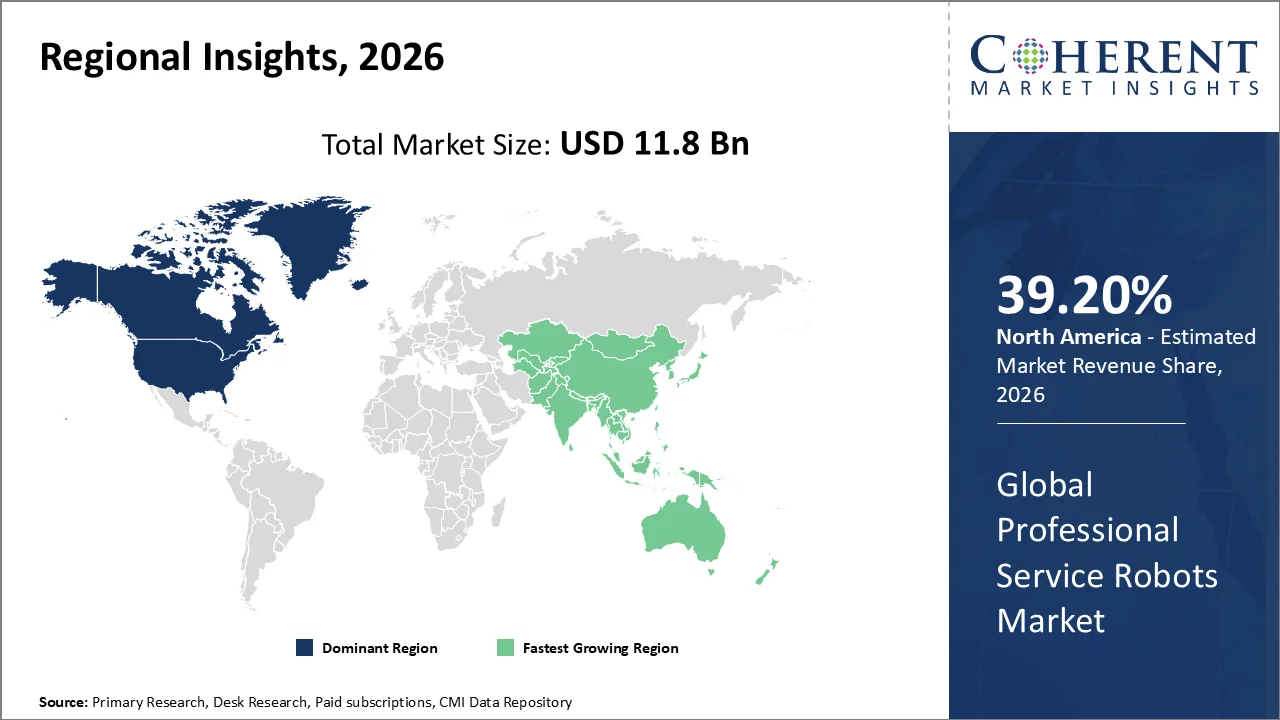
North America dominates owing to strong presence of robotics companies
North America is expected to acquire the dominant share of 39.20% in 2026. Organizations in North America are accelerating the Professional Service Robots Market by adopting automation, advanced healthcare technologies, and intelligent robotic solutions across various industries, including healthcare and logistics. Companies deploy professional service robots to overcome labor shortages, enhance operational efficiency, and improve workplace safety. As of 2025, 70% of U.S. employers report labor shortages, five percentage points below the global average. The expansion of e-commerce, warehouse automation, healthcare robotics, and defense applications strengthens market growth. Technology companies and research institutions drive innovation through advancements in artificial intelligence, machine learning, and autonomous systems, enabling broader development and adoption of professional service robots throughout the region. Realbotix Corp. partnered with Bloom Procurement Services to deploy socially assistive robots in a pilot program aimed at reducing loneliness and improving elderly wellbeing.
Asia Pacific Professional Service Robots Market Trends
The Asia Pacific Professional Service Robots Market grows as industries rapidly adopt automation, address labor shortages, and seek higher operational efficiency. Companies leverage advancements in artificial intelligence, machine learning, and sensor technologies to enhance robotic capabilities. Expanding applications in healthcare, logistics, hospitality, agriculture, and retail drive market adoption. As of 2025, India has installed more than 300 surgical robots across hospital networks and performs approximately 60,000 robotic-assisted procedures annually. Governments support robotics innovation through initiatives and investments in smart infrastructure, while businesses increasingly deploy professional service robots to improve productivity, enhance safety, and streamline operations across the region. In June 2026, UBTECH unveiled its UWORLD U1 Series ultra-bionic humanoid robots at its 2026 Global Launch Event in Shenzhen, positioning them as the world’s first humanoid robots designed for mass production.
United States Professional Service Robots Market Trends
The United States Professional Service Robots Market grows as organizations across healthcare, logistics, hospitality, defense, and retail increasingly adopt automation solutions. Advancements in artificial intelligence, machine learning, and sensor technologies enhance robot performance and expand their applications. Technology firms continue to invest in innovative robotic solutions, while strong research ecosystems and the growing adoption of collaborative robots support market expansion. For instance, in February 2026, Faraday Future launched FF EAI-Robotics Inc. in California and introduced its first Embodied AI robots, including humanoid and quadruped models, with deliveries.
Japan Professional Service Robots Market Trends
Companies and institutions deploy robots to address workforce shortages, support caregiving needs, and enhance operational efficiency amid an aging population. As of 2025, Japan’s elderly population (aged 65+) represents 29% of the total population, surpassing 30 million people, while the median age has reached 50.2 years. Technological advancements in artificial intelligence, robotics, and sensor systems enable developers to create more efficient and capable robots. Japan’s advanced technology sector, government support for automation initiatives, and investments from robotics companies drive market development, while growing applications of autonomous and collaborative robots increase demand across industries.
Who are the Major Companies in Professional Service Robots Industry
Some of the major key players in Professional Service Robots are Northrop Grumman Corporation, Boston Dynamics, Inc., Daifuku Co., Ltd., Aethon Inc., AB Electrolux, Kuka AG, iRobot Corporation, Robert Bosch GMBH, Elbit Systems Ltd., Gecko Systems International Corporation, and Yujin Robot Co., Ltd.
Key News
- In April 2026, Logic introduced the Octopus, an autonomous overhead picking robot that replaces traditional floor-based systems with a ceiling-mounted solution designed for high-speed industrial case handling.
- In June 2026, Albatron.ai launched the NVIDIA Jetson Thor-powered TALO-A1000, an AI computing platform integrating synchronized sensor processing, deterministic networking, and real-time control for robotics, autonomous vehicles, industrial automation, and machine vision applications. The system delivers up to 2,070 TOPS of AI performance for large vision models, multimodal AI, and Physical AI workloads.
- In December 2025, Quantum Systems and Frontline Robotics launched Europe’s first fully automated industrial drone production line for the Ukrainian Armed Forces through their German-Ukrainian defense joint venture, Quantum Frontline Industries.
Market Report Scope
Professional Service Robots Market Report Coverage
| Report Coverage | Details | ||
|---|---|---|---|
| Base Year: | 2025 | Market Size in 2026: | USD 11.8 Bn |
| Historical Data for: | 2020 To 2024 | Forecast Period: | 2026 To 2033 |
| Forecast Period 2026 to 2033 CAGR: | 7.1% | 2033 Value Projection: | USD 15.4 Bn |
| Geographies covered: |
| ||
| Segments covered: |
| ||
| Companies covered: | Northrop Grumman Corporation, Boston Dynamics, Inc., Daifuku Co., Ltd., Aethon Inc., AB Electrolux, Kuka AG, iRobot Corporation, Robert Bosch GMBH, Elbit Systems Ltd., Gecko Systems International Corporation, and Yujin Robot Co., Ltd. | ||
Analyst Opinion
- Professional service robots are shifting from experimental deployments to operational necessitiesThe market’s strongest growth driver is not technological curiosity but the pressure on industries to maintain productivity amid labor constraints. For example, Japan’s service robot adoption is closely linked to its aging workforce, with people aged 65 and above accounting for nearly 30% of the population. Healthcare providers, logistics operators, and hospitality companies are increasingly turning to robots for elderly assistance, delivery, and routine service tasks where human availability remains limited.
- Healthcare and logistics will remain the most commercially viable application areas for professional service robots. Hospitals are already deploying robots for medication delivery, disinfection, and patient assistance, while logistics companies are using autonomous mobile robots to improve warehouse efficiency. For instance, Amazon operates hundreds of thousands of robotic systems across its fulfillment network, demonstrating that automation has moved beyond pilot projects into large-scale industrial operations.
- Artificial intelligence is becoming the deciding factor in professional service robot adoption. Earlier generations of robots struggled with unpredictable environments, but advancements in AI, computer vision, and sensor fusion are enabling machines to perform complex tasks with greater autonomy. A key example is surgical robotics, where Intuitive Surgical has performed millions of procedures using its robotic-assisted systems, proving that precision-driven automation can achieve strong acceptance in high-value applications.
- The next phase of the market will depend on real-world return on investment rather than robot availability. Companies are unlikely to adopt robots simply because they are innovative; they will prioritize solutions that reduce labor dependency, improve service consistency, and generate measurable operational benefits. In sectors such as hospitality and retail, robots that handle repetitive customer interactions, delivery tasks, and inventory management are gaining attention because they directly address cost pressures and workforce challenges.
Speak to the analyst
Want personalized insights?
Take the findings above to one of our principal consultants, or have the report rebuilt around the segments, geographies and competitors you actually track.
Market Segmentation
- By Application (Revenue, USD Bn, 2021-2033)
- Logistics
- Customer Service
- Field Robots
- Military & Defense
- Healthcare
- Inspection & Maintenance
- Construction and Demolition
- Others
- By Type (Revenue, USD Bn, 2021-2033)
- UAV
- Unmanned Ground Based Vehicles
- Demining Robots
- Defense Robot
- Construction Robots
- Others
- By Region (Revenue, USD Bn, 2021-2033)
- North America
- U.S.
- Canada
- Latin America
- Brazil
- Mexico
- Argentina
- Rest of Latin America
- Europe
- Germany
- U.K.
- France
- Italy
- Spain
- Russia
- Rest of Europe
- Asia Pacific
- China
- India
- Japan
- Australia
- South Korea
- ASEAN
- Rest of Asia Pacific
- Middle East
- GCC
- Israel
- Rest of Middle East
- Africa
- South Africa
- Central Africa
- North Africa
- North America
Sources
Primary Research Interviews
- Interviews with industry stakeholders, including robotics manufacturers, automation solution providers, technology developers, system integrators, distributors, and end users across healthcare, hospitality, logistics, retail, defense, and commercial sectors.
- Discussions with industry experts, researchers, engineers, and operational managers to understand adoption trends, technology developments, challenges, and future opportunities in professional service robots.
Databases
- Government technology and industrial databases
- Trade and import-export databases
- Robotics and automation technology databases
- Patent and intellectual property databases
- Company annual reports, investor presentations, and regulatory filings
- Publicly available corporate databases and product catalogs
Magazines
- Robotics and automation industry magazines
- Manufacturing technology publications
- Healthcare technology magazines
- Logistics and supply chain technology magazines
- Hospitality and retail technology publications
Journals
- Peer-reviewed journals covering robotics, artificial intelligence, machine learning, human–robot interaction, automation engineering, and industrial technologies
- Academic publications from robotics, engineering, and computer science research communities
- Technology and innovation journals focused on autonomous systems and service robotics
Newspapers
- Business and technology newspapers
- Industry-focused news publications
- Regional and global news sources covering robotics investments, partnerships, product launches, and automation trends
Associations
- Robotics and automation industry associations
- Artificial intelligence and technology organizations
- Engineering and manufacturing associations
- Healthcare technology and service innovation associations
- Logistics and supply chain industry bodies
Public Domain Sources
- Government publications and policy documents
- Regulatory authority reports and technology frameworks
- Open-access research papers and academic repositories
- Public company disclosures and press releases
- Conference proceedings and publicly available technical presentations
- Open-source robotics and artificial intelligence documentation
Proprietary Elements
- CMI Data Analytics Tool
- Proprietary CMI Existing Repository of information for last 10 years
Get access to 250+ pages report
Every segment, forecast, competitor profile and data table behind the analysis above — available for instant download.
- ESOMAR Member
- ISO 9001:2015 Certified
- D-U-N-S Registered
- GDPR & CCPA Compliant
Missing comfort of reading report in your local language? Find your preferred language:
Transform your Strategy with Exclusive Trending Reports
Frequently Asked Questions
The Professional Service Robots Market is anticipated to grow at a CAGR of 7.1% with USD 11.8 Bn share in 2026 and is expected to reach USD 15.4 Bn in 2033.
Major factor driving the growth of global professional service robots market during the forecast period is increasing use of IoT in robots for cost-effective predictive maintenance.
Major factors hampering the growth of the professional service robots market during the forecast period constitutes prevalent concerns over data privacy and regulations.
North America professional service robots market is expected to generate the highest revenue during the forecast period.
Some of the key players operating in the market are Northrop Grumman Corporation, Boston Dynamics, Inc., Daifuku Co., Ltd., Aethon Inc., AB Electrolux, Kuka AG, iRobot Corporation, Robert Bosch GMBH, Elbit Systems Ltd., Gecko Systems International Corporation, and Yujin Robot Co., Ltd.