

Gi-Fi Technology Market Size and Trends: 2026-2033
The Gi-Fi Technology Market is estimated to be valued at USD 2,100 Mn in 2026 and is expected to reach USD 7,200 Mn by 2033, growing at a compound annual growth rate (CAGR) of 19.3% from 2026 to 2033.
Key Takeaways
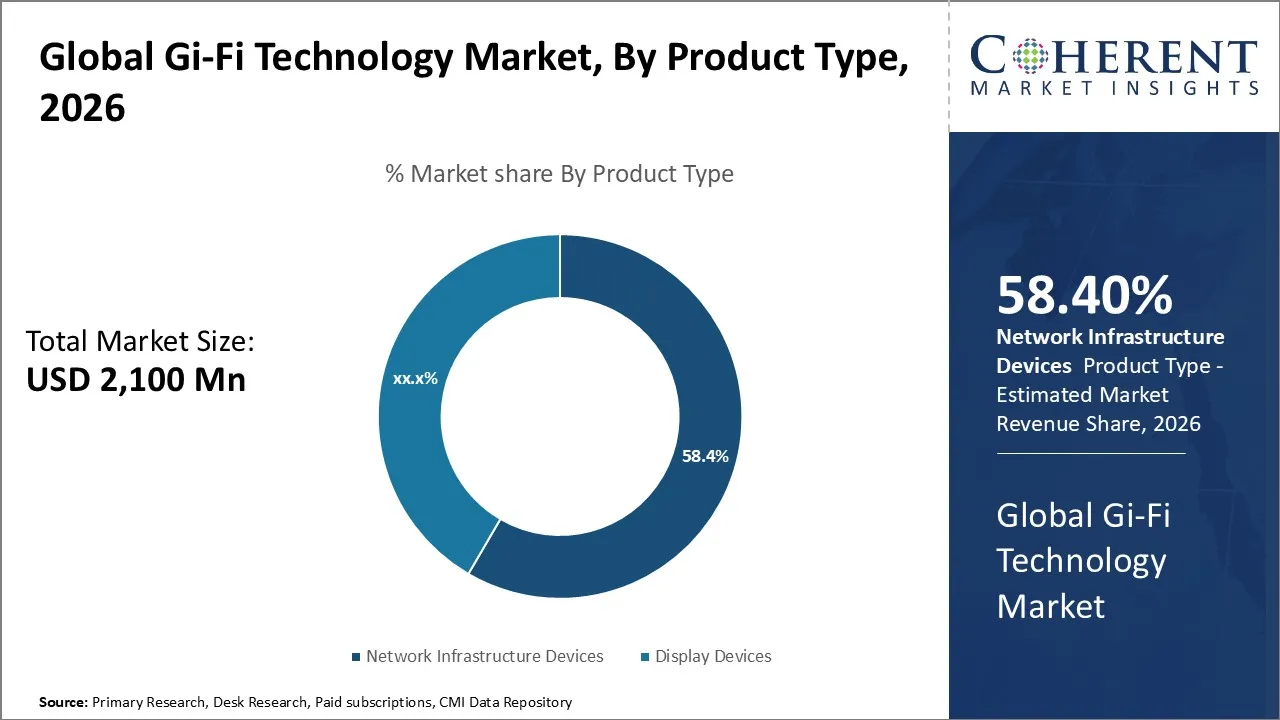
- Based on Product Type, the Network Infrastructure Devices segment is expected to lead the market with 58.40 % share in 2026, due to high-throughput data transmission requirements.
- Based on Technology Type, the System on chip segment is expected to hold 64.30 % share of the market in 2026, driven by higher integration levels and lower power consumption.
- Based on Application Type, the Consumer Electronics segment is projected to account for 46.10 % share in 2026, owing to rising adoption of ultra-fast wireless.
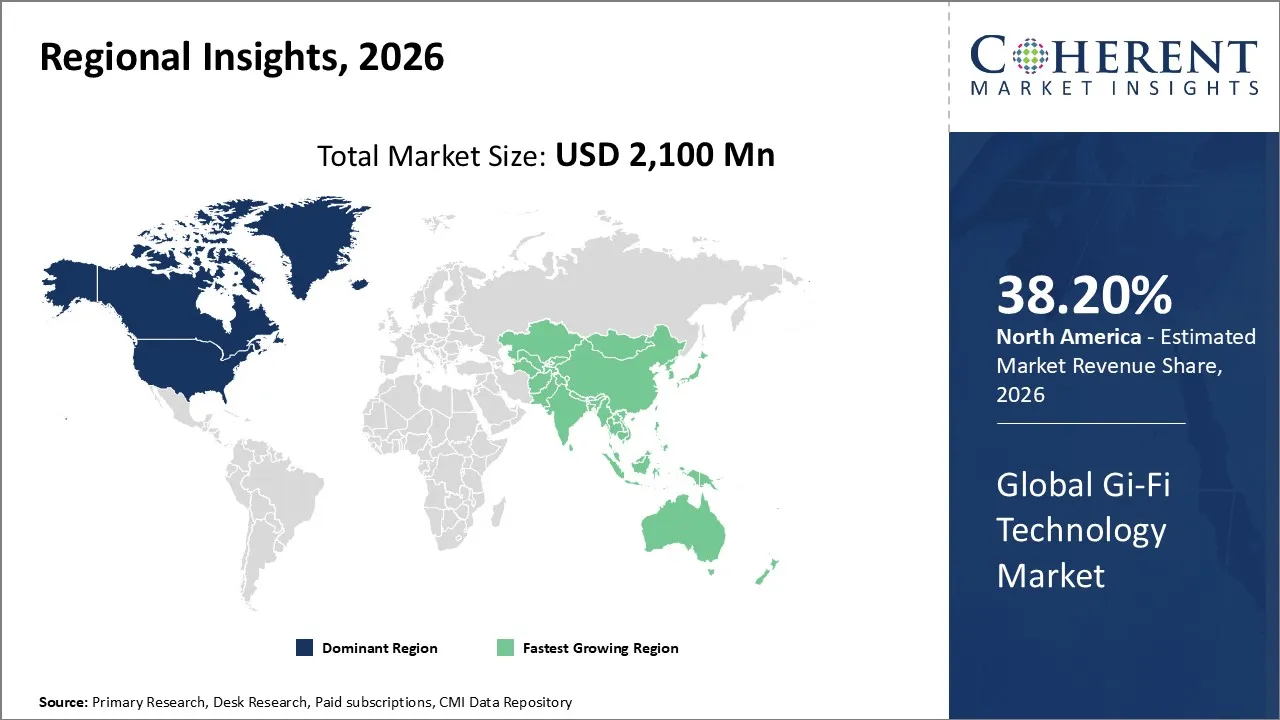
- Based on Region, North America is set to lead the market with 38.20 % share in 2026. While, Asia Pacific is anticipated to be the fastest growing region.
Market Overview
This industry includes fast wireless transmission systems that work at 60 Hz frequency bands, providing data speeds of up to 5 Gbps for short-distance uses. The rising need for smooth internet connections and more data capacity in gadgets and smart devices is boosting the market for Gi-Fi technology solutions.
The Gi-Fi Technology Market is trending toward greater integration and miniaturization of wireless communication modules. Technology makers are working with specialized semiconductor companies and design firms that offer complete chipset solutions along with antenna design skills to improve performance. Development focused on millimeter wave technology and CMOS based transceivers is also growing in popularity over traditional Wi-Fi implementations.
Current Events and Its Impacts on the Gi-Fi Technology Market
Current Event | Description and the Impact |
Technological Advancements in Terahertz Communication
|
|
Regulatory and Spectrum Allocation Changes |
|
Competitive Industry Movements |
|
Segmental Insights
- Current Industry Events of 2026
- Market Size Estimation
- Regional Breakdown
- Competitive Landscape
- Customer Intelligence
- Segmental Analysis
- Pricing Analysis
- Key Market Drivers, Challenges & Future Trends
- Customized Insights Section
Gi-Fi Technology Market Insights, By Product Type - High-throughput Data Transmission Requirements Drives Preference for Network Infrastructure Devices
In terms of product type, the network infrastructure devices segment contributes the highest share of 58.40% in 2026 of the market owing to surging demand for ultra-high-speed wireless connectivity in enterprise environments. The primary drivers include the exponential rise in data traffic, the need for seamless 5G backhaul solutions, and increasing IoT deployments requiring gigabit-level bandwidth. Businesses are increasingly investing in GiFi-enabled routers, switches, and access points to support bandwidth-intensive applications like cloud computing, video conferencing, and real-time data analytics, making this segment the leader in the industry.
For instance, Cambium Networks, a prominent worldwide supplier of wireless networking infrastructure, introduced a new ConnectedPartner program. It is designed to simplify the deployment of solutions by Managed Service Providers (MSPs) using Cambium Networks' reliable, multi-gigabit wireless edge technology.
Gi-Fi Technology Market Insights , By Technology Type - Higher Integration Levels Boosts System on chip Usage
In terms of technology type, the system on chip segment contributes the highest share of 64.30% in 2026 of the market. The segment is growing because they pack multiple components in a single, compact chip, which cuts down costs and power use. The primary drivers for this growth are the growing demand for smaller devices in smartphones, wearables, and IoT gadgets in various industries. They enable faster data transfer at 5 Gbps speeds while staying energy efficient, which makes them perfect for everyday consumer electronics. The advantages, like scalability, cheaper production costs, and the ability to handle high-frequency operations in various sectors, propel demand for this technology.
Gi-Fi Technology Market Insights, By Application Type - Consumer Electronics Lead due to Rising Adoption of Ultra-Fast Wireless
In terms of application type, the consumer electronics segment contribute the highest share of 46.10% in 2026 of the market owing to the growing need for superfast wireless connectivity for smooth performance. Consumers prefer high-quality streaming, online gaming, and quick data transfers that require gigabit-speed data transmission. The increase in incomes and the adoption of digital lifestyles are driving global device upgrades. Manufacturers are using Gi-Fi chipsets to improve user experiences by reducing delays and facilitating faster downloads. The spread of smart home devices, wearables, and portable gadgets needing strong wireless infrastructure is also speeding the segment’s growth.
Regional Insights
North America Gi-Fi Technology Market Analysis & Trends
North America has remained the dominant region with 38.20% in 2026 of the global Gi-Fi Technology Market over the past decade. The growth is due to the rising need for ultrafast data transmission in smart homes, healthcare, and entertainment. The region's strong infrastructure and early use of next-generation wireless solutions are also driving up the need for these solutions. The presence of major technology giants and innovative startups is speeding up investments in research and development activities. The government support for 5G and beyond 5G technologies provides helpful backing.
For instance, in, October 2025, BroadbandOne, a prominent enterprise connectivity provider operating in multiple U.S. states, and Intracom Telecom, a leading provider of technology systems and solutions, are working together to grow their broadband points of presence in Georgia, Louisiana, Texas, Oklahoma, and Florida. This innovative project leverages Intracom Telecom's high-performance multi-gigabit mmWave Fixed Wireless Access (FWA) technology alongside BroadbandOne's distinctive service model.
Asia Pacific Gi-Fi Technology Market Analysis & Trends
The Asia Pacific region has become the fastest growing market. The population density of the region is very high, with rapid urbanization, hence the need for high-speed wireless connectivity. Countries like China, Japan and South Korea are heavily investing in the development of telecommunications infrastructure and smart city projects which involve the need for faster data transfer for the operations of these initiatives. The growing purchasing power of the middle class is promoting the purchase of new gadgets and IoT devices that rely on the rapid transfer rates of Gi-Fi for effective function. The region’s manufacturing strength in electronics and semiconductors is reducing production costs and speeding up the market reach in diverse consumer segments.
For instance, Move Up Internet (MUI), an Internet Service Provider from Australia, revealed its plan to offer an Internet service made by Meta, the company that owns Facebook. The service will bring gigabit Internet to homes and businesses all over the Sunshine Coast area of Australia.
Gi-Fi Technology Market Outlook Country-Wise
The U.S. Gi-Fi Technology Market Trends
The U.S. market growth is owing to a strong demand for fast wireless data with low latency, particularly for IoT devices and smart home applications. The increased investment in technology infrastructure, as well as the growth in the usage of high-bandwidth applications, is also adding to the need for Gi-Fi technology solutions.
China Gi-Fi Technology Market Trends
The market in China is experiencing a boom due to the rising demand for ultrafast and short-range wireless data communications, which play a vital role in smart homes, the Internet of Things (IoT), and consumer electronics. This technology improves the user experience by delivering superior performance for high demand activities like gaming, virtual reality (VR), augmented reality (AR), and seamless connectivity among multiple devices. The availability of low-cost CMOS chips and integrated solutions makes Gi-Fi an appealing choice for devices aimed at the mass market.
Market Report Scope
Gi-Fi Technology Market Report Coverage
| Report Coverage | Details | ||
|---|---|---|---|
| Base Year: | 2025 | Market Size in 2026: | USD 2,100 Mn |
| Historical Data for: | 2020 To 2024 | Forecast Period: | 2026 To 2033 |
| Forecast Period 2026 to 2033 CAGR: | 19.3% | 2033 Value Projection: | USD 7,200 Mn |
| Geographies covered: |
| ||
| Segments covered: |
| ||
| Companies covered: | Samsung Electric, Intel, Qualcomm Atheors, Cisco Systems, Broadcom, Marvell Technology, Panasonic, AzureWave Technologies, NEC, Nvidia, and Broadcom. | ||
| Growth Drivers: |
| ||
| Restraints & Challenges: |
| ||
Gi-Fi Technology Market Drivers
High demand for high speed connectivity
The Gi-Fi technology market is expanding globally due to the increasing demand for high-speed internet access. In today's digital age, activities such as streaming, gaming, video calls, and cloud computing require rapid data transfer. The spread of bandwidth-heavy technologies like 4k/8k video, virtual reality, and augmented reality creates an urgent need for Gi-Fi super-fast speeds to deliver smooth user experiences. Also, the rise of IoT devices in smart homes and industrial settings demands strong wireless solutions that can handle massive data amounts without lag or interruptions. The remote work trends and digital transformation in industries speed up this demand further as professionals need reliable connectivity for productivity. The growing frustration with network congestion and buffering issues pushes consumers toward next-generation solutions that promise better performance. Furthermore, emerging applications in telemedicine, self-driving vehicles, and smart manufacturing require ultra-fast connections that traditional Wi-Fi cannot provide reliably, making Gi-Fi technology increasingly essential for modern needs.
Gi-Fi Technology Market Opportunities
Smart home adoption and 5G integration
The Gi-Fi technology industry is seeing new growth opportunities around the world owing to the rise of smart homes and the use of 5G technology. Gi-Fi provides fast and reliable wireless connectivity for the rapid growth of connected devices like smart speakers, security cameras, thermostats, and appliances. As households add more IoT gadgets, traditional Wi-Fi struggles with bandwidth limitations and interference issues. 5G networks complement Gi-Fi perfectly by handling outdoor and wide-area connectivity, while Gi-Fi manages indoor, short-range, ultra-fast data transfer. This synergy allows for seamless smart home automation and real-time communication between devices. Also, the rollout of 5G infrastructure is speeding up the consumer readiness for next-generation wireless technologies.
Analyst Opinion (Expert Opinion)
- The Gi-Fi technology market is demonstrating growing momentum as demand increases for ultra-high-speed, short-range wireless data transmission. Industry assessments indicate that Gi-Fi adoption is expanding steadily across consumer electronics, enterprise networking, and industrial communication applications. The technology operates in the 60 GHz frequency band and supports data transfer speeds exceeding 5 Gbps, enabling rapid exchange of high-definition video, large datasets, and multimedia content within confined environments.
- Consumer electronics represent a major adoption area, driven by rising usage of smart televisions, laptops, wearable devices, and wireless docking solutions that require high bandwidth with minimal latency. Enterprise and industrial environments are also increasingly deploying Gi-Fi for secure, high-throughput communication in offices, data centers, and automation-driven facilities. Data indicates a consistent rise in research investments focused on millimeter-wave chipsets and antenna miniaturization, which is improving device integration feasibility.
- Regionally, North America remains a leading market due to early technology adoption and strong semiconductor innovation ecosystems. Asia Pacific is emerging as a high-potential region, supported by expanding electronics manufacturing bases and increasing deployment of next-generation wireless infrastructure.
- Technical limitations related to short transmission range and signal attenuation remain key constraints; however, ongoing advancements in beamforming and integrated circuit design are improving performance reliability. Overall, Gi-Fi technology is positioned as a complementary wireless solution addressing high-speed, short-distance connectivity needs across evolving digital ecosystems.
Speak to the analyst
Want personalized insights?
Take the findings above to one of our principal consultants, or have the report rebuilt around the segments, geographies and competitors you actually track.
Pharmaceutical Testing Services Industry News
- In October 2025, Nextlink Internet, a hybrid ISP with operations in 12 states, is now implementing G2, Tarana's second-generation wireless broadband platform to provide gigabit internet service. This deployment marks the largest number of G2 units ever deployed, with 350 sectors already serving active customers.
- In May 2025, GTA, Guam's oldest telecom provider, and Tarana, the company behind of next-generation fixed wireless access (ngFWA) broadband technology, unveiled a new network that is making high-speed internet more widely available on the island. After just three months of availability, GTA has already signed up hundreds of subscribers for the service and has reached over 30,000 homes and businesses.
- In August 2023, Marvell technological, a top supplier of semiconductor solutions for data infrastructure, unveiled a novel technological platform for 5nm multi-gigabit copper Ethernet PHYs. With the help of this platform, enterprise network equipment manufacturers and other stakeholders should be able to meet the rigorous performance and energy efficiency requirements imposed by the next generation of multi-gigabit network technologies, such as Wi-Fi 7.
- In September 2021, Iskratel, a Slovenian company that makes information and telecommunications equipment, released the Innbox G92 multi-gigabit GPON home gateway for fast internet access. It has a built-in fiber termination unit (FTU) that helps operators save money on running costs and get the best total cost of ownership (TCO).
Market Segmentation
- Product Type Insights (Revenue, USD Mn, 2020 - 2033)
- Display Devices
- Network Infrastructure Devices
- Technology Type Insights (Revenue, USD Mn, 2020 - 2033)
- System on Chip
- Integrated Circuit Chip
- Application Type Insights (Revenue, USD Mn, 2020 - 2033)
- Consumer Electronics
- Commercial
- Networking
- Regional Insights (Revenue, USD Mn, 2020 - 2033)
- North America
- U.S.
- Canada
- Latin America
- Brazil
- Argentina
- Mexico
- Rest of Latin America
- Europe
- Germany
- U.K.
- France
- Italy
- Russia
- Rest of Europe
- Asia Pacific
- China
- India
- Japan
- Australia
- South Korea
- ASEAN
- Rest of Asia Pacific
- Middle East & Africa
- GCC Countries
- South Africa
- Rest of Middle East & Africa
- North America
- Key Players Insights
- Samsung Electric
- Intel
- Qualcomm Atheors
- Cisco Systems
- Broadcom, Marvell Technology
- Panasonic
- AzureWave Technologies
- NEC
- Nvidia
- Broadcom
Sources
Primary Research Interviews
- Semiconductor & RF Chipset Manufacturers
- Millimeter-Wave (mmWave) Technology Developers
- Wireless Communication Equipment Manufacturers
- Integrated Circuit (IC) Design Engineers
- Consumer Electronics OEMs
- Telecom Network & Wireless Systems Consultants
- Others
Databases
- Bloomberg Terminal
- Thomson Reuters Eikon
- IHS Markit
- Euromonitor International
- S&P Global Market Intelligence
- Statista
- Others
Magazines
- IEEE Spectrum
- Semiconductor Engineering Magazine
- Microwave Journal
- Wireless Design & Development
- Electronics Weekly
- Others
Journals
- IEEE Transactions on Wireless Communications
- IEEE Communications Magazine
- International Journal of Electronics and Communications (AEÜ)
- Journal of Communications and Networks
- Wireless Personal Communications Journal
- Others
Newspapers
- Financial Times
- The Wall Street Journal
- Reuters
- Bloomberg News
- The Economic Times
- Others
Associations
- Institute of Electrical and Electronics Engineers (IEEE)
- 3rd Generation Partnership Project (3GPP)
- International Telecommunication Union (ITU)
- Wi-Fi Alliance
- Semiconductor Industry Association (SIA)
- Others
Public Domain Sources
- U.S. Federal Communications Commission (FCC)
- International Telecommunication Union (ITU) Publications
- National Institute of Standards and Technology (NIST)
- European Commission – Digital Strategy & Connectivity
- World Bank Open Data
- Others
Proprietary Elements
- CMI Data Analytics Tool
- Proprietary CMI Existing Repository of Information for the Last 8 Years
Get access to 250+ pages report
Every segment, forecast, competitor profile and data table behind the analysis above — available for instant download.
- ESOMAR Member
- ISO 9001:2015 Certified
- D-U-N-S Registered
- GDPR & CCPA Compliant
Missing comfort of reading report in your local language? Find your preferred language:
Transform your Strategy with Exclusive Trending Reports
Frequently Asked Questions
The Gi-Fi Technology Market is estimated to be valued at USD 2,100 Mn in 2026, and is expected to reach USD 7,200 Mn by 2033.
The CAGR of the Gi-Fi Technology Market is projected to be 19.3% from 2026 to 2033.
The growing demand for high speed connectivity along with smart home adoption and 5G integration are the major factors driving the growth of the Gi-Fi Technology Market.
Limited range and susceptibility to signal blockage by obstacles are the major factors hampering the growth of the Gi-Fi Technology Market.
In terms of product type, the network infrastructure devices is estimated to dominate the market revenue share in 2026.
Samsung Electric, Intel, Qualcomm Atheors, Cisco Systems, Broadcom, Marvell Technology, Panasonic, AzureWave Technologies, NEC, Nvidia, and Broadcom are the major players.
North America is expected to lead the Gi-Fi Technology Market in 2026.