

Global Smart Speakers Market Size and Forecast: 2026 to 2033
The global smart speakers market is estimated to be valued at USD 15.65 Bn in 2026 and is expected to reach USD 30.10 Bn by 2033, exhibiting a compound annual growth rate (CAGR) of 9.8% from 2026 to 2033.
Key Takeaways of the Global Smart Speakers Market
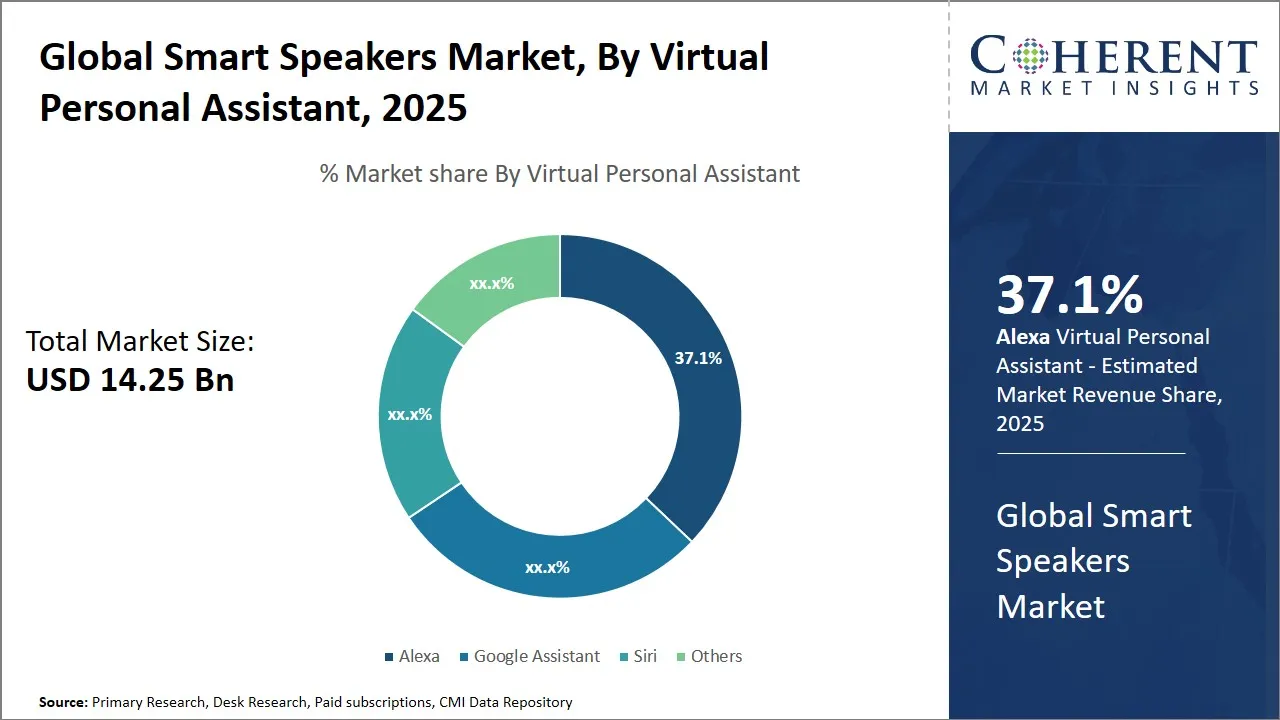
- The Alexa segment is expected to lead the market holding a share of 38.1% in 2026.
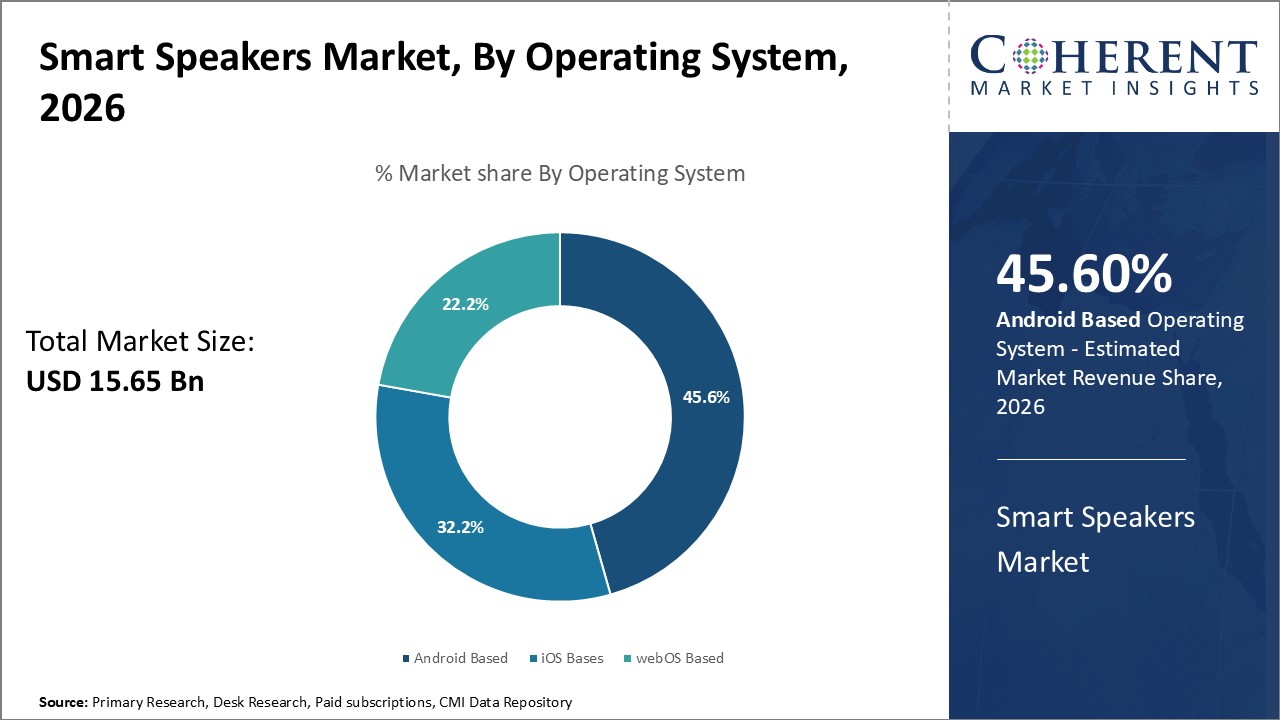
- The android based segment is projected to hold a prominent market share of 45.6% in 2026.
- The Bluetooth segment is projected to account for 43.6% of the market share in 2026
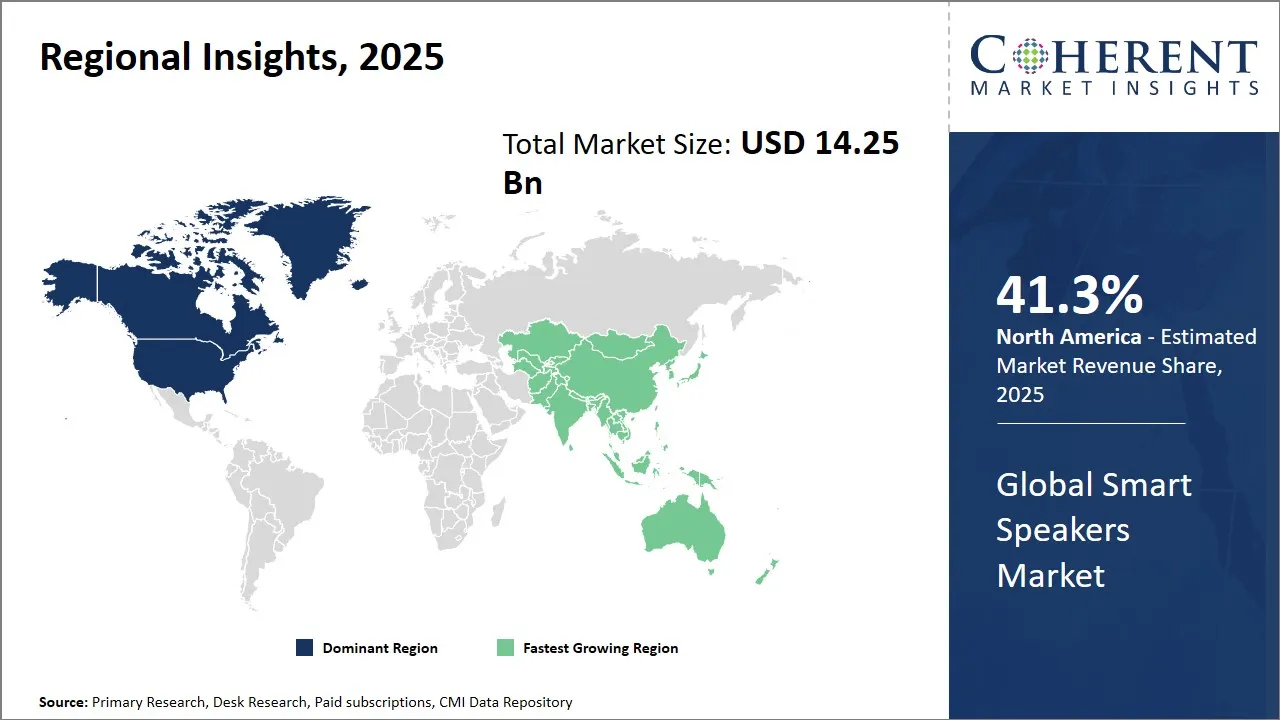
- North America, expected to hold a share of 41.3% in 2026, dominates the market.
- Asia Pacific is expected to be the fastest growing regional market with a share of 27.4% in 2026.
Market Overview
This market rise comes from more people using voice technology, while smart speakers connect with IoT gadgets - boosting ease and satisfaction at homes and businesses globally.
Market trends show rising demand for smart speakers that do more than just play music. Smart devices use AI to adapt to user habits while linking easily with smart home automation systems. Besides this, increased funding in speech recognition technology is accelerating growth, especially as uses grow in areas like medical services, cars, and stores. Also, people now prefer hands-free controls, a change driven by how users interact daily with technology, which keeps reshaping the direction of smart speaker development.
Current Events and Its Impact
Current Events | Description and their Impact |
Amazon Echo Launch |
|
Segmental Insights
- Current Industry Events of 2026
- Market Size Estimation
- Regional Breakdown
- Competitive Landscape
- Customer Intelligence
- Segmental Analysis
- Pricing Analysis
- Key Market Drivers, Challenges & Future Trends
- Customized Insights Section
Global Smart Speakers Market Insights, By Virtual Personal Assistant – Alexa’s Dominance is Propelled by Ecosystem Integration and User Familiarity
In terms of virtual personal assistants, Alexa leads the global smart speakers market with an estimated share of 38.1% in 2026. The increase reflects strong standing, driven largely by wide network connections together with straightforward use. Alexa , developed by Amazon , builds influence via tight integration across numerous smart home devices alongside third-party applications, boosting its draw for users seeking effortless control of linked environments. Because it works with so much, users can operate lights, alarms, heating, and media using just voice prompts - giving a clear advantage over rivals.
Alexa keeps leading largely because Amazon consistently expands its library of "Skills" with voice-powered tools that boost functionality. Since the platform stays open, developers can build custom actions, either for business needs or fun activities, which leads to richer engagement beyond simple commands. On top of this, improvements in how Alexa processes speech have made replies sharper and chats smoother. Better grasp of meaning and what users want leads to higher trust and keeps people coming back.
Global Smart Speakers Market Insights, By Operating System – Android Based Segment Leads the Market Share Driven by Flexibility and Wide Adoption
Within the operating system, the android based segment is expected to command the largest share of 45.6% in 2026. This shows how adaptable android is, plus its global use by makers and buyers. Because it's open source, device builders can adjust the software to fit their tech or local demands so there are many smart speaker types at different prices. Such adaptability drives new ideas and reach, helping these devices attract more kinds of people.
The large network of developers behind Android adds more tools and capabilities to the devices. Because makers can build in Google Assistant along with key services, people get an experience that feels known while linking smoothly to common platforms like YouTube, Maps, or Gmail. Owing to this setup, using smart speakers becomes simpler in helping daily tasks, fun, and finding information if required
Global Smart Speakers Market Insights, By Technology – Bluetooth Segment Leadership in Smart Speakers Market Powered by Universal Connectivity and User Convenience
Bluetooth segment is projected to account for 43.6% of the market share in 2026. Its rise comes from broad device support along with user-friendly operation. Thanks to Bluetooth, speakers connect smoothly to many gadgets like phones, tablets, or computers - without complicated network setups. As it is straightforward, people favor it when they want fast installation combined with hassle-free music playback.
The broad use of Bluetooth in everyday gadgets implies many people already have working devices, so getting into smart speakers feels easier plus more attractive. Rather than Wi-Fi or NFC, which often need setup or closeness, Bluetooth runs on little power while keeping stable direct links, fitting both home and outdoor settings. Such flexibility plays a big role in why it leads the market.
Regional Insights
North America Smart Speakers Market Analysis and Trends
North America is the leader in the global smart speakers market with an estimated share of 41.3% in 2026. North America leads the worldwide smart speaker scene due to advanced technology settings, quick consumer adoption, or strong companies already active in this field. Reliable internet systems help this region, along with efficient distribution paths while people generally feel at ease operating linked household gadgets. In the U.S., progress often stems from players like Amazon, Google, and also Apple - businesses that invested heavily in creating powerful voice assistants including Alexa, Google Assistant, plus Siri. Policies promoting IoT usage together with data protection increase user confidence. Also, close ties between tech developers and communication carriers simplify how smart speakers connect across digital platforms, improving ease of use plus performance.
Asia Pacific Smart Speakers Market Analysis and Trends
Asia Pacific smart speakers market is expected to exhibit the fastest growth and hold a market share of 27.4% in 2026, fueled by expanding internet penetration, increasing disposable incomes, and a rapidly growing middle class in countries like China and India. The regional market is characterized by rising urbanization, youthful demographics, and growing consumer interest in voice-enabled technologies. Local firms like Xiaomi, Baidu, or Huawei make affordable smart speakers designed for local languages and tastes - this boosts their reach. Government efforts that encourage digital tools or urban tech speed up usage instead. Trade factors , for instance, relaxed import rules along with better regional logistics, help deliver products faster into developing areas, lifting expansion chances.
Global Smart Speakers Market Outlook for Key Countries
U.S. Smart Speakers Market Analysis and Trends
The U.S. leads in tech thanks to firms such as Amazon and Google, which keep advancing AI and voice tools that shape sector standards. Because shoppers believe in these products and face many choices, new smart speaker features get picked up fast. Working together with makers of home gadgets or music platforms strengthens their networks while offering more worth to users. Also, American companies increasingly use voice devices to connect better with customers or run smarter offices, expanding how they're used outside homes.
China Smart Speakers Market Analysis and Trends
China’s market sees major involvement from homegrown tech firms like Baidu, Xiaomi, and Alibaba, each building voice assistants tailored to Mandarin plus various local dialects. Support from authorities for AI and connected devices pushes faster rollout; at the same time, huge online shopping systems help bring these tools to more people. Integration into widely used apps for music streaming, buying goods, even chatting strengthens how users interact with smart speakers, making them harder to give up. Moreover, China’s push toward intelligent urban development boosts business uses of this audio tech.
India Smart Speakers Market Analysis and Trends
India's market is expanding quickly, thanks to more people using smartphones and a growing middle class that’s becoming more comfortable online. Leading firms tailor their services by adding regional language options, making tech easier to use for locals. Programs like Digital India encourage households in cities and nearby regions to adopt internet-connected gadgets such as smart speakers. Budget-friendly versions from global and homegrown brands respond well to consumer concerns about cost, broadening access across varied communities.
Germany Smart Speakers Market Analysis and Trends
Germany's smart speaker scene shows slow yet steady uptake, shaped by strict data rules affecting how products are built and sold. While firms such as Apple push secure models suited to careful buyers, regional tech startups alongside phone network operators help spread devices tuned for local languages and EU standards. At the same time, industrial strength in production drives better build quality and smoother connections across household gadgets.
Brazil Smart Speakers Market Analysis and Trends
Brazil shows growing potential due to more people going online and moving into cities. While global companies like Amazon and Google operate there, they provide services in Portuguese and adjust offerings based on regional habits. As the government invests in digital networks, use of smart devices rises gradually. Meanwhile, homegrown online stores play a role in delivering smart speakers across the country. Because individuals and organizations alike seek voice-based tools for tasks or media, applications continue broadening locally.
Global Smart Speakers Market Pricing Analysis
Segment | Amazon | Apple | Others | |
Entry-Level | USD 39.99 - USD 69.99 | USD 49.99 - USD 119.99 | - | USD 149.99 - USD 179.99 |
Mid-Range | USD 89.99 - USD 149.99 | USD 99.99 - USD 259.99 | USD 99.99 - USD 109.99 | USD 219.99 - USD 449.99 |
Premium | USD 199.99 - USD 299.99 | USD 299.99 - USD 399.99 | USD 299.99 - USD 329.99 | USD 899.99 - USD 999.99 |
Market Players, Key Development, and Competitive Intelligence
Key Developments
- On January 23, 2024, Sonos launched an 8-inch in-ceiling speaker made together with Sonance, expanding their well-received range of built-in passive audio units. This model gives professionals and users another choice in dimensions - designed to blend into ceilings while producing strong, even, crisp acoustics.
- On January 10, 2024, Ceva Inc and Sunplus Technology Co., Ltd.vannounced the companies have expanded their collaboration to integrate Ceva’s latest generation RivieraWaves Bluetooth audio solution into the Sunplus Airlyra family of HD audio processors targeting wireless speakers, soundbars and other premium wireless audio devices.
Top Strategies Followed by Smart Speakers Market Players
- The global smart speakers market includes big names, growing brands, and smaller firms, all using different tactics to gain ground. While companies like Amazon, Google, and Apple lead through strong R&D spending, they roll out powerful devices featuring smart voice tech, AI functions, along with rich audio performance. Instead of standing still, these leaders keep refining their technology and this supports capabilities such as synchronized home-wide music playback, smooth device connectivity, or more intuitive interactions.
- Mid-tier companies in the smart speaker industry use varied approaches to offer affordable products that still maintain decent quality. Instead of competing on brand power, they focus on value-driven models aimed at budget-conscious buyers wanting core functionalities. While top names charge more, these firms appeal to users looking for practical access to voice control and internet linking. They keep designs simple, cut unnecessary expenses during production, yet ensure key capabilities remain included. By doing so, they fill a gap between high-end systems and basic audio devices.
- Smaller companies stand out by targeting specific parts of the smart speakers market, using novel functions or focused uses instead of broad appeal. Rather than compete directly, they apply new tech like speech recognition fine-tuned for local dialects, home automation aligned with distinct living habits, or compact shapes emphasizing mobility and visual style. These firms typically team up with nearby innovators, domestic producers, or area-based suppliers - linking capabilities to adapt products quickly while expanding reach.
Market Report Scope
Global Smart Speakers Market Report Coverage
| Report Coverage | Details | ||
|---|---|---|---|
| Base Year: | 2025 | Market Size in 2026: | USD 15.65 Bn |
| Historical Data for: | 2020 To 2024 | Forecast Period: | 2026 To 2033 |
| Forecast Period 2026 to 2033 CAGR: | 9.8% | 2033 Value Projection: | USD 30.10 Bn |
| Geographies covered: |
| ||
| Segments covered: |
| ||
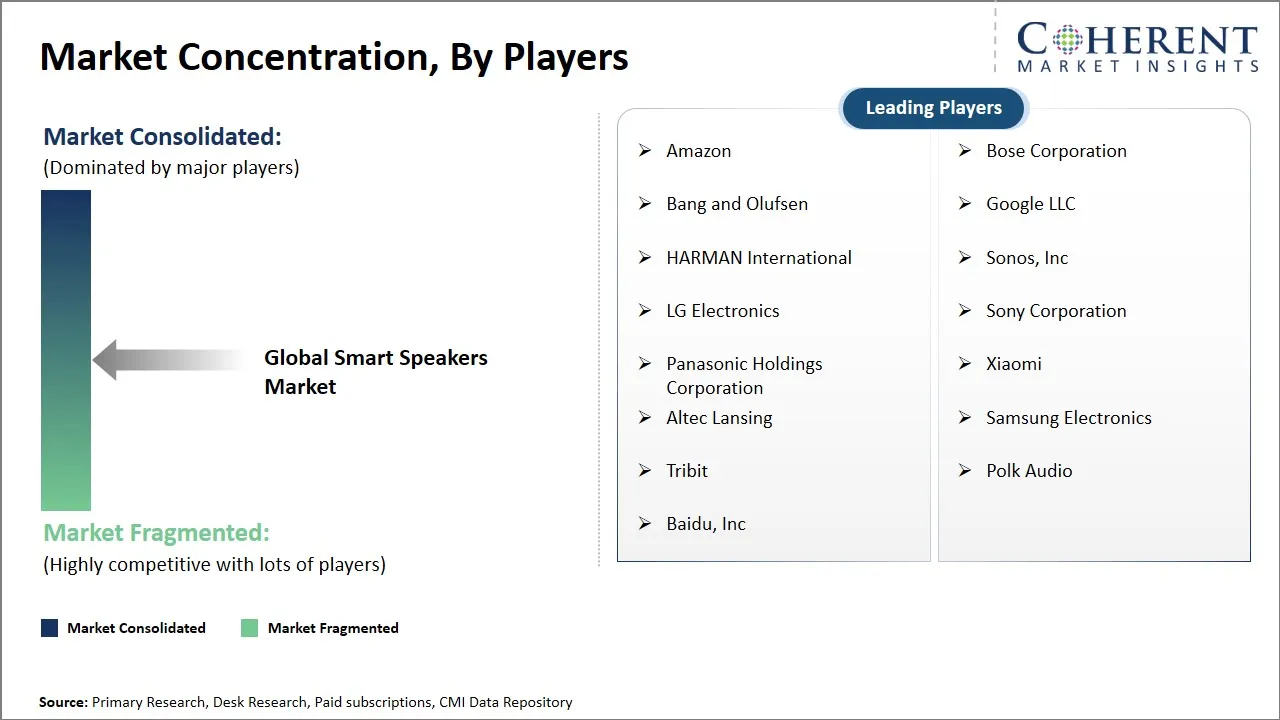
| Companies covered: | Amazon, Bose Corporation, Bang and Olufsen, Google LLC, HARMAN International, Sonos, Inc, LG Electronics, Sony Corporation, Panasonic Holdings Corporation, Xiaomi, Altec Lansing, Samsung Electronics, Tribit, Polk Audio, and Baidu, Inc | ||
| Growth Drivers: |
| ||
| Restraints & Challenges: |
| ||
Market Dynamics
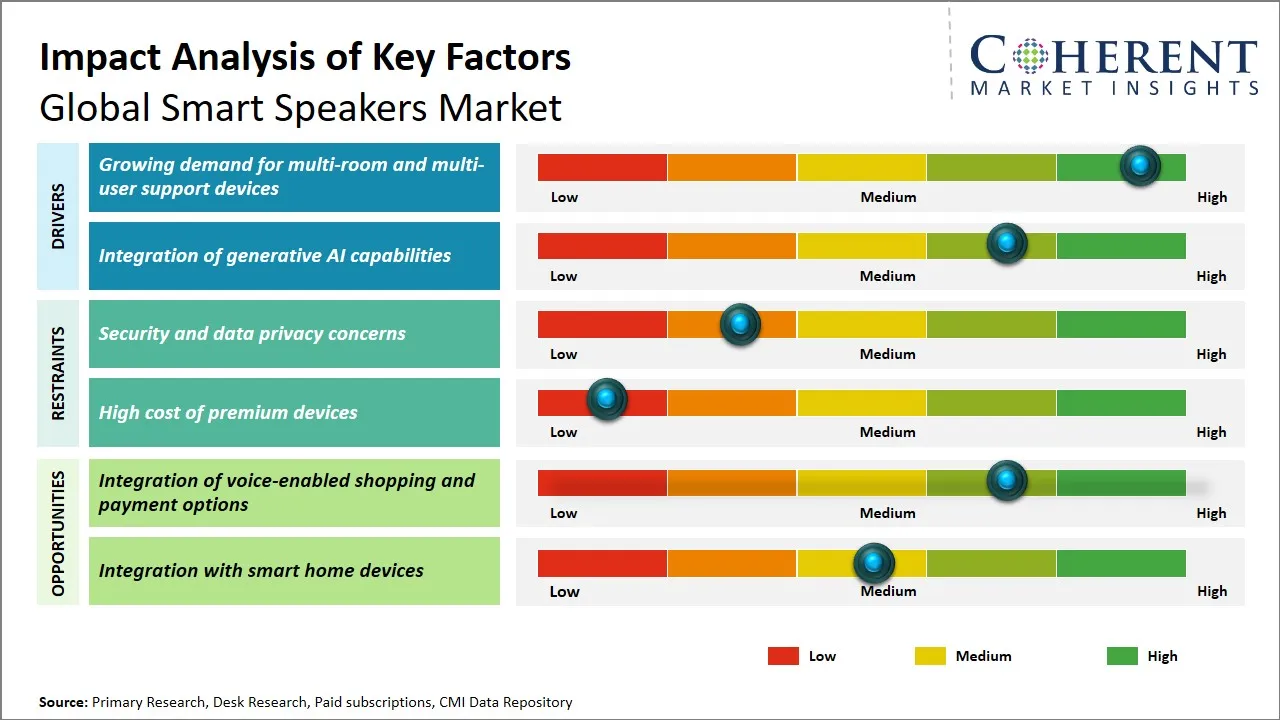
Global Smart Speakers Market Driver - Growing Demand for Multi-Room and Multi-User Support Devices
The shift toward connected home sound systems has boosted sales of smart speakers offering room-to-room sync plus options for several users. As people want effortless playback across areas, they pick gadgets that link audio without delays or interruptions. Such setups don't just simplify daily use, instead, they adjust to varied tastes at home by recognizing voices separately and giving customized answers per person. Controlling lights, locks, or thermostats using one central platform pushes more buyers toward models supporting many accounts without losing clarity from space to space. On top of this, wider access to automated homes along with better understanding of linked appliances increases appeal for these functions, turning zone-based streaming and shared usage into key factors behind growth in the worldwide smart speaker sector.
Global Smart Speakers Market Opportunity - Integration of Voice-Enabled Shopping and Payment Options
The rise of voice-based shopping and payments opens strong growth potential in the global smart speaker industry. Because people want easier, no-hands ways to interact, devices with improved speech detection now play key roles in reshaping online stores and buying habits. With simple spoken requests, users can search items, make orders, or pay - cutting steps and saving time. These smooth actions improve satisfaction while boosting spontaneous buys and ongoing use, leading to increased revenue for sellers.
Furthermore, digital wallets combined with voice verification help reduce worries about transaction safety and this builds user confidence while increasing usage rates. Firms adopting smooth, protected voice-payment tools can outperform rivals by joining the surge in tap-free shopping, particularly where mobile access is widespread yet non-cash transactions remain limited. At the same time, using artificial intelligence to customize suggestions through voice channels enables businesses to deliver relevant offers, raising interaction levels along with revenue chances. Such setups encourage collaboration among tech developers, online sellers, and banking networks, forming linked frameworks that drive broader industry reach. With smart speakers advancing steadily, merging purchase features alongside instant pay options may reshape how people buy - and accelerate development across various fields.
Analyst Opinion (Expert Opinion)
- The worldwide smart speaker sector now moves into a more developed stage, fueled by artificial intelligence upgrades, stronger connections with home automation systems, or shared protocols such as Matter. Leading firms including Amazon or Google focus less on basic voice devices - instead building AI-powered central units that process data locally, combine inputs from multiple sensors, support visual plus spoken interaction, or integrate closely with networked household gadgets.
- Meanwhile, privacy issues are affecting the market, while rivalry from multi-use gadgets like smart screens or voice-enabled TVs is increasing; at the same time, mature areas show little room for expansion. Still, potential continues to rise in developing regions, where cost efficiency combined with region-specific language features could make a real difference.
Speak to the analyst
Want personalized insights?
Take the findings above to one of our principal consultants, or have the report rebuilt around the segments, geographies and competitors you actually track.
Market Segmentation
- Virtual Personal Assistant Insights (Revenue, USD Bn, 2021 - 2033)
- Alexa
- Google Assistant
- Siri
- Others
- Operating System Insights (Revenue, USD Bn, 2021 - 2033)
- Android Based
- iOS Bases
- webOS Based
- Technology Insights (Revenue, USD Bn, 2021 - 2033)
- Bluetooth
- Wi-Fi
- Near Field Communication (NFC)
- Application Insights (Revenue, USD Bn, 2021 - 2033)
- Residential
- Commercial
- Distribution Channel Insights (Revenue, USD Bn, 2021 - 2033)
- Online
- Offline
- Regional Insights (Revenue, USD Bn, 2021 - 2033)
- North America
- U.S.
- Canada
- Latin America
- Brazil
- Argentina
- Mexico
- Rest of Latin America
- Europe
- Germany
- U.K.
- Spain
- France
- Italy
- Russia
- Rest of Europe
- Asia Pacific
- China
- India
- Japan
- Australia
- South Korea
- ASEAN
- Rest of Asia Pacific
- Middle East
- GCC Countries
- Israel
- Rest of Middle East
- Africa
- South Africa
- North Africa
- Central Africa
- North America
- Key Players Insights
- Amazon
- Bose Corporation
- Bang and Olufsen
- Google LLC
- HARMAN International
- Sonos, Inc
- LG Electronics
- Sony Corporation
- Panasonic Holdings Corporation
- Xiaomi
- Altec Lansing
- Samsung Electronics
- Tribit
- Polk Audio
- Baidu, Inc
Sources
Primary Research Interviews
- Smart speaker manufacturers and technology companies executives
- Voice assistant platform developers and AI specialists
- Consumer electronics retailers and distributors
- Smart home ecosystem integrators and IoT solution providers
- Others
Databases
- IDC Worldwide Smart Speaker Tracker
- Strategy Analytics Smart Speaker Database
- Euromonitor International Consumer Electronics Data
- Others
Magazines
- Consumer Electronics Magazine
- Smart Home Magazine
- Voice Technology Magazine
- Audio Engineering Society Magazine
- Others
Journals
- IEEE Transactions on Consumer Electronics
- International Journal of Human-Computer Studies
- Journal of Voice Technology and Applications
- Others
Newspapers
- The Wall Street Journal (Technology Section)
- Financial Times (Consumer Electronics Coverage)
- TechCrunch (Smart Home and IoT News)
- Forbes (Technology and Consumer Electronics)
- Others
Associations
- Consumer Technology Association (CTA)
- Voice & AI Association
- Smart Home Technology Association
- International Consumer Electronics Association
- Others
Public Domain Sources
- Federal Communications Commission (FCC) filings and reports
- U.S. Patent and Trademark Office (USPTO) patent databases
- International Trade Administration (ITA) market reports
- European Commission Digital Single Market reports
- Others
Proprietary Elements
- CMI Data Analytics Tool
- Proprietary CMI Existing Repository of information for last 8 years
Get access to 250+ pages report
Every segment, forecast, competitor profile and data table behind the analysis above — available for instant download.
- ESOMAR Member
- ISO 9001:2015 Certified
- D-U-N-S Registered
- GDPR & CCPA Compliant
Missing comfort of reading report in your local language? Find your preferred language:
Transform your Strategy with Exclusive Trending Reports
Frequently Asked Questions
The global smart speakers market is estimated to be valued at USD 15.65 Bn in 2026 and is expected to reach USD 30.10 Bn by 2033.
The CAGR of the global smart speakers market is projected to be 9.8% from 2026 to 2033.
Growing demand for multi-room and multi-user support devices and integration of generative AI capabilities are the major factors driving the growth of the global smart speakers market.
Security and data privacy concerns and high cost of premium devices are the major factors hampering the growth of the global Smart Speakers Market.
In terms of virtual personal assistant, the Alexa is estimated to dominate the market revenue share in 2026.
Amazon, Bose Corporation, Bang and Olufsen, Google LLC, HARMAN International, Sonos, Inc, LG Electronics, Sony Corporation, Panasonic Holdings Corporation, Xiaomi, Altec Lansing, Samsung Electronics, Tribit, Polk Audio, and Baidu, Inc are the major players.
North America is expected to lead the global smart speakers market in 2026