

Submarine Cables Market Size and Share Analysis: (2026 - 2033)
The Submarine Cables Market is anticipated to grow at a CAGR of 6.3% valued at USD 3,304.7 Mn in 2026 and is expected to reach USD 8,794.2 Mn in 2033. Increasing internet usage worldwide, rising number of offshore energy projects, increasing demands for faster transmission of data, development of international communication systems, and investments in underwater power connectivity are some of the factors that will drive the market growth.
Key Takeaways from the Submarine Cables Market Report
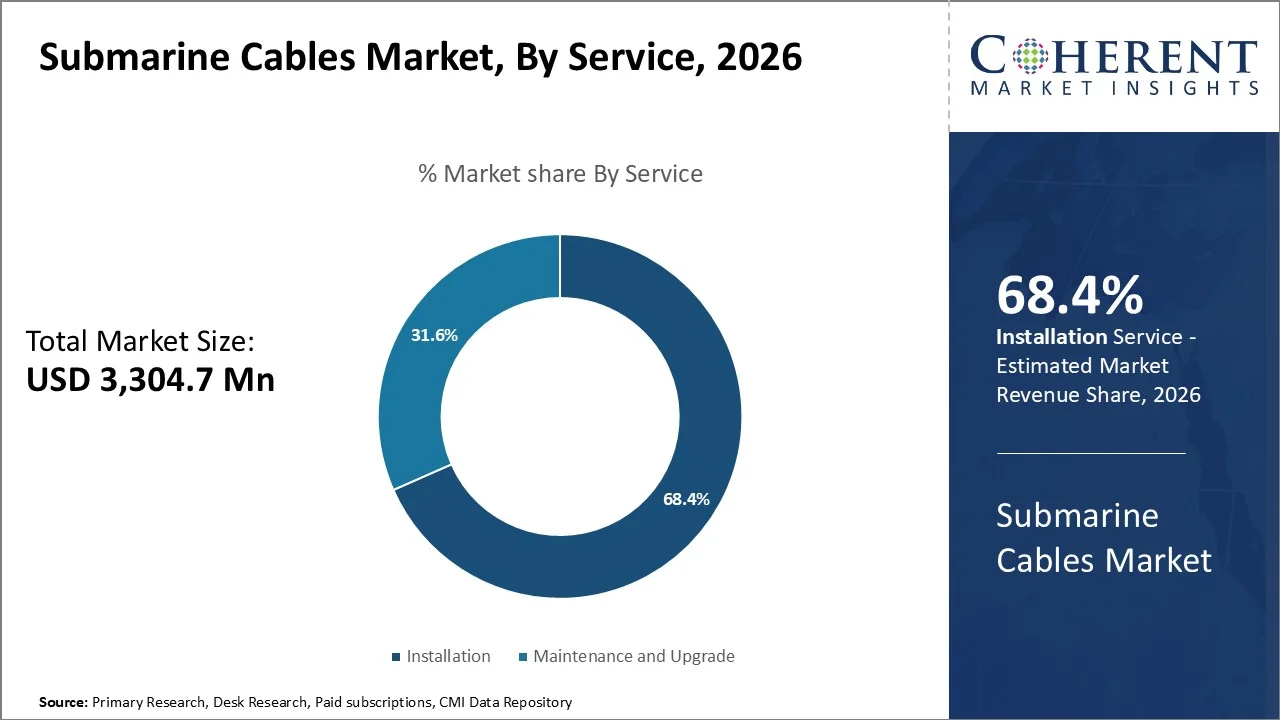
- The installation segment is anticipated to command a dominant market position with a market share of approximately 68.4% in 2026 due to rising installations of submarine communications cables and offshore power transmission cables across the world. As per the International Energy Agency (IEA), wind energy installations are projected to almost double up to more than 2,000 GW by 2030, with offshore wind capacity additions touching 140 GW.
- The submarine power cables segment is expected to have the largest market share, with approximately 61.5% forecasted for 2026 owing to growing offshore wind farms and an increase in cross-border power transmission. This comes against the backdrop that, according to the Global Wind Energy Council (GWEC), a total of 117 GW was installed in the world in a year, setting a new global wind installation record.
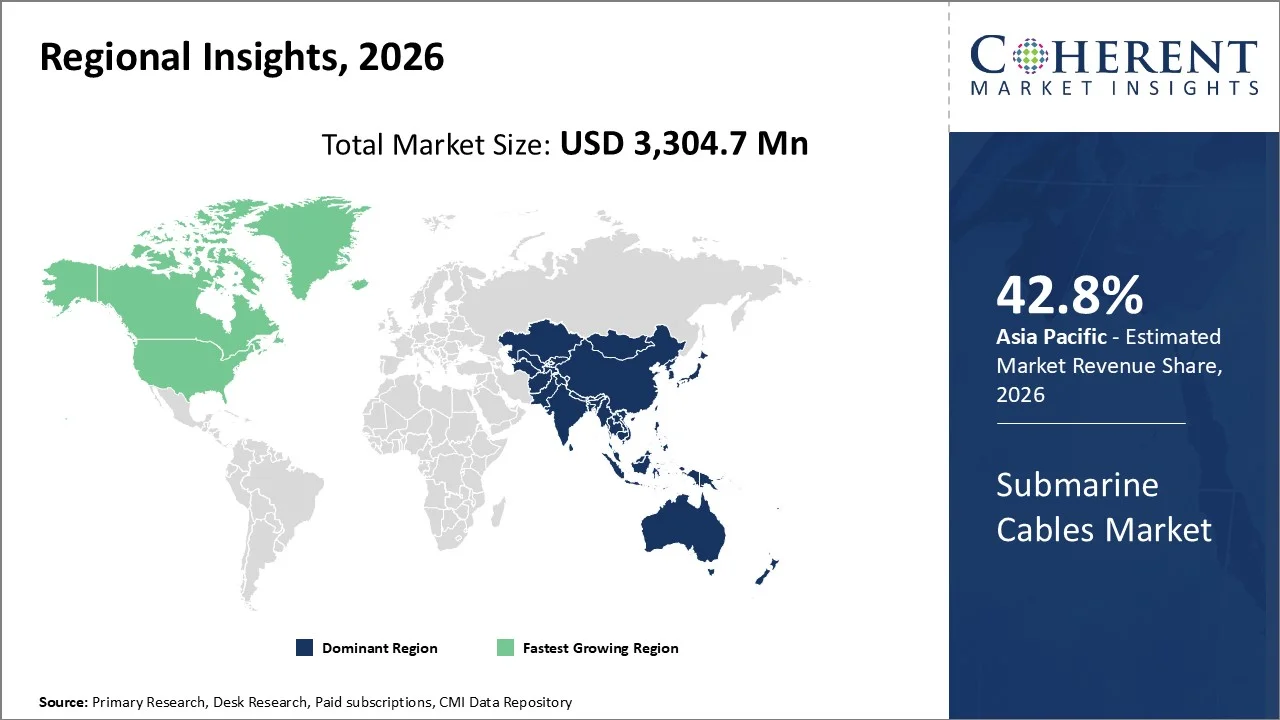
- The Asia-Pacific region is expected to account for the highest market share, which is estimated to be around 42.8% in 2026 due to the fast growth of offshore wind energy projects, investment in submarine communications infrastructure, and increased internet usage in emerging markets like China, India, and Japan. As per ITU statistics, more than 50% of internet users in the world belong to the Asia-Pacific region, which makes up for huge demand for submarine cables for data transmission.
Expansion of Offshore Wind Projects is Accelerating the Submarine Cables Industry Globally
Rapidly increasing offshore wind energy projects are contributing greatly towards the rapid development of the submarine cables market globally. Substantial investments are being made by governments as well as energy firms in building offshore renewable power facilities to bolster their energy production capacity as well as their electricity transmission network. Submarine cables play an essential role in linking offshore wind farms with onshore electricity transmission networks.
According to the International Energy Agency (IEA), global offshore wind capacity is projected to expand substantially by 2030 as countries accelerate renewable energy adoption and grid modernization initiatives.
Rising Global Internet Traffic and Data Center Expansion are Transforming the Submarine Communication Cables Market
The growth of internet traffic globally and increasing investment in hyperscale data centers is leading to innovations in the submarine communication cables market. The use of cloud computing, AI workloads, video streaming, and increased digitization is leading to greater demand for efficient and advanced international data transmission systems. Submarine communication cables transport most global internet traffic between continents.
Submarine networks handle 95–99% of international data traffic, while satellites account for a negligible share of global intercontinental data transmission.
- Current Industry Events of 2026
- Market Size Estimation
- Regional Breakdown
- Competitive Landscape
- Customer Intelligence
- Segmental Analysis
- Pricing Analysis
- Key Market Drivers, Challenges & Future Trends
- Customized Insights Section
Current Events and Their Impact on the Submarine Cables Market
Current Event | Description and its Impact |
Rapid Expansion of Global AI Infrastructure and Hyperscale Data Centers (2025–2026) |
|
Global Offshore Wind Energy Expansion and Energy Transition Policies (2025–2030) |
|
Segmental Insights
Why is the Installation Segment Acquiring the Largest Market Share?
The installation segment is expected to hold the highest market share among other segments of the submarine cables market in 2026, making up about 68.4% of the total market share. The installation sector is fueled by the fast-growing trend of installing new submarine communication cables and offshore electricity transmission lines. Investments in connecting continents, offshore wind farms, and international power transmission have increased demand for cable installations.
In May 2025, Prysmian Group highlighted the operational deployment of its next-generation cable-laying vessel Monna Lisa, designed to support large-scale submarine cable installation projects across offshore wind and telecom networks globally.
Why is the Submarine Power Cables Segment Dominating the Market?
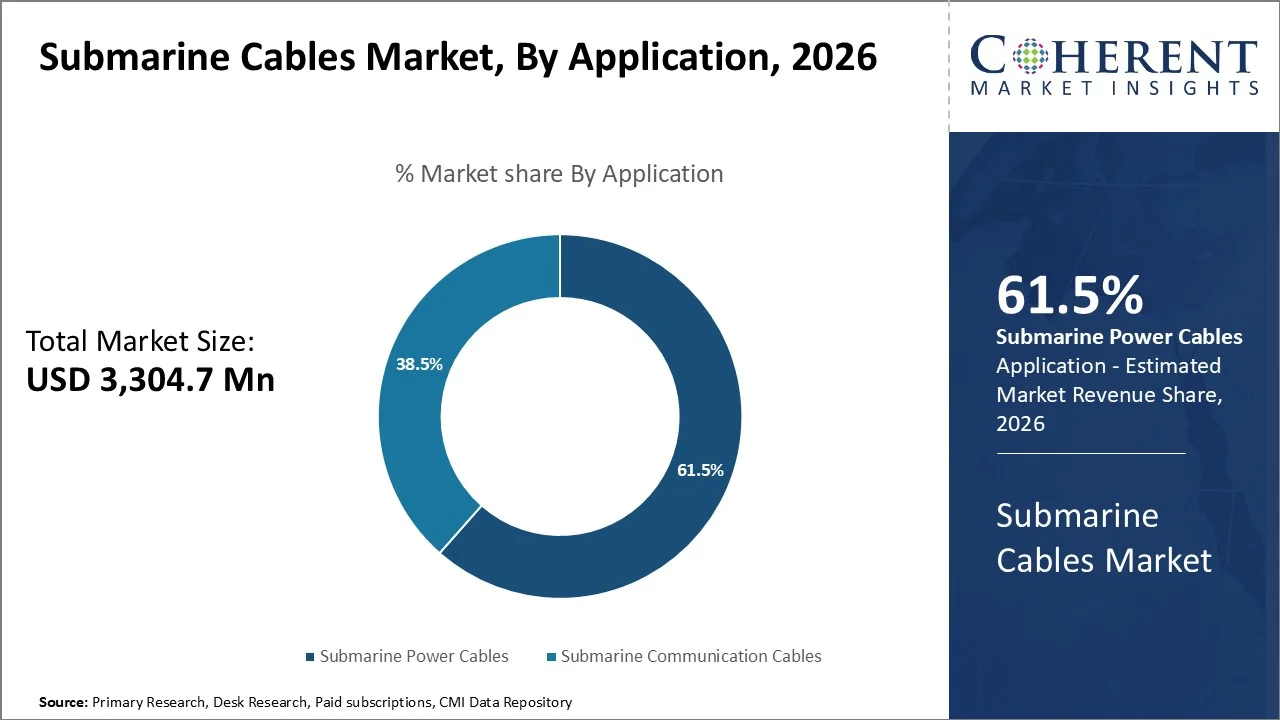
The submarine power cables segment is expected to have the largest market share of 61.5% in 2026 because of increasing investments in offshore wind energy production projects and cross-border transmission activities. Various European governments, China, and other countries are focusing on renewable energy installations and offshore grids. There has been widespread usage of high voltage submarine cables in transmission of power over long distances.
In May 2025, Prysmian Group expanded its high-voltage submarine cable manufacturing capacity at the Pikkala plant in Finland, strengthening production for 525 kV HVDC submarine cables used in offshore wind farms and cross-border power interconnection projects.
Submarine Cables Market Trends
- Rapid development of offshore wind and electricity interconnection infrastructure: Renewable energy generation systems are receiving more attention, resulting in higher demand for underwater power transmission systems. IEA forecasts that the offshore wind energy production will go beyond 380 GW until 2030.
- Switch to high-capacity optical fiber networks (400G/800G): Requirement for bigger network capacities has accelerated the process of improvements in the submarine cables segment. TeleGeography reports that growth rates of international bandwidth worldwide amount to 30% annually.
- Expansion of new submarine cable routes: More redundancy and resilience projects are being deployed globally. Submarine Telecoms Forum notes 60+ new submarine cable systems under development worldwide.
- Advanced cable-laying & deep-sea installation tech: Modern vessels enable installation at depths of 3,000+ meters, improving offshore connectivity and project feasibility (Prysmian Group).
Regional Insights
Asia-Pacific Submarine Cables Market Trends
Asia Pacific Region is forecast to lead in terms of market share in the global Submarine Cables Market with around 42.8% of the market share in 2026 due to rapid growth in offshore wind energy capacity, growing investments in subsea communications networks, and high internet penetration in developing countries like China, India, and Japan.
In July 2025, the Southeast Asia–Japan Cable 2 (SJC2) submarine cable system officially began commercial operations, significantly strengthening high-capacity digital connectivity across the Asia-Pacific region.
North America Submarine Cables Market Trends
North America will be the fastest growing region in the Submarine Cables Market, owing to robust growth in digital infrastructure, offshore renewable energy, and hyperscale data centers. North America will continue to dominate as an important region for submarine cables across the Atlantic and Pacific oceans, due to the presence of tech giants like Google, Microsoft, and Amazon.
In March 2025, a consortium led by SoftBank Corp. announced the E2A Transpacific Submarine Cable System, a new high-capacity subsea cable project connecting Japan, Taiwan, South Korea, and the United States.
United States Submarine Cables Market Trends
The U.S. submarine cables market is experiencing significant growth, propelled by fast-growing demand from hyperscale data centers, artificial intelligence applications, and trans-Pacific/transatlantic connectivity requirements. The U.S. continues to be one of the largest landing sites for worldwide submarine cables, with more than high double-digit terabits per second (Tbps) in annual capacity increases from various new cable constructions.
According to TeleGeography, the United States has connections with over 70 submarine cables, which makes it one of the most interconnected countries worldwide, and plays a major role in the movement of international data.
Japan Submarine Cables Market Trends
The Japan submarine cables market is growing at an exponential pace owing to its strategic positioning within the Asia-Pacific submarine cables network, serving as a significant landing point for transpacific cable systems. The country acts as a bridge for several international cable systems responsible for connecting Asia with North America.
Moreover, Japan has been linked to at least 12 transpacific submarine cables, which include vital routes like FASTER, Jupiter, and E2A. Ongoing improvements in digital infrastructure reliability and redundancy are contributing to the development of Japan’s submarine cable network, leading to future market growth.
Who are the Major Companies in Submarine Cables Industry
Some of the major key players in Submarine Cables are Alcatel Submarine Networks, SubCom, LLC, ABB, Huawei Marine Networks Co., Ltd., NEC Corporation, NEXANS NORWAY AS, FUJITSU, Prysmian Group, Saudi Ericsson, HENGTONG GROUP CO., LTD., ZTT, Corning Incorporated, NKT A/S, Hellenic Cables Group. The Okonite Company, Apar Industries Ltd., JDR Cable Systems Ltd., AFL, Hexatronic Cables & Interconnect Systems, and LEONI Special Cables GmbH.
Key News
- In May 2025, Prysmian Group announced the expansion of its submarine cable installation capabilities with the deployment of its advanced cable-laying vessel Monna Lisa, designed to support deep-sea offshore wind and global telecom submarine cable projects.
- In February 2025, Huawei Marine Networks (HMN Tech) continued participation in global submarine cable projects, focusing on cost-efficient subsea communication systems across Asia, Africa, and emerging markets.
Market Report Scope
Submarine Cables Market Report Coverage
| Report Coverage | Details | ||
|---|---|---|---|
| Base Year: | 2025 | Market Size in 2026: | USD 3,304.7 Mn |
| Historical Data for: | 2020 To 2024 | Forecast Period: | 2026 To 2033 |
| Forecast Period 2026 to 2033 CAGR: | 6.3% | 2033 Value Projection: | USD 8,794.2 Mn |
| Geographies covered: |
| ||
| Segments covered: |
| ||
| Companies covered: | Alcatel Submarine Networks, SubCom, LLC, ABB, Huawei Marine Networks Co., Ltd., NEC Corporation, NEXANS NORWAY AS, FUJITSU, Prysmian Group, Saudi Ericsson, HENGTONG GROUP CO., LTD., ZTT, Corning Incorporated, NKT A/S, Hellenic Cables Group. The Okonite Company, Apar Industries Ltd., JDR Cable Systems Ltd., AFL, Hexatronic Cables & Interconnect Systems, and LEONI Special Cables GmbH. | ||
| Growth Drivers: |
| ||
| Restraints & Challenges: |
| ||
Analyst Opinion
- Submarine cables are emerging as the backbone of the global digital economy, where more than 95% of all international data transmission passes through subsea systems. Consequently, this industry is considered critical infrastructure, not a supplementary telecom investment.
- Demand will be driven by structural factors and not cyclical. Growth in global internet usage will be growing by about 25%-30% per year. This growth is driven primarily by artificial intelligence, cloud computing, and video streaming.
- The hyperscale cloud companies make up most of the investment. Experts believe that firms such as Google, Meta, Amazon, and Microsoft contribute to about half of all investments made into undersea cables.
- Strategic significance of submarine power cables is increasing rapidly. Offshore wind capacity is projected to surpass 380 GW on a worldwide scale by 2030, thus requiring HVDC submarine cables.
- Market resilience is growing in the face of geopolitical threats. Despite increasing hazards for the integrity of cable networks and regulatory hurdles, the preference of policymakers for multiple routes and redundancy means that there will be no cable monopoly.
- Long-term outlook remains highly positive. Analysts consider submarine cables a high-investment, high-barrier, and strategically essential infrastructure sector, with continuous expansion expected across both communication and power transmission segments.
Speak to the analyst
Want personalized insights?
Take the findings above to one of our principal consultants, or have the report rebuilt around the segments, geographies and competitors you actually track.
Market Segmentation
- By Service (Revenue, USD Mn, 2021-2033)
- Installation
- Maintenance and Upgrade
- By Application (Revenue, USD Mn, 2021-2033)
- Submarine Power Cables
- Submarine Communication Cables
- By Region (Revenue, USD Mn, 2021-2033)
- North America
- U.S.
- Canada
- Latin America
- Brazil
- Mexico
- Argentina
- Rest of Latin America
- Europe
- Germany
- U.K.
- France
- Italy
- Spain
- Russia
- Rest of Europe
- Asia Pacific
- China
- India
- Japan
- Australia
- South Korea
- ASEAN
- Rest of Asia Pacific
- Middle East
- GCC
- Israel
- Rest of Middle East
- Africa
- South Africa
- Central Africa
- North Africa
- North America
- Key Players
- Alcatel Submarine Networks
- SubCom, LLC
- ABB
- Huawei Marine Networks Co., Ltd.
- NEC Corporation
- Nexans Norway AS
- Fujitsu
- Prysmian Group
- Saudi Ericsson
- Hengtong Group Co., Ltd.
- ZTT
- Corning Incorporated
- NKT A/S
- Hellenic Cables Group
- The Okonite Company
- Apar Industries Ltd.
- JDR Cable Systems Ltd.
- AFL
- Hexatronic Cables & Interconnect Systems
- LEONI Special Cables GmbH
Sources
Primary Research Interviews
- Submarine cable system manufacturers
- Subsea engineering and installation companies
- Telecom operators and network providers
- Offshore wind energy developers
- Cloud service providers and hyperscale data center operators
- Key opinion leaders (KOLs) in telecom and energy infrastructure
Databases
- International Telecommunication Union (ITU)
- TeleGeography Submarine Cable Database
- International Energy Agency (IEA)
- World Bank Data
- Global Wind Energy Council (GWEC)
- Organisation for Economic Co-operation and Development (OECD)
Magazines
- Submarine Telecoms Forum
- Light Reading
- Offshore Engineer Magazine
- Renewable Energy World
- Data Center Dynamics
Journals
- IEEE Communications Magazine
- Journal of Lightwave Technology
- International Journal of Offshore and Polar Engineering
- Renewable and Sustainable Energy Reviews
- Ocean Engineering Journal
Newspapers
- Financial Times
- The Wall Street Journal
- Reuters
- Bloomberg
- The Economist
Associations
- International Cable Protection Committee (ICPC)
- International Telecommunication Union (ITU)
- Global Wind Energy Council (GWEC)
- IEEE Communications Society
- Offshore Renewable Energy Catapult (ORE Catapult)
Public Domain Sources
- Company Annual Reports and Investor Presentations
- Government energy and telecom ministry publications
- Submarine cable project press releases (Google, Meta, Microsoft, NEC, Prysmian Group, SubCom)
- International infrastructure and telecom regulatory filings
- Climate and renewable energy transition reports
Proprietary Elements
- CMI Data Analytics Tool
- CMI Proprietary Subsea Infrastructure Database (10-year historical dataset)
Get access to 250+ pages report
Every segment, forecast, competitor profile and data table behind the analysis above — available for instant download.
- ESOMAR Member
- ISO 9001:2015 Certified
- D-U-N-S Registered
- GDPR & CCPA Compliant
Missing comfort of reading report in your local language? Find your preferred language:
Transform your Strategy with Exclusive Trending Reports
Frequently Asked Questions
The Submarine Cables Market is expected to reach USD 8,794.2 Mn in 2033.
Major players include Alcatel Submarine Networks, SubCom LLC, ABB, NEC Corporation, Prysmian Group, Huawei Marine Networks Co., Ltd., Nexans Norway AS, Corning Incorporated, ZTT, Hengtong Group Co., Ltd., NKT A/S, JDR Cable Systems Ltd., AFL, and LEONI Special Cables GmbH.
High installation costs, long project timelines, geopolitical risks, and vulnerability to physical damage from anchors, fishing, and natural disasters restrict market growth.
Rising global internet traffic, AI and cloud computing expansion, offshore wind energy projects, and increasing demand for high-speed international connectivity are driving growth.
The Submarine Cables Market is anticipated to grow at a CAGR of 6.3% between 2026 and 2033.
Asia-Pacific is expected to dominate the global submarine cables market with a share of nearly 42.8% in 2026, driven by strong digital and offshore energy expansion.