

Internet Security Market Size and Share Analysis- 2026 To 2033
The Internet Security Market size is anticipated to grow at a CAGR of 9.4%, with USD 46.33 Bn in 2026, and is expected to reach USD 87.05 Bn in 2033. The primary drivers are largely defined by the rapid adoption of bring your own device (BYOD) policies, increasing use of cloud-based applications, rising cybersecurity threats, growing deployment of connected devices, and increasing enterprise investment in advanced network and data security solutions. The Verizon 2025 Data Breach Investigations Report, covering more than 22,000 security incidents and 12,195 confirmed breaches, found that exploitation of vulnerabilities increased 34% year-on-year and represented 20% of breaches.
Key Takeaways
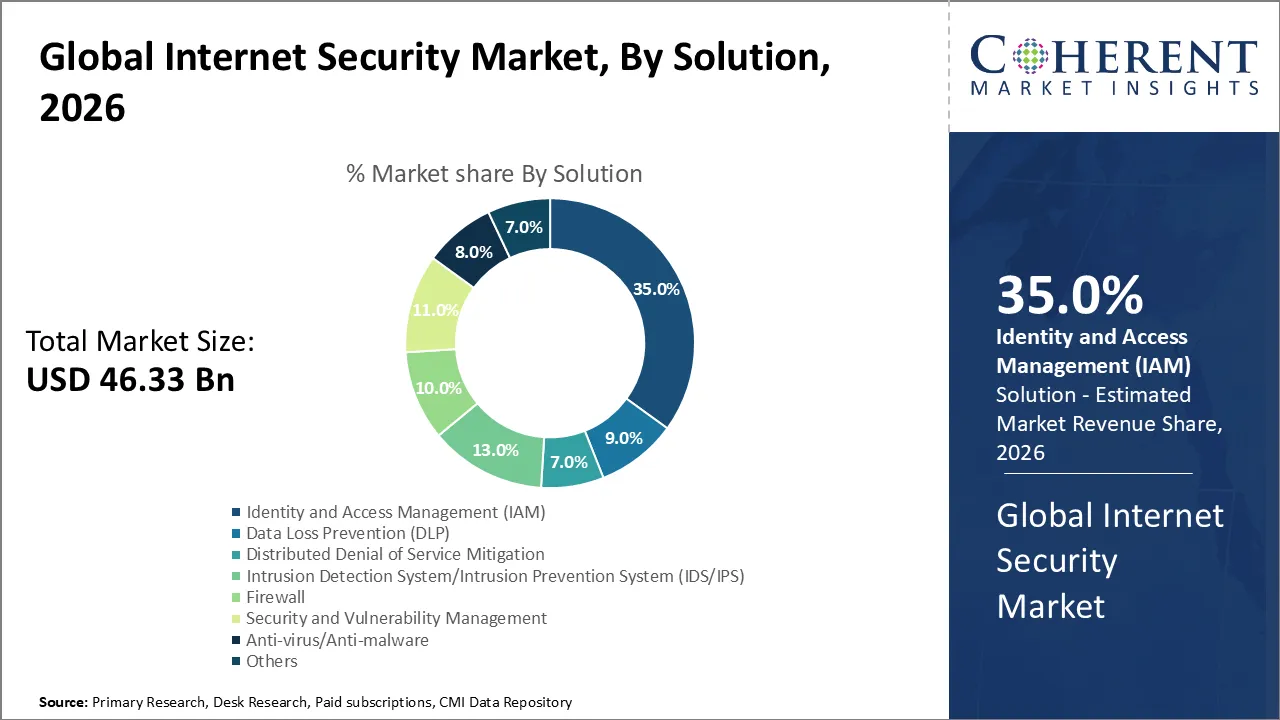
- The identity and access management (IAM) segment is likely to dominate the solution segment with 35% in 2026. The segment’s growth is owing to the increasing incidence of credential theft, account takeover, password-based attacks, cloud identity risks, and enterprise adoption of multi-factor authentication and zero-trust access controls. According to the Microsoft Digital Defense Report 2025, 97% of identity attacks observed were password-spray attacks, while Microsoft analyzes approximately 38 million identity-risk detections every day, highlighting the growing requirement for advanced identity protection.
- The managed services segment is set to lead the service segment with 30% in 2026. The segment’s growth is owing to cybersecurity talent shortages, increasing complexity of enterprise security environments, demand for continuous monitoring, and growing outsourcing of security operations, incident response, and threat detection. According to the ISC2 2025 Cybersecurity Workforce Study found that 59% of cybersecurity professionals cited critical or significant skills needs and 20% of organizations were outsourcing cybersecurity work and 19% were using third-party service providers to overcome skills shortages.
- The network security segment is anticipated to dominate the security type segment with 26% in 2026. The segment’s growth is owing to increasing exploitation of software vulnerabilities, ransomware attacks, expanding enterprise networks, proliferation of connected endpoints, and growing demand for firewalls, intrusion prevention, secure access, and network threat detection. According to the Verizon 2026 Data Breach Investigations Report, vulnerability exploitation became the leading initial breach vector, accounting for 31% of breaches, while ransomware was involved in 48% of breaches.
- The cloud segment is expected to lead the deployment mode segment with 61% in 2026. The segment’s growth is owing to rapid migration of enterprise workloads to cloud infrastructure, widespread SaaS adoption, hybrid working environments, and rising demand for cloud-native security, secure access, data protection, and threat monitoring solutions. According to Eurostat, 52.7% of EU enterprises used paid cloud computing services in 2025, while 65.5% of enterprises using paid cloud services used cloud-based security software applications.
- The large enterprises segment is likely to dominate the organization size segment with 66% in 2026. The segment’s growth is owing to complex IT infrastructure, extensive cloud and application environments, larger numbers of employees and connected endpoints, stringent compliance requirements, and comparatively higher cybersecurity budgets. Verizon’s analysis showed that credential-stuffing attacks made up as much as 25% of authentication events for enterprise-sized organizations versus about 12% for small businesses, highlighting the considerable identity and access security risk faced by large organizations.
- BFSI (banking, financial services and insurance) segment is anticipated to hold the highest share of the market at 22% in 2026. The segment is expanding with the increasing number of digital banking transactions, growing adoption of mobile and online banking, the large volumes of sensitive financial data, the strict regulatory mandates, and growing vulnerability to fraud, ransomware, and account compromise. According to an IMF study published in March 2026, the financial sector accounted for approximately 10% of recorded cyber events across 20 industry sectors in 162 countries over the examined period, while cyber-enabled fraud had nearly tripled, emphasizing growing cybersecurity risks across digital financial services.
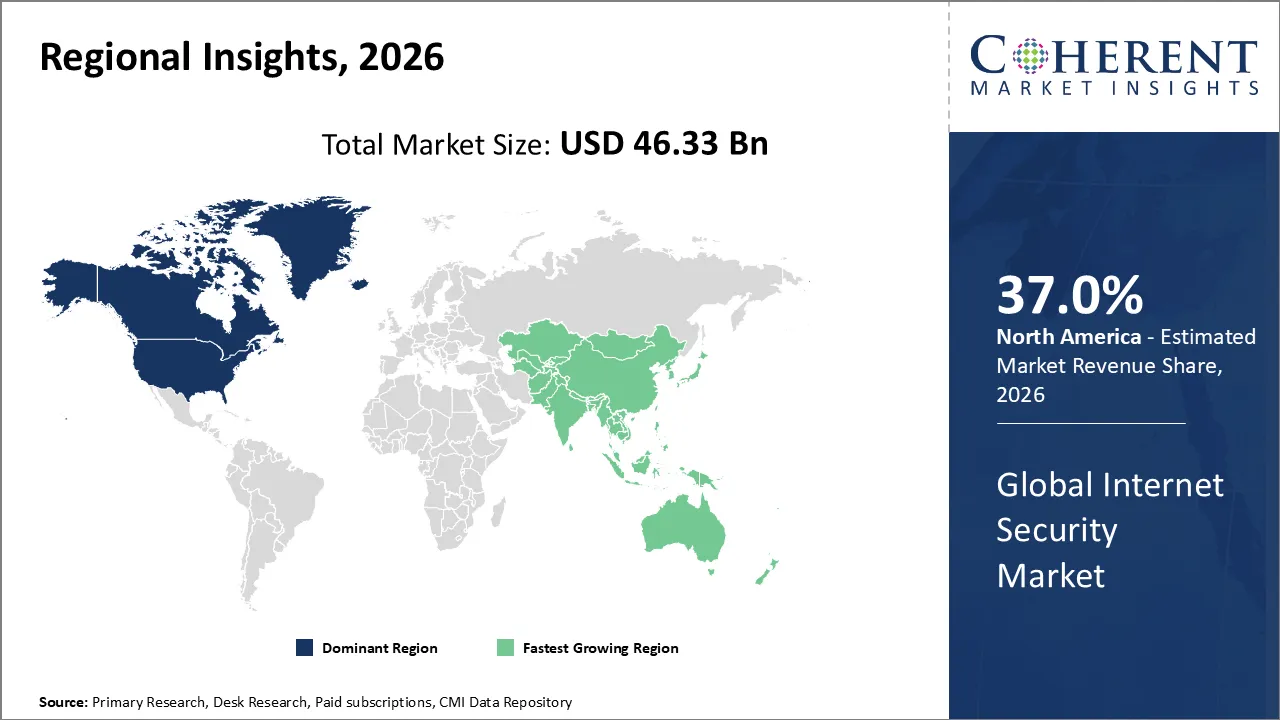
- North America is expected to acquire the prominent market share of 37% in 2026. The region’s growth is owing to the high concentration of cybersecurity vendors, advanced enterprise IT infrastructure, early adoption of cloud and zero-trust architectures, high cybersecurity spending, and increasing frequency and financial impact of internet-enabled crime in the U.S. According to the FBI 2025 Internet Crime Report, IC3 received 1,008,597 complaints in 2025, with reported losses reaching approximately USD 20.88 Bn, representing a 26% increase in losses compared with 2024.
Market Drivers
Escalating Cyberattacks and DDoS Incidents are Accelerating Internet Security Adoption
The Internet Security Market is witnessing strong growth owing to the rapidly increasing frequency, scale, and sophistication of cyberattacks targeting enterprises, digital platforms, government organizations, and critical infrastructure. The increased reliance on internet-based applications has made organizations more vulnerable to distributed denial-of-service (DDoS) attacks, ransomware, malware, phishing, and vulnerability exploitation, driving demand for firewalls, intrusion prevention, DDoS mitigation, threat intelligence, and security monitoring solutions.
According to Cloudflare’s 2025 DDoS Threat Report shows the company mitigated approximately 47.1 million DDoS attacks in 2025, a 121 per cent year-on-year increase. Network-layer attacks alone increased from around 11.4 million in 2024 to 34.4 million in 2025.
Rising Financial Impact of Data Breaches is Driving Enterprise Security Spending
Another major factor driving the Internet Security Market is the growing financial and operational impact of data breaches. Increasingly, organizations rely on infrastructure connected to the Internet to manage customer information, intellectual property, financial transactions and business-critical applications. Successful breaches can lead to regulatory penalties, business disruption, incident-response costs, customer losses and reputational damage.
According to IBM’s 2025 Cost of a Data Breach Report, the average cost of a data breach globally was around USD 4.44 million. This is down 9% from 2024, but organizations still took an average of 241 days to identify and contain a breach.
Current Events and Their Impact on the Internet Security Market
Current Event | Description and its Impact |
EU Cyber Resilience Act Reporting Requirements Enter into Application (September 2026) |
|
UK Cyber Security and Resilience Bill Expands Proposed Cybersecurity Regulation (2026) |
|
- Current Industry Events of 2026
- Market Size Estimation
- Regional Breakdown
- Competitive Landscape
- Customer Intelligence
- Segmental Analysis
- Pricing Analysis
- Key Market Drivers, Challenges & Future Trends
- Customized Insights Section
Segmental Insights
Why is Identity and Access Management (IAM) Acquiring the Largest Share?
On the basis of solution, the identity and access management (IAM) segment is projected to account for the largest Internet Security Market share of 35% in 2026. The segment’s growth is owing to the increasing number of cloud identities, remote users, privileged accounts, and machine identities, along with rising credential theft and account-takeover attacks. Enterprises are consequently investing in multi-factor authentication, privileged access management, single sign-on, identity governance, and zero-trust access controls.
Microsoft reported that its Digital Crimes Unit worked with authorities in 2025 to disrupt Lumma Stealer infrastructure and seize or block more than 2,300 malicious domains. Lumma was used to steal browser credentials and other sensitive information, adding to the importance of identity-centric security in the enterprise.
In September 2026, Okta announced new features across Okta Identity Governance and Okta Privileged Access to strengthen governance, privileged access and identity threat detection for human users, AI agents and other non-human identities.
Why are Managed Services Acquiring the Largest Share?
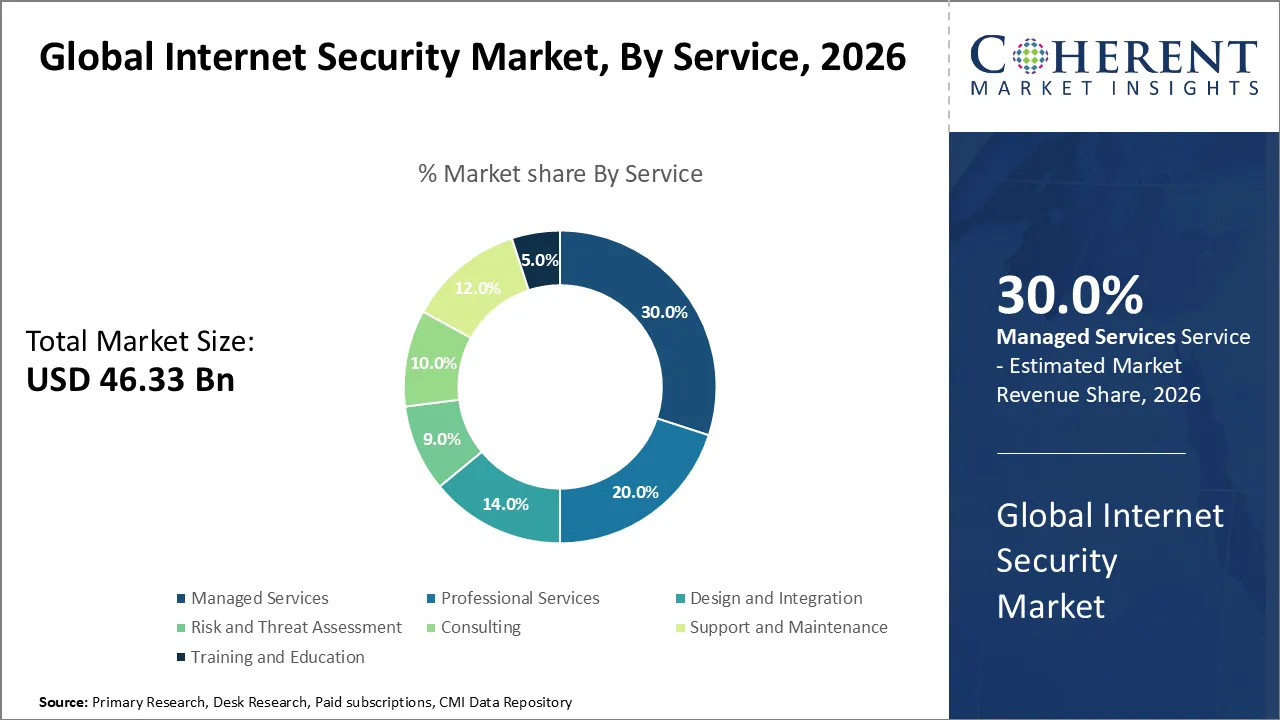
On the basis of service, the managed services segment is set to lead the Internet Security Market with a 30% share in 2026. The segment’s growth is owing to shortages of specialized cybersecurity personnel, increasing complexity of enterprise security environments, and growing requirements for round-the-clock threat detection, vulnerability management, incident response, and security operations.
According to the ISC2 Cybersecurity Workforce Study 2025, 59% of cybersecurity professionals reported critical or significant cybersecurity skills needs, compared with 44% in 2024. Moreover, 95% of respondents reported at least one cybersecurity skills requirement within their organizations.
In February 2026, Palo Alto Networks announced Unit 42 Managed XSIAM 2.0, a new and improved managed security operations center service that combines 24/7 expert monitoring with AI-driven security operations.
Why is Network Security Acquiring the Largest Share?
On the basis of security type, the network security segment is anticipated to dominate the Internet Security Market with 26% in 2026. The segment’s growth is owing to the increasing volume of DDoS attacks, network intrusions, botnet activity, vulnerability exploitation, and growing connectivity between enterprise data centers, cloud platforms, branch locations, and remote endpoints.
According to the Fortinet 2026 Global Threat Landscape Report, FortiGuard Labs observed approximately 122 billion exploitation attempts globally during 2025, while overall exploitation attempts increased by 25.49% year-on-year. The report highlights that attackers are increasingly using automation and AI to identify and exploit exposed infrastructure at machine speed, reducing the time available for network defenders to respond.
Why is Cloud Deployment Acquiring the Largest Share?
On the basis of deployment mode, the cloud segment is expected to lead the Internet Security Market with a 61% share in 2026. The segment’s growth is owing to accelerating enterprise migration toward SaaS, public and hybrid cloud infrastructure, distributed applications, and remote-access environments. This is creating greater demand for cloud-native security, cloud access security brokers, secure web gateways, data-loss prevention, and cloud workload protection.
In 2025, 52.7% of EU enterprises used paid cloud computing services, an increase of 7.4 percentage points compared to 2023. Therefore, organizations are taking a more mainstream approach to cloud adoption across their enterprise IT environments.
In August 2026, CrowdStrike announced the availability of the Falcon platform on Google Cloud infrastructure, allowing customers to run its AI-native security platform on their preferred hyperscaler while maintaining unified protection across cloud workloads, AI agents, identities, endpoints and data.
Why are Large Enterprises Acquiring the Largest Share?
On the basis of organization size, the large enterprises segment is likely to dominate the Internet Security Market with 66% in 2026. The segment’s growth is owing to extensive IT infrastructure, large numbers of employees and endpoints, greater volumes of confidential information, complex supply chains, multiple cloud environments, and stringent regulatory and cybersecurity compliance requirements.
The exposure is even greater in several digitally advanced economies. Approximately 68.2% of large enterprises in Finland, 53.3% in Malta, and 51.2% in France reported ICT-related security incidents with consequences. Large organizations have increased attack exposure and complexity, which justifies greater investment in integrated security platforms, SIEM, identity management, endpoint protection, network security and managed cybersecurity services.
In September 2026, Cisco announced new Splunk security and observability capabilities designed to help enterprises operate and secure AI at scale. The company introduced Cisco AI POD for Splunk, bringing AI capabilities to on-premises Splunk customers, alongside new agentic security operations and AI observability capabilities.
Why is BFSI Acquiring the Largest Share?
On the basis of application, the banking, financial services and insurance (BFSI) segment is set to lead the Internet Security Market with 22% in 2026. The segment’s growth is owing to the rapid expansion of digital banking, mobile payments, online transactions, open banking, cloud-based financial applications, and growing exposure to account takeover, payment fraud, ransomware, and data breaches.
According to Akamai's 2026 Financial Services Security Trends Report, the financial services industry remained the most targeted industry for Layer 3 and Layer 4 DDoS attacks. Volumetric DDoS attacks in the sector grew by 236% between 2024 and 2025, indicating the increasing need for DDoS mitigation and network security solutions.
In July 2026, Visa launched the Visa Threat Intelligence Platform (VTIP), a cybersecurity offering that helps financial institutions detect and respond to cyber risks before they turn into fraud and financial losses.
Internet Security Market Trends
- API security adoption is gaining momentum and is one of the major trends in the Internet Security Market as enterprises increasingly rely on APIs to connect cloud applications, mobile platforms, artificial intelligence systems and digital services. Akamai’s 2026 State of the Internet Security Report also found that 87% of organizations surveyed experienced an API-related security incident in the past year, and the average number of API attacks increased 113% year-on-year.
- The enterprise identity security landscape is being reshaped by the emergence of passwordless, phishing-resistant authentication. Organizations are moving away from passwords and toward passkeys, biometrics, and FIDO-based authentication to lower the risk of credential theft and phishing. The FIDO Alliance’s State of Passkeys 2026 report indicates that there are around 5 billion passkeys actively used worldwide. Additionally, 68% of organizations have already adopted or are currently working on adopting passkeys for employee authentication.
- Cybersecurity tools are becoming increasingly embedded within broader security platforms rather than relying on separate point solutions. Companies are increasingly consolidating network security, cloud security, endpoint protection, threat detection and security operations onto shared platforms for better visibility and automated response. A 2025 research by enterprise strategy group found that organizations operated an average of 8.7 different security consoles. 82% of organizations using a unified platform reported improvements in detection, response time and compliance.
Regional Insights
North America Dominates Owing to Advanced Cybersecurity Infrastructure and Strong Government Investment
North America has the 37% of the Internet Security Market share in 2026. The region’s dominance is driven by the strong presence of leading cybersecurity vendors, broad acceptance of cloud and digital services, extensive enterprise IT infrastructure, high cybersecurity spend, and growing government focus on safeguarding critical infrastructure, federal networks and digital resources.
The U.S. fiscal year 2026 budget provides approximately USD 1.96 billion for Cybersecurity and Infrastructure Security Agency (CISA) operations and support, including roughly USD 966 Million for cybersecurity program activities. This major federal investment progresses protection of networks, management of vulnerabilities, response to cyber incidents, and security services in federal and critical infrastructure environments.
In July 2026, the White House announced the GOLD EAGLE initiative, which would unite CISA, the Department of the Treasury and the Department of War, along with private-sector organizations, to speed up the detection, coordination and remediation of cybersecurity vulnerabilities in U.S. critical infrastructure.
Asia Pacific Internet Security Market Trends
Asia Pacific is expected to witness the fastest growth in the Internet Security Market over the forecast period. The region’s growth is owing to rapid digitalization, increasing cloud and mobile connectivity, expanding IoT deployment, growing online financial activity, and rising cybercrime across major economies such as China, India, Japan, Singapore, South Korea, and Australia.
According to INTERPOL's 2025/2026 Asia and South Pacific Cyberthreat Assessment, more than half of the surveyed countries reported that cybercrime now represents over 30% of all crimes recorded nationally. Furthermore, 33% of countries reported more than 10,000 cyber-scam cases, demonstrating the growing scale of online threats across the region.
Australia is witnessing similar cybersecurity pressure. During FY2024–25, the Australian Signals Directorate's Australian Cyber Security Centre received more than 42,500 calls to its Cyber Security Hotline, up 16%, and responded to more than 1,200 cybersecurity incidents, an increase of 11%. It also issued more than 1,700 notifications of potentially malicious cyber activity, up 83% year-on-year.
Federal Zero-Trust Modernization and Regulatory Requirements are Accelerating the Internet Security Market in the United States
The U.S. Internet Security Market is witnessing strong growth owing to the modernization of federal and enterprise networks, adoption of zero-trust architectures, increasing cloud-security requirements, and rising compliance obligations across critical infrastructure and private-sector organizations. Enterprises are increasingly investing in identity security, network segmentation, cloud protection, continuous monitoring, vulnerability management, and automated threat detection.
In June 2025, the U.S. National Institute of Standards and Technology (NIST) published its final Zero Trust Architecture implementation guidance, developed with 24 technology collaborators and demonstrating 19 different zero-trust architecture implementations using commercially available technologies.
Cybersecurity requirements across U.S. industries are also becoming broader. In July 2026, the U.S. Government Accountability Office identified 117 cybersecurity regulations issued by 37 federal agencies across nine critical-infrastructure sectors. Approximately 80 of the 117 regulations, or nearly 70%, contained reporting requirements similar to at least one other regulation.
China Internet Security Market Trends
China is expected to witness strong growth in the Internet Security Market owing to its enormous internet-user base, rapid expansion of 5G, IoT, cloud and AI infrastructure, and increasingly stringent cybersecurity and data-protection regulations. Growth in connected devices and online services is widening the attack surface and increasing demand for network security, IAM, cloud security, endpoint protection, data-loss prevention, and threat-monitoring solutions.
According to China's National Bureau of Statistics, the country had approximately 1.125 billion internet users at the end of 2025, representing an internet penetration rate of 80.1%. China also had approximately 2.888 billion mobile IoT terminal connections, up by 232 million during the year, while mobile internet traffic increased 17.3% to 395.8 billion GB.
Who are the Major Companies in Internet Security Industry
Some of the major key players in Internet Security Market are IBM Corporation, Hewlett Packard Enterprise, McAfee LLC, Trend Micro, Inc., Symantec Corporation, Cisco Systems, Inc., Palo Alto Networks, Inc., Dell EMC, Fortinet, Inc., Sophos Ltd., Rapid7, Inc., CyberArk Software Ltd., Splunk, Inc., and Imperva, Inc.
Key News
- In May 2026, IBM announced an expanded AI-powered cybersecurity portfolio, supported by its ongoing Project Glasswing research. The initiative focuses on helping enterprises defend against increasingly autonomous and AI-enabled attacks and strengthening detection and response capabilities using advanced AI.
- In March 2026, HPE introduced new enterprise-security capabilities, including the HPE Juniper Networking SRX400 Series Firewalls, expanded hybrid-mesh firewall capabilities, and security enhancements for hybrid cloud and AI environments.
Market Report Scope
Internet Security Market Report Coverage
Report Coverage | Details | ||
Base Year: | 2025 | Market Size in 2026: | USD 46.33 Bn |
Historical Data for: | 2020 to 2024 | Forecast Period: | 2026 to 2033 |
CAGR: | 9.4% | 2033 Value Projection: | USD 87.05 Bn |
Geographies covered: |
| ||
Segments covered: |
| ||
Companies covered: | IBM Corporation, Hewlett Packard Enterprise, McAfee LLC, Trend Micro, Inc., Symantec Corporation, Cisco Systems, Inc., Palo Alto Networks, Inc., Dell EMC, Fortinet, Inc., Sophos Ltd., Rapid7, Inc., CyberArk Software Ltd., Splunk, Inc., and Imperva, Inc. | ||
Growth Drivers: |
| ||
Restraints & Challenges: |
| ||
Analyst Opinion
- The Internet Security Market is increasingly shifting from reactive threat protection toward AI-driven, integrated, and continuously adaptive security architectures. Enterprises are prioritizing automated detection, behavioral analytics, identity protection, and machine-speed response as AI changes both attack methods and defensive capabilities. According to the World Economic Forum’s Global Cybersecurity Outlook 2026 revealed 94% of respondents considered AI the major source of change regarding cybersecurity. The proportion of organizations conducting formal reviews of the security of AI tools jumped from 37% in 2025 to 64% in 2026.
- Regulatory compliance is becoming a structural driver for Internet Security investment, especially in critical infrastructure, financial services, healthcare, cloud services and government environments. In its NIS Investments 2025 study, ENISA found that organizations spent an average of around 9% of their IT budgets on cybersecurity, and that the median investment was EUR 1.5 million. The primary reason for making such investments was regulatory compliance, cited by 70% of the respondents. These investments also improved risk management for 41% of organizations, detection capabilities for 35%, and response capabilities for 26%.
- The market is also being strengthened by rising dependence on third-party technology providers and increasingly interconnected digital supply chains. The World Economic Forum reported that 65% of large companies identified third-party and supply-chain vulnerabilities as their greatest barrier to cyber resilience in 2026, up from 54% in 2025.This is supporting sustained demand for third-party risk management, vulnerability assessment, zero-trust access, managed security services, and continuous monitoring solutions.
Speak to the analyst
Want personalized insights?
Take the findings above to one of our principal consultants, or have the report rebuilt around the segments, geographies and competitors you actually track.
Market Segmentation
- By Solution (Revenue, USD Bn, 2021-2033)
- Identity and Access Management (IAM)
- Data Loss Prevention (DLP)
- Distributed Denial of Service Mitigation
- Intrusion Detection System/Intrusion Prevention System (Ids/Ips)
- Firewall
- Security and Vulnerability Management
- Anti-virus/Anti malware
- Others
- By Service (Revenue, USD Bn, 2021-2033)
- Professional Services
- Design and Integration
- Risk and Threat Assessment
- Consulting
- Support and Maintenance
- Training and Education
- Managed Services
- By Security Type (Revenue, USD Bn, 2021-2033)
- Application Security
- Network Security
- Content Security
- Wireless Security
- Cloud Security
- Endpoint Security
- By Depolyment Mode (Revenue, USD Bn, 2021-2033)
- On-premises
- Cloud
- By Organization Size (Revenue, USD Bn, 2021-2033)
- Large Enterprises
- Small and Medium-sized Enterprises
- By Application (Revenue, USD Bn, 2021-2033)
- Manufacturing
- Government
- Energy and Utilities
- Healthcare
- Aerospace and Defense
- Retail
- Banking, Financial Services and Insurance (BFSI)
- IT and Telecom
- Public Utilities
- Military
- By Region (Revenue, USD Bn, 2021-2033)
- North America
- U.S.
- Canada
- Latin America
- Brazil
- Mexico
- Argentina
- Rest of Latin America
- Europe
- Germany
- U.K.
- France
- Italy
- Spain
- Russia
- Rest of Europe
- Asia Pacific
- China
- India
- Japan
- Australia
- South Korea
- ASEAN
- Rest of Asia Pacific
- Middle East
- GCC
- Israel
- Rest of Middle East
- Africa
- South Africa
- Central Africa
- North Africa
- North America
Sources
Primary Research Interviews
- Cybersecurity solution providers and technology vendors
- Chief Information Security Officers (CISOs) and IT security heads
- Network security and cloud security professionals
- Identity and access management (IAM) specialists
- Managed security service providers (MSSPs) and SOC managers
- Cybersecurity consultants and incident-response specialists
- IT procurement managers across BFSI, healthcare, government, telecom, retail, and manufacturing
- Key opinion leaders (KOLs) in cybersecurity, data protection, and digital risk management
Databases
- World Bank
- International Telecommunication Union (ITU)
- OECD Digital Economy Database
- Eurostat
- U.S. Cybersecurity and Infrastructure Security Agency (CISA)
- National Institute of Standards and Technology (NIST)
- European Union Agency for Cybersecurity (ENISA)
- FBI Internet Crime Complaint Center (IC3)
Magazines
- SC Media
- Dark Reading
- Cybersecurity Dive
- SecurityWeek
- Infosecurity Magazine
- CSO Online
Journals
- Computers & Security
- IEEE Transactions on Information Forensics and Security
- Journal of Cybersecurity
- International Journal of Information Security
- Cybersecurity
- IEEE Security & Privacy
Newspapers
- The Wall Street Journal
- Financial Times
- The New York Times
- Reuters
- Bloomberg
- The Economic Times
Associations
- Information Systems Security Association (ISSA)
- ISACA
- ISC2
- Cloud Security Alliance (CSA)
- FIDO Alliance
- Center for Internet Security (CIS)
- Forum of Incident Response and Security Teams (FIRST)
- Global Cyber Alliance (GCA)
Public Domain Sources
- Company Annual Reports and Investor Presentations
- Government Cybersecurity Strategies and Policy Publications
- Cybersecurity Incident and Threat Intelligence Reports
- Regulatory Publications on Data Protection and Cybersecurity Compliance
- NIST Cybersecurity Frameworks and Security Standards
- CISA Cybersecurity Advisories and Vulnerability Bulletins
- ENISA Threat Landscape and Cybersecurity Investment Reports
- Company Product Launches, Press Releases, and Security Research Reports
- Public Vulnerability Databases such as NVD, CVE, and CISA KEV Catalog
- Regulatory and Legislative Sources such as EU NIS2, Cyber Resilience Act, DORA, and National Cybersecurity Laws
Proprietary Elements
- CMI Data Analytics Tool
- Proprietary CMI Existing Repository of Information for the Last 10 Years
Get access to 250+ pages report
Every segment, forecast, competitor profile and data table behind the analysis above — available for instant download.
- ESOMAR Member
- ISO 9001:2015 Certified
- D-U-N-S Registered
- GDPR & CCPA Compliant
Missing comfort of reading report in your local language? Find your preferred language:
Transform your Strategy with Exclusive Trending Reports
Frequently Asked Questions
The Internet Security Market is expected to reach USD 87.05 Bn in 2033, up from USD 46.33 Bn in 2026.
Major players operating in the global Internet Security Market include IBM Corporation, Hewlett Packard Enterprise, McAfee LLC, Trend Micro, Inc., Symantec Corporation, Cisco Systems, Inc., Palo Alto Networks, Inc., Dell EMC, Fortinet, Inc., Sophos Ltd., Rapid7, Inc., CyberArk Software Ltd., Splunk, Inc., and Imperva, Inc.
The high implementation and maintenance costs and shortage of skilled cybersecurity professionals are the key factors hampering growth of the Internet Security Market.
The increasing frequency and sophistication of cyberattacks, rising adoption of cloud-based applications and services, growing deployment of connected devices, expanding BYOD practices, and increasing enterprise investment in network and data-security solutions are boosting demand for Internet Security.
The Internet Security Market is anticipated to grow at a CAGR of 9.4% between 2026 and 2033.
Among regions, North America is expected to dominate the Internet Security Market with approximately 37% market share in 2026, supported by advanced enterprise IT infrastructure, strong cybersecurity spending, early adoption of cloud and zero-trust architectures, and the presence of major cybersecurity vendors.
Asia Pacific is expected to witness the fastest growth over the forecast period, supported by rapid digitalization, increasing cloud and mobile connectivity, expanding IoT deployment, growing online financial activity, and rising cybercrime across China, India, Japan, South Korea, Australia, and Southeast Asia.