

Global Semiconductor Fabrication Market Size and Forecast – 2026-2033
The global semiconductor fabrication market is estimated to be valued at USD 676.2 Mn in 2026 and is expected to reach USD 1,513.7 Mn by 2033, exhibiting a compound annual growth rate (CAGR) of 12.2% from 2026 to 2033.
Key Takeaways of the Global Semiconductor Fabrication Market
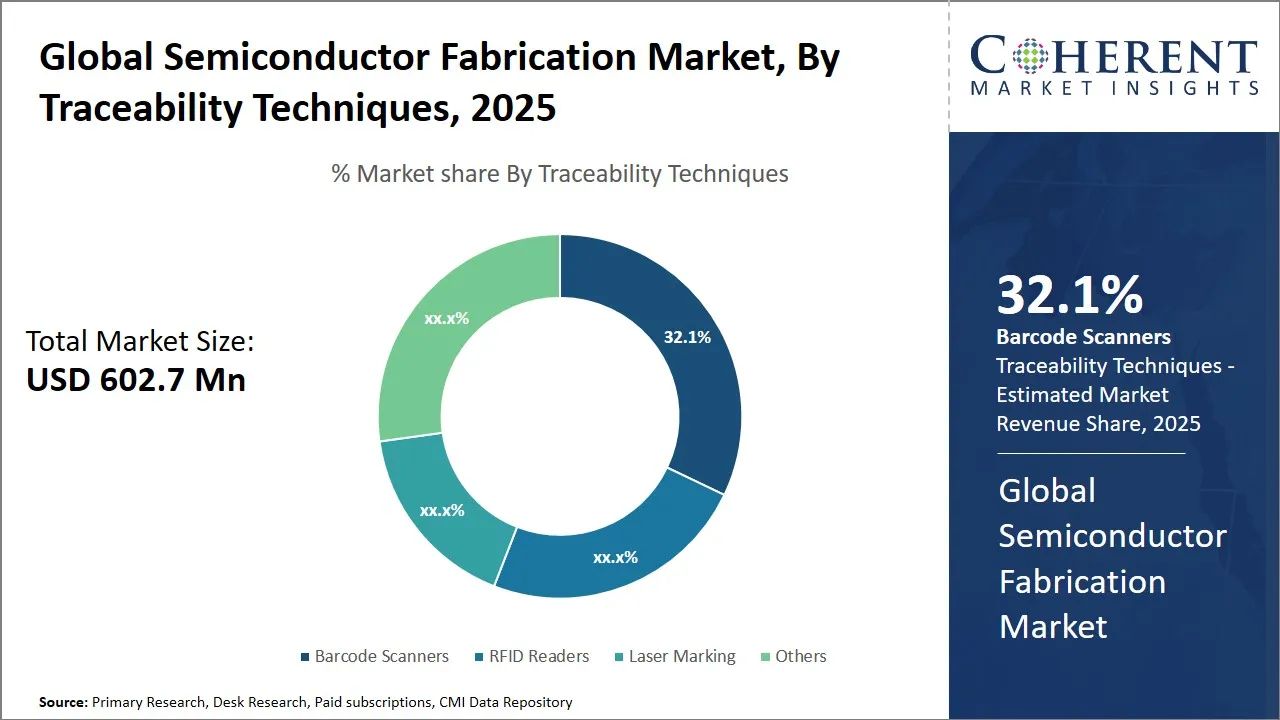
- The barcode scanners segment is expected to lead the market holding a share of 33.1 % in 2026.
- The consumer electronics segment is projected to dominate the market with a share of 57.7 % in 2026.
- Asia Pacific, holding an estimated share of 35.7 % in 2026, and projected to dominate the market.
- Europe, holding a projected share of 21.7 % in 2026, and shows the fastest growth in the market.
Market Overview
Current market trends reveal a strong focus on enhancing process efficiency and scaling down transistor sizes to meet the increasing performance requirements of modern electronic devices. Also, there is a big shift toward adoption of advanced materials and innovative fabrication techniques such as Extreme Ultraviolet (EUV) lithography. Furthermore, geopolitical factors and supply chain diversification are prompting investments in regional fabrication facilities, aiming to reduce dependency on a few dominant manufacturers and ensure a resilient semiconductor supply ecosystem.
Current Events and Its Impact
Current Events | Description and its Impact |
Geopolitical and Trade Developments |
|
Economic and Infrastructure Trends |
|
Segmental Insights
- Current Industry Events of 2026
- Market Size Estimation
- Regional Breakdown
- Competitive Landscape
- Customer Intelligence
- Segmental Analysis
- Pricing Analysis
- Key Market Drivers, Challenges & Future Trends
- Customized Insights Section
Global Semiconductor Fabrication Market Insights, By Traceability Techniques – Traceability Techniques, Barcode Scanners Leads Owing to their Efficiency in Enhancing Supply Chain Visibility and Process Accuracy
Barcode scanners dominate the traceability techniques in semiconductor fabrication market, accounting for an estimated 33.1% of the market share in 2026. Their high adoption comes from a strong balance between accuracy, affordability, and seamless integration with MES and ERP systems. These scanners give real-time visibility across wafer fabrication stages, enhancing defect traceability and compliance with strict quality standards.
Their non-contact operation suits cleanroom environments, while improved durability and print technology maintain readability under harsh fab conditions. Barcode scanners also offer universal compatibility in supply chains, allowing consistent data exchange among global vendors. Compared to RFID and laser marking, their lower capital and maintenance costs make them highly attractive to both established and mid-tier fabs.
TSMC and Intel use Honeywell’s high-precision barcode scanning systems in MES platforms to improve wafer-level traceability and optimize production yield in 300 mm fabs.
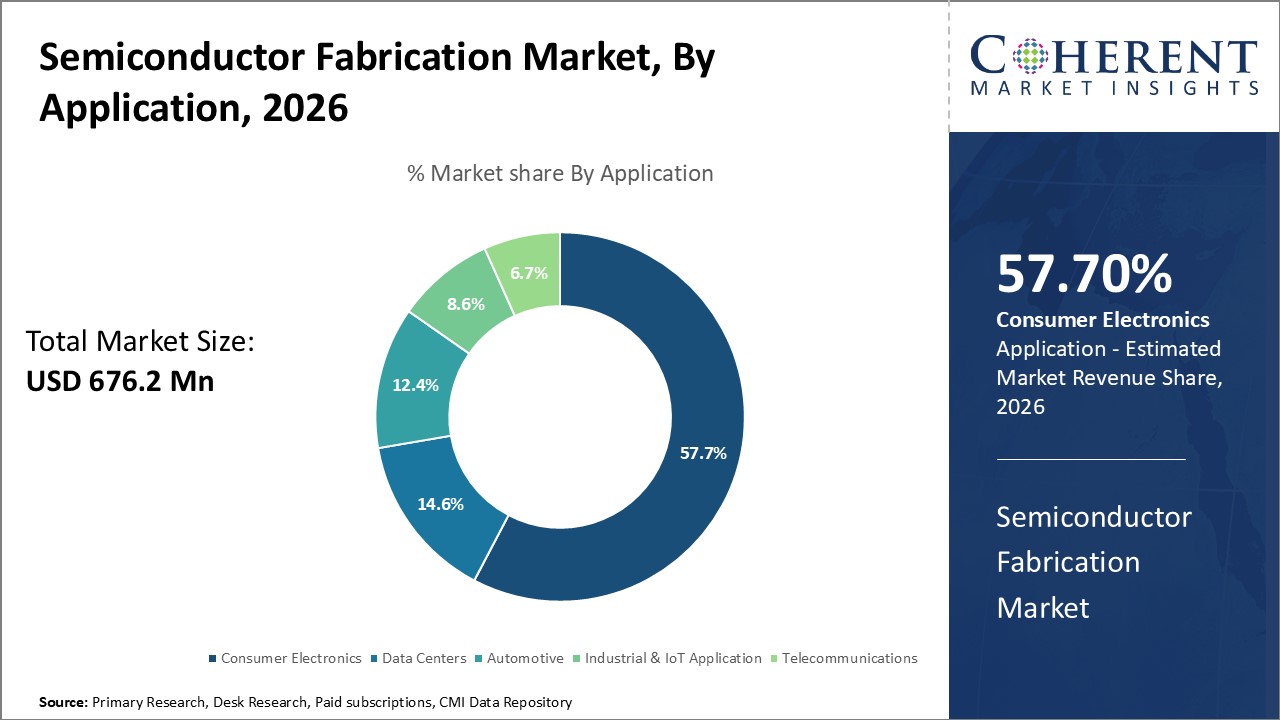
Global Semiconductor Fabrication Market Insights, By Application – Consumer Electronics Leads Because of the Soaring Demand for Advanced Microchips Fueling Innovation and Mass Adoption
The consumer electronics segment is projected to hold 57.7% share in 2026 because of growing demand for smartphones, wearables, laptops, and smart home devices. Fast innovation cycles push fabs to produce smaller, more powerful, and energy-efficient chips, supporting the growing device capabilities.
Growth is also fueled by IoT proliferation and 5G adoption, both needing high volumes of advanced RF and AI-enabled chips. Consumer brands’ need for faster product launches pushes fabs to invest in flexible, high-yield production processes made for mass customization.
Samsung’s Pyeongtaek fab ramped up 5nm production for its Galaxy series processors and wearable chips, reflecting the strong pull of consumer electronics on global fabrication capacity.
Pricing Analysis of the Semiconductor Fabrication Market
Item | Typical Price (USD) |
2 nm — per 300 mm wafer (leading-edge) | USD 30,000.00 |
Samsung 2 nm — per 300 mm wafer (competitive offer) | USD 20,000.00 |
3 nm — per 300 mm wafer | USD 18,000.00 |
5 nm — per 300 mm wafer | USD 16,988.00 → rounded USD 16,988.00 |
7 nm — per 300 mm wafer | USD 9,346.00 |
16–28 nm — per 300 mm wafer (mainstream nodes) | USD 4,000.00 – USD 6,000.00 |
65 nm — per 300 mm wafer (mature node) | USD 1,000.00 |
130 nm and older — per wafer (200/150 mm basis) | USD 200.00 – USD 600.00 |
Full mask set — leading-edge (2nm/3nm) | USD 20,000,000.00 – USD 50,000,000.00 |
Full mask set — 5nm/7nm | USD 5,000,000.00 – USD 15,000,000.00 |
ASML EUV scanner (Low-NA) — unit price | USD 150,000,000.00 |
ASML High-NA/next-gen EUV — unit price (R&D/high-NA) | USD 290,000,000.00 – USD 400,000,000.00 |
Typical advanced-node fab capital expenditure (3nm/5nm-capable) | USD 12,000,000,000.00 – USD 20,000,000,000.00 |
Regional Insights
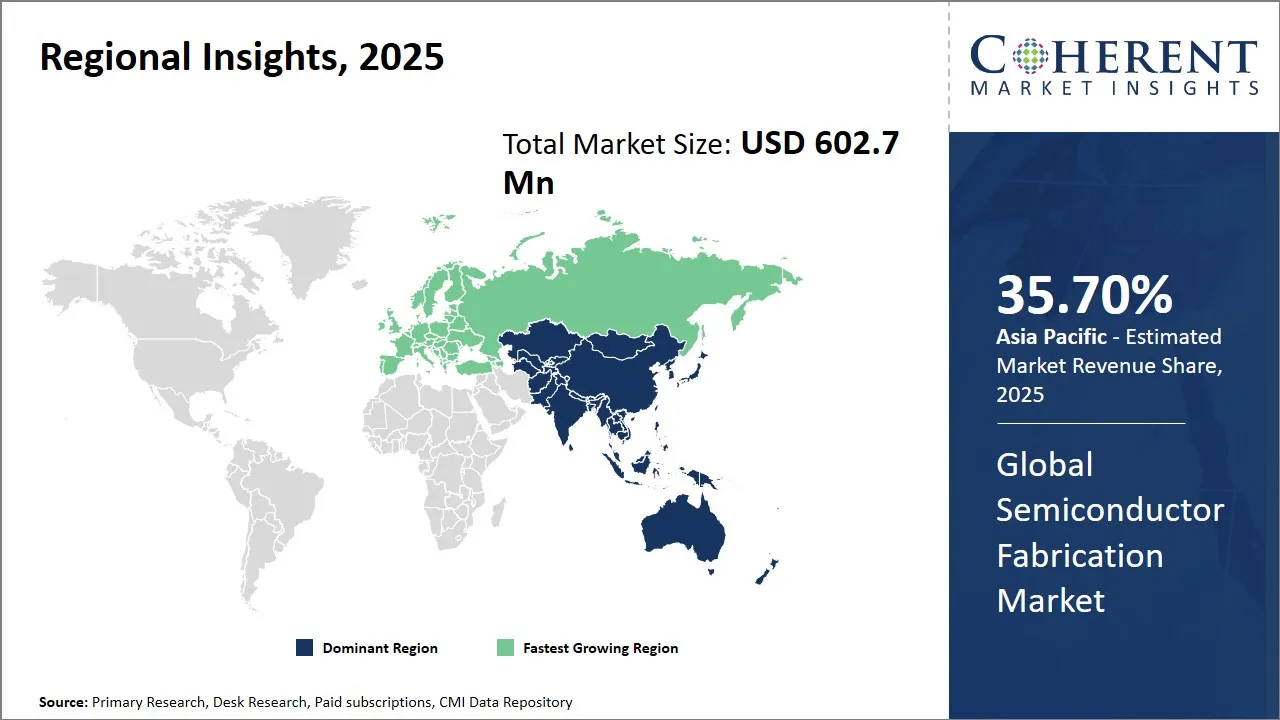
Asia Pacific Semiconductor Fabrication Market Analysis and Trends
Asia Pacific, holding a projected share of 35.7% in 205, dominates the global semiconductor fabrication market, driven by a well-established and highly integrated semiconductor ecosystem, significant government support, and the presence of leading manufacturing giants. Countries such as Taiwan, South Korea, and Japan have cultivated robust semiconductor industries that span design, fabrication, assembly, and testing. Government policies in these countries push innovation through subsidies, investment in research facilities, tax incentives, and public-private partnerships.
Asia Pacific sees advanced manufacturing infrastructure, skilled labor, and strategic trade networks, allowing fast production scalability. Key players include Taiwan Semiconductor Manufacturing Company (TSMC), Samsung Electronics, and Sony Semiconductor Solutions, all known for their cutting-edge fabrication technologies that push global semiconductor supply chains.
Europe Semiconductor Fabrication Market Analysis and Trends
Europe, accounting for an estimated 21.7% share in 2026, is the fastest growing region of the global semiconductor fabrication market because of strategic regional policies and increased investment in technological sovereignty. The European Union’s Chips Act for securing semiconductor supply chains and increasing local production, has pushed large-scale funding initiatives and collaborations between governments, research institutes, and private industry players.
The region sees growth because of its strong foundation in automotive electronics, industrial automation, and power semiconductors, with nations such as Germany, France, and the Netherlands leading development efforts. Big players like Infineon Technologies, STMicroelectronics, and NXP Semiconductors are advancing fabrication capacity and investing in next-generation technologies including wide bandgap semiconductors (SiC, GaN) and energy-efficient chip solutions.
Global Semiconductor Fabrication Market Outlook for Key Countries
Taiwan Semiconductor Fabrication Market Analysis and Trends
The Taiwan semiconductor fabrication market remains a cornerstone of the semiconductor fabrication industry, anchored primarily by TSMC, the world’s largest dedicated independent semiconductor foundry. Taiwan’s ecosystem benefits from deep supplier networks and advanced fabrication facilities specializing in cutting-edge nodes. The government’s collaborative approach to pushing technological innovation and supply chain resilience has added to Taiwan’s leadership. The island’s strategic position as a global supplier of wafers and chips consolidates its influence in the worldwide semiconductor industry.
South Korea Semiconductor Fabrication Market Analysis and Trends
South Korea continues to lead with a high presence in memory chip manufacturing and advanced logic fabrication. Samsung Electronics, a global semiconductor player, pushes innovation with huge investments in new fabs and next-generation technology development. Government initiatives include supporting tech parks and innovation clusters that push cross-sector collaboration. South Korea’s integrated supply chain and export-oriented semiconductor policies make it an important player in meeting global demand for high-performance chips in various applications.
U.S. Semiconductor Fabrication Market Analysis and Trends
The U.S. semiconductor fabrication market is thriving on innovation and substantial federal backing intended to restore domestic chip manufacturing leadership. Companies such as Intel and GlobalFoundries are scaling up fabrication plants and investing heavily in research on next-generation semiconductor processes, including AI and 5G applications. Policy frameworks pushing reshoring of fabs, workforce development, and intellectual property protection have strengthened the market dynamics.
Japan Semiconductor Fabrication Market Analysis and Trends
Japan semiconductor fabrication sector remains important because of specialized manufacturing capabilities and a focus on materials, production equipment, and niche process technologies. Companies like Renesas and Sony Semiconductor contribute significantly with expertise in automotive chips and image sensors. Government programs push innovation and global cooperation while using Japan’s historical strengths in precision manufacturing and quality control. The country continues to lead by improving production capacity and advancing semiconductor process technologies as per the changing market demands.
Germany Semiconductor Fabrication Market Analysis and Trends
Germany acts as a key European hub for semiconductor fabrication, strategically positioned within the continent’s automotive and industrial sectors that increasingly rely on semiconductor components. Firms like Infineon Technologies put efforts in making power semiconductors and specialized chips for automotive and industrial applications. Government investments through the EU and national programs push semiconductor research, production, and ecosystem collaboration to reduce Europe's dependence on external supply chains. Germany’s strong engineering base and focus on innovation adds to its role in the semiconductor fabrication market.
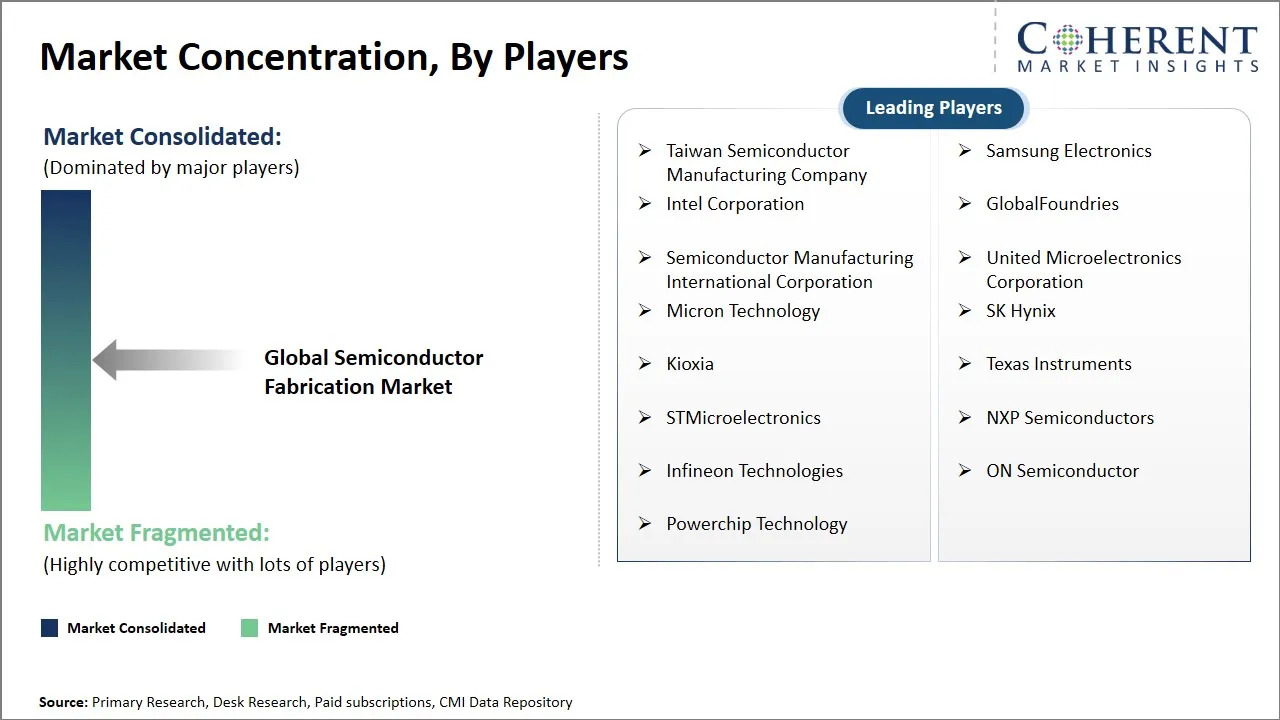
Market Players, Key Development, and Competitive Intelligence
Key Developments
- In June 2025, GlobalFoundries (GF) announced plans to invest USD 16 billion to expand its semiconductor manufacturing and advanced packaging capabilities across its facilities in New York and Vermont. GF’s investment is a strategic response to the explosive growth in artificial intelligence, which is accelerating demand for next-generation semiconductors designed for power efficiency and high-bandwidth performance across datacenters, communications infrastructure and AI-enabled devices.
- In June 2025, Micron Technology, Inc. announced its plans to expand its U.S. investments to approximately USD 150 billion in domestic memory manufacturing and USD 50 billion in R&D, creating an estimated 90,000 direct and indirect jobs.
- In March 2025, TSMC announced its intention to expand its investment in advanced semiconductor manufacturing in the U.S. by an additional USD 100 billion. Building on the company’s ongoing USD 65 billion investment in its advanced semiconductor manufacturing operations in Phoenix, Arizona, TSMC’s total investment in the U.S. is expected to reach USD 165 billion. The expansion includes plans for three new fabrication plants, two advanced packaging facilities and a major R&D team center, solidifying this project as the largest single foreign direct investment in U.S. history.
- In January 2025, Taiwan Semiconductor Manufacturing Co. began producing advanced four-nanometer chips for U.S. customers in Arizona, U.S.
Top Strategies Followed by Semiconductor Fabrication Market Players
- Established giants in the sector prioritize huge investments in research and development to drive innovation, ensuring the creation of high-performance, next-generation semiconductor products that meet evolving technological demands.
- TSMC has publicly committed very big additional investments in U.S. fabs, advanced packaging and a major R&D center.
- Mid-level semiconductor fabricators carve a distinct niche by emphasizing cost-effective solutions that strike a balance between quality and affordability.
- GF emphasizes mature and specialty nodes (e.g., 22FDX, RF, embedded memory variants) and positions these as cost-efficient, high-value solutions for customers who do not require bleeding-edge nodes.
- Small-scale semiconductor fabricators confront unique challenges in an industry dominated by large incumbents, but they find opportunities by focusing on specialized or highly innovative product segments.
- SkyWater markets itself as a U.S.-based specialty foundry (aerospace/defense, medical, MEMS, niche technologies) and has pursued CHIPS funding to expand those capabilities.
Market Report Scope
Semiconductor Fabrication Market Report Coverage
| Report Coverage | Details | ||
|---|---|---|---|
| Base Year: | 2025 | Market Size in 2026: | USD 676.2 Mn |
| Historical Data for: | 2020 To 2024 | Forecast Period: | 2026 To 2033 |
| Forecast Period 2026 to 2033 CAGR: | 12.2% | 2033 Value Projection: | USD 1,513.7 Mn |
| Geographies covered: |
| ||
| Segments covered: |
| ||
| Companies covered: | Taiwan Semiconductor Manufacturing Company, Samsung Electronics, Intel Corporation, GlobalFoundries, Semiconductor Manufacturing International Corporation, United Microelectronics Corporation, Micron Technology, SK Hynix, Kioxia, Texas Instruments, STMicroelectronics, NXP Semiconductors, Infineon Technologies, ON Semiconductor, and Powerchip Technology | ||
| Growth Drivers: |
| ||
| Restraints & Challenges: |
| ||
Market Dynamics
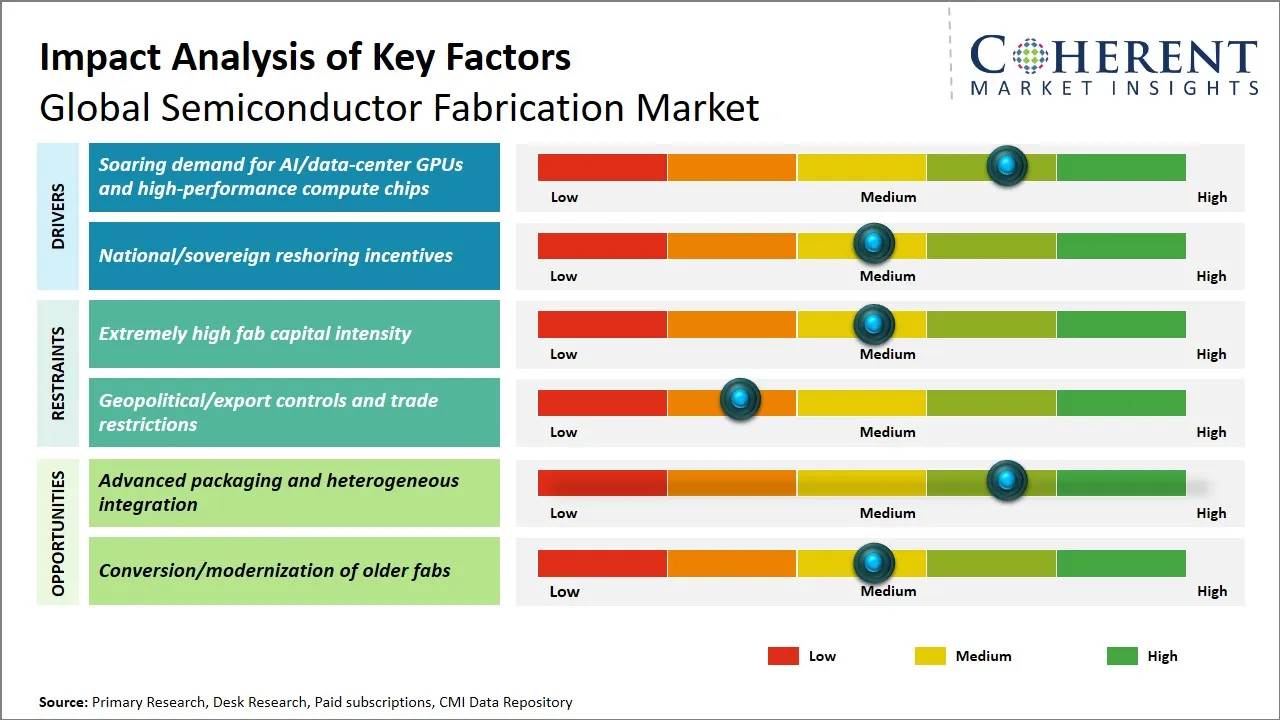
Global Semiconductor Fabrication Market Driver – Soaring Demand for AI/Data-Center GPUs and High-Performance Compute Chips
The surging adoption of AI, machine learning, and cloud computing is dramatically increasing demand for high-performance GPUs and compute chips. To meet these complex workloads, semiconductor fabs are advancing to smaller nodes and investing in EUV lithography and 3D chip architectures. TSMC and Samsung have ramped up 3nm and 2nm node production to support NVIDIA’s AI GPUs and AMD’s data-center chips (2024–2025), directly expanding fab utilization and capital expenditure in high-performance computing segments.
Global Semiconductor Fabrication Market Opportunity – Advanced Packaging and Heterogeneous Integration
Growing need for compact, energy-efficient, and high-performance devices is fueling the demand for advanced packaging solutions like 3D stacking, SiP, and FOWLP. These approaches allow integration of diverse chip types, enhancing performance and reducing latency for AI, 5G, and automotive applications. Intel’s Foveros and TSMC’s CoWoS packaging technologies (2024) enable stacking of logic and memory dies in a single package, allowing chips like NVIDIA’s H100 and AMD’s MI300 to achieve superior computational density and efficiency.
Analyst Opinion (Expert Opinion)
- The semiconductor fabrication industry is reaching an unsustainable level of capital expenditure. With leading-edge fabs costing over USD 20 billion to build, only a few players, like TSMC, Samsung, and Intel, can afford to stay at the technological frontier. This concentration of capability limits competition and creates supply chain vulnerability, leaving making it difficult for mid-tier players to remain viable.
- Despite post-pandemic recovery efforts, the global chip supply chain remains very fragmented. High dependence on specific regions—particularly Taiwan and South Korea—for advanced nodes exposes the market to geopolitical risk. Any escalation in U.S.-China trade restrictions or regional instability could severely affect global chip availability and price stability.
- A severe shortage of skilled engineers and process experts continues to impede innovation. As fabrication technologies become more complex—especially in EUV lithography and heterogeneous integration—the talent gap is widening faster than the industry can train new specialists. This human capital constraint risks slowing the rate of node advancement and delaying the transition to next-generation semiconductor architectures.
Speak to the analyst
Want personalized insights?
Take the findings above to one of our principal consultants, or have the report rebuilt around the segments, geographies and competitors you actually track.
Market Segmentation
- Traceability Techniques Insights (Revenue, USD Mn, 2021 - 2033)
- Barcode Scanners
- RFID Readers
- Laser Marking
- Others
- Application Insights (Revenue, USD Mn, 2021 - 2033)
- Consumer Electronics
- Data Centers
- Automotive
- Industrial & IoT Application
- Telecommunications
- Regional Insights (Revenue, USD Mn, 2021 - 2033)
- North America
- U.S.
- Canada
- Latin America
- Brazil
- Argentina
- Mexico
- Rest of Latin America
- Europe
- Germany
- U.K.
- Spain
- France
- Italy
- Russia
- Rest of Europe
- Asia Pacific
- China
- India
- Japan
- Australia
- South Korea
- ASEAN
- Rest of Asia Pacific
- Middle East
- GCC Countries
- Israel
- Rest of Middle East
- Africa
- South Africa
- North Africa
- Central Africa
- North America
- Key Players Insights
- Taiwan Semiconductor Manufacturing Company
- Samsung Electronics
- Intel Corporation
- GlobalFoundries
- Semiconductor Manufacturing International Corporation
- United Microelectronics Corporation
- Micron Technology
- SK Hynix
- Kioxia
- Texas Instruments
- STMicroelectronics
- NXP Semiconductors
- Infineon Technologies
- ON Semiconductor
- Powerchip Technology
Sources
Primary Research Interviews
Stakeholders
- Semiconductor Foundry Engineers and Plant Managers
- Equipment Manufacturers and Suppliers
- Wafer and Substrate Material Providers
- Semiconductor Design and EDA Firms
- Integrated Device Manufacturers (IDMs) and Fabless Companies
- Supply Chain and Logistics Managers for Semiconductor Components
- Cleanroom Infrastructure Providers and Environmental Safety Experts
Databases
- SEMI Industry Database
- U.S. International Trade Commission (USITC) Data Portal
- Japan Electronics and Information Technology Industries Association (JEITA) Database
- OECD Science, Technology and R&D Statistics
- World Semiconductor Trade Statistics (WSTS)
- Global Trade Atlas (GTA) Semiconductor Export Records
Magazines
- Semiconductor Digest
- EE Times
- Electronic Design Magazine
- Chip Fabrication World
- Silicon Semiconductor Magazine
- Cleanroom Technology
Journals
- IEEE Transactions on Semiconductor Manufacturing
- Journal of Microelectronic Engineering
- Materials Science in Semiconductor Processing
- Journal of Nanotechnology and Semiconductor Research
- Solid-State Electronics Journal
- Journal of Advanced Packaging and Integration
Newspapers
- Nikkei Asia (Japan)
- The Korea Herald (South Korea)
- The Wall Street Journal (U.S.)
- The Economic Times (India)
- The Taiwan News
- Financial Times (UK)
Associations
- SEMI (Semiconductor Equipment and Materials International)
- Semiconductor Industry Association (SIA)
- Taiwan Semiconductor Industry Association (TSIA)
- Korea Semiconductor Industry Association (KSIA)
- European Semiconductor Industry Association (ESIA)
- IEEE Electronics Packaging Society
Public Domain Sources
- U.S. Census Bureau
- EUROSTAT
- World Bank Open Data
- United Nations Industrial Development Organization (UNIDO)
- ResearchGate
- International Energy Agency (IEA) – Technology Reports
Proprietary Elements
- CMI Data Analytics Tool, Proprietary CMI Existing Repository of Information for the last 8 years
Get access to 250+ pages report
Every segment, forecast, competitor profile and data table behind the analysis above — available for instant download.
- ESOMAR Member
- ISO 9001:2015 Certified
- D-U-N-S Registered
- GDPR & CCPA Compliant
Missing comfort of reading report in your local language? Find your preferred language:
Transform your Strategy with Exclusive Trending Reports
Frequently Asked Questions
The global semiconductor fabrication market is estimated to be valued at USD 676.2 million in 2026 and is expected to reach USD 1,513.7 million by 2033.
The CAGR of the global semiconductor fabrication market is projected to be 12.2% from 2026 to 2033.
Soaring demand for AI/data-center GPUs and high-performance compute chips and national/sovereign reshoring incentives are the major factors driving the growth of the global semiconductor fabrication market.
Extremely high fab capital intensity and geopolitical/export controls and trade restrictions are the major factors hampering the growth of the global semiconductor fabrication market.
In terms of traceability techniques, the barcode scanners segment is estimated to dominate the market revenue share in 2026.
Semiconductor fabrication refers to the process of manufacturing integrated circuits (ICs) on silicon wafers using advanced photolithography, etching, and deposition technologies.
Advanced packaging and heterogeneous integration present strong growth opportunities for efficiency and miniaturization.