

Remote Infrastructure Management Market Size and Forecast — 2026-2033
The Global Remote Infrastructure Management Market size is estimated to be valued at USD 16.26 billion in 2026 and is expected to reach USD 32.91 billion by 2033, exhibiting a compound annual growth rate (CAGR) of 10.6% from 2026 to 2033.
Overview
Remote infrastructure management solutions enable IT service providers and enterprises to monitor, manage, and maintain IT infrastructure remotely. These products cover server management, network monitoring, database administration, security, and cloud infrastructure management. RIM platforms provide real-time alerts, automated problem resolution, and predictive maintenance capabilities, allowing organizations to reduce downtime, optimize resource utilization, and ensure business continuity while lowering operational costs.
Key Takeaways
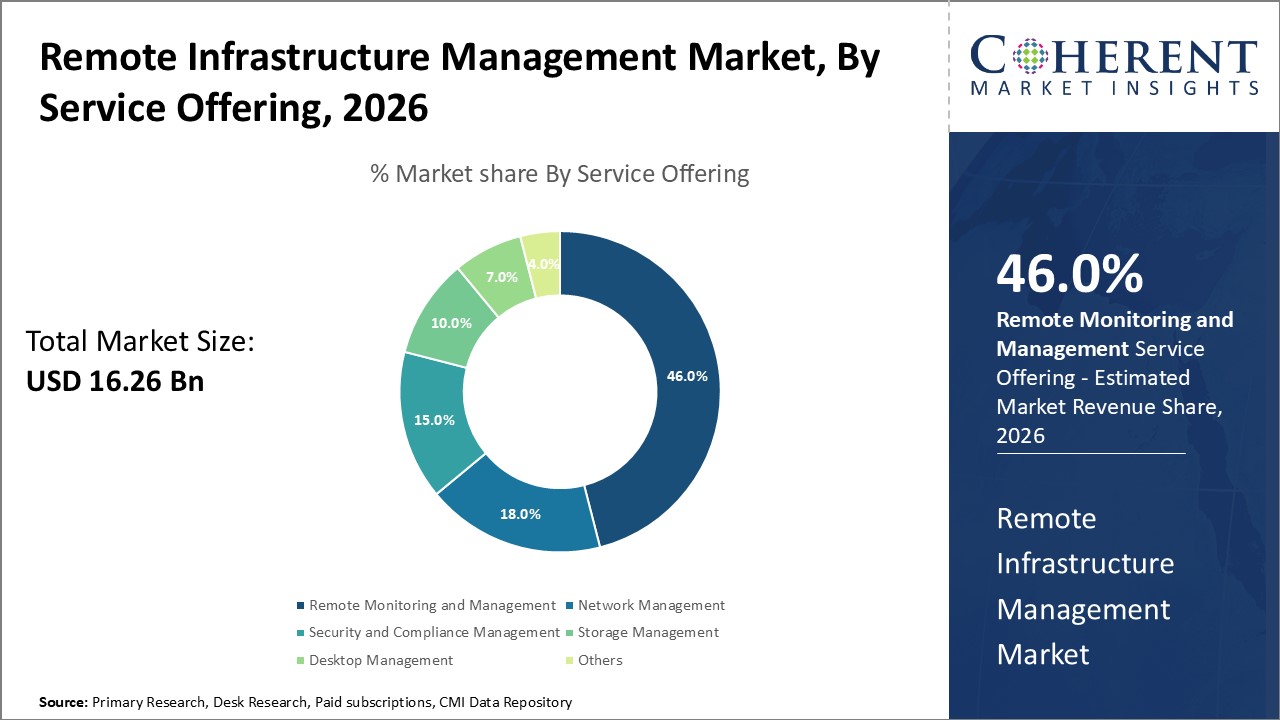
The Remote Monitoring and Management service segment dominates the industry size with a commanding 46% market share due to its crucial role in 24/7 infrastructure visibility and management.
Meanwhile, the cloud-based deployment segment is the fastest growing, propelled by enterprises increasingly shifting away from capital-intensive on-premises solutions to flexible, subscription-based models.
Among industries, BFSI holds the largest share, driven by stringent compliance and operational reliability needs.
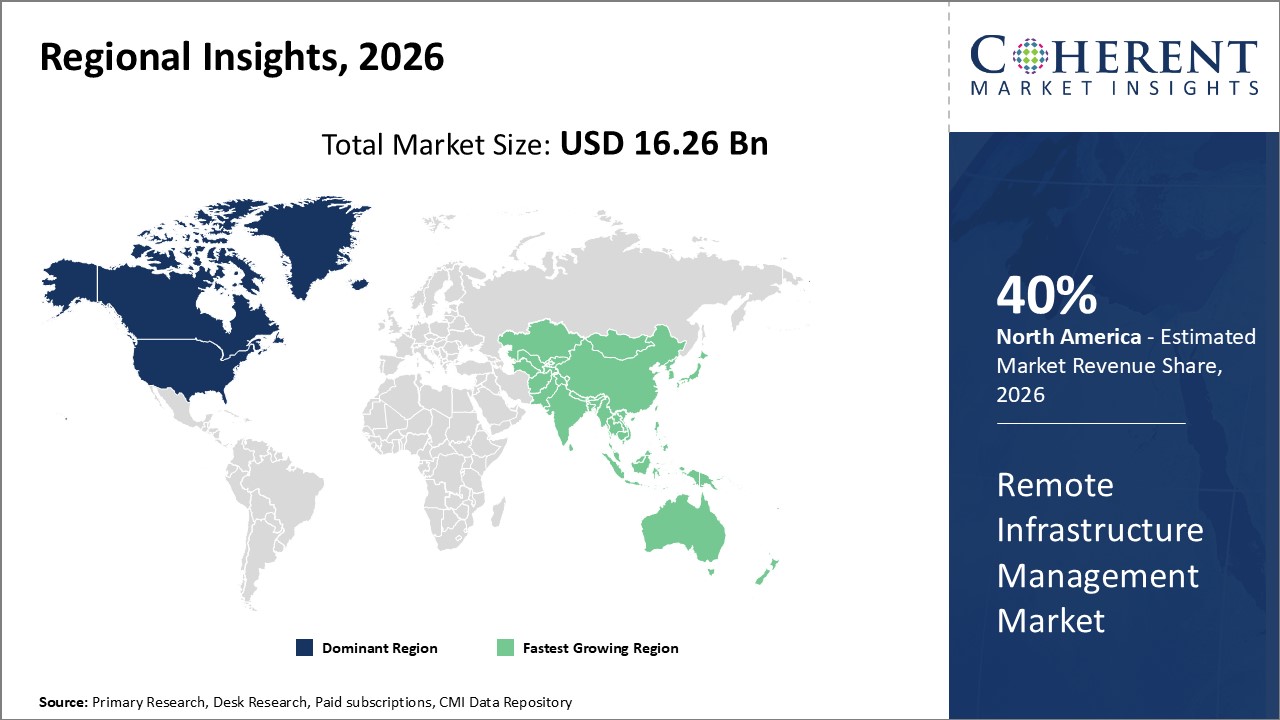
Regionally, North America accounts for nearly 40% of total market revenue due to its mature IT market and early technology adoption, while Asia Pacific emerges as the fastest-growing region with a CAGR surpassing 12%, supported by vigorous digital transformation and government initiatives.
These key takeaways underline the critical segments and regions pivotal to market players’ strategic focus.
Remote Infrastructure Management Market Segmentation Analysis
Remote Infrastructure Management Market Insights, By Service Offering
In terms of service offering, the Remote Monitoring and Management dominates the market share at 46%, primarily due to enterprises’ critical need for continuous, real-time visibility into their IT assets. This segment thrives on providing automated alerts and remediation to maintain system health proactively. The fastest growing subsegment is Security and Compliance Management, driven by increasing regulatory demands and escalating cyber threats across industries, leading to faster adoption of integrated security services within RIM frameworks. Network Management ensures reliable network operations and optimization, Storage Management focuses on data availability and disaster recovery, while Desktop Management handles endpoint devices and user support services.
Remote Infrastructure Management Market Insights, By Deployment
On-Premises deployment holds the dominant share due to enterprises with strict data sovereignty and security concerns preferring localized control over IT assets. Cloud-based deployment is the fastest-growing subsegment, embraced for its scalability, cost-effectiveness, and remote accessibility advantages. This growth aligns with enterprises’ strategic shift to cloud-first architectures, enabling flexible RIM service delivery.
Remote Infrastructure Management Market Insights, By End-User
BFSI leads the market share, reflecting high infrastructure management needs driven by stringent compliance requirements and the critical nature of financial services uptime. This sector’s extensive adoption of RIM primarily addresses risk mitigation and 24/7 availability. The fastest growing subsegment is Healthcare, propelled by increased digitization, telehealth services expansion, and patient data security imperatives driving demand for advanced remote infrastructure capabilities.
Remote Infrastructure Management Market Trends
The Remote Infrastructure Management market trend is principally shaped by emerging innovations in AI and automation. AI-driven predictive maintenance is now a standard feature in leading RIM platforms, reducing system downtime by up to 31% in sectors requiring high availability, such as healthcare and telecom.
Another prevailing trend is the rapid expansion of cloud-based solutions, propelled by enterprise demand for flexibility and cost-efficiency.
For instance, cloud deployments in the RIM space grew by over 36% in 2025, reflecting changing market dynamics and vendor capabilities.
Additionally, edge computing, buoyed by the deployment of 5G technology, is transforming RIM approaches by enabling decentralized infrastructure monitoring and faster response times.
Remote Infrastructure Management Market Insights, By Geography
North America Remote Infrastructure Management Market Analysis and Trends
In North America, the dominance in the Remote Infrastructure Management market is underscored by its 40% market share, supported by a sophisticated IT ecosystem, early cloud adoption, and government policies favoring digital transformation. Major players like IBM and Cisco have a significant presence here, driving continuous innovation and device integration. Robust investments in cybersecurity and compliance further elevate demand for RIM solutions.
Asia Pacific Remote Infrastructure Management Market Analysis and Trends
Meanwhile, the Asia Pacific region exhibits the fastest growth with a CAGR exceeding 12%, catalyzed by aggressive digital infrastructure rollouts in China, India, and Southeast Asia. Government initiatives such as China’s “Digital China” plan and India’s “Digital India” program foster robust growth. Furthermore, rising IT outsourcing and the expanding base of SMEs seeking efficient infrastructure management amplify market revenue.
Remote Infrastructure Management Market Outlook for Key Countries
USA Remote Infrastructure Management Market Analysis and Trends
The USA remains the largest single-country market in Remote Infrastructure Management, accounting for nearly half of North America’s revenue share. The country’s advanced IT infrastructure, coupled with significant investments in hybrid cloud and AI technologies, contributes to market leadership. Notably, financial institutions and healthcare organizations have ramped up RIM adoption to enhance compliance and uptime, influencing revenue growth by 18% in 2025 alone. Major companies such as IBM and Dell Technologies dominate with comprehensive managed services portfolios, driving competition and innovation.
India Remote Infrastructure Management Market Analysis and Trends
India's RIM market is among the fastest-growing globally, anchored by rapid digitization in banking, manufacturing, and government sectors. Government digital initiatives and increasing SME digitization are boosting demand for scalable remote infrastructure solutions. Providers like Wipro and Tech Mahindra have cemented their market presence through tailored cloud-based offerings and automation-led frameworks, leading to a surge in market revenue of over 20% in 2025. Infrastructure modernization and talent availability further fuel business expansion prospects.
Analyst Opinion
The increasing shift towards hybrid and multi-cloud environments is a primary demand-side indicator enhancing the Remote Infrastructure Management market’s growth. Data from 2025 indicate that over 66% of enterprises have adopted hybrid cloud frameworks, boosting the need for comprehensive RIM solutions to monitor distributed assets seamlessly. This multi-cloud adoption directly correlates with a 16% rise in remote management service subscriptions year-over-year.
Supply-side analytics reveal rising innovation in automation and AI-enabled remote infrastructure tools that reduce manual intervention. In 2026, automated root cause analysis features contributed to reducing incident resolution times by up to 31%, as reported by key industry players implementing these technologies. Production capacity for intelligent RIM solutions has also increased by 23% year-on-year, supporting the market’s upward trajectory.
Regional import patterns exhibit strong demand surges in the Asia Pacific and North America, where robust IT infrastructure investments, including government-backed projects, raise the need for reliable RIM capabilities. The U.S. alone accounted for 45% of total market revenue in 2025, reflecting the maturity and scale of its IT ecosystem. Simultaneously, strong import growth in emerging markets, fueled by digitalization, augmented market volume by 18% across those regions.
Market micro-indicators emphasize expanding use cases beyond traditional IT operations, incorporating remote management for IoT devices and edge computing assets. Enterprises in the manufacturing and healthcare sectors reported a 21% increase in remote infrastructure monitoring adoption due to critical uptime requirements. This diversification bolsters revenue channels and opens new revenue streams beyond conventional enterprise IT environments.
- Current Industry Events of 2026
- Market Size Estimation
- Regional Breakdown
- Competitive Landscape
- Customer Intelligence
- Segmental Analysis
- Pricing Analysis
- Key Market Drivers, Challenges & Future Trends
- Customized Insights Section
Market Scope
| Report Coverage | Details | ||
|---|---|---|---|
| Base Year: | 2025 | Market Size in 2026: | USD 16.26 billion |
| Historical Data for: | 2020 To 2024 | Forecast Period: | 2026 To 2033 |
| Forecast Period 2026 to 2033 CAGR: | 10.6% | 2033 Value Projection: | USD 32.91 billion |
| Geographies covered: |
| ||
| Segments covered: |
| ||
| Companies covered: | IBM Corporation, Cisco Systems, Inc., Dell Technologies Inc., HCL Technologies Limited, Wipro Limited, Accenture plc, DXC Technology Company, Fujitsu Limited, Capgemini SE, Atos SE, Tata Consultancy Services Limited, Cognizant Technology Solutions, Infosys Limited, Siemens AG. | ||
| Growth Drivers: | Growing reliance on remote IT operations and managed services Rising adoption of cloud and hybrid infrastructure models | ||
Remote Infrastructure Management Market Growth Factors
The Remote Infrastructure Management market growth is fueled by the accelerating adoption of cloud infrastructure and hybrid IT models that demand seamless remote oversight of diverse assets. Second, the rising importance of cybersecurity compliance and risk mitigation has escalated the deployment of RIM solutions with integrated security functionalities, noted by a 30% increase in security feature adoption in 2026 compared to 2023. Furthermore, the industry’s pivot to automation and AI has driven operational efficiency gains, reflected in a 28% decrease in manual monitoring tasks across businesses implementing these technologies last year. Lastly, regulatory mandates and service level agreements (SLAs) are propelling growth by necessitating continuous infrastructure availability, pushing enterprises to invest heavily in remote monitoring services.
Remote Infrastructure Management Market Development
In August 2026, Rackspace Technology announced its new Rackspace Cloud Management Platform with upgrades to its Managed Cloud (RMC) offering. The enhancements include AI-enabled tools for full-stack observability, intelligent application optimization, and a flexible consumption-based model. The platform aims to streamline operations for hybrid and multicloud environments with lower barriers to entry.
In May 2026, HCL Technologies launched a solution in collaboration with CareAR (a Xerox company) and ServiceNow to manage IT infrastructure leveraging augmented reality. The system provides real-time remote assistance, automation-driven workflows, and digital overlays for datacenter, asset lifecycle, and remote support tasks. It is aimed at reducing downtime and improving issue resolution in distributed and remote sites.
In June 2026, SolarWinds released version 2026.2 of its Platform, including Observability Self-Hosted, Orion Network & Systems modules. New features include a multi-cloud summary dashboard, expanded SNMP monitoring (e.g. enhanced metrics for Arista switches), enriched Layer-2 & Layer-3 diagnostics, hardware health updates, and improved support for GCP virtual machines (start/stop/reboot/delete operations).
Key Players
Leading companies of the market:
IBM Corporation
Cisco Systems, Inc.
Dell Technologies Inc.
HCL Technologies Limited
Wipro Limited
Accenture plc
DXC Technology Company
Fujitsu Limited
Atos SE
Tata Consultancy Services Limited
Cognizant Technology Solutions
Infosys Limited
Siemens AG
Several market players have deployed strategic acquisitions and partnerships to gain access to cutting-edge remote infrastructure automation technologies. For instance, the integration of AI-driven analytics by Wipro has streamlined service delivery models, leading to a reported 25% reduction in client operational expenses. Similarly, IBM’s focus on hybrid cloud-enabled offerings has expanded its service portfolio, contributing to a 12% uptick in service contracts across North America in 2025.
Remote Infrastructure Management Market Future Outlook
The market is expected to expand rapidly as enterprises increasingly rely on cloud, hybrid IT, and edge computing infrastructures. Future RIM solutions will leverage AI, automation, and predictive analytics to ensure proactive monitoring, faster incident resolution, and enhanced performance optimization. Security and compliance management will become integral to RIM platforms, addressing growing cyber threats and regulatory requirements. The increasing need for business continuity, resource optimization, and cost reduction will drive organizations to adopt advanced RIM solutions capable of managing heterogeneous IT environments across geographies.
Remote Infrastructure Management Market Historical Analysis
The remote infrastructure management market emerged as enterprises sought cost-effective solutions to monitor, manage, and maintain IT infrastructure remotely. Initially, RIM solutions focused on server monitoring and basic network management, but the growing complexity of IT operations, adoption of cloud computing, and distributed enterprise environments drove demand for more comprehensive capabilities. Vendors introduced automation, predictive maintenance, real-time monitoring dashboards, and security management features to reduce downtime and improve IT performance. The shift toward hybrid IT environments and multi-cloud architectures further accelerated the adoption of RIM solutions, allowing organizations to manage complex IT landscapes efficiently while minimizing operational costs.
Sources
Primary Research interviews:
IT Infrastructure Managers
Cloud Operations Specialists
Data Center Administrators
Managed Service Providers
Databases:
Gartner IT Infrastructure Services Reports
IDC Cloud & Infrastructure Research
Statista IT Operations Data
Forrester IT Management Studies
Magazines:
InformationWeek
Data Center Knowledge
CIO Review
Network Computing
Journals:
Journal of Cloud Computing
IEEE Transactions on Network and Service Management
International Journal of IT & Systems Management
Journal of Information Technology Services
Newspapers:
Business Standard (Technology)
The Economic Times (IT)
Financial Express (Digital Infrastructure)
The Wall Street Journal (Tech)
Associations:
Information Technology Infrastructure Library (ITIL)
Cloud Native Computing Foundation (CNCF)
IT Service Management Forum (itSMF)
International Association of Managed Service Providers (MSPAlliance)
Get access to 250+ pages report
Every segment, forecast, competitor profile and data table behind the analysis above — available for instant download.
- ESOMAR Member
- ISO 9001:2015 Certified
- D-U-N-S Registered
- GDPR & CCPA Compliant
Missing comfort of reading report in your local language? Find your preferred language:
Transform your Strategy with Exclusive Trending Reports
Frequently Asked Questions
The dominant players include IBM, Cisco, Dell Technologies, HCL Technologies, and Wipro, who lead with extensive infrastructure portfolios and strategic innovations in automation and AI-driven management.
The Remote Infrastructure Management market size is estimated to reach USD 32.91 billion by 2033, reflecting consistent growth driven by cloud adoption and digital infrastructure proliferation.
The BFSI sector presents the largest growth opportunity due to its critical need for compliance, security, and uninterrupted infrastructure uptime.
Market trends will increasingly favor cloud-based RIM solutions, integration of AI-enabled predictive analytics, and edge computing adoption driven by advances in 5G networks.
Management market?
What go-to-market strategies are commonly adopted in the Remote Infrastructure Management market?