

Robot Software Market Size and Share Analysis - Growth Trends and Forecasts (2026 - 2033)
The Robot Software Market size is expected to expand at a CAGR of 14.8% over the forecast period from USD 26.64 Bn in 2026 to about USD 70.04 Bn in 2033. The primary driver of market growth includes increasing use of industrial and service robots, implementation of Artificial Intelligence and Machine Learning, rising demand for automation in warehouses and manufacturing processes, and growing adoption of robots in healthcare, logistics, retail, and other commercial purposes. According to the World Robotics 2025 report published by the International Federation of Robotics, the number of industrial robots installed globally in 2024 was 542,000, with the global operational stock having grown by 9% to reach 4.66 million units.
Key Takeaways
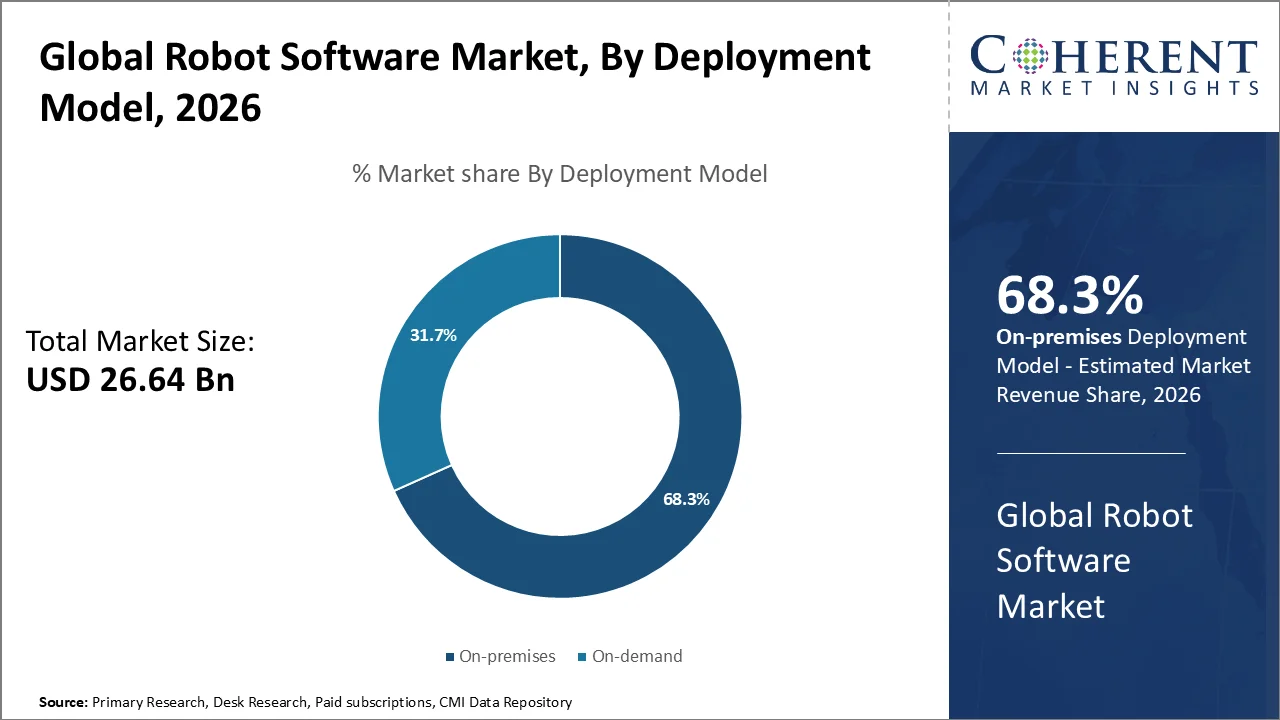
- The on-premises segment is estimated to dominate the market with approximately 68.3% in 2026. The segment’s growth is owing to the need for low-latency robot control, protection of proprietary production data, stronger cybersecurity control, and uninterrupted operation in manufacturing, aerospace, defense, and healthcare environments. Based on Eurostat figures, it was observed that 52.7% of EU firms utilized paid cloud services in 2025, 28.2% employed cloud computing power to run their software, and 26.1 percent utilized cloud platforms to develop applications or perform any other task, which clearly shows that sophisticated operational tasks depend a lot on local infrastructure.
- The industrial robots segment is likely to lead with approximately 57.1% in 2026. The segment’s growth is owing to the extensive use of robot software for motion control, machine vision, welding, assembly, material handling, quality inspection, and production-line integration. According to the 2025 World Robotics report by the International Federation of Robotics, robot density increased to a record number of 267 robots per 10,000 manufacturing employees in Western Europe in 2024. This number is higher than North America’s 204 robots and Asia’s 131 robots per 10,000 manufacturing employees, demonstrating an increase in the intensity of industrial automation.
- The data management and analysis software segment is set to dominate with approximately 34.5% in 2026. The segment’s growth is owing to the increasing requirement for robot-fleet monitoring, sensor-data processing, productivity analysis, anomaly detection, energy optimization, and integration with manufacturing and warehouse management systems. A 2024 National Institute of Standards and Technology (NIST) study reported that approximately 80% of surveyed organizations remotely monitored their deployed robot fleets, around 40% through commercial robot-management software and another 40% through custom-built solution, demonstrating the strong requirement for software platforms that collect, manage, and analyse robotic operational data.
- The large enterprises segment is anticipated to lead with approximately 61.0% in 2026. The segment’s growth is owing to higher automation budgets, large robot fleets, multi-location manufacturing operations, established IT infrastructure, and greater ability to invest in customized AI, simulation, analytics, and predictive-maintenance platforms. Eurofound reported that approximately one in five large EU enterprises used industrial robots, while around one in ten used service robots, with adoption remaining substantially lower among small and medium enterprises.
- The manufacturing segment is projected to dominate the market with approximately 29.5% in 2026. The segment’s growth is owing to the increasing use of robot software in automotive production, electronics assembly, metalworking, machinery manufacturing, packaging, inspection, and predictive maintenance. IFR data show that the electrical and electronics industry accounted for 24% of global industrial robot installations in 2024, followed by automotive at 23% and metal and machinery at 16%, demonstrating the concentration of robot-software demand within manufacturing industries.
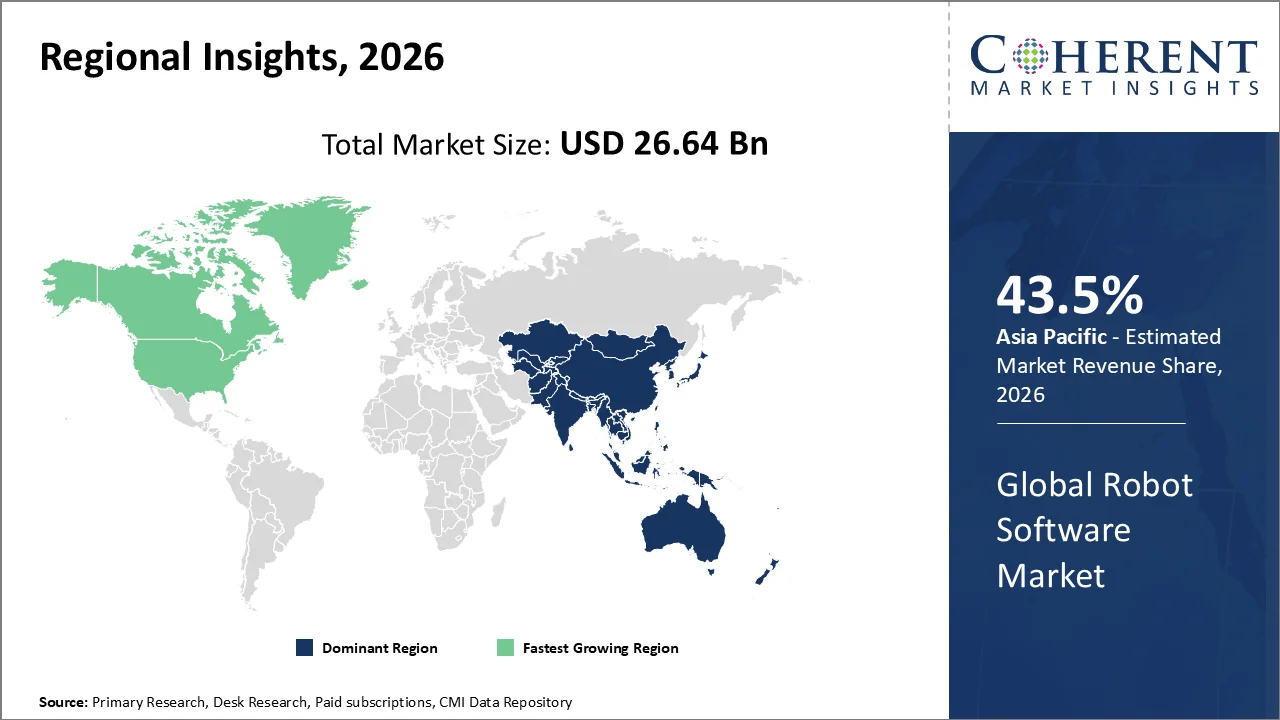
- The Asia-Pacific region is estimated to dominate the global robot software market with approximately 43.5% in 2026. The region’s growth is owing to the high concentration of industrial robot installations, large automotive and electronics manufacturing bases, expansion of smart factories, and increasing development of domestic robotics and automation ecosystems in China, Japan, South Korea, and India. According to the National Bureau of Statistics of China, the country’s production of industrial robots increased by 28.0% in 2025.
Market Drivers
Integration of Generative AI and Foundation Models Is Transforming Robot Software Capabilities
The robot software market is expanding as artificial intelligence models enable robots to understand natural-language instructions, recognize unfamiliar objects, plan complex actions, and adjust their behaviour in changing environments. These capabilities are increasing the demand for recognition, communication, simulation, and data-analysis software across industrial and service robots.
In March 2025, Google DeepMind introduced Gemini Robotics, a vision-language-action model that connects multimodal AI reasoning with physical robotic actions. The company reported that the model delivered more than twice the performance of other advanced vision-language-action models on a comprehensive generalization benchmark. Its Gemini Robotics-ER model also achieved a two-to-three-times higher success rate than Gemini 2.0 in tasks involving perception, spatial reasoning, planning, and code generation.
Expansion of Software-Defined Warehouse Automation Is Driving Fleet-Management Demand
The rapid deployment of autonomous mobile robots in warehouses and fulfilment centres is increasing the requirement for centralized fleet orchestration, route optimization, collision avoidance, task scheduling, predictive maintenance, and real-time operational analytics. As robot fleets become larger, software is increasingly responsible for coordinating the movement and workload of hundreds or thousands of connected machines.
In June 2025, Amazon has revealed its launch of its one-millionth robot on its worldwide operation chain. Amazon has also launched DeepFleet, which is a generative AI foundation model that helps in managing robot movement. According to Amazon, DeepFleet is expected to enhance robotic fleet movement efficiency by roughly 10%.
Current Events and Their Impact on the Robot Software Market
Current Event | Description and its Impact |
EU Cyber Resilience Act Introduces Mandatory Vulnerability Reporting for Digital Products (2026) |
|
European Commission Clarifies AI Act Treatment of AI-Enabled Robotics (2026) |
|
- Current Industry Events of 2026
- Market Size Estimation
- Regional Breakdown
- Competitive Landscape
- Customer Intelligence
- Segmental Analysis
- Pricing Analysis
- Key Market Drivers, Challenges & Future Trends
- Customized Insights Section
Segmental Insights
Why is On-Premises Deployment Acquiring the Largest Share?
On the basis of deployment model, the on-premises segment is projected to account for the largest robot software market share of approximately 68.3% in 2026. The segment’s growth is owing to the need for low-latency robot control, uninterrupted plant operations, protection of proprietary production data, local integration with machinery, and stronger control over cybersecurity and software updates.
The European Commission defines edge nodes as computing resources capable of providing latency below 20 milliseconds and has established a target of deploying at least 10,000 highly secure, climate-neutral edge nodes across the EU by 2030.
In June 2025, FANUC launched ROBOGUIDE Version 10, its next-generation offline robot programming and simulation software. The platform enables manufacturers to design, program, test, and validate robotic work cells in a local 3D environment without requiring physical prototypes or interrupting active production lines.
Why are Industrial Robots Acquiring the Largest Share?
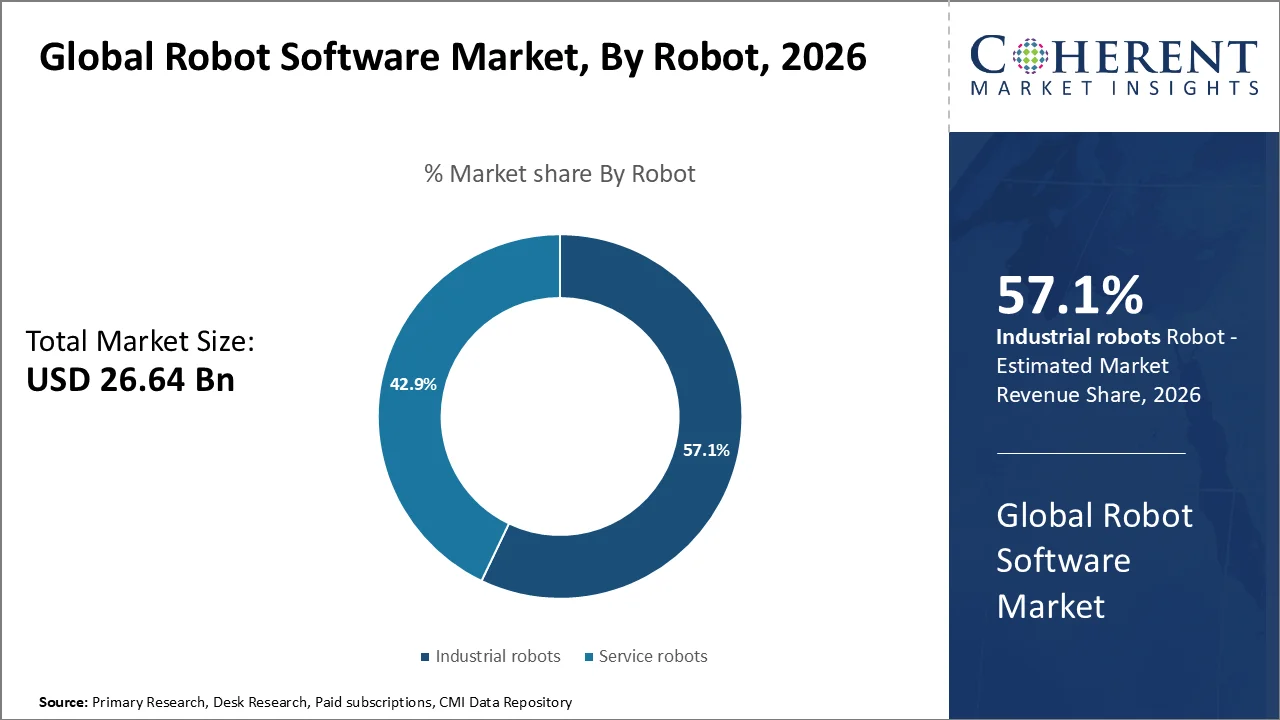
On the basis of robot type, the industrial robots segment is likely to lead with approximately 57.1% in 2026. The segment’s growth is owing to the extensive requirement for robot programming, motion control, machine vision, digital simulation, work-cell coordination, safety monitoring, and integration with manufacturing execution systems.
The International Federation of Robotics expects annual industrial robot installations to increase by 6% to approximately 575,000 units, with global installations projected to exceed 700,000 units by 2028. The continuing expansion of the industrial robot base is increasing recurring demand for control software, analytics platforms, simulation tools, and software upgrades throughout the operational life of robotic systems.
In June 2025, ABB launched three new large industrial robots, the IRB 6730S, IRB 6750S, and IRB 6760, powered by its OmniCore robot-control platform. The launch expanded ABB’s next-generation industrial robot portfolio to 11 robot families with 60 variants, supporting applications such as automotive spot welding, die casting, injection moulding, press tending, and material handling.
Why is Data Management and Analysis Software Acquiring the Largest Share?
On the basis of software type, the data management and analysis software segment is set to dominate with approximately 34.5% in 2026. The segment’s growth is owing to the increasing volume of data generated by robot sensors, cameras, controllers, production equipment, and autonomous fleets. Organizations require these platforms to monitor performance, identify anomalies, optimize robot utilization, predict failures, and coordinate multiple robots across facilities.
A 2024 NIST report, citing a survey of more than 300 robotics professionals, noted that the average robot fleet included approximately 434 robots in manufacturing and 412 robots in warehouse and logistics operations. These fleets were around six times larger than fleets operating in other application areas, highlighting the growing requirement for scalable fleet-data collection, performance analysis, and centralized robot-management software.
In April 2026, Foxglove launched Data Search and Curation, a new capability within its robotics data platform that enables developers and operators to search, organize, and analyse multimodal robot data at petabyte scale.
Why are Large Enterprises Acquiring the Largest Share?
On the basis of organization size, the large enterprises segment is anticipated to lead with approximately 61.0% in 2026. The segment’s growth is owing to larger automation budgets, multi-facility operations, greater access to robotics engineers, established IT infrastructure, and the ability to deploy integrated AI, simulation, predictive-maintenance, and cybersecurity platforms.
According to Eurostat, 55.03% of large EU enterprises used AI technologies in 2025, compared with 30.36% of medium-sized enterprises and 17.0% of small enterprises. Large enterprises also recorded substantially higher AI usage in production processes, at 33.46%, compared with 19.02% among small enterprises. This technology-adoption gap supports the larger share of major organizations in advanced robot software deployment.
In February 2026, BMW Group announced the deployment of humanoid robots at its Leipzig manufacturing plant in Germany and established a new Center of Competence for Physical AI in Production to accelerate the integration of AI-enabled robotics across its global production network.
Why is Manufacturing Acquiring the Largest Share?
On the basis of vertical, the manufacturing segment is projected to dominate the robot software market with approximately 29.5% in 2026. The segment’s growth is owing to the widespread use of robot software in assembly, welding, painting, material handling, electronics production, machine tending, quality inspection, packaging, and predictive maintenance.
The International Federation of Robotics reported that global manufacturing robot density reached 177 robots per 10,000 employees in 2024. The increasing deployment of robots within manufacturing plants is leading to an increased need for software related to production control, machine vision, simulation, data analytics, and maintenance.
In July 2026, NVIDIA announced the availability of Cosmos 3 Edge, which is a newly developed physical-AI model that is meant to empower robots and industrial vision systems with the ability to perceive their environments, think in real-time, and act locally.
Robot Software Market Trends
- The use of artificial intelligence, machine learning, and generative AI is making it possible for robots to understand their environment, identify objects, move efficiently, and make decisions on their own. According to the 2025 smart manufacturing survey done by Rockwell Automation, 95% of manufacturers have already or plan to invest in AI, machine learning, generative AI, and causal AI within the next five years.
- The growing adoption of open-source and interoperable robotics platforms is reducing software-development time and enabling integration across robots, sensors, cameras, and control systems from different manufacturers. In May 2025, Open Robotics released ROS 2 Kilted Kaiju, the eleventh ROS 2 distribution, following nearly 550 public-beta test cases; the release introduced improvements to robot-data recording, image transport, system configuration, and multi-platform deployment.
- The rapid scaling of warehouse and logistics robot fleets is increasing demand for centralized fleet management, task allocation, route optimization, equipment monitoring, and real-time data-analysis software. In May 2025, DHL announced plans to deploy more than 1,000 additional robots and reported that its global network already used over 7,500 robots, approximately 800,000 IoT sensors, and automation or digitalization solutions in more than 90% of its warehouses.
Regional Insights
Asia-Pacific Dominates Owing to Its Large Robotics Manufacturing and Automation Ecosystem
The Asia-Pacific region accounts for an estimated 43.5% of the global robot software market in 2026. The region’s growth is owing to its large industrial robot installed base, strong electronics and automotive manufacturing sectors, rising investment in physical AI, and extensive presence of robot manufacturers across China, Japan, South Korea, and other Asian economies.
According to the International Federation of Robotics’ World Robotics 2025 report, South Korea recorded the world’s highest robot density in 2024, with 1,220 industrial robots per 10,000 manufacturing employees.
In March 2026, South Korea-based Samsung Electronics announced plans to transform all its manufacturing operations into AI-Driven Factories by 2030. The company will introduce digital-twin simulations across manufacturing processes and deploy specialized AI agents for production, quality control, predictive maintenance, equipment repair, and logistics coordination.
North America Robot Software Market Trends
North America is expected to witness the fastest growth in the robot software market during 2026–2033. The region’s growth is owing to the widening adoption of robots beyond automotive manufacturing, expansion of collaborative automation, increasing reshoring of production, and growing investment in robotics across life sciences, electronics, food processing, logistics, and general manufacturing.
According to the Association for Advancing Automation, North American companies ordered 36,766 robots valued at USD 2.25 billion in 2025. Robot orders increased by 6.6% in units, while order revenue rose by 10.1% compared with 2024. Collaborative robots represented 19.6% of all robots ordered during the year, showing increasing demand for flexible and software-intensive automation systems.
In March 2025, Wandelbots presented its NOVA robot operating system in the U.S. for the first time at ProMat 2025 in Chicago. NOVA enables manufacturers and logistics companies to program and control robots from multiple manufacturers through a common software platform, reducing dependence on proprietary robot-specific programming environments.
Federal AI Investment and Advanced Manufacturing Programs Are Accelerating the Robot Software Market in the United States
The U.S. robot software market is witnessing strong growth owing to federal support for artificial intelligence, advanced robotics, autonomous manufacturing, and digital production systems. The country’s established technology ecosystem is supporting the development of robot-control, machine-vision, digital-twin, predictive-maintenance, and human–robot collaboration software.
In October 2025, the Advanced Robotics for Manufacturing Institute, which is funded through the U.S. Department of Defense’s Manufacturing USA network, announced the AI-FORM project call with approximately USD 6 million in planned funding. The program focuses on developing an autonomous robotic forging system that combines AI, robot control, sensing, and adaptive manufacturing software. The initiative supports the commercialization of software-defined robotic systems across defense and commercial manufacturing.
Government Support for Embodied Intelligence Is Strengthening China’s Robot Software Market
The China robot software market is expected to record strong growth owing to national support for embodied intelligence, expansion of humanoid robotics, increasing integration of AI models with physical machines, and rising deployment of intelligent robots across manufacturing, logistics, healthcare, and service applications.
China’s 2025 Government Work Report identified embodied intelligence as a future industry to be developed under the country’s emerging-industry investment framework. Embodied intelligence combines perception, reasoning, motion planning, and real-world interaction, increasing demand for robot operating systems, recognition software, control algorithms, simulation platforms, and AI-based decision-making tools.
In November 2025, China’s National Development and Reform Commission reported that the country had more than 150 humanoid robot companies, with over half comprising start-ups or companies entering from adjacent industries.
Who are the Major Companies in Robot Software Industry
Some of the major key players in Robot Software Market are ABB Robotics, AIBrain, Brain Corporation, CloudMinds Technologies, Energid Technologies, Furhat Robotics, IBM Corporation, Liquid Robotics, Neurala Brain Inc., and Oxbotica Inc.
Key News
- In September 2025, Brain Corp and Driveline Retail launched ShelfOptix, a fully managed robot-powered shelf-intelligence service. The solution uses mobile robots to collect shelf-level information related to out-of-stock products, pricing, planogram compliance, and inventory accuracy.
Market Report Scope
Robot Software Market Report Coverage
| Report Coverage | Details | ||
|---|---|---|---|
| Base Year: | 2025 | Market Size in 2026: | USD 26.64 Bn |
| Historical Data for: | 2020 To 2024 | Forecast Period: | 2026 To 2033 |
| Forecast Period 2026 to 2033 CAGR: | 14.8% | 2033 Value Projection: | USD 70.04 Bn |
| Geographies covered: |
| ||
| Segments covered: |
| ||
| Companies covered: | ABB Robotics, AIBrain, Brain Corporation, CloudMinds Technologies, Energid Technologies, Furhat Robotics, IBM Corporation, Liquid Robotics, Neurala Brain Inc., and Oxbotica Inc | ||
| Growth Drivers: |
| ||
| Restraints & Challenges: |
| ||
Analyst Opinion
- The robot software market is shifting from conventional rule-based programming toward AI-native and software-defined robotics. This transition will increase demand for vision-language-action models, autonomous task planning, simulation, and edge inference. In February 2025, the European Commission launched InvestAI, targeting EUR 200 billion in AI investment, including a EUR 20 billion fund for AI gigafactories. Each planned gigafactory is expected to contain approximately 100,000 advanced AI chips, expanding the computing infrastructure available for complex industrial and physical-AI models.
- Interoperability and multi-robot coordination will become major competitive factors as organizations deploy robots from different manufacturers within the same facility. NIST states that robot integration remains difficult and expensive because robots cannot always communicate easily with sensors, devices, mobility platforms, and manipulation systems. Its robotic-systems program is therefore developing information models, protocols, reference software, and test tools for interoperable robotic systems. Separately, the EU allocated EUR 30 million to its 2025 Pathfinder Challenge for autonomous robot collectives, which received 92 proposals, demonstrating strong development activity in collaborative multi-robot software.
- Updated safety standards will favour robot software providers that can demonstrate reliable motion control, risk management, human oversight, and system-level validation. ISO published the third edition of ISO 10218-1:2025 for industrial-robot safety and the second edition of ISO 10218-2:2025 for industrial robot applications and cells. These updated standards will encourage manufacturers and integrators to strengthen safety logic, monitoring, documentation, testing, and compliance capabilities within robot-control software.
Speak to the analyst
Want personalized insights?
Take the findings above to one of our principal consultants, or have the report rebuilt around the segments, geographies and competitors you actually track.
Market Segmentation
- By Deployment Model (Revenue, USD Bn, 2021-2033)
- On-premises
- On-demand
- By Robot (Revenue, USD Bn, 2021-2033)
- Industrial robots
- Service robots
- By Software Type (Revenue, USD Bn, 2021-2033)
- Recognition software
- Simulation software
- Predictive maintenance software
- Data management and analysis software
- Communication management software
- By Organization Size (Revenue, USD Bn, 2021-2033)
- Small Enterprises
- Medium Enterprises
- Large Enterprises (SMEs)
- By Vertical (Revenue, USD Bn, 2021-2033)
- Banking, Financial Services, and Insurance (BFSI)
- Retail
- Government and Defense
- Healthcare and Life Sciences
- Transportation and Logistics
- Manufacturing
- Telecommunications and IT
- Others
- Global Robot Software Market , By Region (Revenue, USD Bn, 2021-2033)
- North America
- U.S.
- Canada
- Latin America
- Brazil
- Mexico
- Argentina
- Rest of Latin America
- Europe
- Germany
- U.K.
- France
- Italy
- Spain
- Russia
- Rest of Europe
- Asia Pacific
- China
- India
- Japan
- Australia
- South Korea
- ASEAN
- Rest of Asia Pacific
- Middle East
- GCC
- Israel
- Rest of Middle East
- Africa
- South Africa
- Central Africa
- North Africa
- North America
Sources
Primary Research Interviews
- Robot software developers and solution architects
- Industrial and service robot manufacturers
- Robotics system integrators
- AI, machine learning, and computer-vision experts
- Robot simulation and digital-twin software providers
- Manufacturing, logistics, healthcare, and retail automation managers
- Key opinion leaders in robotics, automation, and physical AI
Databases
- World Bank
- Organisation for Economic Co-operation and Development (OECD)
- Eurostat
- National Science Foundation (NSF)
- European Commission – CORDIS Research Database
- National Institute of Standards and Technology (NIST)
Magazines
- The Robot Report
- Robotics 24/7
- IEEE Spectrum
- Automation World
- Design World
Journals
- IEEE Transactions on Robotics
- IEEE Robotics and Automation Letters
- The International Journal of Robotics Research
- Robotics and Autonomous Systems
- Robotics and Computer-Integrated Manufacturing
- Journal of Intelligent & Robotic Systems
Newspapers
- The New York Times
- The Guardian
- The Wall Street Journal
- Financial Times
- The Economic Times
Associations
- International Federation of Robotics (IFR)
- Association for Advancing Automation (A3)
- IEEE Robotics and Automation Society
- euRobotics
- Open Robotics
- ARM Institute
Public Domain Sources
- Company Annual Reports and Investor Presentations
- Company Press Releases and Robot Software Product Announcements
- Government Robotics, AI, and Advanced Manufacturing Publications
- University Robotics Research and Technology Transfer Reports
- Patent Databases such as WIPO, USPTO, and Google Patents
- Publicly Available Robotics and Automation Project Reports
- ISO, IEC, IEEE, and NIST Robotics Standards
- Regulatory and Cybersecurity Publications Related to AI-Enabled Robots
Proprietary Elements
- CMI Data Analytics Tool
- Proprietary CMI Existing Repository of Information for the Last 10 Years
Get access to 250+ pages report
Every segment, forecast, competitor profile and data table behind the analysis above — available for instant download.
- ESOMAR Member
- ISO 9001:2015 Certified
- D-U-N-S Registered
- GDPR & CCPA Compliant
Missing comfort of reading report in your local language? Find your preferred language:
Transform your Strategy with Exclusive Trending Reports
Frequently Asked Questions
The Robot Software Market is expected to reach approximately USD 70.04 Bn by 2033, increasing from USD 26.64 Bn in 2026.
Major players operating in the global Robot Software Market include ABB Robotics, AIBrain, Brain Corporation, CloudMinds Technologies, Energid Technologies, Furhat Robotics, IBM Corporation, Liquid Robotics, Neurala Brain Inc., and Oxbotica Inc
The major factors hampering market growth include high initial investment and integration costs, complex integration with legacy systems, cybersecurity risks, limited interoperability between robot brands, shortage of skilled robotics professionals, and high software maintenance costs.
The market is primarily driven by the increasing adoption of industrial and service robots, rising integration of AI and machine learning, growing warehouse and manufacturing automation, and wider deployment of robots across healthcare, logistics, retail, and other commercial applications.
The Robot Software Market is anticipated to grow at a CAGR of approximately 14.8% between 2026 and 2033.
Asia-Pacific is expected to dominate the global Robot Software Market, accounting for an estimated 43.5% share in 2026. The region’s leadership is supported by its large robotics manufacturing base, high industrial automation penetration, and strong automotive and electronics industries.
North America is expected to witness the fastest growth during 2026–2033, supported by expanding collaborative robot adoption, manufacturing reshoring, warehouse automation, and investments in AI-enabled robotics.