

Vehicle Tracking System Market Size and Trends : 2026 to 2033
The global vehicle tracking system market is estimated to be valued at USD 14.84 Bn in 2026 and is expected to reach USD 33.89 Bn in 2033, exhibiting a compound annual growth rate (CAGR) of 12.5% from 2026 to 2033.
Key Takeaways
- By vehicle type, the passenger vehicles segment is likely to dominate the market and account for 44.2% share in 2026, owing to the increasing adoption of connected cars, rising demand from consumers for safety features, and escalating use of telematics-based insurance solutions.
- Based on end use, transportation & logistics is expected to represent a share of 52.7% in 2026 due to rapid growth in e-commerce, enhanced fleet digitalization, and the need for real-time visibility to enhance delivery performance and reduce operational costs.
- Based on technology type, the GPS/satellite segment is anticipated to dominate the market in 2026 owing to its high degree of accuracy, global coverage, and due to being highly needed for continuous tracking, route optimization, and remote fleet monitoring.
- By type, active continues to dominate at 78.3% in 2026 due to the growing usage by enterprises of real-time data transmission, live alerts, and telematics analytics for enhanced fleet performance and safety.
- By component type, the hardware segment accounted for the largest share of 59.2% of the market in 2026 due to the continuous developments made in the GPS modules, IoT-enabled trackers, OBD devices, and compact plug-and-play telematics solutions.
- Based on Region, North America is set to lead the global vehicle tracking system market with 33.3% share in 2025. While, Asia Pacific is anticipated to be the fastest growing region.
Market Overview
The rising demand for GPS-based technologies and increasing adoption of connected vehicles is driving the market growth. Similarly, government initiatives to promote eco-friendly transportation are also likely to fuel the market growth. These policies promote the use of electric and battery-powered vehicles and are a significant factor driving global demand for these systems. The growth of this market is also supported by the rapid expansion of the app-based transportation system, rise in vehicle leasing and rental activities, and concerns regarding safety of automobiles from theft.
Current Events and Its Impact on the Vehicle Tracking System Market
Current Events | Description and its impact |
Global Supply Chain Disruptions and Semiconductor Shortages |
|
Regulatory Changes and Data Privacy Legislation |
|
Role of AI (Artificial Intelligence) in Vehicle Tracking
Artificial intelligence enhances vehicle tracking systems by transforming raw location data into actionable insights. AI algorithms analyze GPS and sensor inputs in real time to optimize routes, predict delays, and monitor driver behavior. They detect patterns indicating risky driving, unauthorized vehicle use, or potential mechanical issues, enabling faster intervention. AI-powered video telematics can also identify distractions or fatigue, improving overall safety.
In October 2025, Netradyne introduced its Driver•i D-450 video safety platform and a new Driver Monitoring System (DMS) sensor in India. The four-camera D-450 uses AI to record and analyze driving behavior, identifying risks, distractions, and fatigue in real time. The in-cabin DMS sensor enhances the system by tracking eye movements to spot early drowsiness and deliver timely warnings.
- Current Industry Events of 2026
- Market Size Estimation
- Regional Breakdown
- Competitive Landscape
- Customer Intelligence
- Segmental Analysis
- Pricing Analysis
- Key Market Drivers, Challenges & Future Trends
- Customized Insights Section
Segmental Insights
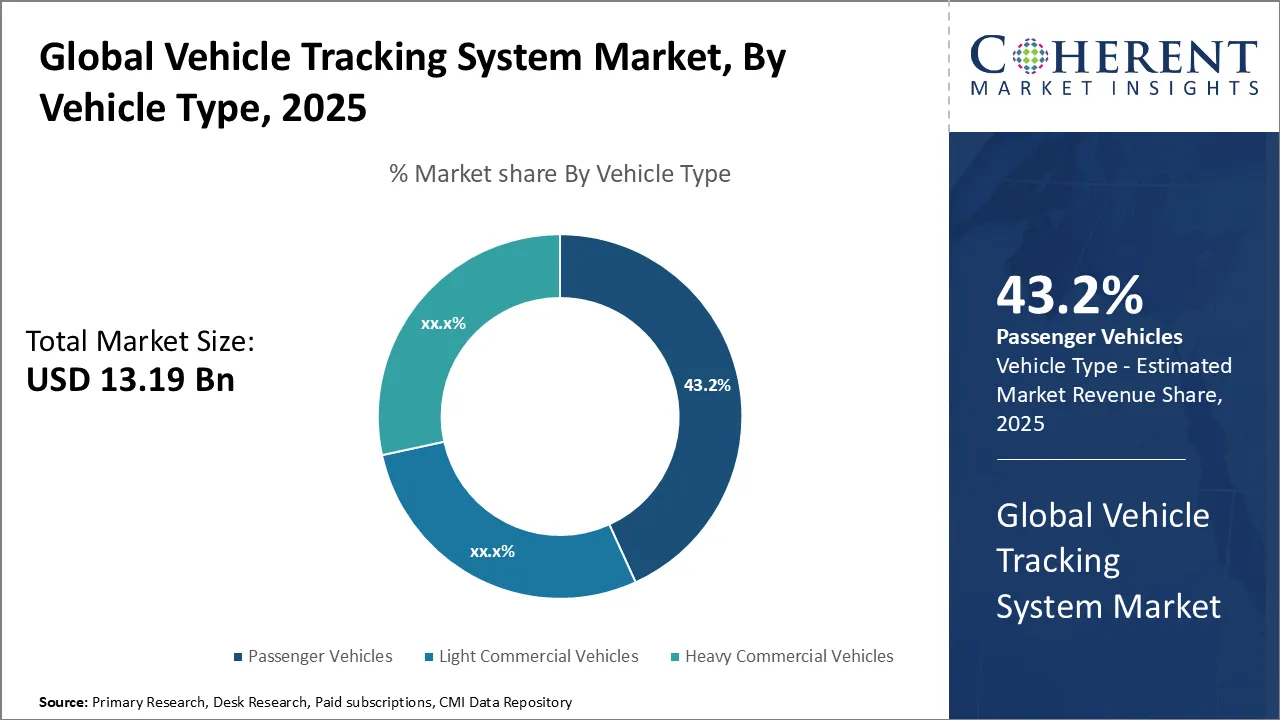
Vehicle Tracking System Market Insights, By Vehicle Type: Passenger Vehicles Lead Due To Widespread Adoption Across Personal and Commercial Use
In terms of vehicle type, the Passenger Vehicles segment contributes 44.2% of the market share in 2026. Passenger vehicles dominate because of their sheer volume globally and increasing demand for personal and shared mobility solutions. Tracking systems are widely deployed for passenger vehicles for theft prevention, insurance monitoring, and fleet management for ride-sharing platforms.
The trackers for modern passenger vehicles are designed with a state-of-the-art integration of telematics, IoT sensors, and mobile applications that enable users to receive data remotely, assisting them in maintaining vehicle health, driver behavior, and fuel efficiency. This increases the value for customers, but on the other hand, such systems are also increasingly required by insurance and regulatory entities in many jurisdictions.
For instance, in September 2025, MMVD announced that about 95,000 passenger vehicles in Maharashtra (India) have been fitted with mandatory GPS-enabled “Vehicle Location Tracking Devices (VLTDs)”, including real-time monitoring and onboard SOS alert functionality.
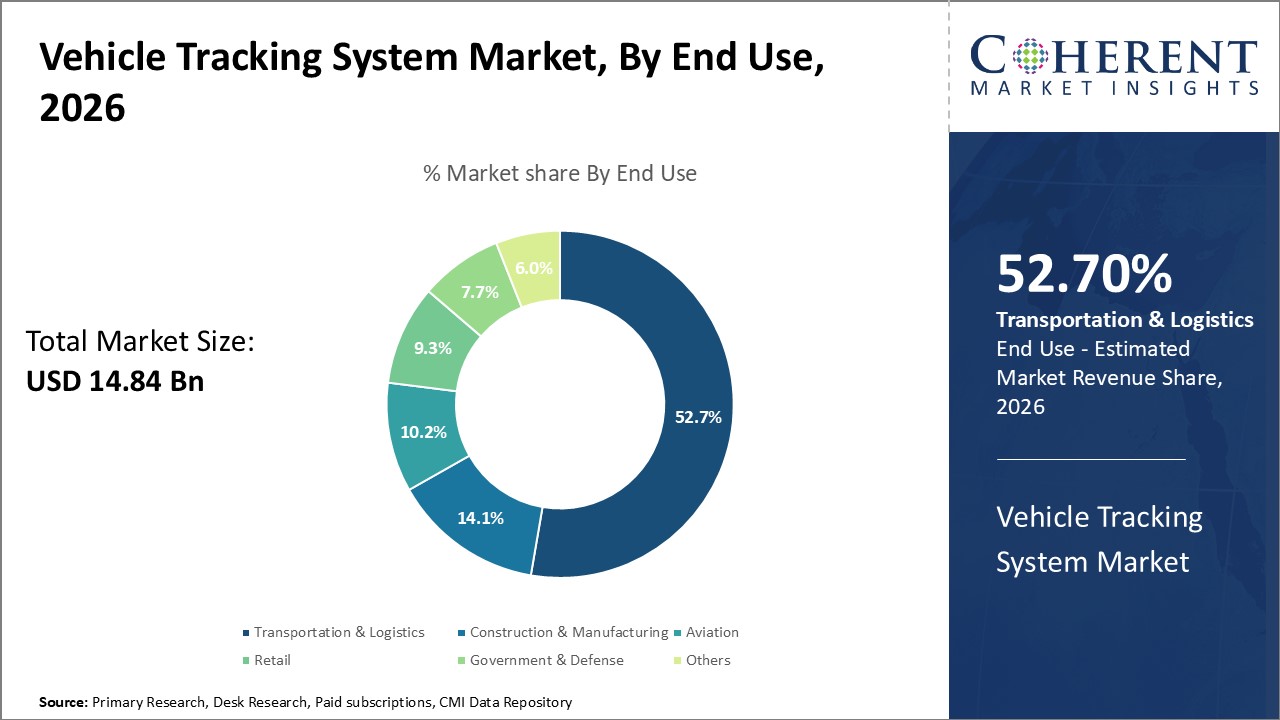
Vehicle Tracking System Market Insights, By End Use: Transportation & Logistics Segment Dominates Due To Fleet Optimization and Delivery Efficiency
By end use, the Transportation & Logistics segment contributes 52.7% of the market share in 2026, while vehicle tracking systems are being increasingly adopted for improving route efficiency, monitoring driver performance, and decreasing operational costs by fleet operators, shipping companies, and delivery services.
Real-time tracking by the logistics manager enables them to optimize routes, manage fuel consumption, and facilitate on-time delivery. In addition, the tracking data support regulatory compliance, load management, and predictive maintenance that minimize downtime and operational disruption.
For instance, in February 2025, at Tech & Telco Summit 2025, TransTRACK introduced an IoT-based fleet monitoring solution, which had the potential to provide real-time GPS tracking, route optimization, predictive maintenance, and driver behavior monitoring.
Vehicle Tracking System Market Insights, By Technology Type: GPS/Satellite Segment Leads Due To Accuracy and Global Coverage
In terms of technology type, the GPS/Satellite segment holds the largest market share in 2026. GPS-based systems provide high accuracy, global coverage, and reliability, making them the preferred choice for tracking both commercial and passenger vehicles.
These systems facilitate real-time location, speed monitoring, and geofencing of vehicles. Along with cloud analytics and mobile dashboards, GPS tracking thus helps operators to monitor fleets remotely, analyze driver behavior, and prevent theft. Satellite-based tracking is considered important in regions with poor coverage of the cellular network, ensuring continuous monitoring across urban and remote areas.
For instance, in May of 2025, at the Conference of 5GAA in Paris, LG Electronics Company demonstrated a satellite-based connected-car solution using IoT-NTN (non-terrestrial/satellite) telematics.
Vehicle Tracking System Market Insights, By Type: Active Trackers Dominate Due To Real-Time Monitoring and Alerts
By type, Active trackers account for the largest share of 78.3% in 2026, while active tracking devices offer real-time communication with fleet managers or vehicle owners by providing location updates, instant alerts, and dynamic route management.
Active tracking solutions find broad applications in passenger, commercial, and government fleets where instant responses and continuous monitoring are highly essential. The integration of IoT sensors and telematics platforms further increases vehicle safety, fuel management, and driver behavior monitoring.
For instance, in August 2025, 3Dtracking’s device-integration announcement showing availability of new tracker devices for fleets.
Vehicle Tracking System Market Insights, By Component Type: Hardware Leads Due To Tracker Devices and OBD Integration
In terms of component type, Hardware (tracker/devices) holds 59.2% of the market share in 2026. Hardware devices, including GPS trackers, OBD devices, and advanced telematics units, form the backbone of vehicle tracking systems.
The hardware segment dominates due to the critical role of devices in capturing vehicle location, speed, diagnostics, and driver behavior. Modern trackers are compact, durable, and compatible with cloud platforms, supporting real-time fleet monitoring and predictive maintenance.
For instance, in April 2024, ATrack Technology Inc. introduced its new hardware, including the AK750 GEO/LEO AI Telematics Box, which supports satellite (GEO/LEO) connectivity + LTE fallback, meant for remote-connectivity vehicle/asset tracking.
Regional Insights
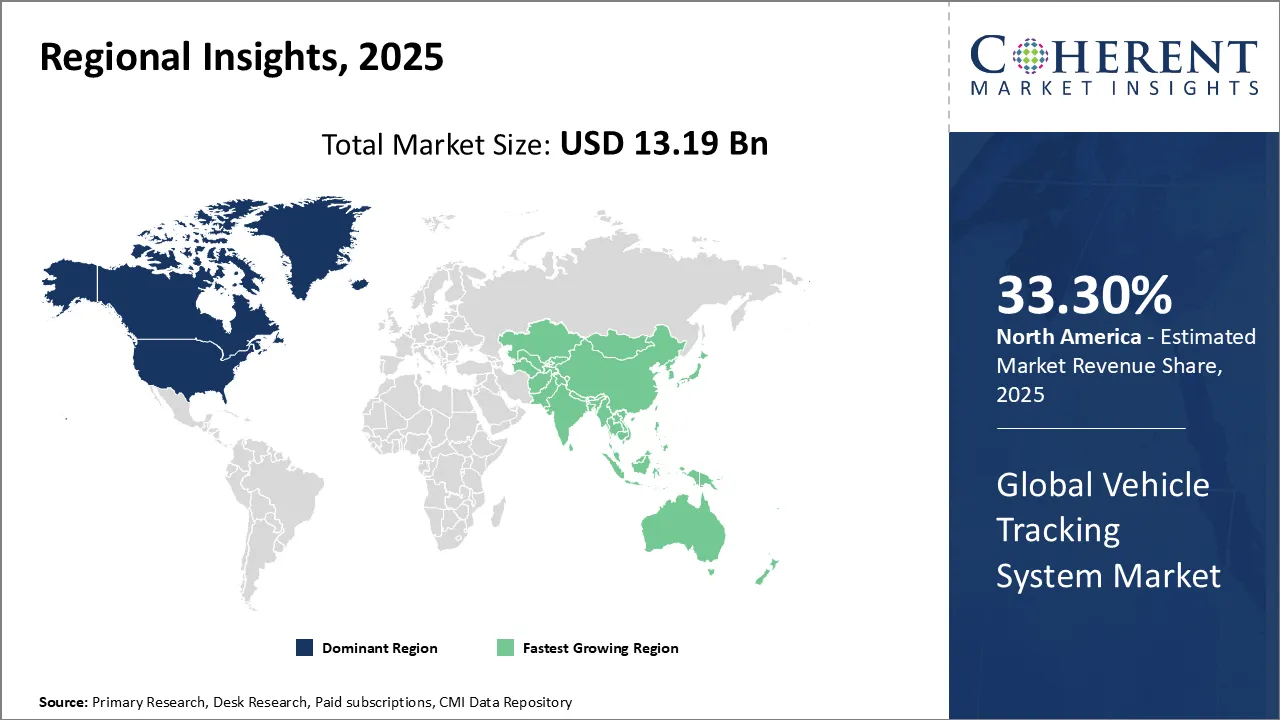
North America Vehicle Tracking System Market Analysis & Trends
North America continues to dominate the global vehicle tracking system market, holding a 33.3% share in 2026, driven by the region's advanced digital infrastructure, widespread telematics adoption, and strong presence of leading fleet-management and GPS-technology providers. The U.S. has emerged as a powerhouse for connected-vehicle technologies due to high demand from transportation & logistics companies, last-mile delivery service providers, and commercial fleet operators seeking real-time visibility and operational efficiency.
For instance, in August 2026, 3Dtracking announced expanded integration of newly released LTE/GNSS hardware trackers such as the GV50 series and ET300 devices, enhancing real-time fleet tracking and security for North American logistics operators.
Asia Pacific Vehicle Tracking System Market Analysis & Trends
Asia Pacific has established itself as the fastest-growing region within the global vehicle tracking system market, driven by an increase in commercial fleet expansions, rapid digitalization, and increased adoption of GPS-based and IoT-enabled vehicle tracking solutions across emerging economies. Countries like China, India, Indonesia, and Vietnam are experiencing solid growth in transport, logistics, ride-hailing, and e-commerce delivery services, thus driving up demand for sophisticated vehicle tracking hardware.
The growing demand for fleet safety, fuel optimization, and route efficiency has driven the widespread deployment of active trackers, OBD devices, and smart telematics units throughout regional logistics networks. Supported by government-backed investments in smart city programs and ITS, adoption is accelerating.
For instance, in May 2026, Arknav GPS launched its “iON-it Guardian Lite” vehicle-tracking device, a compact, hardware-based anti-theft and telematics unit, expanding availability of cost-efficient tracking solutions across Asian markets.
Vehicle Tracking System Market Outlook Country-Wise
U.S. Vehicle Tracking System Market Trends
The U.S. vehicle tracking system market is seeing rapid growth in 2026, driven by increasing adoption of connected vehicles, advanced telematics, and fleet management solutions. E-commerce expansion, together with urban congestion and demand for faster and more efficient deliveries, has prompted logistics and transportation companies to implement real-time GPS/GNSS tracking, AI route optimization, and predictive maintenance systems. Government regulations related to fleet safety, emissions, and ELDs further accelerate the implementation of hardware and cloud-based telematics solutions.
For example, in August 2026, Trucking Hub announced the launch of Dashcam One, referred to as “the industry’s first dashcam with built in ELD, real time telematics, diagnostics, and AI-powered safety” for trucking fleets.
China Vehicle Tracking System Market Trends
China’s vehicle tracking system market is witnessing strong growth in 2026, driven by the rapid expansion of commercial fleets, urbanization, and the increasing adoption of GPS and IoT-based vehicle tracking solutions. Government-backed smart city initiatives, rising e-commerce deliveries, and demand for fleet optimization are fueling adoption of active trackers, OBD devices, and cloud-based fleet monitoring systems.
Market Report Scope
Vehicle Tracking System Market Report Coverage
| Report Coverage | Details | ||
|---|---|---|---|
| Base Year: | 2025 | Market Size in 2026: | USD 14.84 Bn |
| Historical Data for: | 2020 To 2024 | Forecast Period: | 2026 To 2033 |
| Forecast Period 2026 to 2033 CAGR: | 12.5% | 2033 Value Projection: | USD 33.89 Bn |
| Geographies covered: |
| ||
| Segments covered: |
| ||
| Companies covered: | Trackimo Inc., Verizon, Laipac Technology Inc., Geotab Inc., Xirgo Technologies, Llc., Cartrack, Orbcomm Inc., Tomtom International B.V., Teltonika, and Calamp | ||
| Growth Drivers: |
| ||
| Restraints & Challenges: |
| ||
Vehicle Tracking System Market Drivers
Growing transportation and logistics industry to boost the market pace
The expansion of global transportation and logistics industry is increasing all over the world. The tracking fleet has become necessary for the security of vehicle and timely delivery, with the rise in fleet size of transportation and logistics companies. The sales of commercial vehicles are rapidly increasing all over the world, which further is creating demand for vehicle tracking systems for maintenance and fleet tracking operations.
Need for enhancement in operational efficiency to augment the market growth
The need for reduction in cost and enhancement in operational efficiency is increasing for achieving higher productivity along with profitability. A vehicle tracking systems offers services such as telematics, asset tracking, predictive fleet maintenance, and fleet route planning. With these services, the optimum use of resources and operational flexibility is facilitated. Moreover, use of these systems also enhances the customer experience and helps boost cost savings. Due to aforementioned factors, the demand for vehicle tracking systems is increasing all over the world, which in turn is expected to propel growth of the global vehicle tracking system market over the forecast period.
Vehicle Tracking System Market Opportunities
Emerging cloud computing is expected to bring growth opportunities in the global vehicle tracking system market during the forecast period. The adoption of connected vehicle tracking systems has increased, owing to enhanced connectivity services and proliferation of technology. The use of cloud computing has increased in recent years, as it offers software, computation, data, and storage access resources, without needing information of the vehicle owner. The vehicles come with GPS antenna and GSM-enabled device. The GSM-enabled device is connected to sensors to monitor necessary parameters such as fuel consumption, vehicle speed, vehicle location and others. Due to various benefits of cloud computing, its adoption across vehicles technologies is increasing, which in turn is likely to benefit the market in the coming years.
Analyst Opinion (Expert Opinion)
Digital integration, the proliferation of IoT devices, and regulatory controls for fleet safety and emissions performance are driving the vehicle tracking system market. Regional regulations, such as those by the European Union, which require telematics-based monitoring of commercial fleets, along with regulatory interest by the US Department of Transportation in driver behavior and accident prevention, further expedite the adoption of connected vehicle technologies.
Global logistics and e-commerce leaders such as DHL, FedEx, and JD Logistics, are already pushing for telematics adoption across their fleets to increase route optimization and reduce downtime, as well as improve asset security. In fact, passive GPS trackers are rapidly being replaced by active dual-mode devices that provide real-time vehicle data, driver behavior insights, and automated maintenance alerts.
In the end, commercial success in vehicle tracking will depend on the capability to provide actionable intelligence instead of mere location visibility. Vendors offering telematics innovation combined with AI-powered fleet analytics and cross-platform interoperability will achieve deeper enterprise penetration and regulatory alignment while defining the next competitive frontier of the global vehicle tracking system market.
Speak to the analyst
Want personalized insights?
Take the findings above to one of our principal consultants, or have the report rebuilt around the segments, geographies and competitors you actually track.
Vehicle Tracking System Industry News
- In October 2025, Geotab acquired Verizon Connect’s commercial telematics operations in Europe & Australia, significantly expanding its global footprint and strengthening its fleet‑management capabilities.
- In February, ORBCOMM joined Geotab’s “Order Now” program, meaning fleets can now directly purchase ORBCOMM smart trailer‑tracking devices (e.g. CT 1000, GT 1220, GT 1230) through the program, improving trailer visibility & asset tracking
- In June 2025, ORBCOMM also announced that one of its customers in the logistics sector, KLOG Transport Solutions, adopted its satellite‑enabled IoT tracking solution to improve cargo visibility especially where cellular coverage is poor.
Market Segmentation
- By Vehicle Type Insights (Revenue, USD Bn & KT, 2026 - 2033)
- Passenger Vehicles
- Light Commercial Vehicles
- Heavy Commercial Vehicles
- End Use Insights (Revenue, USD Bn & KT, 2026 - 2033)
- Transportation & Logistics
- Construction & Manufacturing
- Aviation
- Retail
- Government & Defense
- Others
- Technology Type Insights (Revenue, USD Bn & KT, 2026 - 2033)
- GPS/Satellite
- GPRS/Cellular Networks
- Dual Mode
- Type Insights (Revenue, USD Bn & KT, 2026 - 2033)
- Active
- Passive
- Component Type Insights (Revenue, USD Bn & KT, 2026 - 2033)
- Hardware
- OBD Device/tracker & advance tracker
- Standalone Tracker
- Software
- Performance Measurement
- Vehicle Diagnostics
- Fleet Analytics and Reporting
- Driver Behavior Monitoring
- Others
- Hardware
- Regional Insights (Revenue, USD Bn & KT, 2026 - 2033)
- North America
- U.S.
- Canada
- Latin America
- Brazil
- Argentina
- Mexico
- Rest of Latin America
- Europe
- Germany
- U.K.
- Spain
- France
- Italy
- Russia
- Rest of Europe
- Asia Pacific
- China
- India
- Japan
- Australia
- South Korea
- ASEAN
- Rest of Asia Pacific
- Middle East & Africa
- GCC Countries
- Israel
- Rest of Middle East & Africa
- North America
- Key Players Insights (Revenue, USD Bn, 2021 - 2033)
- Trackimo Inc.
- Verizon
- Laipac Technology Inc.
- Geotab Inc.
- Xirgo Technologies, Llc.
- Cartrack
- Orbcomm Inc.
- Tomtom International B.V.
- Teltonika
- Calamp
Sources
Primary Research Interviews from the following stakeholders
Stakeholders
- Interviews with fleet operators, telematics solution providers, GPS/GNSS hardware manufacturers, IoT device makers, logistics company heads, and government transport officials across major regional markets.
Specific stakeholders
- Fleet operations and R&D heads at global logistics and transportation companies (e.g., DHL, FedEx, DB Schenker)
- Procurement and telematics managers at e-commerce and delivery firms (e.g., Amazon, JD Logistics, UPS)
- Product development and innovation heads at vehicle tracking hardware companies (e.g., Geotab, ORBCOMM, Calamp)
- IoT and telematics engineers at software providers and SaaS platforms (e.g., Verizon Connect, TomTom Telematics)
- Fleet safety and compliance officers at government transport departments and regulatory authorities (e.g., U.S. DOT, European Union Mobility & Transport)
- Operations and procurement managers at commercial vehicle OEMs integrating tracking solutions (e.g., Ford, Daimler, Tata Motors)
- Data analytics and connected vehicle teams at insurance and mobility solution providers (e.g., Progressive, AXA, Mobility-as-a-Service platforms)
Databases
- United Nations Comtrade Database
- World Trade Organization (WTO) Trade Statistics
- Eurostat – Transport & Logistics Data
- U.S. Census Bureau – Vehicle & Transportation Data
- China Customs Statistics
- Directorate General of Commercial Intelligence and Statistics (DGCIS), India
- Japan External Trade Organization (JETRO) – Automotive & Telematics Statistics
- Korea Customs Service Data Portal
- U.S. Department of Transportation (DOT) – Vehicle Fleet & Safety Data
- Indian Ministry of Road Transport & Highways – Vehicle Registration & Telematics Data
Magazines
- Fleet Owner
- Telematics Wire
- GPS World
- Automotive Fleet
- Transport Topics
- Connected Fleets Magazine
- IoT for Transportation Insights
- Smart Mobility Magazine
- Logistics Management
- Vehicle Telematics News
Journals
- IEEE Transactions on Intelligent Transportation Systems
- Journal of Transportation Engineering (ASCE)
- Sensors (MDPI) – Vehicle IoT & Tracking Section
- International Journal of Automotive Technology
- Journal of Intelligent & Connected Vehicles
- Transportation Research Part C: Emerging Technologies
- Vehicle System Dynamics
- Journal of Transport Geography – Fleet Monitoring Section
Newspapers
- The Wall Street Journal – Automotive & Transport
- The Economic Times – Logistics & Fleet Management
- Financial Times – Transportation Technology
- Nikkei Asia – Automotive & Telematics
- The Hindu Business Line – Commercial Vehicles & Logistics
- South China Morning Post – Vehicle Technology & IoT
- Automotive News – Fleet & Telematics Reports
- The Guardian – Smart Mobility & Connected Vehicles
Associations
- International Association of Public Transport (UITP)
- Telematics Industry Association (TIA)
- European Telematics Forum (ETF)
- American Trucking Associations (ATA) – Telematics Committee
- Intelligent Transportation Society (ITS) of America
- Indian Logistics and Telematics Association (ILTA)
- Global Fleet Managers Association (GFMA)
- Connected Vehicle Trade Association (CVTA)
- Automotive IoT Alliance
- European Automobile Manufacturers Association (ACEA) – Connected Vehicle Section
Public Domain Sources
- U.S. Department of Transportation (DOT) – Intelligent Transportation Systems Reports
- European Union – Connected Vehicles & Telematics Policy Documents
- Ministry of Road Transport & Highways (India) – Fleet Monitoring & Telematics Guidelines
- National Highway Traffic Safety Administration (NHTSA) – Vehicle Safety & Telematics Reports
- Organisation for Economic Co-operation and Development (OECD) – Intelligent Transport Systems Reports
- United Nations Economic Commission for Europe (UNECE) – Vehicle Tracking & Telematics Recommendations
- Environment Protection Agency (EPA) – Commercial Vehicle Emissions & Fleet Data
- Transport for London (TfL) – Smart Fleet & Telematics Programs
- China Ministry of Transport – Vehicle Tracking & Smart Mobility Policies
- Japan Ministry of Land, Infrastructure, Transport and Tourism (MLIT) – Telematics & Connected Vehicle Guidelines
Proprietary Elements
- CMI Data Analytics Tool
- Proprietary CMI Existing Repository of information for last 8 years
Definition: A Vehicle Tracking System is an automated tracking solution that enables fleet management. It consists of a telematics device installed in a car or truck, communicating with a GPS satellite network. It collects and sends information about the vehicle's location, speed, and other data points.
Get access to 250+ pages report
Every segment, forecast, competitor profile and data table behind the analysis above — available for instant download.
- ESOMAR Member
- ISO 9001:2015 Certified
- D-U-N-S Registered
- GDPR & CCPA Compliant
Missing comfort of reading report in your local language? Find your preferred language:
Transform your Strategy with Exclusive Trending Reports
Frequently Asked Questions
The Vehicle Tracking System Market is estimated to be valued at USD 14.84 Bn in 2026, and is expected to reach USD 33.89 Bn by 2033.
The CAGR of the Vehicle Tracking System Market is projected to be 12.5% from 2026 to 2033.
Growing transportation and logistics industry and need for enhancement in operational efficiency are fuelling the market.
In terms of type, active is estimated to dominate the market revenue share in 2026.
High cost and complexity and growing adoption of hardware-agnostic tracking solutions are the major factors restraining growth of the market.
Trackimo Inc., Verizon, Laipac Technology Inc., Geotab Inc., Xirgo Technologies, Llc., Cartrack, Orbcomm Inc., Tomtom International B.V., Teltonika, and Calamp