

Cloud Backup & Recovery Software Market Size and Share Analysis - 2026 To 2033
The Cloud Backup & Recovery Software Market is anticipated to grow at a CAGR of 25.5% with USD 26,090.1 Mn share in 2026 and is expected to reach USD 37,040.0 Mn in 2033. The Cloud Backup and Recovery Software market is gaining demand as enterprises shift from simple storage backup to cyber-resilient recovery across cloud, SaaS, and hybrid workloads. For instance, in April 2026, the U.K. Department for Science, Innovation and Technology reported that 43% of businesses identified cyber breaches or attacks, while only 25% had formal incident response plans, strengthening demand for automated backup, immutable storage, and rapid restore tools. Furthermore, in February 2026, Veeam reported protecting over 25 Mn Microsoft 365 users, showing strong SaaS backup adoption. In March 2026, Commvault and NetApp announced a unified data-protection alliance for rapid recovery across cloud and on-premise environments.
Source: Veeam; GOV.UK; GOV.UK; Commvault
Key Takeaways
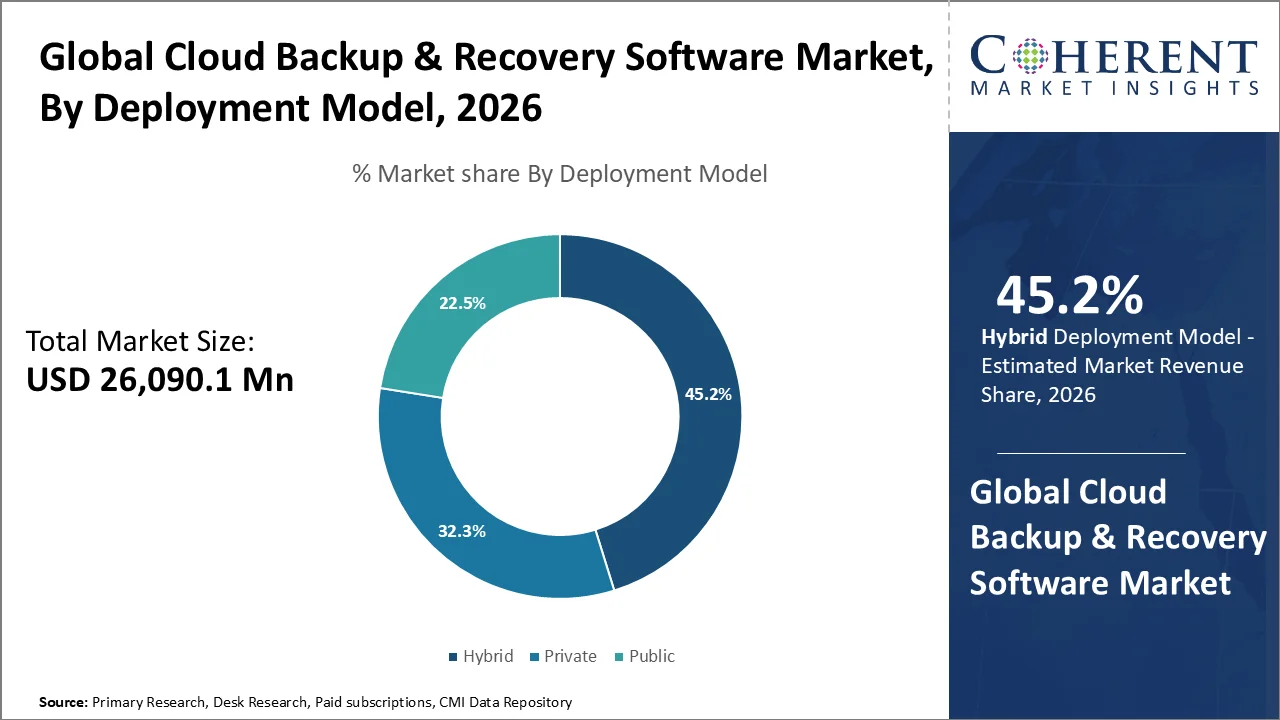
- Hybrid is expected to account the largest share of 45.2% in 2026, as enterprises need to protect both on-premise legacy systems and cloud workloads through one recovery model. In April 2026, the U.K. government reported that 43% of businesses identified cyber breaches or attacks, while only 25% had formal incident-response plans, increasing demand for hybrid backup, immutable copies, and faster recovery. In March 2026, NetApp and Commvault launched a unified cyber-resilience solution for rapid recovery across on-premise and cloud environments, showing strong vendor focus on hybrid protection. This makes hybrid deployment preferred for flexibility, compliance, and business continuity.
- Large enterprises will dominate with 68.4% in 2026, because they manage multi-cloud workloads, regulated data, complex SaaS estates, and high downtime exposure. In April 2026, the FBI reported over one Mn cybercrime complaints and over US$20 billion in losses, while Veeam found only 28% of ransomware victims fully restored data; AWS’s March 2026 air-gapped vault update reinforced stronger enterprise demand.
- BFSI hold the dominant share of 24.6% in 2026 because banks, insurers, and payment firms handle continuous transactions, regulated customer data, legacy core systems, and high ransomware-related downtime risk. In February 2026, BIS published guidelines for improving banks’ operational resilience, while Veeam reported in April 2026 that only 28% of ransomware victims fully recovered affected data, strengthening demand for immutable, tested recovery solutions across critical workloads.
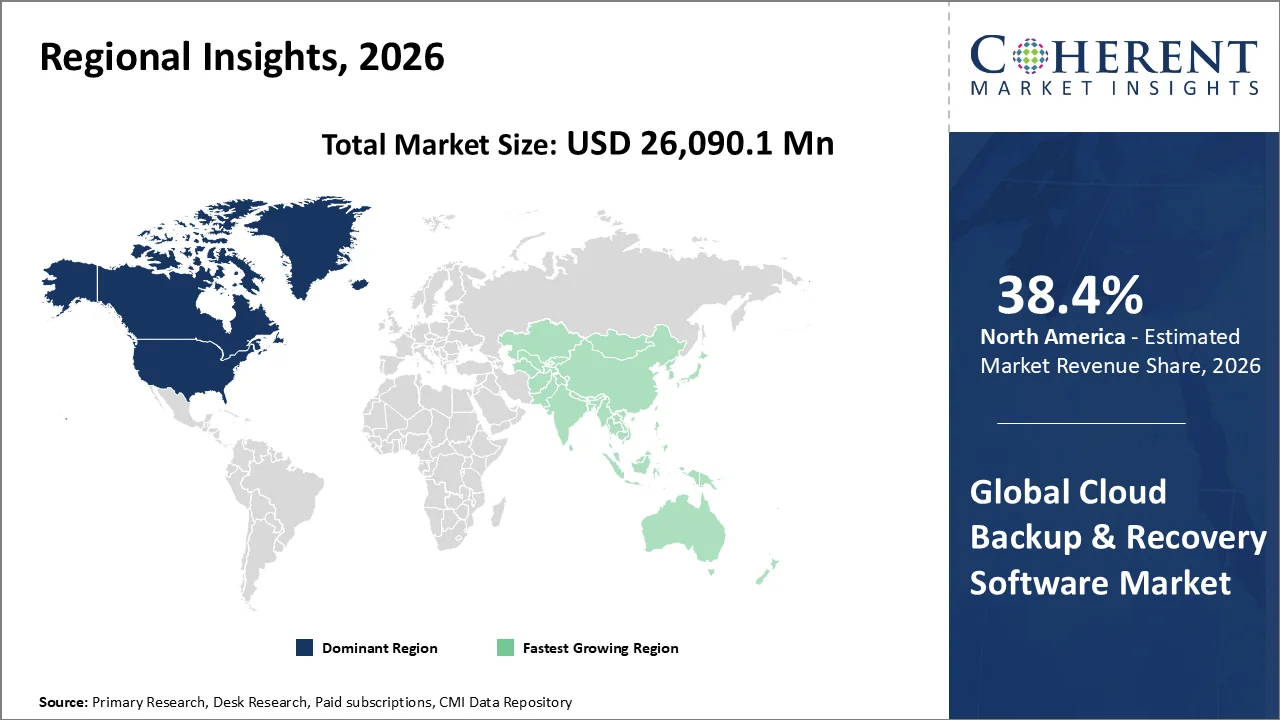
- North America is expected to acquire the dominant share of 38.4% in 2026, due to high cyber-risk exposure, mature cloud adoption, strict resilience needs, and strong vendor innovation. For instance, in April 2026, the FBI website reported cyber-enabled crimes defrauded Americans of nearly US$21 billion. Additionally, in May 2026, Microsoft Azure posted Azure Backup bulk-restore support for up to 100 VMs, strengthening enterprise recovery readiness at scale.
Segmental Insights
Why is Hybrid Acquiring the Largest Market Share?
Hybrid is projected to account for the largest share of cloud backup & recovery software market in 2026, representing approximately 45.2% of the total volume. Hybrid is acquiring the largest market share because enterprises cannot move every workload to the public cloud at once, yet they need cloud-speed recovery for ransomware, outages, compliance audits, and multi-site business continuity. It allows sensitive or latency-critical data to stay on-premise while secondary copies, disaster-recovery repositories, and archived workloads are protected in cloud environments. For instance, in April 2026, the U.K. government’s Cyber Security Breaches Survey reported that 43% of businesses identified cyber breaches or attacks, proving the need for recovery models that work beyond one environment. Furthermore, in March 2026, NetApp and Commvault announced a strategic alliance delivering resilience, security, and rapid recovery across on-premises and cloud environments, directly validating hybrid demand. Additionally, in May 2026, Microsoft Azure Backup introduced bulk restore for up to 100 Azure VMs in one operation, supporting large-scale recovery. Therefore, hybrid remains preferred because it balances control, scalability, regulatory comfort, ransomware resilience, and phased cloud migration.
- Current Industry Events of 2026
- Market Size Estimation
- Regional Breakdown
- Competitive Landscape
- Customer Intelligence
- Segmental Analysis
- Pricing Analysis
- Key Market Drivers, Challenges & Future Trends
- Customized Insights Section
Large Enterprises holds the Largest Market Share
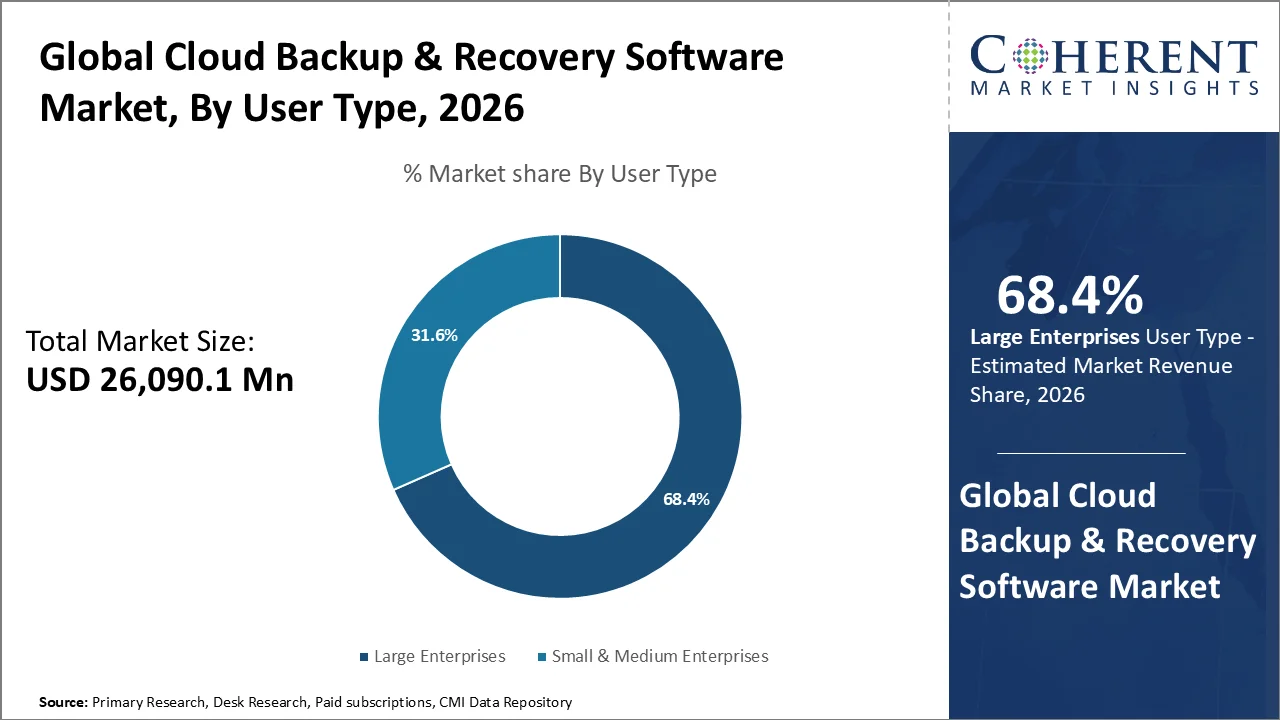
Based on user type, large enterprises dominate the market, accounting for a significant 68.4% share in 2026, because they operate wider hybrid IT estates, higher data volumes, regulated workloads, multi-region applications, and stricter recovery-time objectives than SMEs. For instance, in January 2026, Microsoft’s Azure Backup page, states that Azure Backup can protect on-premises resources, Azure VMs, SQL Server, SAP HANA, PostgreSQL, AKS, Azure Data Lake Storage, and other workloads, with centralized monitoring, long-term retention, ransomware protection, and pay-as-you-use storage, matching large-enterprise scale needs. Furthermore, in May 2026, IBM’s Cloud Backup and Recovery Service update, also highlighted enterprise-grade, policy-based, centralized, consumption-priced protection across VMs, cloud services, Kubernetes, and OpenShift, reducing backup infrastructure complexity across distributed IT environments. Additionally, in April 2026, Veeam’s findings, reported that only 28% of ransomware-affected organizations fully recovered all affected data, pushing large enterprises to invest first in resilient, automated cloud recovery platforms for continuity, audits, and compliance assurance.
Which Industry Vertical segment dominates the market?
BFSI account for the largest share of 24.6% in 2026 because banks, insurers, and payment firms manage sensitive financial records, real-time transactions, audit trails, and strict continuity requirements. BIS guidance published in February 2026 states that banks should maintain response and recovery plans for incidents affecting critical operations. Veeam’s April 2026 Data Trust and Resilience Report found that fewer than one in three ransomware victims fully recovered data, and affected organizations recovered only 72% of data on average. These risks push BFSI firms toward immutable backup, faster recovery testing, long-term retention, and cloud-based disaster recovery to protect regulated workloads and avoid customer, revenue, and compliance disruption.
Market Drivers
Growing demand for cloud-based services in various industry verticals
Increasing demand for cloud-based services in various industry verticals has driven the global cloud backup & recovery software market growth over the forecast period. Growing demand for cloud-based services across BFSI, healthcare, retail, manufacturing, and professional services drives the Cloud Backup & Recovery Software market because each new SaaS application, cloud database, virtual machine, and file-storage environment create additional data that must be protected outside the production system. For instance, in January 2026, Eurostat reported that 52.74% of EU enterprises used paid cloud computing services in 2025, with cloud e-mail at 85.15%, office software at 71.69%, and file storage at 71.53%, showing that daily business functions are increasingly cloud-hosted. Furthermore, in April 2026, the U.K. government reported that 43% of businesses identified cyber breaches or attacks, increasing the need for offsite backup, immutable copies, and faster recovery. Additionally, vendors are also expanding capacity: in May 2026, Microsoft Azure Backup added bulk restore for up to 100 virtual machines in one operation, supporting large-scale recovery for cloud workloads. Therefore, wider cloud adoption directly raises backup volume, compliance pressure, and recovery dependency, especially where downtime can disrupt transactions, care delivery, and supply chains.
Growing focus on reduction of IT expenditure
Growing focus on reduction of IT expenditure drives the cloud backup and recovery software market expansion because enterprises want to replace costly on-premise backup hardware, duplicate tools, manual administration, and disaster-recovery infrastructure with subscription-based, automated cloud protection. For instance, Microsoft stated in its February 2026 website update that Azure Backup and PaaS-native backup features remove the need for third-party backup software and infrastructure. Furthermore, in its March 2026 website update, Microsoft also noted that Azure Blob lifecycle management can automatically move data to cooler tiers or expire unused data, directly supporting lower storage costs as backup volumes grow. Additionally, in April 2026, Microsoft’s backup and recovery benchmark emphasized systematic backup operations, continuous monitoring, and regular recovery testing, reducing downtime and recovery effort. This cost pressure increases adoption because cloud backup allows pay-as-you-use storage, centralized policy management, lower maintenance staffing, faster restore testing, and reduced capital spending on secondary sites while supporting ransomware recovery and compliance retention.
Rising Intelligent Recovery Systems Are Transforming Cloud Backup Strategies
AI-driven resilience is redefining the Cloud Backup & Recovery Software Market as enterprises move from basic storage protection to intelligent, automated recovery. For instance, in April 2026, the FBI reported that cyber-enabled crime caused nearly US$21 billion in losses, highlighting why organizations need faster restore workflows and stronger ransomware protection. Furthermore, in April 2026, Veeam’s Data Trust and Resilience Report found that 90% of security leaders believed they could recover quickly, but only 28% fully restored data after ransomware attacks. Meanwhile, AWS’s March 2026 update added logically air-gapped vault support for Amazon EKS, enabling secure cross-account backup sharing and direct restore. These developments show that innovation is shifting toward AI-assisted anomaly detection, immutable backup, automated orchestration, clean recovery validation, and stronger compliance-ready resilience across complex, high-volume, business-critical data environments. This is especially important for hybrid cloud estates, SaaS applications, and regulated workloads where recovery speed, visibility, and data integrity directly shape continuity planning worldwide.
Current Events and Their Impact on the Cloud Backup & Recovery Software Market
Current Event | Description and its Impact |
Increasing Regulatory Shifts |
|
UK Cyber Security and Resilience Bill Expands Oversight to Data Centres and MSPs |
|
European Commission Proposes New Cybersecurity Resilience Package |
|
Horizon Europe Opens Cybersecurity Funding for AI and Secure Software |
|
EU Sovereign Cloud Procurement Creates Public-Sector Recovery Demand |
|
Cloud Backup & Recovery Software Market Trends
- Ransomware-ready recovery is replacing basic backup storage – Enterprises are shifting from “data backup” to validated cyber recovery because attackers increasingly target backup repositories. In April 2026, Veeam reported that nearly 3 in 10 organizations faced a cyber incident causing data loss, downtime, or business disruption, while only 28% of ransomware-affected organizations fully recovered all impacted data. This is driving demand for immutable backups, clean recovery points, recovery testing, and isolated recovery environments.
- SaaS backup and granular restore are becoming everyday IT needs – As enterprises rely more on Microsoft 365, Google Workspace, Salesforce, Jira, and identity platforms, SaaS backup is becoming a major trend. In March 2026, Keepit’s Annual Data Report found that 90% of restores are single-file downloads, showing that small, frequent recovery actions are more common than large disaster events. The same report stated that 9 in 10 enterprises have validated bulk recovery, showing stronger disaster-recovery maturity among large organizations.
- Air-gapped and immutable cloud recovery is becoming standard – Enterprises are adopting logically isolated backup vaults to reduce ransomware and insider-threat risk. In March 2026, AWS Backup added logically air-gapped vault support for Amazon EKS, allowing secure sharing of backups across AWS accounts and organizations, along with direct restore to reduce recovery time after a data-loss event. This shows how cloud-native backup is moving toward isolated, cross-account, faster-recovery architectures.
- Multi-cloud backup platforms are expanding through hyperscaler marketplaces – Backup vendors are integrating directly with major cloud platforms to protect AI-driven and cloud-first workloads. In April 2026, Commvault announced that Commvault Cloud would be available on Google Cloud, covering workloads such as BigQuery, Google Compute Engine, Google Kubernetes Engine, Cloud SQL, Gmail, and Google Drive. It also added threat scanning, air-gap protection, automated protection recommendations, and cloud data risk analysis.
- Identity recovery is emerging as a major backup-and-recovery trend – Enterprises are realizing that recovery can fail if identity systems such as Active Directory, Entra ID, or Okta are compromised. In March 2026, Rubrik announced a Microsoft Defender integration that connects real-time identity threat detection with automated identity rollback and recovery. Rubrik also cited Zero Labs research showing that 90% of IT and security leaders view identity-driven cyberattacks as a top concern.
Regional Insights
North America dominates owing to Strong Technological Infrastructure
North America account 38.4% market share in 2026, due to its high cloud adoption, strong enterprise cybersecurity spending, strict data-resilience requirements, and presence of major cloud and backup software providers such as Microsoft, Veeam, Commvault, and Veritas. For instance, in April 2026, the FBI reported that cyber-enabled crimes defrauded Americans of nearly USD 21 billion, increasing enterprise focus on ransomware recovery, immutable backup, and disaster recovery planning. Additionally, in May 2026, Microsoft Azure Backup introduced bulk restore for up to 100 Azure virtual machines in one operation, supporting large-scale enterprise recovery. These factors make North America the leading region for advanced cloud backup and recovery adoption.
Asia Pacific Cloud Backup & Recovery Software Market Trends
The Asia-Pacific region is poised to be as the fastest-growing region through 2026-2033, because enterprises and public agencies are expanding cloud workloads, digital services, and cyber resilience controls. For instance, in March 2026, India’s PIB stated that MeghRaj hosts applications for over 2,170 ministries and departments, while national data-centre capacity is about 1,280 MW and projected to expand 4–5 times by 2030, creating more backup demand for cloud-native workloads. Furthermore, in March 2026, AWS expanded Backup for RDS Multi-AZ clusters across Mumbai, Osaka, Seoul, Hong Kong, Jakarta, Hyderabad, Melbourne, and Malaysia, bringing lifecycle management and immutable backup closer to APAC users. Moreover, in April 2026, Veeam found 90% of security leaders were confident in recovery, but only 28% fully restored after ransomware, encouraging APAC firms to shift toward verified cyber recovery. Additionally, in May 2026, Singapore’s Government ICT&SS policy required separate, encrypted backups and recovery testing, reinforcing compliance-driven demand.
Strong Enterprise Cybersecurity Spending is Accelerating the Cloud Backup & Recovery Software Market Demand in United States
The U.S. cloud backup & recovery software market dominates North America because it has the region’s largest concentration of hyperscale cloud platforms, regulated enterprises, cybersecurity-driven IT spending, and early adoption of hybrid cloud disaster recovery. For instance, in January 2026, NIST’s Transit Cybersecurity Framework Community Profile stated that regular backup of operational systems, backup inventory tracking, reliability testing, and centralized backup procedures are essential for rapid recovery from cyber incidents and data loss. Furthermore, in April, 2026, Microsoft strengthened U.S.-led vendor capability by adding Azure Backup support for Elastic SAN, enabling managed backup and restore for cloud storage workloads.
China Cloud Backup & Recovery Software Market Trends
China has become the biggest player in the Asia Pacific cloud backup & recovery software market in 2026. China is dominant in the Asia-Pacific cloud backup and recovery software market because its enterprise digital base is larger, more regulated, and more cloud-native than most regional peers. For instance, in April 2026, China’s National Bureau of Statistics reported that information transmission, software, and IT services grew 10.6% year-on-year in Q1, while the March services production index for the same category increased 11.8%, showing strong demand for cloud-based IT resilience. China also has domestic hyperscalers offering advanced recovery features: Alibaba Cloud’s Cloud Backup documentation, updated in February 2026, highlights cross-region disaster recovery with RPO as low as one minute and RTO as low as 15 minutes. Huawei Cloud further supports enterprise adoption; its March 2026 CBR update introduced backup locking using WORM protection, preventing accidental or malicious backup deletion. The scale of online retail services and industrial automation also expands backup workloads across distributed applications. These capabilities, combined with data-security compliance, local hosting needs, strong BFSI, manufacturing, e-commerce, and public-sector digitization, make China the overall APAC leader.
Who are the Major Companies in Cloud Backup & Recovery Software Market
Some of the major key players in Cloud Backup & Recovery Software Market are Veritas Technologies Llc., Actifio Inc., Veeam Softwares, Commvault Systems Inc., Symantec Corporation, Ca Technologies, Microsoft Corporation, Dell Technologies Inc., Ibm Corporation, and Hewlett Packard Enterprise
Key News
- In January 2026, Acronis, a global cyber protection company launched Acronis Archival Storage, a long-term data protection solution integrated with Acronis Cyber Protect Cloud. The solution offers S3-compatible storage, encryption, immutability/WORM protection, predictable pricing, and compliance-ready retention for MSPs and SMBs. This strengthens the cloud backup and recovery software market by addressing rising demand for secure, low-cost, long-term backup storage for regulated industries.
- In January 2026, Druva, software company launched Threat Watch, a zero-touch, automated cloud-native solution that continuously scans backup snapshots to identify dormant threats and indicators of compromise. This development shows that cloud backup software is shifting from basic data restoration toward proactive cyber recovery, where clean recovery validation becomes a core enterprise requirement.
- In February 2026, Veeam, a company that provides data protection, backup, and recovery software introduced Agent Commander, a solution designed to detect AI risk, protect AI systems, and undo AI-related mistakes. The platform connects data resilience, data security, and AI governance, helping enterprises recover from AI-driven errors and data misuse. This reflects a major technology advancement in backup and recovery software as AI governance becomes linked with recoverable enterprise data.
- In March 2026, Commvault expanded its Identity Resilience portfolio to support Okta. The solution enables automated protection and granular point-in-time recovery of Okta users, groups, applications, policies, and configurations. This advancement expands cloud backup and recovery software beyond files and applications into identity infrastructure, which is becoming critical for post-attack business recovery.
- In April 2026, QNAP Systems, Inc. released HDP Recovery Media Creator, a disaster recovery software tool for Windows PCs and servers. The tool now supports ISO image files and USB recovery media, allowing administrators to restore systems from QNAP NAS backups even when machines fail to boot. This launch improves system-level disaster recovery for remote servers, virtualized environments, and endpoint backup scenarios.
Market Report Scope
Cloud Backup & Recovery Software Market Report Coverage
| Report Coverage | Details | ||
|---|---|---|---|
| Base Year: | 2025 | Market Size in 2026: | USD 26,090.1 Mn |
| Historical Data for: | 2020 To 2024 | Forecast Period: | 2026 To 2033 |
| Forecast Period 2026 to 2033 CAGR: | 25.5% | 2033 Value Projection: | USD 37,040.0 Mn |
| Geographies covered: |
| ||
| Segments covered: |
| ||
| Companies covered: | Veritas Technologies Llc., Actifio Inc., Veeam Softwares, Commvault Systems Inc., Symantec Corporation, Ca Technologies, Microsoft Corporation, Dell Technologies Inc., Ibm Corporation, and Hewlett Packard Enterprise | ||
Analyst Opinion
- The cloud backup and recovery software market has emerged as a critical component of enterprise IT strategies, driven by the need for secure, scalable, and cost-effective data protection solutions. As businesses face increasing threats from ransomware, natural disasters, and operational disruptions, investing in cloud-based backup solutions is no longer optional but essential. In 2026, global spending on cloud backup services is expected to reach USD 16.8 billion, a 35% increase from the previous year, highlighting the industry's rapid growth as enterprises prioritize business continuity and disaster recovery.
- The BFSI (Banking, Financial Services, and Insurance) sector is a major driver of cloud backup adoption due to the sector's strict regulatory compliance requirements and large volumes of sensitive data. With the rise in cyber-attacks, financial institutions are seeking more robust, automated cloud solutions for protecting their critical data. For instance, in February 2026, IBM reported that 75% of financial institutions in the U.S. have already adopted hybrid cloud solutions to ensure data security, regulatory compliance, and faster disaster recovery.
- North America remains the dominant region for cloud backup solutions, driven by technological advancements, high digital adoption, and increasing cybersecurity concerns. In April 2026, Veeam’s Data Trust and Resilience Report revealed that 72% of U.S.-based enterprises prioritize cloud backup solutions to prevent data loss, with an increasing demand for ransomware recovery capabilities. This shows that the U.S. market continues to lead, with substantial investments in cloud resilience solutions to support ongoing digital transformation efforts across industries.
Speak to the analyst
Want personalized insights?
Take the findings above to one of our principal consultants, or have the report rebuilt around the segments, geographies and competitors you actually track.
Market Segmentation
- By Deployment Model (Revenue, USD Mn, 2021-2033)
- Private
- Public
- Hybrid
- By User Type (Revenue, USD Mn, 2021-2033)
- Large Enterprises
- Small & Medium Enterprises
- By Industry Vertical (Revenue, USD Mn, 2021-2033)
- BFSI
- Government
- Healthcare
- Telecom & IT
- Retail
- Manufacturing
- Others
- By Region (Revenue, USD Mn, 2021-2033)
- North America
- U.S.
- Canada
- Latin America
- Brazil
- Mexico
- Argentina
- Rest of Latin America
- Europe
- Germany
- U.K.
- France
- Italy
- Spain
- Russia
- Rest of Europe
- Asia Pacific
- China
- India
- Japan
- Australia
- South Korea
- ASEAN
- Rest of Asia Pacific
- Middle East
- GCC
- Israel
- Rest of Middle East
- Africa
- South Africa
- Central Africa
- North Africa
- North America
Sources
Primary Research Interviews
- IT leaders, CIOs, and digital transformation managers on adoption challenges, integration, and cloud backup’s business impact.
- Cloud backup providers, software developers, and data experts on advancements in ransomware recovery and hybrid cloud.
- Analysts, consultants, and tech advisors on market trends, competition, and cloud backup’s role in continuity and compliance.
- Decision-makers in enterprises and public-sector organizations on investment factors, implementation challenges, and data privacy concerns.
Databases
- U.S. National Institute of Standards and Technology (NIST) Cybersecurity Framework
- European Commission Digital Strategy Database
- U.S. Department of Energy (DOE) Data Storage and Security Reports
- Gartner’s IT Infrastructure and Cloud Backup Market Research
- International Data Corporation (IDC) Cloud Market Database
Magazines
- Cloud Computing Magazine (published by TechTarget)
- Network World (Cloud section)
- InformationWeek (Cloud and Data Protection sections)
- Data Center Journal (Cloud Backup and Disaster Recovery sections)
- ComputerWeekly (Cloud Storage and Backup trends)
Journals
- Journal of Cloud Computing (Springer)
- International Journal of Cloud Computing and Services Science (IJCCSS)
- International Journal of Computer Applications in Technology (Cloud section)
- Journal of Data and Information Quality (Springer)
- Journal of Network and Computer Applications (Elsevier)
Newspapers
- The Wall Street Journal (Cloud Computing and IT Security Sections)
- The New York Times (Technology and Cloud Solutions Sections)
- Financial Times (Cloud Services and Digital Transformation)
- The Guardian (Technology and Data Security sections)
- The Washington Post (Cloud Backup and Security Coverage)
Associations
- Cloud Security Alliance (CSA)
- International Data Corporation (IDC)
- Uptime Institute (Cloud Infrastructure and Backup)
- Institute of Electrical and Electronics Engineers (IEEE) Cloud Computing Section
- The Open Group (Cloud Computing & Security Standards)
Public Domain Sources
- U.S. Government Cloud and Data Security Guidelines (NIST)
- European Commission Cloud Computing Policy Documents
- U.S. Federal Cloud Computing Strategy (GSA.gov)
- Cloud Computing Reports from the U.S. Department of Homeland Security (DHS)
- National Institute of Standards and Technology (NIST) Special Publications on Cloud Backup and Recovery
Proprietary Elements
- CMI Data Analytics Tool
- Proprietary CMI Existing Repository of information for last 10 years
Get access to 250+ pages report
Every segment, forecast, competitor profile and data table behind the analysis above — available for instant download.
- ESOMAR Member
- ISO 9001:2015 Certified
- D-U-N-S Registered
- GDPR & CCPA Compliant
Missing comfort of reading report in your local language? Find your preferred language:
Transform your Strategy with Exclusive Trending Reports
Frequently Asked Questions
The Cloud Backup & Recovery Software Market is expected to reach USD 37,040.0 Mn in 2033.
Major players operating in the global Cloud Backup & Recovery Software Market include Veritas Technologies Llc., Actifio Inc., Veeam Softwares, Commvault Systems Inc., Symantec Corporation, Ca Technologies, Microsoft Corporation, Dell Technologies Inc., Ibm Corporation, and Hewlett Packard Enterprise
Problems regarding storage management and securing backups and inactivity in data retrieval and interruptions are the major factors hampering the growth of the cloud backup & recovery software market.
Growing demand for cloud-based services in various industry verticals and growing focus on reduction of IT expenditure are the key factors driving the growth of the cloud backup & recovery software market.
The Cloud Backup & Recovery Software Market is anticipated to grow at a CAGR of 25.5% between 2026 and 2033.
Among regions, North America is expected to account for a largest market share in the global Cloud Backup & Recovery Software Market over the forecast period.
Cloud backup stores data in remote cloud infrastructure instead of only local servers or physical storage. It improves scalability, geographic redundancy, and disaster recovery flexibility. Unlike traditional backup, cloud backup supports automated scheduling, policy-based retention, encryption, deduplication, and faster recovery across distributed workloads, SaaS applications, virtual machines, endpoints, and databases.