

Video PaaS Market Trends & Growth – 2026 to 2033
Video PaaS Market is estimated to be valued at USD 404.3 Mn in 2026 and is expected to reach USD 607.9 Mn in 2033, exhibiting a compound annual growth rate (CAGR) of 6.0% from 2026 to 2033.
Key Takeaways
- By Deployment Type, the Public Cloud dominates 61% of the global share market due to its scalability, cost-effectiveness, and ease of integration for organizations of all sizes.
- By Application, Video Conferencing contributes a significant amount in the global market share, fuelled by ubiquitous enterprise uptake and the continued dominance of hybrid and remote work patterns.
- By End-Use, the Social, Media & Entertainment contributes a significant proportion to global share market owing to tremendous content consumption in platforms like YouTube, TikTok and others, live streaming apps.
- By Region, North America dominates by 33.4% of the Video PaaS market share, fuelled by early adoption of technology, strong digital infrastructure, high internet penetration, and the presence of leading global video platform providers like Zoom, Twilio, and YouTube (Google).
Market Overview
The Global Video Platform as a Service (PaaS) market has been experiencing robust growth and innovation in recent years, fuelled by the escalating demand for online video content and communication solutions. Video PaaS refers to cloud-based platforms that empower developers and businesses to effortlessly build, deploy, and manage video applications without the need for extensive infrastructure and specialized video processing expertise. Video PaaS solutions offer a range of features such as real-time video encoding, content delivery networks (CDNs), video analytics, live streaming capabilities, and multi-platform compatibility. The market finds applications in e-learning platforms, video conferencing solutions, OTT video streaming services, online gaming, social media platforms, and other domains requiring video content and communication.
Current Events and Its Impact
Current Events | Description and its impact |
Geopolitical Tensions Impacting Technology Trade |
|
Technological Advancements Driving Market Evolution |
|
Regional Market Acceleration and Regulatory Shifts |
|
Role of AI (Artificial Intelligence) in Video PaaS Market
Artificial Intelligence (AI) is increasingly becoming the driving force behind the evolution of the Video Platform as a Service (Video PaaS) market. It is not only enhancing the efficiency and scalability of video delivery but also enabling deeper user engagement, smarter content management, and more robust analytics. AI tools can identify anomalous activities, detect potential security breaches, and even predict and prevent fraud before it happens. This is crucial in protecting sensitive content, especially for industries like entertainment, e-commerce, and education. In April 2025, OrionVM, Blaize Holdings, Inc. and VSaaS.ai introduced a cutting-edge AI-powered video surveillance solution tailored for modern physical edge environments. This solution combines advanced cloud infrastructure, edge AI, and real-time video analytics to provide an effective and cost-efficient way to improve physical security and gain actionable business insights, all without the need for hardware upgrades.
- Current Industry Events of 2026
- Market Size Estimation
- Regional Breakdown
- Competitive Landscape
- Customer Intelligence
- Segmental Analysis
- Pricing Analysis
- Key Market Drivers, Challenges & Future Trends
- Customized Insights Section
Segmental Insights
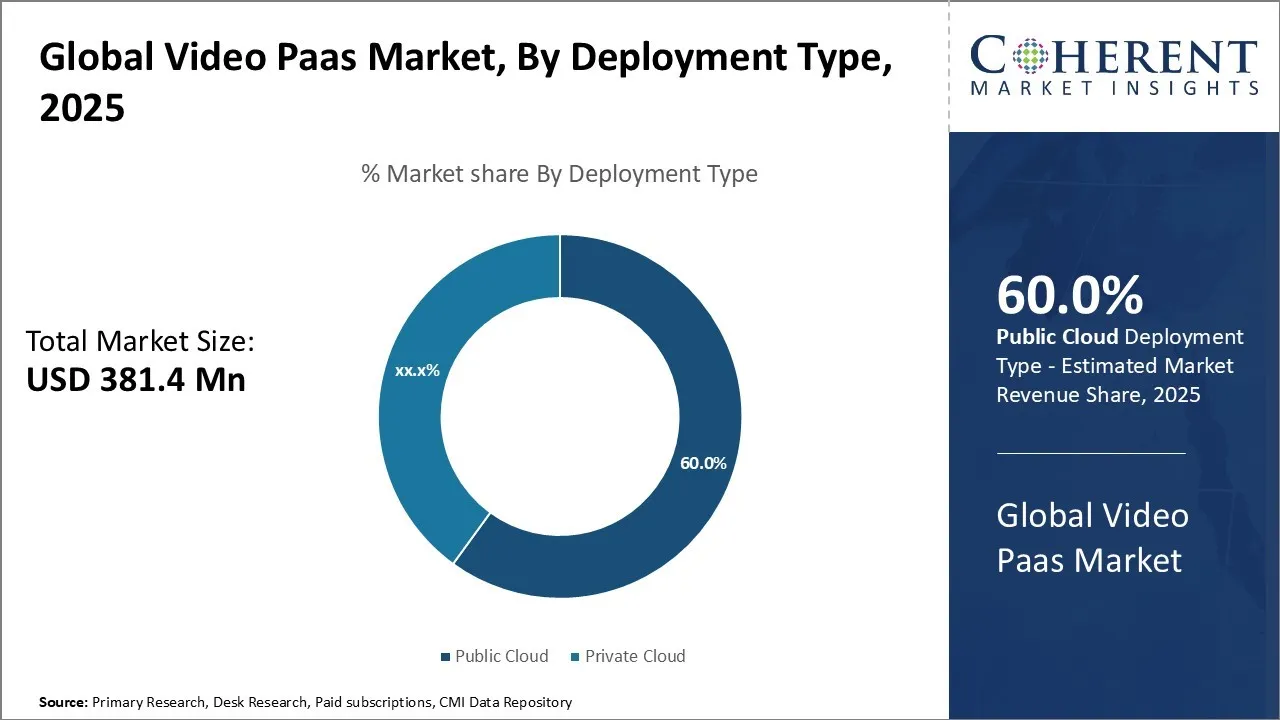
Video PaaS Market Insights, By Deployment Type: Fluctuating Needs in Organization is Driving the Public Cloud Segment’s Growth
Public Cloud dominates the overall market, acquiring a share of 61% of the overall market. Public cloud services provide scalability, flexibility, and cost savings, which make them suitable for companies with fluctuating needs. With this model, organizations can respond to traffic spikes and only pay for the resources consumed, without having to manage physical infrastructure. Private cloud solutions are being used more and more by organizations who need more data security and customizability. This model provides organizations more control over their infrastructure and data which fits in some list of compliance and security requirements. Private clouds offer enhanced security control and resource customisation, making them particularly appropriate for organizations that deal with sensitive video content, or are bound by strict data protection legislation.
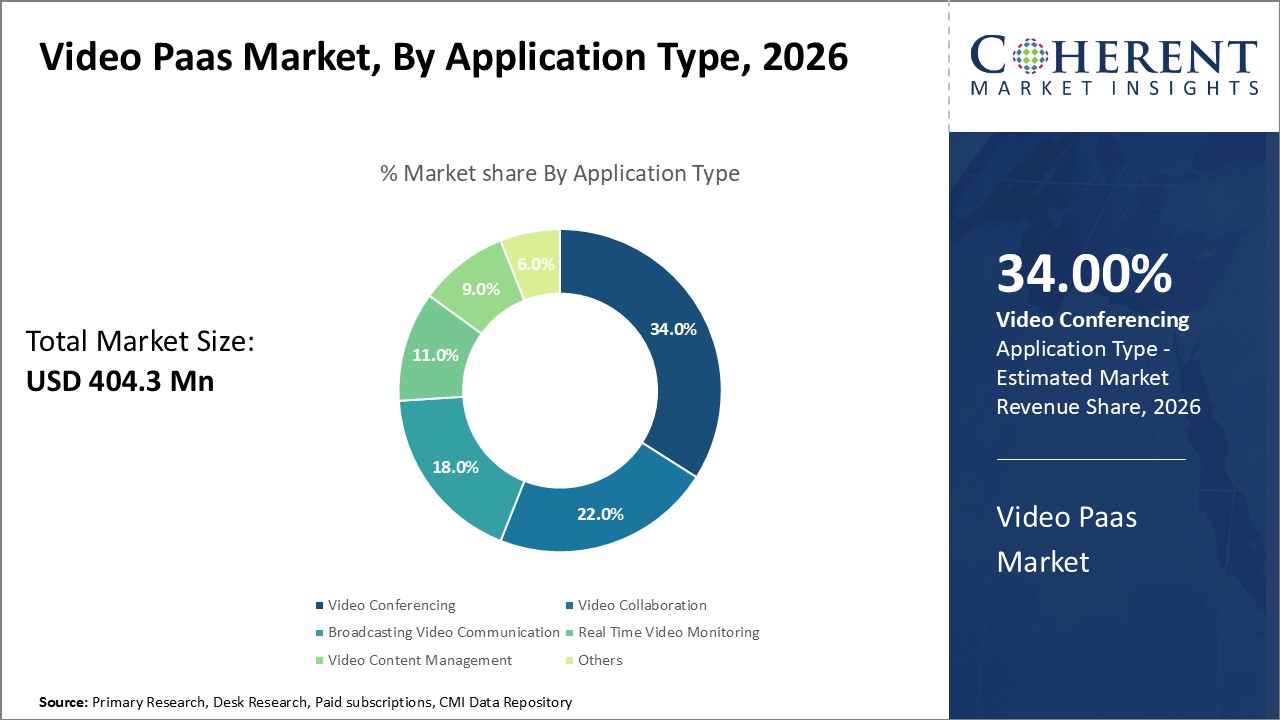
Video PaaS Market Insights, By Application Type: Rising Adoption of Hybrid Work Model is Propelling the Video Conferencing Segment Growth
Video conferencing is now essential in the modernization of meetings with the change in working models towards hybrid work, as organizations begin leaning on video conferencing to promote communication between remote teams. Through this shift, the style with which meetings are conducted has changed and advances in technology that deal with remote collaboration has been implemented to promote cooperation from a distance. Video driven collaboration technologies have become critical in areas such as education and telehealth, making it possible to interact with others face to face in real time. These applications support collaborative learning environments, and facilitate long-distance patient consults which improves access and productivity. There are developments on the way in Broadcasting Video Communication, such as the fact that those advancements are giving cameramen at the Premier League games the ability to record the celebrations of goals immediately. These developments are intended to make audience’s viewing experience better and to show how the most up-to-date video technologies can be applied in live sports broadcasting. Real-Time Monitoring of Video, there have been recent developments in the AI which has improved the capabilities of real time video monitoring and enable the use of automated surveillance and quick incident responses without any constant human intervention. This technology is receiving more acceptance by security and industrial organizations. Video Content Management, a video content management system (CMS) provides consolidated control over all video assets and includes customization, monetization, and holistic analysis. Unlike the mainstream web CMS platforms, this approach includes specific features related to managing and optimizing video-related content strategies. Furthermore, enterprises and developers use video PaaS platforms to improve internal communication, training of employees and overall engagement with the customers. This method favours the production of video-based applications, which are very specific to the specific needs of an organization.
Video PaaS Market Insights, By End Use Type: Rising Gen Z Population is Proliferating the Social, Media & Entertainment Segment Growth
Generation Z is profoundly transforming the social, media, and entertainment space, with their unique tastes driving content consumption patterns. One of the trends is their preference for social video and live streams over TV shows and films. A Deloitte survey pointed out that almost half of Gen Z respondents (48%) like watching social videos and live streams, while 24% like watching TV shows and 11% like watching movies. This shift is indicative of the interest and values of the generation, who desire to view actual, consumer-generated content that mirrors what they care about and what they think about. Prices also exert a significant impact on Gen Z media consumption. Some 52% of Gen Z consumers have unsubscribed from a paid streaming platform in the previous half-year period, frequently through concerns over costs and the nature of free, shareable material available on social platforms. The trend is a signal to all video service companies to rethink approach, with the emphasis on pricing and the implementation of social discovery functionalities to ensure alignment with emerging trends among the segment. Education, the adoption of video technologies in education has revolutionized learning experiences, allowing remote teaching and interactive content delivery. Schools are embracing video PaaS solutions to enable virtual classrooms and increase access to learning resources. This is further positively influencing the video PaaS market forecast.
Regional Insights
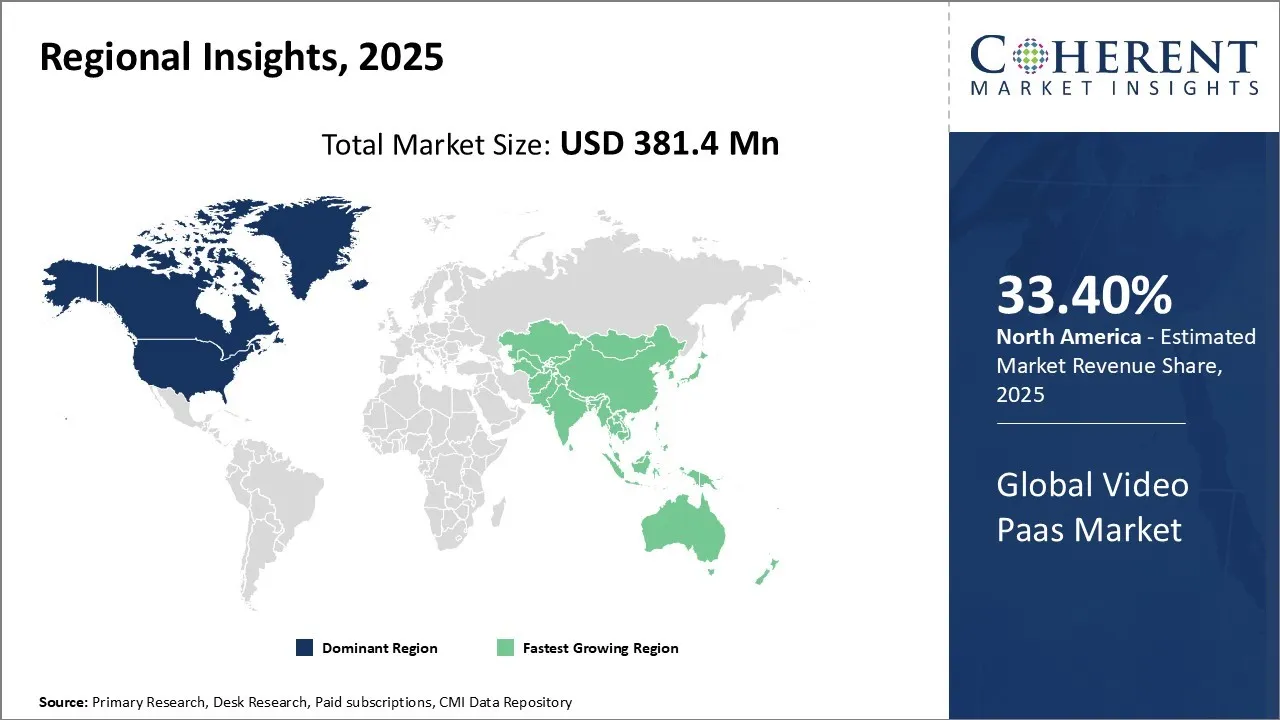
North America Video PaaS Market Trends
North America accounts for the largest share of 33.4%. The demand for live streaming and interactive video content is on the rise, particularly for applications like webinars, virtual events, and online training. In April 2026, the Pan American Health Organization (PAHO) introduced a new Webinar Series focused on Primary Health Care (PHC). This initiative aims to serve as a regional platform for sharing knowledge and fostering collaboration to enhance PHC across the Americas. VPaaS platforms are increasingly supporting these features, providing businesses with tools to engage audiences in real-time and create immersive experiences. This is turn drives the video PaaS market growth.
Asia Pacific Video PaaS Market Trends
Rapid expansion attributed to rising internet penetration and smartphone adoption in countries like China, India, and Southeast Asian nations. India's mobile internet infrastructure has seen significant advancements, as of November 2024, India ranks 25th globally in mobile internet speeds, with a median download speed of 100.78 Mbps, according to the Speedtest Global Index. This improvement is largely attributed to the rapid rollout of 5G services, which have enhanced connectivity and reduced latency across the nation. With over 900 million internet users, India stands as the world's second-largest online market. This expansive user base, coupled with improved internet speeds, provides a robust foundation for the growth of Video PaaS applications, including video conferencing, streaming, and real-time communication services. The increasing demand for high-quality video content and the proliferation of digital platforms further underscore the potential for Video PaaS solutions in India's evolving digital landscape.
Kuwait Video PaaS Market Trends
Kuwait is advancing in digital transformation, with a significant announcement of a partnership between the Kuwaiti government and Google Cloud in January 2023. The partnership aims to digitize multiple industries, such as healthcare and education, using cloud services. With a 97% penetration rate of 5G, Kuwait's cutting-edge network infrastructure is a strong base for the rollout and expansion of Video PaaS market demand across various industries.
Saudi Arabia Video PaaS Market Trends
Saudi Arabia's Vision 2030 program is driving the nation toward impressive digital progress. Investments in data centers, cloud regions, and smart city initiatives are enriching the country's digital ecosystem. Growth of subsea cable networks and construction of carrier-neutral data centers by leading tech firms are making Saudi Arabia a regional center for digital services. These initiatives are likely to drive the use of Video PaaS solutions faster, especially in industries such as education, healthcare, and entertainment.
Global Video PaaS Market Drivers
Rising Demand for Online Video Content
The surging demand for online video content consumption, encompassing activities such as video strearning, user- generated content, and engagement with video-centric social media platforms, has sparked a significant rise in the need for Video Platform as a Service (PaaS) solutions. These Video PaaS offerings have become increasingly sought after as they cater to the requirement of delivering and playing videos flawlessly, ensuring a smooth and enjoyable viewing experience for users.
Company Instance: YouTube, owned by Google (Alphabet Inc.), is a prominent example of a platform that has experienced exponential growth in online video content. To ensure smooth video delivery to billions of users, YouTube relies on sophisticated Video PaaS infrastructure and solutions. This in turn drives the video PaaS market growth.
Global Video PaaS Market Opportunities
E-Learning and Online Education
The rising demand for video-based education has created significant opportunities for Video Platform as a Service (PaaS) providers to collaborate with digital learning tools and educational institutions. The traditional education landscape has evolved, and educators are increasingly incorporating video content into their teaching methodologies to engage students and enhance the learning experience. This shift towards video-based education has given rise to the need for robust, scalable, and user-friendly video solutions, opening doors for Video PaaS providers to offer specialized services tailored to the education sector. For instance, Kaltura, an education technology company, collaborated with universities and corporations to offer video-centric e-learning solutions, including lecture capture, interactive video quizzes, and personalized learning experiences.
Global Video PaaS Market Trends
Real-Time Video Communication
Real-time video communication has emerged as a critical and transformative trend in the Video Platform as a Service (PaaS) market, driven by the growing demand for efficient remote collaboration and communication solutions. As businesses and individuals increasingly adopted remote work and virtual interactions, the need for seamless and high-quality video conferencing, live streaming, and interactive webinars became paramount. For instance, Twilio, a cloud communications platform that offers Twilio Video, enables developers to embed real-time video communication capabilities into their applications. Twilio Video has been widely adopted for virtual meetings, remote telemedicine consultations, and online events.
Market Report Scope
Video PaaS Market Report Coverage
| Report Coverage | Details | ||
|---|---|---|---|
| Base Year: | 2025 | Market Size in 2026: | USD 404.3 Mn |
| Historical Data for: | 2020 To 2024 | Forecast Period: | 2026 To 2033 |
| Forecast Period 2026 to 2033 CAGR: | 6.0% | 2033 Value Projection: | USD 607.9 Mn |
| Geographies covered: |
| ||
| Segments covered: |
| ||
| Companies covered: | Vidyo, Sightcall, Sinch, GENBAND, Twilio Inc., TokBox, Agro.io, and Xura. | ||
| Growth Drivers: |
| ||
| Restraints & Challenges: |
| ||
Global Video PaaS Market Restraints
The demand for video content has surged in recent years, driven by the growing popularity of online streaming platforms, social media videos, e-learning, and video conferencing. However, the smooth delivery of video content can be challenging due to the significant bandwidth requirements, particularly in regions with limited internet connectivity. This limitation results in buffering issues and poor video quality for users, affecting their overall viewing experience.
Global Video PaaS Market: Key Developments
- In May 2025, GardaWorld Security Corporation unveiled ECAM, a leading AI-powered surveillance technology in North America. ECAM integrates cutting-edge live video surveillance with human expertise to provide precise and vigilant real-time protection.
- In April 2025, Hikvision India introduced the Power X DVR, a state-of-the-art upgrade in the digital video recorder (DVR) market. Crafted to boost both intelligence and performance, this next-gen DVR incorporates advanced technologies, providing improved features and efficiency to enhance video security systems.
- In Mar 2025, SimpliFed, a company dedicated to supporting pregnant moms and parents with newborns, formed a strategic alliance with VidyoHealth, a leading Telehealth video conferencing provider. This collaboration aims to enhance the level of care and support available to SimpliFed's patients by offering virtual consultations through VidyoHealth's state-of-the-art video conferencing platform.
- In February 2025, TAG Video Systems announced its plan to further enhance its Realtime Media Platform. Building on a successful 2024, the company aims to expand platform capabilities, forge new partnerships, and grow its team to meet the evolving needs of the broadcast industry.
Analyst Opinion (Expert Opinion)
- The integration of Artificial Intelligence (AI) in Video PaaS platforms is no longer an optional feature but a fundamental enabler. By 2027, AI and ML applications in video surveillance, video recommendations, and automated content moderation are expected to reach $5.61 billion globally, reflecting the robust demand for smart video solutions. This is particularly significant in the North American market, where industries such as e-learning, entertainment, and corporate communications are rapidly adopting these technologies to enhance user experiences.
- For example, Brightcove, a leader in the video streaming space, reported in 2024 that 60% of their clients have now integrated AI-powered analytics into their video streaming infrastructure, improving customer retention by 15%. By enabling real-time, data-driven insights into viewer behavior, AI empowers businesses to personalize content and deliver it to the right audience at the right time. This is no longer an aspirational goal; it's the reality for many organizations striving to maintain competitive advantage in the content delivery ecosystem.
- The demand for live streaming and interactive video is soaring, and Video PaaS platforms are emerging as the backbone of this trend. In fact, the live streaming market is expected to grow, with North America leading this expansion. Platforms such as Vimeo and Kaltura are capitalizing on this trend by offering scalable solutions that allow companies to host live events, webinars, and interactive sessions with global reach.
- A great example of this is Vimeo’s Livestream service, which reported a 40% increase in corporate clients during 2024. The growth was driven by the platform's ability to handle large-scale live streaming events seamlessly, with interactive features like live Q&A sessions and polling. These functionalities cater to the increasing demand for more engaging, real-time content from consumers and businesses alike.
Speak to the analyst
Want personalized insights?
Take the findings above to one of our principal consultants, or have the report rebuilt around the segments, geographies and competitors you actually track.
Market Segmentation
- Global Video Paas Market, By Deployment Type (Revenue, USD Mn, 2021 - 2033)
- Public Cloud
- Private Cloud
- Global Video Paas Market, By Application (Revenue, USD Mn, 2021 - 2033)
- Video Conferencing
- Video Collaboration
- Broadcasting Video Communication
- Real Time Video Monitoring
- Video Content Management
- Others (enterprise and developer-based services)
- Global Video Paas Market, By End User (Revenue, USD Mn, 2021 - 2033)
- Social
- Media & Entertainment
- Education
- Healthcare
- Banking & Finance
- Company Profiles
- Vidyo.
- Sightcall
- Sinch
- GENBAND
- Twilio, Inc.
- TokBox
- Agro.io
- Xura
Sources
Primary Research Interviews
- Cloud integration engineers in enterprise IT teams
- Product managers in SaaS video collaboration platforms
- Application architects in telemedicine and EdTech firms
- Developers and DevOps professionals using API-based video platforms
- Strategic alliance heads at video CDN and platform providers
Databases
- U.S. Federal Communications Commission (FCC) – Reports on digital communications infrastructure
- Ministry of Electronics and Information Technology, Government of India – Video conferencing and remote work adoption policies
- European Commission – Digital Economy and Society Index (DESI) for video-related digitalization
- Statista – Video usage metrics and cloud service adoption rates
- WIPO (World Intellectual Property Organization) – Video streaming technology patents
Magazines & News Articles
- NewscastStudio – Coverage on TAG Video Systems and real-time media platform updates
- Superside – Reviews and rankings of enterprise-grade video platforms
- Vimeo Blog – Trends and use cases of professional video hosting and collaboration tools
- TechCrunch – Launches and funding updates of video communication startups
- The Verge – Reports on remote collaboration trends and platform innovations
Journals
- IEEE Transactions on Circuits and Systems for Video Technology
- Journal of Real-Time Image Processing
- Multimedia Tools and Applications
- Journal of Visual Communication and Image Representation
- International Journal of Digital Multimedia Broadcasting
Newspapers & Reports
- The Guardian – Digital transformation in media and remote learning
- The Economic Times – India’s video conferencing usage surge post-pandemic
- Financial Times – Enterprise video platform innovation in North America
- South China Morning Post – China's EdTech and online video platform growth
- Reuters – Reports on cloud video infrastructure investments
Associations
- Society of Motion Picture and Television Engineers (SMPTE)
- International Association of Broadcasting Manufacturers (IABM)
- Alliance for Open Media (AOMedia)
- Streaming Video Alliance (SVA)
- Video Services Forum (VSF)
Public Domain Sources
- European Commission – Regulations and digital innovation programs
- U.S. Federal Communications Commission (FCC) – Public records on broadband and video service trends
- Ministry of Electronics and Information Technology (India) – Video conferencing standards and programs
- National Institute of Standards and Technology (NIST) – Video transmission and quality metrics standards
- World Intellectual Property Organization (WIPO) – Technology patent filings related to video streaming
Get access to 250+ pages report
Every segment, forecast, competitor profile and data table behind the analysis above — available for instant download.
- ESOMAR Member
- ISO 9001:2015 Certified
- D-U-N-S Registered
- GDPR & CCPA Compliant
Missing comfort of reading report in your local language? Find your preferred language:
Transform your Strategy with Exclusive Trending Reports
Frequently Asked Questions
The Video Paas Market is estimated to be valued at USD 404.3 Mn in 2026, and is expected to reach USD 607.9 Mn by 2033.
The CAGR of the Video Paas Market is projected to be 6.0% from 2026 to 2033.
Rising demand for online video content, growing remote work, and communication are the key factors driving the growth of the market
Bandwidth Limitations and Connectivity Issues, Security and Privacy Concerns are the major factors restraining growth of the Market.
Key players operating in the market are Vidyo, Sightcall, Sinch, GENBAND, Twilio, Inc., TokBox, Agro.io, and Xura.