

Data Center Accelerator Market Size and Share Analysis - 2026 To 2033
The Data Center Accelerator Market is anticipated to grow at a CAGR of 22.9% with USD 17,089.3 Mn share in 2026 and is expected to reach USD 55,701.5 Mn in 2033. The Data Center Accelerator Market is growing rapidly due to rising adoption of AI, generative AI, high-performance computing, cloud workloads, and real-time analytics. Enterprises and hyperscale data center operators are increasingly shifting from CPU-only infrastructure to GPU, ASIC, and FPGA-based accelerators to improve processing speed, memory bandwidth, inference performance, and energy efficiency. For instance, in 2026, according to the International Energy Agency (IEA), global data center electricity demand increased by 17% in 2025, while electricity use from accelerated servers is projected to grow by 30% annually, highlighting the rising role of accelerator-based infrastructure. In 2026, major companies are strengthening this market through advanced AI platforms, including NVIDIA’s Vera Rubin AI computing platform and AMD’s Instinct MI450-based deployment with Meta.
Source: International Energy Agency (IEA); NVIDIA Corporation
Key Takeaways
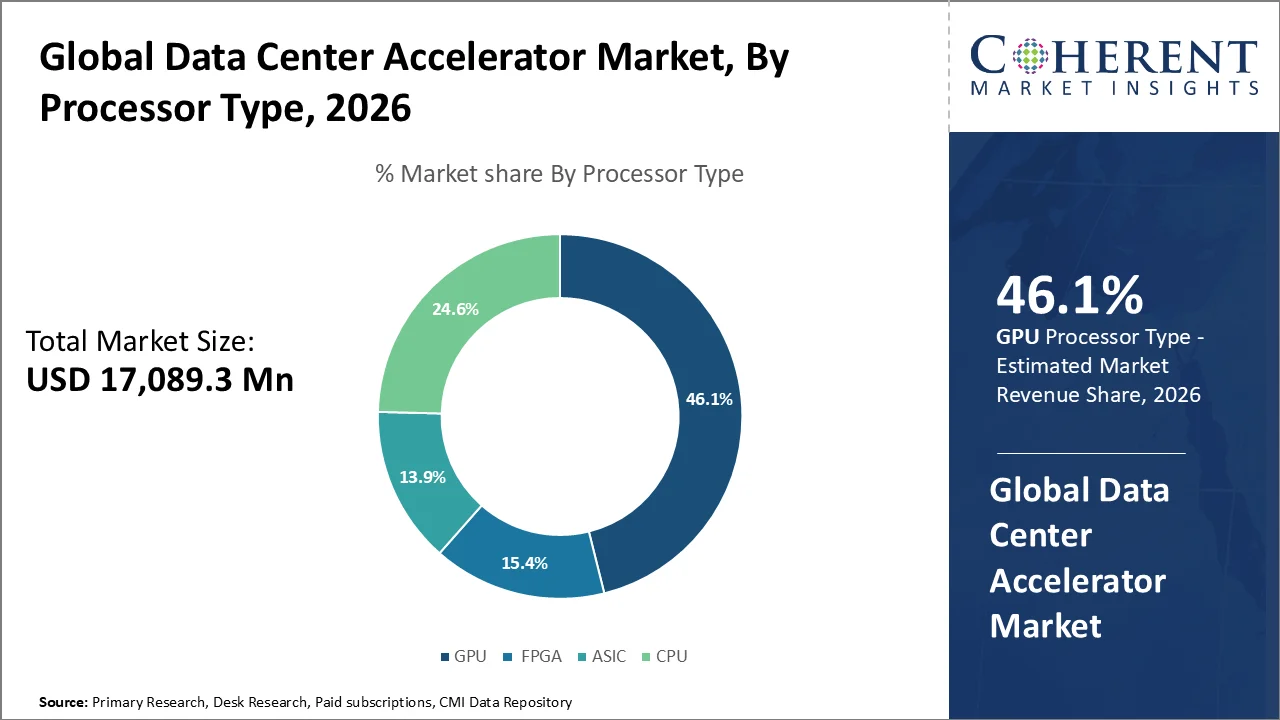
- GPU is expected to account the largest share of 46.1% in 2026, because GPUs support massive parallel processing, making them highly suitable for AI training, inference, generative AI, deep learning, and high-performance computing workloads. According to the IEA, electricity use from accelerated servers is projected to grow 30% annually, mainly driven by AI adoption. In 2026, NVIDIA’s Vera Rubin platform deployment by major cloud providers further supports GPU-led dominance.
Source: NVIDIA Corporation (NVDA); International Energy Agency (IEA)
- Artificial intelligence will dominate with 52.4% in 2026, supported by AI training, inference, LLMs, recommendation engines, and real-time analytics require massively parallel, low-latency accelerator computing. The IEA published in 2026 that AI-focused data center electricity use will grow faster than overall data centres and triple by 2030, while accelerated-server electricity grows 30% annually. Department of Energy announced in 2025 that its Equinox AI system with 10,000 NVIDIA Blackwell GPUs will be delivered in 2026.
Source: International Energy Agency (IEA), International Energy Agency (IEA)
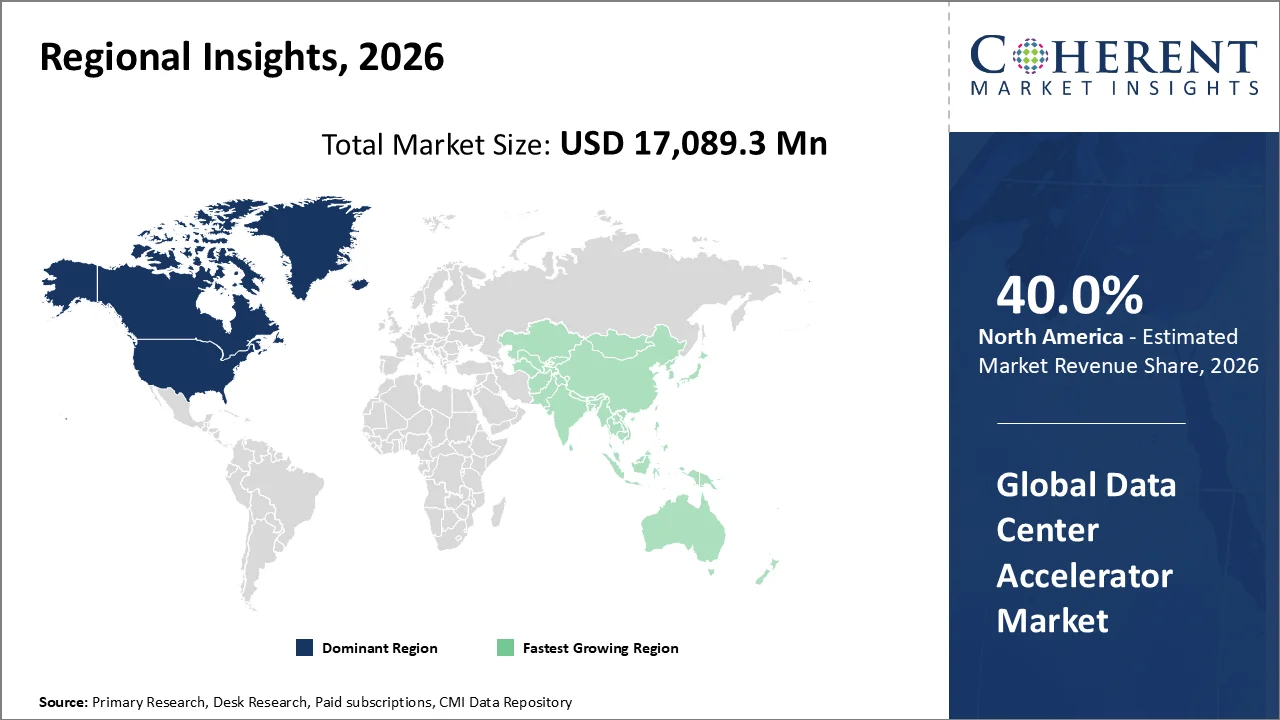
- North America is expected to acquire the dominant share of 40.0% in 2026, attributed to due to the strong presence of hyperscale cloud providers, AI data center clusters, semiconductor innovators, and government-backed compute infrastructure. The U.S. Energy Information Administration published in January 2026 that U.S. electricity use is expected to rise 1% in 2026 and 3% in 2027, mainly driven by large computing centers, including data centers.
Segmental Insights
Why is GPU Acquiring the Largest Market Share?
GPU is projected to account for the largest share of data center accelerator in 2026, representing approximately 46.1% of the total volume. The GPU processor type segment is dominant in the Data Center Accelerator Market because GPUs offer strong parallel processing capability, making them highly suitable for AI training, AI inference, high-performance computing, cloud workloads, data analytics, and generative AI applications. Unlike CPUs, GPUs can process thousands of operations simultaneously, which improves workload throughput and reduces latency in AI-driven data centers. In April 2026, Gartner reported that data center systems spending is expected to grow 55.8% in 2026, driven by AI infrastructure, advanced memory, high-performance compute, and demand for AI-optimized processors and accelerators. In February 2026, NVIDIA reported record quarterly Data Center revenue of USD 62.3 billion, up 75% year-over-year, driven by accelerated computing and AI. Similarly, AMD reported in May 2026 that its Data Center segment revenue reached USD 5.8 billion, up 57% year-over-year, supported by strong demand for AMD EPYC processors and continued ramp-up of AMD Instinct GPU shipments. Moreover, IndiaAI Mission provisioned 38,000+ GPUs and announced the addition of 20,000 GPUs, showing direct government-backed GPU adoption for AI compute infrastructure.
Source: Gartner; NVIDIA Corporation; Advanced Micro Devices, Inc.
- Current Industry Events of 2026
- Market Size Estimation
- Regional Breakdown
- Competitive Landscape
- Customer Intelligence
- Segmental Analysis
- Pricing Analysis
- Key Market Drivers, Challenges & Future Trends
- Customized Insights Section
Artificial Intelligence holds the Largest Market Share
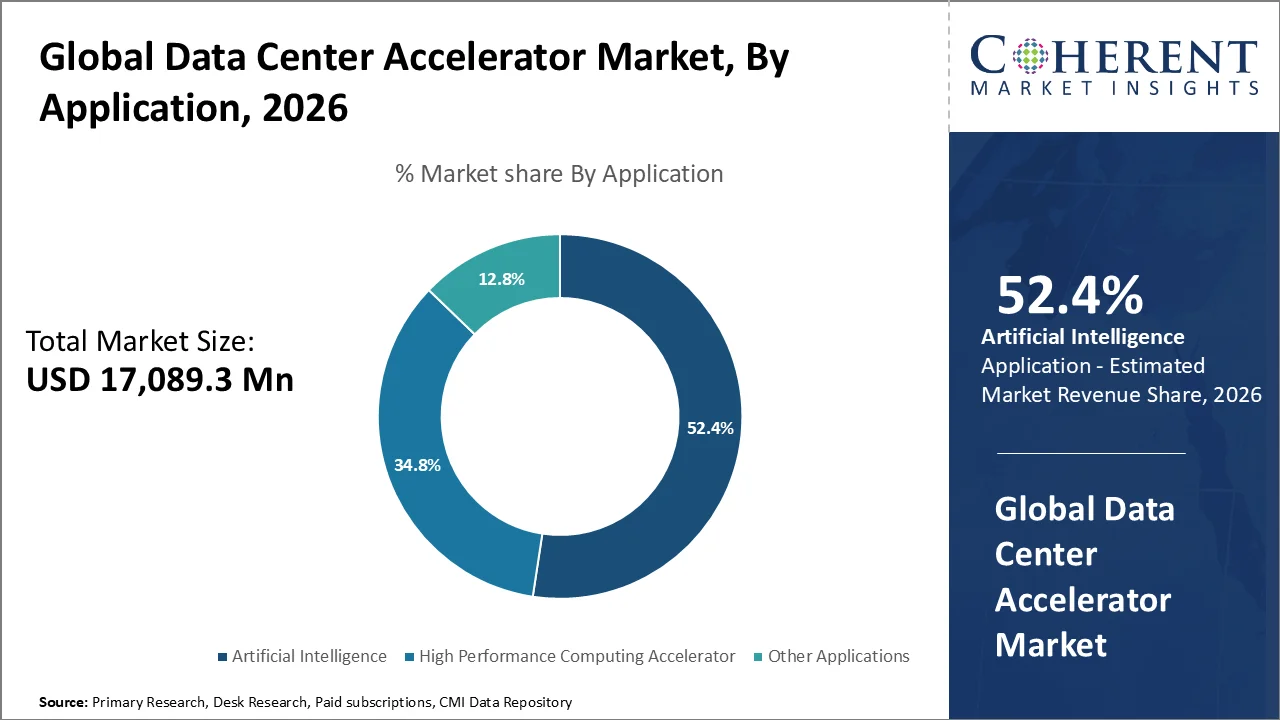
Artificial intelligence dominates the market, accounting for a significant 52.4% share in 2026, because AI workloads require very high parallel processing, fast memory access, low latency, and high energy efficiency, which are difficult to achieve with traditional CPUs alone. Generative AI, large language models, machine learning training, AI inference, computer vision, natural language processing, and real-time analytics need GPUs, ASICs, FPGAs, and other AI accelerators to process massive datasets quickly. In April 2026, Gartner reported that data center systems spending is expected to grow 55.8% in 2026, supported by rising AI infrastructure and AI-optimized processors. In March 2026, India’s IndiaAI Mission onboarded 38,000+ GPUs for a common AI compute facility, showing strong government-backed AI accelerator adoption. The European Commission’s AI plan also includes up to five AI gigafactories, each designed around 100,000+ advanced AI processors. In addition, NVIDIA reported Q4 FY2026 data center revenue growth of 75% year-over-year, driven by accelerated computing and AI demand, while AMD reported 57% year-over-year growth in its Q1 2026 data center segment, supported by AMD Instinct GPU shipments.
Source: Gartner; PIB; NVIDIA Corporation
Market Drivers
Growing use of AI in HPC data centers
Growing use of AI in HPC data centers has driven the global data center accelerator market growth over the forecast period. Growing use of AI in HPC data centers is driving the data center accelerator market because AI workloads require faster parallel processing, high-bandwidth memory, low-latency networking, and energy-efficient compute compared with CPU-only infrastructure. For instance, in February 2026, India’s PIB highlighted that AI-driven data center expansion is creating concentrated power loads and cited NREL’s Colorado HPC Data Centre with 10,000+ sq. ft. facility space and up to 10 MW of computing power for large-scale modelling, simulation, and AI-driven research. This shows that HPC facilities are increasingly being designed around accelerator-heavy infrastructure. Similarly, the U.S. DOE announced that the Lux AI cluster, powered by AMD Instinct MI355X GPUs, AMD EPYC CPUs, and advanced networking, would be deployed in early 2026 to expand AI capacity for fusion, materials discovery, quantum, manufacturing, and grid modernization. Such deployments increase demand for GPUs, AI accelerators, interconnects, and memory-rich server architectures.
Rise in deployment of cloud-based services and data center facilities
The rise in deployment of cloud-based services and data center facilities drives the data center accelerator market expansion because cloud operators need faster, energy-efficient processors to handle AI, machine learning, high-performance computing, analytics, virtualization, cybersecurity, and real-time enterprise workloads. For instance, in April 2026, the data center systems spending is expected to grow 55.8% in 2026, while IT services, including infrastructure services and IaaS, will remain the largest IT spending category, reflecting strong cloud infrastructure expansion. Cloud IaaS spending will reach USD 80 billion in 2026, up 35.6% from 2025, as governments and regulated industries deploy more localized cloud infrastructure. Moreover, the IEA stated in April 2026 that data center electricity consumption may nearly double from 485 TWh in 2025 to 950 TWh by 2030, with AI-focused data centers growing even faster. This increases demand for GPUs, ASICs, FPGAs, and AI accelerators that improve workload throughput while reducing power per computation.
Accelerating the Future: How AI-Driven Chip Innovation Is Redefining the Data Center Accelerator Industry
Increasing innovation and AI integration in the data center accelerators has created significant opportunity for the data center accelerator market growth over the forecast period. Data center accelerators are specialized hardware components used to improve the speed, efficiency, and computing performance of modern data centers. These accelerators include GPUs, FPGAs, and ASICs, which are designed to handle complex workloads faster than traditional CPUs. Their adoption is increasing as data centers manage larger volumes of data generated from cloud computing, artificial intelligence, machine learning, big data analytics, and high-performance computing applications. By enabling parallel processing, lower latency, and improved power efficiency, accelerators help data centers process demanding workloads while reducing operational pressure. The growing use of AI models and real-time analytics has made accelerator chips an important part of hyperscale and enterprise data center infrastructure. For instance, according to IDC, published in June 2023, the global data center accelerator market is expected to reach USD 25 billion by 2026. The same report noted that NVIDIA’s data center revenue increased by 67% in Q1 2023.
Furthermore, innovations in data center accelerators have transformed the Data Center Accelerator Market because advanced GPUs, ASICs, FPGAs, DPUs, and AI chips now help data centers process AI training, AI inference, high-performance computing, analytics, cloud virtualization, cybersecurity, and real-time enterprise workloads with higher speed and lower power use. In April 2026, Gartner reported that data center systems spending is expected to grow 55.8% in 2026, supported by strong hyperscale and AI infrastructure investments. Gartner also stated in February 2026 that sovereign cloud IaaS spending will reach US$80 billion in 2026, up 35.6% from 2025, as governments and regulated industries deploy more localized cloud infrastructure. Moreover, the Information Energy Agency reported in April 2026 that data center electricity demand rose 17% in 2025 and could reach around 945 TWh by 2030. This increases demand for accelerators that improve processing density, energy efficiency, and workload performance.
Source: Information Energy Agency; Gartner
Current Events and Their Impact on the Data Center Accelerator Market
Current Event | Description and its Impact |
Increasing Government Initiatives |
|
Increasing Regulatory Shifts and Supportive Policy |
|
U.S. Policy Shift on AI Chip Export Controls |
|
Data Center Accelerator Market Trends
- Shift toward AI reasoning and inference accelerators - NVIDIA GB300 NVL72 is available and integrates 72 Blackwell Ultra GPUs and 36 Grace CPUs in a fully liquid-cooled rack-scale platform. It offers 2x higher attention performance and up to 50x AI factory output improvement versus Hopper-based platforms. This increases demand for GPUs and AI accelerators optimized for real-time inference, reasoning models, video generation, and enterprise AI workloads.
Source: NVIDIA Corporation
- High-bandwidth memory becoming a key accelerator requirement - AMD Instinct MI355X GPUs offer 288 GB HBM3E memory and 8 TB/s memory bandwidth, with MXFP6 and MXFP4 datatype support for AI and HPC workloads. Larger memory and faster bandwidth help run large language models, scientific simulations, and multimodal AI workloads more efficiently.
Source: Advanced Micro Devices, Inc.; AMD
- Custom cloud AI chips gaining adoption - In 2026, AWS Trainium3 provides 2.52 PFLOPs FP8 compute, 144 GB HBM3e memory, and 4.9 TB/s memory bandwidth, while Microsoft Maia 200 delivers over 10 PFLOPS FP4 and over 5 PFLOPS FP8 for inference workloads. Hyperscalers are reducing dependency on general GPUs and expanding demand for purpose-built accelerators across cloud AI services.
- Liquid cooling and high-density racks becoming mainstream - IEA stated in 2026 that AI server power density increased 11x between 2020 and 2025 and may rise another 4x by 2027; one advanced AI rack could demand power equivalent to 65 households. Higher rack density pushes adoption of liquid-cooled accelerator platforms, especially for GPU clusters and AI supercomputers.
- Scale-out networking and accelerator clustering - Google’s 2026 TPU 8t architecture supports up to 9,600 chips per superpod, 121 ExaFlops, and near-linear scaling up to one million TPU chips through Virgo Network, JAX, and Pathways. Data centers are moving from single-server acceleration to large accelerator clusters, increasing demand for GPUs, TPUs, interconnects, NICs, and AI networking.
- Public-sector AI supercomputing investments - The U.S. DOE announced the Lux AI cluster for early 2026 deployment at Oak Ridge National Laboratory, powered by AMD Instinct MI355X GPUs, AMD EPYC CPUs, and AMD Pensando networking for fusion, materials discovery, quantum, manufacturing, and grid modernization. Government-backed HPC-AI systems create strong demand for advanced accelerators in research, defense, energy, and scientific computing.
Regional Insights
North America dominates owing to Strong Government-Backed Compute Infrastructure
North America account 40.0% market share in 2026, supported by due to the strong presence of hyperscale cloud providers, AI data center clusters, semiconductor innovators, and government-backed compute infrastructure. The U.S. Energy Information Administration published in January 2026 that U.S. electricity use is expected to rise 1% in 2026 and 3% in 2027, mainly driven by large computing centers, including data centers. EIA also published in April 2026 that data center load is becoming the dominant driver of long-term U.S. electricity growth. Additionally, EIA launched pilot data center energy-use surveys in March 2026 across Texas, Washington, Northern Virginia, and Washington, DC, showing rising government focus on major data center hubs. Canada also supports regional dominance through its AI Sovereign Compute Infrastructure Program, published in April 2026, providing around US$ 890 million-equivalent funding for sovereign AI compute infrastructure.
Source: U.S. Energy Information Administration; Energy Information Administration; Government of Canada
Asia Pacific Data Center Accelerator Market Trends
The Asia-Pacific region is poised to be as the fastest-growing region through 2026-2033, because cloud providers, AI platforms, telecom operators, and enterprises are rapidly expanding GPU-ready data center capacity across India, Japan, Singapore, Malaysia, and Thailand. For instance, in February 2026, India’s PIB reported a tax holiday till 2047 for eligible foreign cloud service providers using India-based data centers, supporting long-term cloud and AI infrastructure investment. Singapore’s EDB also reported in 2026 that the country is setting aside S$1 billion over five years for AI research and talent, while IMDA’s Green Data Centre Roadmap targets at least 300 MW of additional data center capacity. Thailand’s BOI approved 913 billion baht in data center and hosting projects in May 2026, including large-scale server and processing infrastructure expansion. These developments directly increase demand for GPUs, ASICs, FPGAs, and AI accelerators to support cloud AI, HPC, analytics, and real-time digital workloads.
Growing Development and Strong Presence of Hyperscale Cloud Operators is Accelerating the Data Center Accelerator Market Demand in United States
The U.S. data center accelerator market dominates North America because it has the strongest combination of hyperscale cloud operators, AI model developers, chip companies, and data center infrastructure. For instance, JLL’s 2026 Global Data Center Outlook states that the U.S. accounts for about 90% of data center capacity in the Americas, showing its clear infrastructure lead. Furthermore, in April 2026, the U.S. Energy Information Administration reported that data center load is emerging as the dominant driver of long-term U.S. electricity growth, reflecting rapid AI and cloud infrastructure expansion. Department of Energy also noted that data centers could consume up to 9% of total U.S. electricity demand by 2030, with the largest growth linked to AI capabilities. This creates strong demand for GPUs, CPUs, ASICs, FPGAs, and networking accelerators. In FY2026 Q3, Microsoft reported that nearly two-thirds of its capex was for GPUs and CPUs, while AMD’s Q1 2026 data center revenue rose sharply on AI infrastructure demand. Additionally, CHIPS for America has allocated over US$32 billion across 16 states, strengthening domestic semiconductor supply.
China Data Center Accelerator Market Trends
China dominates the Asia Pacific Data Center Accelerator Market because it has the region’s largest AI-user base, strong cloud infrastructure, fast-growing intelligent computing centers, and a rapidly localizing AI chip ecosystem. For instance, in February 2026, China’s State Council reported that the country had 1.125 billion internet users, while generative AI users reached 602 million by December 2025, growing 141.7% year-on-year. The same report stated that China had built 42 ten-thousand-GPU intelligent computing clusters, supporting large-scale AI model training and inference workloads. China also had more than 8.1 million data center racks and 230 EFLOPS of computing power, with a target to reach 300 EFLOPS, creating strong demand for GPUs, ASICs, FPGAs, and AI accelerators. Moreover, in Q1 2026, China’s high-tech industry sales revenue grew 14.6%, while integrated circuit design and manufacturing rose sharply due to AI and computing-power-center demand. Reuters also reported that Chinese GPU and AI chipmakers captured 41% of China’s AI accelerator server market in 2025, strengthening domestic accelerator adoption.
Who are the Major Companies in Data Center Accelerator Market
Some of the major key players in data center accelerator market are Qualcomm Technologies Inc., Intel Corporation, Cisco Systems Inc., NVIDIA Corporation, IBM Corporation, Advanced Micro Devices Inc., Dell Technologies Inc., Achronix Semiconductor Corporation, NEC Corporation, and Xilinx Inc.
Key News
- In January 2026, Microsoft, global technology company introduced Maia 200, a custom AI inference accelerator for Azure. It is built on TSMC’s 3nm process, supports FP8/FP4 tensor cores, has 216GB HBM3e memory, and delivers over 10 petaFLOPS FP4 performance. It is deployed in Microsoft’s U.S. Central datacenter region, with U.S. West 3 planned next. Strengthens demand for hyperscaler-owned AI accelerators, especially for large-scale inference, Microsoft Copilot, Azure AI Foundry, and synthetic data generation workloads.
Source: Microsoft
- In 2026, NVIDIA Corporation, a premier American technology company launched the Rubin platform, including Vera CPU, Rubin GPU, NVLink 6, ConnectX-9, BlueField-4 DPU, and Spectrum-6 Ethernet switch. The Rubin GPU delivers 50 PFLOPS of NVFP4 inference, and Rubin-based products are expected from partners in the second half of 2026. Drives next-generation rack-scale GPU adoption for AI factories, cloud AI training, inference, and agentic AI workloads.
- In April 2026, Google Cloud announced TPU 8t and TPU 8i, its eighth-generation TPUs. TPU 8t is designed for training and supports 9,600 chips in one superpod, while TPU 8i targets inference and reinforcement learning with 288GB HBM and higher on-chip SRAM. Expands adoption of purpose-built cloud AI accelerators for training, inference, reasoning, and agentic AI applications.
- In May 2026, Advanced Micro Devices, Inc., multinational semiconductor company introduced Instinct MI350P PCIe cards for enterprise AI. These are dual-slot, drop-in PCIe accelerators for standard air-cooled servers, offering up to 144GB HBM3e and up to 4,600 peak TFLOPS at MXFP4. Advanced Micro Devices, Inc. previewed the Instinct MI430X GPU for HPC and AI-for-science workloads. AMD stated that the GPU is projected to deliver over 200 TFLOPS of native FP64 performance for simulation, modeling, and AI-driven scientific workloads.
Market Report Scope
Data Center Accelerator Market Report Coverage
| Report Coverage | Details | ||
|---|---|---|---|
| Base Year: | 2025 | Market Size in 2026: | USD 17,089.3 Mn |
| Historical Data for: | 2020 To 2024 | Forecast Period: | 2026 To 2033 |
| Forecast Period 2026 to 2033 CAGR: | 22.9% | 2033 Value Projection: | USD 55,701.5 Mn |
| Geographies covered: |
| ||
| Segments covered: |
| ||
| Companies covered: | Qualcomm Technologies Inc., Intel Corporation, Cisco Systems Inc., NVIDIA Corporation, IBM Corporation, Advanced Micro Devices Inc., Dell Technologies Inc., Achronix Semiconductor Corporation, NEC Corporation, and Xilinx Inc. | ||
Analyst Opinion
- The Data Center Accelerators Market is becoming a core infrastructure market, not only a semiconductor sub-segment, because cloud providers and enterprises are moving AI workloads from pilot projects to full-scale production. Accelerators such as GPUs, ASICs, FPGAs, and DPUs are now required for AI training, AI inference, high-performance computing, analytics, and cloud workloads. In April 2026, Gartner reported that data center systems spending is expected to grow 55.8% in 2026, reaching around US$787.99 billion, while IT services, including IaaS and infrastructure services, are expected to remain the largest spending category at over US$1.87 trillion. This shows that accelerator demand is being supported by large-scale cloud and AI infrastructure expansion.
Source: Gartner
- AI infrastructure demand is the strongest commercial driver for data center accelerators, as leading chip companies are reporting record data center revenue from accelerated computing. NVIDIA reported in February 2026 that its quarterly data center revenue reached US$62.3 billion, up 75% year-over-year, driven by accelerated computing and AI demand. Similarly, AMD reported in May 2026 that its data center segment revenue reached US$5.8 billion, up 57% year-over-year, supported by strong demand for AMD EPYC processors and the continued ramp-up of AMD Instinct GPU shipments. This indicates that hyperscalers and enterprises are prioritizing accelerator-rich servers for AI and cloud workloads.
- North America dominates the Data Center Accelerators Market because the U.S. has the strongest concentration of hyperscale cloud operators, AI model developers, semiconductor leaders, and large AI data center investments. The IEA stated in 2026 that the U.S. accounts for by far the largest share of the projected rise in global data center electricity demand, and data centers are expected to account for nearly half of U.S. electricity demand growth between now and 2030. This reflects the scale of AI-ready data center deployment in North America. In addition, Amazon announced an investment of up to US$50 billion, set to break ground in 2026, to add nearly 1.3 GW of AI and supercomputing capacity for AWS U.S. government customers.
- Energy efficiency is becoming a key purchasing factor for data center accelerators, as AI workloads are increasing power pressure on data center operators. In April 2026, the IEA reported that data center electricity demand increased by 17% in 2025, while AI-focused data centers grew even faster. The IEA also projected that global data center electricity consumption may increase from 485 TWh in 2025 to around 950 TWh by 2030. This makes performance-per-watt a critical selection parameter, encouraging operators to adopt advanced GPUs, ASICs, DPUs, and custom AI accelerators that can deliver higher compute output with lower energy use per workload.
Source: IEA
- Government policy is also strengthening accelerator adoption, especially in North America, where AI infrastructure is being treated as a strategic priority. In March 2026, the White House National AI Legislative Framework called for streamlined permitting so that data centers can generate power on-site and improve grid reliability, while also ensuring residential ratepayers do not bear the cost of new AI data center construction. This policy direction supports faster deployment of AI infrastructure, which will increase demand for accelerators used in AI training, inference, cybersecurity, defense workloads, and sovereign cloud applications.
Speak to the analyst
Want personalized insights?
Take the findings above to one of our principal consultants, or have the report rebuilt around the segments, geographies and competitors you actually track.
Market Segmentation
- By Processor Type (Revenue, USD Mn, 2021-2033)
- CPU
- GPU
- FPGA
- ASIC
- By Application (Revenue, USD Mn, 2021-2033)
- High Performance Computing Accelerator
- Artificial Intelligence
- Other Applications
- By Region (Revenue, USD Mn, 2021-2033)
- North America
- U.S.
- Canada
- Latin America
- Brazil
- Mexico
- Argentina
- Rest of Latin America
- Europe
- Germany
- U.K.
- France
- Italy
- Spain
- Russia
- Rest of Europe
- Asia Pacific
- China
- India
- Japan
- Australia
- South Korea
- ASEAN
- Rest of Asia Pacific
- Middle East
- GCC
- Israel
- Rest of Middle East
- Africa
- South Africa
- Central Africa
- North Africa
- North America
Sources
Primary Research Interviews
- Interviews with data center operators and cloud leaders to understand accelerator deployment, power, cooling, and integration challenges.
- Insights from GPU, FPGA, ASIC, DPU, and AI chip manufacturers on product innovation, performance, and workload demand.
- Discussions with cloud providers, colocation firms, and IT procurement teams to assess demand, scalability, cost, and vendor selection.
- Conversations with AI engineers, HPC specialists, and system integrators to understand software compatibility, workload optimization, and deployment barriers.
Databases
- Bloomberg Terminal
- S&P Global Market Intelligence
- IDC Tracker Database
- Omdia Data Center & Cloud Infrastructure Database
- Gartner Market Databases
- IEEE Xplore Digital Library
- ACM Digital Library
- U.S. Energy Information Administration (EIA) Data Center and Electricity Data
Magazines
- IEEE Spectrum
- HPCwire
- Data Center Dynamics
- EE Times
- Network World
- Data Center Frontier
- Semiconductor Engineering
- The Next Platform
Journals
- IEEE Transactions on Parallel and Distributed Systems
- IEEE Transactions on Cloud Computing
- ACM Transactions on Architecture and Code Optimization
- Journal of Parallel and Distributed Computing
- Future Generation Computer Systems
- IEEE Micro
- ACM Computing Surveys
- The Journal of Supercomputing
Newspapers
- Financial Times – Technology Section
- The Wall Street Journal – Technology Section
- Reuters – Technology and Semiconductors
- Bloomberg News – Technology and AI Infrastructure
- The New York Times – Technology Section
- The Guardian – Technology and AI Section
Associations
- IEEE Computer Society
- Association for Computing Machinery (ACM)
- Open Compute Project (OCP)
- Uptime Institute
- MLCommons
- Cloud Native Computing Foundation (CNCF)
- Semiconductor Industry Association (SIA)
- Storage Networking Industry Association (SNIA)
Public Domain Sources
- U.S. Department of Energy (DOE)
- U.S. Energy Information Administration (EIA)
- National Institute of Standards and Technology (NIST)
- CHIPS for America – U.S. Department of Commerce
- National Science Foundation (NSF)
- European Commission Digital Strategy and Data Centre Policy Documents
- International Energy Agency (IEA)
- Company Annual Reports and Investor Presentations from publicly listed accelerator, cloud, and semiconductor firms
Proprietary Elements
- CMI Data Analytics Tool
- Proprietary CMI Existing Repository of information for last 10 years
Get access to 250+ pages report
Every segment, forecast, competitor profile and data table behind the analysis above — available for instant download.
- ESOMAR Member
- ISO 9001:2015 Certified
- D-U-N-S Registered
- GDPR & CCPA Compliant
Missing comfort of reading report in your local language? Find your preferred language:
Transform your Strategy with Exclusive Trending Reports
Frequently Asked Questions
The Data Center Accelerator Market is expected to reach USD 55,701.5 Mn in 2033.
Major players operating in the global Data Center Accelerator Market include Qualcomm Technologies Inc., Intel Corporation, Cisco Systems Inc., NVIDIA Corporation, IBM Corporation, Advanced Micro Devices Inc., Dell Technologies Inc., Achronix Semiconductor Corporation, NEC Corporation, and Xilinx Inc.
Lack of AI hardware experts and rise in infrastructural concerns are the major factors hampering the growth of the data center accelerator market.
Growing use of AI in HPC data centers and rise in deployment of cloud-based services and data center facilities are the factors driving the growth of the data center accelerator market.
The Data Center Accelerator Market is anticipated to grow at a CAGR of 22.9% between 2026 and 2033.
Among regions, North America is expected to account for a largest market share in the global Data Center Accelerator Market over the forecast period.
Data center accelerators are specialized hardware components used to improve the speed and efficiency of computing workloads in data centers. They are designed to handle intensive tasks such as artificial intelligence, machine learning, high-performance computing, data analytics, cloud computing, and video processing more efficiently than traditional CPUs.