

Livestock Monitoring Market Size and Forecast – 2026 to 2033
Livestock Monitoring Market is estimated to be valued at USD 10.06 Bn in 2026 and is expected to reach USD 32.24 Bn in 2033, exhibiting a compound annual growth rate (CAGR) of 18.1% from 2026 to 2033.
Key Takeaways
- By Animal Type, Cattle acquired the prominent share of 46% in 2026 on account of the growing consumption of dairy products.
- By Component, Hardware dominates the overall market share in 2026 owing to the real-time tracking & early detection.
- By Application, Milk Harvesting hold the largest market share in 2026 owing to its labor efficiency and automation via automatic milking systems (ams).
- By Region, North America dominates the overall market with an estimated share of 30.7% in 2026 owing to the large livestock population & production demands.
Market Overview
The livestock monitoring market is growing rapidly as farmers seek more efficient ways to manage their farms and monitor animal health. Technological advancements in IoT, sensors, and data analytics allow real-time tracking of livestock behavior, health, and productivity. Farmers actively adopt automated systems to cut labor costs, boost productivity, and improve animal welfare. Growing concerns about food safety, traceability, and disease control are driving this shift, with strong support from governments and industry players for smart farming technologies.
Current Events and their Impact on the Livestock Monitoring Market
Current Events | Description and its impact |
Regulatory and Policy Changes in Key Agricultural Regions |
|
Climate Change and Environmental Challenges |
|
Economic Trends Affecting Farming Investments |
|
End-user Feedback and Unmet Needs in the Livestock Monitoring Market
End-user Feedback and Unmet Needs
- Demand for User-Friendly Interfaces: End-users seek easy-to-use monitoring systems with intuitive interfaces to simplify data interpretation and reduce the learning curve, especially among small and medium-scale farmers.
- Need for Affordable Solutions: Many farmers highlight the high cost of advanced monitoring technologies as a barrier, calling for more affordable, scalable options tailored to diverse farm sizes and budgets.
- Desire for Better Integration: Users want seamless integration of hardware and software systems to provide comprehensive insights and avoid managing multiple disconnected platforms.
- Current Industry Events of 2026
- Market Size Estimation
- Regional Breakdown
- Competitive Landscape
- Customer Intelligence
- Segmental Analysis
- Pricing Analysis
- Key Market Drivers, Challenges & Future Trends
- Customized Insights Section
Segmental Insights
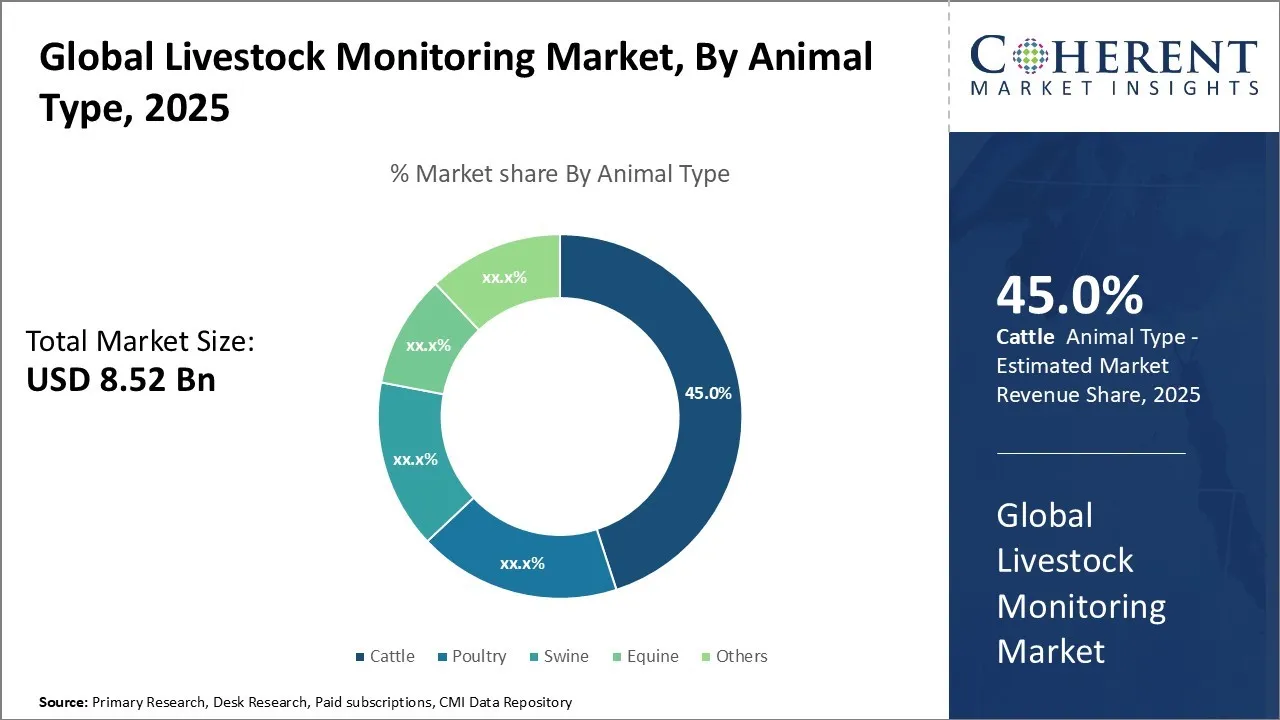
Livestock Monitoring Market Insights, By Animal Type: Cattle contribute the highest share of the market owing to its health monitoring & early disease detection
Cattle acquired the prominent share of 46.0% in 2026. Farmers are driving the growth of cattle monitoring in the livestock monitoring market by focusing on improving animal health, productivity, and overall farm efficiency. They actively use technologies such as RFID tags, sensors, and GPS trackers to monitor cattle behavior, feeding habits, and health in real time. These tools enable early disease detection, minimize losses, and optimize the use of resources. Growing demand for dairy and beef, along with concerns about food safety and traceability, is encouraging wider adoption of monitoring systems. For instance, in July 2025, LoneStar Tracking has launched a new GPS-enabled Bluetooth ear tag for cattle, pricing it under $20 to make advanced livestock tracking more accessible than ever.
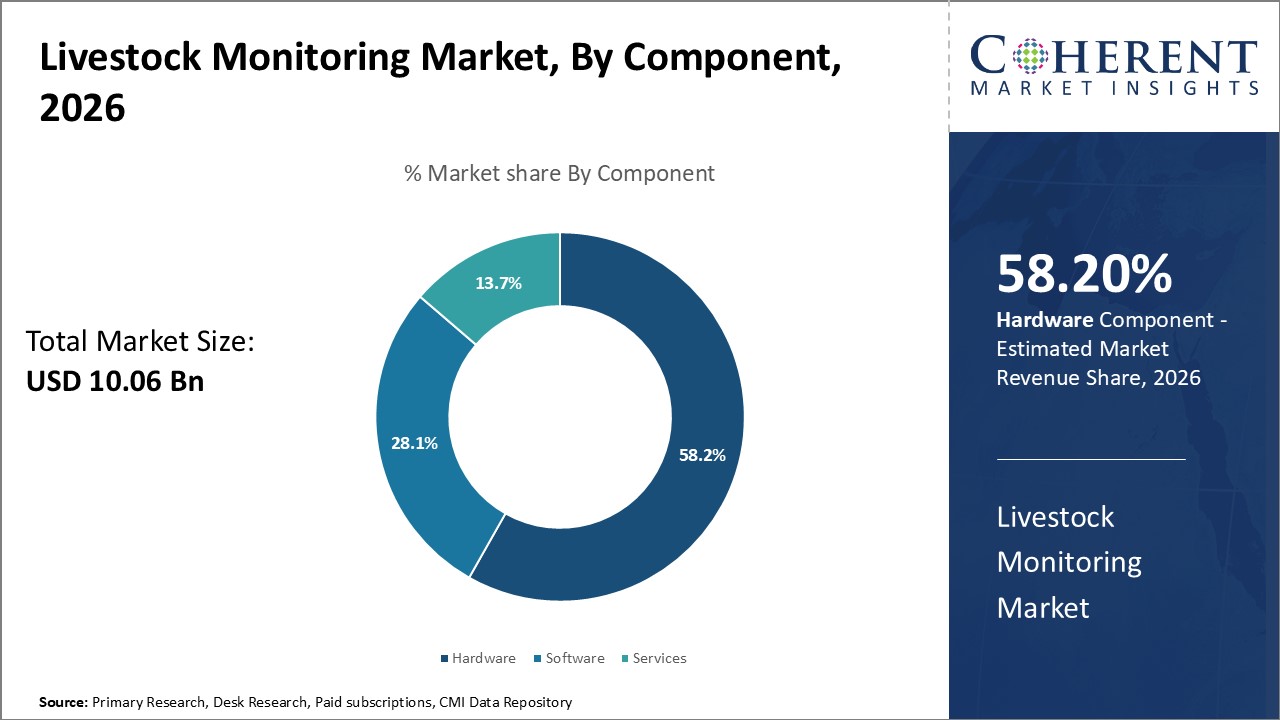
Livestock Monitoring Market Insights, By Component: Hardware contributes the highest share of the market owing to its cost reductions & labor efficiency
The hardware segment drives the livestock monitoring market by serving as the essential foundation for real-time data collection and animal tracking. Farmers and ranchers use hardware devices such as sensors, RFID tags, GPS collars, and smart cameras to directly gather critical health and behavior information from animals. This hands-on interaction enables them to quickly detect diseases, track movements, and monitor environmental conditions. Because of its constant data capture and physical connection to livestock, hardware plays a crucial role that distinguishes it from software and service solutions.
Livestock Monitoring Market Insights, By Application: Milk Harvesting contribute the highest share of the market owing to its Realtime monitoring of milk quality and yield
Farmers uniquely drive the milk harvesting segment of the livestock monitoring market by using automated milking systems and advanced sensors that specifically target milk production optimization. Unlike general health or location tracking technologies, these tools focus on monitoring milk yield, quality, and udder health in real time. By enhancing milking efficiency, cutting labor needs, and ensuring product safety, these solutions offer specialized benefits centered on dairy output and quality, clearly setting milk harvesting apart from other livestock monitoring areas.
In October 2024, Prime Minister Narendra Modi introduced a Unified Genomic Chip for cattle and an indigenous sex-sorted semen production technology. This initiative aims to boost the efficiency of dairy farming and address the issue of stray cattle by helping farmers breed more high-quality bulls and milch animals.
Regional Insights
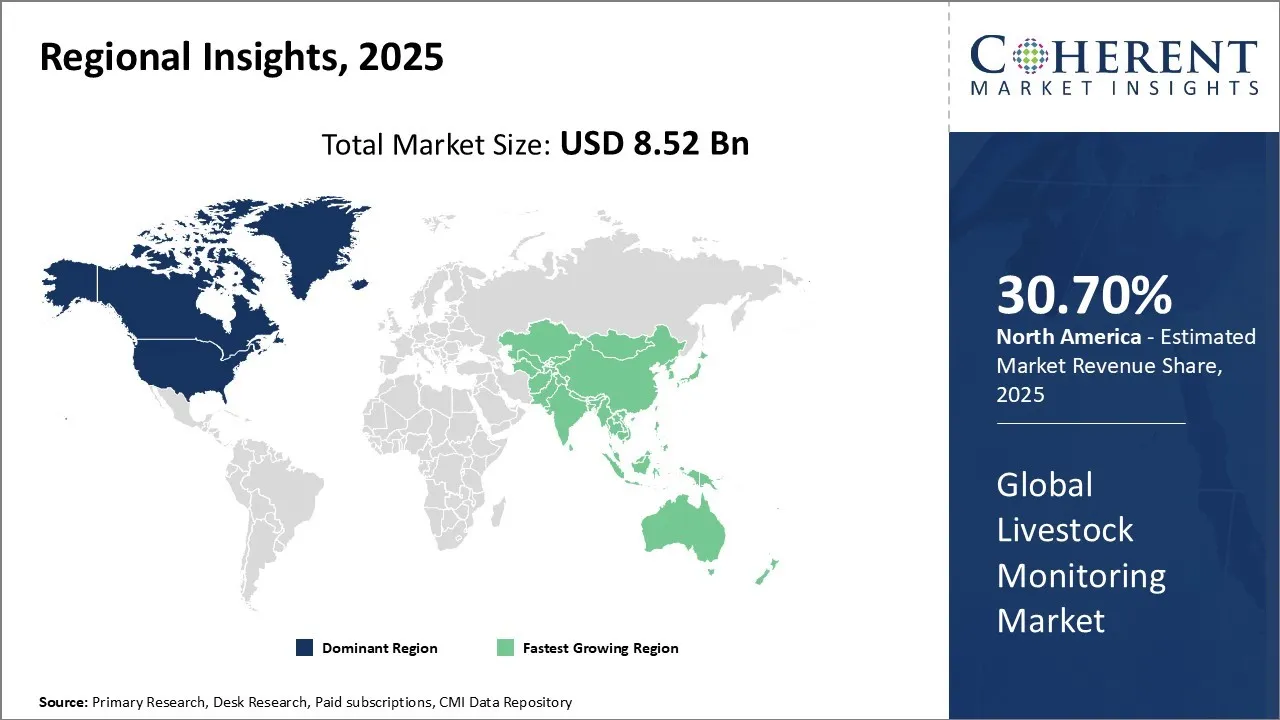
North America Livestock Monitoring Market Trends
North America acquires the largest share of 30.70%. In North America, farmers and industry leaders actively adopt advanced technologies like IoT devices, AI analytics, and wearable sensors to improve herd health and productivity. They prioritize disease detection, traceability, and regulatory compliance more than other regions, backed by strong government support and private investments. Large-scale farming operations drive the demand for scalable, automated solutions that reduce labor and boost efficiency. This emphasis on innovation, disease management, and operational scale clearly sets North America’s livestock monitoring market apart from others. For instance, in May 2026, California wildlife officials introduced a public mapping system that shows the approximate locations of GPS-collared gray wolves throughout the state, providing livestock producers with a new tool to help protect their herds.
Asia Pacific Livestock Monitoring Market Trends
The rising integration of advanced technologies to improve farm management and productivity across the region is proliferating the livestock monitoring market demand. They focus on early disease detection and control through advanced monitoring systems to protect animal health and minimize losses due to frequent outbreaks. Rising population and incomes drive increased consumption of livestock products, motivating farmers to use monitoring solutions that enhance yield and quality. The shift toward commercial farming boosts demand for scalable, automated systems that improve efficiency and reduce labor.
For instance, in August 2024, Cision, a leader in consumer and media intelligence solutions, has launched its CisionOne platform in the Asia-Pacific (APAC) region. With this move, Cision enters the APAC full-service media monitoring market for the first time, offering a comprehensive solution that enhances its existing Brandwatch and PR Newswire offerings.
United States Livestock Monitoring Market Trends
Frequent outbreaks prompt the region to prioritize early disease detection and control using advanced monitoring systems to protect animal health and minimize losses. Governments in several countries provide subsidies and incentives that encourage farmers to adopt livestock monitoring technologies, speeding up market growth and modernizing farming practices. Rising populations and incomes drive greater demand for livestock products, motivating farmers to implement monitoring solutions that improve yield and quality. The move toward commercial farming increases the demand for scalable, automated systems that boost efficiency and lower labor costs.
In January 2026, the Pan American Health Organization (PAHO) has introduced an interactive dashboard to track avian influenza A(H5N1) cases across the Americas. This tool aims to enhance data accessibility on outbreaks in birds, mammals, and humans, offering vital information to support public and animal health authorities.
India Livestock Monitoring Market Trends
India emphasizes improving milk yield and monitoring udder health through automated systems, distinguishing itself from regions that focus more on meat production. The Indian government actively promotes digital agriculture by offering schemes and subsidies that encourage farmers to adopt technology and increase livestock productivity and income. Education and outreach programs raise farmers’ awareness of disease prevention and nutrition, leading them to quickly embrace real-time health monitoring tools. Widespread smartphone use in rural areas allows farmers to access monitoring data and expert advice remotely, enhancing real-time decision-making.
Market Report Scope
Livestock Monitoring Market Report Coverage
| Report Coverage | Details | ||
|---|---|---|---|
| Base Year: | 2025 | Market Size in 2026: | USD 10.06 Bn |
| Historical Data for: | 2020 To 2024 | Forecast Period: | 2026 To 2033 |
| Forecast Period 2026 to 2033 CAGR: | 18.1% | 2033 Value Projection: | USD 32.24 Bn |
| Geographies covered: |
| ||
| Segments covered: |
| ||
| Companies covered: | DeLaval Inc., Fancom BV, GEA Group Aktiengesellschaft, MSD Animal Health, Afimilk Ltd., BouMatic, and Sensaphone | ||
| Growth Drivers: |
| ||
| Restraints & Challenges: |
| ||
Livestock Monitoring Market Trend
- Increasing Adoption of IoT and Smart Sensors
The livestock monitoring market is witnessing rapid growth due to the widespread integration of IoT devices and smart sensors. These technologies provide real-time data on animal health, behavior, and location, enabling farmers to make informed decisions. The trend toward connected devices enhances operational efficiency, reduces labor costs, and improves disease management. Farmers increasingly rely on these tools to optimize feeding, breeding, and overall herd management, driving innovation and adoption worldwide.
- Focus on Animal Welfare and Disease Prevention
Rising awareness about animal welfare and the need for early disease detection are key trends shaping the market. Advanced monitoring systems track vital signs and behavior changes to detect illness early, reducing mortality and improving productivity. Governments and industry stakeholders emphasize traceability and health compliance, fueling demand for robust monitoring solutions. This trend not only safeguards livestock but also enhances food safety and quality for consumers, reinforcing the market’s strategic importance.
Livestock Monitoring Market News
- In June 2025, the Government of Zimbabwe has launched a new digital livestock tracking system to modernize animal record-keeping, strengthen disease surveillance, and support the country's food security initiatives.
- In January 2025, Munich-based NewSpace startup TALOS, focused on animal tracking and IoT technologies, signed a four-year cooperation agreement with the Max Planck Society to launch ICARUS 2.0. Under this partnership, TALOS will deploy a fleet of at least five CubeSats to monitor animal movements, giving the Max Planck Society access to both the technology and the collected data.
- In November 2024, the International Livestock Research Institute (ILRI) and the Centre for Tropical Livestock Genetics and Health (CTLGH) developed and launched a real-time livestock monitoring app. As part of the African Asian Dairy Genetics Gains Project (AADGG), the app is designed to enhance livestock productivity and provide support to smallholder farmers.
- In May 2024, MSD Animal Health UK introduced LeeO, its advanced real-time monitoring system for pigs, to the UK market during the British Pig & Poultry Fair (BPPF).
Analyst Opinion (Expert Opinion)
- The livestock monitoring market is at a critical inflection point where technology adoption is not just a competitive advantage but a necessity for sustainable farming. From my analysis, the rapid integration of IoT and AI-powered devices is fundamentally reshaping herd management practices. For instance, farms employing sensor-based monitoring report up to a 30% reduction in disease-related losses, as demonstrated by the implementation of smart collars in New Zealand’s dairy sector, where early mastitis detection has drastically improved milk yield quality.
- Furthermore, the U.S. market showcases how AI-driven predictive analytics are transforming operational efficiency. Tyson Foods’ adoption of advanced monitoring technologies across its supply chain has reduced labor costs by approximately 20%, while simultaneously improving traceability—a critical factor given rising consumer demand for food safety transparency.
- However, the market still faces challenges, particularly regarding the affordability and usability of hardware in small to medium-sized farms in emerging economies. Despite this, Indian dairy cooperatives that integrated low-cost RFID tagging saw a 15% productivity increase within the first year, indicating that tailored, scalable solutions can drive adoption and yield measurable results.
- In conclusion, the future of livestock monitoring hinges on continued innovation in data analytics and cost-effective hardware, coupled with targeted government support and farmer education. Firms that prioritize real-time actionable insights over simple data collection will decisively lead the market, as livestock operations shift towards precision and sustainability.
Speak to the analyst
Want personalized insights?
Take the findings above to one of our principal consultants, or have the report rebuilt around the segments, geographies and competitors you actually track.
Market Segmentation
- Global Livestock Monitoring Market, By Animal Type
- Cattle
- Poultry
- Swine
- Equine
- Others
- Global Livestock Monitoring Market, By Component
- Hardware
- Software
- Services
- Global Livestock Monitoring Market, By Application
- Milk Harvesting
- Breeding Management
- Feeding Management
- Animal Health Monitoring & Comfort
- Heat stress
- Behavior monitoring
- Others
- Global Livestock Monitoring Market, By Regional
- North America
- U.S.
- Canada
- Latin America
- Brazil
- Argentina
- Mexico
- Rest of Latin America
- Europe
- Germany
- U.K.
- Spain
- France
- Italy
- Russia
- Rest of Europe
- Asia Pacific
- China
- India
- Japan
- Australia
- South Korea
- ASEAN
- Rest of Asia Pacific
- Middle East
- GCC Countries
- Israel
- Rest of Middle East
- Africa
- South Africa
- North Africa
- Central Africa
- North America
- Company Profile
- DeLaval Inc.
- Fancom BV
- GEA Group Aktiengesellschaft
- MSD Animal Health
- Afimilk Ltd.
- BouMatic
- Sensaphone
Sources
Primary Research Interviews
- Livestock farmers and ranchers
- Veterinary professionals and animal health experts
- Agricultural technology developers
- Farm equipment manufacturers
- Dairy and meat processing companies
Databases
- FAO (Food and Agriculture Organization) statistical database
- USDA (United States Department of Agriculture) livestock reports
- World Bank agriculture and livestock statistics
- National livestock census data from various countries
Magazines
- Modern Farmer
- Farm Journal
- Dairy Herd Management
- The Cattle Site
Journals
- Journal of Animal Science
- Livestock Science
- Sensors (special issues on agricultural monitoring)
- Precision Agriculture
Newspapers
- The Wall Street Journal (Agriculture section)
- The Guardian (Environment and Farming sections)
- Financial Times (Agribusiness news)
- Times of India (Agriculture section)
Associations
- International Livestock Research Institute (ILRI)
- American Society of Animal Science (ASAS)
- Global Dairy Platform (GDP)
- World Organisation for Animal Health (OIE)
Public Domain Sources
- Government agricultural extension services reports
- UN reports on food security and livestock
- Open-access research articles on livestock technology
- National agricultural census and livestock monitoring guidelines
Proprietary Elements
- CMI Data Analytics Tool, and Proprietary CMI Existing Repository of information for last 8 years
Get access to 250+ pages report
Every segment, forecast, competitor profile and data table behind the analysis above — available for instant download.
- ESOMAR Member
- ISO 9001:2015 Certified
- D-U-N-S Registered
- GDPR & CCPA Compliant
Missing comfort of reading report in your local language? Find your preferred language:
Transform your Strategy with Exclusive Trending Reports
Frequently Asked Questions
The Livestock Monitoring Market is estimated to be valued at USD 10.06 Bn in 2026, and is expected to reach USD 32.24 Bn by 2033.
The CAGR of the Livestock Monitoring Market is projected to be 18.1% from 2026 to 2033.
Growing population of livestock and rising cases of zoonotic diseases are fuelling the market.
The Animal Type segment is the leading component segment in the market.
Lack of standardization of regulations and high cost involved with livestock monitoring solutions are the major factors restraining market.
DeLaval Inc., Fancom BV, GEA Group Aktiengesellschaft, MSD Animal Health, Afimilk Ltd., BouMatic, and Sensaphone.