

Telecom Power Systems Market Size & Forecast: 2026 - 2033
Telecom Power Systems Market is estimated to be valued at USD 5,190.8 Mn in 2026 and is expected to reach USD 8,645.6 Mn in 2033, exhibiting a compound annual growth rate (CAGR) of 7.6% from 2026 to 2033.
Key Takeaways
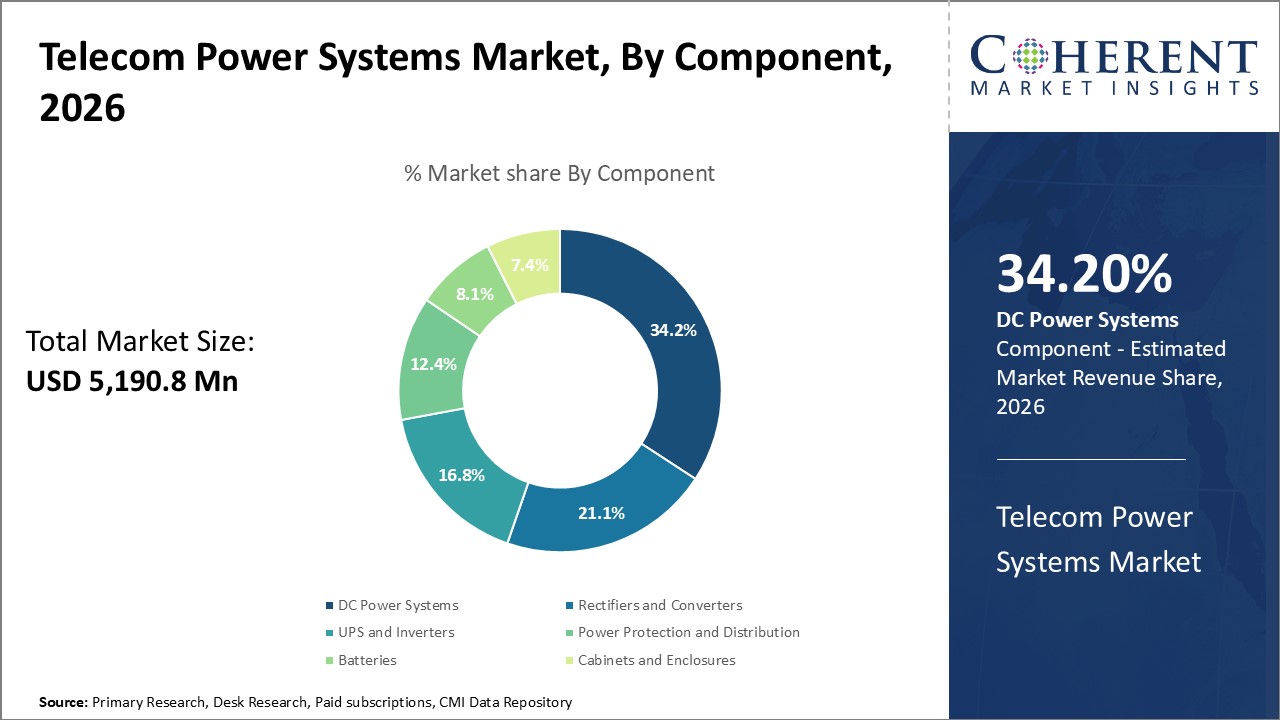
- Based on Component, the DC Power Systems segment is anticipated to account of the largest share of 34.2% for telecom power systems market in 2026, driven by their efficiency, reliability, and seamless integration with modern, hybrid energy solutions.
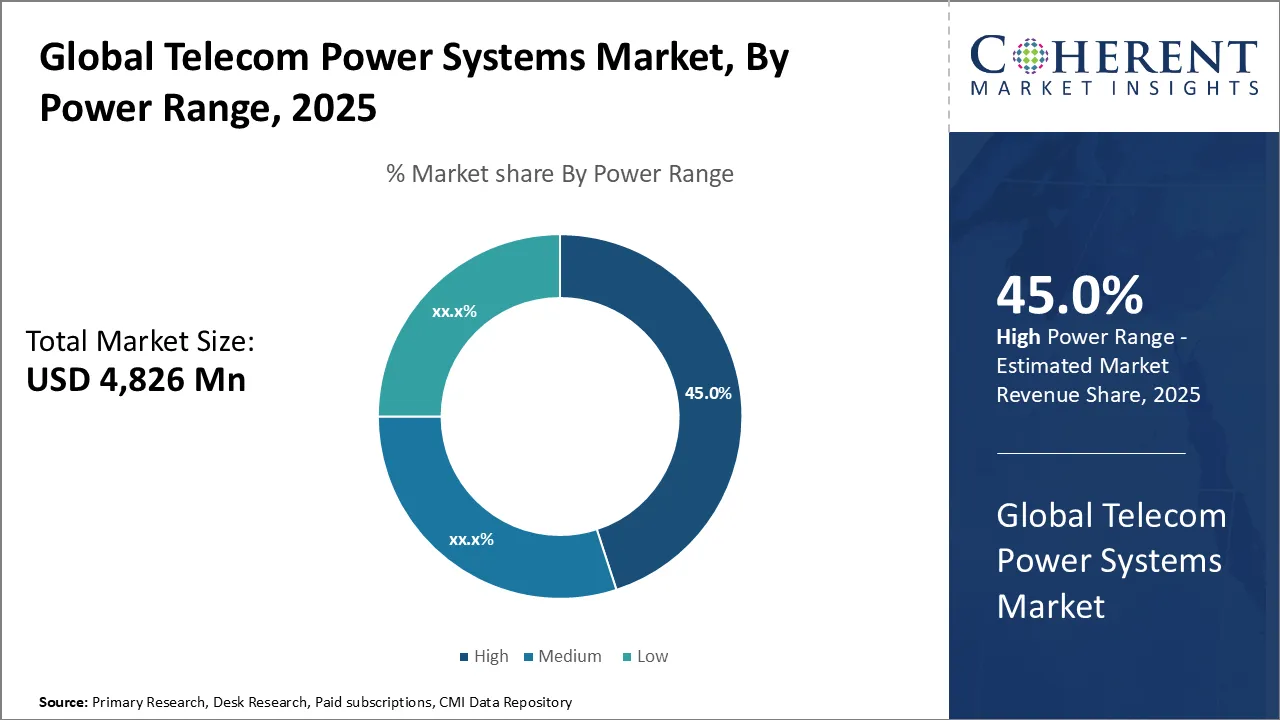
- Based on Power Range, the High segment is anticipated to hold the highest share of the global telecom power systems market in 2026, due to the growing complexity and scale of modern telecom networks.
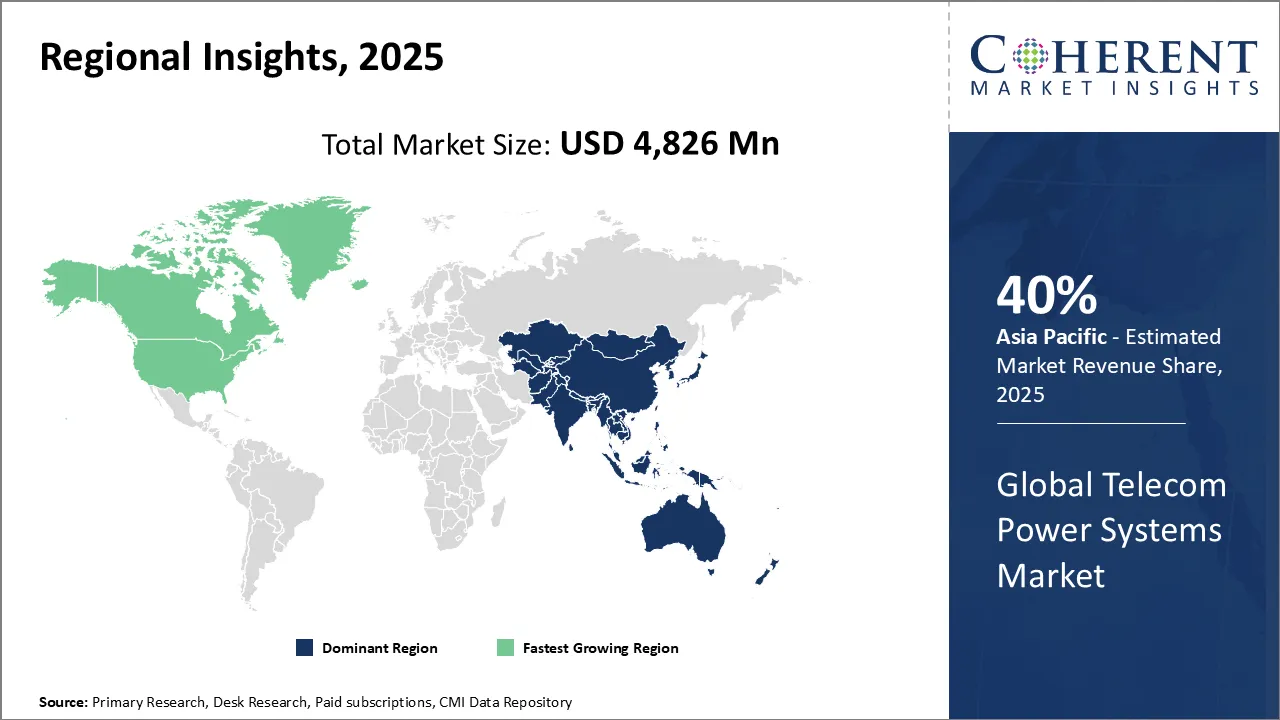
- Based on Region, Asia Pacific holds the largest market share of 40.0% for the telecom power systems market in 2026. While, North America is considered to be the fastest growing region of the market during the forecast period.
Market Overview
The telecom power systems market is set to grow rapidly, driven by the rising telecom service adoption, expanding 5G infrastructure, and increasing network demand in remote areas. As operators work to enhance coverage and reliability, the need for efficient and resilient power solutions is accelerating.
A key driver of telecom power systems market demand is the growing adoption of hybrid power systems, which combine solar, wind, and diesel sources to improve energy efficiency and reduce operational costs, especially in off-grid and rural regions. The shift toward sustainable and intelligent power infrastructure is expected to fuel strong market growth in the coming years.
Current Events and Its Impact
Current Event | Description and its Impact |
North American 5G Deployment Acceleration |
|
Regulatory and Investment Shifts |
|
General Power Range Classifications in Telecom
Power Range | Capacity | Use Case |
Low Power Range | Up to 2–3 kW | Small cells, indoor/urban micro base stations |
Medium Power Range | 3–10 kW | Macro towers, suburban installations |
High Power Range | Above 10 kW | Large macro towers, rural sites, multi-tenant tower setups |
- Current Industry Events of 2026
- Market Size Estimation
- Regional Breakdown
- Competitive Landscape
- Customer Intelligence
- Segmental Analysis
- Pricing Analysis
- Key Market Drivers, Challenges & Future Trends
- Customized Insights Section
Segmental Insights
Telecom Power System Market Insights, By Power Range
High Power Acquires the Largest Share owing to Growing Complexity and Scale of Modern Telecom Networks
In terms of power range, the high segment is expected to dominate the global market with highest share in 2026, due to growing complexity and scale of modern telecom networks. High-speed 4G and emerging 5G technologies require significantly more base stations, antennas, and data transmission equipment—all of which consume more power. High power systems ensure consistent performance across dense urban and large rural deployments. With rising mobile and internet usage, data centers and telecom towers need to handle heavier workloads, which increases overall power requirements. High power systems are essential to prevent outages and manage peak loads efficiently.
Modern telecom towers now host not only telecom equipment but also surveillance, edge computing, and IoT devices. This multi-equipment setup demands higher power capacities to maintain uninterrupted operations. To meet uptime requirements and regulatory standards, telecom operators deploy high-capacity power systems with built-in backup (e.g., batteries, diesel generators). High power ranges support longer backup durations and faster recovery.
In June 2025, State-owned telecom operator BSNL launched its 5G Fixed Wireless Access (FWA) solution in Hyderabad, marking its entry into the high‑power broadband segment. The system uses high‑frequency spectrum to deliver ultra‑fast internet directly to homes and enterprises without fibre, further supporting the telecom power systems market revenue.
Telecom Power System Market Insights, By Component
DC Power Systems Holds the Dominant share owing to Seamless Integration with Modern, Hybrid Energy Solutions
In terms of components, the DC Power Systems segment is expected to dominate the global market with a 34.2% share in 2026, driven by its efficiency, reliability, and seamless integration with modern, hybrid energy solutions. Most telecom equipment, such as base transceiver stations (BTS), routers, switches, and signal processing units, operates on DC power (typically 48V DC). Using a DC power system eliminates the need for AC-to-DC conversion, reducing power loss and improving efficiency. DC systems minimize conversion stages and related energy losses. This results in better energy efficiency compared to traditional AC systems, especially in off-grid or hybrid power setups where efficiency is critical for battery and solar integration. DC power systems offer more stable output and are less prone to electrical noise or surges. This stability is vital for telecom networks where uptime and consistent power are non-negotiable. DC systems pair easily with battery backup systems and renewable energy sources like solar panels, which naturally generate DC electricity. This enables smooth switching during power outages and supports hybrid energy models.
In July 2025, Delta Electronics launched its new SMART PDU I‑Type, a compact 1U DC power distribution unit designed for telecom operators, tower companies, and data centres. Equipped with up to 21 intelligent, programmable breakers and remote-management capabilities via Delta’s ORION or Smartpack Controller, it offers granular power oversight and real-time energy monitoring. The unit’s ultra‑slim form factor optimizes rack space while reducing on-site maintenance and operational costs. This is further adding to the telecom power systems market share.
Regional Insights
Asia Pacific Telecom Power System Market Analysis & Trends
Asia Pacific is expected to dominate the telecom power system market, holding an estimated 40% share in 2026, driven by rapid telecom sector development and the region's vast and growing customer base. Countries such as India, China, Australia, Japan, South Korea, and Singapore are significantly increasing their investments in 5G infrastructure to strengthen domestic connectivity. For instance, India’s Department of Telecommunications recently announced the next phase of 5G rollouts across rural areas, coupled with government-led initiatives to ensure uninterrupted network operations—further boosting demand for reliable power systems at telecom sites. According to telecom power systems market research, this regional momentum, combined with large-scale infrastructure upgrades, is expected to accelerate the adoption of advanced and hybrid power systems across the Asia Pacific region in the near future.
For instance, in July 2026, Vietnam deployed approximately 11,000 5G base stations, covering all provinces and cities and reaching around 26% of its population, according to the Authority of Radio Frequency Management.
North America Telecom Power System Market Analysis & Trends
North America is the fastest growing region. This is due to the early adoption of novel innovative technologies in the telecom sector of the region, as penetration of mobile and adoption of 5G is high in the region. The growing consumption of one 5G frequency balanced between 3.5kW and 4.5kW leads to shorter cell coverage and necessitates more tower deployments. This trend directly boosts the telecom power systems market growth as operators scale power infrastructure to maintain network performance and coverage.
In recent developments, telecom operators are integrating renewable energy and energy storage into power systems. For example, in October 2023, Aither Systems deployed its iQM550 energy storage system at a U.S. Tier‑1 carrier site, enabling three days of uninterrupted operation using solar-backed storage, which is a clear sign of demand for resilient and high-capacity systems.
North America’s dominance is further reinforced by sustained government support, including the FCC's 5G Fund for Rural America, which allocates billions for power infrastructure upgrades. These investments, coupled with widespread 5G spectrum deployment, make the U.S. account for over 84% of North America’s telecom power systems market in 2026.
Telecom Power System Market Outlook Country-Wise
India Telecom Power System Market Trends
India is witnessing strong demand for telecom power systems due to its rapid 5G rollout and rural connectivity initiatives like BharatNet. With a massive subscriber base and growing mobile data usage, reliable power infrastructure is critical, especially in areas with poor grid access.
In 2024, the government launched a plan to expand telecom services to over 24,000 uncovered villages, many of which lack electricity. This has led to increased adoption of off-grid and hybrid power systems, such as solar-diesel and solar-battery setups, to ensure network uptime and support sustainable connectivity in remote regions, further contributing to the telecom power system market demand in India.
China Telecom Power System Market Trends
China’s telecom power system market continues to dominate globally, driven by the 5G base station deployment, with over 3.5 million active sites as of 2026. This rapid expansion significantly increases energy demand, particularly for high-power 5G equipment like massive MIMO antennas and small cells. China is heavily investing in green and smart power systems. Telecom giants are adopting solar-diesel hybrids, lithium-ion batteries, and AI-powered energy management to improve efficiency and reduce emissions. This push aligns with national sustainability goals and is driving strong Telecom Power Systems Market demand in the country.
Market Report Scope
Telecom Power Systems Market Report Coverage
| Report Coverage | Details | ||
|---|---|---|---|
| Base Year: | 2025 | Market Size in 2026: | USD 5,190.8 Mn |
| Historical Data for: | 2020 To 2024 | Forecast Period: | 2026 To 2033 |
| Forecast Period 2026 to 2033 CAGR: | 7.6% | 2033 Value Projection: | USD 8,645.6 Mn |
| Geographies covered: |
| ||
| Segments covered: |
| ||
| Companies covered: | Schneider Electric SE, Eaton Corporation PLC, ABB Ltd., Huawei Technologies Co. Ltd., EnerSys, Cummins Inc., Delta Electronics Inc., Myers Power Products Inc., Efore, and Vertiv Co. | ||
| Growth Drivers: |
| ||
| Restraints & Challenges: |
| ||
Global Telecom Power Systems Market Drivers
Increasing expansion of telecom infrastructure to fuel the market growth
Due to increasing number of remote workers, the strain on communication infrastructure began to grow. Thus, providers of telecom services started to build enhanced telecom power systems in several regions. Thus, expansion of industry demand for advanced communication infrastructure led to increase in telecom power market expansion. Moreover, investments in telecom sector are increasing in various regions with increasing user base. For instance, as per the Department for Promotion of Industry and Internal Trade, during April 2000 to March 2021, the FDI inflow into the telecom sector was total USD 37.66 billion. Thus, growing expansion of telecom infrastructure is expected to drive growth of the global telecom power systems market over the forecast period.
Growing deployment of hybrid power systems in telecom sector to augment the market pace
The telecom industry is increasingly witnessing adoption of hybrid power for reducing cost of power system life-cycle and carbon emissions. The components of power conversion consist highest efficiency and are capable of gathering the most energy from renewable sources. For instance, Stealth Power, has partnered with Tower Solutions, a leading provider of mobile tower for expanding future work and collaboration. The mobile power solutions of Stealth Power will power the mobile towers of Tower Solutions. Such deployment of hybrid power systems in telecom sector is expected to fuel the global telecom power systems market demand during the forecast period.
Global Telecom Power Systems Market Opportunities
Growing awareness regarding carbon footprint of telecom industry, and growing expansion of telecom infrastructure in rural areas is expected to create multiple opportunities in the global telecom power systems market during the forecast period. Telecom sector involves businesses that increase feasibility of information transfer all over the world, through phone, internet, airways, cables, or wirelessly. The infrastructure of these companies allows to send the data anywhere across the globe through words, speech, video, or audio. The expansion of these companies is increasing all over the world, which in turn is expanding the telecom industry. This in turn is expected to drive the adoption of telecom power systems creating ample opportunities in the telecom power systems market.
Analyst Opinion (Expert Opinion)
The telecom power systems market value is undergoing a pivotal transformation, driven not merely by the expansion of mobile networks but by the increasing energy density and power efficiency requirements posed by next-generation network architectures.
The deployment of 5G infrastructure has introduced an entirely new power paradigm. Unlike 4G, which relied heavily on fewer, centralized macro towers, 5G densification demands significantly more small cells, edge data nodes, and micro base stations. Each of these components has specific power demands that challenge traditional rectifier and backup configurations. For instance, the power load per 5G base station has been observed to increase by 1.5–2× compared to LTE, especially in urban high-capacity zones. In such environments, power systems are expected to operate with >98% conversion efficiency to remain commercially viable.
Moreover, edge computing has exacerbated the spatial distribution of power needs. The latency-sensitive workloads processed at the network edge demand high-availability power solutions that are both compact and highly redundant. This has brought modular, lithium-ion-based DC systems into the spotlight. Operators in South Korea and Germany, for example, have begun deploying lithium-based power shelves with integrated thermal management systems, replacing bulky lead-acid arrays that underperform under variable environmental loads.
Another critical consideration is energy cost optimization. While energy constitutes 20–40% of telecom OPEX in many emerging economies, progressive operators have started leveraging AI-driven energy management platforms integrated into their power systems. MTN Group, operating across sub-Saharan Africa, has successfully trialed hybrid energy systems combining solar, diesel, and lithium storage, achieving a 32% reduction in diesel consumption across selected towers in Nigeria. These are not pilot deployments; they signal a maturing ecosystem wherein power resilience, remote management, and grid independence become essential but not optional features.
In parallel, regulatory pressure and ESG mandates are redefining telecom power procurement strategies. In Europe, operators such as Orange and Telefónica have pledged net-zero carbon emissions by 2040, spurring early investments in hydrogen fuel cell integration. The hybridization of telecom power, wherein DC power systems integrate solar inverters, fuel cells, and remote monitoring, will soon become a standard requirement rather than a value-added capability.
Speak to the analyst
Want personalized insights?
Take the findings above to one of our principal consultants, or have the report rebuilt around the segments, geographies and competitors you actually track.
Key Developments
- In March 2025, India unveiled a plug‑and‑play hydrogen fuel‑cell backup system powered by Proton Exchange Membrane Fuel Cells (PEMFC) to power telecom towers during grid outages. With over a million towers nationwide, especially in remote regions, the move aims to reduce reliance on diesel generators, cutting costs and carbon emissions.
- In November 2024, Delta Electronics EMEA unveiled its SMART PDU I‑Type, a compact 1U intelligent power distribution unit tailored for telecom operators, tower firms and data‑centre planners. Equipped with up to 21 programmable breakers and remote management via Delta’s ORION or Smartpack controllers, the unit enables precise monitoring, load prioritization and energy-based billing, optimizing power use and cutting operational costs.
- In May 2024, At the 8th Global ICT Energy Efficiency Summit, Huawei Digital Power introduced its new All‑Scenario Smart Telecom Power Solutions, designed for “one‑time deployment, ten‑year evolution”. The modular system delivers double the density of conventional setups and supports seamless capacity expansion and multi‑energy input/output.
- In February 2024, Ooredoo Group launched the GCC Innovation Hub for Power Solutions, a collaborative initiative across GCC telecom operators including e&, STC, Zain, Batelco, Omantel, du and industry giants like Huawei, Ericsson, Nokia, and Intel. Launched in Doha, the hub aims to pioneer cost-effective, sustainable energy solutions, leveraging solar, wind, battery storage, AI, and automation to alleviate rising fuel and power costs while advancing ESG goals.
Market Segmentation
- Global Telecom Power Systems Market, By Component (Revenue, USD Mn, 2021 - 2033)
- DC Power Systems
- Rectifiers and Converters
- UPS and Inverters
- Power Protection and Distribution (AVR, ATS, etc.)
- Batteries
- Cabinets and Enclosures
- Global Telecom Power Systems Market, By Power Range (Revenue, USD Mn, 2021 - 2033)
- High
- Medium
- Low
- Global Telecom Power Systems Market, By Geography (Revenue, USD Mn, 2021 - 2033)
- North America
- U.S.
- Canada
- Latin America
- Brazil
- Argentina
- Mexico
- Rest of Latin America
- Europe
- Germany
- U.K.
- Spain
- France
- Italy
- Russia
- Rest of Europe
- Asia Pacific
- China
- India
- Japan
- Australia
- South Korea
- ASEAN
- Rest of Asia Pacific
- Middle East
- GCC Countries
- Israel
- Rest of Middle East
- Africa
- South Africa
- North Africa
- Central Africa
- North America
- Key Companies Insights (Revenue, USD Mn, 2021 - 2033)
- Schneider Electric SE
- Eaton Corporation PLC
- ABB Ltd.
- Huawei Technologies Co. Ltd.
- EnerSys
- Cummins Inc.
- Delta Electronics Inc.
- Myers Power Products Inc.
- Efore
- Vertiv Co.
Sources
Primary Research Interviews from the following stakeholders
Stakeholders
- Interviews with telecom operators, energy infrastructure specialists, power system OEMs, data center facility heads, tower management firms, and utility integration teams across major regional markets.
Specific stakeholders
- Network operations heads at telecom giants
- Energy efficiency leads at hyperscale data centers
- Procurement and infrastructure heads at tower companies
- Field engineers and regional deployment managers for renewable telecom hybrid systems
- Grid and utility integration officers in remote/rural electrification projects
- Facility managers at mission-critical network hubs in urban and semi-urban zones
- Power system architects and product developers at equipment OEMs
Databases
- International Telecommunication Union (ITU) – Telecom Infrastructure Indicators
- UN Comtrade Database
- Ministry of Power (India) – National Power Portal
- International Energy Agency (IEA) – Off-grid & Telecom Power Statistics
- Eurostat – Energy Sector Reports
- China State Grid Corporation Statistics
- U.S. Energy Information Administration (EIA)
- Japan’s Agency for Natural Resources and Energy
- ASEAN Centre for Energy – ICT Power Reports
Magazines
- Telecom Review
- TowerXchange Journal
- Mobile Europe
- Energy Digital
- Power Systems Design
- Light Reading
- Smart Energy International
- Telecom Lead – Power and Infrastructure Section
Journals
- IEEE Transactions on Power Delivery
- IEEE Access – Telecom Energy Systems
- Energies (MDPI) – Special Issue on Hybrid Telecom Power
- Elsevier’s Renewable & Sustainable Energy Reviews
- International Journal of Power and Energy Conversion
- Journal of Telecommunications and Information Technology
Newspapers
- The Economic Times – Energy & Telecom
- The Hindu Business Line – Power Infrastructure
- Nikkei Asia – Grid and Telecom Tech
- Financial Times – Digital Infrastructure & Energy Reports
- South China Morning Post – Green Telecom Deployments
- Business Standard – Telecom Equipment & Power Section
Associations
- Global System for Mobile Communications Association (GSMA) – Energy for Telecoms Program
- International Telecommunication Union (ITU-T Study Group 5 – Environment and Climate Change)
- Power Electronics Society (PELS)
- Telecom Equipment and Services Export Promotion Council (TEPC), India
- Federation of Indian Chambers of Commerce and Industry (FICCI) – Power & Renewable Cell
- Association of Renewable Energy Agencies of States (AREAS)
- Smart Grid Coordination Group – European Telecommunications Standards Institute (ETSI)
Public Domain Sources
- Ministry of New and Renewable Energy (MNRE), India
- National Renewable Energy Laboratory (NREL), U.S.
- Ministry of Economy, Trade and Industry (METI), Japan
- U.S. Department of Energy – Office of Electricity
- Energy Efficiency Services Limited (EESL), India
- International Renewable Energy Agency (IRENA)
- Bureau of Energy Efficiency (BEE), India
- Reserve Bank of India (RBI) – Reports on Energy Sector Financing
Proprietary Elements
- CMI Data Analytics Tool, and Proprietary CMI Existing Repository of information for last 8 years
*Definition: The Telecom Power System is a key part of the telecommunication infrastructure, and it helps to manage and maintain electrical energy for the telecom network. Telecom Power Systems are an essential component of the telecommunication industry and play a key role in providing uninterrupted power to the telecom towers and base stations. This is done by utilizing rectifiers, batteries and power system controllers to secure telecommunication services in case of grid power interruptions and fluctuations.
Get access to 250+ pages report
Every segment, forecast, competitor profile and data table behind the analysis above — available for instant download.
- ESOMAR Member
- ISO 9001:2015 Certified
- D-U-N-S Registered
- GDPR & CCPA Compliant
Missing comfort of reading report in your local language? Find your preferred language:
Transform your Strategy with Exclusive Trending Reports
Frequently Asked Questions
The Telecom Power Systems Market is estimated to be valued at USD 5,190.8 Mn in 2026, and is expected to reach USD 8,645.6 Mn by 2033.
The CAGR of the Telecom Power Systems Market is projected to be 7.6% from 2026 to 2033.
Increasing expansion of telecom infrastructure and growing deployment of hybrid power systems in telecom sector are fueling the market.
The DC Power System segment is the leading component segment in the market.
High cost of deployment and operation and Environmental issues of telecom power supply systems are the major factors restraining growth of the market.
Schneider Electric SE, Eaton Corporation PLC, ABB Ltd., Huawei Technologies Co. Ltd., EnerSys, Cummins Inc., Delta Electronics Inc., Myers Power Products Inc., Efore, and Vertiv Co.
What are the primary components of a typical telecom power system? Rectifiers, batteries, power distribution units, solar modules, and generators form the core components of a telecom power system.