

Natural Language Generation Market Size and Share Analysis - 2026 To 2033
The global natural language generation market size is expected to reach USD 1,650 Mn in 2026 and USD 6,500 Mn by 2033, registering a compound annual growth rate (CAGR) of 22% during the forecast period (2026-2033). This can be attributed to increasing adoption of AI-powered content automation, rising demand for personalized customer communication, and growing use of natural language generation in industries like healthcare, finance, and e-commerce to improve efficiency and decision-making.
Key Takeaways from the Natural Language Generation Market Report
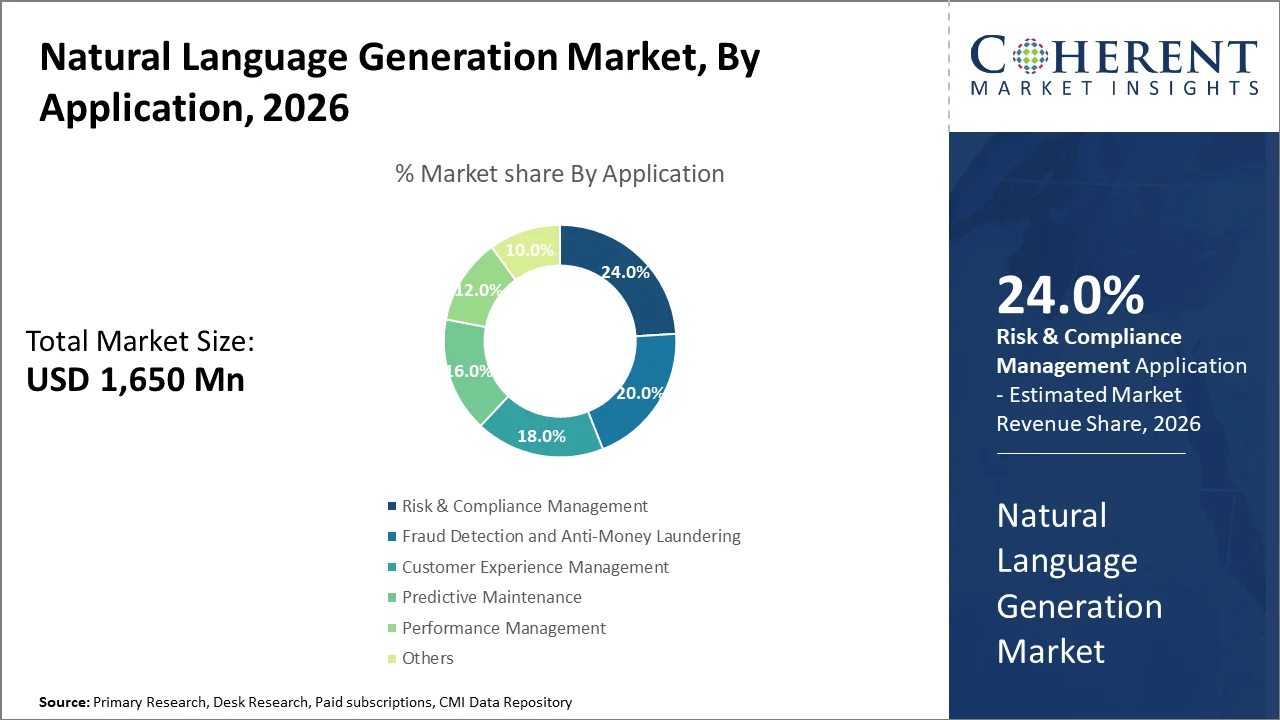
- Based on application, risk & compliance management segment is projected to lead the market with a share of 24% in 2026 due to regulatory reporting automation and financial analytics demand. For example, JPMorgan Chase uses its COiN AI platform to check legal documents automatically. This saves about 360,000 hours of manual work every year.
- By deployment, cloud segment is set to account for a prominent market share of more than 70% in 2026 because of scalability and SaaS adoption. For example, 45.2% of businesses in the European Union used cloud computing in 2023. This number increased to 52.7% in 2025.
- Based on vertical, BFSI segment is likely to hold the largest market share of 23% in 2026 due to heavy use in financial reporting, fraud analytics, and compliance automation. For example, almost 80% of organizations expect to invest in AI for financial crime compliance by 2026.
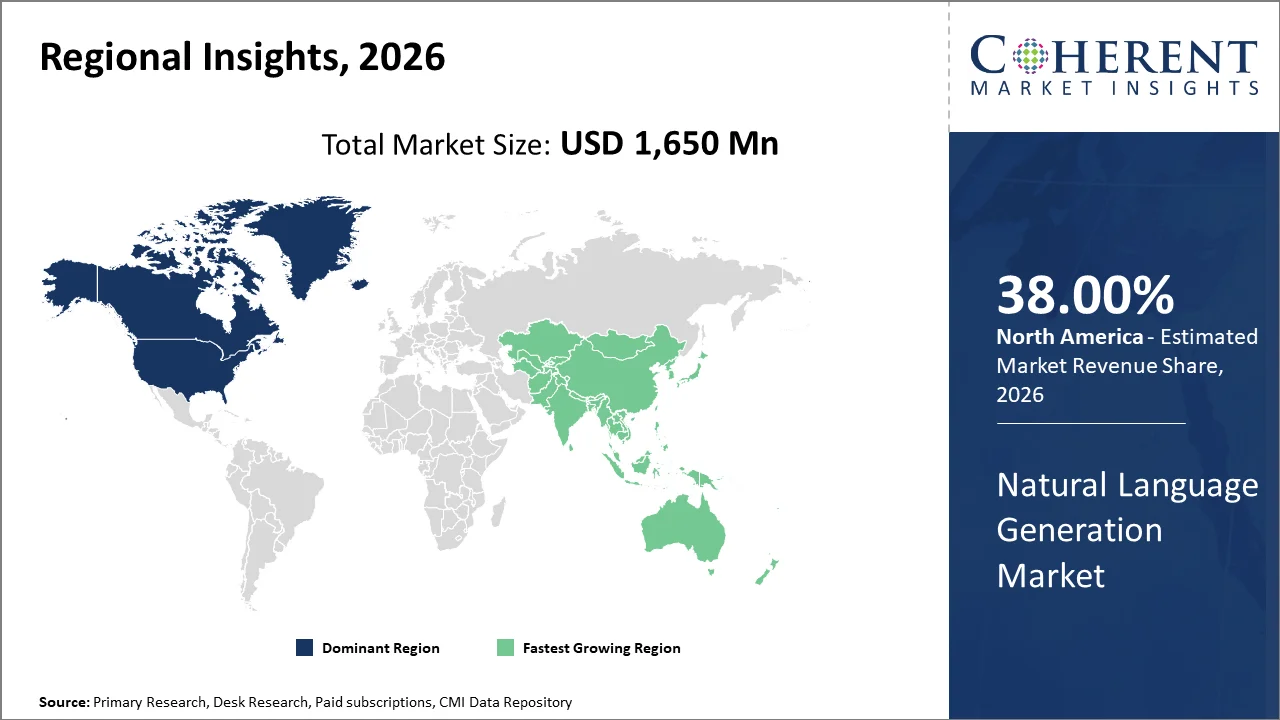
- North America is expected to retain its dominance over the global natural language generation industry with a share of 38% in 2026, owing to increasing AI adoption and presence of leading industry players.
- Asia Pacific, capturing a share of 25% in 2026, is poised to emerge as the fastest growing market for natural language generation solutions, thanks to rapid digitalization, rising adoption of AI, and increasing investments.
Natural Language Generation Market Overview
The global natural language generation market is projected to grow rapidly during the forecast period. This is due to increasing adoption of artificial intelligence (AI) and machine learning technologies across industries. Rising demand for real-time analytics, personalized communication, and automated reporting solutions in sectors such as BFSI, healthcare, retail, and media is also supporting NLG market growth.
Natural language generation (NLG) is a subfield of artificial intelligence that automatically transforms structured data into human-readable text. It is used to generate reports, summaries, and customized content for mobile applications as well as business systems. NLG is part of natural language processing (NLP), which covers both understanding and generating human language.
Advancements in artificial intelligence, machine learning, and deep learning models (including LLMs) have significantly improved the quality, fluency, and contextual accuracy of generated text. These technologies are the main base of modern NLG systems and are helping them spread faster across industries.
Explosive growth of enterprise data is fueling demand for natural language generation technologies. Organizations generate massive volumes of data from CRM systems, IoT devices, financial platforms, and digital channels. NLG tools help convert this complex structured and unstructured data into readable insights and reports. They have the tendency to make decision-making faster as well as more reliable.
Expansion of cloud-based deployment models, growing integration of NLG with business intelligence platforms, and advancements in deep learning and natural language processing (NLP) capabilities are creating significant opportunities for market expansion. However, challenges such as data privacy concerns, high implementation costs, and the need for domain-specific customization may slightly hinder the growth trajectory.
Segmental Insights
Which Application Segment Leads the Natural Language Generation Market?
Risk & Compliance Management Segment Leads the Market
According to Coherent Market Insights, risk & compliance management segment is set to account for the largest market share of 24% in 2026. This can be attributed to growing need for organizations to follow strict regulations, reduce compliance risks, and avoid penalties. Companies are increasingly using Natural Language Generation tools to automatically create accurate reports, monitor regulatory changes, and ensure timely compliance documentation, which improves efficiency as well as reduces manual effort.
- Current Industry Events of 2026
- Market Size Estimation
- Regional Breakdown
- Competitive Landscape
- Customer Intelligence
- Segmental Analysis
- Pricing Analysis
- Key Market Drivers, Challenges & Future Trends
- Customized Insights Section
Why Are Cloud-Based Solutions Gaining Popularity in the Market?
Scalability and Cost Efficiency Drive Adoption of Cloud-Based NLG Tools
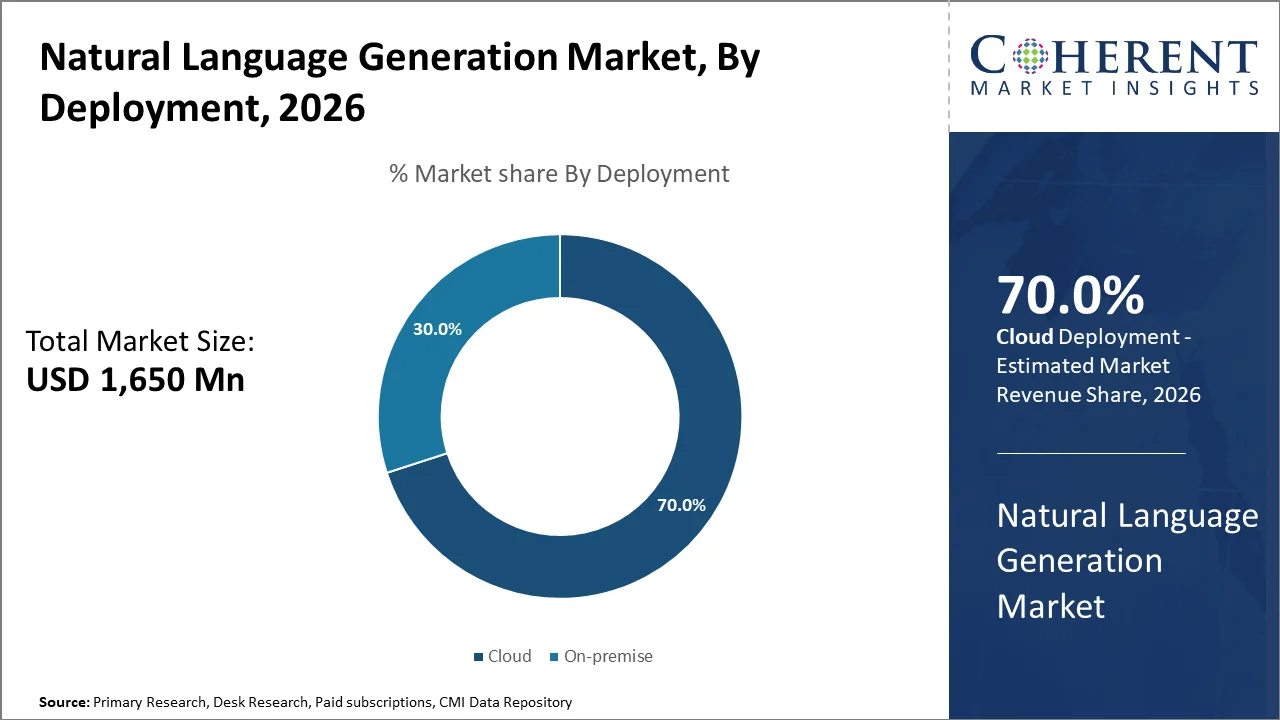
According to Coherent Market Insights’ latest natural language generation market analysis, cloud segment is expected to dominate the market, capturing a share of 70% in 2026. This is due to increasing preference among enterprises for flexible, on-demand computing resources that reduce upfront infrastructure costs and eliminate the need for heavy on-premise maintenance.
Cloud-based NLG platforms also enable seamless scalability, allowing organizations to process large volumes of data and generate real-time insights without performance limitations. Moreover, rising adoption of AI-driven analytics across industries such as BFSI, healthcare, and retail is accelerating cloud deployment. This is because these sectors require faster integration, remote accessibility, and continuous model updates.
Natural Language Generation Market Growth Drivers
Growing Need for Understanding Customer’s Behavior
Rising need to understand customer behavior is expected to boost growth of natural language generation (NLG) market during the forecast period. Organizations in the contemporary world increasingly use data analytics and AI-driven tools to analyze consumer behavior and preferences, enabling more targeted marketing strategies and improved customer engagement.
NLG solutions help automate the creation of personalized content, such as product descriptions and marketing messages, based on customer data and segmentation models. These systems also improve operational efficiency by reducing the time spent on routine content generation tasks. In addition, NLG supports multilingual content generation, enabling businesses to scale communication across global markets.
Rising Penetration of Big Data and Advanced Analytics Platforms
The growing reliance on big data analytics across enterprises is significantly driving the adoption of natural language generation (NLG) solutions. Organizations are increasingly processing large volumes of structured and unstructured data to derive real-time, actionable insights, creating a need for automated tools that can simplify complex analytical outputs. NLG technologies address this requirement by transforming data-driven insights into clear, human-readable narratives that enhance business intelligence workflows.
As enterprises increasingly deploy analytics platforms such as SAP, Tableau, and Qlik, NLG is being integrated to streamline reporting processes and improve data interpretability across non-technical users. This reduces dependency on manual reporting as well as enhances operational efficiency and supports faster decision-making cycles. Thus, the global NLG market forecast appears bright as a result of expanding use of big data ecosystems across industries such as BFSI, retail, and healthcare.
Natural Language Generation Market Opportunities
Rising Adoption Across Emerging Applications
Expanding application areas are creating lucrative growth opportunities in the global natural language generation market. Natural language generation is being used across various applications such as automated editorial content creation, e-commerce content generation, chatbot development, and financial reporting automation.
Among these, chatbots represent one of the most prominent applications of NLG, where systems are designed to interact with users in a natural and conversational manner. Advanced chatbots leverage NLG to generate human-like responses, improving user engagement and interaction quality. As NLG technologies continue to evolve, their adoption across diverse industries is expected to increase significantly.
Natural Language Generation Market Trends
Increasing R&D in NLG solutions
Key market participants are investing in research and development to enhance the capabilities of natural language generation systems, particularly in improving language accuracy, contextual understanding, and domain-specific applications. These advancements are expanding NLG adoption across sectors such as weather forecasting, journalism, healthcare documentation, and financial reporting.
Rising Adoption of NLG in Marketing and Analytics
NLG is increasingly being integrated into marketing and business intelligence platforms to automatically convert structured data into readable insights. This enables faster interpretation of sales and marketing analytics by generating human-like narratives from dashboards, reports, and performance metrics, improving decision-making efficiency.
Current Events and Their Impact on the Natural Language Generation Market
Current Event | Description and its Impact |
Enterprise rollout of AI systems for automated writing and reporting |
|
Rise of AI agents for automated enterprise communication |
|
Regional Insights
North America Leads NLG Market with 38% Share in 2026
North America is expected to dominate the global natural language generation market, accounting for a share of 38% share in 2026. Increasing adoption of artificial intelligence, widespread cloud infrastructure, and heavy use of automation in finance, healthcare, and customer engagement are some key factors driving North America natural language generation market growth.
Increasing deployment of AI-driven reporting tools, rising demand for real-time business intelligence, and integration of NLG in enterprise software platforms are supporting market expansion. The presence of major technology companies such as Microsoft, IBM, Amazon Web Services, and Google also accelerates commercialization of NLG solutions across industries.
Enterprises across North America are increasingly adopting AI technologies for productivity and automation use cases. According to OECD data, around 40% of large firms across OECD countries have adopted AI technologies, compared with about 12% of small firms. This enterprise-scale adoption is directly increasing demand for NLG tools that convert structured data into automated narratives, especially in financial reporting, insurance claims processing, and customer analytics dashboards.
Asia Pacific Becoming a hub for Natural Language Generation Solution Providers
Asia Pacific is anticipated to emerge as a highly lucrative market for natural language generation tool providers, holding a global market share of 25% in 2026. This is attributed to rapid digital transformation, an expanding IT services sector, and rising demand for multilingual AI-generated content.
Industries like e-commerce, banking, and telecommunications across Asia Pacific are increasingly adopting artificial intelligence to enhance productivity and reduce costs, thereby fueling demand for natural language generation solutions. In addition, the growing outsourcing of content automation services, along with government-backed investments in artificial intelligence infrastructure across countries such as China, India, Japan, and South Korea, is further supporting market growth.
Natural Language Generation Market Outlook – Country-wise
U.S. Natural Language Generation Market Trends
The United States is expected to remain a leading market for natural language generation tools during the assessment period. This is due to increasing adoption of AI, ML, and Large Language Models across industries such as BFSI, healthcare, retail, and IT.
Big enterprises across the United States are using AI in business processes, especially for text generation, analytics narration, and customer service automation. This strong enterprise-level adoption is directly driving demand for NLG solutions across industries requiring high-volume, structured content generation.
China Natural Language Generation Market Forecast
China’s natural language generation market is witnessing strong growth due to rapid digital transformation, expansion of AI infrastructure, and wide adoption of intelligent automation across e-commerce, finance, telecom, and government services. Increasing use of AI-driven content generation for digital platforms, rising demand for multilingual customer engagement tools, and growing integration of NLG in large-scale digital ecosystems such as e-commerce marketplaces as well as fintech applications are also supporting market growth.
China has one of the world’s largest internet user bases, with over 1.1 billion internet users, creating strong demand for automated content generation in areas such as product descriptions, chatbots, and customer support systems. This large-scale digital activity is encouraging companies to adopt NLG solutions to efficiently manage high-volume, real-time content creation across multiple platforms and languages.
Who are the Major Companies in the Natural Language Generation Market?
Some of the major players in Natural Language Generation Market are Retresco, Narrative Science, AX Semantics, IBM Corporation, Artificial Solutions, Yseop, Narrative Science, CoGenTex, Inc., ARRIA NLG plc, Automated Insights, Inc., and Phrasetech.
Key Strategies Adopted by Industry Players
Leading players in the Natural Language Generation market are focusing on improving AI model accuracy and integrating advanced large language models to generate more human-like and context-aware text. Companies are also strengthening cloud-based deployment to ensure scalability and real-time data processing for enterprise users. Similarly, vendors are developing industry-specific NLG solutions for sectors such as finance, healthcare, and e-commerce to improve relevance and adoption across different use cases. For example,
- In April 2025, Nintex introduced new generative AI features in its automation platform. These features allow users to create processes, workflows, forms, and system integrations using simple natural language prompts.
- In March 2025, Phrase introduced new AI features for global content. These features help users create and adapt content for different languages more easily.
- In December 2024, Arria announced an updated enterprise AI platform. It combines its rules-based language technology with ChatGPT-style AI to generate accurate data-driven narratives.
Market Report Scope
Natural Language Generation Market Report Coverage
| Report Coverage | Details | ||
|---|---|---|---|
| Base Year: | 2025 | Market Size in 2026: | USD 1,650 Mn |
| Historical Data for: | 2020 To 2024 | Forecast Period: | 2026 To 2033 |
| Forecast Period 2026 to 2033 CAGR: | 22% | 2033 Value Projection: | USD 6,500 Mn |
| Geographies covered: |
| ||
| Segments covered: |
| ||
| Companies covered: | Retresco, Narrative Science, AX Semantics, IBM Corporation, Artificial Solutions, Yseop, CoGenTex, Inc., ARRIA NLG plc, Automated Insights, Inc., and Phrasetech. | ||
| Growth Drivers: |
| ||
| Restraints & Challenges: |
| ||
Analyst Opinion (Expert Opinion)
- Over 80% of enterprise data is unstructured (emails, documents, text, logs), creating the core raw material that NLG systems are designed to convert into readable insights.
- Global data creation is projected to reach over 180 zettabytes by 2025, increasing demand for automated text generation tools that can summarize and explain large-scale datasets.
- Studies show that language models can reduce document drafting time by up to ~50% in knowledge work tasks, especially in reporting and summarization workflows using AI writing systems.
- Around 33% of business tasks in knowledge industries involve text generation or communication-heavy work, which is the primary automation target for NLG systems. This is further propelling the demand for natural language generation.
Speak to the analyst
Want personalized insights?
Take the findings above to one of our principal consultants, or have the report rebuilt around the segments, geographies and competitors you actually track.
Market Segmentation
- By Application Insights ( Revenue, USD Mn, 2021 - 2033)
- Fraud Detection and Anti-Money Laundering
- Predictive Maintenance
- Risk & Compliance Management
- Performance Management
- Customer Experience Management
- Others
- By Deployment Insights ( Revenue, USD Mn, 2021 - 2033)
- On-premise
- Cloud
- By Organization Size Insights ( Revenue, USD Mn, 2021 - 2033)
- SME’s
- Large Enterprises
- By Vertical Insights ( Revenue, USD Mn, 2021 - 2033)
- BFSI
- Retail and Ecommerce
- Government and Defense
- Healthcare and Life Sciences
- Manufacturing
- Telecom and IT
- Media and Entertainment
- Energy and Utilities
- Others
- By Region Insights ( Revenue, USD Mn, 2021 - 2033)
- North America
- U.S.
- Canada
- Latin America
- Brazil
- Argentina
- Mexico
- Rest of Latin America
- Europe
- Germany
- U.K.
- Spain
- France
- Italy
- Russia
- Rest of Europe
- Asia Pacific
- China
- India
- Japan
- Australia
- South Korea
- ASEAN
- Rest of Asia Pacific
- Middle East & Africa
- GCC Countries
- Israel
- Rest of Middle East & Africa
- North America
Sources
Primary Research interviews
- Interviews with industry experts, IT decision-makers, enterprise AI/ML engineers, NLP solution architects, and data science professionals across key end-use industries such as BFSI, healthcare, retail, and media & entertainment.
Databases
- IEEE Xplore Digital Library
- ACM Digital Library
- SpringerLink
- ScienceDirect
- PubMed
- Google Dataset Search
- UCI Machine Learning Repository
Magazines
- MIT Technology Review
- Wired
- Forbes Tech
- CIO Review
- InformationWeek
- TechCrunch
Journals
- Journal of Artificial Intelligence Research (JAIR)
- IEEE Transactions on Neural Networks and Learning Systems
- Natural Language Engineering Journal
- ACM Transactions on Information Systems
Newspapers
- The Wall Street Journal
- Financial Times
- The New York Times (Technology section)
- The Guardian (Tech section)
- The Economic Times (Tech/AI coverage)
Associations
- Association for Computational Linguistics (ACL)
- IEEE Computer Society
- ACM (Association for Computing Machinery)
- National Institute of Standards and Technology (NIST – NLP-related publications)
Public Domain sources
- World Bank Open Data
- OECD AI Policy Observatory
- arXiv preprints
- GitHub repositories (open-source NLP/NLG frameworks)
- Government open data portals
Proprietary Elements
- Data Analytics Tool
- Proprietary CMI Existing Repository of information for last 8 years
Get access to 250+ pages report
Every segment, forecast, competitor profile and data table behind the analysis above — available for instant download.
- ESOMAR Member
- ISO 9001:2015 Certified
- D-U-N-S Registered
- GDPR & CCPA Compliant
Missing comfort of reading report in your local language? Find your preferred language:
Transform your Strategy with Exclusive Trending Reports
Frequently Asked Questions
The global NLG market size is estimated to be valued at USD 1,650 Mn in 2026.
The global Natural Language Generation Market value is expected to reach USD 6,500 Mn by 2033.
The global market is poised to exhibit a CAGR of 22% from 2026 to 2033.
Major growth factors include rising adoption of AI, ML, and Large Language Models (LLMs), increasing data generation, and growing demand for hyper-personalization.
Risk & compliance management segment is expected to lead the market with a share of 24% in 2026.
Some major companies in the Natural Language Generation Market include Retresco, Narrative Science, AX Semantics, IBM Corporation, Artificial Solutions, Yseop, Narrative Science, CoGenTex, Inc., ARRIA NLG plc, Automated Insights, Inc., and Phrasetech.
North America, with 38% share in 2026, is set to lead the market during the forecast period.