This rapid growth also means telecom operators will face a wider range of AI investment opportunities. As the number of potential applications increases, the challenge is increasingly about prioritizing the use cases that can deliver measurable business value with manageable data, implementation, and operational risks, rather than simply identifying where AI can be applied.
AI in Telecommunication Market Trends Shaping Use-Case Adoption
Three major trends are influencing how telecom operators evaluate and deploy AI.
1. Growing Adoption of AI for Network Optimization and Automation
Telecom networks are becoming more complex as operators expand 5G infrastructure, connected devices, cloud-native networks, as well as software-defined architectures. AI can analyze network data, identify congestion, detect anomalies, with supporting automated resource allocation.
This trend increases the potential value of network optimization and automation, but at the same time raises implementation and operational risks. Use cases that can demonstrate measurable improvements in network performance with limited deployment scope may therefore rank higher than projects requiring immediate autonomous control of live networks. Controlled pilots, human oversight, and clear performance measures become important when comparing network AI investments.
However, the market impact depends heavily on implementation readiness. AI that recommends network changes to engineers presents a different risk profile from AI that automatically changes live network parameters. As a result, operators increasingly need controlled pilots and human oversight before moving toward autonomous network operations.
2. Increasing Use of AI for Customer Analytics
Telecom companies has large amounts of customer, network, billing, and usage data. Machine learning can aid identify churn patterns, understand customer behavior, personalize offers, as well as improve service interactions.
The high use of customer analytics expands AI opportunities apart from network operations and creates additional use cases across customer experience, retention, fraud management, and revenue protection. These applications can usually be tested on defined customer groups, making their financial and operational outcomes simple to measure. Hence, data availability, measurable customer outcomes, as well as the ability to run contained pilots become important factors when ranking customer centric AI projects.
3. Rising Demand for AI-Enabled Cloud and Data Infrastructure
AI applications needs reliable access to large volumes of data and sufficient computing infrastructure. Telecom operators therefore need cloud platforms, data pipelines, system integration, security controls, as well as real-time data access alongside AI models.
This trend means the feasibility of an AI project depends not only on the model but also on the infrastructure required to deploy it. A use case with strong projected returns may rank below a smaller project if it requires extensive legacy-system integration, data engineering, or infrastructure upgrades. Operators therefore need to include data readiness, implementation cost, system complexity, and deployment time when determining which AI use cases should move into pilot or production.
AI in Telecommunication Market Segmentation and Telecom AI Use-Case Analysis
For evaluating telecom AI use cases, the market can be viewed through two major classifications: technology and application. These segments provide context for the types of AI capabilities available to telecom operators and the business areas in which those capabilities are being deployed. However, segment size alone does not determine which use case should receive investment priority.
By Technology
Machine Learning
Natural Language Processing
Others
Machine learning held 44.2% of the AI in telecommunication market size in 2026, making it the leading technology segment. Its adoption is being fueled by growing network complexity, increasing volumes of customer and operational data, 5G deployment, as well as the need for predictive decision-making. Machine learning is used across applications such as customer analytics, predictive maintenance, fraud detection, network optimization, forecasting, etc., giving it high relevance in telecom operations.
Despite its leading market position, machine learning adoption does not automatically make every machine-learning application a priority for telecom operators. Investment decisions also depend on data availability, accountable business outcomes, execution of requirements, and operational risk. This distinction highlights how strong market adoption can create a broad pool of opportunities at the same time requiring operators to prioritize individual use cases based on their ability to deliver measurable value.
By Application
Customer Analytics
Network Security
Others
Customer analytics accounted for 27.98% of the AI in telecommunication market size in 2026, reflecting the growing use of AI to understand customer behavior, improve customer experience, support retention, and identify commercially relevant patterns.
Network optimization and predictive maintenance focus more heavily on network and asset operations, while fraud detection, billing automation, and customer support address commercial, financial, and customer-facing processes. Telecom operators have access to extensive customer interaction, usage, billing, and service data, creating opportunities to apply AI across these areas.
Customer analytics provides a useful example of how an AI application can be evaluated through a controlled business case. For example, an operator could test an AI-driven churn model within a defined customer group and measure retention outcomes before expanding deployment. This makes data availability, measurable financial impact, pilot scope, and implementation feasibility important considerations when ranking customer-focused AI projects. A use case with a smaller market opportunity but stronger evidence and lower implementation complexity may therefore be a more practical first investment than a larger but harder-to-validate project.
Define the Decision Before Comparing AI Projects
Translate each proposal into an operational problem
"Deploy AI in customer service" is too vague to score. Draw the workflow boundary first. Name the affected process and population, document the current baseline, spell out the proposed intervention, and put a business owner on the hook for the operating outcome.
- Network optimization: Reduce congestion-related degradation in chosen cells.
- Predictive maintenance: Flag equipment at risk of failing within a set maintenance window.
- Fraud detection: Catch suspicious subscriptions or transactions before money moves.
- Billing automation: Cut invoice exceptions and reconciliation work.
- Customer support: Improve first-contact resolution for a defined set of inquiries.
Kevin Dam and the team at Circles maintain a telecom-focused educational guide to AI use cases in telecom that maps each common application to the operational considerations behind it. The guide ties network optimization, predictive maintenance, fraud detection, billing automation, and intelligent customer support to data infrastructure and implementation cost, and it takes on privacy and legacy constraints directly. Circles CTO Kannan Alagappan puts the legacy problem plainly: "Telcos have had to rely on legacy systems to process data in batch modes, which introduces latency and inefficiencies." Read it to build a shortlist, then apply the scoring method below.
Rank AI Use Cases in Telecom With a Six-Step Process
Rank candidates by stating one measurable problem per use case and checking data readiness. Price the full implementation before scoring expected value, apply risk penalties, then fund the highest-scoring project that can show value in a controlled pilot.
1. Establish the baseline and business owner
Name an accountable executive and an operating owner who can authorize workflow changes. Build the baseline on a defined population and observation period. A fraud proposal might use confirmed losses; a support proposal might use cost per contact. Keep the evidence comparable. An incomplete baseline or calculations that shift between business units undermine any credible claim of incremental value.
2. Test data readiness before estimating model performance
Check that the required records exist and are complete enough. Confirm permitted use and access at the latency you need. Historical data feeds training and validation; live data supplies predictions and actions; outcome data shows whether those actions worked; these are three separate requirements. Archived support conversations do not, by themselves, carry reliable resolution labels.
Score readiness low when essential labels are missing or customer identifiers cannot be reconciled. Batch-oriented records earn a low score too when the intervention needs immediate decisions. Demand a tested data sample, not a promise of future access.
3. Calculate the full implementation cost
Split one-time deployment costs from recurring operating expenses. Deployment covers data engineering and cleansing plus connections to operational and business support systems. Fund the security and privacy reviews, the process redesign, and the training before production use.
Recurring expenses cover cloud infrastructure and compute, storage, and licensing. Add monitoring and ongoing model governance. False positives cost money too: investigators burn hours reviewing legitimate activity. Fold missed detections and incorrect automated actions into the estimate, with explicit frequency assumptions.
4. Score expected business value
Evaluate each use case on expected financial value, operational impact, data readiness, feasibility, risk, and time to a measurable result. Every score needs an operating baseline or a documented assumption. Measurability earns its own grade, because a plausible benefit can still resist attribution.
Estimate revenue protected or generated, then subtract recurring delivery costs. Assess avoided operating expense and outage costs without double-counting overlaps. Record customer impact separately. Shared capabilities may seed later AI use cases for telecom operations, but speculative reuse should never outweigh measurable pilot value.
5. Apply feasibility and risk penalties
Weigh privacy exposure and cybersecurity alongside model error. Look at regulatory consequences, vendor dependence, interface complexity, and automation scope. A high-value proposal can rank below a smaller project when failure could interrupt service or wrongly alter customer accounts.
Use a five-point scale: 1 means weak or unacceptable evidence, 3 means workable with material remediation, 5 means strong and validated. Reverse-score risk so greater danger lowers priority: a raw risk rating of 4 becomes a readiness score of 2.
6. Calculate the weighted priority score
Agree on weights before departments submit final scores. The illustrative model below assigns the largest single weight to value while keeping separate tests for evidence and delivery readiness. Every candidate gets the same weights.
|
Criterion
|
Weight
|
Evidence required
|
|
Expected financial and operational value
|
25%
|
Baseline financial or service measure
|
|
Measurability of the expected benefit
|
15%
|
Observable outcome and attribution method
|
|
Data readiness
|
20%
|
Usable records with tested access and latency
|
|
Implementation feasibility
|
15%
|
Validated interface effort and workflow fit
|
|
Risk and governance readiness
|
15%
|
Documented controls and reversible actions
|
|
Time to first measurable result
|
10%
|
Realistic pilot and deployment timeline
|
Multiply each one-to-five score by its decimal weight and add the results. An illustrative billing pilot, in the table's criterion order:
Priority score: (4 × 0.25) + (5 × 0.15) + (4 × 0.20) + (4 × 0.15) + (4 × 0.15) + (5 × 0.10) = 4.25 out of 5.
A large theoretical benefit does not offset weak delivery. Set hard thresholds: no project proceeds with a privacy-approval or outcome-measurement score of 1. Then test whether a one-point shift in an uncertain assumption flips the ranking.
Compare the Strongest Telecom AI Candidates on Equivalent Evidence
Network and asset applications
Network optimization and predictive maintenance often share telemetry and alarms. Performance counters and equipment histories feed both, though their validation requirements differ. Optimization can target congestion or latency, with dropped-session rates and throughput supplying corroborating evidence. Energy consumption matters when service quality remains protected.
Changing live network parameters carries heavier consequences than recommending changes to engineers. Run advisory mode before autonomous control. Predictive maintenance needs a long enough history linking asset conditions to confirmed failures; inconsistent records weaken the labels, and rare failures can leave too few events to validate credibly inside the pilot window.
Commercial and customer applications
Fraud detection can protect revenue fast, but false positives may block legitimate customers. Billing automation produces auditable savings, though legacy billing connections can dominate deployment cost. Weigh both against customer support on expected error costs and the staff hours needed to review exceptions.
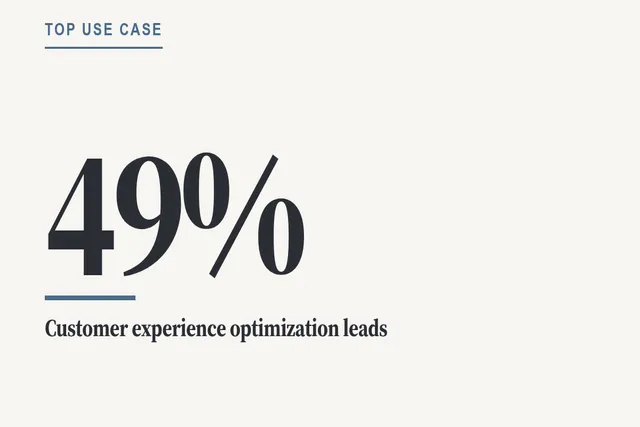 Nearly half of telecom respondents named customer experience optimization the most popular AI use case.
Popularity is not priority. Support offers abundant interaction data and a visible pilot boundary, yet deflection volume proves nothing about successful resolution.
The best AI use cases for telecom companies are not universal. A strong first candidate has accessible data, a measurable operating outcome, manageable system connections, and a failure mode you can contain during a pilot.
Choose the First Pilot and Define Its Measures
Select a pilot with measurable boundaries
Begin with the highest-ranked use case that has a reliable baseline, usable data, a contained deployment area, and a result you can measure within the test period. The largest projected return should never override missing evidence or unacceptable operational risk.
Pick one network region or equipment class, never the whole estate. Commercial pilots can cover a single fraud type or billing exception category. A support pilot can address a limited inquiry set. Assign an owner and rehearse the rollback before launch.
Match each use case to a primary outcome
Give every telecom AI use case one primary operating outcome, and define acceptance thresholds before implementation. Network optimization tracks downtime and congestion; watch latency, service quality, and intervention frequency too.
Predictive maintenance should estimate avoided failures against a comparison group, measuring warning precision, maintenance lead time, and emergency repair cost. Fraud detection tracks prevented loss and detection precision; the false-positive rate and investigation time expose customer impact and review workload.
Billing automation should measure billing accuracy and exception volume, checking processing time and disputed charges before any expansion. Customer support tracks resolution time and first-contact resolution, with escalation rate and repeat contact as quality checks. Assess churn in the affected cohort over a long enough observation window.
Use control groups and stage gates
Compare the pilot population against a similar untreated group or a defensible historical baseline. Record traffic and staffing shifts that could distort the comparison. Pricing changes, maintenance schedules, and customer mix need explicit treatment in the attribution method.
Then move through five gates: data and governance readiness, offline validation, advisory or shadow mode, limited human-approved actions, and expansion only after operational and financial thresholds are met. Each gate names an approving owner and the required evidence. Offline testing uses records excluded from training, preferably from a later period when that mirrors the intended deployment.
Define stop conditions before launch
Set stop conditions early. Halt for a material service breach or a privacy-control failure. Stop spending once the approved cost ceiling is exceeded, and freeze expansion if outcomes cannot be attributed. When stopping a pilot, document the reason and decide whether to remediate or withdraw funding.
U.S. AI in Telecommunication Market: Adoption Trends and AI Use-Case Priorities
The U.S. is an important market for telecom AI adoption because operators are managing increasingly complex networks while investing in cloud infrastructure, automation, 5G, and data-driven customer services. The country also has a mature technology ecosystem, providing access to AI platforms, cloud infrastructure, network technology, and specialized analytics capabilities. These conditions support adoption across both network and customer-facing applications. The broader market outlook is reinforced by growing use of machine learning for network optimization, predictive analytics, customer churn, fraud detection, and automation. North America has historically been a strong region for telecom AI adoption, supported by early uptake of AI technologies and established digital infrastructure.
For U.S. operators, however, the investment decision still depends on practical implementation factors. Legacy infrastructure, cybersecurity, data governance, and the availability of skilled AI and telecom professionals can affect deployment timelines and costs. This makes controlled pilots particularly relevant in the U.S. market, where operators can test AI applications within defined network regions, customer groups, or operational workflows before committing to broader deployment.
Resolve the Problems That Distort AI Rankings
Legacy systems make an inexpensive model costly
Model development can be a small slice of spend when records must be pulled from fragmented operating and billing systems. Estimate the work at each interface and each affected workflow; skip the single "complexity rating." A narrow billing or support pilot can outrank network automation precisely because it demands fewer production changes.
Privacy controls should change the design, not trail it
Specify purpose limitations and role-based access before requesting production records. Minimize collected data and set retention rules. Require audit trails and human review wherever decisions could materially affect customers. The NIST AI Risk Management Framework offers a recognized governance reference; operational approval still demands controls suited to the proposed use and the applicable jurisdiction.
Unclear returns usually mean a weak baseline
A Business Wire report carried by Morningstar found 97% of telecom executives expected major productivity and operational gains within five years, while talent and operating-model gaps threatened delivery. Expectation is not return. Released capacity becomes a financial benefit only when the operator documents plans to redeploy it or convert it into avoided spend.
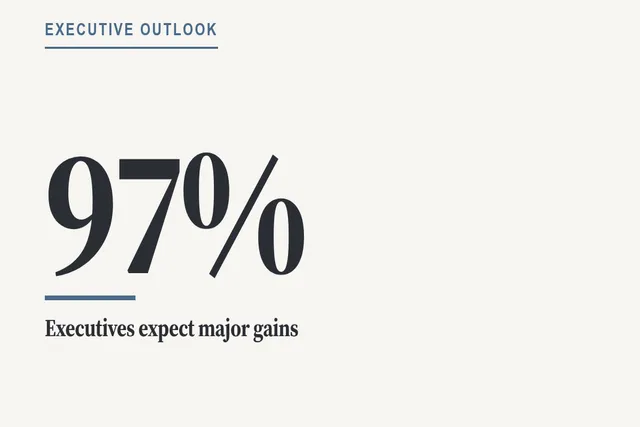 Most telecom executives expected major productivity and operational gains within five years.
Talent constraints belong in the feasibility score
Data engineering skills differ from telecom-domain validation. Model operations and security review need their own accountable specialists, as does workflow redesign. Cut the feasibility score when scarce expertise has no committed allocation or internal owner. Vendor help does not replace an operator employee who can validate outputs and authorize production actions.
Key Market Participants in the AI in Telecommunication Market
The AI in Telecommunication Market includes technology companies, network equipment providers, cloud platforms, enterprise software providers, and IT service companies. Relevant participants include IBM, Microsoft, NVIDIA, Google, Intel, Cisco, Infosys, Nokia, Ericsson, Oracle, Accenture, and Amazon Web Services (AWS). Their recent developments also illustrate how AI is moving from experimentation toward specific telecom use cases, making vendor capabilities an important consideration when operators rank potential AI investments.
For example, Ericsson has been advancing AI-native RAN capabilities, including AI-powered network optimization features designed to improve spectral efficiency and throughput. In 2026, Ericsson reported commercial trials of its AI-native Scheduler with T-Mobile, with the technology delivering improvements in network performance compared with rule-based approaches. This directly relates to the blog's discussion of network optimization, but it also highlights why operators should evaluate AI projects based on measurable performance improvements and deployment risk rather than technology potential alone.
Nokia has similarly expanded its autonomous-network portfolio with agentic AI capabilities for network operations. Its 2026 developments include AI-driven troubleshooting and frameworks designed to allow AI agents to operate within defined policies and security boundaries. These developments reinforce the importance of starting with controlled, measurable applications before progressing toward broader autonomous network operations.
NVIDIA is expanding its role beyond AI computing infrastructure by providing AI platforms, models, and agentic-AI capabilities for telecom operations. Its recent telecom initiatives focus on applications including network management, customer care, back-office automation, and distributed AI infrastructure. This broadens the vendor landscape and gives operators more options, but also makes use-case selection, infrastructure requirements, governance, and expected ROI important parts of vendor evaluation.
For telecom operators, these developments show why vendor selection should be linked to the specific AI use case being considered. A provider focused on AI infrastructure may be appropriate for large-scale analytics or AI-RAN deployment, while a network vendor may offer a stronger fit for network optimization or autonomous operations. The relevant question is therefore not simply which company offers the most advanced AI technology, but which solution can deliver measurable value within the operator's existing data, infrastructure, risk, and workflow constraints.
Telecom AI Questions Worth Asking Precisely
Which five AI applications are common in telecom today?
The referenced AI in Telecom guide covers network optimization and predictive maintenance for network operations and physical assets. Its commercial applications include fraud detection and billing automation. Intelligent customer support completes the five categories, serving customer inquiries rather than network control or back-office reconciliation.

