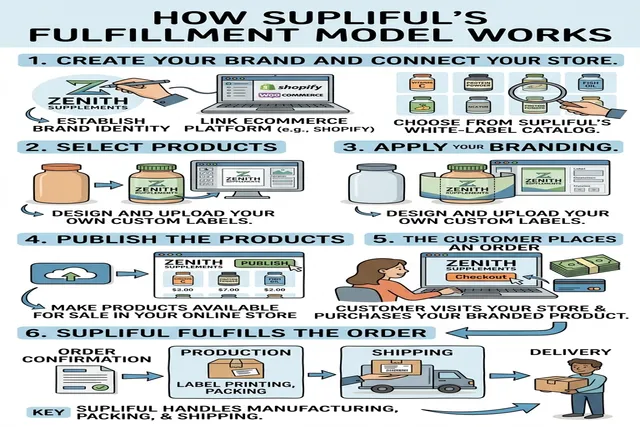
Building a branded product line involves more than choosing products and putting your logo on the packaging. Someone also needs to manufacture those products, manage inventory, process orders, pack packages, and get them to customers.
For an ecommerce operator or creator, that can create an uncomfortable choice: build an entire fulfillment operation internally or limit the product line to what existing infrastructure can support.
There is another option. A business can own the customer-facing brand while outsourcing much of the manufacturing and fulfillment infrastructure behind it.
This approach is becoming more relevant as ecommerce fulfillment becomes a larger part of the online retail ecosystem. According to Coherent Market Insights (CMI), the global e-commerce fulfillment services market is estimated to be valued at USD 160.44 billion in 2026 and USD 416.49 billion by 2033, expanding at a CAGR of 14.6% during the forecast period.
The wider market is being supported by the growth of online shopping, higher expectations for delivery speed, and the increasing use of third-party fulfillment services. Coherent Market Insights also identifies warehousing and storage, bundling, shipping, and other fulfillment services as major service areas within the market.
The growth is also being shaped by a few clear trends. First, more ecommerce businesses are outsourcing fulfillment instead of building warehouses and shipping operations themselves. This allows smaller and growing brands to use established logistics infrastructure without making the same level of upfront investment.
Second, fulfillment centers are becoming more technology-driven. Automation, inventory systems, real-time tracking, and other digital tools are helping providers process orders more quickly and accurately. This matters as online shoppers expect shorter delivery times and better visibility after placing an order.
Third, businesses are looking for more flexible fulfillment models. On-demand fulfillment, smaller inventory commitments, bundled products, and services that can scale with order volume make it easier for brands to test new products without immediately building a large logistics operation.
That is the model behind Supliful. The company describes itself as brand-building infrastructure that handles manufacturing, fulfillment, and shipping while businesses focus on their products, pricing, customers, and growth. Its current platform is designed around on-demand fulfillment, meaning businesses don't have to purchase large quantities of inventory before they can start testing a product line.
What Actually Goes Into Running Product Fulfillment?
When customers see a product online, they primarily see the front end of the business.
That includes:
- The brand
- Product design and packaging
- Ecommerce store
- Product descriptions
- Pricing
- Marketing
- Customer experience
Behind that is a second layer of operations.
Every order may require inventory management, order verification, product picking, labeling, packing, shipping, tracking, and inventory replenishment.
This is also where shipping fulfillment services become important. In the e-commerce fulfillment services market, shipping fulfillment services were the largest service type, accounting for 40% of market revenue in 2026. These services cover the movement of completed orders from the fulfillment facility to the customer and are especially important for online brands that want to offer reliable delivery without managing carrier operations themselves. For growing product brands, using a fulfillment partner can make it easier to handle increasing order volumes while keeping the customer experience consistent.
If a company manages all of these activities internally, it may need warehouse space, employees, inventory systems, packaging materials, carrier relationships, and processes for keeping products available as demand changes.
That infrastructure can make sense for an established brand with predictable volume. But it can be disproportionate for a business launching its first few products.
This is why separating brand ownership from fulfillment ownership can be useful.
A company can remain responsible for the parts customers actually associate with the brand while using a specialized partner to manage the operational layer.
This model also fits the broader structure of the e-commerce fulfillment services market. The market is divided by service type into warehousing and storage fulfillment services, bundling fulfillment services, shipping fulfillment services, and others. It is also segmented by application, sales channel, organization size, and region.
Applications include automotive, beauty and personal care, books and stationery, consumer electronics, healthcare, clothing and footwear, home and kitchen, sports and leisure, and others. Sales channels include direct to customer, business to customer, and business to business, while organization size covers SMEs and large enterprises.
Why Ecommerce Operators Outsource Fulfillment
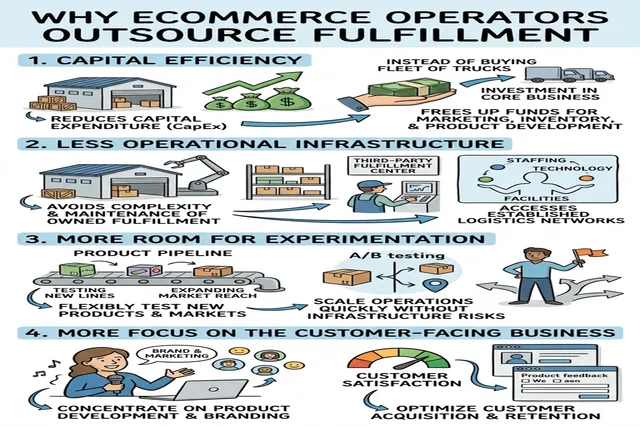
Outsourcing fulfillment isn't simply about avoiding warehouse work. For many businesses, it is a way to allocate capital and attention toward activities that directly influence growth.
Capital efficiency
Buying inventory in advance means committing cash before the corresponding products have been sold.
An on-demand model changes that timing. With Supliful, businesses can sell products without holding the same level of upfront inventory. The company says its model allows merchants to pay for product fulfillment when orders are placed rather than purchasing large quantities of inventory in advance.
Less operational infrastructure
A business doesn't necessarily need to establish its own warehouse, packing operation, or inventory-management system before testing a product line.
More room for experimentation
If the operational burden of adding another SKU is relatively low, a brand can test additional products without making every new launch a major logistics project.
More focus on the customer-facing business
The operator can spend more time on positioning, acquisition, content, partnerships, retention, and product strategy.
There is an important qualification, however: outsourced fulfillment isn't automatically the cheapest option at every scale. High-volume businesses may eventually find that bulk purchasing or internal fulfillment produces better unit economics. The right approach depends on sales volume, margins, capital availability, operational capabilities, and growth plans.
The objective is not to outsource everything indefinitely. It is to avoid building infrastructure before the business actually needs it.
The same idea is reflected in the growth of the SME segment in the wider fulfillment market. Smaller businesses often use fulfillment providers because they can access warehousing, shipping, and inventory support without making a large investment in their own logistics network. GVR expects the SME segment to grow at a strong pace as more smaller businesses sell through digital channels.
Meet Supliful: The Infrastructure Behind the Brand
Supliful was created around a relatively simple problem: entrepreneurs could use on-demand infrastructure to build personalized physical products in some categories, but similar infrastructure wasn't readily available for consumer packaged goods.

The company's origins go back to Grafomap, an earlier ecommerce business founded by Supliful's team that produced personalized map posters on demand. According to Supliful's account of its history, the founders later wanted to build a consumer wellness brand and found that they could not find a similar on-demand supplier for supplements. That gap became the starting point for Supliful.
Today, Supliful positions itself as infrastructure for businesses building consumer brands rather than simply as a traditional supplier. Its platform handles manufacturing, fulfillment, and shipping while the merchant controls the customer-facing brand.
The company currently says it has seven U.S. locations across six states, has fulfilled more than 2 million partner-brand orders, shipped more than 600,000 items globally, and generated more than US$70 million in revenue through the platform. These are company-reported figures and are included as context rather than as independently verified market statistics.
Supliful's current offering also shows how fulfillment providers are moving beyond basic warehousing and shipping. The company offers private-label products, store integrations, automated fulfillment as well as U.S.-based fulfillment, allowing brands to connect the operational side of their business with their ecommerce storefront.
From Startup Idea to Product Infrastructure
Supliful's growth provides some useful context for how the business has evolved.
The company was founded in October 2021. Its early milestones included launching dietary supplements in the United States, adding private-label coffee, launching its Shopify integration, and opening its first warehouse in Denver.
According to the company's published timeline
- 2022: Supliful closed a $2 million seed round, surpassed 10,000 registered users, recorded more than $2.5 million in GMV across customer brands, and expanded its catalog beyond supplements.
- 2023: The company reports 5.6× revenue growth, more than $7.2 million in GMV, international shipping, more than 200,000 orders shipped, and the launch of its Production Partner Program.
- 2024: Supliful reports shipping more than 500,000 products, expanding its catalog with more than 100 on-demand products, and moving into a larger Denver warehouse.
- 2025: The company reports reaching $9.9 million in trailing-twelve-month net revenue, sustained profitability, more than 500 creator brands launched, and the introduction of self-serve Fulfillment by Amazon.
The significance of this progression is less about any individual milestone and more about the direction of the business.
Supliful started with a focus on on-demand consumer products and has expanded toward a broader infrastructure model for brands that want to launch and scale physical products without building the entire supply chain themselves.
This shift reflects a wider change in ecommerce fulfillment. Fulfillment providers are increasingly expected to support more than storage. They may also handle bundling, labeling, order processing, returns, shipping, and technology integration. GVR includes these services within its broader market definition.
How Supliful's Fulfillment Model Works
The process is designed to keep the brand owner focused on the customer-facing business while Supliful handles the physical order.