

Global E-Commerce Logistics Market Size and Forecast – 2026 To 2033
The global e-commerce logistics market is expected to grow from USD 473.75 Bn in 2026 to USD 880.50 Bn by 2033, registering a compound annual growth rate (CAGR) of 12% from 2026 to 2033. The global e-commerce logistics market is driven by increasing smartphone usage and internet penetration. For instance, on October 8, 2025, Reliance Jio introduced a new Safety-First capability on its JioBharat phones at the India Mobile Congress (IMC) 2025, aiming to make digital safety and connectivity more accessible for every Indian household. (Source: Times of India)
Key Takeaways of the Global E-Commerce Logistics Market
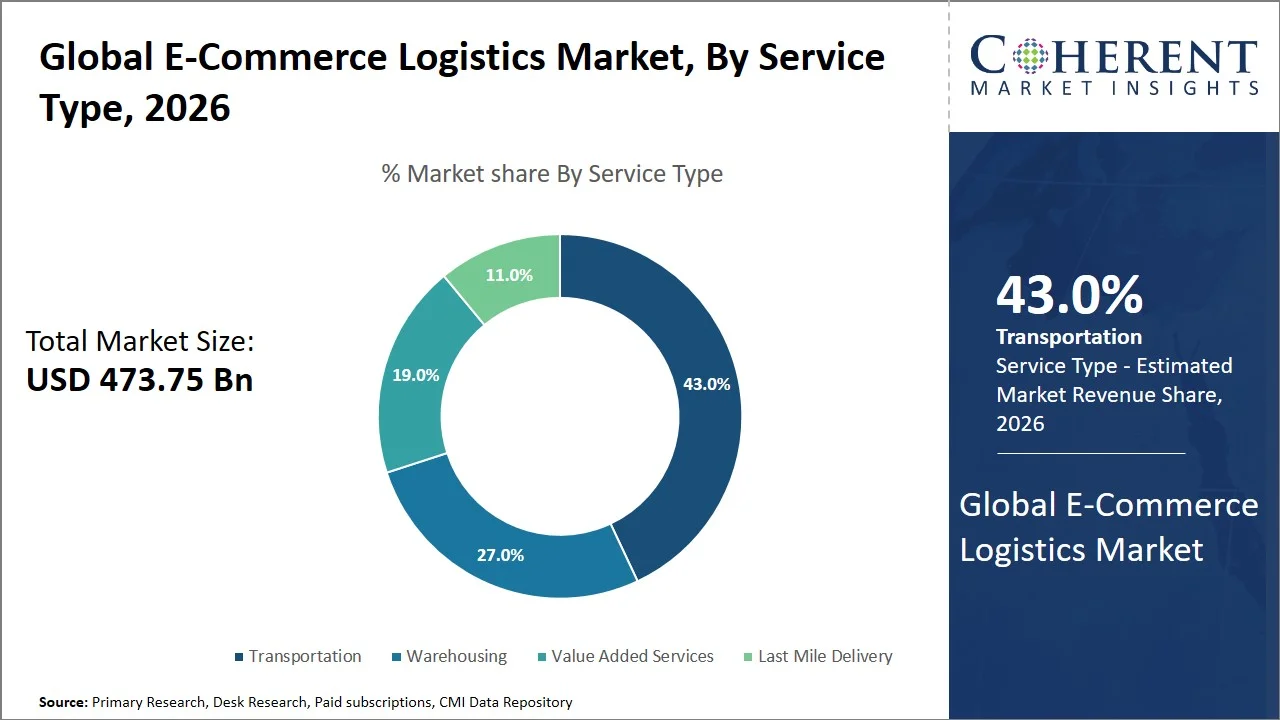
- The transportation segment is expected to account for 43.0 % of the global e-commerce logistics market share in 2026. Expansion of cross-border e-commerce is a key factor driving the growth of the segment. On June 18, 2025, JINGDONG Logistics launched JoyExpress, its self-operated B2C express delivery service in Saudi Arabia. (Source: Jingdong)
- The roadways segment is estimated to capture 49.0 % of the market share in 2026. Growing integration of AI-driven route optimization and smart warehousing are driving the growth of the roadways segment. On June 30, 2025, Amazon announced next-generation warehouse systems using agentic AI robots that independently manage sorting, unloading, and inventory movement while optimizing internal warehouse routing in real time. (Source: Amazon)
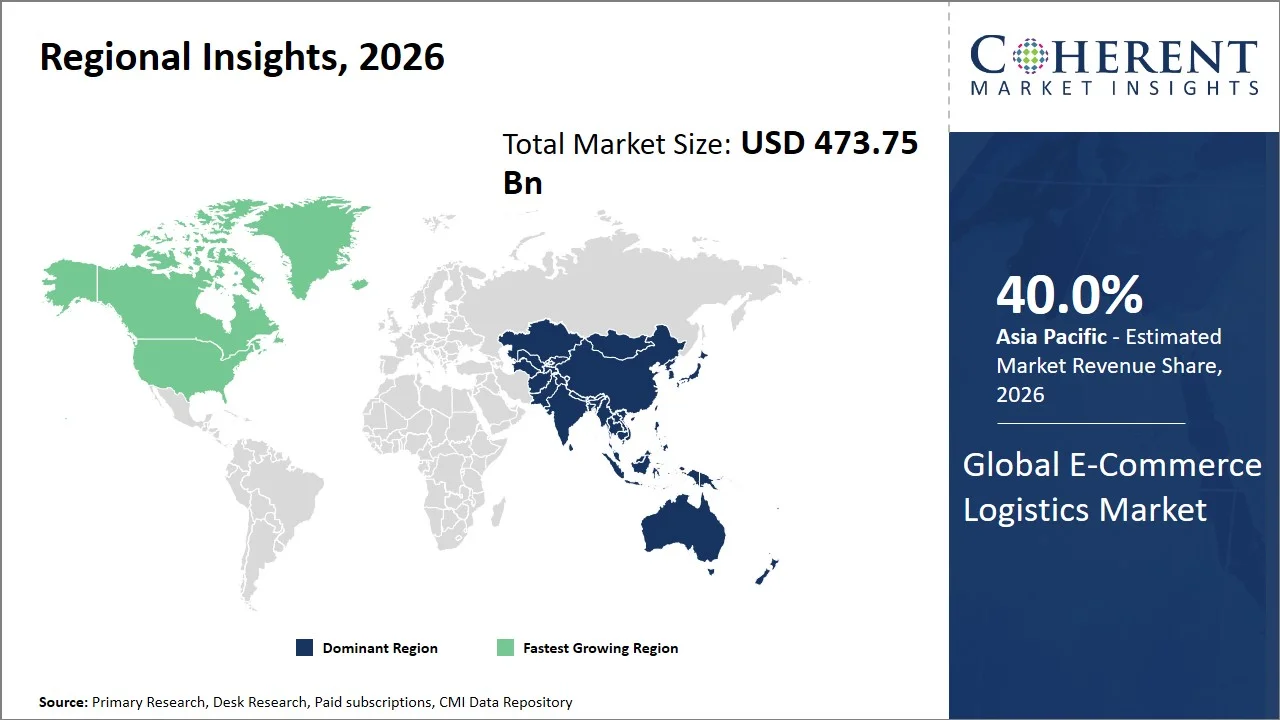
- Asia Pacific is expected to dominate the e-commerce logistics market in 2026 with a market share of 40.0 %. Increasing use of drone & autonomous delivery systems in Asia Pacific is a primary factor driving the growth of the region e-commerce logistics market. On April 27, 2026, South Korea conducted a major pilot project where drones were used to transport food across sea routes to Biyang Island, followed by autonomous ground robots completing doorstep delivery. (Source: The Korea Times)
- North America is expected to account for 27.0 % share in 2026 and is projected to record the fastest growth over the forecast period. Green logistics and sustainable supply chain development are expected to guide the growth of the regional market over the forecast period. On June 19, 2025, Amazon expanded its electric delivery network significantly in the U.S., surpassing 1 billion EV-powered package deliveries and deploying 20,000+ electric vans as part of its decarbonization strategy. (Source: Amazon)
- Increasing Adoption of Warehouse Automation and Robotics: E-commerce logistics companies are adopting automated storage and retrieval systems (AS/RS), robotic picking solutions, automated guided vehicles (AGVs), and AI-based warehouse management systems at a rapid pace, which is improving operational efficiency.
- Expansion of Sustainable and Green Logistics Practices: Environment sustainability has been a grave concern in the logistics industry. Companies are increasingly embracing green practices, from electric delivery vans to energy-efficient warehouses, eco-friendly packaging materials and carbon footprint reduction programs.
Segmental Insights
Why Does Transportation Dominate the Global E-Commerce Logistics Market?
The transportation segment is expected to account for 43.0% of the global e-commerce logistics market share in 2026. The worldwide e-commerce logistics business is driven mostly by transportation as each purchase made online involves the physical movement of items from fulfillment centers to end customers. The rapid growth of e-commerce has led to a huge rise in the number of parcels being sent, notably in last mile delivery, which is the most crucial and expensive element of the logistics process. Transportation is the largest revenue-generating component of the e-commerce logistics market with increased spending on road, air, rail and express transportation networks due to growing customer demand for same-day and next-day delivery services. On May 28, 2026, the United States Postal Service (USPS) and DHL eCommerce signed a multi-year USD 10 billion partnership where USPS handles last-mile delivery across 170 million U.S. locations, reinforcing how transportation networks remain the core revenue driver in e-commerce logistics. (Source: DHL)
- Current Industry Events of 2026
- Market Size Estimation
- Regional Breakdown
- Competitive Landscape
- Customer Intelligence
- Segmental Analysis
- Pricing Analysis
- Key Market Drivers, Challenges & Future Trends
- Customized Insights Section
Why are Roadways the Most Widespread Mode of Transport?
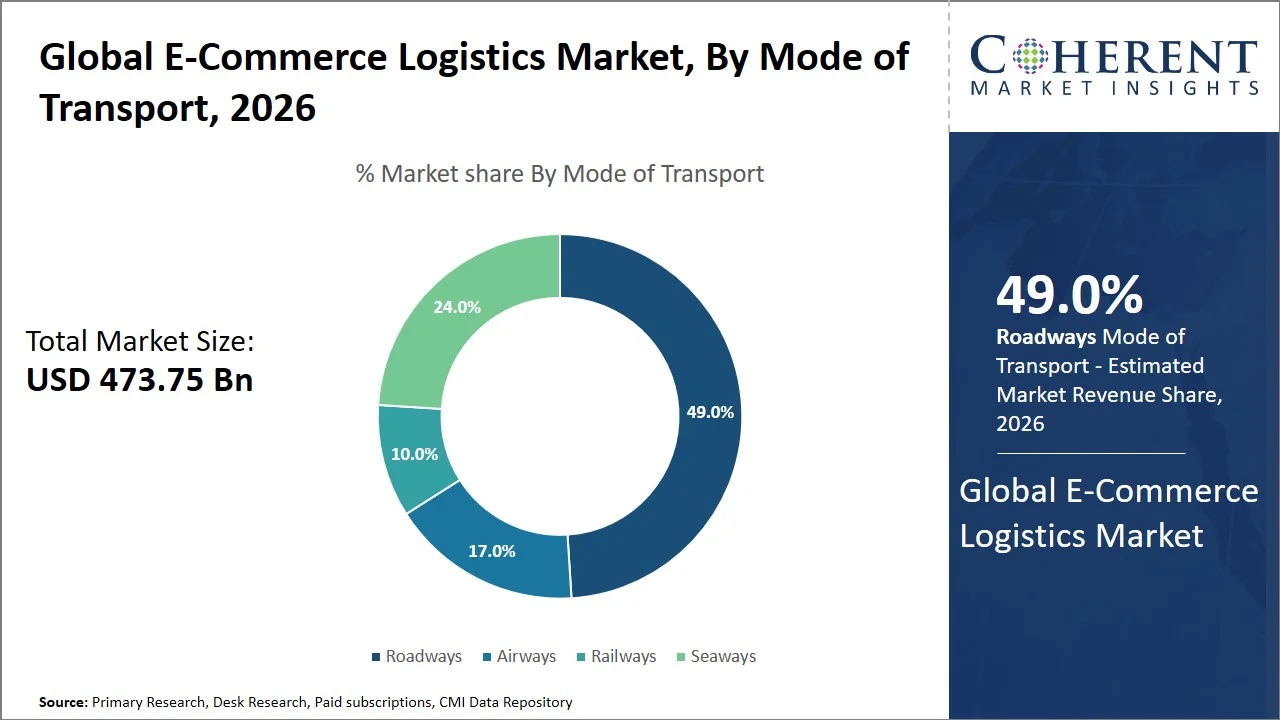
The roadways segment is expected to account for 49.0% of the global e-commerce logistics market share in 2026. Roadways are the most widely used transport mode as they give direct and flexible access to customers’ locations and hence are key for last-mile deliveries. Road networks are more efficient and cost-effective than air, rail or sea transport because they connect warehouses, distribution centers, retail hubs and end consumers, therefore enabling speedier delivery of e-commerce orders in urban, suburban and rural locations. For example, United Parcel Service expanded AI-driven routing systems that continuously optimize delivery paths based on traffic, volume, and delivery windows. This reflects how road transportation is becoming more efficient and scalable through dynamic route optimization, enabling it to handle rising parcel volumes. (Source: UPS)
Currents Events and their Impact
Current Events | Description and its Impact |
EU Customs Reform Package (2025–2026) |
|
EU Digital Services Act (DSA) Enforcement |
|
(Source: European Commission, European Commission)
E-Commerce Logistics Market Dynamics
Market Drivers
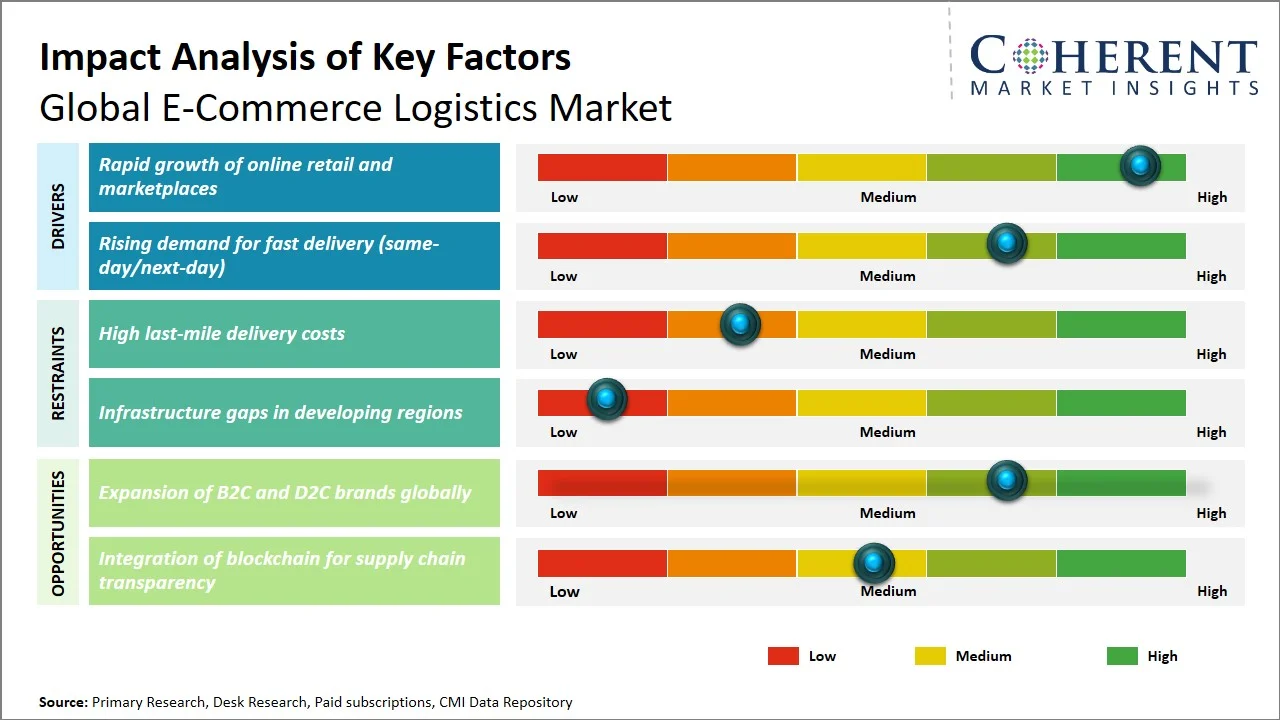
- Rapid growth of online retail and marketplaces: The rapid growth of e-commerce and digital marketplaces is driving the global e-commerce logistics industry. The order volumes are expanding dramatically over the world with the increasing penetration of internet, usage of smartphones and demand of consumers for convenient online shopping. The expansion is generating increased demand for efficient warehouse, transportation, fulfillment and last-mile delivery services to ensure fast and reliable product delivery. On December 10, 2025, India’s e-commerce platform, Meesho debuted strongly, reaching a valuation of USD 8.78 billion after a 58% listing surge, reflecting rising demand for low-cost online marketplaces targeting tier-2 and tier-3 cities. (Source: Times of India)
- Rising demand for fast delivery (same-day/next-day): The e-commerce logistics market is primarily driven by the rise in demand for same-day and next-day delivery services. Retailers and logistics providers are investing in sophisticated distribution networks, local fulfillment centers and route optimization tools to meet consumer demand for faster order fulfillment and real-time shipment tracking. This tendency is increasing delivery efficiency, and fueling demand for robust logistical infrastructure. On March 24, 2026, FedEx Corp. announced the rollout of FedEx SameDay Local, a delivery offering designed to enable its customers to meet rising consumer expectations for flexibility, control, and convenience while balancing their cost to serve. (Source: FedEx)
Emerging Trends
- Growth of Same-Day and Ultra-Fast Delivery Services: Consumer demand for rapid delivery is affecting logistics worldwide. Retailers and logistics providers are investing in micro-fulfillment centers, urban distribution hubs and advanced route optimization technologies to enable same-day, next-day and even within-hours delivery. This trend is particularly visible in cities with high e-commerce penetration.
- Rising Integration of Artificial Intelligence and Data Analytics: Artificial intelligence and advanced analytics are transforming e-commerce logistics by facilitating demand forecasting, inventory management, predictive maintenance, dynamic route planning, and real-time shipment tracking. These technologies help logistics companies improve decision making, reduce operating costs, increase customer satisfaction and create more resilient and flexible supply networks.
Regional Insights
Why is Asia Pacific a Strong Market for E-Commerce Logistics?
Asia Pacific is expected to account for a market share of 40.0% in 2026. The world’s greatest e-commerce logistics market is in Asia Pacific, fueled by the huge parcel quantities created in China, India and Southeast Asia. In China alone, Cainiao Network, JD Logistics and SF Express run networks that handle tens of billions of e-commerce parcels each year. India is the fastest expanding market in the world, with logistics demand being driven by the rapid expansion of quick-commerce platforms and investments into automated fulfillment facilities by companies such as Flipkart and Amazon. On September 11, 2025, Cainiao Network expanded its Global 5-Day Delivery program to multiple Southeast Asian markets including Vietnam and Singapore, reducing cross-border delivery times to domestic-like speeds. This expansion reflects the rapid scaling of Asia Pacific-based marketplace logistics into international fulfillment ecosystems.
Why Does the North America E-Commerce Logistics Market Exhibit High Growth?
North America is projected to account for 27.0% of the global e-commerce logistics market and is expected to register the fastest growth. North America is still one of the most mature regions for e-commerce logistics, with a well-developed fulfillment infrastructure and strong customer demand for next-day delivery. Amazon, FedEx and United Parcel Service are the big players in the U.S. with vast warehousing and transportation networks. Companies are increasingly using robotics, artificial intelligence-driven inventory systems and regional fulfillment centers to keep pace with speedy delivery pledges and growing online retail volumes. On May 4, 2026, Amazon expanded its logistics business into a standalone service called Amazon Supply Chain Services, allowing external companies like P&G and 3M to use its warehouses, air fleet, and road network. This marks a major shift where Amazon is no longer just a retailer but a full-scale logistics competitor to UPS and FedEx in North America. (Source: Amazon)
Global E-Commerce Logistics Market Outlook for Key Countries
Why is China Emerging as a Major Hub in the E-Commerce Logistics Market?
Supported by a highly integrated digital commerce ecosystem, China is the world’s largest single-country e-commerce logistics market. Logistics providers like Cainiao Network and JD Logistics operate large smart warehouse networks that can handle millions of orders every day. The country is also a leader in automated sorting facilities, delivery lockers, and cross-border e-commerce logistics, feeding big online shopping events such as the annual Singles’ Day sales festival.
Is the U.S. the Next Growth Engine for the E-Commerce Logistics Market?
The U.S. e-commerce logistics business is characterized by large-scale fulfillment operations and a high demand for premium delivery services. Amazon has built one of the world's biggest logistics networks, with planes, delivery vans and regional fulfillment centers, decreasing the need for third-party carriers. Big retailers like Walmart are also turning storefronts into fulfillment hubs to provide same-day delivery and curbside pickup in big urban areas.
Japan E-Commerce Logistics Market Analysis and Trends
The Japan e-commerce logistics market contains high-efficiency urban delivery models and superior automation technology. Companies such as Yamato Transport and Sagawa Express offer delivery service at specific time slots for the dense city populations. This has also boosted spend on warehouse robotics, automated sorting systems, and AI-driven route optimization to keep delivery efficiency high.
South Korea E-Commerce Logistics Market Analysis and Trends
South Korea has one of the most advanced e-commerce logistics ecosystems internationally, spurred by high internet penetration and dense metropolitan populations. Coupang has transformed the market with its Rocket Delivery, delivering overnight and same-day delivery in parts of the country. South Korea has become a benchmark market for next-generation e-commerce logistics operations, with heavy investments in fulfillment centers, sophisticated warehouse automation and significant customer appetite for ultra-fast delivery.
E-Commerce Logistics Market – Average Last-Mile Delivery Cost
Region | Average Cost per Order | Cost as % of Total Fulfillment |
North America | USD 8 – USD 12 | ~45% – 55% |
Europe | USD 7 – USD 11 | ~40% – 50% |
Asia Pacific | USD 2 – USD 6 | ~35% – 45% |
Latin America | USD 5 – USD 9 | ~45% – 55% |
Middle East & Africa | USD 6 – USD 10 | ~50% – 60% |
How is the Expansion of B2C and D2C Brands Globally Creating New Growth Opportunities in the E-Commerce Logistics Market?
The e-commerce logistics market is experiencing robust development possibilities owing to the rapid increase of Business-to-Consumer (B2C) and Direct-to-Consumer (D2C) businesses throughout the world, which is raising the demand for flexible fulfillment, warehousing, and last-mile delivery services. Brands are selling more directly through their own websites and digital channels, while logistics providers are building out capabilities such as order processing, inventory management, returns management and cross-border shipping to meet higher customer expectations for faster delivery and better experiences. This trend is driving investments into enhanced fulfillment networks and technology assisted logistics solutions worldwide. On February 20, 2026, Bath & Body Works expanded its e-commerce strategy by officially selling on Amazon in the U.S. for the first time, marking a major shift from store-first retail to a hybrid B2C and marketplace-driven model. The move was driven by strong online demand and the need to capture younger digital consumers. (Source: CNBC)
Market Players, Key Development, and Competitive Intelligence
Key Developments
- On March 19, 2026, DHL announced a significant expansion of its North America data center logistics (DCL) infrastructure with 10 dedicated warehouse sites totaling more than seven million square feet of capacity.
- On June 24, 2025, Amazon announced plans of investment in the UK that includes four new fulfilment centers, including facilities opening in Hull (2025), Northampton (2026), and the East Midlands (2027).
Competitive Landscape
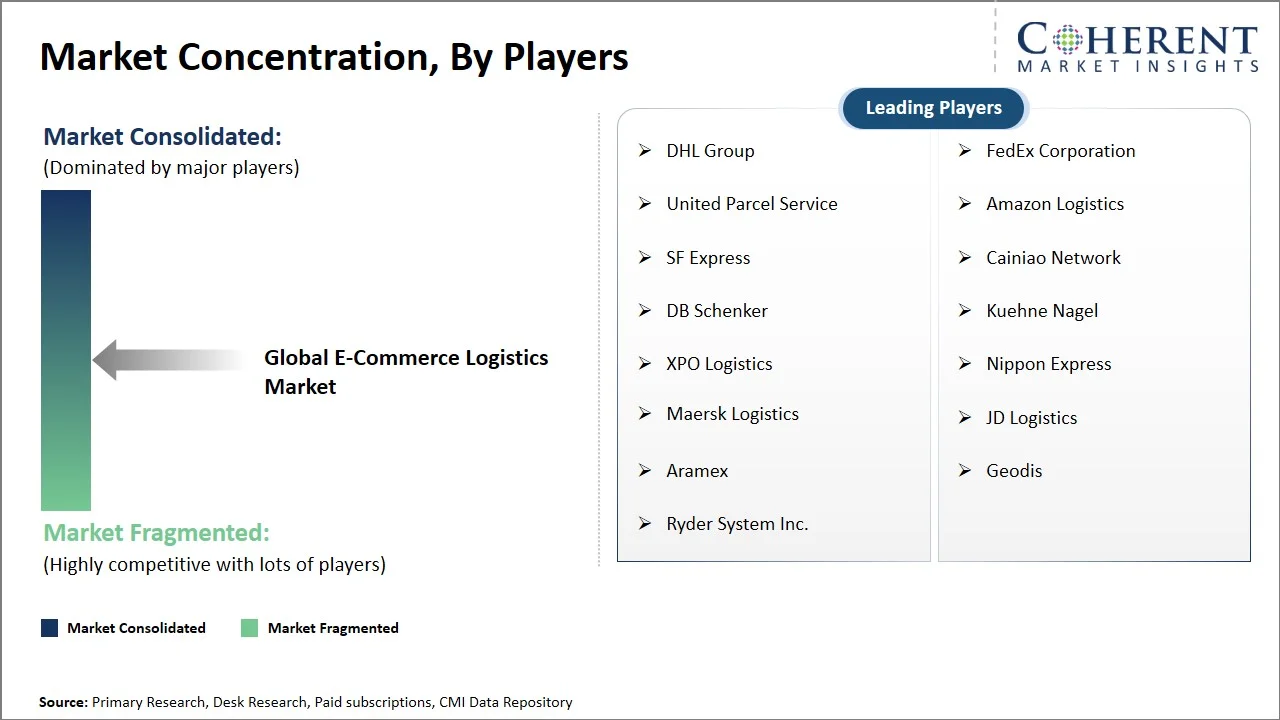
The worldwide e-commerce logistics market is very competitive with the participation of integrated express carriers, third-party logistics (3PL) providers and e-commerce platform-led logistics arms. Amazon, FedEx, United Parcel Service and China-based giants like Cainiao Network and JD Logistics are among the big firms with strong positions, growing through automation, worldwide collaborations and network integration. There has been intense rivalry in terms of last-mile delivery efficiency, pricing tactics and technology adoption, while regional companies continue to build their footprint through specialist services and localized fulfillment models.
Market Report Scope
E-Commerce Logistics Market Report Coverage
| Report Coverage | Details | ||
|---|---|---|---|
| Base Year: | 2025 | Market Size in 2026: | USD 473.75 Bn |
| Historical Data for: | 2020 To 2024 | Forecast Period: | 2026 To 2033 |
| Forecast Period 2026 to 2033 CAGR: | 12% | 2033 Value Projection: | USD 880.50 Bn |
| Geographies covered: |
| ||
| Segments covered: |
| ||
| Companies covered: | DHL Group, FedEx Corporation, United, Parcel Service, Amazon Logistics, SF Express, Cainiao Network, DB Schenker, Kuehne Nagel, XPO Logistics, Nippon Express, Maersk Logistics, JD Logistics, Aramex, Geodis, and Ryder System Inc. | ||
| Growth Drivers: |
| ||
| Restraints & Challenges: |
| ||
Analyst Opinion (Expert Opinion)
- Digitalization is accelerating and consumers’ expectations for fast delivery is growing, changing the e-commerce logistics space. There was a strong emphasis on the necessity for scalable infrastructure, automation and sustainable logistics techniques to remain competitive. Moreover, players investing in AI-led supply chain optimization and localized fulfillment networks are better positioned to thrive in the changing market landscape, whereas traditional logistics models are slowly being disrupted.
- The future of the e-commerce logistics market is likely to be driven by sustained growth of global online shopping, increased penetration of quick commerce, and rising demand for ultra-fast delivery services. Strong growth is expected in emerging economies with fast-growing digital penetration and cross border e-commerce. The logistics networks are expected to become more decentralized, automated, and customer-centric during the forecast period. The use of advanced technologies such as autonomous delivery vehicles, drone logistics, AI-powered forecasting, and green supply chain solutions will redefine operational efficiency.
Speak to the analyst
Want personalized insights?
Take the findings above to one of our principal consultants, or have the report rebuilt around the segments, geographies and competitors you actually track.
Market Segmentation
- Service Type Insights (Revenue, USD Billion, 2021 - 2033)
- Transportation
- Warehousing
- Value Added Services
- Last Mile Delivery
- Mode of Transport Insights (Revenue, USD Billion, 2021 - 2033)
- Roadways
- Airways
- Railways
- Seaways
- Regional Insights (Revenue, USD Billion, 2021 - 2033)
- North America
- U.S.
- Canada
- Latin America
- Brazil
- Argentina
- Mexico
- Rest of Latin America
- Europe
- Germany
- U.K.
- Spain
- France
- Italy
- Russia
- Rest of Europe
- Asia Pacific
- China
- India
- Japan
- Australia
- South Korea
- ASEAN
- Rest of Asia Pacific
- Middle East
- GCC Countries
- Israel
- Rest of Middle East
- Africa
- South Africa
- North Africa
- Central Africa
- North America
- Key Players Insights
- DHL Group
- FedEx Corporation
- United Parcel Service
- Amazon Logistics
- SF Express
- Cainiao Network
- DB Schenker
- Kuehne Nagel
- XPO Logistics
- Nippon Express
- Maersk Logistics
- JD Logistics
- Aramex
- Geodis
- Ryder System Inc.
Sources
Primary Research Interviews
- E-commerce platform executives and logistics heads
- Third-party logistics (3PL) service providers
- Warehouse automation technology vendors
- Last-mile delivery service managers
Magazines
- Supply Chain Management Review
- Logistics Management Magazine
- E-commerce Times
- Modern Materials Handling
Journals
- International Journal of Physical Distribution & Logistics Management
- Journal of Business Logistics
- Supply Chain Management: An International Journal
Associations
- Council of Supply Chain Management Professionals (CSCMP)
- International Association of Logistics & Supply Chain Management (IALSCM)
- E-commerce Europe Association
- National Retail Federation (NRF)
Public Domain Sources
- World Trade Organization (WTO) reports
- OECD Digital Economy Outlook
- United Nations Conference on Trade and Development (UNCTAD)
- International Trade Administration databases
Proprietary Elements
- CMI Data Analytics Tool
- Proprietary CMI Existing Repository of information for last 10 years
Get access to 250+ pages report
Every segment, forecast, competitor profile and data table behind the analysis above — available for instant download.
- ESOMAR Member
- ISO 9001:2015 Certified
- D-U-N-S Registered
- GDPR & CCPA Compliant
Missing comfort of reading report in your local language? Find your preferred language:
Transform your Strategy with Exclusive Trending Reports
Frequently Asked Questions
The global e-commerce logistics market is expected to stand at USD 473.75 Bn in 2026 and is expected to reach USD 880.50 Bn by 2033.
The CAGR of the global e-commerce logistics market is projected to be 12% from 2026 to 2033.
Rapid growth of online retail and marketplaces and rising demand for fast delivery (same-day/next-day) are the major factors driving the growth of the global e-commerce logistics market.
High last-mile delivery costs and infrastructure gaps in developing regions are the major factors hampering the growth of the global e-commerce logistics market.
In terms of service type, the transportation segment is estimated to dominate the market revenue share in 2026.
It is a warehouse where online orders are stored, processed, and shipped to customers.
It is the process of handling product returns from customers back to sellers or warehouses.