Pet technology has moved well beyond blinking collars and automatic treat dispensers. Today, you can buy devices that record where your dog goes, how long they sleep, when they eat, how much they drink, and what they do while you are away.
That sounds useful. It can also get confusing very quickly.
A GPS collar, activity tracker, automatic feeder, pet camera, and smart pet bowl may all connect to an app, but they do not collect the same information. Some products are designed mainly to save time. Others can help owners follow changes in behaviour or daily wellness.
Before spending money on any of these devices, it helps to ask one basic question: what does it actually measure?
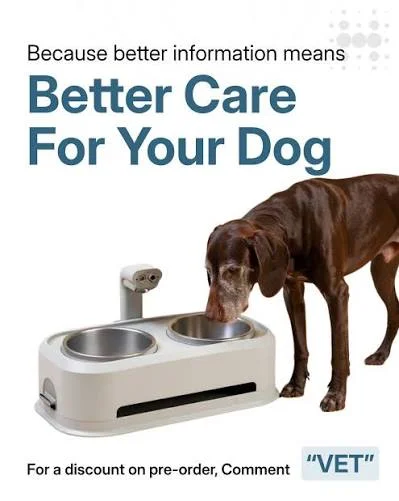
What Does a Smart Pet Bowl Track?
A smart pet bowl is designed to collect information at the point where a dog eats or drinks. The exact capabilities vary widely between products, from basic weight measurement to systems that monitor feeding behaviour and build an individual pet baseline.
The category is also developing alongside the broader pet feeding market. The pet food bowl market is estimated to be valued at USD 4.08 Bn in 2026 and is expected to reach USD 5.97 Bn by 2033, exhibiting a compound annual growth rate (CAGR) of 5.6% from 2026 to 2033. As pet owners become more interested in monitoring feeding routines rather than simply providing food, some manufacturers are adding sensors and connected features to traditional feeding products.
Basic models may use a built-in scale to measure how much food or water is placed in the bowl. More technical systems can record when the dog approaches, how quickly the contents are consumed, and whether the dog's normal mealtime behaviour has changed.
Hoomanely’s EverBowl, for example, is positioned as a monitoring bowl rather than a food dispenser. It uses load, pressure, acoustic, thermal, proximity, and visual sensing to study activity around food and water. Its system is intended to build an individual baseline for hydration patterns, eating speed, weight stability, and temperature over the initial period of use.
Food and Water Intake
Load sensors can measure changes in the weight of the bowl’s contents. That makes it possible to estimate how much food or water was present before and after a visit.
This is more useful than simply confirming that the bowl is empty. An empty bowl does not tell you whether the dog consumed everything, another pet helped, or some water was spilled.
The quality of the insight depends on how the device handles those variables. Multi-pet homes, bowl movement, evaporation, and wet food can all affect measurements.
Eating Speed and Meal Duration
A smart bowl may record when feeding begins, how long the session lasts, and how quickly the food disappears.
Eating speed is worth observing because sudden changes can add context to other symptoms. A dog that normally finishes in four minutes but begins taking fifteen may be distracted, uncomfortable, less interested in food, or having trouble chewing. One slow meal means very little. A repeated change is more informative.
Chewing and Swallowing Behaviour
Microphones and acoustic sensors can capture sound patterns around eating and drinking. Hoomanely’s technical material explains that EverBowl uses acoustic sensing to identify shifts in chewing and swallowing behaviour. Audio collection is triggered when proximity sensing detects a dog near the bowl rather than running continuously.
Sound alone cannot diagnose a medical condition. It may, however, help reveal that a familiar pattern has changed.
Posture and Visual Behaviour
A camera or vision system can examine how the dog positions its head and body near the bowl. This may help separate a normal feeding visit from someone walking past the device.
Hoomanely has described combining visual, thermal, and proximity information to align readings and interpret activity near the bowl. Some processing is handled close to the device, which can reduce the amount of sensitive raw data that needs to leave the home.
This is where a monitoring bowl differs most clearly from a plain digital scale. It looks at the event, not just the final weight.
What Does an Automatic Pet Feeder Track?
Automatic feeders are mainly built to deliver food at set times. Most use a motor or rotating compartment to release a programmed amount.
The move toward more structured feeding equipment extends beyond household pets. The global cattle feeder market is estimated to be valued at USD 3.98 Bn in 2026 and is expected to reach USD 5.17 Bn by 2033, registering a compound annual growth rate (CAGR) of 3.8% from 2026 to 2033. While cattle feeders serve a very different purpose and operating environment, the category illustrates a broader shift toward equipment designed to make animal feeding more consistent and manageable. In the pet market, that same emphasis is appearing through automated feeders and connected feeding systems.
Depending on the model, the feeder may record
- Scheduled meal times
- Portions dispensed
- Missed dispensing events
- Remaining food levels
- Manual feeds triggered through an app
Some use cameras or RFID tags to recognise individual pets. Others simply open on schedule.
Here is the catch: dispensing food is not the same as confirming that the dog ate it. Unless the feeder also measures the bowl after the meal or observes the pet, its data may show what was served rather than what was consumed.
Automatic feeders are useful for routine and convenience. They are especially practical when owners work irregular hours. For health trends, though, the sensors matter more than the dispensing mechanism.
What Do Activity Trackers Measure?
Pet activity trackers are commonly attached to a collar. They generally use accelerometers and related motion sensors to estimate movement.
Depending on the software, they may report
- Active minutes
- Rest periods
- Steps or movement intensity
- Walk duration
- Distance estimates
- Sleep patterns
- Changes from the dog’s normal activity level
Activity trackers are helpful when an owner wants to compare one day or week with another. They may show that a dog is resting more, taking shorter walks, or becoming active at unusual times.
These figures are estimates, not direct medical measurements. A collar may classify prolonged stillness as sleep even when the dog is awake. Reviews of pet wearables have noted that activity and sleep categories are not always completely accurate because software has to infer behaviour from movement.
What Does a GPS Collar Track?
A GPS collar answers a different question: where is the dog?
It may record:
- Live location
- Location history
- Distance travelled
- Escape alerts
- Entry into or exit from a virtual boundary
- Routes taken during walks
Some GPS collars also include activity and sleep estimates. That can make them look similar to health collars, but location remains their main function.
A GPS collar is most valuable for dogs that roam, escape, travel, or spend time off-leash. It may support safety, but it will not tell you how much the dog ate or whether water intake has changed.
What Do Pet Cameras Track?
Pet cameras are designed for remote observation. Common functions include:
- Live video
- Recorded clips
- Two-way audio
- Bark or motion alerts
- Treat dispensing
- Night vision
- Pet recognition
They are useful for checking separation behaviour, destructive activity, pacing, barking, or interactions between pets.
A camera gives context that a simple sensor may miss. Yet it also requires interpretation. Watching a clip of a dog near a water bowl does not provide an accurate measurement of how much was consumed unless the camera is paired with other sensors.
For me, this is the easiest way to separate camera products from monitoring devices: cameras show you what happened, while sensor systems try to quantify it.
What Does a Smart Water Fountain Track?
Smart fountains are mainly designed to keep water circulating and remind owners about maintenance. Some advanced models also monitor drinking.
They may track
- Water level
- Filter life
- Pump status
- Drinking frequency
- Approximate consumption
- Time spent drinking
A fountain can encourage some pets to drink because the water remains moving and filtered. Still, product capabilities differ. Many fountains measure reservoir levels rather than individual intake.
In a household with several pets, total water loss cannot always be assigned to one animal unless identification technology is included.
What Do Health-Monitoring Collars Track?
Health-monitoring collars go further than basic activity trackers. Some attempt to estimate physiological or behavioural trends such as:
- Resting heart rate
- Resting respiratory rate
- Sleep
- Activity
- Scratching
- Licking
- Behavioural changes
- Temperature-related patterns
Certain products are developed with veterinary input and focus on tracking changes over time rather than presenting isolated readings. One health-monitoring collar provider, for example, specifically distinguishes its device from a GPS tracker and focuses on activity, rest, breathing, and heart-rate trends.
These collars can collect information throughout the day. Their main limitation is placement. A device worn on the neck is well suited to movement and location, but it does not directly measure food or water disappearing from a bowl.
What Should You Check Before Buying?
Ask whether the product
- Collects direct measurements or estimates
- Learns the individual dog’s normal pattern
- Works in a multi-pet household
- Explains why an alert was generated
- Allows reports or trends to be shared
- Processes camera and audio data responsibly
- Requires a subscription
- Continues working during an internet outage
- Supports veterinary care without claiming to replace it
Conclusion
Pet cameras are useful when you want to see what your dog does at home. GPS collars help locate a missing dog. Automatic feeders make meal schedules easier. Activity and health collars follow movement and wearable signals.
A monitoring smart pet product covers a different part of daily life. It focuses on what happens during eating and drinking, when changes in appetite, hydration, speed, sound, temperature, or posture may become visible over time.

