

Global Cattle Feeder Market Size and Forecast – 2026 to 2033
According to Coherent Market Insights, the global cattle feeder market is estimated to be valued at USD 3.98 Bn in 2026 and is expected to reach USD 5.17 Bn by 2033, registering a compound annual growth rate (CAGR) of 3.8% from 2026 to 2033.
Key Takeaways of the Cattle Feeder Market
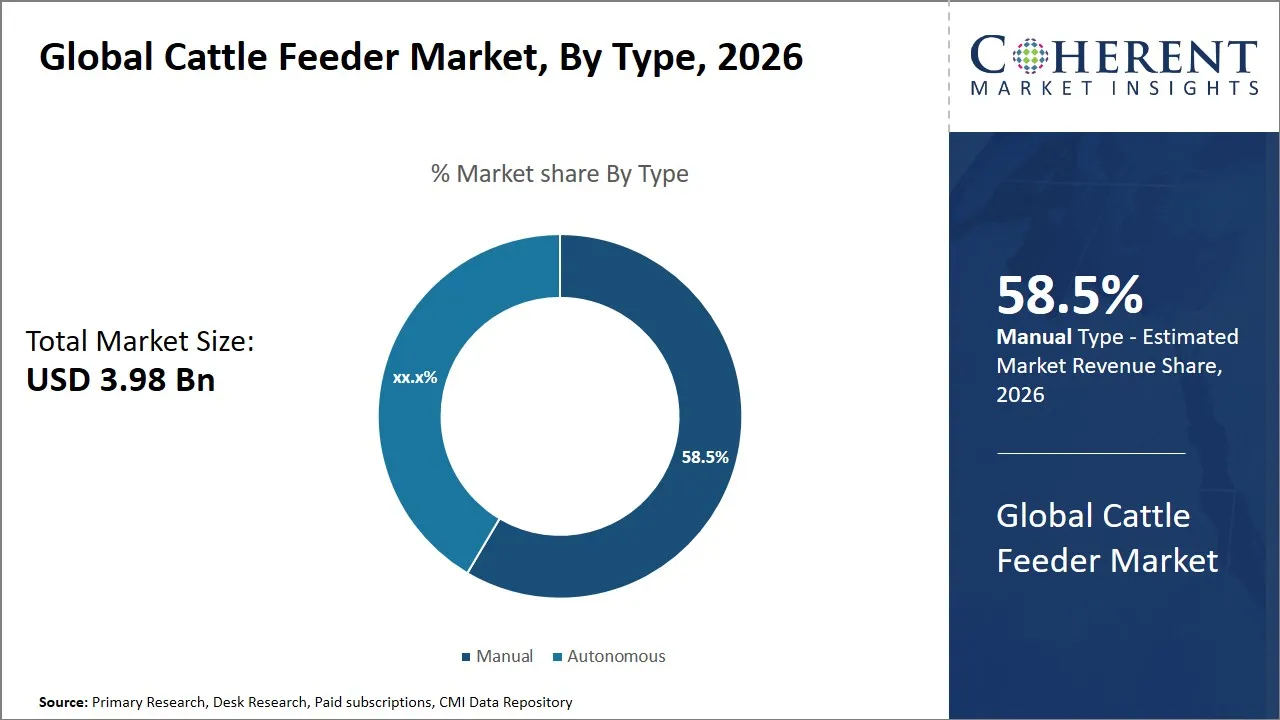
- The manual segment is expected to account for 58.5% of the market share in 2026.
- The plastic feeders segment is estimated to capture 29.7% of the global cattle feeder market share in 2026.
- The mature ruminants segment is projected to hold 45.8% of the market share in 2026.
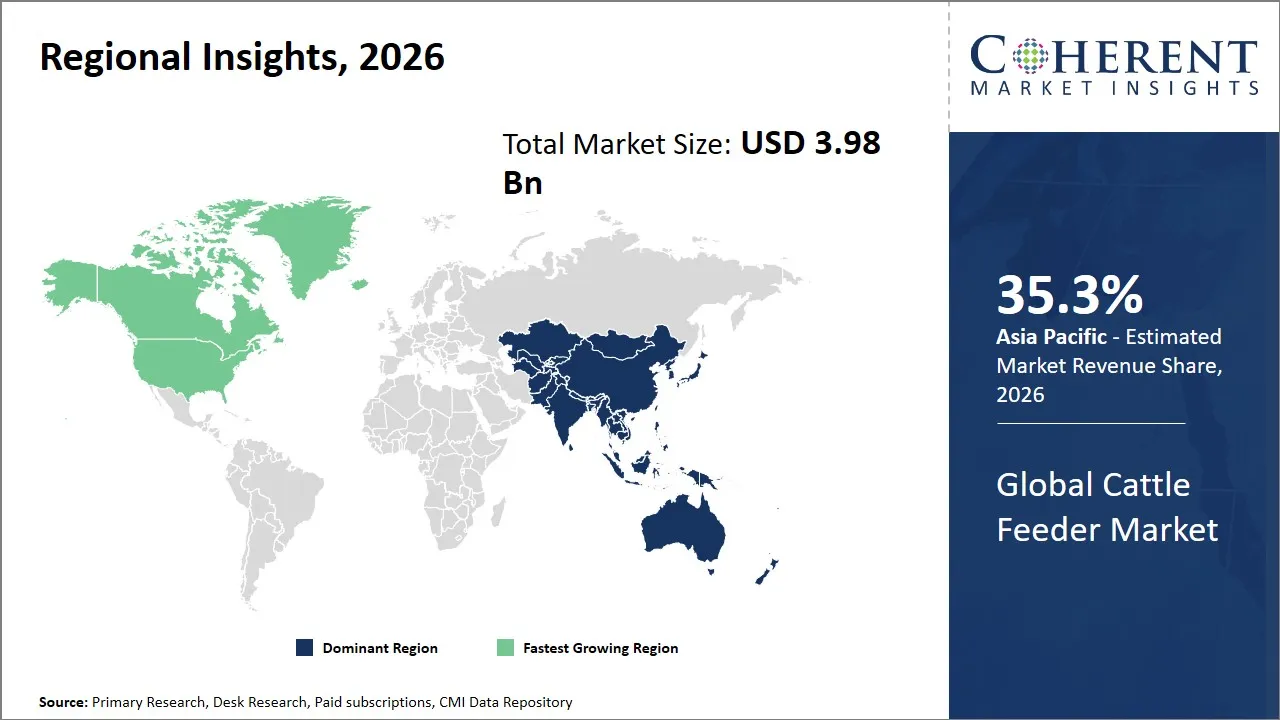
- North America is anticipated to lead the market in 2026 with an estimated 35.3% share.
- Asia Pacific is projected to be the fastest-growing regional market in 2026, contributing 22.3% of the market share.
Market Overview
- Market trends indicate a significant shift towards integrated and automated cattle feeding systems, aimed at optimizing feed conversion ratios and reducing environmental impact.
- There is a growing emphasis on precision animal feed techniques that leverage data analytics, IoT, and AI to improve cattle health and productivity.
- Additionally, sustainability initiatives and stricter regulations on livestock emissions are encouraging the adoption of eco-friendly feeder solutions.
- These trends are anticipated to shape the competitive landscape and drive innovation in the cattle feeder market over the forecast period.
Currents Events and Its Impacts
Current Events | Description and its Impact |
China imposes safeguard curbs on beef imports (effective January 1, 2026) |
|
U.S. herd tightness and lower feedlot placements signal constrained supply into early 2026 |
|
Segmental Insights
- Current Industry Events of 2026
- Market Size Estimation
- Regional Breakdown
- Competitive Landscape
- Customer Intelligence
- Segmental Analysis
- Pricing Analysis
- Key Market Drivers, Challenges & Future Trends
- Customized Insights Section
Why Does Manual Dominate the Global Cattle Feeder Market?
Manual segment is projected to hold 58.5% of the global cattle feeder market share in 2026, making it mostly on the basis of low cost and ease of operation. Manual feeders have low technological requirements, thus they are often preferred by the more conservative cattle farmer as well as medium to small-scale operator, where low initial investment is of utmost importance.
Compared to autonomous feeders, which rely on electronic controls, sensors, and software systems, sensor-based feeders are unproblematic to design and maintain and farmers can be confident of operating using established feeding programs without the stress of system malfunctions or problematic troubleshooting.
In the U.S. Midwest, family-owned beef cattle farms with herd sizes below 200 heads widely use manual bunk feeders and gravity-based hay feeders supplied by companies like Sioux Steel. These farms prioritize durability and low lifetime cost over automation, especially where labor availability is stable and margins are tight.
Why are Plastic Feeders the Preferred Material in the Global Cattle Feeder Market?
Plastic feeders segment is expected to capture 29.7% of the cattle feeder market share in 2026, since they have robustness and lightweight construction who have a great boost of ease of use and installation. The natural resistance of plastics to corrosion, rust, and weathering are inherent, and therefore, in most instances, are hard to resist by the metal feeders, particularly when they are subjected to adverse environmental factors. Plastic feeders are also usually less costly than their metallic or fiberglass counterparts that will decrease the cost of operation, and are therefore attractive to cattle farmers who desire a long value on investments.
In the animal welfare perspective, plastic feeders are a better alternative to cattle. They are smooth in edges and not made of metal, therefore the risk of injuries during feeding is low since animals can get into contact with sharp or rusting metals. The importance of this aspect of safety is critical in herd health and a reduced use of veterinary expenses thereby indirectly influencing the adoption of plastic feeders.
Mature Ruminants Dominate the Global Cattle Feeder Market
The mature ruminants segment is expected to account for 45.8% of the market share in 2026, with the higher feed intake requirement of fully grown cattle relative to young cattle. The adult cows and bulls, which produce the milk, breed or offer meat, are mature ruminants, which means that they demand higher amounts of various and nutritionally balanced food. This requires the application of stronger and higher capacity feeders capable of carrying huge volumes of feed that are thus tailor-made feeder solutions.
The rearing of grown cows is also more organized and regular and the farmers are investing in sound feeding systems in order to make the maximum out of their production. Better feed conversion ratio in mature ruminants is one of the areas of concern since proper feeding can greatly affect the rate of weight gain, milk production, and overall well-being. As a result, feeder designs that are appealing to mature ruminants in most cases have features that minimize feed loss and other factors that promote even distribution that favors animal nutrition plans to maintain herd productivity.
Regional Insights
Asia Pacific Cattle Feeder Market Analysis and Trends
The Asia Pacific region is projected to lead the market with a 35.3% share in 2026, driven by population growth, increasing disposable incomes, and shifting dietary preferences. The market ecosystem is growing at a very fast pace with a shift towards less traditional cattle rearing to more industrialized and commercialized cattle feeding activities.
China, India and Vietnam are governments that are spending very much in agricultural reforms and livestock modernization initiatives that are aimed at enhancing the quality of feed and cattle nutrition. There is also growth in trade dynamics where there are more imports of feed ingredients, advanced feed additives as well as breeding stock. The cattle feeder market in the regions is also enhanced by the increasing existence of multinational agribusiness companies forming joint ventures and technology transfer alliances. New Hope Group, Muyuan Foods, and TH Group are major players in the Asian Pacific that have fueled cattle feeder productivity and penetration of the market.
North America Cattle Feeder Market Analysis and Trends
The North America region is expected to exhibit the fastest growth in the market contributing 22.3% share in 2026, driven by a well-established livestock ecosystem, advanced farming infrastructure, and robust government support in terms of subsidies and regulatory frameworks aimed at ensuring sustainable cattle production. The U.S., specifically, enjoys a robust feedlot sector, which is concentrated in states like Texas, Kansas and Nebraska, which have embraced technological utilizations, which entail precision feeding and health monitoring units.
This is due to the existence of large-scale cattle feeder operations as well as integration of feed producers, cattle ranchers and meat processors in which there is a synergistic environment that drives leadership in the market. Also, the policy framework focuses on animal welfare and environmental regulations, a factor that drives innovations in feed formulations and efficiencies. There are major companies in North America such as Cargill, JBS USA, and Tyson Foods, which play a significant role as a result of their investments in the cattle feeding technologies, optimization of their supply chains, and sustainability efforts.
Global Cattle Feeder Market Outlook for Key Countries
Why is the U.S. Leading the Global Cattle Feeder Market?
The U.S cattle feeder market is a world leader that is backed by massive, technologically oriented feedlots and supply chain integration. The major players in the industry like Cargill and Tyson Foods have also invested much on feeding that focuses on efficiency and sustainability. Existing animal health and environmental standards, which are supported by the regulation, promote innovation in feed formulation and waste management, which strengthen the market. The availability of large corn and soybean fields also ensures the supply of feed, which ensures efficiency in costs and scaling.
Brazil Cattle Feeder Market Trends
Cattle feeder market in Brazil has been marked by the availability of large piece of land and deep livestock culture. The nation is a major exporter of beef so the operators of the feed lots are increasing the feeding efficiency and the quality of meat in order to meet the international standards. Such prominent businesses as JBS and Marfrig play a significant role in the modernization of the feeding process by implementing new feed technologies and breeding plans. The government subsidies to assist in sustainable production and exportation of cattle have left Brazil as a giant in the cattle feeder industry in the world.
China Cattle Feeder Market Trends
China is fast shifting to large cattle feeding industries as opposed to small holder farming. The government address to food security and sustainable livestock production is based on massive investments in the quality of feeds and development of infrastructure. New Hope Group and Muyuan Foods are the companies that dominate the market due to the use of technology and size in serving the increasing domestic demand. The market is also subject to the dynamics of imports where China obtains feed ingredients all over the world to sustain its ever-growing feeder cattle stocks.
Australia Cattle Feeder Market Trends
Australia is still on the top as they have a reputation of producing beef of high quality and have large cattle grazing area that is supplemented with fresh start-up feedlot activities. The government endeavors favoring biosecurity, feed efficiency, and cutting down carbon footprint are a positive move in the industry. The major actors like Meat and livestock Australia and JBS Australia highlight the innovations in feed supplements and the cattle health measures. It is an export-oriented strategy that is supported by good trade arrangements and effective supply chain management which has kept Australia in the world market competitive.
Why is India Emerging as a Developing Market for Cattle Feeders?
The cattle feeder market in India is at the developing stage where there is increased interest in commercial feeding systems due to the increased domestic beef and dairy demand. Modernization and the use of better feed resources is promoted by government schemes with environmental regulations slowly dictating sustainable practices. Firms such as Amul and Godrej Agrovet are putting in place feed mills and cattle health products to improve on productivity. The scaling up of operations still stands as a challenge, though the awareness and government support are encouraging toward the future growth trends.
Market Access & Export Pathways Analysis
Export Pathway/Market Access Route | Explanation |
OEM Direct Export to Commercial Feedlots | Tracks annual unit shipments from feeder manufacturers directly to large-scale feedlots (>10,000 head capacity). Data includes order size (units/export consignment), average FOB price per feeder (USD/unit), contract duration (1–3 years), and buyer concentration. |
Project-Based Exports (Greenfield Feedlots) | Records feeder exports linked to new feedlot construction projects, mainly in Middle East, Brazil, and Australia. Dataset includes project capacity (headcount), feeder units per project, and phased shipment schedules. |
Market Players, Company Overview, and Competitive Intelligence
Company Overview
- Cargill continues to enhance its portfolio with customized feed formulations and management programs, offering calf starter, grower feeds, and dairy cow rations, tailored to improve cattle growth and health. Leveraging big data and AI, Cargill provides advanced nutrient analysis tools and herd management software, enabling farmers to optimize feeding programs for better performance and profitability.
Top Strategies Followed by Global Cattle Feeder Market Players
Player Type | Strategic Focus | Example |
Established Market Leaders | Heavy investment in R&D and innovation | For example, AGCO Corporation (through brands such as GSI) invests into advanced feed management systems that enhance feed conversion and wastage by commercial feedlots. |
Mid-Level Players | Cost-effective solutions with balanced quality | Behlen Country concentrates on standardized designs and cost-effective manufacturing to provide high-quality feeders at affordable prices, which have become popular with family-owned ranches in the U.S. Tarter Farm and Ranch Equipment have been working towards standardized designs and economical manufacturing which will enable it to offer high-quality feeders at affordable costs. |
Small-Scale Players | Niche specialization & innovative variants | For instance, agri-tech startups in Australia and Europe of solar-powered, sensor-based feeders as part of sustainability-oriented farms and remote grazing activities, where the issue of minimizing manual intervention and feed loss is paramount. |
Market Report Scope
Cattle Feeder Market Report Coverage
| Report Coverage | Details | ||
|---|---|---|---|
| Base Year: | 2025 | Market Size in 2026: | USD 3.98 Bn |
| Historical Data for: | 2020 To 2024 | Forecast Period: | 2025 To 2032 |
| Forecast Period 2026 to 2033 CAGR: | 3.8% | 2033 Value Projection: | USD 5.17 Bn |
| Geographies covered: |
| ||
| Segments covered: |
| ||
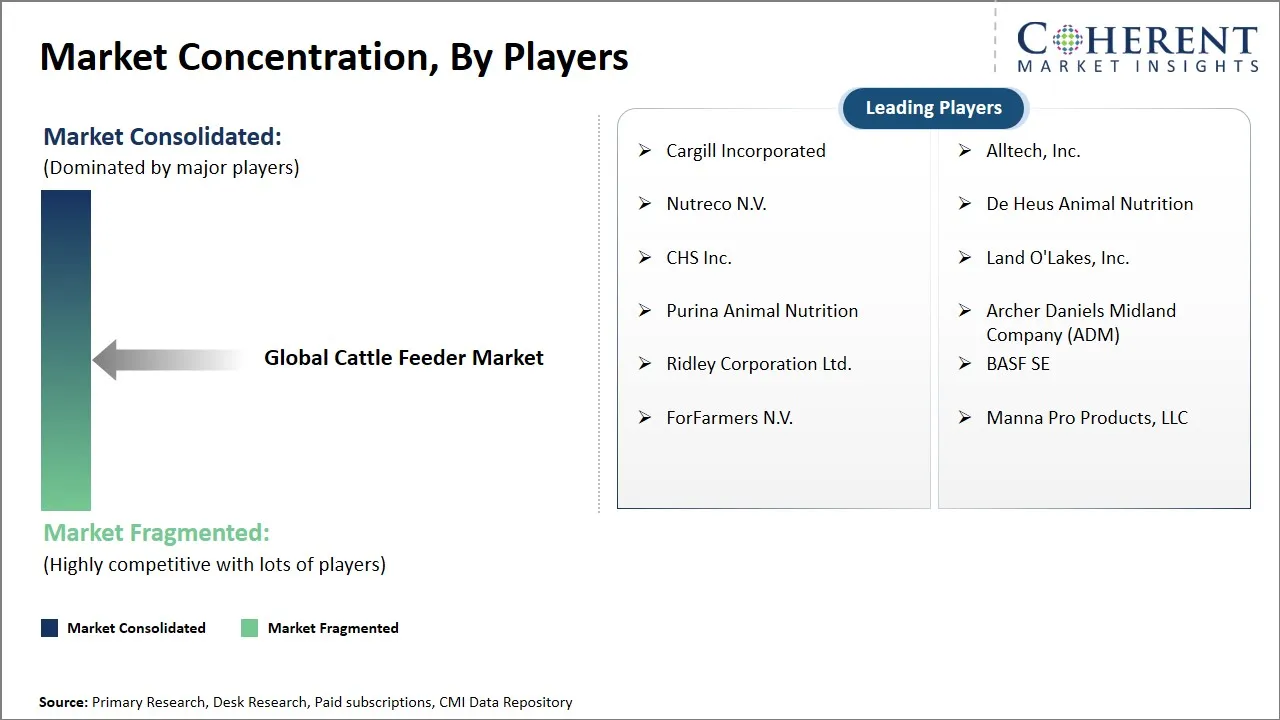
| Companies covered: | Cargill Incorporated, Alltech, Inc., Nutreco N.V., De Heus Animal Nutrition, CHS Inc., Land O'Lakes, Inc., Purina Animal Nutrition, Archer Daniels Midland Company (ADM), Ridley Corporation Ltd., BASF SE, ForFarmers N.V., and Manna Pro Products, LLC | ||
| Growth Drivers: |
| ||
| Restraints & Challenges: |
| ||
Cattle Feeder Market Dynamics
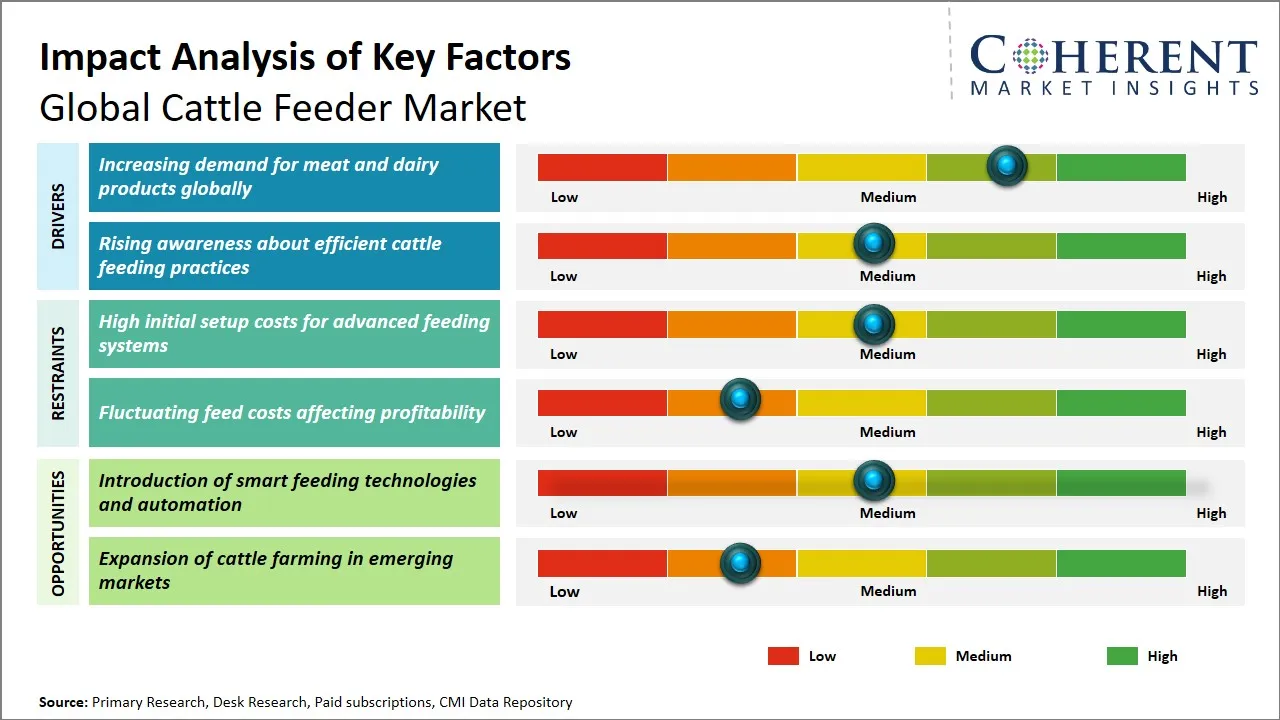
Cattle Feeder Market Driver - Increasing Demand for Meat and Dairy Products Globally
The increasing meat and dairy products consumption across the globe is a major force that is driving the development of the cattle feeder market across the globe. As population increases and incomes get higher, particularly in developing nations, the consumer preference is shifting to the protein-based food that incorporates beef and dairy products. The shift in diets increases the demand in effective rearing methods of cattle in order to satisfy the increased demand.
Cattle feeders are important since they allow more responsible feeding regimens, increased feed efficiency, and better animal health, which subsequently results in high quality of meat and dairy production. Moreover, the increased awareness of the producers on the need to balance the amount of feed consumed to ensure that the cost of feeding the cattle is minimized to maximize the yield is fueling the investment in modern cattle feeding equipment.
As an example, industrial dairy farms in California, Wisconsin, and Texas in the U.S. increasingly rely on precision feeding systems and automated silage feeders to optimize milk yield per cow while managing volatile feed costs.
Cattle Feeder Market Opportunity - Integration of Smart Feeding Technologies and Automation
The introduction of smart feeding machinery and automation is an enormous prospect in the cattle feeder industry across the world, transforming the past history on how cattle were fed and how efficiently these operations have been conducted. As the Internet of Things (IoT), artificial intelligence (AI), and sensor technologies continue to grow rapidly, cattle feeders are now becoming automated to track feed consumption, alter feeding timetables and adapt nutrition to the current data.
Through these innovations, the farmers are able to control the amount of feed given to the farms to a very high level, wastage is reduced and the overall health and productivity of the herd is improved. Also, fully automated feeders with intelligent sensors can monitor the behavior of individual animals and identify health abnormalities in them at a young age, thus providing an opportunity to intervene and eliminate losses.
As an example, advanced dairy farms in countries such as the Netherlands and Germany use AI-driven robotic feeders integrated with herd management software. These systems personalize feed mixes per cow, resulting in higher milk yield consistency and reduced metabolic disorders.
Analyst Opinion (Expert Opinion)
- Cattle feeder market has high potential growth owing to the increase in meat consumption across the world and the search of more efficient feeding methods. The International Livestock Feed Conference (2023) and the Global Cattle Industry Forum (2022) indicated essential progress and companies such as Nutreco and Cargill were the first to introduce new feeder technologies that facilitate better nutrient delivery and feed efficiency.
- A good example of how technology can be used to maximize the growth of cattle with less waste is the recent release of a precision feeding system by Nutrecos which is able to measure the feed intake of each individual cattle. Conferencing focused on the relevance of sustainability and reducing environmental impact in cattle farming operations was a central theme of these conferences especially in reaction to rising consumer demands of responsibly sourced meat.
- Nevertheless, some barriers to adoption were identified as the uncertainty of the feed price, the necessity to educate farmers about the new technologies, and so on. Those companies which invest into the area of R&D and create the alternative solutions of the feeder which can be adjusted to the needs of the particular farmers will most probably be successful. The cattle feeder market will grow based on how it manages to be innovative throughout its operations and to respond to the changing needs toward efficiency and sustainability in livestock production.
Speak to the analyst
Want personalized insights?
Take the findings above to one of our principal consultants, or have the report rebuilt around the segments, geographies and competitors you actually track.
Market Segmentation
- Type Insights (Revenue, USD Bn, 2021 - 2033)
- Manual
- Autonomous
- Material Insights (Revenue, USD Bn, 2021 - 2033)
- Plastic Feeders
- Metal Feeders
- Fiberglass Feeders
- Animal Type Insights (Revenue, USD Bn, 2021 - 2033)
- Mature Ruminants
- Young Ruminants
- Regional Insights (Revenue, USD Bn, 2021 - 2033)
- North America
- U.S.
- Canada
- Latin America
- Brazil
- Argentina
- Mexico
- Rest of Latin America
- Europe
- Germany
- U.K.
- Spain
- France
- Italy
- Russia
- Rest of Europe
- Asia Pacific
- China
- India
- Japan
- Australia
- South Korea
- ASEAN
- Rest of Asia Pacific
- Middle East
- GCC Countries
- Israel
- Rest of Middle East
- Africa
- South Africa
- North Africa
- Central Africa
- North America
- Key Players Insights
- Cargill Incorporated
- Alltech, Inc.
- Nutreco N.V.
- De Heus Animal Nutrition
- CHS Inc.
- Land O'Lakes, Inc.
- Purina Animal Nutrition
- Archer Daniels Midland Company (ADM)
- Ridley Corporation Ltd.
- BASF SE
- ForFarmers N.V.
- Manna Pro Products, LLC
Sources
Primary Research Interviews
- CEO – Leading Cattle Feeder Equipment Manufacturer (e.g., Sioux Steel Company or Sweetlix equivalent)
- Supply Chain Director – Major Livestock Feed Additive Distributor
- Production Lead – Cattle Feedlot Automation Specialist
- Sustainability Officer – Livestock Feed Certification Authority
Stakeholders
- Manufacturers
- End-use Sectors
- Beef Cattle Feedlots (Finishing Operations)
- Dairy Farm Feed Systems
- Stocker and Backgrounding Operations
- Regulatory & Certification Bodies (e.g., FDA for animal feed, EFSA in EU)
- E-commerce Platforms and Retailers (Alibaba, Tractor Supply, Purina Mills)
- Technology Integration Players: Precision feeding system providers and automation tech firms
Databases
- UN Comtrade Database (Live Bovine Animals HS Code 0102)
- India Import Export (EXIM) Database (Cattle Feed Equipment)
- USDA Livestock and Meat International Trade Data
- Eurostat Trade Statistics for Agricultural Machinery
- USGS (Indirect via Livestock Stats) or FAS USDA Reports
Magazines
- Feedlot Magazine – Trends in cattle feeding operations
- Progressive Cattle – Cattle production and feeder tech
- BEEF Magazine – Feedlot management innovations
- Livestock & Feed Trends – Global feed market dynamics
- Progressive Dairy – Dairy Cattle Feeder systems
Journals
- Animal Feed Science and Technology – Feed efficiency research
- Journal of Animal and Feed Sciences – Nutrition and feeder impacts
- Journal of Animal Science – Cattle growth and feeding studies
Newspapers
- Drovers – Beef industry and feeder cattle news
- The Cattle Business Weekly – Market reports and trends
- Wall Street Journal – Commodity prices for feeder cattle
- Business Standard (India) – Asia livestock feed growth
Associations
- International Feed Industry Federation (IFIF)
- American Feed Industry Association (AFIA)
- National Cattlemen's Beef Association (NCBA)
- Compound Livestock Feed Manufacturers Association (CLFMA, India)
- European Feed Manufacturers’ Federation (FEFAC)
Public Domain Sources
- FDA – Guidelines for animal feed and feeders
- European Commission – EFSA regulations on livestock feed
- FAO – Livestock feeding standards
- USDA – Feeder cattle reports and trade data
Proprietary Elements
- CMI Data Analytics Tool
- Proprietary CMI Existing Repository of information for last 8 years.
Get access to 250+ pages report
Every segment, forecast, competitor profile and data table behind the analysis above — available for instant download.
- ESOMAR Member
- ISO 9001:2015 Certified
- D-U-N-S Registered
- GDPR & CCPA Compliant
Missing comfort of reading report in your local language? Find your preferred language:
Transform your Strategy with Exclusive Trending Reports
Frequently Asked Questions
The global cattle feeder market is estimated to be valued at USD 3.98 Bn in 2026 and is expected to reach USD 5.17 Bn by 2033.
The CAGR of Global cattle feeder market is projected to be 3.8% from 2026 to 2033.
Increasing demand for meat and dairy products globally and rising awareness about efficient cattle feeding practices are the major factors driving the growth of the global cattle feeder market.
High initial setup costs for advanced feeding systems and fluctuating feed costs affecting profitability are the major factors hampering the growth of the global cattle feeder market.
In terms of type, manual is estimated to dominate the market revenue share in 2026.
Cargill Incorporated, Alltech, Inc., Nutreco N.V., De Heus Animal Nutrition, CHS Inc., Land O'Lakes, Inc., Purina Animal Nutrition, Archer Daniels Midland Company (ADM), Ridley Corporation Ltd., BASF SE, ForFarmers N.V., and Manna Pro Products, LLC are the major players.
Asia Pacific is expected to lead the global cattle feeder market in 2026.