

Agricultural Balers Market Size and Share Analysis- 2026 To 2033
The Agricultural Balers Market size is anticipated to grow at a CAGR of 7.5%, with a market value of USD 5.19 Bn in 2026, and is expected to reach USD 8.63 Bn by 2033. The major market drivers are increasing agricultural mechanization, rising demand for efficient hay and straw harvesting equipment, rising demand for livestock feed and developments in automated and high capacity baling machines. According to the Food and Agriculture Organization (FAO), agricultural mechanization enhances productivity, mitigates labor shortages, optimizes the timing of agricultural operations, and facilitates more efficient utilization of resources.
Key Takeaways
- The square balers segment is anticipated to hold highest share of 55% in agricultural balers market in 2026. The segment’s growth is driven by rising demand for high-density bale production, improved storage & transportation efficiency, and innovations in automated agricultural machinery. In November 2025, CLAAS announced its next-generation CUBIX square baler, highlighting the technological advances in high-capacity baling machines with straw baling performance of up to 70 metric tons per hour and maximum bale densities of 235 kg/m³.
- The hay compressing segment is projected to retain its dominance with share 40% in 2026. The growth of the segment is attributed to the growing demand for the livestock feed, expansion of commercial forage production, increasing adoption of mechanized hay harvesting, and demand for efficient feed preservation. In January 2026, the U.S. Department of Agriculture (USDA) estimated U.S. dry hay production for 2025 at 123 million short tons harvested on 49.6 million acres, which underscores the scale of hay production and handling operations.
- The individual end-user segment is projected to hold the largest market share of 60% in 2026 due to rampant family-operated farming, increasing adoption of mechanized hay production, and demand for equipment that reduces manual labor and improves harvesting efficiency. According to the USDA Economic Research Service as of July 2026, smaller family farms produced 51% of the US hay production value in 2024. The agency has also highlighted the significance of smaller agricultural operations in forage production.
- North America is projected to account for a significant 35% share of the agricultural balers market in 2026. Mechanized farming, the growing of vast areas of forage, the use of modern agricultural machinery and the demand for high-capacity harvesting equipment are driving the region’s growth. U.S. combine sales were up 3.9% year-over-year in June 2026, and Canadian combine sales were up 14.2% in July 2026, according to the Association of Equipment Manufacturers (AEM), a sign of selective investment in agricultural harvesting equipment despite broader challenges in the equipment market.
Market Drivers
Growing Focus on Sustainable Crop Residue Management is Driving the Agricultural Balers Market
The agricultural balers market is witnessing growing demand due to rising concerns over agricultural waste management, crop residue burning and need for sustainable farming practices. Agricultural balers are used by farmers to collect and compress paddy straw, wheat straw and other agricultural crop residues into dense bales for use in biomass energy production, animal bedding, industrial processing and other agricultural applications. Farmers are also gaining new sources of income from the rising use of mechanized residue collection, which is also helping in contributing to environmental sustainability.
In July 2026, CNH announced the extension of its Sustainable Environment Solutions (SES) program to South India. The initiative helped to bale more than 60,000 metric tons of paddy straw, saving an estimated 97,000 metric tons of CO2 emissions.
Rising Demand for High-Capacity Baling Equipment Among Agricultural Contractors
Increasing demand for efficient forage collection and enhanced agricultural contractor productivity, and increased harvesting capacity is benefiting the agricultural balers market. Commercial hay and straw producers are adopting high density balers to increase crop volume, reduce field operations and improve transportation efficiency. Investments in machinery that can give uniform bale quality and avoid operational downtime are driven by the increasing significance of harvesting within tight seasonal windows.
In March 2026, New Holland said a New South Wales, Australia, agricultural contractor averaged approximately 65 bales per hour with its BigBaler 1290 HD with straw bale weights of up to 500 kg. To meet its customers’ growing demand and increase its operating capacity without adding another baling machine, the contractor chose the high-density baler.
Current Events and Their Impact on the Agricultural Balers Market
Current Event | Description and its Impact |
Indian Government Expands Crop Residue Management Support and Farm Mechanization Targets (2026) |
|
Indian Government Strengthens Paddy Straw Biomass Utilization Requirements and Anti-Burning Enforcement (2025–2026) |
|
- Current Industry Events of 2026
- Market Size Estimation
- Regional Breakdown
- Competitive Landscape
- Customer Intelligence
- Segmental Analysis
- Pricing Analysis
- Key Market Drivers, Challenges & Future Trends
- Customized Insights Section
Segmental Insights
Why are Square Balers Acquiring the Largest Market Share?
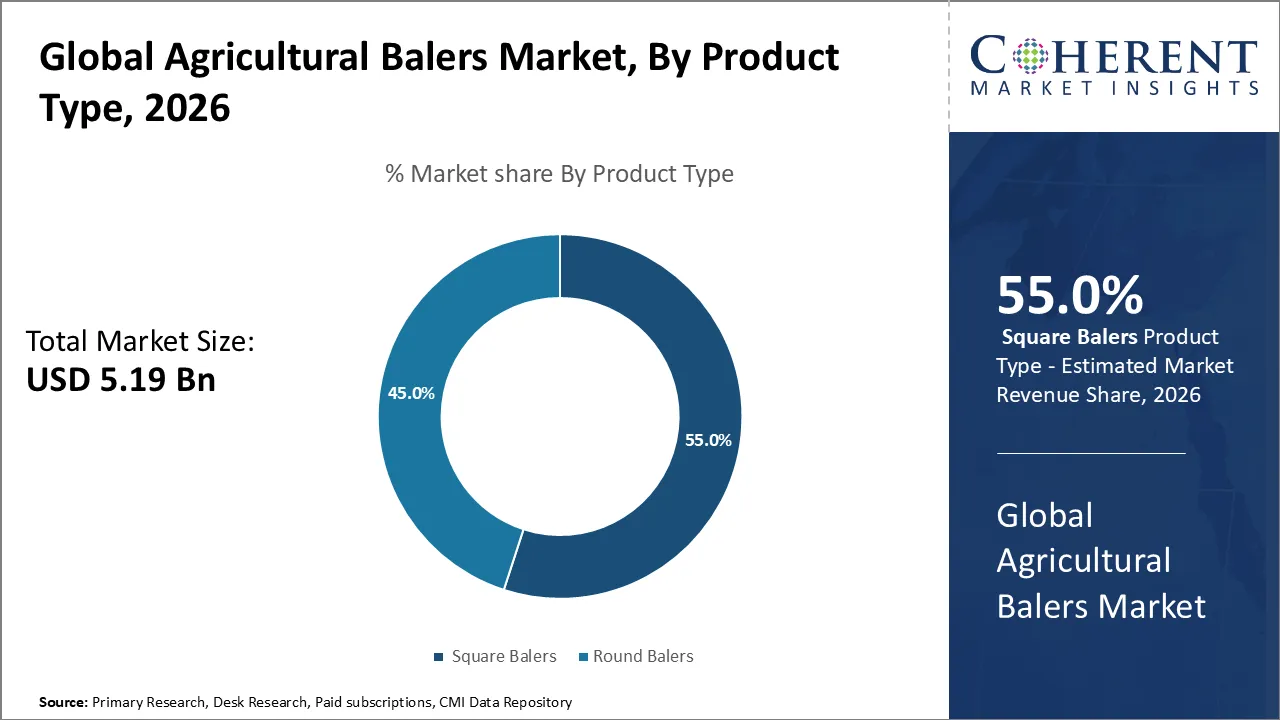
On the basis of product type, the square balers segment is projected to account for the largest agricultural balers market share of 55.0% in 2026. The segment’s ability to produce high-density, uniformly shaped bales that improve storage utilization, reduce transportation costs, and facilitate mechanical handling is expected to drive the segment’s growth. High-capacity crop-feeding systems and automated density control on large square balers are being encouraged by increasing demand from commercial hay producers, livestock farms and agricultural contractors.
In August 2026, KRONE expanded its sixth-generation BiG Pack large square baler range with new and improved BiG Pack Plus and Pro models, featuring improved baling technology and operational efficiency. The development highlights continued investment by manufacturers in high-capacity square balers.
Why is Hay Compressing Holding the Largest Market Share?
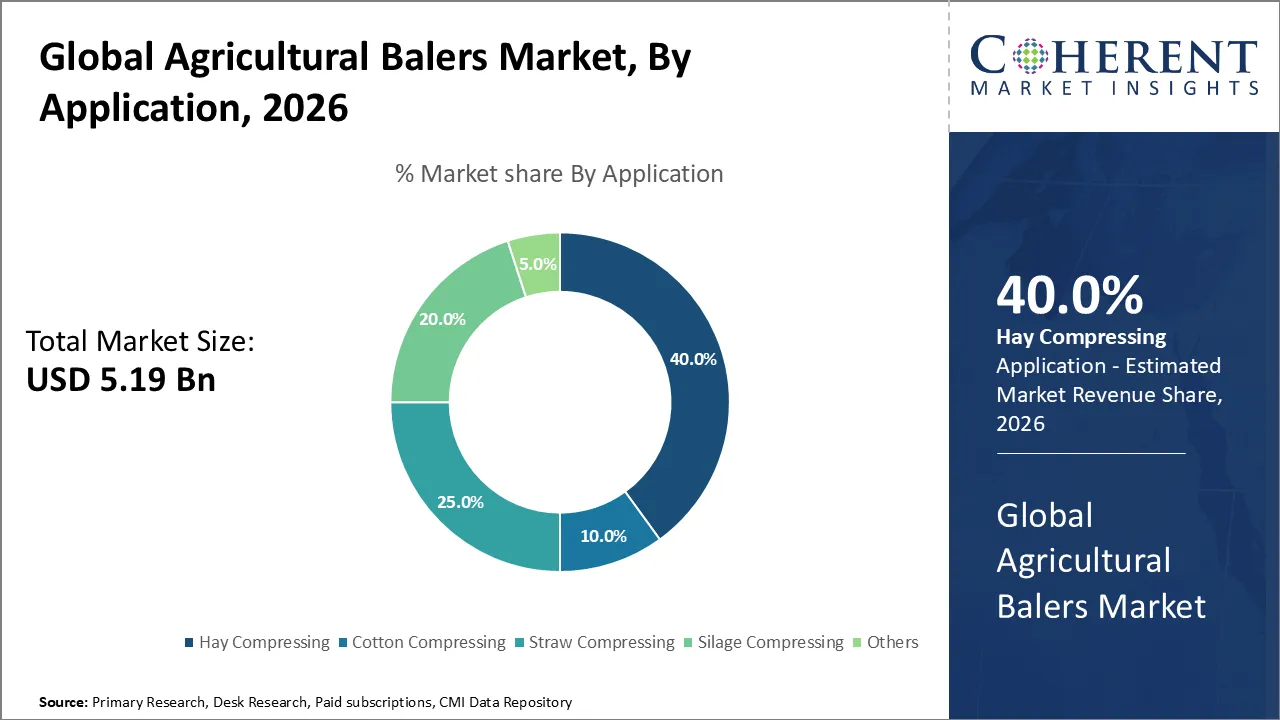
Based on application, the hay compressing segment is expected to dominate the agricultural balers market with 40.0% share in 2026. The segment growth is attributed to the need for efficient forage preservation, increasing demand for livestock feed, growth of commercial dairy and cattle farming and more focus on reduction of post-harvest losses. The key are balers in agriculture which compress the harvested hay into manageable bales, which can be easily stored long term, transported and distributed as feed.
According to the U.S. inventory of cattle and calves was about 94.2 million head as of July 2026, including 28.5 million beef cows and 9.65 million milk cows, according to the U.S. Department of Agriculture (USDA). The large numbers of livestock ensure continued demand for forage and conserved feed such as baled hay for both cattle and dairy enterprises.
In September 2026, Vermeer Corporation introduced its new 605 S-Series round baler lineup. The lineup includes four models: Rancher, Signature, Premium and Cornstalk Special. The new line-up offers improved baling capability and options for automation to meet the needs of hay producers from the smaller farm to the high-productivity commercial application.
Why is the Individual End-User Segment Accounting for a Significant Market Share?
Based on end user, the individual segment is projected to lead the major agricultural balers market with a market share of 60.0% in 2026. The segment is expected to see growth due to the presence of independently operated and family-owned agricultural farms, increasing adoption of small and medium capacity baling equipment, and the need to enhance harvesting efficiency through mechanization. Individual farm operators are increasingly using agricultural balers to deal with the harvesting of hay, straw and forage, reducing dependence on manual labor and outside harvesting services.
According to USDA Economic Research Service, small family farms accounted for about 86% of all U.S. farms in 2024, farming about 40% of U.S. agricultural land as of May 2026. The importance of family-owned farms to the farming industry is shown by the fact that the family farms of all sizes made up around 97% of all U.S. farms.
In February 2026, Kubota Tractor Corporation unveiled its new SSB Series small square balers, the SSB2014 and SSB2012, at the U.S. National Farm Machinery Show. The machines incorporate patented dual-chamber technology for making two bales at a time, 100 plunger strokes per minute, and built-in bale-density monitoring.
Agricultural Balers Market Trends
- Growing use of high-capacity and dual-bale production technologies is increasing harvesting productivity, reducing field operating time and allowing commercial hay producers to maximize output within limited harvesting windows. Massey Ferguson launched its SB.1436DB double small square baler in Australia and New Zealand in March 2026 which could potentially make two rows of bales per field pass doubling output over a conventional single baler that makes 14-by-18-inch bales.
- The increasing integration of automated baler controls with precision monitoring systems is allowing farmers to achieve uniform bale weight, density and dimensions with less operator input. In February 2026, AGCO announced its Massey Ferguson SB.1436DB double baler was awarded the 2026 AE50 Award from the American Society of Agricultural and Biological Engineers. The machine comes with a 105 inch pickup and electronic monitoring for bale length, weight and flake count.
- Tractor and implement automation and digital connectivity continue to grow in adoption, resulting in more efficient baling operations with automated equipment adjustments, better machine coordination, and real-time monitoring of operations. Next-generation double-baler technology, such as an inline dual-bale system for faster, more efficient bale collection, will be exhibited by Massey Ferguson at the 2026 Farm Progress Show, AGCO announced in August 2026
Regional Insights
North America Dominates Owing to Advanced Farm Mechanization and Large-Scale Forage Harvesting Operations
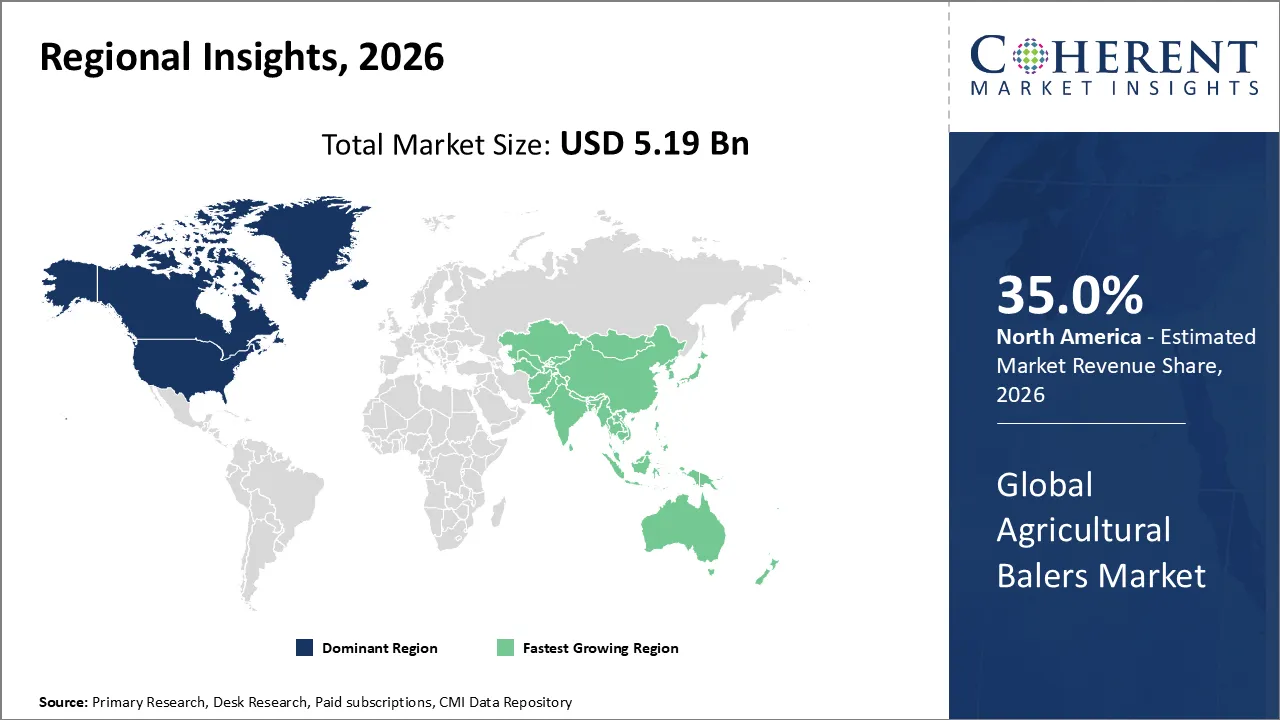
North America is projected to retain its leading position in the agricultural balers market with 35% share in 2026. The region’s expansion is fueled by widespread use of mechanized farm equipment, large-scale commercial hay and forage production, and the strong presence of agricultural machinery manufacturers. Increased demand for high capacity square and round balers, automated equipment controls and efficient crop residue handling systems is backing regional market growth.
According to the U.S. Department of Agriculture (USDA), U.S. farmers reported planting about 95.3 million acres of corn in June 2026, of which 87.4 million acres were expected to be harvested for grain. This large area under cultivation constitutes an important potential source of crop residues for baling and biomass use however not all residues are collected.
Additionally, the Association of Equipment Manufacturers (AEM) reported in May 2026 that the U.S. equipment manufacturing industry supports more than 2.2 million jobs and contributes USD 415 billion annually to the national economy. This highlights the established equipment manufacturing infrastructure supporting agricultural mechanization and advanced machinery development.
Asia Pacific Agricultural Balers Market Trends
Asia Pacific is expected to emerge as the fastest-growing region in the agricultural balers market during 2026–2033. The region’s growth is driven by increasing agricultural mechanization, government subsidies for farm equipment, rising demand for efficient crop residue management, and expanding adoption of balers among small and medium-sized agricultural producers. India and China are important growth markets, supported by efforts to modernize harvesting practices and improve agricultural productivity.
In August 2026, Ministry of Agriculture and Farmers’ Welfare, India stated that the Sub-Mission on Agricultural Mechanization (SMAM) was providing financial assistance of 40-50% on purchase of eligible agricultural machinery. The scheme also provides assistance to Custom Hiring Centers for improving access to mechanized agricultural equipment to the extent of 40% of the eligible project cost.
Growing Demand for Efficient Hay Storage and Forage Management is Supporting the U.S. Agricultural Balers Market
The U.S agricultural balers market is witnessing steady demand owing to the established forage production industry, increased adoption of mechanized harvesting equipment and growing need for effective hay storage and livestock feed management. Agricultural producers are seeking high density baling, automated bale handling and reliable harvesting equipment to increase efficiency and reduce forage losses.
The U.S. Department of Agriculture (USDA) reported that as of May 1, 2026, hay stocks across the U.S. totaled approximately 23.29 million short tons, down 3.3% compared with the previous year. This emphasizes the importance of forage inventory, preservation and storage management throughout all agricultural operations.
China Agricultural Balers Market Trends
China Agricultural Baler Market Trends China is projected to witness growth in the agricultural balers market during the forecast period, owing to increasing agricultural mechanization, growth of commercial farming activities, and government initiatives to promote modern agricultural equipment. The increasing focus on mechanized crop harvesting, efficient straw collection and sustainable utilization of agricultural residue is creating opportunities for agricultural baler manufacturers and machinery service providers.
In February 2026, China’s Ministry of Agriculture and Rural Affairs said the country had built and renovated some 75.68 million mu (5.05 million hectares) of high-standard farmland in 2025, raising the total area of high-standard farmland to more than 1 billion mu. The growth of modern agricultural infrastructure is encouraging mechanized farming operations and providing conducive conditions for the adoption of advanced agricultural machinery.
In June 2026, the Chinese government issued an agricultural and rural modernization plan for 2026-2030 to increase the contribution of agricultural scientific and technological progress to 67% by 2030. The plan emphasizes intelligent agricultural machinery, agricultural technology innovation, and modernization of farming operations.
Who are the Major Companies in Agricultural Balers Industry
Some of the major key players in Agricultural Balers Market are John Deere, Vermeer, Claas, Krone, Minos, Abbriata, Case IH, Massey Ferguson, Kuhn, New Holland, and Foton Lovol.
Key News
- In August 2025, Vermeer Corporation announced the launch of five new balers as part of eight new hay and forage equipment offerings for 2026. The introduction included the ZR-2200 self-propelled baler, the 604 S-Series round balers, and the 605S Rancher.
- In July 2025, CLAAS introduced its ROLLANT 630 RC fixed-chamber round baler, featuring a 25-knife cutting rotor, MULTIFLOW pickup, and a 1.25-meter bale chamber diameter. Positioned above the ROLLANT 520, the machine incorporates reinforced components and maintenance improvements designed to support reliable hay, straw, and silage baling operations.
Market Report Scope
Agricultural Balers Market Report Coverage
Report Coverage | Details | ||
Base Year: | 2025 | Market Size in 2026: | USD 5.19 Bn |
Historical Data for: | 2020 to 2024 | Forecast Period: | 2026 to 2033 |
CAGR: | 7.5% | 2033 Value Projection: | USD 8.63 Bn |
Geographies covered: |
| ||
Segments covered: |
| ||
Companies covered: | John Deere, Vermeer, Claas, Krone, Minos, Abbriata, Case IH, Massey Ferguson, Kuhn, New Holland, and Foton Lovol. | ||
Growth Drivers: |
| ||
Restraints & Challenges: |
| ||
Analyst Opinion
- The agricultural balers market is expected to benefit from increasing demand for mechanized harvesting equipment and improved operational efficiency across commercial farming operations. According to the USDA Economic Research Service, in September 2026, average net cash farm income for U.S. farm businesses was forecast to increase 7.1% to USD 121,700 in 2026.
- Increasing agricultural operating costs will probably drive farmers to high-efficiency balers that can cut labor needs, boost harvesting productivity and reduce per-bale fuel consumption. The USDA’s September 2026 forecast sees total U.S. farm production expenses rising 4.5% from 2025 to USD 492.8 billion in 2026.
- Agricultural equipment manufacturers are expected to increasingly emphasize affordable machinery, financing solutions, and productivity-enhancing technologies to address cautious farmer investment. According to the Association of Equipment Manufacturers (AEM), in September 2026, U.S. agricultural tractor sales declined 8.0% year over year in August 2026, while combine sales fell 4.0%.
Speak to the analyst
Want personalized insights?
Take the findings above to one of our principal consultants, or have the report rebuilt around the segments, geographies and competitors you actually track.
Balers Market Segmentation
- By Product Type (Revenue, USD Bn, 2021-2033)
- Square Balers
- Round Balers
- By Application (Revenue, USD Bn, 2021-2033)
- Hay Compressing
- Cotton Compressing
- Straw Compressing
- Silage Compressing
- Others
- By End User (Revenue, USD Bn, 2021-2033)
- Individual
- Industrial
- By Region (Revenue, USD Bn, 2021-2033)
- North America
- U.S.
- Canada
- Latin America
- Brazil
- Mexico
- Argentina
- Rest of Latin America
- Europe
- Germany
- U.K.
- France
- Italy
- Spain
- Russia
- Rest of Europe
- Asia Pacific
- China
- India
- Japan
- Australia
- South Korea
- ASEAN
- Rest of Asia Pacific
- Middle East
- GCC
- Israel
- Rest of Middle East
- Africa
- South Africa
- Central Africa
- North Africa
- North America
Sources
Primary Research Interviews
- Agricultural baler manufacturers and equipment developers
- Agricultural machinery distributors and dealers
- Hay, straw, and forage producers
- Commercial farming operators and agricultural contractors
- Agricultural mechanization and precision farming experts
- Livestock farm owners and forage procurement managers
- Agricultural equipment R&D and product development heads
Databases
- Food and Agriculture Organization Corporate Statistical Database (FAOSTAT)
- U.S. Department of Agriculture (USDA)
- USDA National Agricultural Statistics Service (NASS)
- World Bank
- Organisation for Economic Co-operation and Development (OECD)
- Eurostat – Agricultural Statistics
- UN Comtrade Database
Magazines
- Farm Equipment Magazine
- Successful Farming
- Progressive Forage
- Future Farming
- Farm Machinery Journal
Journals
- Computers and Electronics in Agriculture
- Biosystems Engineering
- Agricultural Systems
- Journal of Agricultural Engineering
- Applied Engineering in Agriculture
- International Journal of Agricultural and Biological Engineering
Newspapers
- Reuters
- The Wall Street Journal
- Financial Times
- The Economic Times
- The Hindu BusinessLine
Associations
- Association of Equipment Manufacturers (AEM)
- Agricultural Engineers Association (AEA)
- American Society of Agricultural and Biological Engineers (ASABE)
- European Agricultural Machinery Industry Association (CEMA)
- European Federation of Agricultural Machinery Distributors (CLIMMAR)
- Tractor and Mechanization Association (TMA India)
Public Domain Sources
- Agricultural Machinery Manufacturers' Annual Reports and Investor Presentations
- Government Agricultural Mechanization Policies and Subsidy Programs
- USDA Crop Production and Hay Inventory Reports
- FAO Agricultural Mechanization and Farm Equipment Publications
- Agricultural Equipment Sales and Registration Statistics
- Company Product Launch Announcements and Technical Specifications
- Publicly Available Agricultural Machinery Trade and Export Data
- Agricultural Equipment Standards and Regulatory Publications
Proprietary Elements
- CMI Data Analytics Tool
- Proprietary CMI Existing Repository of Information for the Last 10 Years
Get access to 250+ pages report
Every segment, forecast, competitor profile and data table behind the analysis above — available for instant download.
- ESOMAR Member
- ISO 9001:2015 Certified
- D-U-N-S Registered
- GDPR & CCPA Compliant
Missing comfort of reading report in your local language? Find your preferred language:
Transform your Strategy with Exclusive Trending Reports
Frequently Asked Questions
The Agricultural Balers Market is expected to reach USD 8.63 Bn by 2033, compared to USD 5.19 Bn in 2026.
Major players operating in the global Agricultural Balers Market include John Deere, Vermeer, Claas, Krone, Minos, Abbriata, Case IH, Massey Ferguson, Kuhn, New Holland, and Foton Lovol.
High initial investment and maintenance costs, seasonal demand, low equipment utilization, and limited access to financing among small-scale farmers are the key factors hampering market growth.
The increasing adoption of mechanized hay and forage harvesting equipment, rising demand for efficient crop residue management, growing livestock feed requirements, and advancements in automated baling technologies are driving market growth.
The Agricultural Balers Market is anticipated to grow at a CAGR of approximately 7.5% between 2026 and 2033.
North America is expected to account for a prominent share of the global Agricultural Balers Market in 2026, supported by advanced agricultural mechanization, extensive forage production, and increasing adoption of high-capacity baling equipment.
Agricultural balers are farming machines designed to collect, compress, and bind harvested agricultural materials such as hay, straw, silage, and crop residues into compact bales for efficient handling, transportation, and storage.