

Chainsaw Market Analysis & Forecast: 2026-2033
Chainsaw Market is estimated to be valued at USD 4.68 Bn in 2026 and is expected to reach USD 6.81 Bn in 2033, exhibiting a compound annual growth rate (CAGR) of 5.5% from 2026 to 2033.
Key Takeaways:
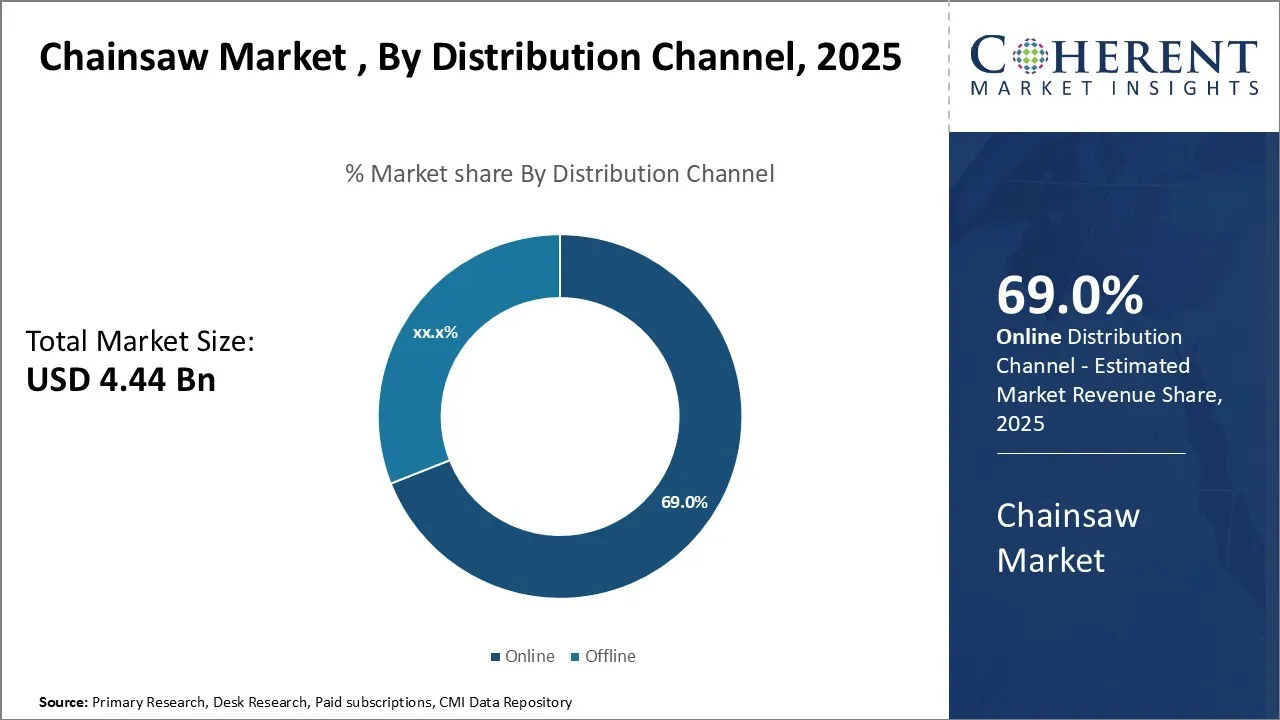
- By Distribution Channel, Online Retailing Segment is projected to dominate the chainsaw market with a 70% market share in 2026.
- Based on Distribution Channel, Offline Retailing Division is accounting for 32% of the market in 2026.
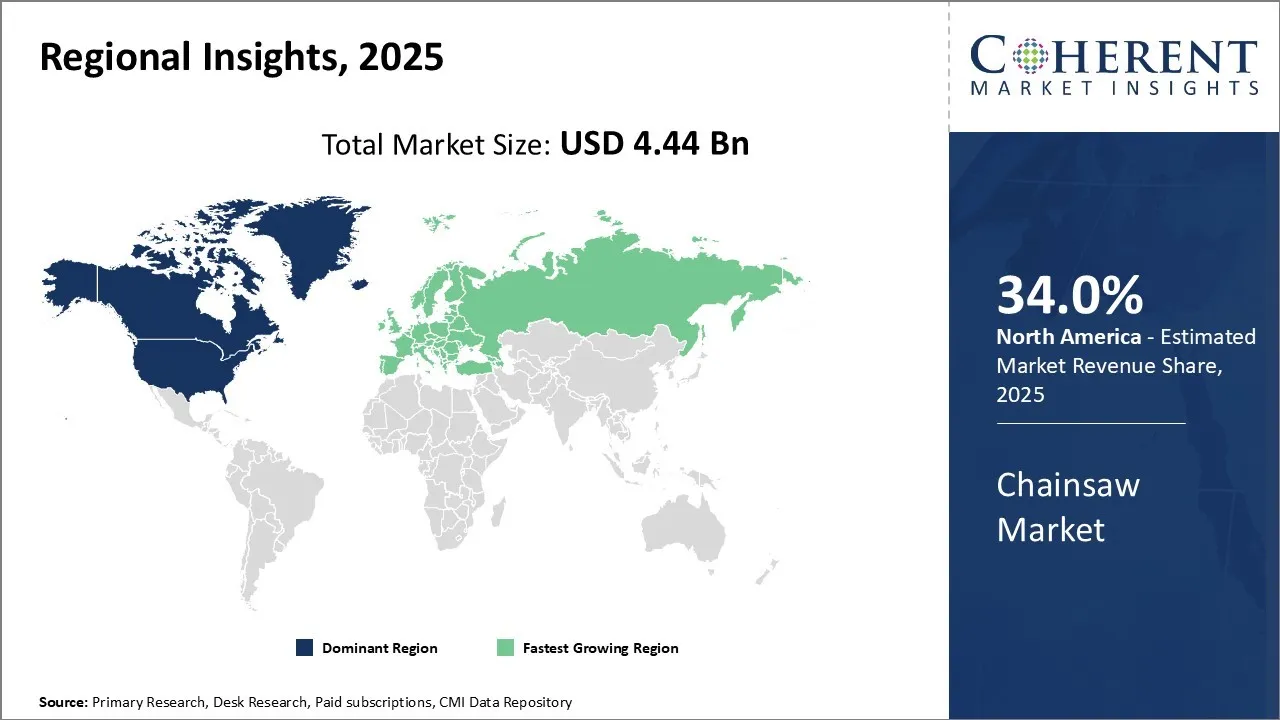
- Regionally, North America accounted for 34% shares of the global chainsaw market in 2026.
- Europe is accounted for 25% share of the global chain saw market in 2026.
- Asia Pacific is projected to hold a 20% share of the global chainsaw market in 2026.
- Latin America holds an 11% market share in the global chainsaw market during the forecast period.
- The Middle East and Africa region accounts for 10% shares of the global market in 2026.
Market Overview:
The global chainsaw market is witnessing steady growth driven by increasing demand from forestry, construction, and landscape industries. Other key growth factors include the expansion of commercial logging operations, rising infrastructure development, and heightened interest in gardening and do-it-yourself (DIY) projects. The adoption of technologically advanced chainsaws, such as battery-powered and low-emission models, is gaining momentum due to growing environmental awareness and regulatory pressure on emissions.
Current Events and its Impact on the Chainsaw Market
Current Event | Description and its impact |
Increased Frequency of Natural Disasters and Storm Recovery Efforts |
|
Government Initiatives for Sustainable Forestry |
|
Shift Toward Battery-Powered Chainsaws |
|
Pricing Analysis of the Chainsaw Market
The chainsaw market exhibits a diverse pricing structure influenced by factors such as product type, power source, brand reputation, regional variations, and end-user segments. Prices range from affordable, entry-level models for occasional users to high-end professional chainsaws designed for heavy-duty forestry and construction work.
Gas-powered chainsaws generally command higher prices compared to electric and battery-operated variants. Their superior power, longer runtime, and suitability for demanding tasks justify the premium cost. Battery-operated chainsaws are increasingly popular due to their portability and eco-friendliness, with prices gradually declining as battery technologies advance. Electric chainsaws typically occupy the lower to mid-price segments, favored by casual users for light-duty applications.
Brand positioning plays a significant role in pricing. Established brands with strong reputations often price their products higher, reflecting advanced features such as anti-vibration technology, automatic chain lubrication, and enhanced safety mechanisms. In contrast, emerging regional manufacturers offer competitively priced alternatives to appeal to budget-conscious consumers.
Geographically, chainsaw prices vary due to differences in import duties, taxes, and operational costs. North America and Europe generally report higher prices owing to stringent safety regulations and quality standards. Meanwhile, Asia Pacific, Latin America, and Africa offer more cost-effective models suited to the growing demand in developing markets.
Customer segments also influence pricing strategies. Consumer-grade chainsaws target DIY enthusiasts with affordable options, while professional users invest in durable, high-performance machines with premium pricing. Technological advancements and raw material cost fluctuations continue to shape pricing trends, balancing affordability with product innovation.
- Current Industry Events of 2026
- Market Size Estimation
- Regional Breakdown
- Competitive Landscape
- Customer Intelligence
- Segmental Analysis
- Pricing Analysis
- Key Market Drivers, Challenges & Future Trends
- Customized Insights Section
Chainsaw Market Trends
- Expanding Technological Advances
Rapid technology advancements in recent years have resulted in new outdoor power tools. These advancements boost the efficiency and efficacy of outdoor power equipment. Manufacturers are also focusing on many developments in order to suit customer demands. Manufacturers, for example, presented their new generation of 90cc chainsaws 281 XP, 288 XP, 390 XP, and 395 XP in 2021. These items are primarily designed for expert foresters and tree workers.
In August 2024, Husqvarna launched the T540 XP® Mark III, a professional-grade chainsaw designed for arborists. This model features AutoTune™ 3.0 technology for optimal engine performance, X-Torq® engine design for increased power output, and LowVib® technology to reduce handling vibrations, enhancing user comfort and efficiency.
- Development Of Lithium-Ion Batteries
The battery has grown tremendously in recent years as a result of technological advancements. This battery's rapid adoption is increasing its domination year after year. Several developments in batteries for greater backup capacity have been made in response to the growing demand for long-lasting battery life. This has enhanced Li-ion battery performance and efficiency.
In May 2023, ECHO Incorporated expanded its product range with four new gas chainsaws, including the CS-4920 and CS-4010 models. These chainsaws are equipped with stratified 2-stroke engines for lower emissions and improved performance. The CS-4010, tailored for homeowners, offers reduced starting effort and lighter weight, aligning with consumer demands for user-friendly equipment.
Opportunities in the Chainsaw Market:
- Adoption Of Eco-Friendly Products Is Increasing
The chainsaw market is likely to be driven by rising demand for environmentally friendly products during the forecast period. Gas-powered equipment emits toxic gases, causing air pollution. Customers are increasingly interested in electric and battery-powered chainsaws as they become more environmentally conscious and seek for environmentally friendly items. As a result, people choose products that have the least environmental impact.
Segmental Analysis
Global Chainsaw Market Insights, By Distribution Channel
Online retailing is projected to dominate the global chainsaw market, capturing a significant 70% market share in 2026. The growing preference for e-commerce platforms stems from the convenience of home delivery, broader product selection, transparent pricing, and ease of comparison. DIY users, gardening enthusiasts, and hobbyists are increasingly choosing online channels due to accessible product information, video tutorials, and user reviews that guide informed purchases.
Chainsaw Market: Regional Insight
North America Chainsaw Market Trends and Analysis
North America is set to dominate the global chainsaw market, accounting for approximately 34% of the market share in 2025. This dominance is driven by the region’s vast timber resources, extensive forest coverage, and robust construction activities. The United States and Canada lead demand due to their large-scale forestry operations and significant consumption of wood pallets products.
Europe Chainsaw Market Trends and Analysis
Europe holds the second-largest share, estimated at 25% in 2025, fueled primarily by the expansion of timber and construction sectors. Countries like Germany, Sweden, and Finland are key contributors, driven by advanced logging practices and stringent environmental policies. Increasing government investments in sustainable infrastructure and the ongoing conversion of forest areas for agricultural and development projects are additional factors boosting demand.
Chainsaw Market Dominating Country:
United States Chainsaw Market Trends and Analysis
The United States and Canada collectively dominate the global chainsaw market, with North America accounting for over 34% of the market share in 2025. The United States leads with significant demand from the construction sector, forestry operations, and residential users, driven by high timber consumption and extensive woodland areas. Canada, as the second-largest global producer of engineered wood lumber and a major manufacturer of northern bleached softwood kraft pulp, plays a critical role in the global chainsaw landscape.
Market Report Scope
Chainsaw Market Report Coverage
| Report Coverage | Details | ||
|---|---|---|---|
| Base Year: | 2025 | Market Size in 2026: | USD 4.68 Bn |
| Historical Data for: | 2020 To 2024 | Forecast Period: | 2026 To 2033 |
| Forecast Period 2026 to 2033 CAGR: | 5.5% | 2033 Value Projection: | USD 6.81 Bn |
| Geographies covered: |
| ||
| Segments covered: |
| ||
| Companies covered: | Husqvarna Group, Stiga, Stihl, Robert Bosch, Oregon Tools, Active, Al-Ko Kober, Einhell Germany, Cobra, Emak Group | ||
| Growth Drivers: |
| ||
| Restraints & Challenges: |
| ||
Analyst Viewpoint – Chainsaw Market
- The chainsaw market is witnessing steady growth driven by rising demand across forestry, agriculture, construction, and landscaping sectors. Analysts emphasize that increased mechanization and the need for efficient timber harvesting are key factors propelling market expansion. The growing preference for battery-powered and electric chainsaws reflects a broader shift towards eco-friendly and user-friendly equipment, supported by advancements in battery technology and safety features.
- Technological innovations, including improved engine efficiency, anti-vibration systems, and smart safety mechanisms, are enhancing product performance and user experience. These innovations are enabling manufacturers to cater to both professional users and DIY consumers with tailored offerings. Additionally, digital marketing and online retail platforms are expanding product reach and influencing purchasing behavior by providing detailed product information, tutorials, and user reviews.
- Sustainability concerns are also influencing market dynamics, with an increasing focus on environmentally responsible forestry practices and emission standards driving the adoption of clean chainsaw models.
- Geographically, North America maintains a dominant market position due to its extensive forestry activities and construction projects, while Asia Pacific represents the fastest-growing region, fueled by rapid urbanization and infrastructure development. Europe continues to emphasize innovation and sustainability, and Latin America and MEA markets are expanding through increased agricultural and forestry mechanization.
- Experts caution that market players must continuously innovate in product design, safety, and digital engagement to stay competitive amid rising consumer expectations and regulatory pressures. Nevertheless, strong demand for versatile, efficient, and sustainable chainsaws is expected to sustain robust market momentum in the coming years.
Chainsaw Market: Key Development
- In March 2025, Stihl launched a new line of battery-powered chainsaws featuring enhanced battery life and noise reduction technology, targeting both professional loggers and residential users. This innovation underscores Stihl’s commitment to eco-friendly and user-centric product development.
- In February 2025, Husqvarna introduced an advanced smart chainsaw model integrated with IoT capabilities for real-time monitoring of tool performance, maintenance needs, and safety alerts. This move strengthens Husqvarna’s position in the connected outdoor power equipment segment.
- In January 2025, Echo partnered with a leading forestry company to supply customized chainsaw solutions designed to improve efficiency and safety in large-scale timber harvesting operations. The collaboration aims to boost mechanization and reduce manual labor risks.
- In December 2024, Makita expanded its electric chainsaw portfolio by unveiling models with quick battery swap features and improved ergonomics, catering to the growing demand for portable and lightweight equipment among DIY enthusiasts.
- In November 2024, STIHL invested in a sustainability initiative focusing on recyclable materials and lower emissions in its chainsaw manufacturing process, aligning with increasing global environmental regulations and consumer demand for greener products.
Market Segmentation
- Global Chainsaw Market, By Product (Revenue, USD Bn, 2021 - 2033)
- Gas-Powered
- Electric Corded
- Cordless
- Global Chainsaw Market, By Distribution (Revenue, USD Bn, 2021 - 2033)
- Commercial
- Residential
- Global Chainsaw Market, By Distribution (Revenue, USD Bn, 2021 - 2033)
- Online
- Offline
Regional Insights (Revenue, USD Bn, 2021 - 2033)
- North America
- U.S.
- Canada
- Latin America
- Brazil
- Argentina
- Mexico
- Rest of Latin America
- Europe
- Germany
- U.K.
- Spain
- France
- Italy
- Russia
- Rest of Europe
- Asia Pacific
- China
- India
- Japan
- Australia
- South Korea
- ASEAN
- Rest of Asia Pacific
- Middle East
- GCC Countries
- Israel
- Rest of Middle East
- Africa
- South Africa
- North Africa
- Central Africa
- North America
- Key Players Insights
- HUSQVARNA GROUP
- STIGA
- STIHL
- ROBERT BOSCH
- OREGON TOOLS
- ACTIVE
- AL-KO KOBER
- EINHELL GERMANY
- COBRA
- EMAK GROUP
Sources
The Stakeholders Consulted:
- Forestry operations managers and logging supervisors
- Manufacturers and distributors of chainsaws and related outdoor power equipment
- Retailers and online sales platforms specializing in power tools
- Safety and regulatory compliance experts in forestry and construction
- Industry consultants focused on mechanization and equipment efficiency
- Environmental agencies overseeing sustainable forestry practices
- End-users including commercial loggers, agricultural workers, and DIY consumers
Databases Accessed:
- U.S. Forest Service – Timber Harvesting and Equipment Usage Data
- International Forestry Products Association (IFPA) – Market and Production Statistics
- China National Forest Inventory – Industry Analytics
- World Bank Open Data – Forestry and Agricultural Equipment Usage
Magazines & Trade Publications:
- Forestry Equipment & Technology Magazine
- Outdoor Power Equipment News
- Logging and Sawmilling Journal
- Construction and Forestry Machinery Today
- Power Tool World
Scientific and Industry Journals:
- Journal of Forest Engineering
- International Journal of Forestry Research
- Journal of Cleaner Production – Sustainable Equipment Usage
- Applied Ergonomics – Tool Safety and User Efficiency
Newspapers & Media Outlets:
- The Wall Street Journal – Industrial and Forestry Sector
- Bloomberg – Agriculture and Machinery News
- Reuters – Global Equipment Markets
- The Economic Times – Infrastructure and Rural Development
- Business Standard – Construction and Forestry Equipment
Associations and Regulatory Bodies:
- Occupational Safety and Health Administration (OSHA)
- International Powered Access Federation (IPAF)
- American Forest & Paper Association (AF&PA)
- Environmental Protection Agency (EPA) – Emissions Standards
- Forestry Stewardship Council (FSC)
Public Domain Sources:
- U.S. Energy Information Administration (EIA) – Equipment Energy Use Reports
- European Commission – Machinery Emissions and Efficiency Regulations
- World Bank – Agricultural and Forestry Mechanization Reports
- International Renewable Energy Agency (IRENA) – Sustainable Equipment Practices
Proprietary Research Elements:
- Internal Market Analytics Platform
- Exclusive Industry Surveys and Interviews with Key Stakeholders
- Custom Data Modeling on Sales, Pricing, and Regional Demand Patterns
Get access to 250+ pages report
Every segment, forecast, competitor profile and data table behind the analysis above — available for instant download.
- ESOMAR Member
- ISO 9001:2015 Certified
- D-U-N-S Registered
- GDPR & CCPA Compliant
Missing comfort of reading report in your local language? Find your preferred language:
Transform your Strategy with Exclusive Trending Reports
Frequently Asked Questions
The Chainsaw Market size is estimated to be valued at USD 4.68 Bn in 2026, and is expected to reach USD 6.81 Bn by 2033.
The CAGR of the global Market is projected to be 5.5% from 2026 to 2033.
Growing demand for timber goods is increasing the rate of deforestation are fuelling growth of the Market.
The commercial use segment is the leading application segment in the Market
Strict government regulations is the major factors restraining growth of the Market
Husqvarna Group, Stiga, Stihl, Robert Bosch, Oregon Tools, Active, Al-Ko Kober, Einhell Germany, Cobra, Emak Group