

Global Biomass Pellets Market Size and Forecast – 2026 To 2033
The Global Biomass Pellets Market is estimated to be valued at USD 10.27 Bn in 2026 and is expected to reach USD 16.38 Bn by 2033, growing at a compound annual growth rate (CAGR) of 6.90% from 2026 to 2033. This robust growth is driven by increasing demand for sustainable energy solutions, decarbonization initiatives, and supportive government policies encouraging renewable fuel adoption across power generation, industrial heating, and combined heat and power applications. The market is further supported by rising utilization of agricultural residues, forestry waste, and other biomass resources as alternative feedstocks for pellet manufacturing, strengthening supply diversification and circular energy systems.
Growing investments in biomass processing infrastructure, improved pellet quality standards, and integration of biomass fuels into existing thermal energy systems are creating new opportunities for producers and technology providers. In April 2025, India’s Ministry of New and Renewable Energy continued supporting biomass pellet manufacturing through its Biomass Programme, which provides financial assistance for establishing pellet production facilities and promoting biomass-based energy projects, strengthening the commercial ecosystem for renewable solid fuels.
Key Takeaways of the Global Biomass Pellets Market
- Wood Pellets is estimated to register a 7.1% CAGR and account for 61.9% of the global biomass pellets market in 2026, supported by established supply chains, large-scale utility adoption, and compatibility with existing biomass power infrastructure. In April 2025, Drax highlighted its North American pellet operations and continued investment in sustainable biomass pellet production capacity.
- Torrefied Pellets is estimated to achieve a 7.4% CAGR and represent 76.6% of the global biomass pellets market in 2026, as higher energy density, improved storage characteristics, and coal replacement potential strengthen industrial applications. In May 2025, the European Commission reinforced renewable energy deployment targets and sustainability frameworks supporting advanced biomass utilization across energy sectors.
- Forest and Wood Waste is estimated to record a 6.8% CAGR and hold 46.8% of the global biomass pellets market in 2026, owing to its established availability from forestry operations and efficient conversion of residual materials into renewable fuels. In April 2025, Drax showcased its wood pellet production process using by-products from the lumber industry at its Louisiana facility.
- Europe is estimated to expand at a 6.5% CAGR and account for 31.5% of the global biomass pellets market in 2026, supported by renewable energy policies, biomass sustainability regulations, and continued use of pellets for power and heating applications. In May 2025, the European Commission advanced implementation measures under the revised Renewable Energy Directive covering renewable heating, industry, and biomass sustainability criteria.
- North America is estimated to grow at an 8.0% CAGR and represent 29.8% of the global biomass pellets market in 2026, supported by large-scale pellet manufacturing infrastructure, export-oriented supply chains, and access to forestry resources. In February 2025, Drax reported continued expansion of its North American pellet supply chain and highlighted pellet production capacity supporting global biomass markets.
Segmental Insights
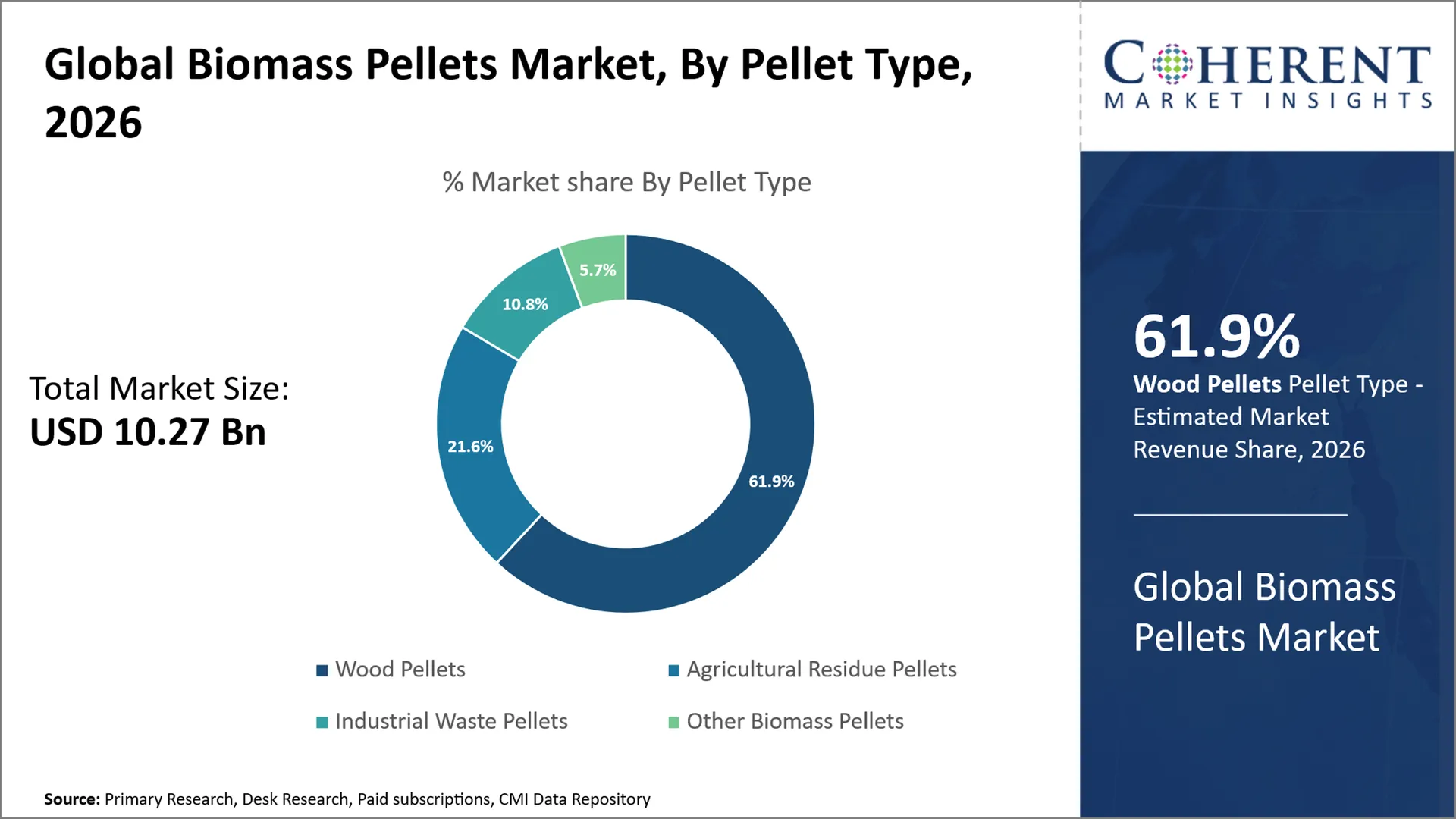
Why Does Wood Pellets Dominate the Global Biomass Pellets Market?
Wood Pellets are expected to account for 61.9% of the global biomass pellets market in 2026, supported by their established production ecosystem, standardized fuel characteristics, and widespread acceptance among utility and industrial energy users. Unlike alternative biomass sources that require additional processing adjustments, wood pellets benefit from consistent density, predictable combustion performance, and mature handling infrastructure. Large forestry industries generate continuous raw material availability through sawmill residues and managed forest by-products, enabling manufacturers to maintain stable production volumes. Utilities and industrial heating operators prefer wood pellets because existing biomass boilers and co-firing systems can integrate them with limited operational modifications. Pellet producers with access to sustainable forestry resources and efficient export logistics gain commercial advantages. In March 2025, the Advanced Woody Biomass Alliance highlighted continued efforts to strengthen sustainable wood pellet supply chains for global energy applications.
- Current Industry Events of 2026
- Market Size Estimation
- Regional Breakdown
- Competitive Landscape
- Customer Intelligence
- Segmental Analysis
- Pricing Analysis
- Key Market Drivers, Challenges & Future Trends
- Customized Insights Section
Why Do Torrefied Pellets Represent the Largest Product Type Category in the Global Biomass Pellets Market?
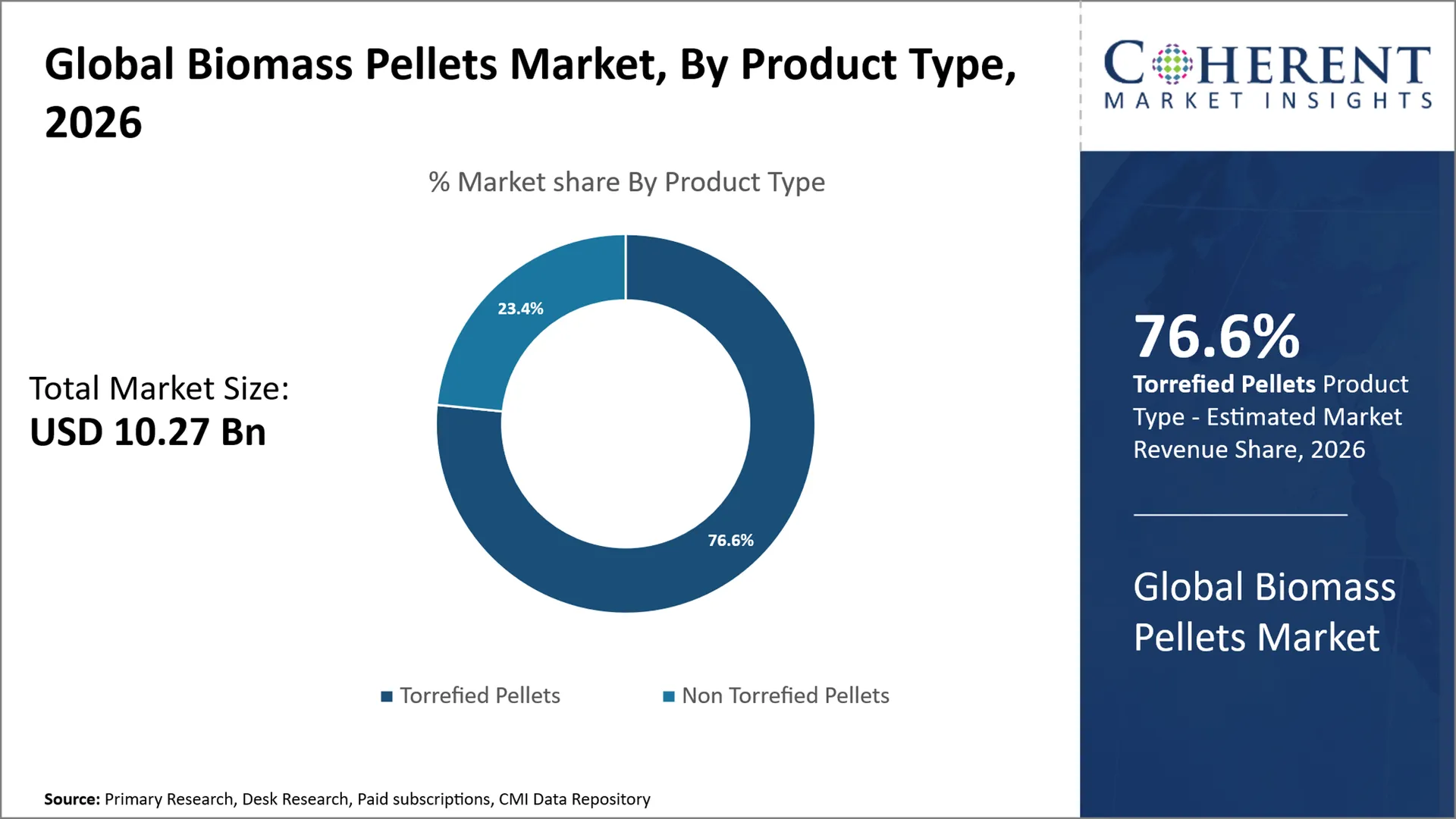
Torrefied Pellets are expected to represent 76.6% of the global biomass pellets market in 2026, driven by their improved energy characteristics, storage stability, and suitability for large-scale industrial applications requiring higher-performance renewable fuels. The torrefaction process reduces moisture sensitivity and improves handling properties, allowing these pellets to better replicate certain operational advantages associated with conventional solid fuels. Power producers and industrial users evaluating biomass conversion strategies increasingly consider upgraded pellet formats where transportation distance, storage conditions, and combustion efficiency are important purchasing factors. Manufacturers investing in advanced thermal treatment capabilities can differentiate through premium fuel specifications and specialized customer requirements. In October 2024, the International Energy Agency continued highlighting the importance of advanced biomass conversion pathways, including improved solid biofuel technologies, within renewable energy transition strategies.
Why Do Forest and Wood Waste Dominate the Feedstock Category of the Global Biomass Pellets Market?
Forest and Wood Waste are expected to hold 46.8% of the global biomass pellets market in 2026, primarily due to their availability from established forestry operations, timber processing activities, and waste recovery systems. This feedstock category provides pellet manufacturers with a cost-effective raw material base because residues such as sawdust, chips, and processing by-products can be converted into valuable renewable fuels instead of being discarded. The integration of waste utilization into pellet production improves resource efficiency and supports circular biomass supply chains. Forestry companies, pellet producers, and energy users benefit from stable feedstock networks that improve production reliability and sustainability positioning. In April 2025, the Food and Agriculture Organization of the United Nations emphasized the importance of sustainable forest management and improved utilization of forest resources for bioenergy applications.
Current Events and their Impact
Current Event | Description and Its Impact |
United Kingdom Biomass Sustainability Requirements Update – February 2025 |
|
South Korea Biomass Subsidy Policy Adjustment – 2025 |
|
India Biomass Co-Firing Policy Implementation – 2025 |
|
Global Biomass Pellets Market Dynamics
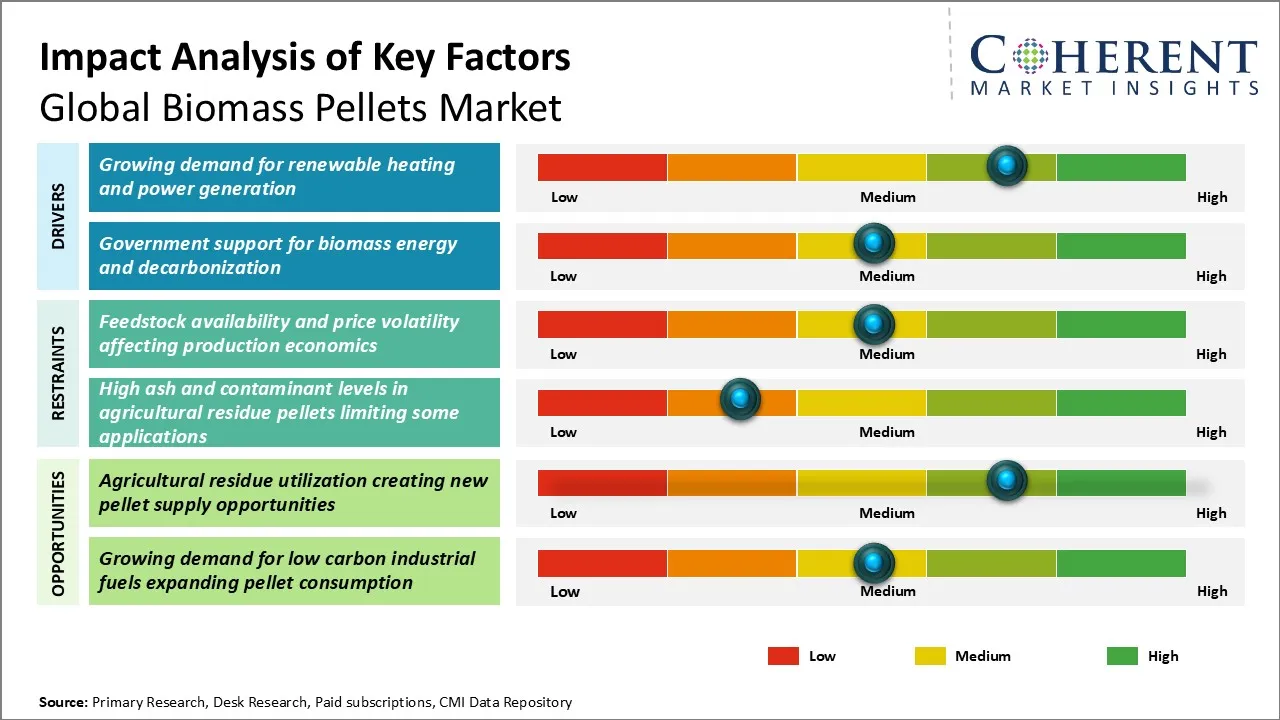
Key Market Drivers
- Growing Demand for Renewable Heating and Power Generation: Renewable heating and power generation requirements are strengthening biomass pellet adoption as utilities, district heating operators, and industrial facilities seek dispatchable alternatives to fossil fuels. Biomass pellets provide standardized fuel characteristics, easier storage, and compatibility with existing combustion infrastructure, enabling power producers and heating providers to transition without complete system replacement. Pellet manufacturers, forestry operators, and logistics providers benefit from expanding demand across utility-scale and decentralized applications. In February 2025, the UK government revised its agreement with Drax requiring stricter sustainable biomass sourcing conditions while continuing support for biomass-based power generation.
- Government Support for Biomass Energy and Decarbonization: Government decarbonization policies and renewable energy frameworks continue to influence biomass pellet investment decisions by creating incentives for renewable solid fuel utilization. Regulatory support for reducing coal dependence, improving renewable heat penetration, and managing agricultural residues is encouraging pellet producers, energy companies, and waste-processing firms to develop supply chains around sustainable biomass resources. These policies are particularly significant in regions with established thermal power infrastructure where biomass co-firing provides a transition pathway. In August 2025, Ministry of new and renewable energy India continued implementation of biomass co-firing initiatives in thermal power plants through national renewable energy programs to reduce agricultural residue burning.
Emerging Market Trends
- Shift Toward Advanced Feedstock Diversification and Circular Biomass Supply Chains: The biomass pellets market is gradually moving beyond conventional wood-based supply models toward diversified feedstock portfolios incorporating agricultural residues, industrial waste, and other biomass resources. This transition is reshaping procurement strategies as producers seek stable raw material availability while improving sustainability credentials. Pellet manufacturers are increasingly evaluating decentralized sourcing models that connect agricultural communities, forestry operators, and waste management companies. Over the forecast period, companies with flexible feedstock conversion capabilities are expected to gain advantages by reducing dependence on specific biomass sources and improving supply resilience.
- Increasing Focus on Sustainability Certification and Traceable Biomass Procurement: Sustainability verification is becoming a central factor in biomass pellet purchasing decisions as regulators, utilities, and industrial buyers demand stronger evidence regarding feedstock origin and environmental impact. The market is moving toward greater transparency in sourcing, chain-of-custody documentation, and lifecycle assessment practices. Pellet suppliers that integrate certification systems, digital traceability, and responsible forestry management practices are likely to strengthen customer relationships. This trend may increase compliance requirements for smaller producers while creating differentiation opportunities for suppliers capable of demonstrating consistent sustainability performance.
Regional Insights
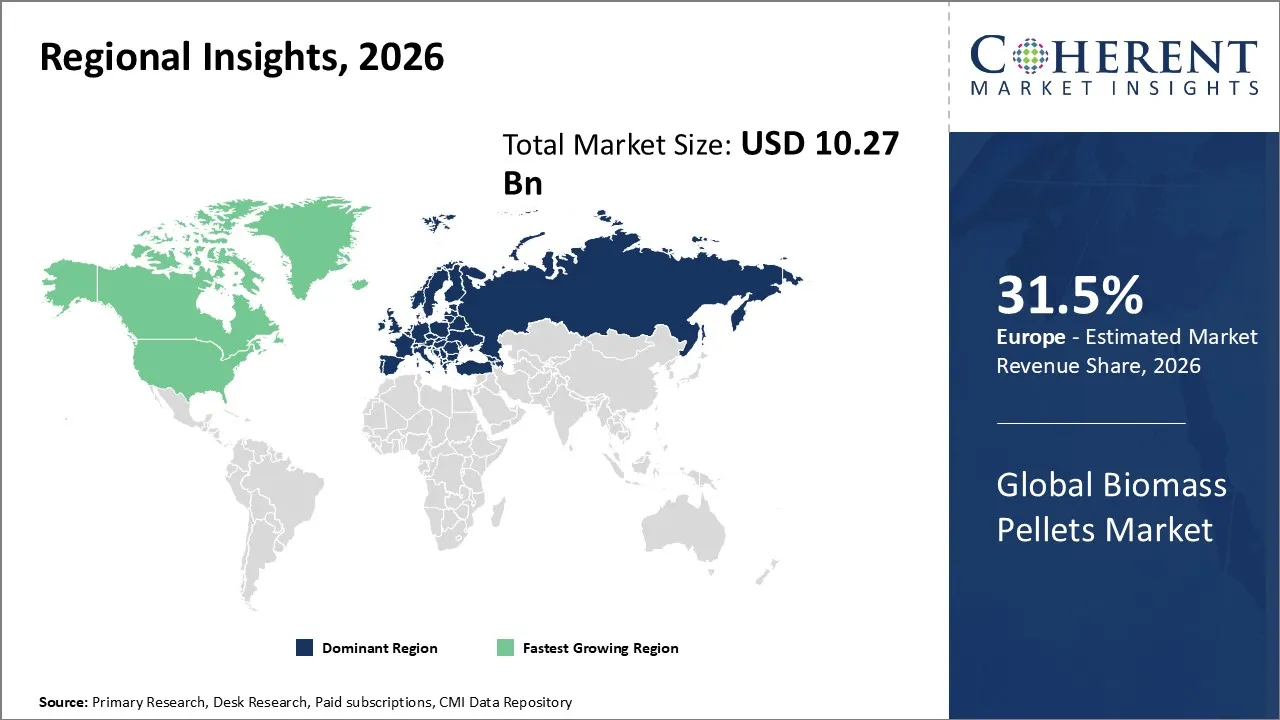
Why Does North America Dominate the Global Biomass Pellets Market?
North America is expected to account for 29.8% of the global biomass pellets market in 2026, supported by its extensive forestry resources, established pellet manufacturing infrastructure, and strong export-oriented supply chain connecting producers with international utility customers. The region benefits from abundant wood residues generated from lumber and forest management activities, enabling consistent feedstock availability for industrial pellet production. Growing utilization of biomass pellets in power generation and industrial heating applications further strengthens regional demand. The presence of large-scale pellet producers, advanced logistics networks, and access to Atlantic and Pacific export routes enhances North America’s competitive position in global biomass trade. In March 2025, the U.S. Department of Energy highlighted biomass utilization as part of its broader clean energy and carbon management initiatives, supporting continued development of sustainable biomass supply chains.
Why Is Europe Emerging as the Fastest-Growing Region in the Global Biomass Pellets Market?
Europe is expected to represent 31.5% of the global biomass pellets market in 2026, driven by strong renewable energy commitments, established district heating networks, and increasing focus on reducing fossil fuel dependency in industrial and residential heating. The region’s biomass pellet demand is supported by mature renewable energy policies, sustainability certification frameworks, and continued integration of biomass into combined heat and power systems. Countries across Northern and Western Europe are expanding renewable heating solutions while improving biomass traceability requirements. The region also remains a major importer of sustainably sourced pellets to support energy transition goals. In June 2025, the European Commission continued implementation efforts under the Renewable Energy Directive framework, reinforcing sustainability requirements for renewable energy including biomass applications.
Global Biomass Pellets Market Outlook for Key Countries
Why Is the U.S. a Key Market for the Global Biomass Pellets Market?
The U.S. is expected to remain a key market for biomass pellets, supported by its large forest product industry, availability of wood processing residues, and position as one of the major suppliers to international biomass markets. The country benefits from integrated pellet production clusters located near timber-producing regions, allowing manufacturers to secure feedstock while serving domestic industrial users and overseas utilities. Demand is also supported by biomass heating applications, renewable power generation initiatives, and industrial customers seeking lower-carbon fuel alternatives. Strong transportation infrastructure, including rail networks and export terminals, improves supply-chain efficiency for pellet producers. In January 2025, the U.S. Department of Agriculture continued supporting biomass utilization research and rural bioeconomy development through its renewable energy programs, strengthening opportunities for biomass-based industries.
Why Is India Important in the Global Biomass Pellets Market?
India is becoming increasingly important in the biomass pellets market due to its large agricultural residue availability, growing focus on reducing crop residue burning, and increasing adoption of biomass co-firing in thermal power plants. The country’s extensive agricultural base provides significant potential for converting materials such as rice straw, cotton stalks, and other residues into commercially usable pellets. Biomass pellet production also supports rural income opportunities by creating demand for agricultural waste collection and processing networks. The government’s emphasis on improving biomass utilization in power generation is encouraging investments in pellet manufacturing capacity and supply-chain development. In April 2025, India’s Ministry of Power continued promoting biomass utilization in coal-based power plants through its biomass co-firing initiatives, supporting increased adoption of agricultural residue-based pellets.
Why Does China Support Growth in the Global Biomass Pellets Market?
China plays an important role in the global biomass pellets market due to its extensive agricultural sector, large industrial energy consumption base, and increasing efforts to utilize agricultural and forestry residues for renewable energy applications. The country has significant availability of biomass resources including crop residues, forestry waste, and agricultural processing by-products, creating opportunities for domestic pellet production. Biomass pellets are increasingly considered for industrial heating, distributed energy systems, and waste-to-energy applications as China continues improving energy efficiency and reducing emissions from traditional fuels. Strong manufacturing capabilities, domestic equipment production, and regional biomass processing clusters support market development. In September 2024, China’s National Energy Administration emphasized renewable energy development and biomass utilization as part of its broader renewable energy expansion strategy, supporting future biomass fuel adoption.
Why Is Germany a Strategic Country in the Global Biomass Pellets Market?
Germany holds strategic importance in the global biomass pellets market due to its advanced renewable energy ecosystem, established heating infrastructure, and strong emphasis on sustainable energy transition. The country has a mature residential and commercial heating sector where biomass boilers and pellet-based heating systems are integrated into decentralized renewable energy solutions. Germany’s industrial expertise in energy equipment, strict sustainability standards, and focus on efficient resource utilization support demand for high-quality biomass pellets. The country also serves as an important European market for certified biomass products due to its regulatory focus on responsible sourcing and emissions reduction. In February 2025, Germany’s Federal Ministry for Economic Affairs and Climate Action continued supporting renewable heating adoption through policies promoting sustainable heating technologies, strengthening the role of biomass-based solutions.
Why Is Brazil an Important Growth Market for the Global Biomass Pellets Market?
Brazil represents an important growth market for biomass pellets due to its strong agricultural and forestry industries, abundant biomass availability, and expanding renewable energy capabilities. The country generates significant volumes of agricultural residues from sugarcane, forestry operations, and agro-industrial activities, creating opportunities for converting waste materials into energy products. Brazil’s established pulp and paper sector, plantation forestry resources, and renewable energy expertise provide a favorable foundation for pellet production. The market also benefits from increasing interest in alternative fuels for industrial applications and export opportunities linked to global biomass demand. In May 2025, Brazil’s Ministry of Mines and Energy continued advancing renewable energy initiatives through national bioenergy programs, supporting broader utilization of biomass resources across the energy sector.
Market Players, Key Development, and Competitive Intelligence
Key Developments
- In February 2025, Drax Group announced updates to its biomass generation strategy following discussions with the U.K. government regarding future operation of its biomass power assets. The development is important for the global biomass pellets market because it highlights the increasing importance of sustainable sourcing, regulatory compliance, and long-term supply arrangements between pellet producers and large-scale energy users.
- In January 2025, Enviva progressed through its restructuring process following its financial challenges, creating uncertainty around traditional wood pellet supply structures in international biomass markets. This development is important because it highlights the need for pellet suppliers to maintain efficient operations, diversified customer portfolios, and stronger financial resilience while serving utility-scale biomass demand.
Competitive Landscape
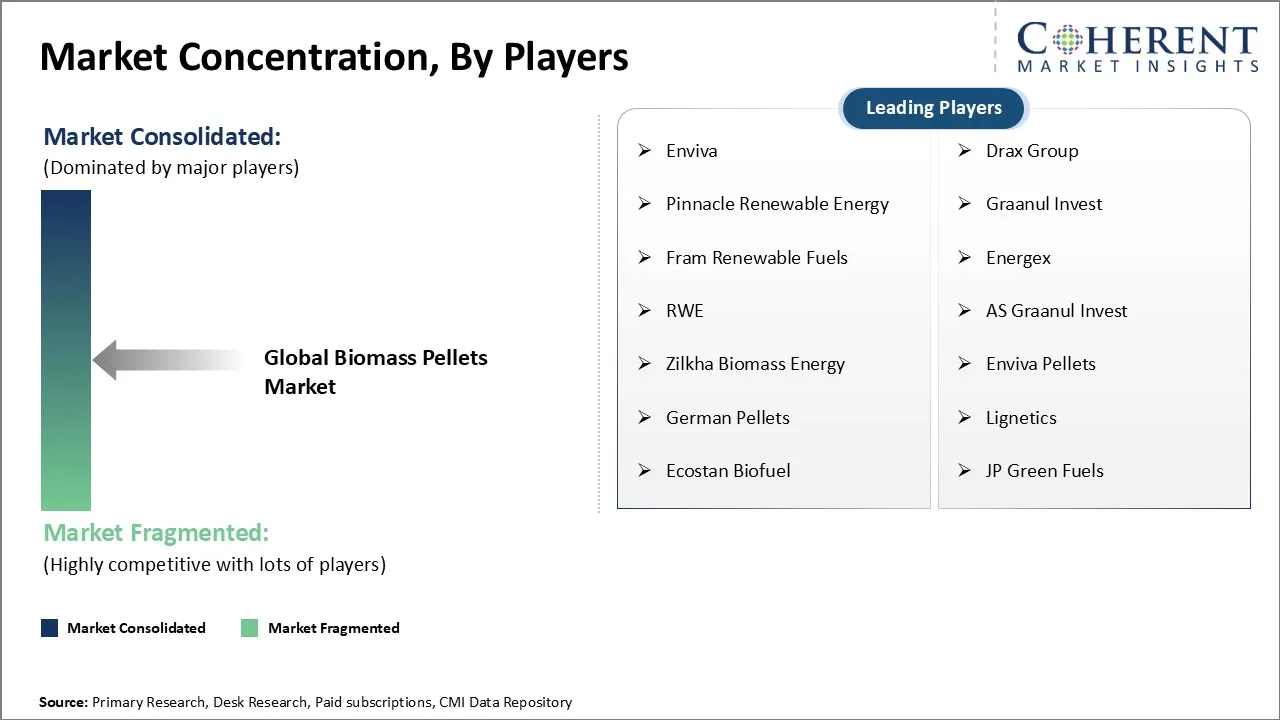
The global biomass pellets market is moderately consolidated, with competition involving large-scale pellet producers, forestry companies, renewable energy suppliers, and regional biomass processors. Market positioning depends on feedstock access, production efficiency, sustainability certifications, logistics capability, and long-term supply agreements with utilities and industrial consumers. Large suppliers benefit from integrated sourcing and export infrastructure, while regional players compete through localized biomass availability and customer relationships.
Key Focus Areas Include
- Sustainable feedstock sourcing and supply-chain reliability
- Production capacity and operational efficiency of pellet manufacturing facilities
- Product consistency including moisture content durability and calorific value
- Certification compliance and traceability of biomass origin
- Transportation infrastructure and export logistics capabilities
- Ability to process diversified feedstocks including agricultural residues and waste biomass
- Long-term contracts with utilities industrial users and heating providers
- Integration of digital monitoring systems for quality management
Market Report Scope
Global Biomass Pellets Market Report Coverage | |||
Report Coverage | Details | ||
Base Year | 2025 | Market Size in 2026: | USD 10.27 Bn |
Historical Data For: | 2020 To 2024 | Forecast Period: | 2026 To 2033 |
Forecast Period 2026 To 2033 CAGR: | 6.90% | 2033 Value Projection: | USD 16.38 Bn |
Geographies covered: |
| ||
Segments covered: |
| ||
Companies covered: | Enviva, Drax Group, Pinnacle Renewable Energy, Graanul Invest, Fram Renewable Fuels, Energex, RWE, AS Graanul Invest, Zilkha Biomass Energy, Enviva Pellets, German Pellets, Lignetics, Ecostan Biofuel, JP Green Fuels | ||
Growth Drivers: |
| ||
Restraints & Challenges: |
| ||
Analyst Opinion (Expert Opinion)
- The global biomass pellets market is likely to transition from a commodity fuel business toward a more integrated renewable energy supply ecosystem. Future competitive advantage will depend less on production volume alone and more on the ability to control feedstock sourcing, ensure sustainability compliance, optimize logistics, and provide customized fuel solutions for utilities and industrial users. Companies combining biomass processing expertise with supply-chain integration are expected to create stronger market positions.
- A major transformation opportunity lies in the commercialization of diversified biomass feedstocks beyond conventional wood resources. Agricultural residues, industrial waste streams, and region-specific biomass materials could reshape supply networks by reducing dependence on limited raw material sources. Companies capable of developing efficient preprocessing, quality management, and collection infrastructure may influence future market dynamics, while producers relying on narrow feedstock channels may face greater supply and compliance pressure.
- Market participants should prioritize sustainable sourcing capabilities, advanced pellet processing technologies, and flexible production systems capable of handling multiple biomass inputs. Companies should carefully evaluate exposure to regulatory changes related to biomass sustainability, transportation costs, and feedstock availability. Building regional supplier networks, strengthening certification capabilities, and developing long-term customer relationships with industrial energy users will be essential for maintaining competitiveness and managing supply-chain risks.
Speak to the analyst
Want personalized insights?
Take the findings above to one of our principal consultants, or have the report rebuilt around the segments, geographies and competitors you actually track.
Market Segmentation
- Pellet Type Insights (Revenue, USD Bn, 2021 - 2033)
- Wood Pellets
- Agricultural Residue Pellets
- Industrial Waste Pellets
- Other Biomass Pellets
- Product Type Insights (Revenue, USD Bn, 2021 - 2033)
- Torrefied Pellets
- Non Torrefied Pellets
- Feedstock Insights (Revenue, USD Bn, 2021 - 2033)
- Forest and Wood Waste
- Agricultural Residues
- Virgin Lumber
- Energy Crops
- Food Waste and Others
- Application Insights (Revenue, USD Bn, 2021 - 2033)
- Power Generation
- Heating
- Industrial Energy
- Combined Heat and Power
- End User Insights (Revenue, USD Bn, 2021 - 2033)
- Industrial
- Residential
- Commercial
- Agriculture
- Distribution Channel Insights (Revenue, USD Bn, 2021 - 2033)
- Direct Sales
- Indirect Sales
- Regional Insights (Revenue, USD Bn, 2021 - 2033)
- North America
- U.S.
- Canada
- Latin America
- Brazil
- Argentina
- Mexico
- Rest of Latin America
- Europe
- Germany
- U.K.
- Spain
- France
- Italy
- Russia
- Rest of Europe
- Asia Pacific
- China
- India
- Japan
- Australia
- South Korea
- ASEAN
- Rest of Asia Pacific
- Middle East
- GCC Countries
- Israel
- Rest of Middle East
- Africa
- South Africa
- North Africa
- Central Africa
- North America
Sources
Primary Research Interviews
- Biomass pellet manufacturers, utility companies, industrial energy users, renewable energy developers, distributors, and biomass fuel suppliers
- Forestry operators, agricultural residue processors, pellet plant operators, boiler manufacturers, power generation companies, and energy consultants
Stakeholders
- Biomass pellet producers, forestry companies, agricultural waste processors, renewable energy companies, and bioenergy project developers
- Feedstock suppliers, equipment manufacturers, logistics providers, storage operators, power utilities, industrial heating users, and district heating operators
- Government energy agencies, sustainability certification bodies, and renewable energy organizations
End-use Sectors
- Power generation and biomass co-firing applications
- Industrial heating and process energy applications
- Residential and commercial heating systems
- Combined heat and power (CHP) facilities and distributed energy solutions
Regulatory and Industry Bodies
- International Energy Agency (IEA)
- Food and Agriculture Organization (FAO)
- European Commission energy and sustainability bodies
- U.S. Department of Energy (DOE)
- National renewable energy ministries and biomass energy authorities
- Biomass and bioenergy industry associations
Databases
- Company annual reports, investor presentations, and sustainability reports
- Renewable energy databases and bioenergy project databases
- Forestry production and agricultural residue datasets
- Energy consumption and power generation databases
- Trade statistics, biomass fuel import-export datasets, and customs databases
- Feedstock availability and commodity pricing databases
Magazines and Journals
- Bioenergy and renewable energy publications
- Biomass conversion and fuel technology journals
- Forestry and agricultural resource management publications
- Energy transition and sustainability research journals
- Industrial heating and power generation publications
Associations
- U.S. Industrial Pellet Association (USIPA)
- European Pellet Council (EPC)
- World Bioenergy Association (WBA)
- International Renewable Energy Association
- Regional biomass and bioenergy industry associations
Public Domain Sources
- Renewable energy policies and biomass development initiatives
- Biomass power generation and co-firing projects
- Sustainable forestry and agricultural residue utilization developments
- Renewable heating adoption trends
- Biomass supply chain and logistics developments
Key Standards and Regulations
- Biomass sustainability certification requirements
- Renewable energy and carbon reduction regulations
- Forest management and responsible sourcing standards
- Biomass fuel quality and pellet certification standards
- Emission control requirements for biomass combustion systems
- International biomass fuel trade regulations
Proprietary Elements
- CMI Data Analytics Tool
- Proprietary CMI repository containing 10+ years of renewable energy, bioenergy, industrial fuel, and sustainability market intelligence.
Get access to 250+ pages report
Every segment, forecast, competitor profile and data table behind the analysis above — available for instant download.
- ESOMAR Member
- ISO 9001:2015 Certified
- D-U-N-S Registered
- GDPR & CCPA Compliant
Frequently Asked Questions
The CAGR of global biomass pellets market is projected to be 6.90% from 2026 to 2033.
The global biomass pellets market is estimated to be valued at USD 10.27 Bn in 2026 and is expected to reach USD 16.38 Bn by 2033.
Biomass pellets are primarily used in power generation, industrial heating, residential heating, and combined heat and power systems as renewable solid fuel alternatives.
Biomass pellets are produced by processing biomass materials through drying, grinding, conditioning, and palletization processes to create a dense and standardized fuel product.
Buyers typically evaluate feedstock sustainability, pellet quality, supply reliability, certification compliance, logistics capabilities, and supplier production capacity before procurement decisions.
Key trends include increasing focus on sustainable biomass sourcing, adoption of advanced pellet processing technologies, improved supply-chain traceability, and diversification of biomass feedstocks.
Growing demand for renewable heating and power generation and Government support for biomass energy and decarbonization are the major factor driving the growth of global biomass pellets market.