

Global Residue Testing Market Size and Forecast – 2026 To 2033
The global residue testing market is expected to grow from USD 8.6 Bn in 2026 to USD 14.2 Bn by 2033, registering a compound annual growth rate (CAGR) of 7.4% from 2026 to 2033. The market for global residue testing is poised for significant expansion, fueled by increasingly rigorous food safety legislation, and growing surveillance activities of pesticide residues in food products.
The U.S. Department of Agriculture (USDA) Pesticide Data Program, recorded a 0.41% year-over-year increase in analyzed food samples, rising from 9,832 samples in 2023 to 9,872 samples in 2024, reflecting continued efforts to strengthen pesticide residue monitoring and support food safety compliance.
(Source: U.S. Department of Agriculture (USDA), U.S. Department of Agriculture (USDA))
Key Takeaways of the Global Residue Testing Market
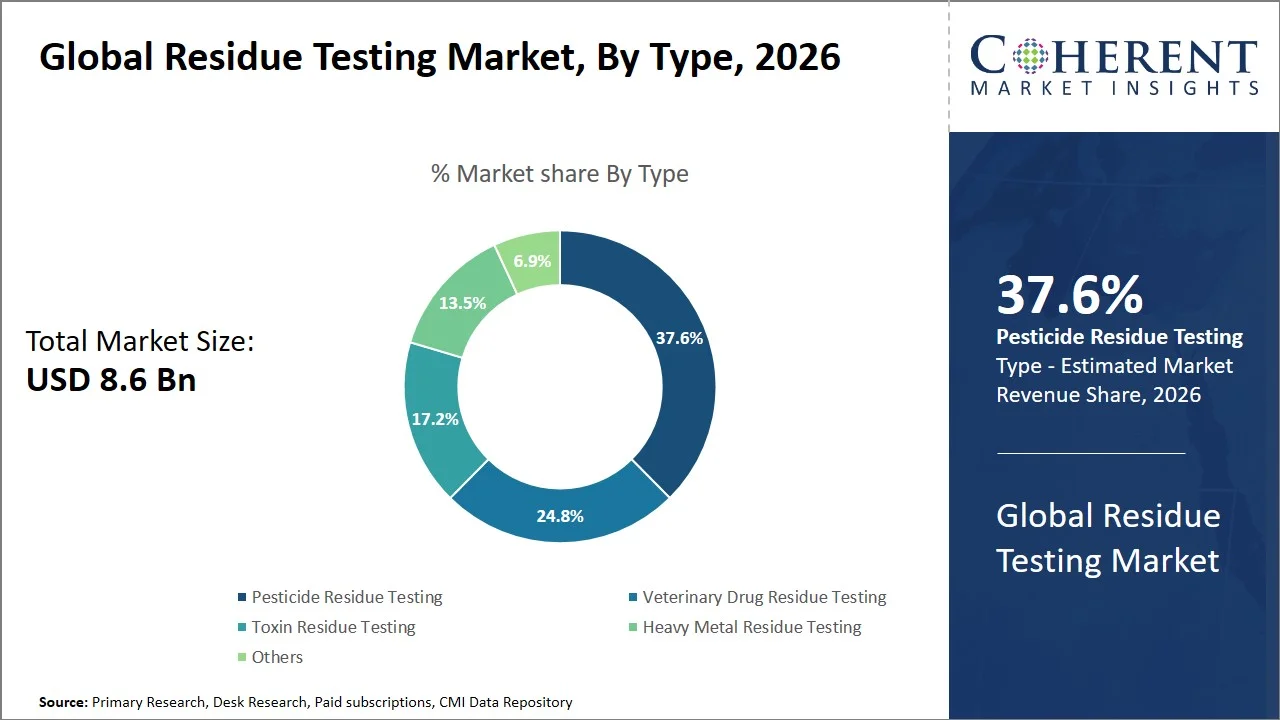
- Pesticide residue testing is projected to hold 37.6 % of the global residue testing market share in 2026, making it the dominant type segment, across North America due to stringent food safety regulations and the extensive implementation of residue surveillance programs aimed at ensuring food quality and compliance across agricultural products and imported commodities. For instance, the U.S. Food and Drug Administration (FDA) pesticide residue monitoring program screens a wide array of domestic and imported commodities for about 800 pesticide residues to determine if they adhere to preset safety limits. (Source: Food and Drug Administration)
- Chromatography-based testing is projected to hold 44.3 % of the global residue testing market share in 2026, making it the dominant technology segment, with strong demand across Europe, due to strict food safety regulations along with requirement for highly sensitive muti-residue detection method. For instance, pesticide residue laboratories within the European Union use the highly sophisticated techniques of gas chromatography–tandem mass spectrometry (GC-MS/MS) and liquid chromatography–tandem mass spectrometry (LCMS/MS) for pesticide residue analysis in cereals and feed commodities highlighting the widespread adoption of chromatography-based technologies in the region. (Source: National Food Institute)
- The food and beverages segment is projected to hold 34.9 % of the global residue testing market share in 2026, making it the dominant sample type segment, especially in Asia Pacific where growth is stimulated by rising processed food consumption, increasing food trade activities and stringent food safety regulations. For instance, according to the government of India, more than 0.518 million (5.18 lakh) samples of foods were tested over a three-year span, in the endeavor to control adulteration and improve monitoring of food quality. This demonstrates a growing trend in testing and surveillance of various food and beverage products. (Source: Ministry of Health and Family Welfare)
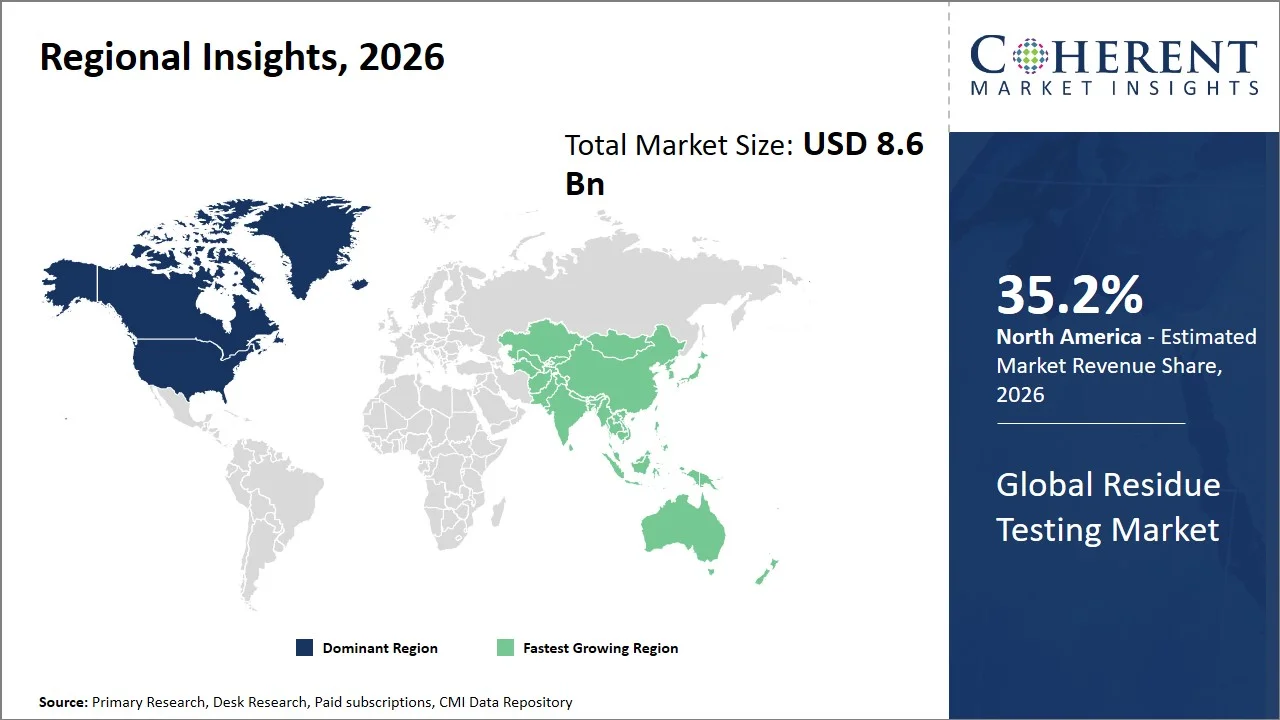
- North America maintains its dominance with an expected share of 35. 2% in 2026, in response to rigorous food safety regulations, sophisticated laboratory facilities, and prevalent implementation of high-tech analytical testing equipment. For instance, the Food Safety Modernization Act of the U.S. Food and Drug Administration (FDA) imposed stronger controls to prevent food safety risks and increased testing requirements along the entire food supply chain, boosting market demand for residual testing. (Source: Food and Drug Administration)
- Asia Pacific is expected to exhibit the fastest growth with an estimated contribution of 24.1 % share in 2026, driven by expanding food trade activities, intensified regulatory supervision, and improved food quality provisions in emerging economies. For instance, in March 2024, China's National Health Commission (NHC) published 47 new national food safety standards and 6 amendments that will enhance food safety regulation monitoring and quality assessment systems, facilitating the escalation of residue testing demand in the region. (Source: Hangzhou REACH Technology Group Co., Ltd.)
- Rising Stringency of Global Food Safety Regulations and Maximum Residue Limits (MRLs): The rising enactment of strict food safety rules and regulation by regulatory bodies has increased the requirement for residue testing on a global platform. Regulatory bodies frequently alter existing maximum residue levels (MRLs) for pesticides, veterinary drugs, toxins and contaminants in food directly or induce them to ensure safety of their consumers. This has resulted in food bodies, processors & exporters to institute for elaborate testing process and means of detection, such as research potential and executing elevated sales Growth.
- Expansion of International Food Trade and Export-Oriented Quality Compliance: Rising globalization of food supply chains and expansion of the international food trade have opened up significant avenues for the residue testing industry. Export oriented sectors need to adhere to distinct region-specific standards and standard quality parameters prior to a product's entry into foreign markets. In an effort to tighten import inspection systems and preventive food product quality controls, the need for contemporary residue testing technologies has garnered impetus among food producers and export companies.
Segmental Insights
Why Does Pesticide Residue Testing Dominate the Global Residue Testing Market?
Pesticide residue testing is projected to hold a market share of 37.6% in 2026, owing to widespread usage of pesticides in commercial farming practices and the persistent need for data collection leading to its usage in every step of food production chains. Rising adoption of high throughput multi residue analysis techniques for detection of various pesticide residues simultaneously is favoring segment growth. Furthermore, rising requirement of precise tracing of analytes at sub-parts per million levels in perishables and processed foods is strengthening the use of such techniques. For instance, the European Union Reference Laboratories (EURLs) applies a chemical procedure QuE ChERS using Gas chromatography coupled with Tandem Mass Spectrometry (GC-MS/MS) and Liquid chromatography with mass spectrometry (LC-MS/MS) for the analysis of pesticide residues in food matrices means to providing ultra-sensitive multi-residue detection capabilities. (Source: European Union)
- Current Industry Events of 2026
- Market Size Estimation
- Regional Breakdown
- Competitive Landscape
- Customer Intelligence
- Segmental Analysis
- Pricing Analysis
- Key Market Drivers, Challenges & Future Trends
- Customized Insights Section
Why Does Chromatography-Based Testing Represent the Largest Technology Segment in the Residue Testing Market?
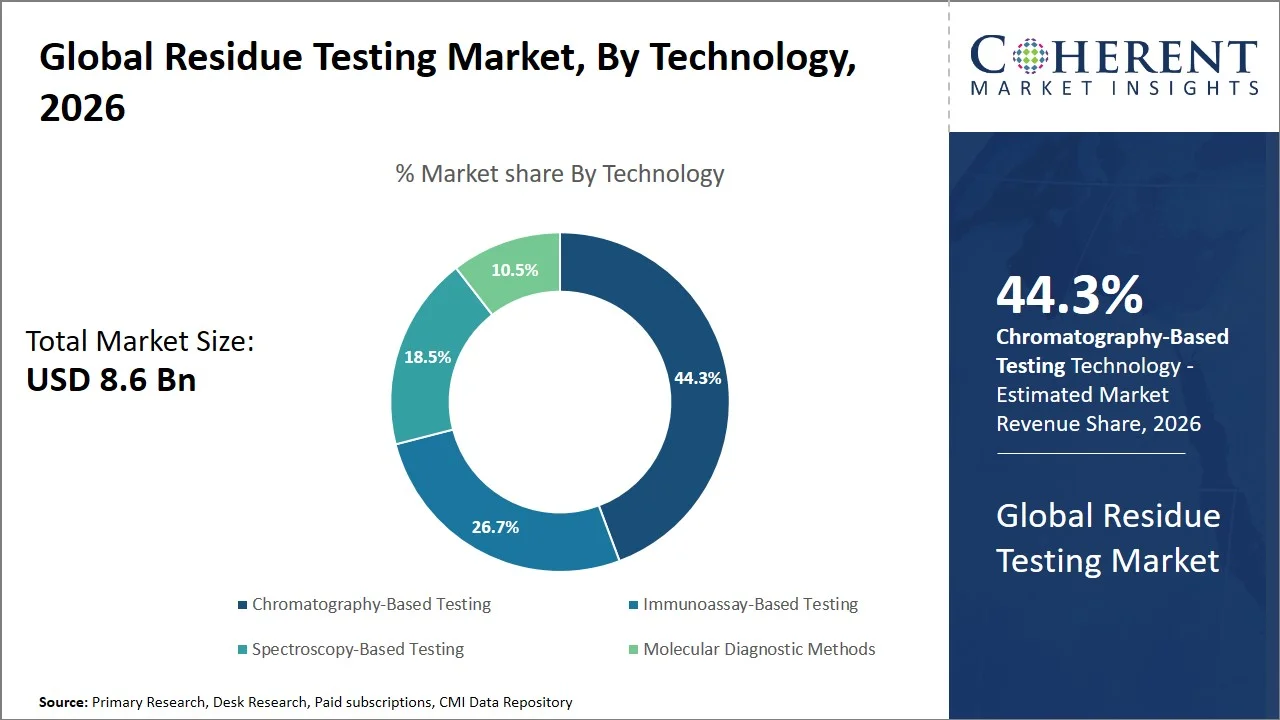
Chromatography-based testing is projected to hold a market share of 44.3% in 2026, owing to its compatibility for broad-spectrum screening across various food matrices on a single analytical platform. Further, chromatography technology allows the assessment of a higher number of different chemical classes with a complex sample matrix resulting in increased laboratory efficiency and cumulative reduction in testing time. Increasing appetite for standardized analytical protocols and rapid high-volume screening across food processing and manufacturing facilities is anticipated to bolster adoption of chromatography systems. For instance, Waters Corporation created the APGC-MS/MS (Atmospheric Pressure Gas Chromatography-Tandem Mass Spectrometry) method workflow for food safety to provide an even greater capability to analyze pesticides residues in complex food matrices and greater analytical coverage for residue screening tests. (Source: Waters Corporation)
Food and Beverages Segment Dominates the Global Residue Testing Market
The food and beverages segment is projected to hold a market share of 34.9% in 2026, due to the enormous need for testing of residues contamination throughout the production, processing & distribution of foods items. This segment requires high number of continuous tests & analyses of different chemical residues such as pesticides, veterinary drugs, toxins, biocide agents to guarantee the essential quality & safety standards. The considerable large number of diverse food items such as vegetables, milk & dairy products, beverages, citrus and processed foods is also significantly driving this segment. In addition, the soaring demand of high-capacity testing procedures in commercial food supply chains is supporting this segment. For instance, the Food Safety and Standards Authority of India (FSSAI) in association with ICAR-National Research Centre for Grapes (NRCG) designed a technical training and analytical protocol for pesticide residue profiling in food commodities; reflecting increasing focus on comprehensive residue monitoring of commodities. (Source: Food Safety and Standards Authority of India)
Currents Events and their Impact
Current Events | Description and its Impact |
European Commission Adopts Coordinated Pesticide Residue Control Programme for 2026–2028 (May 2025) |
|
European Union Revises Maximum Residue Limits (MRLs) for Selected Pesticide Substances (January 2025) |
|
(Source: European Commission, European Union)
Residue Testing Market Dynamics
Market Drivers
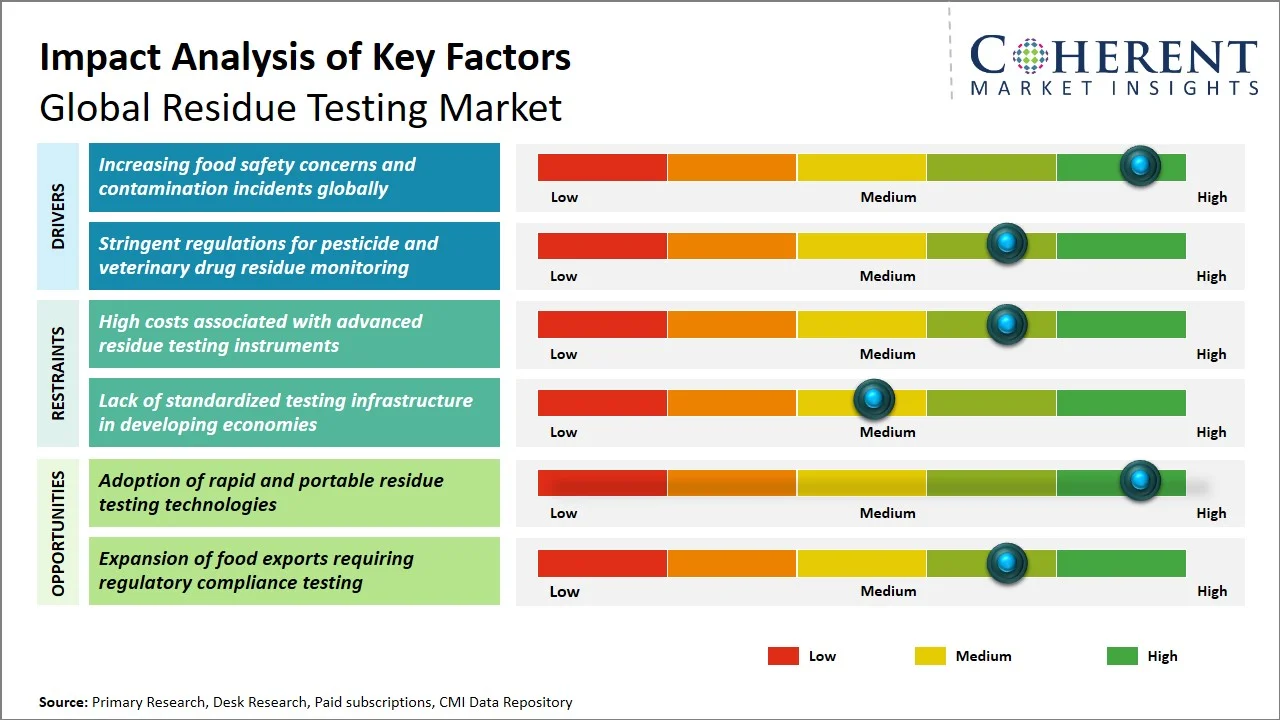
- Increasing food safety concerns and contamination incidents globally: The increasing adoption of precision agriculture across farming processes is providing substantial growth to the global residue testing market. Farmers practice advanced methods of agriculture such as specific application of fertilizers, pesticides, crop protection solutions, etc. requiring an active monitoring system for residues testing. The requirement for advanced analytical solutions to maintain consistent quality in produce has enhanced the growth of this market. The massive implementation of digital farming methods is further stimulating adoption of technique-based residues testing systems. For instance, the Food and Agriculture Organization (FAO) has increasingly promoted the adoption of digital, precision agriculture practices as a way to improve farm monitoring and resource management practices. The use of sensor-based systems, data analysis, and real-time monitoring equipment have been seen to improve crop management practices and adapt to growing demand for analytical testing across farm operations. (Source: Food and Agriculture Organization)
- Stringent regulations for pesticide and veterinary drug residue monitoring: The market for residue testing is expanding rapidly due to evolving stringent regulations of pesticide and veterinary drug residues. Regulatory authorities globally keep tightening monitoring requirements and establishing maximum residue limits (MRLs) to make sure of quality of the food for consumer safety. Food companies and the agriculture producers are taking up residue testing practices more extensively to sustain compliance and mitigate the risk of their products being refused, thus further fostering acceptance of sophisticated analytical tools for precise multi-residue detection in food. For instance, in May 2025, the European Union issued a report on pesticide residues in food, reporting on comprehensive pesticide residue monitoring programs and assessment of food items against maximum residue limits (MRLs). (Source: European Food Safety Authority) Such initiatives are indicative of a growing trend towards residue monitoring and promote the implementation of multi-residue analyses in the food industry.
Emerging Trends
- Growing Adoption of AI-Integrated and Automated Residue Testing Systems: The laboratories are employing automatic sample pre-processing machines and computerized AI-integrated analysis systems to minimize test execution time and maximize throughput capacity. They have helped considerably in better understanding data and have been found to be a boon in multi- residue analysis in the fields of Food and Agriculture.
- Increasing Shift Toward Rapid and Portable Residue Testing Technologies: An increasing number of portable biosensors, handheld analytical instruments, and point-of-use testing technologies are emerging at the market for on-site detection of residues. Such devices allow real-time assessment, minimize reliance on central laboratories, and facilitate expedited decision-making in food manufacturing and distribution environments.
Regional Insights
Why is North America a Strong Market for Residue Testing?
North America leads the global residue testing market, accounting for an estimated 35.2% share in 2026, driven by sophisticated technology infrastructure, widespread use of advanced technology and mature regulatory environment. The region has instituted comprehensive frameworks for monitoring risks associated with agricultural products and food safety, facilitated by stringent regulations from authorities such as the U.S. Food and Drug Administration (FDA) and U.S. Environmental Protection Agency (EPA).For instance, The U.S. Department of Agriculture (USDA), via its Pesticide Data Program (PDP), carries out extensive annual monitoring of pesticide residues in food commodities in support of the review of food safety and chemical regulation and regulation authorities, further endorsements North America's fairly well established and mature pesticide residues testing system. (Source: U.S. Department of Agriculture)
In addition, the region comprises many major laboratory services and equipment producers such as SGS North America and Eurofins Scientific, offering advanced testing technology and distribution network of lab services. Matured supply chain system and increasing agricultural products exports & imports have further encouraged North America to attain the dominant position in this segment.
Why Does the Asia Pacific Residue Testing Market Exhibit High Growth?
The Asia pacific residue testing market is expected to exhibit the fastest growth with an estimated contribution of 24.1% share to the global market in 2026, owing to rising food safety concerns, growth in agricultural activities and increasing evolutionary mandates in emergent countries. Countries like China, India and Japan are upgrading their residue monitoring programs in response to demand for food safety and those from global trade. For instance, India's Food Safety and Standards Authority of India (FSSAI) has enhanced overall surveillance and monitoring activities throughout the country to facilitate food safety oversight and efficiently recognize contaminants and residues in food commodities– an indication of the growing focus on residue monitoring and quality assurance actions in the country. (Source: Food Safety Surveillance)
The rapid urbanization, growing disposable income of consumers (driving consumption of safer food products) and government and private sector investments in laboratory activities are the key factors contributing to the regions rising growth. Additionally, growing regional players like ALS Limited, intertek Group plc, etc., are further boosting the growth in the region through regional presence and customer-oriented services.
Global Residue Testing Market Outlook for Key Countries
Why is the U.S. Leading Innovation and Adoption in the Residue Testing Market?
The U.S. is at the forefront of technological adoption and development in the residue testing market, owing to the proliferation of advanced analytical platforms like Gas Chromatography–Tandem Mass Spectrometry (GC-MS/MS) and Liquid Chromatography–Tandem Mass Spectrometry (LC-MS/MS) across commercial and research testing laboratories. The country has an advanced food testing ecosystem with significant presence of contract testing laboratories, analytical instrument manufacturers, and food quality service providers. Growing focus on multi-residue screening and highspeed testing workflows is additionally driving larger-scale adoption of automated and AI-enabled analytical systems at the industry level.
Is Japan a Favorable Market for Residue Testing Market?
Japan is a promising market for residue testing owing to its strategic inclination toward precise food quality monitoring and adoption of cutting-edge analytical technologies for contaminant detection. The country has a mature food processing industry that subsequently resorts to high-sensitivity multi residue testing technologies to sustain the quality and timely distribution of the food production. Furthermore, Japan's inclination toward premium laboratory upgradation along with its pursuit of accurate analytical solutions keep boosting the adoption of advanced residue testing platform across agricultural and food sectors.
Is China Emerging as a Key Growth Hub for the Residue Testing Market?
The residue testing market is a principal growth area in China owing to its burgeoning food processing sector and their augmenting efforts to implement robust food quality monitoring systems. The coutry’s vast agricultural production base and the ever-proliferating export-oriented food sector are generating rising demand for exhaustive residue screening of foodstuff. Further, progress in adoption of innovative analytical tools and enhancement in testing labs capacities are catalyzing widespread acceptance of residue testing practices throughout the supply chain.
Why Does Germany Top the Europe Residue Testing Market?
Germany dominates the Europe residue testing market attributed to the long-established high-quality analytical testing infrastructure and a large number of leading food testing laboratories in Germany with multi residue detection capabilities. The country benefits from widespread utilization of highly sensitive analytical techniques such as, Gas Chromatography–Tandem Mass Spectrometry (GC-MS/MS) and Liquid Chromatography–Tandem Mass Spectrometry (LC-MS/MS) throughout food quality and contaminant screening. Additionally, the sizeable processed-food industry and high level of integration into the European food supply/processing chain persist to create high-level, ongoing demand for overall residue analysis services.
Is Residue Testing Market Developing in India?
Residue testing market is growing in India at a fast pace on account of realization of food processing as a lucrative sector and matching rise in export of agricultural produces on one hand and heightened awareness of quality assurance needs for efficient management of food supply chains on other. Use of modern analytical testing techniques for residue testing of pesticides, contaminants and veterinary drugs residues across food supply chains are on the rise. Growth of food testing laboratory network and focus on enhancement of food quality monitoring system through residue testing applications enhancement are also on the growth path for India.
Regulatory Landscape Governing the Global Residue Testing Market
Region | Authority & Classification | Approval Pathway | Key Regulatory Insight |
North America | U.S. Food and Drug Administration (FDA), U.S. Department of Agriculture (USDA), Environmental Protection Agency (EPA) | Residue testing methods and food products must comply with EPA-established pesticide tolerance limits and FDA food safety regulations | The U.S. regulatory framework emphasizes preventive controls under FSMA and continuous monitoring of pesticide, veterinary drug, and contaminant residues across domestic and imported food products |
Europe | European Food Safety Authority (EFSA), European Commission (EC) | Compliance with Maximum Residue Levels (MRLs) established under EU food safety regulations | The region maintains stringent MRL standards and requires continuous scientific risk assessments for pesticides and contaminants in food products |
Asia Pacific | Food Safety and Standards Authority of India (FSSAI), National Health Commission (NHC–China), Ministry of Health, Labour and Welfare (Japan) | Product testing and regulatory compliance based on country-specific food safety standards and contaminant limits | Governments across the region are strengthening food quality regulations and increasing surveillance programs to support food safety and export compliance |
Latin America | Brazilian Health Regulatory Agency (ANVISA), National Service for Agro-Alimentary Public Health and Quality (SENASA) | Food products undergo residue evaluation and compliance verification against regional food safety standards | Increasing agricultural exports are driving the implementation of stricter residue monitoring and food quality control requirements |
Middle East & Africa | Saudi Food and Drug Authority (SFDA), Gulf Standards Organization (GSO), South African Health Products Regulatory Authority (SAHPRA) | Compliance with national food safety regulations and import inspection requirements | Growing food imports and increasing focus on consumer safety are strengthening regulatory emphasis on food testing and contaminant surveillance |
How is the adoption of rapid and portable residue testing technologies creating new growth opportunities in the residue testing market?
The adoption of rapid, portable applications for residue testing is opening up large and expanding opportunities in the residue testing market as they allow individuals to detect contaminants in a timely manner at the actual site of production or throughout a supply chain. Portable programs allow manufacturers of food and crops to continue their work in a cheaper, quicker way with less need to send samples to a centralized laboratory for testing. They also allow for screening of large volumes of food in relatively short times for faster regulatory processing. For instance, in November 2025, a study published in National Library of Medicine, detailed recent achievements in methods of detection of pesticides residues such as portable biosensors, systems using mobile phones and nanotechnology-based detection platforms, in order to shorten the time to perform field testing. Such inventions are soon to lead to a progression of decentralized testing and new markets for residues testing. (Source: National Library of Medicine)
Market Players, Key Development, and Competitive Intelligence
Key Developments
- In January 2026, Dubai Municipality announced a new digital service for food safety using AI, robotic & smart inspection tech, targeted to strengthen the Food Safety and Regulatory control capacity. Other expected benefits include providing a better monitoring and detection capability for the residues of insecticide and pesticide contamination in food & agricultural value chains. This development should improve laboratory efficiency, cater to a rising demand for high tech residue analysis and ensure regulatory controls.
- In July 2025, Geo-Chem India commenced operation of a newly-equipped food testing laboratory at Unjha, Gujarat. The new facility will increase company’s broader analytical testing capabilities for various food quality and safety applications. This installation will likely enhance testing infrastructure for the analysis of pesticide and insecticide residues, contaminants, and other food safety measures and is expected to incentivize investment in laboratory capacity and residue testing services to meet regulatory compliance requirements.
Competitive Landscape
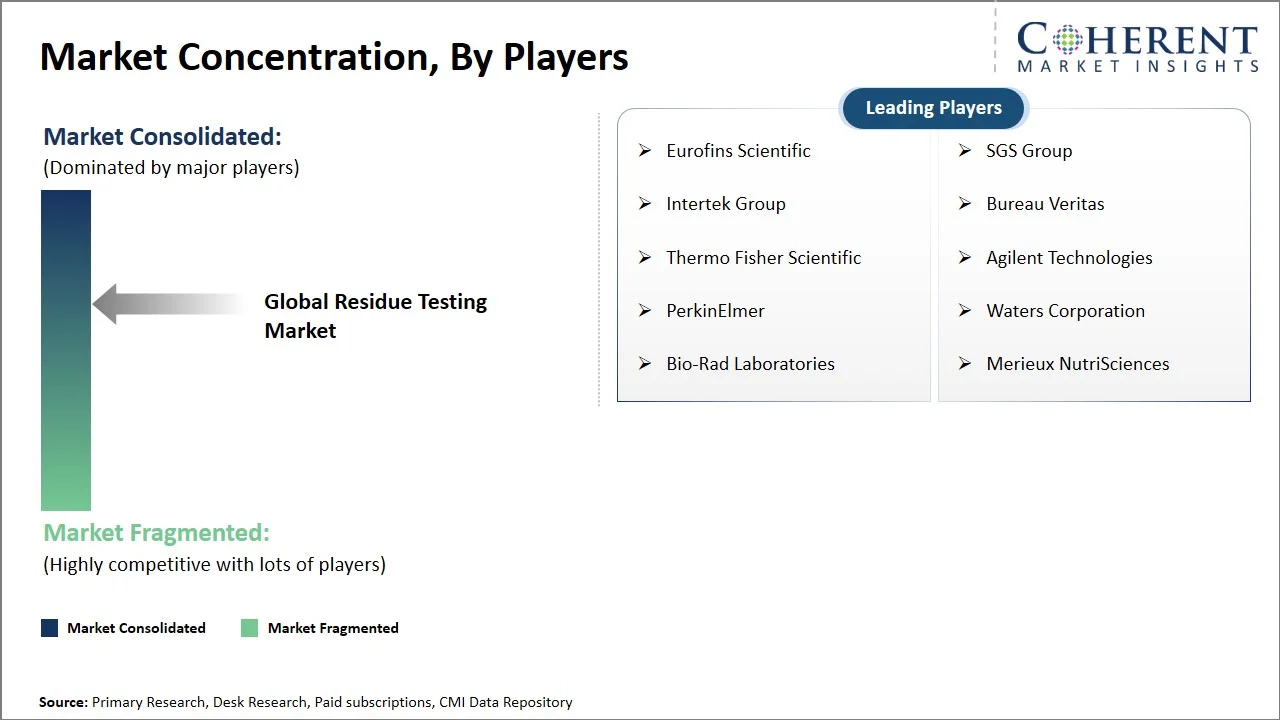
The global residue testing market is highly competitive, as industry players have growing investments on upgrading analytical technology and broadening testing capacity to meet the changing demands of food safety. Industry players are striving to achieve the goal of high sensitivity and rapid turnaround time with efficiently multi-residue screening to meet worldwide regulatory pressure. Significant investments are focused on strategic partnering with food manufacturers, regulatory bodies and research institutes to boost innovation and broaden the application coverage of food, agricultural and environmental testing. Major investments are made on laboratory automation and AI-enabled laboratory systems to enhance the accuracy and efficiency of testing. Key focus areas include:
- Development of advanced multi-residue analytical platforms
- Expansion of rapid testing and automated sample preparation solutions
- Integration of AI-driven data analytics and digital laboratory systems
- Strategic collaborations with food manufacturers, regulatory bodies, and research institutions
- Investments in testing capabilities for pesticides, veterinary drugs, toxins, heavy metals, and emerging contaminants across food products
Market Report Scope
Residue Testing Market Report Coverage
| Report Coverage | Details | ||
|---|---|---|---|
| Base Year: | 2025 | Market Size in 2026: | USD 8.6 Bn |
| Historical Data for: | 2020 To 2024 | Forecast Period: | 2026 To 2033 |
| Forecast Period 2026 to 2033 CAGR: | 7.4% | 2033 Value Projection: | USD 14.2 Bn |
| Geographies covered: |
| ||
| Segments covered: |
| ||
| Companies covered: | Eurofins Scientific, SGS Group, Intertek Group, Bureau Veritas, Thermo Fisher Scientific, Agilent Technologies, PerkinElmer, Waters Corporation, Bio-Rad Laboratories, and Merieux NutriSciences | ||
| Growth Drivers: |
| ||
| Restraints & Challenges: |
| ||
Analyst Opinion (Expert Opinion)
- In the future, growing food safety standards, increased international food trade, and a higher consumer awareness of food quality will all drive growth in residue testing market. Coupled with this, the residue testing market is anticipated to move toward rapid and highly sensitive analysis systems, such as AI-enabled laboratory suites, high throughput, automated sample preparation systems, and multi residue analysis methods through single tests capable of determining every contaminant of concern simultaneously. The residue industry is anticipated to be long-term stable with the continuing evolution of food standards and increasing government enforcement programs.
- The maximum opportunity for growth is foreseen in food and beverage applications, especially pesticide residue testing in China and India. Rising processed food consumption, largely from the agriculture export boom, along with strengthening food safety law and standards, should lead to regulatory and consumer demands for reduced pesticide residues and expansion of inspection and monitoring infrastructure, creating significant opportunities for Asia Pacific-based residue testing providers.
- In order to secure a competitive advantage, the market should continue to broaden a suite of extensive high-throughput testing services via Chromatography–Tandem Mass Spectrometry (GC-MS/MS) and Liquid Chromatography–Tandem Mass Spectrometry (LC-MS/MS) instruments combined with AI-powered analytical programs for speed and accuracy improvement and place resources in strategic alliances, especially with food products producers, research laboratories, and authorities, to build a stronger validation capability, diversify a range of services offered and promote compliance assistance worldwide.
Speak to the analyst
Want personalized insights?
Take the findings above to one of our principal consultants, or have the report rebuilt around the segments, geographies and competitors you actually track.
Market Segmentation
- Type Insights (Revenue, USD Bn, 2021 - 2033)
- Pesticide Residue Testing
- Veterinary Drug Residue Testing
- Toxin Residue Testing
- Heavy Metal Residue Testing
- Others
- Technology Insights (Revenue, USD Bn, 2021 - 2033)
- Chromatography-Based Testing
- Immunoassay-Based Testing
- Spectroscopy-Based Testing
- Molecular Diagnostic Methods
- Sample Type Insights (Revenue, USD Bn, 2021 - 2033)
- Food and Beverages
- Agricultural Products
- Dairy Products
- Meat and Poultry Products
- Others
- End User Insights (Revenue, USD Bn, 2021 - 2033)
- Food Manufacturers
- Testing Laboratories
- Regulatory Agencies
- Research Institutes
- Others
- Regional Insights (Revenue, USD Bn, 2021 - 2033)
- North America
- U.S.
- Canada
- Latin America
- Brazil
- Argentina
- Mexico
- Rest of Latin America
- Europe
- Germany
- U.K.
- Spain
- France
- Italy
- Russia
- Rest of Europe
- Asia Pacific
- China
- India
- Japan
- Australia
- South Korea
- ASEAN
- Rest of Asia Pacific
- Middle East
- GCC Countries
- Israel
- Rest of Middle East
- Africa
- South Africa
- North Africa
- Central Africa
- North America
- Key Players Insights
- Eurofins Scientific
- SGS Group
- Intertek Group
- Bureau Veritas
- Thermo Fisher Scientific
- Agilent Technologies
- PerkinElmer
- Waters Corporation
- Bio-Rad Laboratories
- Merieux NutriSciences
Sources
Primary Research Interviews
- Food safety and quality assurance managers involved in residue monitoring and compliance testing programs
- Analytical chemists and laboratory experts specializing in pesticide, veterinary drug, and contaminant residue analysis
- Regulatory affairs professionals involved in food safety compliance and maximum residue limit (MRL) implementation
- Testing laboratory directors and food quality specialists overseeing multi-residue testing workflows
Stakeholders
- Residue testing solution providers and analytical instrument manufacturers
- End-use Sectors
- Food and beverage manufacturers
- Agricultural producers and exporters
- Food testing laboratories and contract research organizations (CROs)
- Retail and food processing companies
- Regulatory & Health Bodies: U.S. Food and Drug Administration (FDA) – food safety and residue monitoring regulations, European Food Safety Authority – pesticide residue risk assessments and MRL regulations, Food Safety and Standards Authority of India – food quality and testing standards, World Health Organization – food safety guidelines and contaminant frameworks
Databases
- FDA Pesticide Residue Monitoring Program Database – pesticide residue surveillance data
- WHO Global Health Observatory – food safety and public health statistics
- OECD Agriculture Statistics – agricultural production and food trade data
- FAO Food and Agriculture Database (FAOSTAT) – food production and export/import statistics
Magazines
- Food Safety Magazine – food quality testing and regulatory developments
- Food Quality & Safety Magazine – testing technologies and food contaminant trends
- Analytical Chemistry Magazine – analytical testing and laboratory technology advancements
- Laboratory Equipment Magazine – testing equipment and analytical innovation trends
Journals
- Journal of Food Protection
- Food Chemistry
- Journal of Agricultural and Food Chemistry
- Food Control
Newspapers
- Financial Times – food industry and regulatory developments
- The Wall Street Journal – food safety and agricultural market trends
- The New York Times (Health & Food Section) – consumer food safety developments
- The Guardian (Science & Environment Section) – food contamination and regulatory updates
Associations
- AOAC International
- International Association for Food Protection
- Institute of Food Technologists
- Codex Alimentarius Commission
Public Domain Sources
- National Pesticide Information Center (NPIC) – pesticide information, residue monitoring data, and food safety resources
- U.S. Food and Drug Administration (FDA) – food safety regulations, pesticide residue monitoring programs, and compliance guidelines
- U.S. Department of Agriculture (USDA) – pesticide surveillance programs, agricultural statistics, and food quality monitoring initiatives
- European Food Safety Authority (EFSA) – pesticide residue assessments, maximum residue limit (MRL) regulations, and food safety evaluations
Proprietary Elements
- CMI Data Analytics Tool, Proprietary CMI Existing Repository of information for last 10 years.
Get access to 250+ pages report
Every segment, forecast, competitor profile and data table behind the analysis above — available for instant download.
- ESOMAR Member
- ISO 9001:2015 Certified
- D-U-N-S Registered
- GDPR & CCPA Compliant
Missing comfort of reading report in your local language? Find your preferred language:
Transform your Strategy with Exclusive Trending Reports
Frequently Asked Questions
The global residue testing market is estimated to be valued at USD 8.6 Bn in 2026 and is expected to reach USD 14.2 Bn by 2033.
Pesticide residue testing dominates due to increasing regulatory scrutiny regarding pesticide usage in food products, growing concerns over food safety, and rising demand for compliance with maximum residue limits (MRLs) across domestic and international food trade.
Residue testing is the analytical process used to detect and quantify chemical residues such as pesticides, veterinary drugs, toxins, and contaminants in food and agricultural products to ensure regulatory compliance and consumer safety.
The CAGR of the global residue testing market is projected to be 7.4% from 2026 to 2033.
Increasing food safety concerns and contamination incidents globally, and stringent regulations for pesticide and veterinary drug residue monitoring are the major factors driving the growth of the global residue testing market.
High costs associated with advanced residue testing instruments, and lack of standardized testing infrastructure in developing economies are the major factors hampering the growth of the global residue testing market.
Gas Chromatography–Tandem Mass Spectrometry (GC-MS/MS) and Liquid Chromatography–Tandem Mass Spectrometry (LC-MS/MS) are widely used due to their high sensitivity and multi-residue detection capabilities.