

Global Waste Heat to Power Market Size and Forecast: 2026-2033
The Global Waste Heat to Power Market is estimated to be valued at USD 32.53 Bn in 2026 and is expected to reach USD 66.69 Bn by 2033, exhibiting a compound annual growth rate (CAGR) of 10.8% from 2026 to 2033.
Key Takeaways of the Waste Heat to Power Market
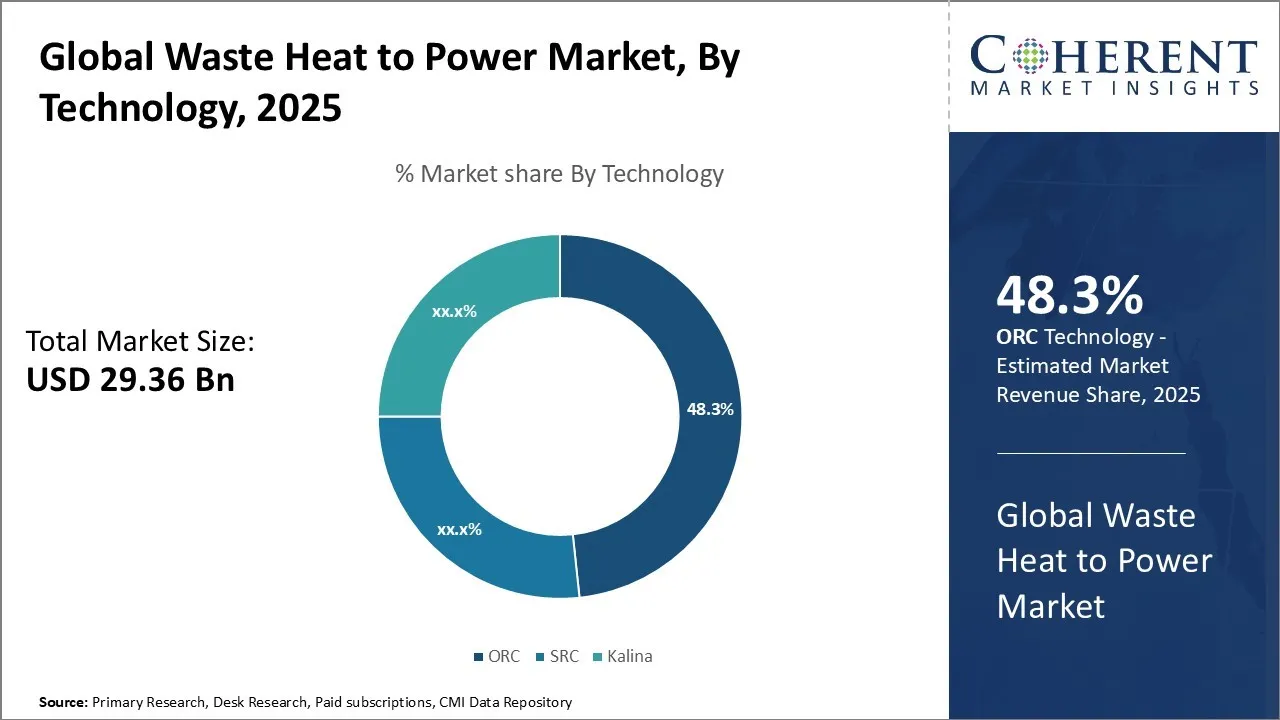
- The ORC segment is expected to account for 49.3% of the waste heat to power market in 2026.
- The petroleum refining segment is set to command a 34.7% share of the market in 2026.
- Asia Pacific is set to lead the global waste heat to power market in 2026 with a 59. 2% share. Europe, with a 26.5% share, will be the fastest-growing region.
Market Overview
A significant market trend is the integration of advanced technologies such as Organic Rankine Cycle (ORC) systems, which enable the efficient conversion of low-temperature waste heat to electricity. Additionally, expanding applications across various industries like manufacturing, automotive, hydropower generation, and power generation are boosting demand. Growing focus on sustainability and government incentives further accelerate the market growth, making waste heat to power an essential component of future energy management strategies.
Currents Events and their Impact
Current Events | Description and its impact |
Turboden launches ORC WHP at Riyadh Cement, Saudi Arabia (Oct 2024) |
|
U.S. DOE Industrial Efficiency & Decarbonization FOA funding (ongoing; $104 million call) |
|
Segmental Insights
- Current Industry Events of 2026
- Market Size Estimation
- Regional Breakdown
- Competitive Landscape
- Customer Intelligence
- Segmental Analysis
- Pricing Analysis
- Key Market Drivers, Challenges & Future Trends
- Customized Insights Section
Waste Heat to Power Market Insights, By Technology – ORC Segment Dominates the Market Due to Its Superior Efficiency and Versatility
The ORC segment is expected to hold 49.3% share of the waste heat to power market in 2026, largely due to its exceptional adaptability and operational efficiency across a diverse range of waste heat sources. ORC systems are specifically designed to convert low to medium temperature waste heat into electricity, which makes them highly valuable in industries where residual heat typically remains untapped. Unlike conventional steam Rankine cycles, ORC uses organic fluids with low boiling points, enabling the recovery of energy from lower temperature heat streams that would otherwise be wasted.
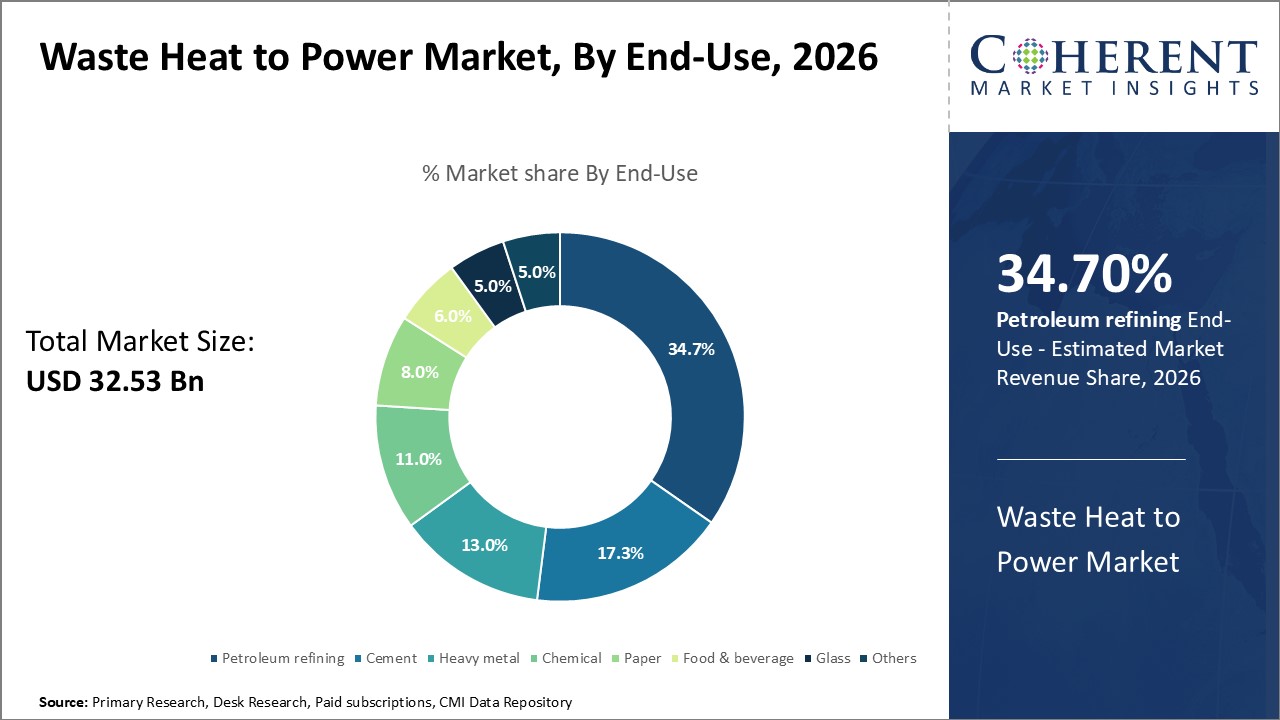
Waste Heat to Power Market Insights, By End-use Industry Petroleum Refining Segment Leads Due to Its High Waste Heat Generation and Energy Demand
The petroleum refining segment is set to hold 34.7% share of the market in 2026, driven by the sector’s substantial generation of waste heat and the intense demand for energy efficiency improvements. Petroleum refineries operate complex thermal processes such as catalytic cracking, distillation, and reforming, which produce a significant amount of low to medium temperature waste heat. Capturing this waste heat for power generation presents an attractive opportunity to enhance operational economics and reduce energy costs.
The sector’s emphasis on improving energy efficiency and minimizing environmental impact fuels the widespread adoption of waste heat to power technologies. Refining operations are often subject to stringent environmental regulations aimed at curtailing greenhouse gas emissions and enhancing sustainability. Waste heat recovery systems provide a pathway to meet these targets by reducing reliance on external power sources and lowering carbon emissions through onsite generation of clean electricity.
Regional Insights
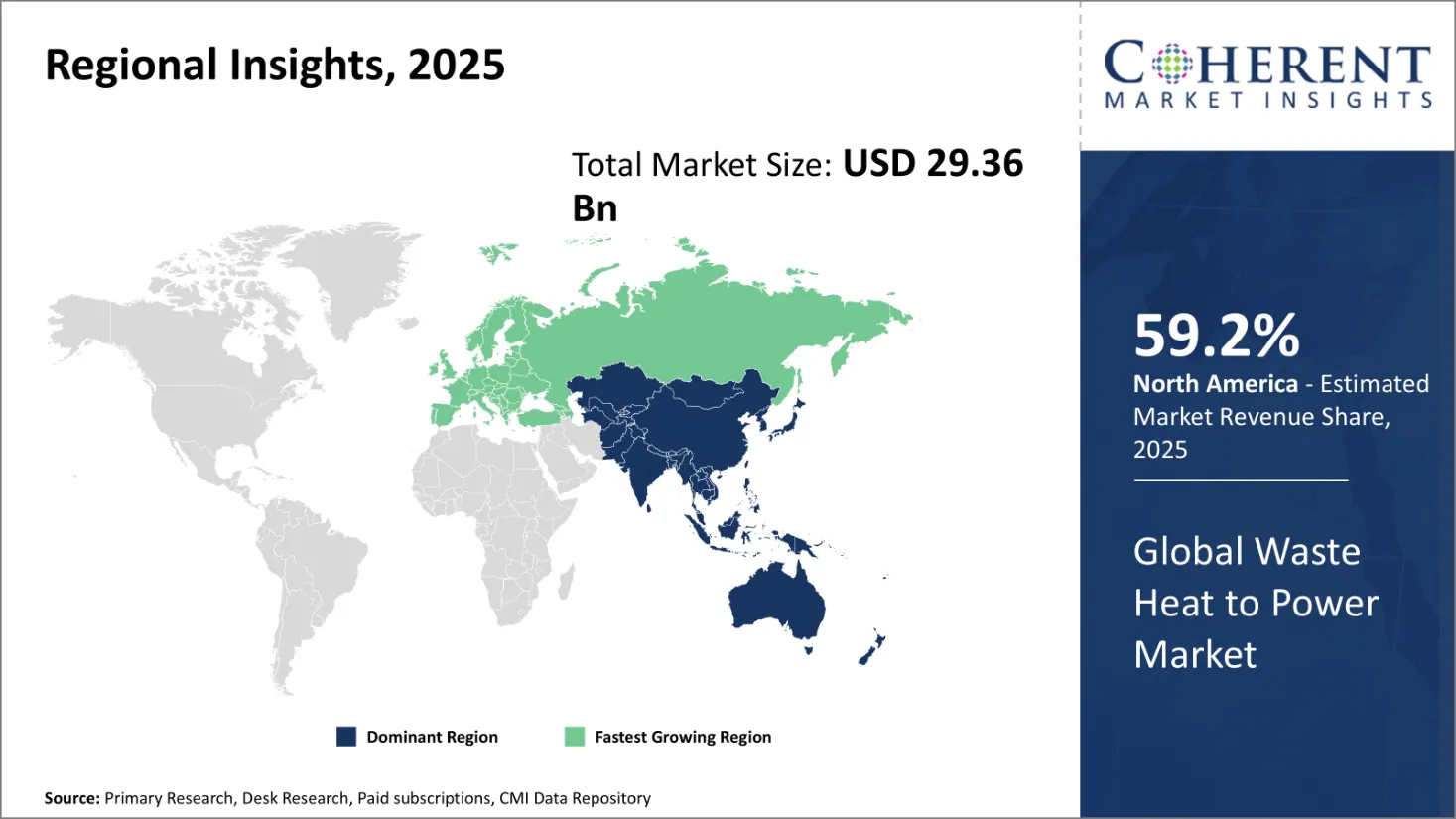
Asia Pacific Waste Heat to Power Market Analysis and Trends
The Asia Pacific region is projected to lead the market with a 59.2% share in 2026, due to its extensive industrial base and increasing focus on energy efficiency amid rapidly growing economies like China, India, and Japan. The region benefits from a well-established manufacturing ecosystem, especially in heavy industries such as steel, cement, and chemical production, which generate significant amounts of waste heat.
Government policies focused on environmental sustainability and renewable energy adoption, such as China’s stringent emission norms and India’s push for energy-efficient technologies, further bolster the market growth. Additionally, Asia Pacific’s trade dynamics favor regional collaborations and technology exchanges, strengthening domestic production capabilities. Leading companies active in the region include Mitsubishi Heavy Industries (Japan), Doosan Lentjes (South Korea), and Thermax (India), which contribute through advanced WHRP (Waste Heat Recovery Power) systems tailored for various industrial applications.
Europe Waste Heat to Power Market Analysis and Trends
The Europe region is expected to exhibit the fastest growth in the market contributing 26.5% share in 2026, driven by aggressive climate policies, mandatory energy efficiency targets, and rising industrial modernization efforts. The European Union’s commitment to carbon neutrality and stringent regulations like the Ecodesign Directive push industries to adopt waste heat recovery solutions. The presence of a strong environmental regulatory framework encourages innovation and the deployment of cutting-edge technologies.
The well-organized market ecosystem includes prominent engineering firms, technology providers, and collaboration between public and private sectors, fostering rapid adoption. Major players such as Siemens Energy (Germany), MAN Energy Solutions (Germany), and ABB (Switzerland) are instrumental in expanding the market through their energy recovery solutions and integration expertise across sectors like oil & gas, automotive, and manufacturing.
Global Waste Heat to Power Market Outlook for Key Countries
China Waste Heat to Power Market Trends
China’s market remains the global epicenter for waste heat to power systems owing to its massive industrial sector and government-led clean energy initiatives. Policies promoting emission reductions in power plants and heavy industries have created substantial demand for waste heat recovery technologies. Chinese companies like Shanghai Electric and Dongfang Electric Corporation are ascending as key contributors, developing domestic innovations that blend cost efficiency with high energy recovery rates. The country’s immense industrial capacity fuels continuous market expansion, supported by import partnerships with international technology leaders for advanced WHRP components.
India Waste Heat to Power Market Trends
India’s market is rapidly evolving, propelled by the government’s commitment to sustainable energy practices and improved industrial energy efficiency. Numerous incentives, including subsidies and mandatory adoption of waste heat recovery in specific sectors like cement and steel, encourage market penetration. Indian firms such as Thermax and Kirloskar Industries actively lead the development and deployment of waste heat recovery boilers and power systems, catering to local industries with customized solutions. The country’s expanding industrial base and focus on reducing dependence on fossil fuels create a conducive environment for market growth.
U.S. Waste Heat to Power Market Trends
The U.S. continues to lead innovation and deployment of waste heat to power technologies in North America, driven by diverse industrial applications and an increasing push towards reducing carbon footprints. Federal and state policies encourage energy efficiency through tax incentives and funding for cleaner technologies. With a strong presence of major engineering and energy companies like General Electric, Caterpillar, and Cummins, the U.S. market emphasizes advanced system integration and retrofitting in power generation and manufacturing sectors. The country’s robust R&D ecosystem also facilitates breakthroughs in waste heat conversion technologies.
Germany Waste Heat to Power Market Trends
Germany’s waste heat to power market is shaped by the country’s leadership in industrial efficiency and renewable energy adoption within Europe. Stringent environmental regulations combined with the Energiewende (energy transition) policy create a fertile ground for WHRP technology implementation, particularly in chemical, automotive, and manufacturing hubs. Germany’s well-developed supply chain and emphasis on sustainable industrial practices maintain its market prominence.
Japan Waste Heat to Power Market Trends
Japan’s market thrives on technological innovation and its mature industrial framework, emphasizing energy conservation and reduction of industrial emissions. The government supports energy-efficient technology adoption through subsidies and partnership programs within sectors like steel, cement, and glass manufacturing. Mitsubishi Heavy Industries and Toshiba are notable contributors, delivering technically advanced and highly efficient waste heat recovery solutions tailored for Japan’s high-tech industries. Japan’s focus on upgrading aging infrastructure with WHRP systems and integrating digital monitoring enhances energy savings and operational reliability.
Macro-Economic Factors Impacting the Growth of the Waste Heat to Power Market
- Industrial Growth and Capital Investment: The expansion of industrial sectors such as manufacturing, oil & gas, cement, petroleum refining, and heavy metal production significantly drives the demand for WHP technologies. Capital investment, labor input, and financial investment in these sectors support the adoption of waste heat recovery systems by enabling modernization and increasing energy efficiency efforts.
- Government Initiatives and Environmental Regulations: Stringent environmental regulations aimed at reducing greenhouse gas emissions and promoting energy efficiency compel industries to deploy waste heat to power solutions. Government policies, incentives, and initiatives promoting renewable energy and sustainable industrial practices create a conducive environment for market growth. Examples include ambitious national commitments to net-zero emissions and renewable energy targets.
- Rising Energy Costs and Demand for Clean Energy: Increasing global energy prices and a rising demand for electricity, especially in emerging markets and rapidly urbanizing economies, fuel the adoption of WHP systems. Waste heat recovery offers industries a way to reduce operating costs by capturing and converting waste energy into usable electricity.
- Technological Advancements: Innovations in heat recovery technologies, such as organic Rankine cycle systems and advanced heat exchangers, enhance the feasibility and efficiency of capturing lower-temperature waste heat, expanding market opportunities. Modularization, standardization, and new pilot projects further lower costs and drive adoption.
- Economic Growth in Emerging Markets and Urbanization: Strong economic growth, particularly in developing economies, along with rapid urbanization, increases industrial energy consumption and demand for efficient energy solutions like WHP. Urban centers with high industrial activities provide ample opportunities for waste heat recovery.
Market Players, Key Development, and Competitive Intelligence
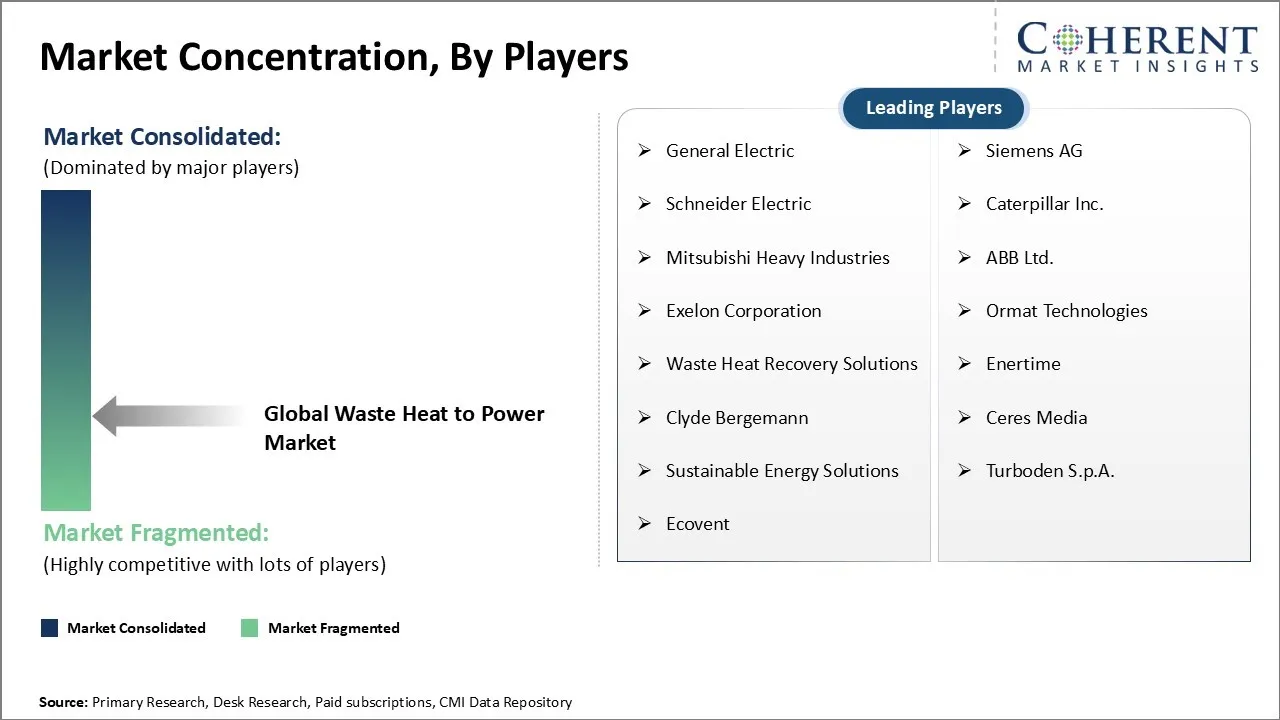
Key Developments
- In April 2025, Quanta Global Capital Limited launched a USD 10 billion green bond with a five-year maturity and a 7.5% annual coupon, structured into 100,000 Preferred Notes priced at USD 100,000 each. Secured by an AA-rated insurance wrap and thermoelectric waste heat recovery assets, the bond—set to list on Nasdaq Stockholm—will distribute annual interest payments every February.
- In December 2024, Climeon delivered six HeatPower 300 waste heat recovery units for installation on six new A.P. Møller–Maersk 17,200 TEU container vessels, enabling the conversion of engine exhaust heat into sustainable electricity while at sea.
Top Strategies Followed by Global Waste Heat to Power Market Players
- Established market leaders primarily invest heavily in research and development (R&D) to drive innovation in high-performance WHP technologies. This persistent focus on product advancement allows them to enhance energy recovery efficiency, reduce operational costs, and meet stringent environmental regulations, thereby maintaining a competitive edge.
- For example, Ormat’s advanced Organic Rankine Cycle (ORC) systems have achieved notable efficiency gains in recovering low- to medium-temperature waste heat from industrial processes. Siemens Energy, through its Heat Recovery Steam Generator (HRSG) innovations, has enabled large-scale power producers to meet stringent EU and U.S. environmental regulations while significantly lowering operational costs.
- Mid-level players in the waste heat to power market typically adopt strategies centered on delivering cost-effective, yet reliable solutions that appeal to price-sensitive customers, such as small and medium-sized enterprises (SMEs) or industries in developing economies. Understanding the balance between performance and affordability, these companies focus on optimizing manufacturing processes to reduce production costs without compromising product quality.
- For instance, ElectraTherm’s Power+ Generator has been widely adopted by small-scale biomass plants and geothermal facilities in Southeast Asia for its compact footprint and low installation costs.
- Small-scale players in the global waste heat to power market carve out competitive niches by focusing on specialized features or developing innovative products that address unique or emerging customer requirements. For example, they may pioneer solutions optimized for specific industrial processes, integrate smart monitoring systems, or design compact modular units suitable for decentralized power generation. Embracing cutting-edge technologies such as digital sensors, IoT-enabled controls, and advanced materials enables these smaller companies to differentiate their offerings and remain agile in a rapidly evolving market.
- For example, innovators such as Infinity Turbine LLC and Calnetix Technologies differentiate themselves by developing specialized WHP products tailored to unique industrial needs. Infinity Turbine, for example, has designed compact, modular ORC units optimized for micro-waste heat recovery in breweries and food processing plants.
Market Report Scope
Waste Heat to Power Market Report Coverage
| Report Coverage | Details | ||
|---|---|---|---|
| Base Year: | 2025 | Market Size in 2026: | USD 32.53 Bn |
| Historical Data for: | 2020 To 2024 | Forecast Period: | 2026 To 2033 |
| Forecast Period 2026 to 2033 CAGR: | 10.8% | 2033 Value Projection: | USD 66.69 Bn |
| Geographies covered: |
| ||
| Segments covered: |
| ||
| Companies covered: | General Electric, Siemens AG, Schneider Electric, Caterpillar Inc., Mitsubishi Heavy Industries, ABB Ltd., Exelon Corporation, Ormat Technologies, Waste Heat Recovery Solutions, Enertime, Clyde Bergemann, Ceres Media, Sustainable Energy Solutions, Turboden S.p.A., and Ecovent | ||
| Growth Drivers: |
| ||
| Restraints & Challenges: |
| ||
Waste Heat to Power Market Dynamics
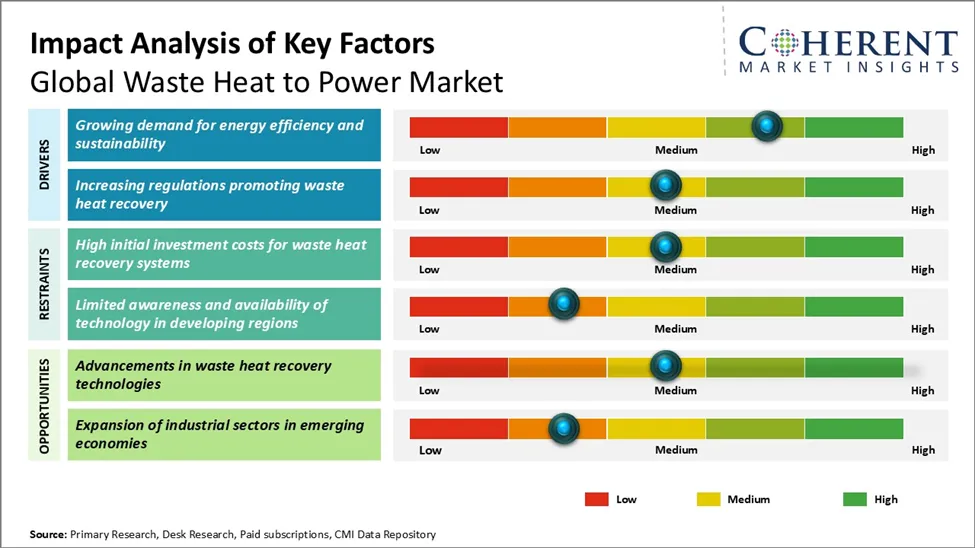
Waste Heat to Power Market Driver - Growing Demand for Energy Efficiency and Sustainability
Rising global awareness around environmental concerns and the pressing need to reduce carbon footprints have significantly intensified the focus on energy efficiency and sustainable practices across industries. Waste heat to power (WHP) technology offers a compelling solution by capturing and converting residual heat from industrial processes into usable electricity, thereby minimizing energy wastage. Companies and governments are increasingly adopting stringent regulations and setting ambitious sustainability targets, driving industries such as manufacturing, chemical processing, and power generation to explore innovative methods for enhancing energy utilization.
For example, ArcelorMittal’s Ghent steel plant in Belgium partnered with Mitsubishi Power and Engie to install a large-scale WHP system that converts blast furnace waste heat into electricity, reducing CO₂ emissions by an estimated 125,000 tons annually.
Waste Heat to Power Market Opportunity - Advancements in Waste Heat Recovery Technologies
The global waste heat to power market is poised for significant growth due to continuous advancements in waste heat recovery technologies. These technological innovations are enhancing the efficiency and cost-effectiveness of converting waste heat into usable electrical energy, thereby expanding the scope of WHP applications across various industries such as manufacturing, steel, cement, and power generation. Improved thermoelectric materials, thermoelectric generator, ORC systems, and innovative heat exchanger designs are enabling higher energy capture from low-grade heat sources, which were previously considered unviable for energy recovery.
For instance, next-generation thermoelectric materials like skutterudites and half-Heusler alloys are achieving significantly higher conversion efficiencies, making small-scale waste heat recovery economically viable for applications ranging from automotive exhaust systems to industrial furnaces.
Analyst Opinion (Expert Opinion)
- The global waste heat to power market is on the brink of substantial expansion, driven by increasing energy efficiency regulations and the urgent need for sustainable energy solutions. Insights from the Waste Heat Recovery Conference (2023) and the Energy Efficiency Expo (2022) revealed a growing interest in technologies that convert waste heat into usable energy, with companies like Siemens and GE leading the charge. Siemens' recent developments in organic Rankine cycle (ORC) systems demonstrate how innovative engineering can maximize energy recovery from industrial processes.
- Discussions at these conferences highlighted the importance of integrating waste heat recovery systems into existing infrastructures, which can significantly enhance overall efficiency and reduce carbon footprints. As industries grapple with rising energy costs and environmental pressures, the adoption of waste heat recovery technologies is becoming increasingly critical.
- Companies that prioritize scalability and adaptability in their solutions will likely capture a larger market share. Ultimately, the future of the waste heat to power market will hinge on technological advancements, regulatory support, and a growing commitment to sustainability in energy practices across various sectors.
Speak to the analyst
Want personalized insights?
Take the findings above to one of our principal consultants, or have the report rebuilt around the segments, geographies and competitors you actually track.
Market Segmentation
- Technology Insights (Revenue, USD Bn, 2021 - 2033)
- ORC
- SRC
- Kalina
- End-use Industry Insights (Revenue, USD Bn, 2021 - 2033)
- Petroleum refining
- Cement
- Heavy metal
- Chemical
- Paper
- Food & beverage
- Glass
- Others
- Regional Insights (Revenue, USD Bn, 2021 - 2033)
- North America
- U.S.
- Canada
- Latin America
- Brazil
- Argentina
- Mexico
- Rest of Latin America
- Europe
- Germany
- U.K.
- Spain
- France
- Italy
- Russia
- Rest of Europe
- Asia Pacific
- China
- India
- Japan
- Australia
- South Korea
- ASEAN
- Rest of Asia Pacific
- Middle East
- GCC Countries
- Israel
- Rest of Middle East
- Africa
- South Africa
- North Africa
- Central Africa
- North America
- Key Players Insights
- General Electric
- Siemens AG
- Schneider Electric
- Caterpillar Inc.
- Mitsubishi Heavy Industries
- ABB Ltd.
- Exelon Corporation
- Ormat Technologies
- Waste Heat Recovery Solutions
- Enertime
- Clyde Bergemann
- Ceres Media
- Sustainable Energy Solutions
- Turboden S.p.A.
- Ecovent
Sources
Primary Research Interviews
- R&D Directors at top waste heat to power (WHP) technology firms.
- Procurement Managers at major EPC (engineering, procurement, construction) companies involved in energy recovery projects.
- Product Development Heads at global energy firms, focusing on industrial waste heat solutions.
- Sustainability Managers at certification bodies overseeing industrial energy efficiency.
Stakeholders
- Manufacturers
- End-use Sectors
- Heavy industry Petroleum Refining, Cement, Glass, Steel, Chemicals, Power Generation.
- Distributed and decentralized sectors district heating networks, marine engine exhaust recovery.
- Regulatory & Certification Bodies
- International energy safety authorities United States Department of Energy (DOE), European Food Safety Authority (EFSA), Clean Label Project.
- E-commerce Platforms and Retailers
- EPC solution integrators, industrial equipment distributors.
- Technology Integration Players
- Digital controls, remote monitoring, grid interconnection, performance optimization platforms.
Databases
- UN Comtrade Database
- India Import Export (EXIM) Database
Magazines
- Power Engineering International – Industrial waste heat recovery projects & technologies
- Renewable Energy World – WHP and industrial energy efficiency solutions
- Modern Power Systems – Innovations in ORC and turbine systems
- Industrial Heating – Heat recovery in manufacturing industries
Journals
- Applied Thermal Engineering – WHP technology performance and efficiency studies
- Energy Conversion and Management – WHP system design and optimization
- Journal of Cleaner Production – Environmental benefits of WHP systems
Newspapers
- The Financial Times – Large-scale industrial energy efficiency investments
- The Guardian – Policy developments and sustainability trends in heavy industries
- Nikkei Asia – WHP adoption in Asia-Pacific manufacturing
- European Energy News – EU WHP policies and funding
Associations
- U.S. Department of Energy – Industrial Energy Efficiency & WHP Program
- International Energy Agency (IEA) – Industrial Decarbonization initiatives
- Heat Power Alliance – Industry advocacy for WHP
- ORC Power Systems Association
- World Energy Council – Energy recovery & efficiency reports
Public Domain Sources
- U.S. EPA – Combined Heat and Power (CHP) & WHP guidelines
- European Commission – Industrial Emissions Directive & WHP inclusion
- World Bank – WHP potential in emerging economies
Proprietary Elements
- CMI Data Analytics Tool, Proprietary CMI Existing Repository of information for last 8 years.
Get access to 250+ pages report
Every segment, forecast, competitor profile and data table behind the analysis above — available for instant download.
- ESOMAR Member
- ISO 9001:2015 Certified
- D-U-N-S Registered
- GDPR & CCPA Compliant
Missing comfort of reading report in your local language? Find your preferred language:
Transform your Strategy with Exclusive Trending Reports
Frequently Asked Questions
The global waste heat to power market is estimated to be valued at USD 32.53 Bn in 2026 and is expected to reach USD 66.69 Bn by 2033.
The CAGR of global waste heat to power market is projected to be 10.8% from 2026 to 2033.
Growing demand for energy efficiency and sustainability and Increasing regulations promoting waste heat recovery are the major factors driving the growth of global waste heat to power market.
High initial investment costs for waste heat recovery systems and Limited awareness and availability of technology in developing regions are the major factors hampering the growth of global waste heat to power market.
In terms of Technology, ORC segment is estimated to dominate the market revenue share in 2026.
General Electric, Siemens AG, Schneider Electric, Caterpillar Inc., Mitsubishi Heavy Industries, ABB Ltd., Exelon Corporation, Ormat Technologies, Waste Heat Recovery Solutions, Enertime, Clyde Bergemann, Ceres Media, Sustainable Energy Solutions, Turboden S.p.A., and Ecovent are the major players.
Waste Heat to Power (WHP) is the process of capturing heat that would otherwise be wasted from industrial or energy systems and converting it into electricity.