

Agricultural Equipment Market Analysis & Forecast: 2026-2033
Agricultural Equipment Market is estimated to be valued at USD 152.36 Bn in 2026 and is expected to reach USD 212.96 Bn in 2033, exhibiting a compound annual growth rate (CAGR) of 4.9% from 2026 to 2033.
Key Takeaways
- Based on Product Type, the Tractors segment is expected to lead the market with 33.2% share in 2026, driven by their versatility and widespread adoption.
- Based on Region, the Asia Pacific region is set to lead the market with 37.6% share in 2026. While, North America is anticipated to be the fastest growing region.
Market Overview
Agricultural equipment or equipment is the machinery used in the agriculture and farming applications. Different types of tools and equipment are used in agricultural applications such as hand tools, power tools, tractors, and more. Moreover, equipment varies according to the type of farming, i.e., organic farming and inorganic farming. Tractors, seed drill, thresher, combine harvesters, rotavators, power weeder, mowers, rakes, and balers are some of the commonly used agricultural equipment. Technological revolution and constant research and development have introduced high-functioning equipment that performs extensive amount of work efficiently.
Current Events and their Impacts on the Agricultural Equipment Market
Current Event | Description and its Impact |
Systemic farm economy financial crisis |
|
Labor shortage and automation technology convergence |
|
Automation In Agricultural Equipment Market
Automation is transforming the agricultural equipment industry, reshaping how farmers manage their operations with greater precision, efficiency, and sustainability.
Modern farms are increasingly adopting autonomous tractors, robotic harvesters, and AI-powered planting systems to streamline labor-intensive tasks. These technologies integrate GPS guidance, real-time data analytics, and sensor-based controls to optimize field activities like tillage, seeding, and spraying. Automation also supports precision agriculture, enabling targeted resource use and reducing environmental impact.
Leading manufacturers are embedding smart features into their equipment, allowing farmers to monitor performance remotely, adjust settings dynamically, and make data-driven decisions. This shift not only improves productivity but also helps address challenges like labor shortages and climate variability. As automation becomes more accessible, it’s paving the way for a new era of intelligent, resilient farming.
For instance, in August 2025, Case IH launched new agricultural machinery and farmer-focused innovations at the Farm Progress Show, spotlighting automation and precision technology. Highlights include advanced tillage tools, smart planting systems, and digital solutions aimed at boosting productivity and sustainability. The launch reflects Case IH’s commitment to modernizing farming through cutting-edge equipment and data-driven tools.
- Current Industry Events of 2026
- Market Size Estimation
- Regional Breakdown
- Competitive Landscape
- Customer Intelligence
- Segmental Analysis
- Pricing Analysis
- Key Market Drivers, Challenges & Future Trends
- Customized Insights Section
Segmental Insights
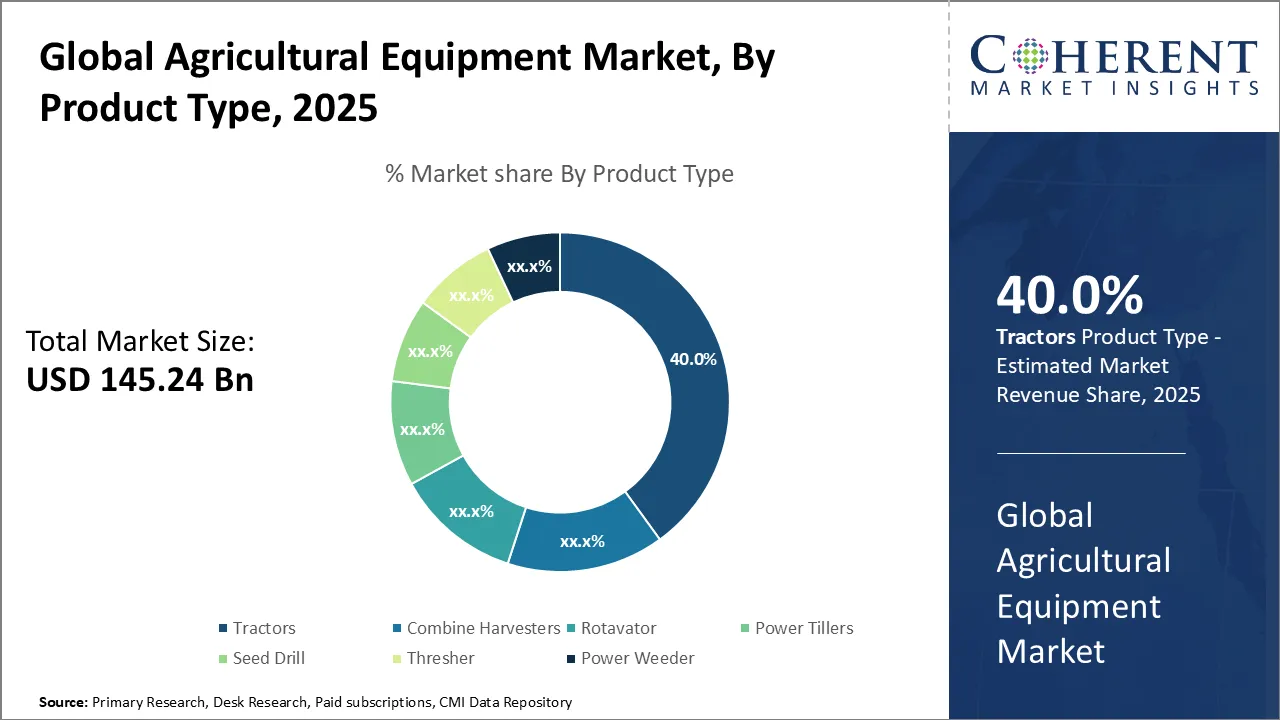
Agricultural Equipment Market Insights, By Product Type: Tractors Leads as the Most Dominant and Widely Used Product Segment
In terms of product type, the tractors segment is expected to lead the market with 33.2% share in 2026, driven by their versatility and widespread adoption. They are essential for plowing, tilling, hauling, and powering other implements, making them indispensable across farm sizes. Technological advancements like GPS and automation enhance their appeal, especially in large-scale operations. Emerging economies such as India and Brazil see rising tractor demand due to labor shortages and government subsidies. Compared to other equipment like combine harvesters, rotavators, and seed drills, tractors command higher market value and broader usage. Their utility, innovation, and economic impact secure their position as the leading segment in agricultural machinery.
For instance, in October 2025, Gromax Agri Equipment, a Mahindra Group subsidiary, launched eight new tractors across various horsepower categories in both 2WD and 4WD segments. This expansion aims to meet diverse farming needs and strengthen Gromax’s presence in India’s agricultural machinery market, offering enhanced performance, reliability, and value to farmers nationwide.
Regional Insights
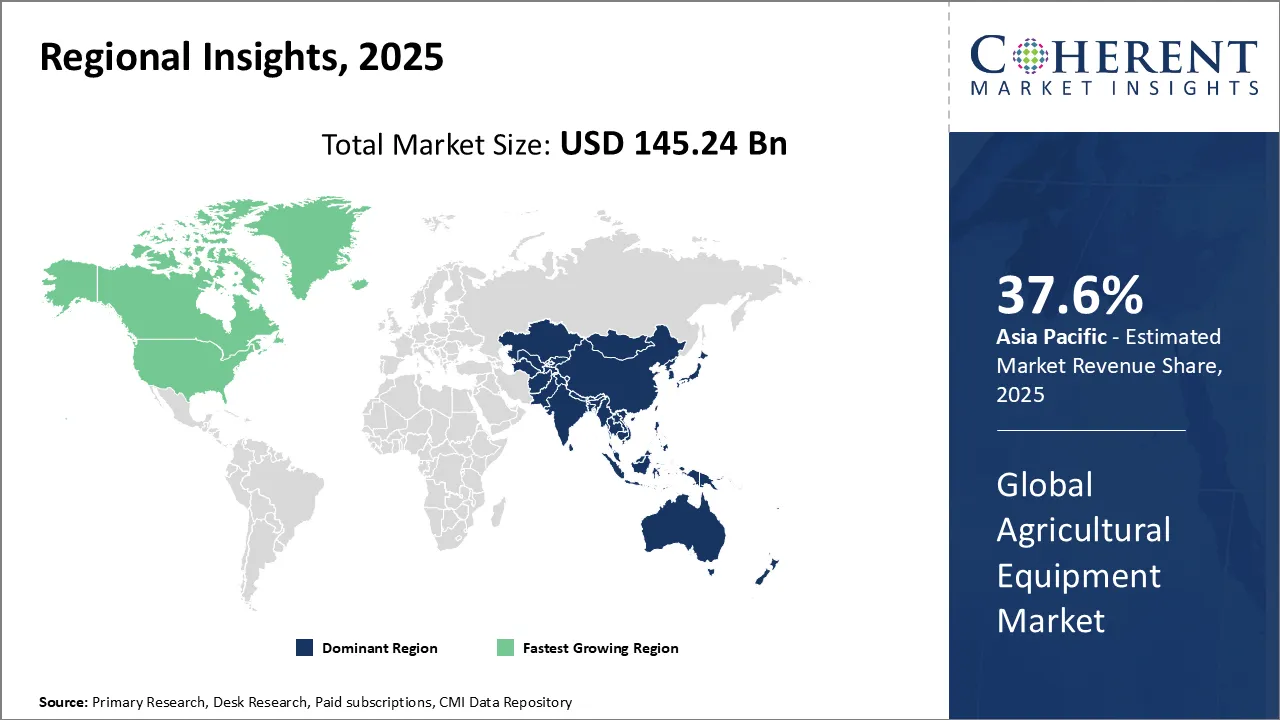
Asia Pacific Agricultural Equipment Market Analysis & Trends
Asia Pacific, holding an estimated share of 37.6% in 2026, is set to dominate the global agricultural equipment market. This is primarily due to rising food demand, labor shortages, and government subsidies promoting mechanization. Countries like India and China are investing in modern tools to boost productivity. Affordable, locally manufactured equipment and precision farming technologies are also driving adoption, making the region a hotspot for agricultural innovation.
For instance, in March 2026, Vietnam unveiled Asia’s largest agricultural machinery exhibition, showcasing cutting-edge farming technologies and equipment. The event highlights innovations in tractors, harvesters, irrigation systems, and smart farming solutions, drawing global attention to Vietnam’s growing role in agricultural modernization and international collaboration. It marks a major milestone for the region’s agri-tech industry.
North America Agricultural Equipment Market Analysis & Trends
North America shows the fastest growth in the agricultural equipment market due to rising demand for precision farming, labor shortages, and the adoption of advanced technologies like autonomous tractors and smart irrigation. Large-scale farms in the U.S. and Canada are investing in high-efficiency machinery to boost productivity and sustainability, driving strong market growth across the region.
For instance, in September 2026, AGCO Corporation finalized the sale of its interest in TAFE (Tractors and Farm Equipment Limited), marking a strategic shift in its global operations. The move aligns with AGCO’s focus on streamlining its portfolio and strengthening core business areas in agricultural machinery and technology. The transaction was officially completed on September 30, 2026.
Agricultural Equipment Market Outlook Country-Wise
India Agricultural Equipment Market Trends
In 2026, India’s agricultural equipment market is booming due to rising mechanization, government subsidies, and labor shortages. Smallholder farmers are adopting tractors, tillers, and smart tools to boost productivity and reduce manual effort. Local manufacturing and affordable pricing also drive demand, making India one of the fastest-growing markets for farm machinery and technology.
For instance, in September 2026, Escorts Kubota introduced the PRO588i-G harvester, designed to enhance harvesting efficiency and productivity for Indian farmers. Engineered for performance and durability, the new model supports multiple crops and challenging field conditions. This launch reinforces Escorts Kubota’s commitment to agricultural innovation and meeting the evolving needs of modern farming in India.
The U.S. Agricultural Equipment Market Trends
In 2026, the U.S. agricultural equipment market is thriving due to widespread adoption of precision farming, autonomous machinery, and smart irrigation systems. Labor shortages and the need for sustainable, high-efficiency farming drive demand. Large-scale commercial farms are investing in advanced technologies to boost productivity, reduce costs, and meet growing food and environmental challenges.
For instance, in October 2026, JCB unveiled the Loadall 546-70 and 555-70 telescopic handlers, designed to enhance material handling in agriculture. These new models offer increased lift capacity, improved efficiency, and robust performance for demanding farm operations. The launch reinforces JCB’s commitment to innovation and supporting modern farming needs with advanced machinery solutions.
Market Report Scope
Agricultural Equipment Market Report Coverage
| Report Coverage | Details | ||
|---|---|---|---|
| Base Year: | 2025 | Market Size in 2026: | USD 152.36 Bn |
| Historical Data for: | 2020 To 2024 | Forecast Period: | 2026 To 2033 |
| Forecast Period 2026 to 2033 CAGR: | 4.9% | 2033 Value Projection: | USD 212.96 Bn |
| Geographies covered: |
| ||
| Segments covered: |
| ||
| Companies covered: | AGCO Corporation, Bucher Industries AG, CLAAS KGaA mbH, CNH Industrial N.V., KUBOTA Corporation, ISEKI & CO., LTD., Tractors and Farm Equipment Limited, SDF Group, Deere & Company., EXEL Industries, Mahindra&Mahindra Ltd., YTO Group, Kioti Tractor, Massey Ferguson., Minsk Tractor Works. | ||
| Growth Drivers: |
| ||
| Restraints & Challenges: |
| ||
Global Agricultural Equipment Market Drivers
Increasing demand for food across the world due to rapidly growing population is expected to drive growth of the agricultural equipment market
The world population continues to grow, resulting in the increased demand for food and agricultural products. To meet the growing demand for food, farmers and farms are turning to mechanization and advanced equipment to increase productivity, reduce labor costs and increase overall efficiency. Innovative devices, such as precision farming equipment, autonomous machines, and sensor-based systems, enable farmers to optimize resource use, monitor yields, and increase yields. These technological advances are driving the adoption of agricultural equipment as farmers strive to remain competitive and maximize yields. For instance, in March 2023, Deere & Company, doing business as John Deere, a U.S.-based company that manufactures agricultural equipment, heavy equipment, forestry machinery, diesel engines, drivetrains used in heavy equipment, and lawn care equipment. John Deere Company announced the launch of its new See & Spray Ultimate autonomous sprayer. This sprayer is equipped with a variety of sensors and cameras that allow it to operate autonomously in the field.
Proactive initiatives taken by government agencies, such as subsidies and incentives, are expected to propel the agricultural equipment market
In many countries, governments offer supporting policies to farmers to purchase agricultural equipment, in order to work more efficiently. The government offers subsidies, credit schemes, subsidized interest rates, in order to boost the market growth. Governments around the world are supporting and subsidizing the agricultural sector to modernize, boost productivity, and increase food security. These efforts often include financial incentives and tax incentives for farmers to invest in agricultural equipment. Rapid technological progress has revolutionized the agricultural sector. For instance, in 2023, the India government announced The PM Kisan Tractor Scheme 2023, a government effort that aims to provide financial support to farmers based in India, helping them purchase tractors. Eligible farmers receive a subsidy of up to 20% of the tractor's cost, or a maximum of US$ 609.52, whichever is less. The scheme is implemented by the state authorities. Subsidy provided by the government is directly transferred to the bank account of the applicant.
Global Agricultural Equipment Market Opportunities
Advent of autonomous tractors is expected to offer lucrative growth opportunities for market players:
Market leaders are actively focusing on research and development activities to provide consumers with innovative and high-quality products. Some companies are introducing the next generation of autonomous tractors to take advantage of the growing market. In response to the growing market demand and technological advancements, market leaders in the agricultural equipment industry are placing significant emphasis on research and development activities. These companies are actively investing resources to develop innovative and high-quality products that meet the evolving needs of consumers. As part of their efforts, some companies are introducing the next generation of autonomous tractors, leveraging the advancements in automation and robotics. These autonomous tractors are designed to operate with minimal human intervention, utilizing advanced technologies such as GPS, sensors, and artificial intelligence. They offer increased efficiency, precision, and productivity in various farming operations, including planting, harvesting, and field maintenance. By leveraging autonomous capabilities, these tractors can navigate fields, optimize routes, and perform tasks with high accuracy, ultimately leading to improved yields and reduced operational costs for farmers.
Global Agricultural Equipment Market Trends
Growing trend of contract farming and committed sourcing with corporate partnership
Contract farming has emerged as a significant trend in various countries, in order to reduce migration from rural to urban areas, generate stable source of income, and get seasonal rotation of crops. In this type of farming, the farmers are contracted to plant the contractor’s crop on his land and then harvest and deliver the crop to the contractor at a pre-agreed price. According to Coherent Market Insights analysis, in Brazil, 75% of poultry production are under contract farming. Moreover, emerging economies such as Vietnam, India, Morocco, and more have developed policies for endorsing contract farming. In the U.S. and European countries, contract farming has witnessed significant growth.
Mechanized equipment
Key players in the market are involved in developing smart tractors that are equipped with advanced technologies such as GPS antenna, different attachments such as thresher, hauler, and fertilizer distributors, and better hydraulic systems. Such equipment is expected to offer more efficient performance that its contemporaries. Smart tractors are equipped with different attachments such as threshers, tractors and spreaders. These attachments increase the equipment's versatility and functionality, allowing the farmer to perform multiple operations with his single machine. Installing such attachments streamlines farming operations, reduces the need for separate machines, and optimizes resource utilization.
Analyst Opinion (Expert Opinion)
The agricultural equipment market value is undergoing structural transformation driven by digitalization, automation, and changing farm economics. Precision technologies such as GPS guidance and autosteer have reached over 70% adoption among large farms, yet penetration among smallholders remains limited, creating a two-speed equipment ecosystem. Dealers now act as gateways for connected services and telemetry, shifting profit pools from machinery sales to recurring data and maintenance revenues.
Demand trends reveal sharp polarization: high-horsepower tractor sales in mature markets like the UK fell by nearly 38% in early 2025, reflecting weaker farm incomes and delayed replacement cycles. Conversely, India and other Asian economies continue to post record tractor sales supported by mechanization subsidies and rural credit expansion. Electric and autonomous tractors, while still niche, are gaining commercial credibility in horticulture and specialty crops, offering measurable operating cost reductions and improved labor efficiency.
The market’s next phase will be defined by platform modularity, dealer-led service integration, and regional duality, cost-efficient models for emerging markets and precision-enabled systems for developed regions. Success will favor OEMs that convert digital upgrades into service revenue while maintaining production efficiency. Structural winners will be those delivering real, measurable productivity and sustainability gains to farmers under rising cost pressure.
Speak to the analyst
Want personalized insights?
Take the findings above to one of our principal consultants, or have the report rebuilt around the segments, geographies and competitors you actually track.
Global Agricultural Equipment Market: Key Developments
- In February 2025, CNH introduced a locally manufactured Trem V-compliant engine tailored for agricultural and construction machinery in India. This launch supports India’s emission norms while enhancing equipment performance and sustainability. The move reflects CNH’s commitment to innovation, localization, and cleaner technology in the agricultural equipment sector.
- In February 2025, Yamaha Motor launched Yamaha Agriculture, Inc., a new subsidiary dedicated to autonomous farming equipment and AI-driven solutions. With acquisitions of Robotics Plus and The Yield, the company aims to revolutionize specialty crop farming through advanced spraying, weeding, and data analytics tools, marking a bold step into agricultural innovation and automation.
- In June 2023, KUBOTA Corporation, a Japan-based multinational corporation, announced the launch of its new Kubota Vision Series tractors. These tractors are equipped with a variety of advanced safety features including a 360-degree camera system.
- In March 2023, the U.S. government announced a new program to train farmers on the use of agriculture equipment. The program will provide training on a variety of topics including safety, maintenance, and operation of agriculture equipment
Market Segmentation
- Global Agricultural Equipment Market, By Product Type (Revenue, USD Bn, 2021 - 2033)
- Tractors
- Combine Harvesters
- Rotavator
- Power Tillers
- Seed Drill
- Thresher
- Global Agricultural Equipment Market, By Region (Revenue, USD Bn, 2021 - 2033)
- North America
- U.S.
- Canada
- Latin America
- Brazil
- Argentina
- Mexico
- Rest of Latin America
- Europe
- Germany
- U.K.
- Spain
- France
- Italy
- Russia
- Rest of Europe
- Asia Pacific
- China
- India
- Japan
- Australia
- South Korea
- ASEAN
- Rest of Asia Pacific
- Middle East
- GCC Countries
- Israel
- Rest of Middle East
- Africa
- South Africa
- North Africa
- Central Africa
- North America
- Global Agricultural Equipment Market Companies Insights (Revenue, USD Bn, 2021 - 2033)
- AGCO Corporation
- Bucher Industries AG
- CLAAS KGaA mbH
- CNH Industrial N.V.
- KUBOTA Corporation
- ISEKI & CO., LTD.
- Tractors and Farm Equipment Limited
- SDF Group
- Deere & Company.
- EXEL Industries
- Mahindra&Mahindra Ltd.
- YTO Group
- Kioti Tractor
- Massey Ferguson
- Minsk Tractor Works
Sources
Primary Research Interviews from the following stakeholders
Stakeholders
- Interviews with agricultural equipment manufacturers, component suppliers, farm machinery dealers, agri-input distributors, farmers’ associations, and agricultural cooperatives across major producing regions.
- Discussions with R&D heads, precision agriculture solution providers, and aftersales service managers.
Specific stakeholders
- Operations heads at leading tractor and harvester OEMs (e.g., John Deere, Mahindra & Mahindra, CNH Industrial, Kubota)
- Procurement and fleet managers at contract farming firms and large agribusinesses (e.g., Olam, ADM, Cargill)
- Farm machinery rental service providers and rural mechanization centers in emerging economies (e.g., India, Kenya, Brazil)
- Technology integrators and telematics providers offering precision farming, GPS, and IoT solutions for equipment optimization
- Spare parts distributors and component suppliers (e.g., hydraulic systems, engines, transmissions)
- Agricultural extension officers and government rural development agencies
- Dealership managers handling sales, leasing, and maintenance of tractors, harvesters, tillers, and planters
- Farmer-producer organizations (FPOs) and cooperatives adopting mechanized equipment in collective farming systems
Databases
- United Nations Food and Agriculture Organization (FAO) Statistics
- World Bank Agriculture & Rural Development Database
- OECD Agriculture and Trade Data
- UN Comtrade Database
- World Trade Organization (WTO) Trade Statistics
- US Department of Agriculture (USDA) Economic Research Service
- Eurostat – Agriculture and Machinery Trade Section
- China Customs Statistics
- Japan External Trade Organization (JETRO) – Agricultural Machinery Trade Reports
- Directorate General of Commercial Intelligence and Statistics (DGCIS), India
- Ministry of Agriculture and Farmers Welfare, India
- Korea Customs Service Data Portal
Magazines
- Farm Machinery Journal
- Agricultural Engineering International
- AgriBusiness Global
- Machinery World
- Modern Farmer
- Ag Equipment Intelligence
- Precision Ag Professional
- Farm Equipment Magazine
- Agriculture Today
- The Progressive Farmer
Journals
- Journal of Agricultural Engineering
- Computers and Electronics in Agriculture (Elsevier)
- Journal of Biosystems Engineering
- Applied Engineering in Agriculture
- International Journal of Agricultural Management
- Precision Agriculture (Springer)
- Journal of Sustainable Agriculture
- Mechanization and Modernization in Farming (Wiley)
Newspapers
- The Wall Street Journal – Agribusiness & Commodities Section
- The Economic Times – Agriculture & Rural Economy
- The Hindu Business Line – Agri-Business
- Financial Times – Commodities & Equipment Industry Reports
- Nikkei Asia – Agri-Tech and Machinery Trends
- Reuters Agriculture and Equipment News
- South China Morning Post – Industrial Machinery and Rural Development
Associations
- Indian Agricultural Machinery Manufacturers’ Association (IAMMA)
- European Agricultural Machinery Association (CEMA)
- Association of Equipment Manufacturers (AEM) – U.S.
- Federation of Asian Agricultural Machinery Manufacturers (FAAMM)
- American Society of Agricultural and Biological Engineers (ASABE)
- Confederation of Indian Industry (CII) – Agriculture & Farm Equipment Council
- Australian Agricultural Machinery Manufacturers Association (AAMMA)
- Asian and Pacific Centre for Agricultural Engineering and Machinery (APCAEM – UNESCAP)
Public Domain Sources
- Ministry of Agriculture and Farmers Welfare (Government of India)
- Department of Heavy Industry – Agricultural Machinery Division
- U.S. Department of Agriculture (USDA)
- European Commission – Agricultural Equipment Market Reports
- Ministry of Economy, Trade and Industry (METI), Japan
- NITI Aayog – Mechanization and Farm Productivity Reports
- World Bank – Mechanization and Rural Transformation Studies
- Reserve Bank of India (RBI) – Agri Credit and Farm Equipment Financing Data
- International Fund for Agricultural Development (IFAD)
- Food and Agriculture Organization (FAO) Mechanization Division Reports
Proprietary Elements
- CMI Data Analytics Tool
- Proprietary CMI Existing Repository of information for last 8 years
Get access to 250+ pages report
Every segment, forecast, competitor profile and data table behind the analysis above — available for instant download.
- ESOMAR Member
- ISO 9001:2015 Certified
- D-U-N-S Registered
- GDPR & CCPA Compliant
Missing comfort of reading report in your local language? Find your preferred language:
Transform your Strategy with Exclusive Trending Reports
Frequently Asked Questions
The Agricultural Equipment Market is estimated to be valued at USD 152.36 Bn in 2026, and is expected to reach USD 212.96 Bn by 2033.
The CAGR of the Agricultural Equipment Market is projected to be 4.9% from 2026 to 2033.
The increasing demand for food across the world due to the rapidly growing population is expected to drive the growth of the market during the forecast period.
The leading product segment of the market is tractors.
Significant capital investments are hampering the growth of the market.
The major players operating in the market mare AGCO Corporation, Bucher Industries AG, CLAAS KGaA mbH, CNH Industrial N.V., KUBOTA Corporation, ISEKI & CO., LTD., Tractors and Farm Equipment Limited, SDF Group, Deere & Company., EXEL Industries, Mahindra&Mahindra Ltd., YTO Group, Kioti Tractor, Massey Ferguson. Minsk Tractor Works.