

Hand Tools Market Analysis & Forecast: 2026-2033
Hand Tools Market is estimated to be valued at USD 28.32 Bn in 2026 and is expected to reach USD 42.86 Bn in 2033, exhibiting a compound annual growth rate (CAGR) of 6.1% from 2026 to 2033.
Key Takeaways
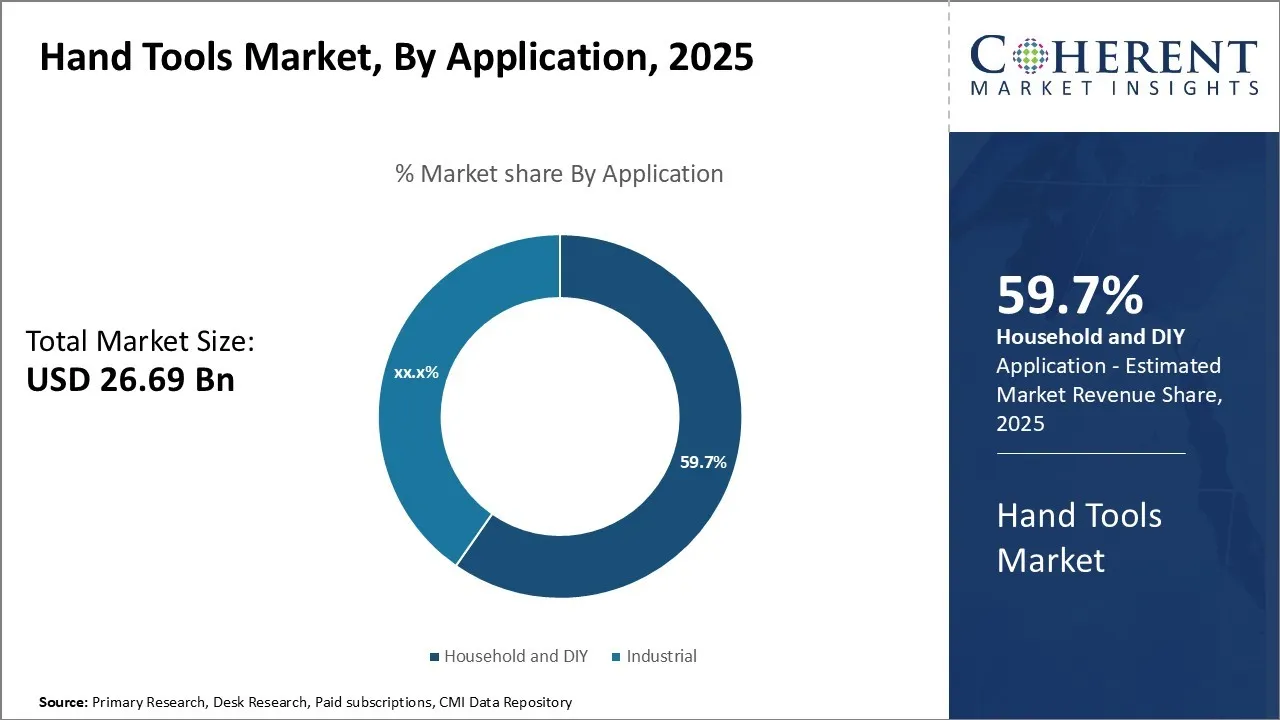
- According to application, the household and DIY category is anticipated to account for the largest share of 60.7% for the Hand Tools market in 2026. DIY home improvement, furniture assembly, unkeep, and repairs are becoming more popular among consumers as a way to reduce professional expenses, promote independence, and customize living areas.
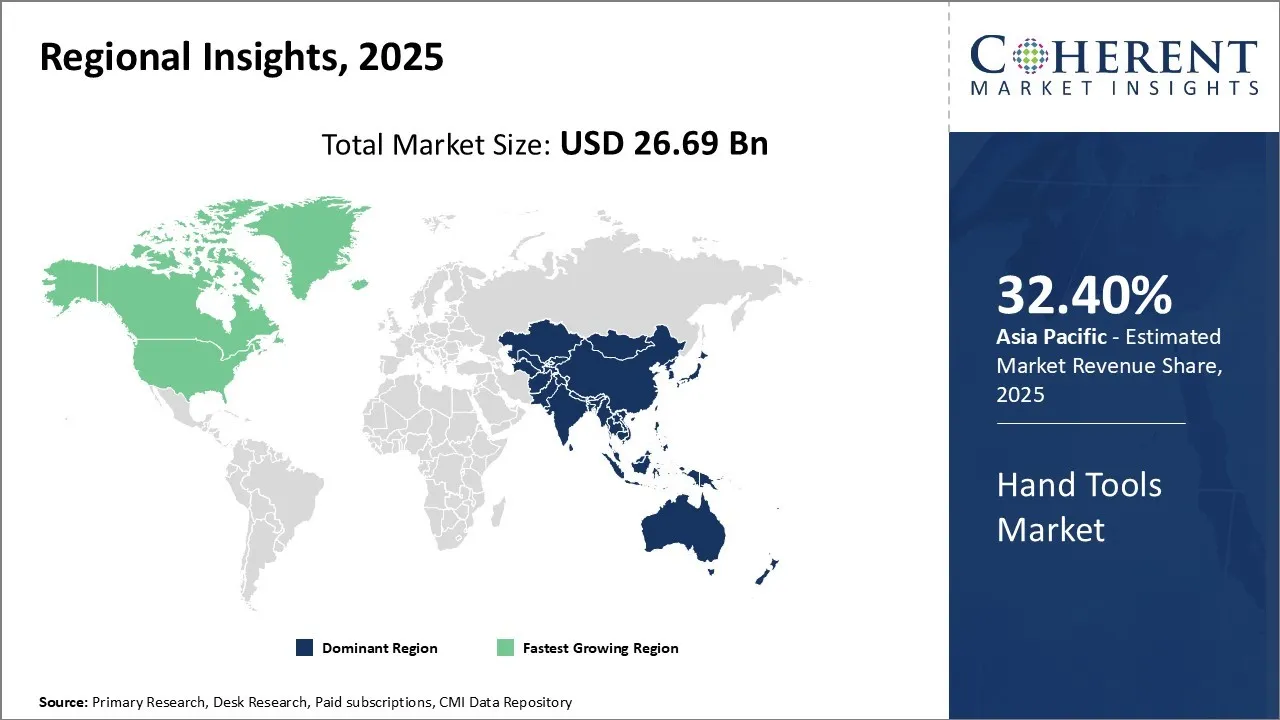
- Asia Pacific is considered to be the most largest region with 32.4% market shareby 2026 for Hand Tools market, as it is fueled by high growth in industries like construction, automotive, and aerospace, as well as by fast urbanization and strong infrastructure development.
Market Overview
The Hand Tools Market Size is expanding steadily, propelled by rising demand in sectors including industrial, automotive, and construction as well as the growing acceptance of do-it-yourself projects. Due to increased investments in the automotive, construction, and other industries, the global hand tools market has significantly expand over the past several years. Hand tools have applications in the electronics, construction, aerospace, automotive, shipbuilding, and other industries.
Hand tools include tools such as spanners, wrenches, sockets, pliers, hammers, screwdrivers, punches, crimping tools, and others. Hand tools market research shows significant growth driven by increasing demand across construction, automotive, and DIY sectors. Spanners are available in two types of shapes, open-ended spanner and ring spanner. Ring spanners are generally double-ended and frequently with offset handles to improve the fitting of nuts and bolts.
Current Events and Its Impact on the Hand Tools Market
Event | Description and Impact |
Economic Expansion in Europe
|
|
Adoption of AI and Machine Learning in Automation |
|
Pricing Analysis
Hand tools pricing is significantly affected by the cost of raw materials, predominantly steel, aluminum, and polymers. In 2025, raw material expenses are forecast to rise by 6–8% year-over-year, directly contributing to a projected 4–5% increase in the retail prices of basic hand tools. Production costs constitute a substantial portion of the overall pricing structure, with labor costs in Asia Pacific being around 40% lower than in Western markets due to cheaper labor and fewer regulations.
However, rising wages in China (an annual increase of about 8%) are narrowing this gap. In contrast, hand tools manufactured in North America and Europe can carry a 25–30% cost premium over those from lower-cost regions, largely due to stricter labor and environmental regulations. Thus, while material costs form a major share of total expenses, regional labor and compliance costs also play a crucial role in shaping the final retail price.
- Current Industry Events of 2026
- Market Size Estimation
- Regional Breakdown
- Competitive Landscape
- Customer Intelligence
- Segmental Analysis
- Pricing Analysis
- Key Market Drivers, Challenges & Future Trends
- Customized Insights Section
Technological Advancement
- Technological advancements in the hand tools market are primarily centered around ergonomics, multi-functionality, and sustainability. Manufacturers are designing hand tools with improved ergonomic grips to minimize user fatigue and enhance productivity, catering to both professionals and hobbyists.
- Another significant development is the introduction of multi-functional tools, such as pliers that combine cutting, gripping, and crimping functions into a single device. These innovations meet the demands of users seeking efficiency and versatility in compact forms.
Segmental Insights
Hand Tools Market Insights, By Application
In terms of application, the household and DIY segment in the hand tools market has seen robust growth, driven by several key trends. The market is fueled by rising interest in DIY home improvement and repair activities, with consumers increasingly opting to take on tasks such as furniture assembly, garden maintenance, and minor household repairs themselves rather than hiring professionals. This shift is further amplified by online tutorials and the influence of social media, which provide guidance and inspiration for DIY projects and home customization.
Hand Tools Market Insights, By Product Type
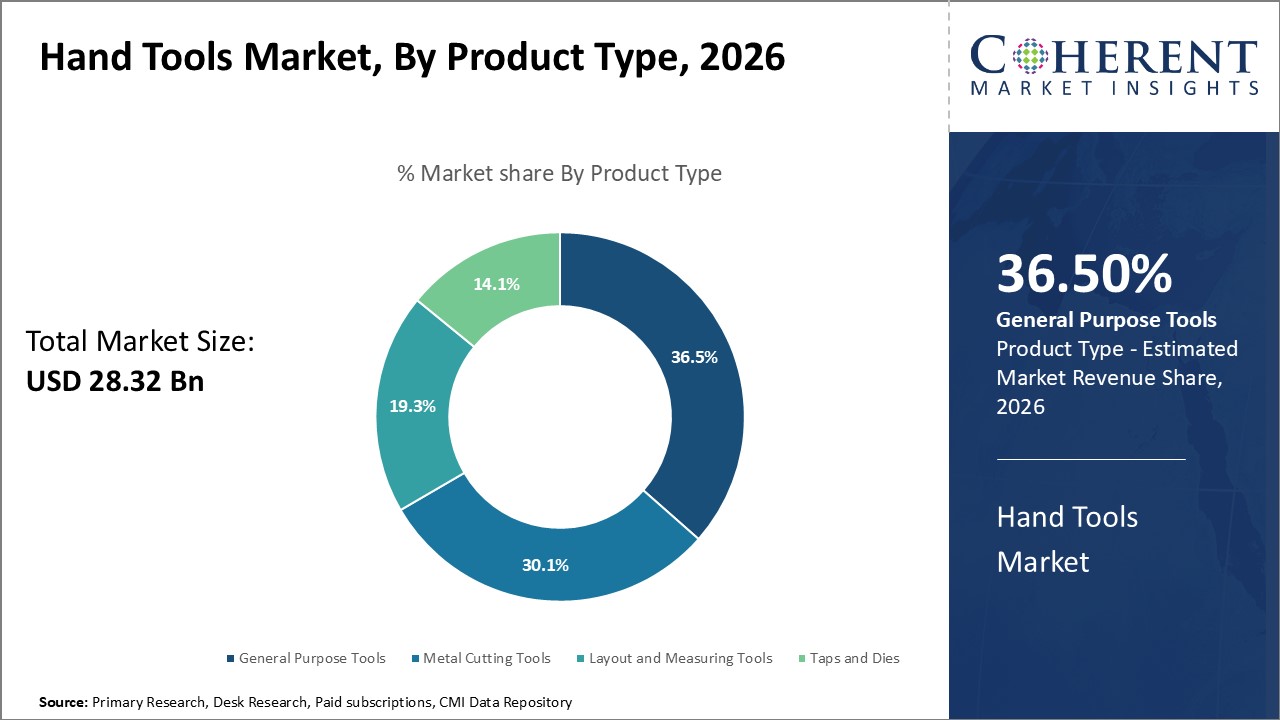
In terms of product type, the General Purpose Tools segment is expected to contribute largest share of the Hand Tools market trends in 2026. The General Purpose Tools segment holds a dominant position in the global hand tools market. This segment typically includes widely used tools such as hammers, screwdrivers, and pliers, which are essential across construction, maintenance, and DIY activities. Their broad applicability in both professional and household settings makes them indispensable for a variety of tasks.
Hand Tools Market Insights, By Sales Channel
In terms of sales channel, the Distributor Sales segment is expected to contribute largest share of the Hand Tools market trends in 2026. One important and established way for manufacturers to connect with commercial, professional, and industrial clients is through the distributor sales segment of the hand tool industry.
Distributors usually act as middlemen, buying hand tools in large quantities from producers and delivering them to shops, workshops, contractors, and companies that need consistent access to a variety of goods. This market is especially significant in areas and sectors where consumers value face-to-face interactions, post-purchase assistance, and knowledgeable counsel from reputable distributors.
Hand Tools Market – Regional Insights
Asia Pacific Hand Tools Market
The Asia Pacific region is anticipated to hold a prominent position in the hand tools market throughout the analysis period, driven by the surge in urbanization and heightened investments in infrastructure. Notably, China stands out as a significant global exporter of hand tools. The rapid industrial advancement in China has prompted manufacturers of hand tools and accessories to establish their production facilities within the country.
The favorable combination of inexpensive labor and materials in China enables manufacturers to produce hand tools and accessories at cost-effective rates, while also achieving elevated levels of manufacturing efficiency. Within the Chinese hand tools market, numerous small-scale manufacturers cater primarily to the demand for hand tools in the Asia region. Additionally, the burgeoning automotive, electronics, and aerospace sectors in China present favorable prospects for the expansion of the global hand tools market within the country.
North America Hand Tools Market
The North America hand tool market exhibits resilience and innovation, driven by a strong industrial base and technological advancements. With a focus on precision and durability, the region's manufacturers cater to diverse sectors including construction, automotive, and aerospace.
Ongoing investments in infrastructure projects and a steady demand for maintenance and repair activities sustain the market. Additionally, stringent quality standards and a skilled workforce contribute to North America's reputation for producing reliable hand tools that meet the rigorous requirements of various industries.
Hand Tools Market In Europe
Europe's hand tool market thrives on a rich heritage of craftsmanship and engineering excellence. Renowned for its precision and quality, the European hand tool industry serves a broad spectrum of sectors, ranging from woodworking to automotive manufacturing.
Embracing traditional craftsmanship alongside technological innovation, European manufacturers uphold strict standards, ensuring the longevity and effectiveness of their products. The market benefits from a sophisticated distribution network and a deep-rooted culture of skilled artisans, bolstering its position as a global hub for high-quality hand tools.
Hand Tools Market Dominating Countries
U.S Hand Tools Market
The Infrastructure Investment and Jobs Act (IIJA) and the expansion of residential and commercial construction both contribute to the continuous need for hand tools for jobs like assembly, demolition, and framing. Additionally, e-commerce and online content support the growing do-it-yourself culture, which maintains a high demand for both consumer and professional-grade products.
India Hand Tools Market
India's fast industrialization, urbanization, and expanding middle class with rising disposable income make it stand out in the hand tool industry. The country's need for hand tools, including hand tools of aviation technicians, is being driven mostly by the increase in construction projects, infrastructure development, and a growing DIY and home renovation culture.
Hand Tools Market In China
Large-scale infrastructure developments, ongoing industrialization, and rapid urbanization guarantee a steady, high-volume need for a variety of hand tools. Parallel to global movements, the increase of the middle class in China and the growing appeal of do-it-yourself (DIY) trends also drive market expansion in consumer segments.
Market Report Scope
Hand Tools Market Report Coverage
| Report Coverage | Details | ||
|---|---|---|---|
| Base Year: | 2025 | Market Size in 2026: | USD 28.32 Bn |
| Historical Data for: | 2020 To 2024 | Forecast Period: | 2026 To 2033 |
| Forecast Period 2026 to 2033 CAGR: | 6.1% | 2033 Value Projection: | USD 42.86 Bn |
| Geographies covered: |
| ||
| Segments covered: |
| ||
| Companies covered: | Kennametal Inc., Apex Tools Group, Akar Tools Ltd., Channellock, Inc., JK Files (India) Limited, Stanley Black Decker, Sears, Wera Tools, Snap-On, Irwin Industrial Tools, and Klein Tools | ||
| Growth Drivers: |
| ||
| Restraints & Challenges: |
| ||
Hand Tools Market: Growth Drivers
- Rising Industrial demand and economic conditions
The demand for hand tools is intricately linked with industrial activities, construction projects, and manufacturing processes. Economic conditions play a pivotal role, especially within the construction and manufacturing sectors, as they exert substantial influence on the hand tool demand. During phases of economic growth, such as expansions, heightened construction endeavors and increased industrial production propel the requirement for specialized hand tools.
Industries rely on these tools for tasks demanding precision and efficiency, further amplifying the demand. The global hand tools market experiences fluctuations in tandem with economic shifts, with prosperous periods triggering higher demand due to elevated construction and industrial projects necessitating specialized tools.
- Technological advancements
Technological advancements are pivotal in shaping advanced hand tools through innovations in materials, design, and manufacturing procedures. Ergonomic designs, precision engineering, and the integration of smart technologies constitute key technological strides that enhance hand tool efficiency.
Hand tools with drywall installation are a prime example of how these innovations are applied in specific applications to improve usability and performance. Manufacturers continuously endeavor to introduce tools that minimize user fatigue, elevate accuracy, and streamline tasks.
Through novel materials and intricate engineering, these tools become not only more durable but also ergonomically efficient, resulting in heightened productivity and user satisfaction. The drive for innovation in the hand tools sector is underscored by the pursuit of tools that resonate with contemporary demands for precision, convenience, and performance optimization. Moreover, many market players are adopting strategies, such as collaboration, partnerships, expansions, and others, to expand and strengthen their position in the market.
For instance, on December 2020, Techtronic Industries Co. Ltd., a hand tools manufacturer headquartered in the U.S., concluded arrangements to establish a novel manufacturing facility in Wisconsin. The intended purpose of this facility is to augment the manufacturer's production capacity, specifically to facilitate the advancement of an improved range of manually operated tools.
Hand Tools Market: Trends
Technology is seeing a growing emphasis on ergonomic designs, multipurpose goods, and the incorporation of cutting-edge materials to improve comfort and durability. Compact hand tools for toolboxes are becoming increasingly popular as they combine functionality with space-saving design, catering to both professional and personal use. Interestingly, the usage of sustainable and eco-friendly materials is becoming more popular as consumers and producers place a greater emphasis on ecologically beneficial solutions.
Additionally, businesses are becoming more distinctive in a more competitive market by introducing smart and connected hand tools, such those with digital feedback systems, and personalizing and customizing their products. These patterns, along with ongoing increases in infrastructure spending and building worldwide, should support strong demand and ongoing innovation in the hand tool industry.
Hand Tools Market: Opportunities
- DIY and home improvement opportunities
The rapidly increasing DIY (Do it yourself) culture has sparked a heightened demand for hand tools that align with the principles of user-friendliness and versatility. As more individuals embrace do-it-yourself projects for home improvement and creative endeavours, the need for accessible and adaptable hand tools has surged.
Manufacturers are capitalizing on this trend by designing tools that are intuitive to use, capable of accommodating various tasks, and suited for both novices and experienced DIY enthusiasts. This shift in consumer preferences underscores the importance of crafting tools that empower users to confidently engage in a diverse range of projects, thereby fostering the growth of the global hand tools market within the realm of DIY and home improvement.
For instance, in March 2021, Great Star USA, a prominent participant in the field of mechanical hand tools designed for both professional home use (do-it-yourself) and industrial applications, disclosed its acquisition of SK Professional Tools. This strategic acquisition aligns with the company's objectives of fortifying U.S.-centered manufacturing capabilities while concurrently expanding its distribution and sales networks.
- Sustainable manufacturing
The growing consumer inclination toward eco-friendly products has paved the way for manufacturers to harness opportunities in sustainable manufacturing practices within the hand tools market. This trend propels manufacturers to create hand tools using environmentally responsible materials and processes.
By adopting sustainable sourcing, minimizing waste, and utilizing recycled or biodegradable materials, manufacturers align their offerings with eco-conscious consumer demands. This not only addresses environmental concerns but also positions them favorably in a market where sustainability is a driving force. Consequently, sustainable hand tools not only cater to consumer preferences but also contribute to the industry's overall commitment to minimizing its ecological footprint.
Hand Tools Market: Key Developments
- April 2025, NITI Aayog has launched a wide-ranging roadmap for bringing India's hand and power tools industry's over $25 billion export potential by 2035, underlining its huge potential in becoming a force to strengthen India's manufacturing ecosystem, generate employment, and make India a world manufacturing hub. The strategic report 'Unlocking $25+ Billion Export Potential - India's Hand & Power Tools Sector' was formally released by Shri Suman Bery, Vice Chairman, NITI Aayog, in the presence of Dr. V.K. Saraswat and Dr. Arvind Virmani, Members of NITI Aayog, and Shri BVR Subrahmanyam, CEO of NITI Aayog.
- May 2025, Design company Figma announced multiple features, including AI-powered site and web app creation, a way for marketers to create assets in bulk, and a new drawing tool. With this launch, the company is taking on other creative solutions such as Canva and Adobe, along with AI-powered website and prototype creators such as WordPress, Wix, Hostinger, and Replit.
- January 2025, Hilti North America, a maker of tools, technology, software, and services to the commercial construction industry, has expanded the all-on-one Nuron battery platform with technology that meets the needs of contractors, including the launch of its DD 150-U-22 Cordless Diamond Core Rig, two DSH 600/700 Cut-off Saws and PR 4/40/40G-22 Rotating Lasers. A versatile option for both rig-mounted and hand-held coring is the new DD 150-U-22. It is the first core rig powered by Nuron that uses the same battery platform as handheld cordless tools. This means that contractors can use the same set of interchangeable batteries for all Hilti tools, whether they are used for light-duty or heavy-duty tasks, without sacrificing performance.
Analyst Opinion
- The market for hand tools is expected to grow steadily and robustly through 2035, supported by strong demand from a variety of industries and the ongoing global DIY movement.
- This expansion is attributed to several converging factors like increased infrastructure and construction investment, the rise of home improvement activities, and the ongoing requirement for hand tools across automotive, manufacturing, and service sectors.
- The market is also experiencing an influx of technological innovations—such as ergonomic and multi-functional designs—as companies compete to meet evolving customer expectations while focusing on sustainability and durability.
- Asia Pacific, led by China, continues to dominate global share, benefiting from large-scale manufacturing and rising regional demand driven by urbanization and industrial growth.
Speak to the analyst
Want personalized insights?
Take the findings above to one of our principal consultants, or have the report rebuilt around the segments, geographies and competitors you actually track.
Market Segmentation
- Global Hand Tools Market, By Application (Revenue, USD Bn, 2021 - 2033)
- Industrial
- Household and DIY
- Global Hand Tools Market, By Product Type (Revenue, USD Bn, 2021 - 2033)
- General Purpose Tools
- Metal Cutting Tools
- Layout and Measuring Tools
- Taps and Dies
- Global Hand Tools Market, By Sales Channel (Revenue, USD Bn, 2021 - 2033)
- Online Sales
- Company Direct Sales
- Distributor Sales
- Global Hand Tools Market, By Region (Revenue, USD Bn, 2021 - 2033)
- North America
- U.S.
- Canada
- Europe
- Germany
- Italy
- U.K.
- France
- Spain
- Russia
- Rest of Europe
- Asia Pacific
- China
- Japan
- Australia
- India
- ASEAN
- South Korea
- Rest of Asia Pacific
- Latin America
- Brazil
- Mexico
- Argentina
- Rest of Latin America
- Middle East and Africa
- GCC Countries
- Israel
- South Africa
- Rest of Middle East and Africa
- North America
- Company Profiles
- Kennametal Inc.
- Apex Tools Group
- Akar Tools Ltd.
- Channellock, Inc.
- JK Files (India) Limited
- Stanley Black Decker
- Sears
- Wera Tools
- Snap-On
- Irwin Industrial Tools
- Klein Tools
Sources
Primary Research Interviews
- Construction site supervisors and technicians
- Automotive service professionals and garages
- Tool design engineers or R&D leads
- Import/export agents for tools and machinery
Databases
- UN Comtrade
- IBISWorld (just the platform name, not a firm)
- Trade Map (by ITC)
Magazines
- Power Transmission Engineering
- Construction Week
- The Manufacturer
- Modern Machine Shop
Journals
- Applied Mechanics and Materials
- Construction and Building Materials
- SAE International Journal of Materials and Manufacturing
- Procedia Manufacturing
Newspapers
- Times of India (Business section)
- The Wall Street Journal
- New York Times (Business/Manufacturing section)
- The Guardian (Economy section)
- Nikkei Asia
Associations
- Indian Machine Tool Manufacturers’ Association (IMTMA)
- European Tool Committee (ETC)
- American Hardware Manufacturers Association (AHMA)
- Builders Hardware Manufacturers Association (BHMA)
- Indian Industrial Fasteners & Tools Association (IIFTA)
Proprietary Elements
- CMI Data Analytics Tool, Proprietary CMI Existing Repository of information for last 8 years
*Definition: Hand tools refer to a category of manually operated devices designed to perform various tasks, usually without the need for external power sources. These tools are typically operated by hand, relying on human effort and skill for their functionality. Hand tools encompass a wide range of implements used in tasks such as cutting, shaping, fastening, measuring, and manipulating materials. They are commonly utilized across industries such as construction, woodworking, automotive, gardening, and others. Examples of hand tools include hammers, wrenches, screwdrivers, pliers, saws, chisels, and tape measures. Hand tools are valued for their precision, versatility, and ability to perform tasks that require manual dexterity and control.
Get access to 250+ pages report
Every segment, forecast, competitor profile and data table behind the analysis above — available for instant download.
- ESOMAR Member
- ISO 9001:2015 Certified
- D-U-N-S Registered
- GDPR & CCPA Compliant
Missing comfort of reading report in your local language? Find your preferred language:
Transform your Strategy with Exclusive Trending Reports
Frequently Asked Questions
The Hand Tools Market size is estimated to be valued at USD 28.32 Bn in 2026, and is expected to reach USD 42.86 Bn by 2033.
The CAGR of the global Market is projected to be 6.1% from 2026 to 2033.
The major players operating in the market include Kennametal Inc., Apex Tools Group, Akar Tools Ltd., Channellock, Inc., JK Files (India) Limited, Stanley Black Decker, Sears, Wera Tools, Snap-On, Irwin Industrial Tools, and Klein Tools.
Utilizing AI and IoT-integrated electric tools to mitigate potential market advancements are the key factors hampering the growth of the market.
Rising Industrial demand and economic conditions are the key factors driving the growth of the market.
Among regions, Asia Pacific held a dominant position in the global hand tools industry in 2026 accounting for 32.4% share, in terms of value.
Wrenches are the dominant product segment in the hand tools market, holding a significant share of around 25.9% in 2026.