

Water Heater Market Size and Forecast – 2026 to 2033
Water Heater Market is estimated to be valued at USD 48.28 Bn in 2026 and is expected to reach USD 110.81 Bn in 2033, exhibiting a compound annual growth rate (CAGR) of 12.6% from 2026 to 2033.
Key Takeaways
- By Product Type, Storage Water Heater acquired the prominent share of 55% in 2026 owing to the growing demand for energy efficiency & sustainability.
- By Type, Electric water heater holds the largest market share in 2026 owing to its energy efficiency & cost savings.
- By Application, Residential dominates the overall market share in 2026 owing to the energy efficiency & environmental regulations.
- By Region, North America dominates the overall market with an estimated share of 37.3% in 2026 owing to the regulatory pressure & energy efficiency programs.
Market Overview
A water heater or storage water heater is a domestic water heating appliance that uses a hot water storage tank to optimize heating capacity and provide prompt hot water whenever needed. Conventional storage water heaters use a variety of fuels namely electricity, oil, propane, natural gas, and oil. However, unconventional heaters use solar energy to provide hot water. Solar water heater has been adopted widely around the world since it clean, renewable, and cost-efficient. The selection of proper water solar depends upon several factors such as availability of fuels, type of building that it is being installed, fuel cost, requirements of household, and user safety.
Current Events and their Impact on the Water Heater Market
Current Events | Description and its impact |
Global Energy Crisis and Rising Utility Costs |
|
Climate Policy Acceleration and Regulatory Changes |
|
Supply Chain Disruptions and Material Shortages |
|
End-user Feedback and Unmet Needs in the Water Heater Market
- Demand for Faster Heating and Instant Hot Water: End-users often express the need for quicker heating times and immediate access to hot water, especially in colder regions. Delays in hot water availability remain a common complaint, prompting demand for instant or rapid heating technologies that improve user convenience.
- Energy Efficiency and Cost Savings: Consumers seek water heaters that significantly reduce electricity or fuel consumption to lower utility bills. Many users find current models still costly to operate, highlighting a gap for more energy-efficient systems with affordable upfront and operational costs.
- Durability and Maintenance Concerns: Users frequently report issues with the durability of heating elements and tanks, along with expensive maintenance. There is a strong demand for longer-lasting products that require minimal repairs and offer easier access to service and replacement parts.
- Current Industry Events of 2026
- Market Size Estimation
- Regional Breakdown
- Competitive Landscape
- Customer Intelligence
- Segmental Analysis
- Pricing Analysis
- Key Market Drivers, Challenges & Future Trends
- Customized Insights Section
Role of Artificial Intelligence (AI) in Water Heater
Artificial Intelligence (AI) is transforming water heaters by making them smarter, more efficient, and user-friendly. They can detect usage patterns, adjust temperatures automatically, and reduce power consumption during off-peak times. AI also enhances safety by monitoring for faults, overheating, or unusual activity, ensuring timely alerts or shutdowns. With remote control via mobile apps and personalized settings, AI enables a seamless and efficient bathing experience. Overall, AI brings intelligence, convenience, and energy efficiency to modern water heating solutions.
In January 2025, Symphony Ltd entered the water heating market with three geyser models featuring nine SKUs. These models include advanced PUROPOD Cartridge technology for hard water treatment and SmartBath technology, making the Symphony Spa range India’s first AI-powered water heater.
Segmental Insights
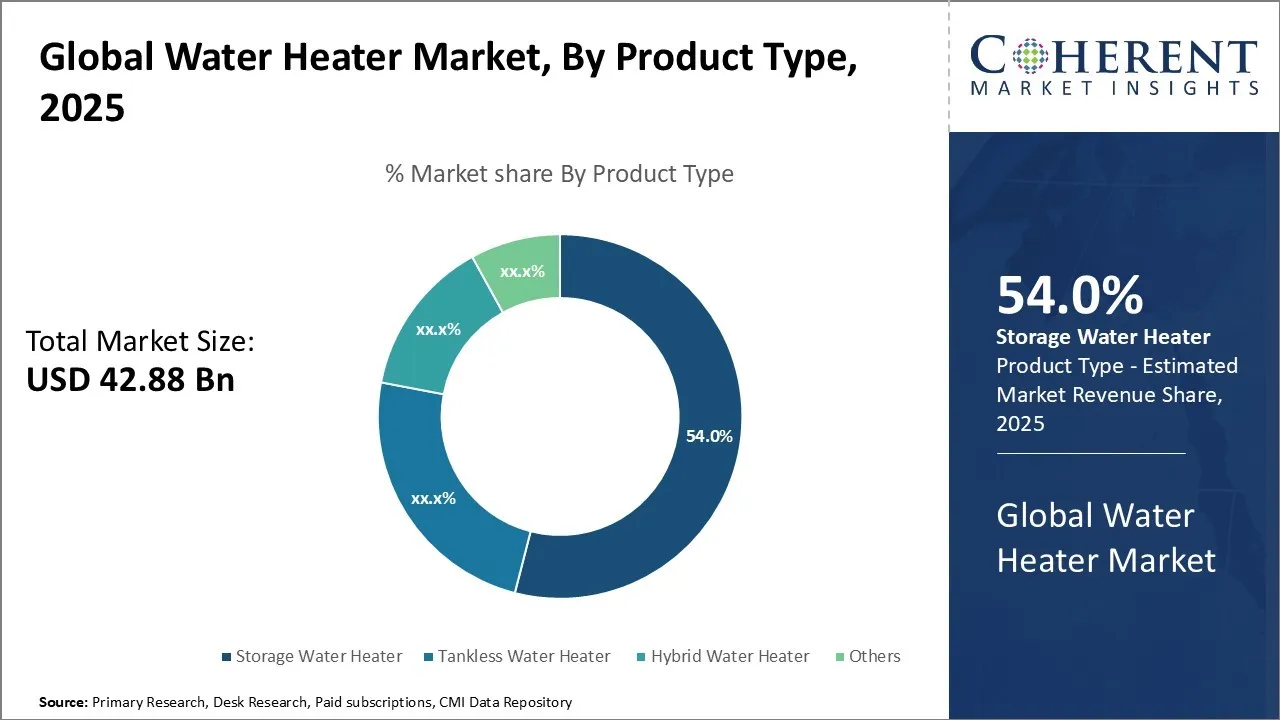
Water Heater Market Insights, By Product Type - Storage Water Heater contribute the highest share of the market owing to its urbanization & infrastructure growth
Storage Water Heater acquired the prominent share of 55.0% in 2026. Rising demand for energy-efficient and cost-effective water heating solutions drives the storage water heater market growth, particularly across residential and commercial sectors. Consumers adopt these systems due to rapid urbanization, higher disposable incomes, and increased awareness of sustainable living. Manufacturers enhance product appeal through technological advancements such as better insulation, smart controls, and hybrid models. Governments further boost adoption by offering incentives and enforcing regulations that favor low-energy appliances. In colder regions, households rely on storage heaters for consistent hot water access. For instance, in October 2024, Nyle Water Heating Systems unveiled the Pyroclast™ Commercial Integrated Heat Pump Water Heater, developed in partnership with Htec Packaged Systems and Controls. This innovative system uses advanced Phase Change Material (PCM) technology for thermal storage and significantly reduces installation time, complexity, and the potential for errors.
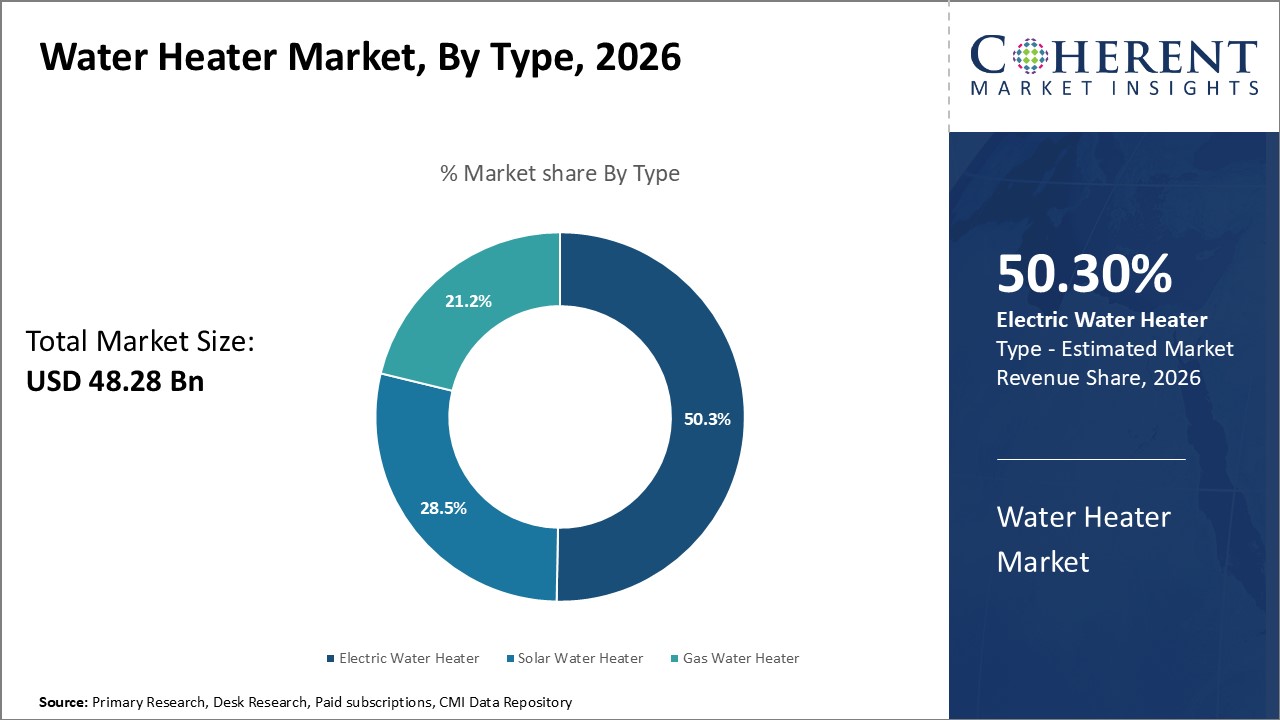
Water Heater Market Insights, By Type - Electric Water Heater contribute the highest share of the market owing to its government policies & incentives
Consumers are driving the electric water heater market by seeking energy-efficient, low-maintenance, and easy-to-install solutions. Rapid urbanization, expanding residential construction, and growing awareness of eco-friendly appliances fuel this demand. Manufacturers boost product appeal through innovations like smart controls and compact designs that enhance convenience. Governments support adoption by offering incentives for electric and energy-saving kitchen appliances. As electricity access improves in developing regions, more households choose electric models over gas-based systems, favoring cleaner energy and reliable hot water solutions. For instance, in January 2025, Midea introduced its energy-efficient heat pump water heater, offering a smarter alternative to traditional systems. Unlike electric resistance heaters or gas-fired water systems—which generate heat and lead to high energy costs and carbon emissions—Midea’s heat pump transfers heat instead. This approach drastically reduces energy consumption and supports cleaner energy use.
Water Heater Market Insights, By Application - Residential contribute the highest share of the market owing to its rising consumer awareness & disposable income
Households are driving the residential water heater market by demanding reliable and energy-efficient hot water solutions. Rapid urbanization, expanding housing projects, and increased renovation work fuel market growth. Consumers prefer modern appliances that offer safety, convenience, and reduced energy use. Manufacturers boost appeal by incorporating smart features and compact designs. Governments promote adoption through incentives and energy-efficiency regulations. Additionally, rising environmental awareness and a strong preference for eco-friendly technologies are encouraging more homeowners to switch to advanced water heaters. For instance, in May 2025, Lennox, a leader in innovative HVACR climate solutions, has entered into a joint venture with Ariston Group, a global expert in sustainable climate and water comfort. Together, they will deliver a competitive range of residential water heaters to homeowners across the United States and Canada.
Regional Insights
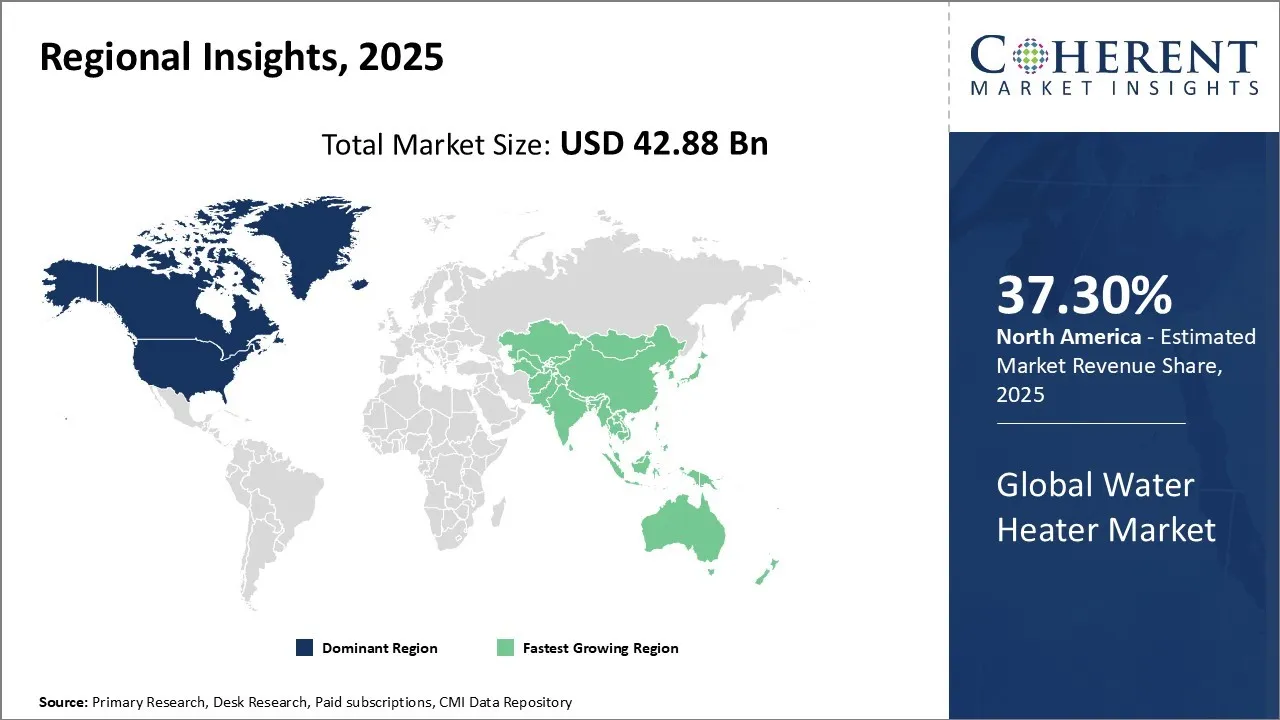
North America Water Heater Market Trends
North America dominates the overall market with an estimated share of 37.30% in 2026. Consumers in North America are driving the water heater market by demanding energy-efficient and environmentally friendly appliances. They are increasingly choosing smart and hybrid models that deliver improved performance and reduce energy costs. Governments support this shift by offering incentives and enforcing regulations that encourage the replacement of outdated units. Ongoing residential construction and renovation projects further boost market demand. Additionally, the region is actively embracing electric and heat pump technologies to promote sustainability, reduce energy consumption, and modernize home heating solutions. For instance, in January 2026, Samsung, based in South Korea, introduced new residential air-to-water heat pumps designed for heating and domestic hot water (DHW) in multi-unit homes, apartments, new constructions, and retrofits. The company aims to enter the North American market with this Air to Water Heat Pump, which offers a slim design, AI Home integration, and reliable performance.
Asia Pacific Water Heater Market Trends
Households across India, China, and Southeast Asia are driving demand for water heaters by investing in modern appliances as urban growth and residential construction accelerate. As infrastructure improves in urban and semi-urban areas, more families upgrade their homes with essential comforts. A growing middle class with higher disposable income is further boosting the water heater market share. Consumers are prioritizing convenience and energy-efficient technologies, choosing advanced water heaters to enhance daily living as their living standards continue to rise across rapidly developing regions. For instance, Voltas, India’s leading AC brand and a major player in the home appliances industry, has entered the water heater segment with the launch of Voltas Water Heaters.
India Water Heater Market Trends
Manufacturers are driving innovation by introducing features like digital temperature control, fast heating elements, and Wi-Fi-enabled smart water heaters. Space-conscious consumers, especially in crowded urban homes and apartments, prefer compact designs and instant heating technology. India’s government actively supports solar water heaters and energy-efficient appliances through subsidies and awareness campaigns. These efforts reduce reliance on conventional energy sources and speed up the transition to renewable and hybrid heating technologies. Urban consumers now focus on comfort, safety, and convenience, boosting demand for smart and instant water heaters. For instance, Morphy Richards, a well-known home and kitchen appliances brand, has launched its new range of instant water heaters called 'Quente' and introduced a 6-litre capacity model in its premium storage water heater line, 'Salvo'. This is further propelling the water heater market revenue.
China Water Heater Market Trends
China’s government actively promotes the adoption of solar water heaters and energy-efficient electric models by providing subsidies and enforcing regulations. These efforts help reduce carbon emissions and dependence on fossil fuels, speeding up the shift to greener water heating technologies. As incomes rise and environmental awareness grows, Chinese consumers increasingly demand premium, eco-friendly water heaters. Urban residents prioritize appliances that offer a combination of performance, convenience, and sustainability to enhance household comfort. For instance, in March 2026, Xiaomi introduced the Mijia Smart Crystal Dual Tank Electric Water Heater 60L P10 in China. The company claims the product features “crystal clear” tanks that minimize mineral build-up due to an upgraded tank lining material. Xiaomi also states the device achieves a 99.5% scale prevention rate, protecting the inner tank and pipes.
Market Report Scope
Water Heater Market Report Coverage
| Report Coverage | Details | ||
|---|---|---|---|
| Base Year: | 2025 | Market Size in 2026: | USD 48.28 Bn |
| Historical Data for: | 2020 To 2024 | Forecast Period: | 2026 To 2033 |
| Forecast Period 2026 to 2033 CAGR: | 12.6% | 2033 Value Projection: | USD 110.81 Bn |
| Geographies covered: |
| ||
| Segments covered: |
| ||
| Companies covered: | A. O. Smith Corporation, Zhongshan Inse Group Co, Ltd., Haier Electronics Group Co., Ltd., Himin Solar Co., Ltd., Ariston Thermo Group, Genrui, Bajaj Electricals Ltd., Rheem Manufacturing Company, Jiaxing Jinyi Solar Energy Technology Co, Ltd., Noritz Corporation, SIEMENS AG, Bradford White Corp., Venus Home Appliances (P) Ltd., Havells. | ||
| Growth Drivers: |
| ||
| Restraints & Challenges: |
| ||
Water Heater Market Trend
- Growth of Energy-Efficient and Eco-Friendly Technologies
The water heater market is increasingly driven by demand for energy-efficient and environmentally friendly technologies. Consumers and governments prioritize appliances that reduce energy consumption and carbon emissions. Heat pump, solar, and hybrid water heaters are gaining popularity for their ability to deliver sustainable hot water solutions. Manufacturers are focusing on improving insulation, using eco-friendly refrigerants, and integrating smart controls to optimize energy use. This trend supports global sustainability goals and responds to rising environmental awareness.
- Rising Adoption of Smart Water Heaters
Smart water heaters equipped with Wi-Fi connectivity, remote control, and advanced sensors are transforming the market. These models allow users to monitor and manage water heating from mobile devices, enhancing convenience and energy management. Integration with smart home systems and voice assistants increases appeal among tech-savvy consumers. Real-time diagnostics and automated maintenance alerts improve product reliability. This trend reflects growing consumer demand for connected appliances that provide greater control and efficiency.
In March 2025, Xiaomi unveiled the Mijia Smart Crystal Dual Tank Electric Water Heater 60L P10 in China. Despite its 60L capacity, it can provide up to 840L of hot water continuously in about 168 minutes. Equipped with a 3,300W heating element, it heats water quickly within a 30–80°C range and offers hot water on demand.
Water Heater Market News
- In June 2025, V-Guard Industries announced the launch of its new Luxecube water heater series, aiming to set a new benchmark for luxury and smart living. On the occasion, Managing Director Mithun Chittilappilly stated that V-Guard is redefining modern living by delivering more than just a product—offering a complete lifestyle upgrade.
- In January 2025, Symphony unveiled its AI-powered water heaters designed to combat hair fall and improve the bathing experience. Equipped with advanced 9-layer PuroPod Technology, these geysers soften hard water and filter out harmful chemicals and sediments, delivering a safer and more comfortable shower.
- In January 2025, KENT, a prominent name in home appliances, introduced the KENT Instant Drinking Water Heater—a revolutionary innovation aimed at adding convenience and warmth to daily routines. This advanced appliance instantly provides hot water at the push of a button, making it ideal for preparing baby milk, tea, coffee, instant meals, or enjoying a warm drink.
- In December 2024, A.O. Smith, a pioneer in water heating and treatment solutions, launched its latest water heater range in India—the Elegance Neo series—offering both vertical and horizontal models.
Analyst Opinion (Expert Opinion)
- The water heater market is at a pivotal crossroads where technological innovation and shifting consumer priorities are redefining traditional boundaries. The surge in adoption of heat pump water heaters, particularly in developed markets like the U.S. and Europe, exemplifies this shift. For instance, the U.S. Department of Energy highlights that heat pump water heaters consume up to 60% less electricity compared to conventional electric resistance models, signaling a clear path toward energy efficiency.
- Moreover, the rapid proliferation of smart water heaters integrated with IoT platforms is not a mere trend but a necessary evolution responding to the demand for real-time energy management and predictive maintenance. Brands like Rheem and A.O. Smith have set benchmarks by embedding AI-driven diagnostics, drastically reducing maintenance costs and downtime. This level of technological integration is no longer optional but essential to maintain competitive advantage.
- From a regional perspective, the stark contrast between mature markets and emerging economies presents both challenges and unprecedented opportunities. In Asia-Pacific, especially India and China, despite infrastructural hurdles, government policies incentivizing solar water heaters are yielding tangible results—India’s Ministry of New and Renewable Energy reported over 4 million solar water heating systems installed by 2022 alone, underscoring the market’s massive untapped potential.
Speak to the analyst
Want personalized insights?
Take the findings above to one of our principal consultants, or have the report rebuilt around the segments, geographies and competitors you actually track.
Market Segmentation
- Global Water Heater Market, By Product Type (Revenue, USD Bn, 2021 - 2033)
- Storage Water Heaters
- Tankless Water Heaters
- Hybrid Water Heaters
- Others
- Global Water Heater Market, By Type (Revenue, USD Bn, 2021 - 2033)
- Electric Water Heater
- Solar Water Heater
- Gas Water Heater
- Global Water Heater Market, By Application (Revenue, USD Bn, 2021 - 2033)
- Residential
- Industrial
- Commercial
- Global Water Heater Market, By Region (Revenue, USD Bn, 2021 - 2033)
- North America
- U.S.
- Canada
- Latin America
- Brazil
- Argentina
- Mexico
- Rest of Latin America
- Europe
- Germany
- U.K.
- Spain
- France
- Italy
- Russia
- Rest of Europe
- Asia Pacific
- China
- India
- Japan
- Australia
- South Korea
- ASEAN
- Rest of Asia Pacific
- Middle East
- GCC Countries
- Israel
- Rest of Middle East
- Africa
- South Africa
- North Africa
- Central Africa
- North America
- Key Players Insights
- O. Smith Corporation
- Zhongshan Inse Group Co, Ltd.
- Haier Electronics Group Co., Ltd.
- Himin Solar Co., Ltd.
- Ariston Thermo Group
- Genrui
- Bajaj Electricals Ltd.
- Rheem Manufacturing Company
- Jiaxing Jinyi Solar Energy Technology Co, Ltd.
- Noritz Corporation
- SIEMENS AG
- Bradford White Corp.
- Venus Home Appliances (P) Ltd.
- Havells
Sources
Primary Research Interviews
- Product managers and engineers from leading water heater manufacturers
- Regional distributors and suppliers of residential and commercial water heaters
- HVAC system installers and plumbing contractors
- Energy efficiency program managers from utility companies
- Government officials from renewable energy and infrastructure departments
- Procurement heads in hospitality, healthcare, and real estate sectors
Databases
- International Energy Agency (IEA)
- U.S. Energy Information Administration (EIA)
- World Bank Open Data
- UN Comtrade Database
- International Renewable Energy Agency (IRENA)
- Eurostat
- IndiaStat
- China National Bureau of Statistics (NBS)
Magazines
- Appliance Design
- HPAC Engineering
- Green Builder Magazine
- HVACR Business
- Plumbing & Mechanical
- Energy World
- Electrical Construction & Maintenance (EC&M)
Journals’
- Journal of Renewable and Sustainable Energy
- Applied Energy
- Energy Policy
- International Journal of Energy Research
- Journal of Building Performance
- Journal of Cleaner Production
Newspapers
- The New York Times
- The Economic Times
- The Guardian
- China Daily
- Nikkei Asia
- Washington Post
- Business Standard
Associations
- American Council for an Energy-Efficient Economy (ACEEE)
- Bureau of Energy Efficiency (BEE – India)
- Solar Energy Industries Association (SEIA)
- European Heat Pump Association (EHPA)
- Japan Electrical Manufacturers’ Association (JEMA)
- U.S. Department of Energy (DOE)
- Indian Renewable Energy Development Agency (IREDA)
Public Domain Sources
- Government energy efficiency program portals
- National and state-level building codes and regulations
- Utility company public filings and energy usage reports
- Patent databases (Google Patents, WIPO)
- Climate action plans and carbon neutrality roadmaps
- Census data and population growth statistics
- Ministry of Energy and Environment websites
Proprietary Elements
- CMI Data Analytics Tool, and Proprietary CMI Existing Repository of information for last 8 years
Get access to 250+ pages report
Every segment, forecast, competitor profile and data table behind the analysis above — available for instant download.
- ESOMAR Member
- ISO 9001:2015 Certified
- D-U-N-S Registered
- GDPR & CCPA Compliant
Missing comfort of reading report in your local language? Find your preferred language:
Transform your Strategy with Exclusive Trending Reports
Frequently Asked Questions
The Water Heater Market is estimated to be valued at USD 48.28 Bn in 2026, and is expected to reach USD 110.81 Bn by 2033.
The CAGR of the Water Heater Market is projected to be 12.6% from 2026 to 2033.
Growing urbanization across the world is expected to propel the market growth over the forecast period.
The market has been dominated by storage water heaters as a major product type.
Constant struggle to meet quality and energy efficiency standards is expected to restrain the growth of the market during the forecast period.
The major players in the market are A. O. Smith Corporation, Zhongshan Inse Group Co, Ltd., Haier Electronics Group Co., Ltd., Himin Solar Co., Ltd., Ariston Thermo Group, Genrui, Bajaj Electricals Ltd., Rheem Manufacturing Company, Jiaxing Jinyi Solar Energy Technology Co, Ltd., Noritz Corporation, SIEMENS AG, Bradford White Corp., Venus Home Appliances (P) Ltd., Havells.