

Industrial Dryer Market Size and Share Analysis - Growth Trends and Forecast (2026 - 2033)
The global industrial dryer market size was estimated at USD 3,760 Mn in 2026 and is projected to exhibit a CAGR of 3.6% during the forecast period (2026-2033), reaching USD 4,820 Mn by 2033. This growth is attributable to increasing demand for energy-efficient drying solutions across industries like food processing, pharmaceuticals, and chemicals.
Key Takeaways from the Industrial Dryer Market Report
- By product type, spray dryer segment dominates the market, accounting for a 32% share in 2026, because of increasing adoption in food and pharmaceutical sectors. Spray drying is one of the most widely used technologies in food processing, especially in dairy applications like milk powder and The rotary dryer segment is narrowing the gap, with an estimated market share of 29% in 2026.
- Food segment is slated to account for 34% of the global industrial dryer market share in 2026 due to rising need for advanced drying technologies in food applications. The This is driving adoption of efficient drying technologies in the food industry to extend shelf life as well as reduce waste. On the other hand, pharmaceutical segment is likely to witness the fastest growth during the forecast period.
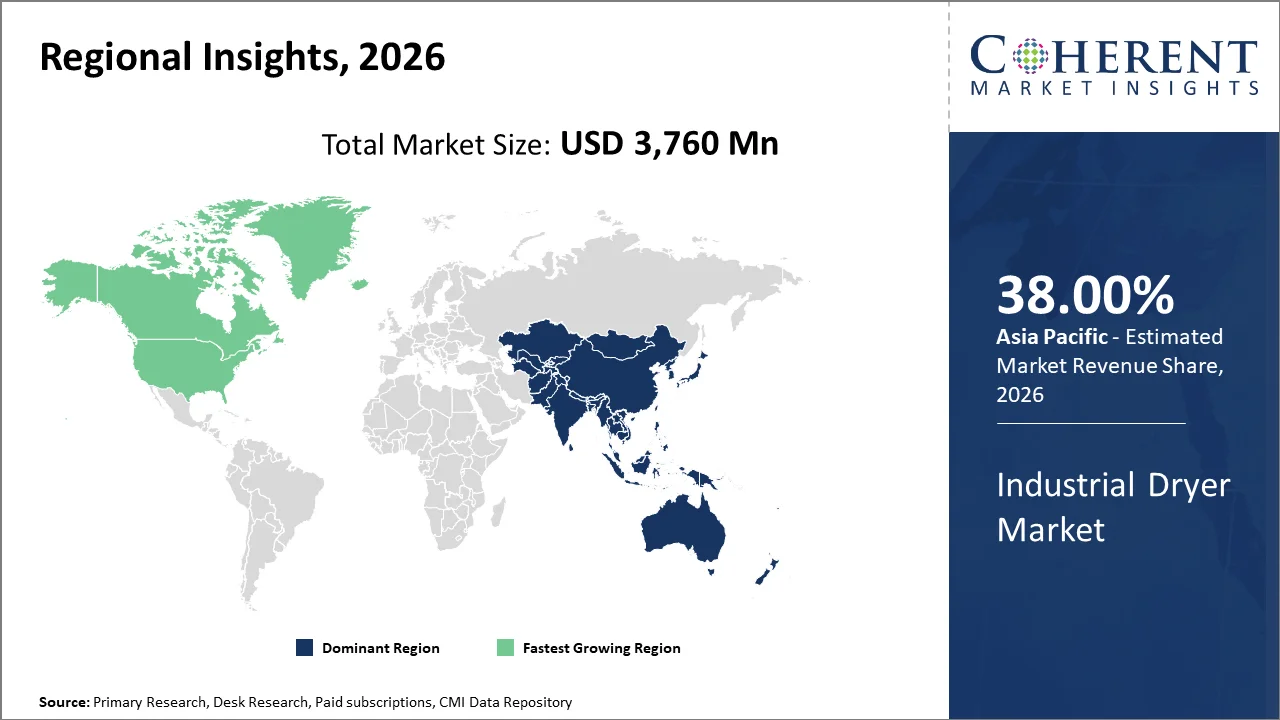
- Asia Pacific is expected to dominate the global industrial dryer market with a share of 38% in 2026, mostly due to industrial growth and manufacturing expansion. Asia Pacific leads global manufacturing, accounting for over 57% of total manufacturing value added, according to the United Nations Industrial Development Organization, making the region a key hub for industrial activity and equipment demand, including industrial dryers.
- North America, holding more than 30% share in 2026, is anticipated to create lucrative growth opportunities for industrial dryer manufacturers during the forecast period, thanks to strong pharma and food processing base.
Segmental Insights
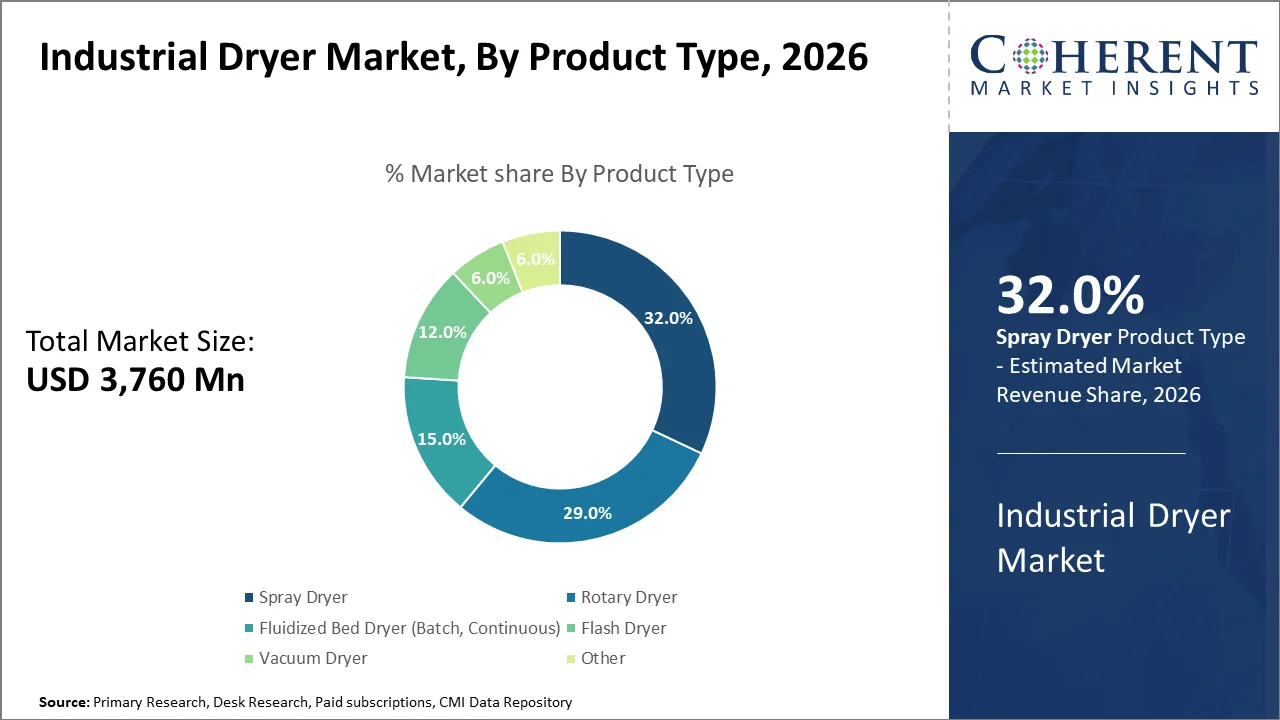
Which is the Top-Selling Product Type in the Industrial Dryer Market?
Spray Dryer Remains the Most Widely Used Product Type
As per Coherent Market Insights’ latest industrial dryer market analysis, spray dryer segment is projected to account for a major revenue share of 32% in 2026. This is due to widespread use of spray dryer technology in food and beverages, pharmaceuticals, chemicals and other industries, where it enables rapid drying of liquid or slurry materials into fine powders.
Spray drying produces uniform particle size and stable powders with low moisture content, which helps improve product quality and extend shelf life. Scientific studies confirm that spray drying enables controlled particle morphology and improved product stability, making it a preferred industrial method.
In addition, spray dryers offer advantages such as consistent product quality, better control over particle size, and high production efficiency. They have the tendency to handle heat-sensitive materials and support large-scale continuous processing, thereby encouraging adoption across multiple industries, reinforcing their position as a dominant product type segment in the industrial dryer market.
- Current Industry Events of 2026
- Market Size Estimation
- Regional Breakdown
- Competitive Landscape
- Customer Intelligence
- Segmental Analysis
- Pricing Analysis
- Key Market Drivers, Challenges & Future Trends
- Customized Insights Section
Which End-Use Industry Dominates the Industrial Dryer Market
Food Sector to Remain Leading Consumer of Industrial Dryers
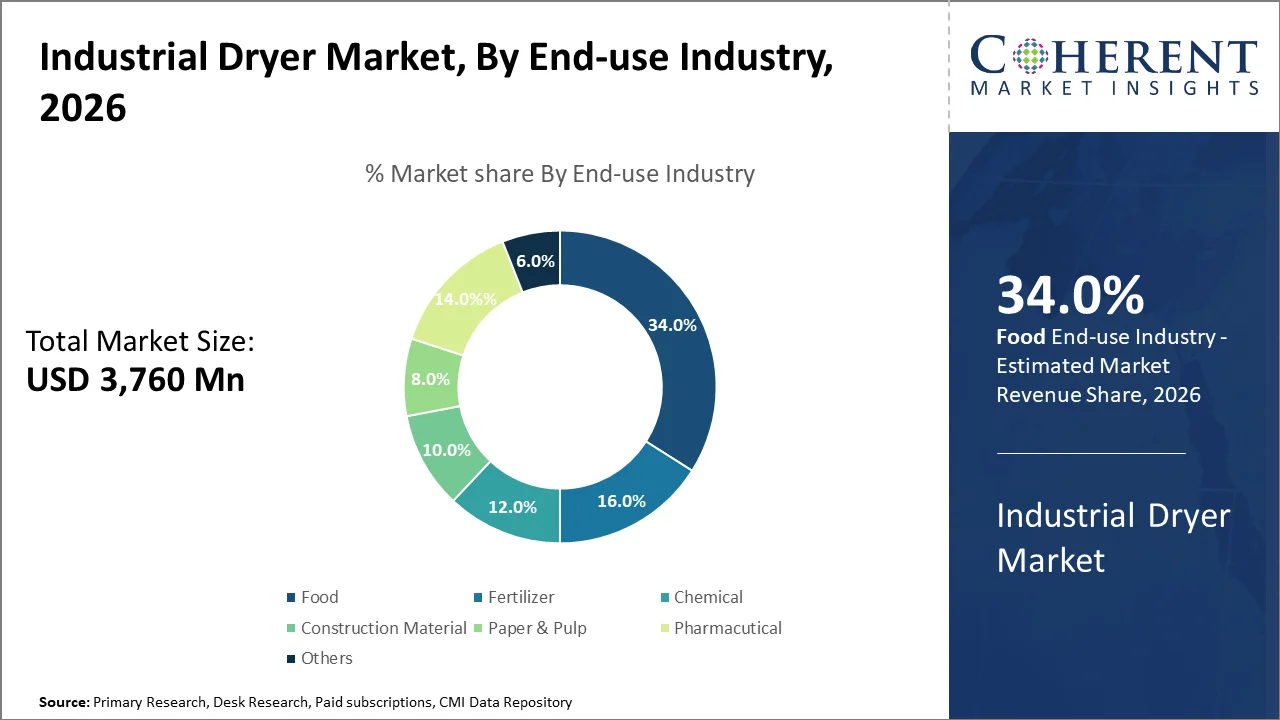
By end-use industry, food segment is expected to lead the global industrial dryer market, accounting for a share of 34% share in 2026. This is mostly due to rising demand for processed and packaged foods, where drying plays a key role in extending shelf life and maintaining product quality. Industrial dryer systems are widely used for drying fruits, vegetables, dairy products, meat, and grains to reduce moisture and prevent spoilage.
In addition, growing urbanization, changing consumer lifestyles, and increasing preference for ready-to-eat and convenience foods are driving adoption of industrial dryers in the food industry. Leading industrial dryer manufacturers are introducing novel solutions to meet rising demand from the food sector. For instance, in October 2024, GEA launched new batch freeze dryers for food applications.
Industrial Dryer Market Growth Drivers
Expansion of Food Processing Industry
A major factor driving the growth of the industrial dryer market is the expansion of the food processing industry. The food processing sector is expanding steadily thanks to rising global demand for packaged and processed food products. This, in turn, is expected to drive demand for industrial dryers during the forecast period.
According to the This highlights the critical need for improved preservation and processing technologies, including industrial drying systems, which help reduce moisture content in food products, inhibit microbial growth, and extend shelf life.
Industrial dryers are widely used for the dehydration of dairy products, instant foods, coffee, fruits, and vegetables to extend shelf life and reduce food waste. Improved drying processes also support efficient packaging, transportation, and storage. Thus, the rising demand for processed and convenience foods globally continues to drive the adoption of industrial drying equipment.
Industrial Dryer Market Trends
Shift Towards Energy-Efficient Drying Technologies
Increasing transition towards energy-efficient and low-emission dryers is a key trend in the industrial dryer market. Manufacturers of industrial dryers are adopting heat recovery systems, hybrid heating, and optimized airflow designs to reduce energy consumption as well as lower operating costs. For instance, Tonello recently introduced its first in-house range of industrial dryers for garment processing. The dryers are designed to improve efficiency, flexibility, and energy savings in textile production.
Industrial Dryer Market Innovations
Decarbonization and Electrified Drying Systems
A major trend in the industrial dryer market is the shift toward electrified drying systems, including high-temperature heat pump dryers and waste-heat recovery–based technologies, along with low-temperature drying solutions. These innovations improve energy efficiency and support industrial decarbonization by reducing reliance on fossil-fuel-based heat sources and lowering overall carbon emissions.
Rise of Intelligent and Automated Industrial Drying Technologies
Industrial dryers are increasingly integrated with IoT-based monitoring, smart moisture control systems, automation, and predictive maintenance technologies. These advancements enhance operational efficiency, reduce downtime, and improve product consistency across industrial applications. For example, in March 2026, Flying Tiger KJ launched an infrared rotary dryer. The infrared rotary dryer is designed to improve drying efficiency and support PET crystallization processes.
Current Events and Their Impact on the Industrial Dryer Market
Current Event | Description and its Impact |
Increasing Focus on Energy Efficiency Regulations |
|
Growth in Food Processing and Industrial Production |
|
Regional Insights
Asia Pacific to Remain at the Epicenter of Industrial Dryer Growth
Asia Pacific is expected to lead the global industrial dryer market, capturing a share of 38% in 2026. This is mostly due to its strong industrial base across food processing, pharmaceuticals, chemicals, and agriculture-based manufacturing. Rapid expansion of agro-processing industries in countries such as India, Vietnam, and Indonesia is increasing deployment of industrial drying systems for products like grains, fruits, dairy, and seafood.
Increasing agricultural output, which requires large-scale post-harvest processing infrastructure, is playing a key role in boosting Asia Pacific industrial dryer market growth. Asia accounts for ~45–50% of global agricultural production value in recent OECD-FAO Outlook estimates. This is making industrial drying systems critical for reducing post-harvest losses and improving shelf life in export-oriented supply chains.
Furthermore, manufacturers are increasingly investing in energy-efficient and automated drying systems to improve productivity as well as comply with environmental standards. For instance, companies like GEA Group and Buhler AG have expanded advanced drying system deployments across Southeast Asia, especially for dairy, rice, and specialty food processing applications. This reflects the region’s shift toward modernized industrial processing infrastructure.
Expanding Pharmaceutical Sector Fueling Industrial Dryer Demand in North America
The North America industrial dryer market is growing steadily due to the high adoption of advanced drying technologies across pharmaceuticals, food processing, and wastewater treatment industries. The region is expected to account for nearly 30% share of the global industrial dryer market in 2026.
Rapid expansion of pharmaceutical production capacity in the U.S. is providing a strong impetus to the industrial dryer market in North America. The pharmaceutical sector is a major end-user, where precise moisture control is essential in drug formulation, granulation, and the drying of active pharmaceutical ingredients (APIs). This has increased demand for advanced drying systems, such as fluidized bed and vacuum dryers used in high-value drug manufacturing.
In addition, the region is witnessing strong innovation in sustainable and low-energy drying technologies, particularly in food and beverage processing. Rising demand for dehydrated and ready-to-eat food products, along with stringent environmental compliance norms, is encouraging manufacturers to adopt smart drying systems integrated with automation and heat recovery technologies, further supporting market growth across industrial sectors.
Industrial Dryer Market Outlook – Country-wise
China Industrial Dryer Market Forecast
China remains one of the largest markets for industrial dryers, owing to strong growth in food processing, chemical manufacturing, pharmaceuticals, and agricultural processing industries, along with ongoing industrial modernization. The country’s robust manufacturing ecosystem and high output of agricultural and chemical products are generating sustained demand for efficient industrial drying equipment, particularly in grain processing, fertilizers, and industrial chemicals.
A key supporting factor is China’s push toward industrial automation and green manufacturing under its “Made in China 2025” strategy and dual-carbon goals (carbon neutrality by 2060). These initiatives are speeding up the replacement of energy-intensive drying systems with energy-efficient, automated, and low-emission dryers, especially in chemical and food processing sectors. This is driving the adoption of advanced drying technologies to meet stricter environmental regulations as well as improve efficiency.
U.S. Industrial Dryer Market Trends
The industrial dryer market in the United States is poised to exhibit steady growth during the forecast period. This can be attributed to rising demand for industrial dryers from pharmaceutical, food processing, chemical, and wastewater treatment industries. Increasing focus on product quality, process efficiency, and energy optimization is encouraging industries to upgrade from conventional drying systems to advanced technologies such as vacuum dryers, fluidized bed dryers, and freeze dryers, especially in high-value pharmaceutical and biotech applications.
Who are the Major Players in Industrial Dryer Market?
Some of the major players in Industrial Dryer Market are Metso Corporation, Anivi Ingenieria SA, ThyssenKrupp AG, YAMATO SANKO MFG. CO. LTD., ANDRITZ AG, Wuxi Modern Spray Drying Equipment Co., Ltd, Buhler AG, Ventilex Inc., GEA Group, Comspain XXI S.A., Carrier Vibrating Equipment, Inc., FEECO International, Inc., HEINKEL Drying and Separation Group, Mitchell Dryers Ltd., Spooner Industries Ltd, Changzhou Fanqun Drying Equipment Co. Ltd., and Changzhou Yibu Drying Equipment Co., Ltd.
Key Strategies Adopted by Industry Players
Leading industrial dryer companies are developing advanced drying solutions with improved features such as energy-efficient heat recovery systems, smart automation, and IoT-enabled monitoring for real-time process control. They are also focusing on enhanced temperature and humidity precision, along with modular, scalable designs to improve flexibility and performance across diverse industrial applications. Partnerships, mergers, collaborations, acquisitions, and agreements are also becoming popular in the industrial dryer market as companies look to boost their sales and solidify their position.
For example,
- In April 2026, ANDRITZ launched a new generation of modular small-scale spray dryers. These dryers are designed for R&D, process development, and small-scale production.
- In February 2026, Metso Corporation partnered with Loesche GmbH to introduce VRM dry grinding technology. The technology is used for processing different types of minerals in industrial applications.
- In July 2025, WuXi STA launched a new PSD-4 spray dryer at its Taixing API manufacturing facility in China. The new equipment is expected to increase its commercial spray drying capacity.
- In October 2024, GEA introduced the RAY® Plus series of batch freeze dryers. The dryers are used in food processing to improve drying efficiency and product quality.
Market Report Scope
Industrial Dryer Market Report Coverage
| Report Coverage | Details | ||
|---|---|---|---|
| Base Year: | 2025 | Market Size in 2026: | USD 3,760 Mn |
| Historical Data for: | 2020 To 2024 | Forecast Period: | 2026 To 2033 |
| Forecast Period 2026 to 2033 CAGR: | 3.6% | 2033 Value Projection: | USD 4,820 Mn |
| Geographies covered: |
| ||
| Segments covered: |
| ||
| Companies covered: | Metso Corporation, Anivi Ingenieria SA, ThyssenKrupp AG, YAMATO SANKO MFG. CO. LTD., ANDRITZ AG, Wuxi Modern Spray Drying Equipment Co., Ltd, Buhler AG, Ventilex Inc., GEA Group, Comspain XXI S.A., Carrier Vibrating Equipment, Inc., FEECO International, Inc., HEINKEL Drying and Separation Group, Mitchell Dryers Ltd., Spooner Industries Ltd, Changzhou Fanqun Drying Equipment Co. Ltd., and Changzhou Yibu Drying Equipment Co., Ltd. | ||
| Growth Drivers: |
| ||
| Restraints & Challenges: |
| ||
Analyst Opinion (Expert Opinion)
- The industrial dryer market is closely tied to core manufacturing sectors such as food processing, chemicals, and pharmaceuticals, where drying is a fundamental step to reduce moisture, improve stability, and enable safe storage and transport. This means demand is largely linked to overall industrial output rather than discretionary consumption.
- Market structure is driven more by process necessity than product diversification, as industries rely on a limited set of established drying technologies (such as rotary, fluidized bed, and spray dryers). This creates a relatively stable but equipment-replacement-driven demand cycle rather than rapid expansion from new applications.
- Energy efficiency and emission control are becoming the main innovation drivers, as industrial drying is one of the most energy-intensive unit operations in manufacturing. This is pushing gradual replacement of older systems rather than rapid capacity expansion.
- Going forward, the market is expected to shift toward upgrade-led growth rather than volume-led expansion, meaning demand will increasingly come from retrofitting, automation, and energy optimization instead of new industrial capacity alone.
Speak to the analyst
Want personalized insights?
Take the findings above to one of our principal consultants, or have the report rebuilt around the segments, geographies and competitors you actually track.
Market Segmentation
- By Product Type Insights
- Fluidized Bed Dryer
- Batch
- Continuous
- Rotary Dryer
- Spray Dryer
- Flash Dryer
- Vacuum Dryer
- Other
- Fluidized Bed Dryer
- By Operating Principle Insights
- Direct Drying
- Indirect Drying
- By End-use Industry Insights
- Food
- Fertilizer
- Chemical
- Construction Material
- Paper & Pulp
- Pharmaceutical
- Others
- By Region Insights
- North America
- U.S.
- Canada
- Latin America
- Brazil
- Argentina
- Mexico
- Rest of Latin America
- Europe
- Germany
- U.K.
- Spain
- France
- Italy
- Russia
- Rest of Europe
- Asia Pacific
- China
- India
- Japan
- Australia
- South Korea
- ASEAN
- Rest of Asia Pacific
- Middle East & Africa
- GCC Countries
- Israel
- Rest of Middle East & Africa
- North America
Sources
Primary Research interviews
- Interviews with industry experts, equipment manufacturers, plant engineers, procurement managers, and end-use industry stakeholders across food processing, chemicals, pharmaceuticals, and textiles
Databases
- Government trade databases
- Customs/import-export data portals
- Industrial equipment shipment databases
- UN Comtrade
- World Bank Data
- National statistics portals
Magazines
- Industrial engineering magazines
- Manufacturing and processing technology publications
- Equipment-focused trade magazines
- Sector-specific industrial automation magazines
Journals
- Peer-reviewed journals covering mechanical engineering, chemical engineering, drying technology, heat transfer systems, and industrial process optimization
Newspapers
- Business and financial newspapers reporting on manufacturing investments, industrial expansion projects, energy efficiency trends, and capital equipment procurement
Associations
- Manufacturing and engineering industry associations
- Process engineering bodies
- Chemical and food processing associations
- Industrial equipment standards organizations
Public Domain sources
- Government publications
- Regulatory filings
- Patent databases
- Technical whitepapers
- University research repositories
- Publicly available industry reports and energy efficiency guidelines
Proprietary Elements
- CMI Data Analytics Tool
- Proprietary CMI Existing Repository of information for last 8 years
Get access to 250+ pages report
Every segment, forecast, competitor profile and data table behind the analysis above — available for instant download.
- ESOMAR Member
- ISO 9001:2015 Certified
- D-U-N-S Registered
- GDPR & CCPA Compliant
Missing comfort of reading report in your local language? Find your preferred language:
Transform your Strategy with Exclusive Trending Reports
Frequently Asked Questions
The global market is estimated to be valued at USD 3,760 Mn in 2026.
The global Industrial Dryer Market value is expected to reach USD 4,820 Mn by 2033.
The global market is poised to exhibit a CAGR of 3.6% from 2026 to 2033.
Major growth factors include rising demand for industrial dryers from food and pharmaceutical sectors, growing need for advanced drying technologies, and increasing adoption in the chemical and textile industries.
Spray dryer segment, with about 32% share in 2026, dominates the market.
Some major companies in the Industrial Dryer Market include Metso Corporation, Anivi Ingenieria SA, ThyssenKrupp AG, YAMATO SANKO MFG. CO. LTD., ANDRITZ AG, Wuxi Modern Spray Drying Equipment Co., Ltd, Buhler AG, Ventilex Inc., GEA Group, Comspain XXI S.A., Carrier Vibrating Equipment, Inc., FEECO International, Inc., HEINKEL Drying and Separation Group, Mitchell Dryers Ltd., Spooner Industries Ltd, Changzhou Fanqun Drying Equipment Co. Ltd., and Changzhou Yibu Drying Equipment Co., Ltd.
Asia Pacific, with 38% share in 2026, is set to lead the market during the forecast period.