

Robot As A Service Market Size and Forecast – 2026 to 2033
The global robot as a service market is estimated to be valued at USD 33,965.8 Mn in 2026. It is poised to exhibit a compound annual growth rate (CAGR) of 21.6% from 2026 to 2033, surpassing USD 1,31,723.5 Mn by 2033.
Key Takeaways from the Robot As A Service Market Report
- Demand is expected to remain high for professional service robots, with the target segment accounting for 73.9% of the global robot as a service market share in 2026.
- Logistics is slated to remain the leading end-use industry for robot as a service during the forecast period.
- North America, with an estimated share of 34.3% in 2026, is slated to dominate the robot as a service industry.
- Asia Pacific is expected to account for 29.9% of the global robot as a service industry share by 2026.
Robot As A Service Market Overview
The global robot as a service market is expected to experience strong growth during the forecast period. This is mostly due to increasing automation across industries, advancements in robotics technology, and growing demand for cost-effective operational solutions.
RaaS offers flexible deployment models that reduce upfront capital investments. This is making it particularly attractive for small and medium enterprises looking to improve efficiency as well as scalability.
A notable example is the recent launch Primech AI’s latest launch. In March 2025, Primech AI Pte. Ltd. started a new Robotics-as-a-Service business. The company also signed an MOU with CCG Property Services to use its AI-powered HYTRON robot for fully automated toilet cleaning in selected facilities.
Despite promising growth, the market must navigate challenges including integration complexity, data security concerns, and workforce adaptation. Nonetheless, the ongoing evolution of AI, machine learning, and edge computing is expected to accelerate the expansion of RaaS across a broader range of industries during the forthcoming period.
Impact of Artificial Intelligence on the Robot as a Service Market
Artificial intelligence (AI) is revolutionizing the robot as a service market by enabling smarter, autonomous decision-making, improving robot adaptability, and enhancing operational efficiency across industries. AI-driven RaaS solutions are significantly boosting performance in logistics, healthcare, security, and customer service by facilitating real-time analytics, intelligent navigation, and human-robot interaction.
Advancements in AI and automation are improving efficiency in robot as a service solutions across various industries. Many companies are using advanced technologies like AI in their products to woo more and more customers. For instance,
- In June 2022, South Korea’s LG CNS launched a cloud-based subscription model for warehouse RaaS. It uses AI and IoT for remote control, data analytics, and optimized robot deployment, minimizing upfront capital as well as boosting efficiency.
- In November 2024, Covariant introduced its Robotics Foundation Model (RFM‑1). This AI system, trained on images, text, and sensor data, empowers robots with human‑like reasoning for tasks like order sortation and depalletization in warehouses.
Current Events and Their Impact on the Robot As A Service Market
Current Event | Description and its Impact |
AI-Powered Robotaxi Expansion and Robot-as-a-service market Growth |
|
Surge in Healthcare Robot Deployments Post-Pandemic |
|
- Current Industry Events of 2026
- Market Size Estimation
- Regional Breakdown
- Competitive Landscape
- Customer Intelligence
- Segmental Analysis
- Pricing Analysis
- Key Market Drivers, Challenges & Future Trends
- Customized Insights Section
Segmental Insights
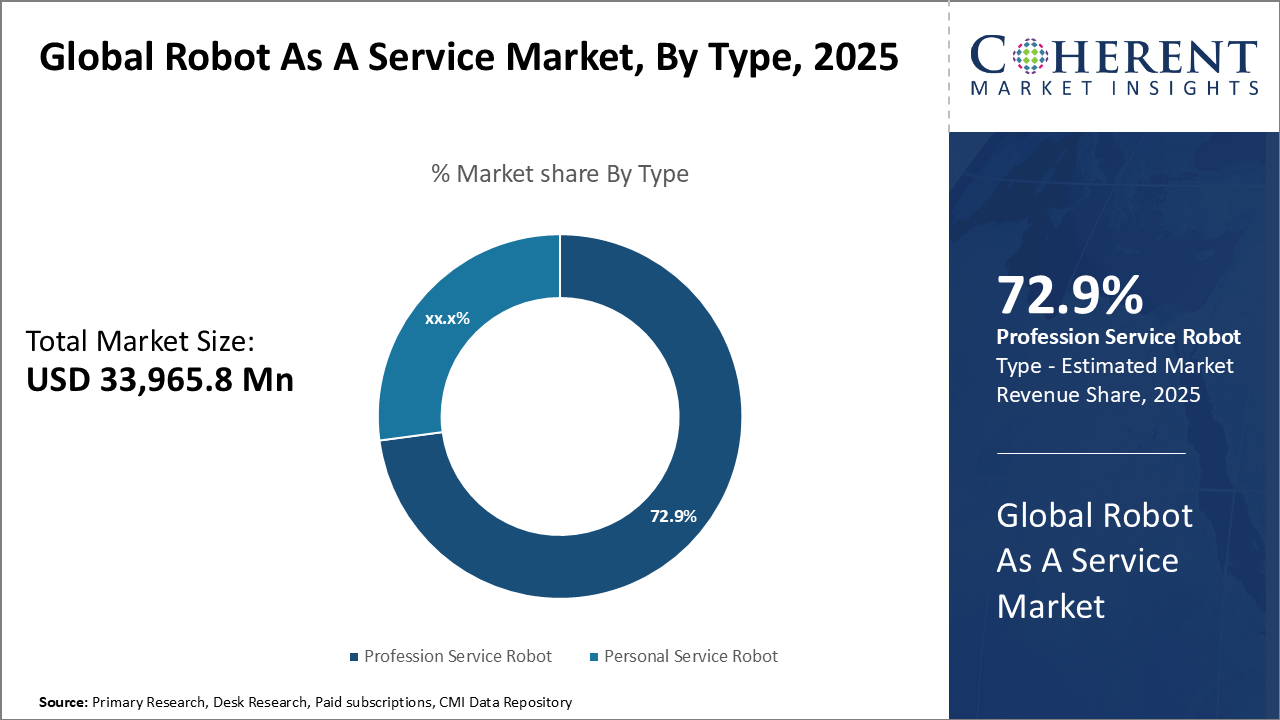
Robot As A Service Market Insights, By Type: Professional Service Robot Remains Highly Sought-after Type
The professional service robot segment is expected to lead the global robot as a service market with a dominant 73.9% share in 2026. This is mostly due to rising adoption of automation across manufacturing and logistics sectors.
Professional service robots are increasingly deployed to perform critical industrial tasks such as material handling, assembly, inspection, and machine tending. Their integration helps businesses boost productivity, improve operational efficiency, and enhance workplace safety.
Mobile robots and collaborative robots (cobots) are witnessing strong demand across various industries. This is due to their ability to streamline workflows and work alongside human operators.
A good example of this is the recent partnership between GXO and Agility Robotics. In June 2024, the logistics company GXO signed a multi-year agreement with Agility Robotics to use the humanoid robot Digit in its logistics operations. This agreement claimed to be both the industry’s first formal commercial deployment of humanoid robots and first Robots-as-a-Service (RaaS) deployment of humanoid robots.
Mobile robots enable autonomous material transport across production lines, reducing reliance on manual labor for repetitive tasks as well as improving layout flexibility. Meanwhile, cobots are gaining traction thanks to their ease of use, safety features, and ability to augment human workers in complex or ergonomically risky operations.
As factories move toward just-in-time manufacturing and mass customization, logistics and material-handling robots are playing a key role in ensuring timely inventory movement and reducing production disruptions. The versatility and operational benefits offered by professional service robots are expected to reinforce their dominant position in the robot-as-a-service market.
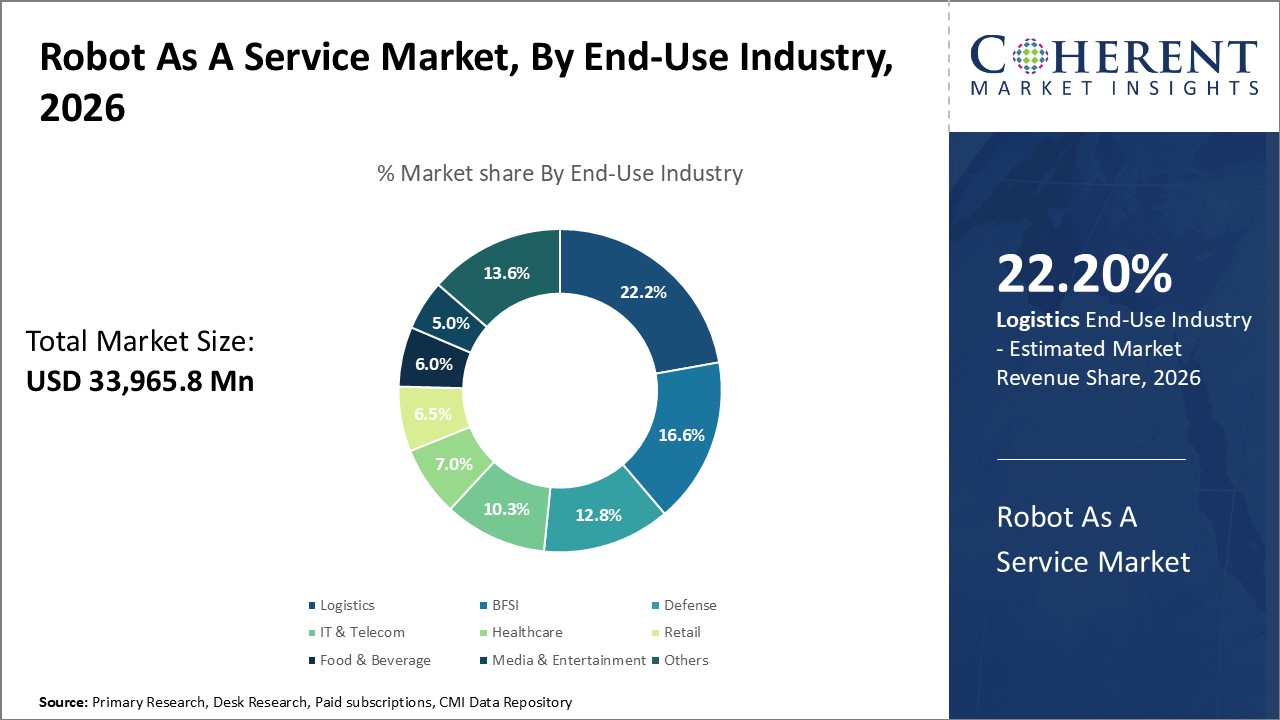
Robot As A Service Market Insights, By End-Use Industry: Logistics Leads Due to E-Commerce-Driven Automation Needs
As per Coherent Market Insights’ latest robot as a service market report, logistics segment is set to dominate market during the forecast period. This can be attributed to rapid expansion of e-commerce and the growing need for efficient, automated fulfillment solutions.
Robotics technologies are increasingly deployed in logistics operations to streamline warehouse processes such as picking, sorting, transporting, and packaging. Autonomous mobile robots (AMRs) and robotic arms are widely used to accelerate throughput, reduce errors, and operate continuously without the limitations of manual labor. These robots enhance productivity as well as enable scalable operations in high-volume distribution centers.
Rise of fast delivery expectations has also increased the adoption of robotics in last-mile logistics, with pilot programs testing autonomous delivery robots to improve delivery efficiency. As e-commerce volumes continue to surge and supply chains become more complex, demand for robotics-enabled logistics solutions is expected to remain strong during the forthcoming period.
Regional Insights
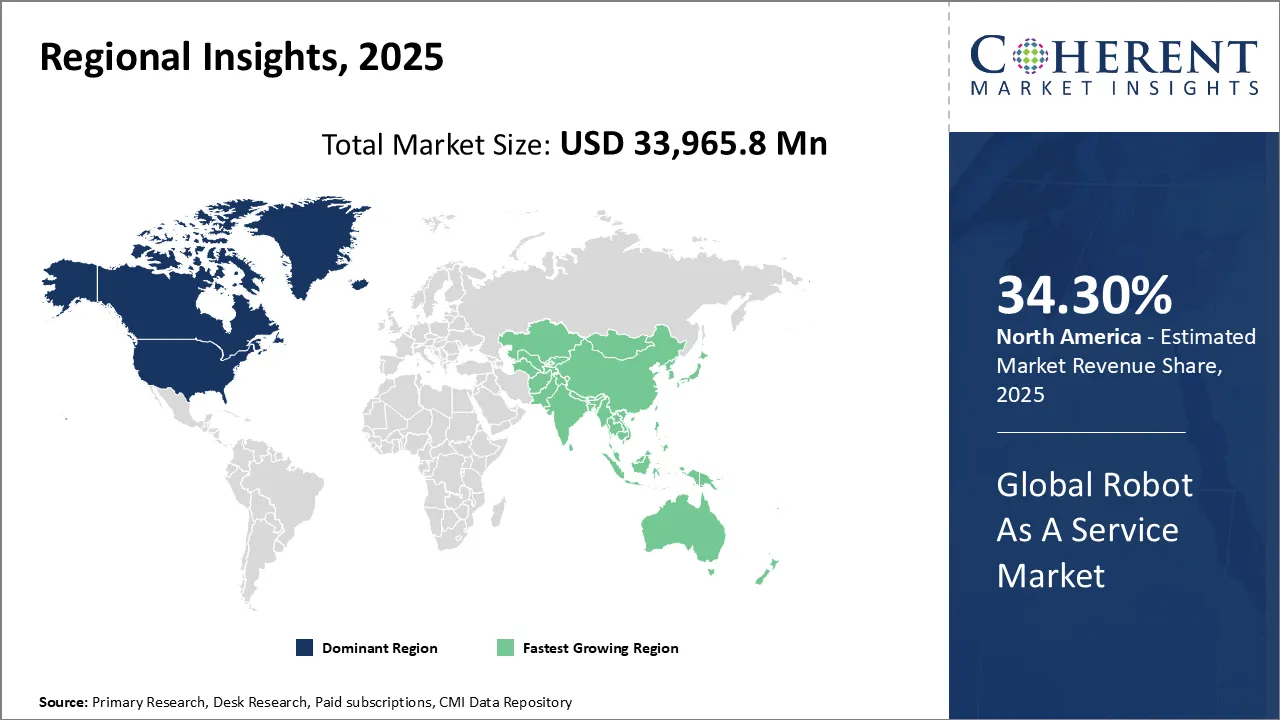
North America Remains at the Epicenter of Robot as a Service Market Growth
North America is expected to dominate the global robot-as-a-service market with a 34.3% share in 2026. This is attributable to a strong ecosystem of robotics innovation, advanced industrial automation, and a mature technology infrastructure.
The region benefits from the presence of leading robotics companies and startups that are driving the development and commercialization of RaaS solutions. For instance, Brightpick unveiled Autopicker 2.0, an advanced version of its flagship multi-purpose AI robot, in June 2026.
Rising labor costs and growing need for flexible automation are prompting businesses in logistics, healthcare, and manufacturing to favor subscription-based robotics models. This shift allows companies to access advanced robotic solutions without the burden of large upfront capital investments.
Additionally, North America’s early adoption of emerging technologies, including collaborative robots and AI-enabled automation, continues to accelerate RaaS deployment across various industries. These factors position North America as a central hub for RaaS innovation and implementation in the global market.
Asia Pacific Robot As A Service Market Outlook
Asia Pacific is poised to be emerge as a highly lucrative pocket for robot as a service market companies during the forecast period. This is attributable to rapid industrialization, rising labor costs, and increasing demand for automation across key economies such as China, Japan, South Korea, and India.
China continues to lead in industrial robotics production, with significant public and private investments in AI and automation technologies. Meanwhile, countries like India and Southeast Asian nations are experiencing rising demand for robotic solutions as businesses seek to enhance productivity and offset workforce shortages.
Robot providers are localizing offerings and adopting flexible pricing models, including pay-per-use, to improve accessibility and adoption across cost-sensitive markets. With favorable government initiatives and a strong push for digital transformation, Asia Pacific is expected to be a major growth engine for the Robot-as-a-service market in the years ahead.
Robot As A Service Market Outlook – Country-wise
U.S. Robot as a Service Market Trends
The United States is anticipated to account for a prominent global market share of 29.5% in 2026. This can be attributed to the country's robust technology ecosystem, advanced industrial infrastructure, and strong focus on automation.
Presence of leading robotics firms and tech innovators, along with a mature base of early adopters across manufacturing, healthcare, logistics, and retail sectors, supports continued growth in subscription-based robotic solutions. Market expansion is also fueled by rising labor costs, workforce shortages, and the increasing need for operational flexibility.
Businesses are turning to RaaS to reduce upfront capital investment, increase scalability, and access cutting-edge robotics integrated with AI and machine learning. The model allows companies to optimize productivity while outsourcing maintenance, upgrades, and technical support to service providers.
With a well-developed network of R&D institutions, supportive policy frameworks, and high digital readiness, the U.S. continues to lead in the commercialization and deployment of service and collaborative robots. Growing demand for warehouse automation, autonomous delivery solutions, and surgical robotics is expected to further solidify the U.S. as a global hub for RaaS innovation and adoption.
China Robot As A Service Market Forecast
China is slated to hold 11.1% of the global robot as a service industry share in 2026. This is mainly due to the country’s strong focus on industrial automation and smart manufacturing.
The Chinese government has been actively promoting robotics adoption through initiatives like “Made in China 2026”. These initiatives encourage factories to use robots to improve efficiency and reduce labor costs. Many local manufacturers are also turning to RaaS models because they allow companies to use advanced robots without making large upfront investments.
Another major growth driver is the expanding use of service robots in sectors like healthcare, logistics, and retail. For example, delivery robots and cleaning robots are becoming more common in Chinese cities, while hospitals are increasingly adopting robotic assistance for patient care and disinfection.
Robot As A Service Industry News
- In August 2025, Primech AI signed an MOU with Savills Property Management Ltd. to expand the reach of its HYTRON autonomous bathroom cleaning robot in Greater China. The partnership focuses on building strong distribution, market growth, and scalable Robotics-as-a-Service (RaaS) models to support sustainable facility automation.
- In July 2025, ABB expanded its portfolio with three new robot families to support China’s expansion in advanced manufacturing. These new robotic solutions will help the company meet growing automation needs as well as strengthen its robotics leadership in the country.
- In June 2025, Primech AI Pte. Ltd. partnered with Hong Kong-based ReMining Ai Ltd to bring its advanced HYTRON autonomous bathroom cleaning robot to the Hong Kong market.
Market Report Scope
Robot As A Service Market Report Coverage
| Report Coverage | Details | ||
|---|---|---|---|
| Base Year: | 2025 | Market Size in 2026: | USD 33,965.8 Mn |
| Historical Data for: | 2020 To 2024 | Forecast Period: | 2026 To 2033 |
| Forecast Period 2026 to 2033 CAGR: | 21.6% | 2033 Value Projection: | USD 1,31,723.5 Mn |
| Geographies covered: |
| ||
| Segments covered: |
| ||
| Companies covered: | ABB, Aethon, Bastian Solutions, LLC, Boston Dynamics, CYBERDYNE INC., Daifuku Co., Ltd., DeLaval, Dematic, DJI, ecoRobotix Ltd, Hitachi, Ltd., Intuitive Surgical, KONGSBERG, KUKA AG, Lely, Neato Robotics, Inc., Northrop Grumman, OMRON Corporation, Parrot Drone SAS, SoftBank Robotics, Starship Technologies | ||
| Growth Drivers: |
| ||
| Restraints & Challenges: |
| ||
Market Drivers
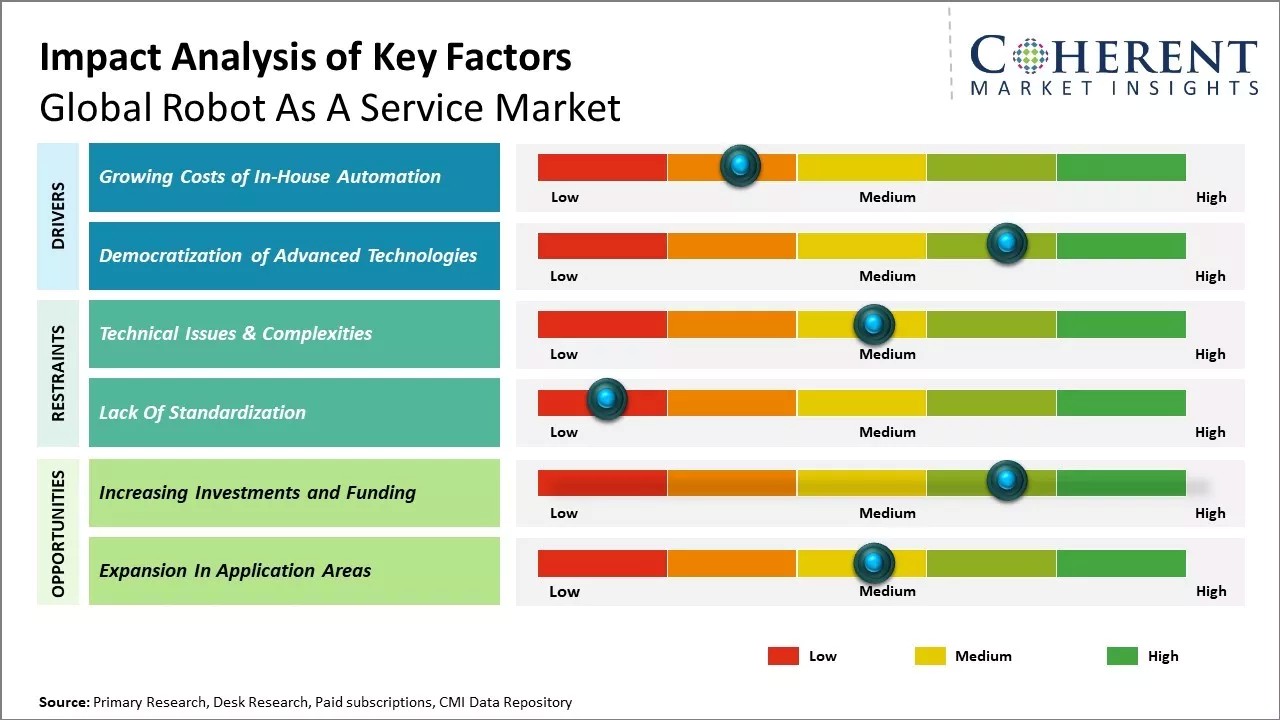
Growing Costs of In-house Automation
Large manufacturing firms and businesses have traditionally faced high capital expenses to automate in-house processes. Upfront investments in robotic equipment, tools, and programming require extensive planning, often months or years ahead. Additionally, ongoing costs for maintenance teams and technical support add to the fixed operational burden, limiting companies’ ability to swiftly adapt to shifting market demands.
Robot-as-a-Service providers are addressing these challenges by offering scalable, flexible automation through an operational expenditure model. Instead of owning costly robotic assets, businesses can outsource automation needs and pay only for actual usage hours. Service providers remotely manage maintenance and upgrades, freeing businesses from staffing and upkeep complexities.
For example, in April 2020, Japan-based company UBTECH Robotics introduced medical robots for body temperature monitoring and disinfection in hospitals. Such innovations, combined with rising automation demand across sectors including logistics, manufacturing, healthcare, and retail, have significantly boosted the adoption of RaaS solutions globally.
Global Robot As A Service Market Trends
Growing Infrastructure for Green Hydrogen
The aviation industry is working on new technologies to build the first zero-emission commercial aircraft. One major step in this direction is the use of green hydrogen, which helps reduce carbon emissions.
Many governments and companies are investing in green hydrogen projects, such as hydrogen production plants and refueling stations. These growing investments are expected to boost the global robot-as-a-service market growth in the coming years.
Robot As A Service Market Opportunity –Increasing Investments and Funding
Rising investments and funding from both private and public sectors are significantly accelerating innovation in robotics. They are also expanding the viability of robot-as-a-service models.
Capital inflows are enabling companies to develop more affordable, flexible, and intelligent robotic solutions, while allowing businesses to access these technologies without incurring high upfront costs. This shift is making robotics more accessible to small and medium enterprises, supporting broader adoption across diverse industries.
In December 2024, Robonnement raised US$ 15 million in asset-based financing to expand its RaaS platform across Europe. The funding is being used to scale its robotic fleet and onboard new integrators, allowing SMEs in countries such as Switzerland, Germany, and Austria to rent robotic solutions through subscription models rather than making capital purchases. This demonstrates the growing investor confidence in the scalability and future potential of the robot as a service market.
Analyst Opinion (Expert Opinion)
- The robot-as-a-service market is rapidly transitioning from a niche automation model to a widely used business solution. This change is mainly driven by the growing need for flexibility, scalability, and efficiency in industries dealing with labor shortages, high capital costs, and rising productivity demands.
- Professional service robots are setting the pace, particularly in logistics and manufacturing. These robots are no longer limited to predefined, rigid tasks. With the infusion of AI and edge computing, they can now operate with adaptive intelligence, handling tasks like material transport, inspection, and pick-pack-ship with minimal human input. Their increasing use in busy places like warehouses and hospitals shows the move toward more autonomy, teamwork, and continuous learning.
- North America is a mature, innovation-heavy market where early adoption is driven by labor economics and an established tech ecosystem. However, Asia Pacific, particularly China and South Korea, is emerging as a strategic growth engine. Their focus on AI-native robotics, government-driven automation roadmaps, and localized RaaS platforms is accelerating deployments across both industrial and service sectors.
- The market is still moderately consolidated, with global leaders like ABB, FANUC, and SoftBank Robotics in the lead. However, regional players and specialized companies are gaining ground through innovation, affordability, and customization. The next phase of competition will focus on platform compatibility, AI-based features, and wide service integration — not just hardware.
Speak to the analyst
Want personalized insights?
Take the findings above to one of our principal consultants, or have the report rebuilt around the segments, geographies and competitors you actually track.
Market Segmentation
- Type Insights (Revenue, US$ Mn, 2026 - 2033) (Revenue, USD Mn, 2021 - 2033)
- Professional Service Robot
- Personal Service Robot
- End-Use Industry Insights (Revenue, US$ Mn, 2026 - 2033) (Revenue, USD Mn, 2021 - 2033)
- IT & Telecom
- BFSI
- Defense
- Logistics
- Healthcare
- Retail
- Food & Beverage
- Media & Entertainment
- Others
- Regional Insights (Revenue, US$ Mn, 2026 - 2033) (Revenue, USD Mn, 2021 - 2033)
- North America
- U.S.
- Canada
- Latin America
- Brazil
- Argentina
- Mexico
- Rest of Latin America
- Europe
- Germany
- U.K.
- Spain
- France
- Italy
- Russia
- Rest of Europe
- Asia Pacific
- China
- India
- Japan
- Australia
- South Korea
- ASEAN
- Rest of Asia Pacific
- Middle East & Africa
- GCC Countries
- Israel
- South Africa
- Rest of Middle East & Africa
- Key Players Insights
- ABB
- Aethon
- Bastian Solutions, LLC
- Boston Dynamics
- CYBERDYNE INC.
- Daifuku Co., Ltd.
- DeLaval
- Dematic
- DJI
- ecoRobotix Ltd
- Hitachi, Ltd.
- Intuitive Surgical
- KONGSBERG
- KUKA AG
- Lely
- Neato Robotics, Inc.
- Northrop Grumman
- OMRON Corporation
- Parrot Drone SAS
- SoftBank Robotics
- Starship Technologies
Sources
Primary Research Interviews
- Industry experts, robotics engineers, automation system integrators, technology vendors, end-use industry representatives (manufacturing, logistics, healthcare, defense), academic researchers, and robotics startup founders.
Databases
- IEEE Xplore, ScienceDirect, Statista, World Bank Data, International Federation of Robotics (IFR) Database, Eurostat, and U.S. Bureau of Labor Statistics.
Magazines
- Robotics Business Review, Automation World, Manufacturing Automation, Robotics Tomorrow, and Control Engineering.
Journals
- Journal of Field Robotics, IEEE Transactions on Robotics, International Journal of Robotics Research, Robotics and Autonomous Systems, and Advanced Robotics.
Newspapers
- The Wall Street Journal, The Guardian, The New York Times, Financial Times, and The Economic Times.
Associations
- International Federation of Robotics (IFR), Robotics Industries Association (RIA), Association for Advancing Automation (A3), European Robotics Association (euRobotics), and Japan Robot Association (JARA).
Public Domain Sources
- World Robotics Reports (IFR), U.S. Patent and Trademark Office (USPTO), European Patent Office (EPO), National Institute of Standards and Technology (NIST), and company annual reports and press releases.
Proprietary Elements
- CMI Data Analytics Tool, Proprietary CMI Existing Repository of information for last 8 years.
Get access to 250+ pages report
Every segment, forecast, competitor profile and data table behind the analysis above — available for instant download.
- ESOMAR Member
- ISO 9001:2015 Certified
- D-U-N-S Registered
- GDPR & CCPA Compliant
Missing comfort of reading report in your local language? Find your preferred language:
Transform your Strategy with Exclusive Trending Reports
Frequently Asked Questions
The global market is estimated to be valued at USD 33,965.8 Mn in 2026.
Global robot as a service demand is expected to rise at 21.6% CAGR from 2026 to 2033.
The global robot as a service market value is projected to surpass US$ 1,31,723.5 Mn by 2033.
Technical issues & complexities, and lack of standardization are the major factors hampering the growth of the global robot as a service market.
Key players in the robot-as-as-service market include ABB, Aethon, Bastian Solutions, LLC, Boston Dynamics, CYBERDYNE INC., Daifuku Co., Ltd., DeLaval, Dematic, DJI, ecoRobotix Ltd, Hitachi, Ltd., Intuitive Surgical, KONGSBERG, KUKA AG, Lely, Neato Robotics, Inc., Northrop Grumman, OMRON Corporation, Parrot Drone SAS, SoftBank Robotics, Starship Technologies.
North America is expected to dominate the global market during the forecast period.
Professional service robot dominates the overall market