The wider market is being supported by the growth of online shopping, higher expectations for delivery speed, and the increasing use of third-party fulfillment services. Coherent Market Insights also identifies warehousing and storage, bundling, shipping, and other fulfillment services as major service areas within the market.
The growth is also being shaped by a few clear trends. First, more ecommerce businesses are outsourcing fulfillment instead of building warehouses and shipping operations themselves. This allows smaller and growing brands to use established logistics infrastructure without making the same level of upfront investment.
Second, fulfillment centers are becoming more technology-driven. Automation, inventory systems, real-time tracking, and other digital tools are helping providers process orders more quickly and accurately. This matters as online shoppers expect shorter delivery times and better visibility after placing an order.
Third, businesses are looking for more flexible fulfillment models. On-demand fulfillment, smaller inventory commitments, bundled products, and services that can scale with order volume make it easier for brands to test new products without immediately building a large logistics operation.
That is the model behind Supliful. The company describes itself as brand-building infrastructure that handles manufacturing, fulfillment, and shipping while businesses focus on their products, pricing, customers, and growth. Its current platform is designed around on-demand fulfillment, meaning businesses don't have to purchase large quantities of inventory before they can start testing a product line.
What Actually Goes Into Running Product Fulfillment?
When customers see a product online, they primarily see the front end of the business.
That includes:
- The brand
- Product design and packaging
- Ecommerce store
- Product descriptions
- Pricing
- Marketing
- Customer experience
Behind that is a second layer of operations.
Every order may require inventory management, order verification, product picking, labeling, packing, shipping, tracking, and inventory replenishment.
This is also where shipping fulfillment services become important. In the e-commerce fulfillment services market, shipping fulfillment services were the largest service type, accounting for 40% of market revenue in 2026. These services cover the movement of completed orders from the fulfillment facility to the customer and are especially important for online brands that want to offer reliable delivery without managing carrier operations themselves. For growing product brands, using a fulfillment partner can make it easier to handle increasing order volumes while keeping the customer experience consistent.
If a company manages all of these activities internally, it may need warehouse space, employees, inventory systems, packaging materials, carrier relationships, and processes for keeping products available as demand changes.
That infrastructure can make sense for an established brand with predictable volume. But it can be disproportionate for a business launching its first few products.
This is why separating brand ownership from fulfillment ownership can be useful.
A company can remain responsible for the parts customers actually associate with the brand while using a specialized partner to manage the operational layer.
This model also fits the broader structure of the e-commerce fulfillment services market. The market is divided by service type into warehousing and storage fulfillment services, bundling fulfillment services, shipping fulfillment services, and others. It is also segmented by application, sales channel, organization size, and region.
Applications include automotive, beauty and personal care, books and stationery, consumer electronics, healthcare, clothing and footwear, home and kitchen, sports and leisure, and others. Sales channels include direct to customer, business to customer, and business to business, while organization size covers SMEs and large enterprises.
Why Ecommerce Operators Outsource Fulfillment
Outsourcing fulfillment isn't simply about avoiding warehouse work. For many businesses, it is a way to allocate capital and attention toward activities that directly influence growth.
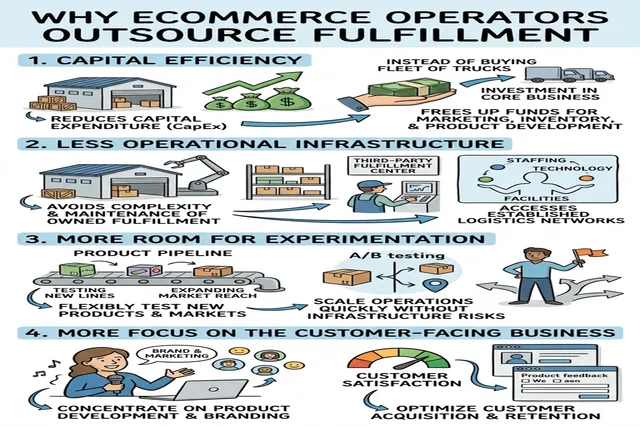
Capital efficiency
Buying inventory in advance means committing cash before the corresponding products have been sold.
An on-demand model changes that timing. With Supliful, businesses can sell products without holding the same level of upfront inventory. The company says its model allows merchants to pay for product fulfillment when orders are placed rather than purchasing large quantities of inventory in advance.
Less operational infrastructure
A business doesn't necessarily need to establish its own warehouse, packing operation, or inventory-management system before testing a product line.
More room for experimentation
If the operational burden of adding another SKU is relatively low, a brand can test additional products without making every new launch a major logistics project.
More focus on the customer-facing business
The operator can spend more time on positioning, acquisition, content, partnerships, retention, and product strategy.
There is an important qualification, however: outsourced fulfillment isn't automatically the cheapest option at every scale. High-volume businesses may eventually find that bulk purchasing or internal fulfillment produces better unit economics. The right approach depends on sales volume, margins, capital availability, operational capabilities, and growth plans.
The objective is not to outsource everything indefinitely. It is to avoid building infrastructure before the business actually needs it.
The same idea is reflected in the growth of the SME segment in the wider fulfillment market. Smaller businesses often use fulfillment providers because they can access warehousing, shipping, and inventory support without making a large investment in their own logistics network. GVR expects the SME segment to grow at a strong pace as more smaller businesses sell through digital channels.
Meet Supliful: The Infrastructure Behind the Brand
Supliful was created around a relatively simple problem: entrepreneurs could use on-demand infrastructure to build personalized physical products in some categories, but similar infrastructure wasn't readily available for consumer packaged goods.

The company's origins go back to Grafomap, an earlier ecommerce business founded by Supliful's team that produced personalized map posters on demand. According to Supliful's account of its history, the founders later wanted to build a consumer wellness brand and found that they could not find a similar on-demand supplier for supplements. That gap became the starting point for Supliful.
Today, Supliful positions itself as infrastructure for businesses building consumer brands rather than simply as a traditional supplier. Its platform handles manufacturing, fulfillment, and shipping while the merchant controls the customer-facing brand.
The company currently says it has seven U.S. locations across six states, has fulfilled more than 2 million partner-brand orders, shipped more than 600,000 items globally, and generated more than US$70 million in revenue through the platform. These are company-reported figures and are included as context rather than as independently verified market statistics.
Supliful's current offering also shows how fulfillment providers are moving beyond basic warehousing and shipping. The company offers private-label products, store integrations, automated fulfillment as well as U.S.-based fulfillment, allowing brands to connect the operational side of their business with their ecommerce storefront.
From Startup Idea to Product Infrastructure
Supliful's growth provides some useful context for how the business has evolved.
The company was founded in October 2021. Its early milestones included launching dietary supplements in the United States, adding private-label coffee, launching its Shopify integration, and opening its first warehouse in Denver.
According to the company's published timeline
- 2022: Supliful closed a $2 million seed round, surpassed 10,000 registered users, recorded more than $2.5 million in GMV across customer brands, and expanded its catalog beyond supplements.
- 2023: The company reports 5.6× revenue growth, more than $7.2 million in GMV, international shipping, more than 200,000 orders shipped, and the launch of its Production Partner Program.
- 2024: Supliful reports shipping more than 500,000 products, expanding its catalog with more than 100 on-demand products, and moving into a larger Denver warehouse.
- 2025: The company reports reaching $9.9 million in trailing-twelve-month net revenue, sustained profitability, more than 500 creator brands launched, and the introduction of self-serve Fulfillment by Amazon.
The significance of this progression is less about any individual milestone and more about the direction of the business.
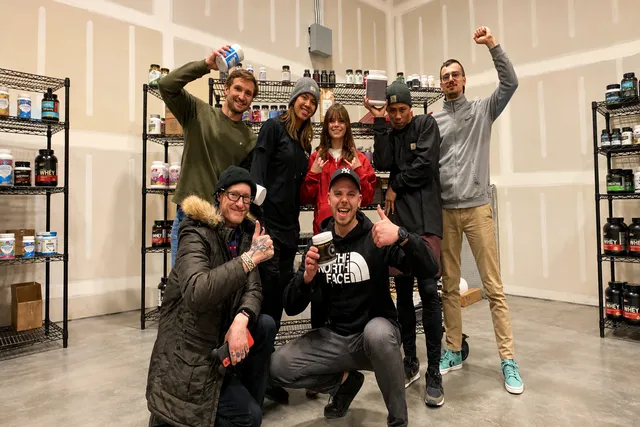
Supliful started with a focus on on-demand consumer products and has expanded toward a broader infrastructure model for brands that want to launch and scale physical products without building the entire supply chain themselves.
This shift reflects a wider change in ecommerce fulfillment. Fulfillment providers are increasingly expected to support more than storage. They may also handle bundling, labeling, order processing, returns, shipping, and technology integration. GVR includes these services within its broader market definition.
How Supliful's Fulfillment Model Works
The process is designed to keep the brand owner focused on the customer-facing business while Supliful handles the physical order.
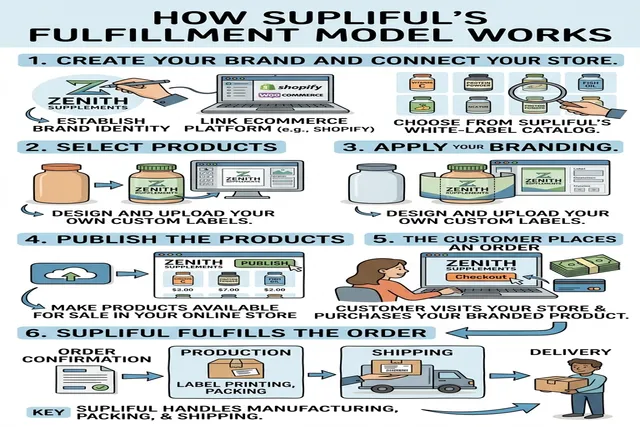
1. Create your brand and connect your store
A new Supliful account starts on the Free plan. Users can build their brand, customize product labels, connect a store, and publish their branded products before upgrading to a selling plan.
Shopify is one of the supported ecommerce platforms, and Supliful currently also lists integrations with other ecommerce channels.
2. Select products
The merchant chooses products from Supliful's catalog that fit the intended product line.
The catalog has expanded beyond the company's original supplement focus and now covers supplements, skincare, coffee, wellness products, and other categories.
3. Apply your branding
Instead of selling an unbranded catalog item, the merchant can upload label files and customize the product presentation.
Supliful provides label templates and allows merchants to set their own retail prices.
This distinction matters.
The objective isn't simply to sell someone else's product. The objective is to create a product that fits into your brand.
4. Publish the products
Once products have been customized, they can be published to the connected ecommerce store.
The customer sees the product as part of the merchant's product line.
5. The customer places an order
The customer purchases through the merchant's store and pays the retail price established by the merchant.
Supliful then receives the order information automatically.
6. Supliful fulfills the order
Supliful handles the physical process: verifying the order, picking the product, applying the custom label, preparing the package, and shipping it to the customer.
The company states that packages are shipped using the merchant's store name as the sender, keeping the customer-facing experience centered on the merchant's brand.
The result is a simple division of responsibilities:
You build the brand. Supliful runs the fulfillment infrastructure behind it.
What Does "Without Running Fulfillment" Actually Mean?
Outsourcing fulfillment doesn't mean outsourcing the business.
The brand owner still controls the decisions that determine whether the product line succeeds:
- Product selection
- Brand positioning
- Pricing
- Storefront
- Marketing
- Customer acquisition
- Customer relationships
- Product strategy
- Distribution
Supliful handles the operational layer required to turn an online order into a physical product delivered to the customer.
That distinction is important because fulfillment is infrastructure, not a substitute for product-market fit.
A great fulfillment operation cannot make an irrelevant product successful. It can, however, remove some of the operational complexity that stands between an operator and a new product launch.
How Supliful's Pricing Model Works
Understanding fulfillment economics is essential before launching any product line.
Supliful's current pricing structure varies according to membership plan and order volume for each SKU. Its published pricing information states that product pricing can change based on the membership plan and the previous 30-day order volume for the product.
The company also separates different components of the cost, including:
- Product cost
- Fulfillment fee
- Processing fee
- Shipping fee
This makes it possible to calculate the economics of a product before deciding how aggressively to scale it.
For an operator, the basic calculation remains:
Retail price − product and fulfillment costs − shipping − acquisition costs = contribution margin
Supliful also supports bulk ordering when a business has a reason to hold physical inventory. This can be useful when a company wants to stock another location or prepare for larger-volume requirements.
That gives businesses more than one operational path as their needs change.
When Does Outsourced Fulfillment Make the Most Sense?
The model can be particularly useful for businesses that already have distribution but don't want to build manufacturing and fulfillment infrastructure from scratch.
The need for outsourced fulfillment is not limited to supplements or wellness products. Different product categories have different fulfillment requirements. Clothing and footwear accounted for 27% of the market in 2026. These products can involve multiple sizes, colors, styles, and SKUs, making inventory tracking, picking, packing as well as returns more demanding as an online brand grows. Fulfillment partners can help brands manage this operational workload while they focus on product selection, marketing, and customer relationships.
Existing ecommerce brands
An established ecommerce business may have customers and acquisition channels but want to expand into a new product category.
Creators with an established audience
A creator can use an existing audience as distribution for a branded product line instead of relying entirely on third-party products.
Health and wellness professionals
Coaches, practitioners, trainers, and other professionals may have expertise and customer relationships that can support a product line without wanting to become manufacturers.
Operators testing new products
Businesses can use on-demand fulfillment to test demand before deciding whether larger inventory commitments make economic sense.
Brands expanding their catalog
A fulfillment partner can make it easier to add SKUs without increasing internal warehouse operations at the same rate.
This is consistent with Supliful's own positioning around "builders": people who already have something to build-an audience, expertise, customer base, or distribution channel-and need infrastructure to support the next stage.
This is also where the broader direct-to-customer and business-to-customer fulfillment segments become relevant. Direct-to-customer services support brands selling through their own websites and platforms, while business-to-customer fulfillment supports online retailers and marketplaces selling directly to individual shoppers. Both models benefit from fulfillment services that can handle smaller orders efficiently and connect with digital storefronts.
What You Still Need to Own as a Brand
The most important thing to understand is that outsourcing fulfillment doesn't eliminate the hard part of building a product business.
You still need to answer:
Who is this product for?
Why should they buy it?
Why should they buy it from your brand?
What price makes sense?
How will you acquire customers?
What makes them come back?
Those decisions remain with the brand owner.
Supliful provides the infrastructure that makes the physical product available and gets it to the customer. The competitive advantage still comes from the brand, positioning, audience, expertise, distribution, and customer relationship built around that infrastructure.
That is why the distinction between supplier and brand-building infrastructure matters.
What Happens as Your Product Line Grows?
An outsourced fulfillment model doesn't necessarily mean remaining at a small scale.
Supliful's current pricing system is designed around product-level sales volume. Its pricing tiers use recent order volume for each product, while membership plans determine the pricing available to sellers.
The platform also supports bulk ordering when a business has a reason to hold physical inventory, such as stocking another warehouse or preparing for a large event.
This creates a useful progression
Test on demand → identify products that sell → increase volume → evaluate better pricing and operational options.
The business doesn't have to decide on day one exactly how its fulfillment operation will look at its eventual scale.
The broader market shows a similar need for scalable services. Large enterprises currently account for the largest share of e-commerce fulfillment services, but SMEs are expected to grow strongly as smaller online businesses look for flexible logistics without major infrastructure investment.
The U.S. particularly remains a key market for e-commerce fulfillment services, accounting for a global market share of nearly 18% in 2026. Rising online sales, the need for faster delivery, and the use of digital fulfillment systems are supporting demand. Shipping fulfillment is currently the largest service type in the U.S., while bundling fulfillment services is expected to grow quickly.
This market environment gives brands more choices in how they structure fulfillment. A small business can start with an outsourced provider, while a larger company can combine third-party fulfillment with its own warehouses and distribution network.
Building a Product Brand Without Building a Warehouse
Owning a product brand doesn't require owning every physical component of the supply chain.
A modern product business can divide the operation into two layers.
The brand owner controls
- Brand identity
- Product selection
- Positioning
- Pricing
- Marketing
- Audience
- Customer relationships
- Growth strategy
The fulfillment infrastructure handles
- Manufacturing
- Product preparation
- Order processing
- Packing
- Shipping
- Inventory operations
Supliful was built around this separation. Its founders experienced the advantages of an on-demand model through their previous ecommerce company and then applied the same concept to consumer packaged goods when they couldn't find an equivalent solution for their own product ambitions.
Today, the company reports more than 2 million partner-brand orders fulfilled, more than 600,000 items shipped globally, and more than $70 million in revenue generated through the platform. These figures are reported by Supliful.
For an ecommerce operator, the practical takeaway is straightforward: you don't necessarily need to build a warehouse, hire a fulfillment team, or purchase large quantities of inventory before finding out whether customers want your product.
You can build the customer-facing business first and use fulfillment infrastructure to support it.
If you already have an audience, ecommerce store, or customer base, Supliful provides a way to explore a branded product line while keeping manufacturing and fulfillment outside your day-to-day operation. The platform lets businesses build and customize products, connect their store, and use on-demand fulfillment as they begin selling.

