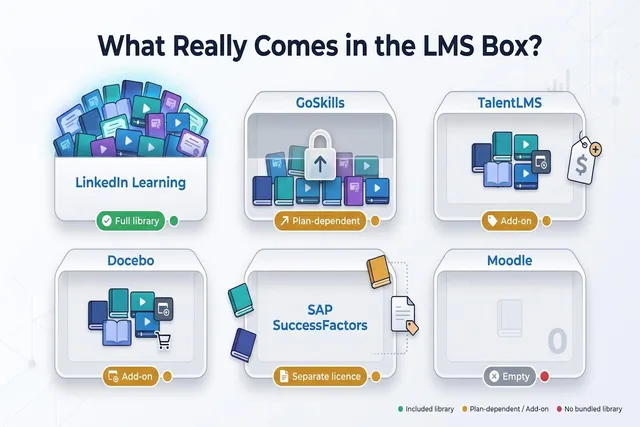
However, selecting an LMS involves more than comparing its available features. Organizations must also know if a platform provides ready-made courses, supports internally developed training materials, give useful reporting tools, fits within their technology budgets, etc. For example, GoSkills provides an LMS comparison that helps show how platform plans can differ in terms of course libraries as well as learning management features.
Some platforms include learning content within selected subscriptions, on the other hand some charge separately for course libraries or advanced capabilities. These differences make platform selection an important consideration for businesses investing in employee training and development.
What Are the Key Trends in the Learning Management System Market?
Major trends shaping the Learning Management System Market are growing cloud adoption, multichannel and mobile learning, as well as the inclination towards upskilling intelligent skills. These advancements are changing what organizations expect from learning platforms, like how training is delivered, accessed, measured, etc.
Growing Adoption of Cloud-Based Learning Platforms
Cloud technology is making it more attractive for organizations to use digital learning without having extensive internal infrastructure. Employees can avail training materials through internet-connected devices, at the same time administrators can manage courses, assignments, as well as learner records with a centralized platform.
This approach is particularly useful for businesses with multiple offices, remote employees, geographically distributed teams, etc. It also lower the need for organizations to manage software updates and maintain their own learning infrastructure.
As businesses looking for flexible as well as accessible training solutions, cloud-based platforms are becoming a major part of the LMS industry. Their ability to support different groups of learners and provide access across locations is also supporting wider adoption.
Multichannel and Mobile Delivery Widens Learning Access
CMI's report identifies multichannel learning as an important factor supporting the growth of the global Learning Management System Market. This approach combines mobile applications, web platforms, virtual classrooms, as well as social learning to make training accessible through different channels. Increasing smartphone usage along with wider internet access are also supporting this development, along with the growing use of personal devices for workplace activities.
These changes are creating demand for platforms that allow learners to avail training beyond traditional desktop environments. Employees working in different locations can use mobile devices or virtual classrooms to be connected with learning programmes. This is particularly useful for businesses that need to provide consistent training to employees working remotely.
As a result, organizations are paying high attention to mobile compatibility, internet-based access, as well as integration with existing workplace tools. LMS providers that support different learning channels can cater to the advancing requirements of educational institutions.
Intelligent Skills Development Moves Platforms Beyond Completion Tracking
Educational institutions are adopting interactive online learning ways to improve their teaching. CMI's report take this growing interest as another factor supporting market expansion. At the same time, organizations are going from basic course delivery to completion tracking toward learning platforms that support workforce development, compliance, personalized training, etc.
This is changing how businesses seek LMS solutions. At the same time, completion reports help organizations check training activities, connecting learning programmes with employee skills provides a full understanding of workforce development requirements.
This is why there is a growing need for platforms that can organise employee skills information, recommend learning paths, and connect training records with job requirements. These capabilities are increasingly critical for organisations looking to understand the skills gaps they have and prepare their employees for jobs that look different in the future.
What Are the Main Segments of the Learning
CMI's report divides the Learning Management System Market into several categories, including deployment model, application, delivery mode, user type, and industry vertical.
By deployment model: cloud and on-premises.
By application: content management, performance management, communication and collaboration, administration, learner management and other functions.
By delivery mode: distance learning, instructor-led training and other modes, and distance learning leads.
By user type: academic and corporate users.
By vertical: healthcare, retail, government, banking, financial services and insurance, manufacturing, IT and telecom, consulting and other sectors.
Sub-Segment Analysis of the Learning Management System Market
Corporate Segment
The corporate segment is expected to account for the largest share of the Learning Management System Market in 2026.
Growing demand for workforce development is an important factor supporting this position. Businesses need employees to regularly update their knowledge as job responsibilities, workplace technologies, industry requirements, etc., change.
Corporate LMS platforms help organizations plan training activities, assign courses according to job roles, as well as maintain records of employee participation. They can also lower the administrative work in handling training programmes.
The segment has applications across employee induction, leadership development, technical training, workplace safety, professional certification, etc. For companies with distributed teams, these platforms bring a consistent way to deliver training across a number of locations.
The availability of internally developed courses along with ready-made learning libraries is also important. Businesses can use their own materials for company-specific procedures at the same time providing external courses for communication, management, and technical skills. This growing need for organized employee training is expected to support the corporate segment's contribution to the overall market.
Distance Learning Segment
The distance learning segment is expected to lead the Learning Management System Market by delivery mode in 2026.
Its growth is being supported by the rising preference for flexible education and training methods that do not require the learners and instructors to be at the same location.
The escalating use of internet-enabled devices, cloud platforms, along with digital learning materials is making distance learning more accessible. Educational institutions use these solutions to conduct online classes, recorded lectures, assignments, assessments, etc. At the same time, businesses depend on distance learning to teach remote employees, launch new workplace policies, as well as support professional development in different locations.
Another important factor is the flexibility it provide to learners. Employees can access training materials around their work schedules, at the same time organizations can deliver consistent learning programmes to geographically distributed teams. This reduces dependence on physical training facilities and makes it easier to manage large groups of learners.
As remote education and workplace training continue to expand, distance learning is expected to remain an important contributor to the Learning Management System Market.
The United States Learning Management System Market
The United States learning management system market is stimulated by widespread corporate training requirements, established digital infrastructure, with continued investment in education technology. North America is projected to lead the global Learning Management System Market, accounting for an estimated 40% share in 2026. U.S. Businesses across healthcare, banking, financial services, manufacturing, information technology, etc., use LMS platforms to manage employee onboarding, compliance training, along with professional development. Educational institutions also rely on these systems to support online as well as hybrid learning programmes.
The high adoption of remote and hybrid working arrangements is further stimulating the use for platforms that make sure employees to have training from a number of locations. Organizations are also showing escalating interest in cloud-based learning, mobile access, AI-supported tools that ease course development as well as help identify employee skill gaps.
Another growth inducing factor is the need to maintain reliable training records, particularly in regulated industries. LMS platforms aid businesses assign mandatory courses, monitor completion, and maintain employee learning histories. These requirements are supporting continued demand for flexible learning solutions across the U.S. market.
Companies Leading the Learning Management System Market
The Learning Management System Market includes companies operating across enterprise software, digital education, and professional training. Key participants identified in CMI's report include Cornerstone OnDemand Inc., Xerox Corporation, IBM Corporation, NetDimensions Ltd., SAP SE, Blackboard Inc., SABA Software Inc., McGraw-Hill Companies, Pearson PLC, and D2L Corporation.
These companies serve different learning requirements through their software platforms, educational resources, and training management solutions. SAP SE and IBM Corporation participate in enterprise technology and workplace learning, at the same time Cornerstone OnDemand focuses on workforce development and learning management.
Pearson PLC and McGraw-Hill are related with educational content and learning resources, whereas D2L Corporation and Blackboard provide digital learning solutions for educational institutions.
The competitive environment also includes providers with different approaches to course delivery, content availability, and platform management. As organizations compare available solutions, factors such as ease of use, integration capabilities, reporting features, course access, and overall costs are becoming important considerations.
Conclusion and Outlook for the Learning Management System Market
The Learning Management System Market is inclining toward more connected as well as intelligent learning platforms. The high adoption of interactive online education, cloud-based delivery, and workforce development solutions is creating new opportunities for LMS providers.
Educational institutions are highly using digital platforms to create and distribute learning materials across websites, mobile devices, and virtual classrooms. in line with this, businesses are depending on these systems to manage employee training, monitor performance, and support professional development.
Course management, reporting, learner tracking, automated training activities, etc., are becoming a major feature for organizations looking to improve their learning processes. As market requirements continue to change, platforms that combine accessible content, flexible delivery, and useful learning insights are likely to remain relevant to both academic and corporate users.
Frequently Asked Questions
What is driving the learning management system market growth?
The market is supported by escalating use of smartphone, wider internet access, and the growing adoption of digital learning. Multichannel delivery through mobile applications, web platforms, virtual classrooms, and social learning is also encouraging demand.
How is virtual reality changing the learning management system market?
Virtual reality is opening up opportunities for more interactive training. It can support practical learning wit the help of simulated environments, particularly for technical training, workplace safety, as well as skill development.
Which region leads the learning management system market?
North America is projected to lead the global Learning Management System Market, accounting for an estimated 40% share in 2026.
Who are the leading learning management system companies?
Key companies include Cornerstone OnDemand, Xerox, IBM, NetDimensions, SAP SE, Blackboard, SABA Software, McGraw-Hill Companies, Pearson, and D2L.
What is the learning management system market forecast?
The market is estimated to reach USD 108.05 billion by 2033, registering a CAGR of 19.1% from 2026 to 2033.

