

Learning Management System Market Analysis & Forecast: 2026-2033
Learning Management System Market is estimated to be valued at USD 31.79 Bn in 2026 and is expected to reach USD 108.05 Bn in 2033, exhibiting a compound annual growth rate (CAGR) of 19.1% from 2026 to 2033.
Key Takeaways
- Based on Deployment Model, the Cloud-Based segment leads the market holding an estimated share of 77% in 2026, due to its scalability, remote access, and cost-efficiency.
- Based on Application, the Administration segment is expected to dominate with the largest share in 2026, due to rising demand for automated workflows, compliance tracking, and scalable operations.
- Based Delivery Mode, Distance Learning segment is expected to lead the market with the highest share in 2026, driven by remote education and global workforce needs.
- Based on User Type, the corporate segment is expected to account for the greatest share of the market in 2026, fueled by rising demand for employee training and compliance.
- Based on Vertical, the IT & Telecom segment is projected to capture the biggest share of the market in 2026, driven by its urgent need for continuous tech training and global workforce scalability.
- Based on Region, North America is projected to lead the global learning management system market in 2026 with 40% While, Europe is projected to be the fastest growing region.
Market Overview
The primary factor contributing to the expansion of the global market for learning management systems is the rising prevalence of gamification and virtual reality technology across a wide range of business sectors. Additionally, the rise of bring your own device (BYOD) culture in a variety of larger industries has contributed significantly to the global growth of the learning management system market. The adoption of a bring your own device culture by various corporate managements has increased as a result of its numerous benefits, including increased innovation and productivity, increased employee satisfaction and retention, and cost savings. These trends have collectively driven up learning management system market demand, positioning it as a vital tool for modern workforce development.
Current Events and their Impact on the Learning Management System Market
Current Event | Description and its Impact |
AI Integration and Government Mandates Reshaping Educational Technology |
|
Budget Constraints and Economic Pressures Driving Strategic LMS Investment |
|
Role of Artificial Intelligence (AI) in Learning Management System Market
In 2025, AI integration is a key catalyst for Learning Management System Market growth. AI-powered LMS platforms use machine learning and natural language processing to deliver personalized learning paths, adapt content to individual performance, and automate administrative tasks like grading and feedback. This enhances learner engagement and reduces instructor workload. AI also enables predictive analytics, helping institutions and businesses identify skill gaps and optimize training strategies. As digital transformation accelerates, AI-driven LMS solutions are becoming essential for scalable, intelligent, and outcome-focused education across academic and corporate sectors.
For instance, in July 2025, Instructure announced a global partnership with OpenAI to embed advanced AI capabilities into its learning platforms. The collaboration aims to personalize education, enhance engagement, and streamline content creation for educators and learners worldwide. This strategic move marks a significant step in integrating AI-driven experiences into modern digital learning ecosystems.
- Current Industry Events of 2026
- Market Size Estimation
- Regional Breakdown
- Competitive Landscape
- Customer Intelligence
- Segmental Analysis
- Pricing Analysis
- Key Market Drivers, Challenges & Future Trends
- Customized Insights Section
Segmental Insights
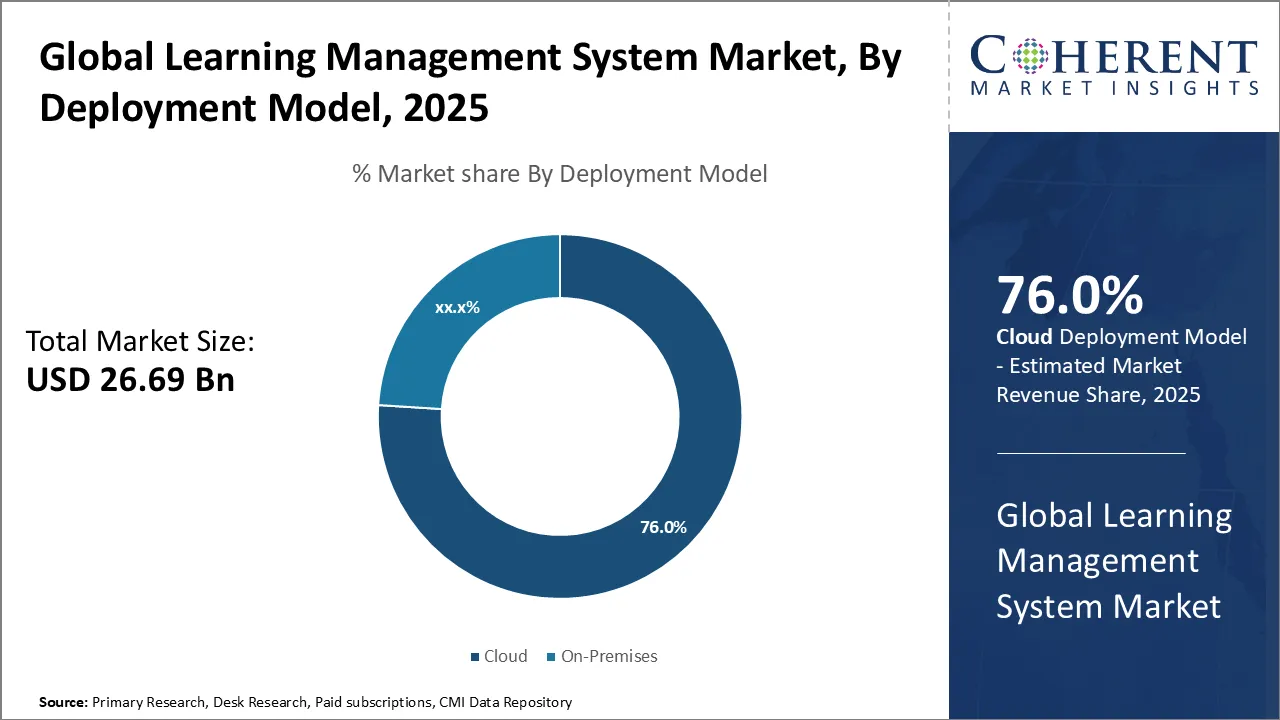
Learning Management System Market Insights, By Deployment Model: Cloud-Based LMS Dominates Due To Its Scalability, Remote Access, And Cost-Efficiency
In terms of deployment model, the cloud-based segment is expected to contribute 77% share of the market in 2026, due to their scalability, flexibility, and cost-effectiveness. Organizations increasingly prefer cloud deployments because they eliminate the need for extensive IT infrastructure and allow seamless updates and remote access. This model supports hybrid and remote work environments, making it ideal for global enterprises and educational institutions. On-premises LMS, while still relevant for organizations with strict data security requirements, is gradually losing ground due to higher maintenance costs and limited accessibility.
For instance, in October 2025, Amazon Web Services (AWS) and e& have introduced a new AI and cloud training initiative aimed at building a future-ready workforce in the UAE. The programme focuses on upskilling professionals in emerging technologies, supporting national digital transformation goals and enhancing the region’s competitiveness in the global tech landscape.
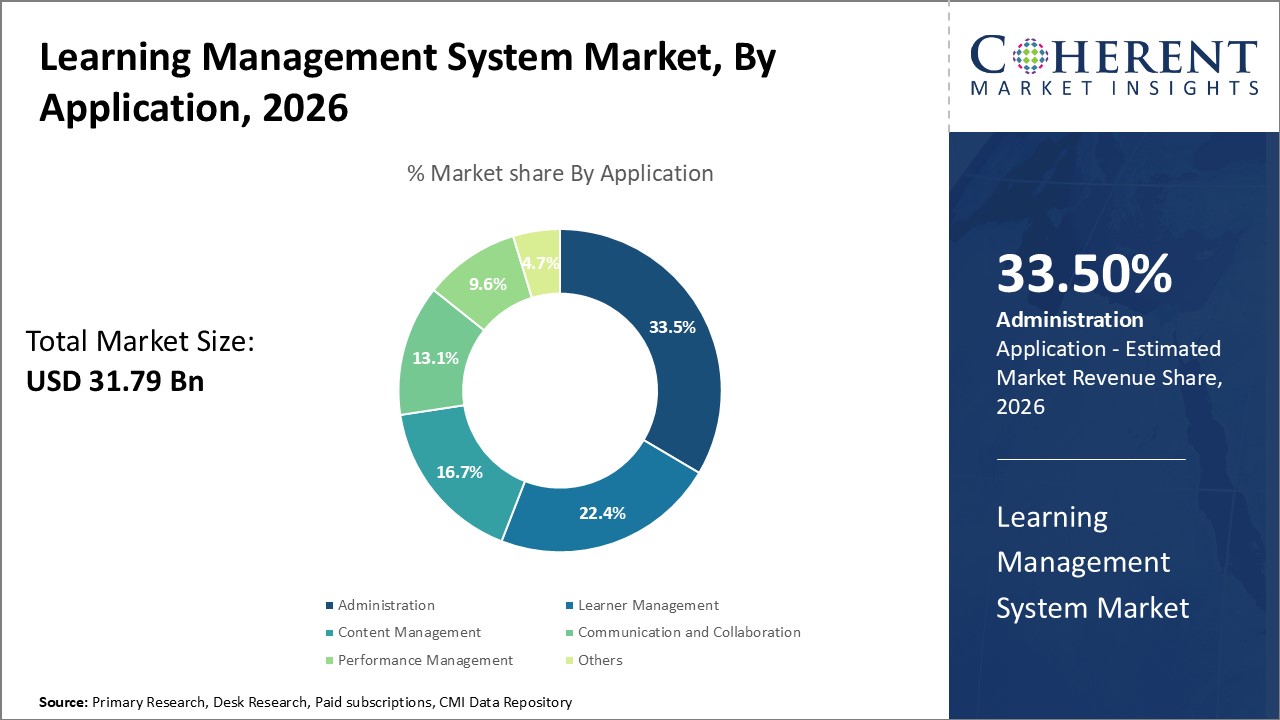
Learning Management System Market Insights, By Application: Administration is Demanding Due To Rising Demand for Automated Workflows, Compliance Tracking, And Scalable Operations
In terms of application, the administration and learning management segment is expected to hold the largest share of the market in 2026 due to its ability to streamline and automate critical educational and corporate processes. Institutions and organizations increasingly rely on LMS platforms to manage enrollment, scheduling, certification, and compliance reporting. These administrative tools enhance efficiency, reduce manual workload, and support data-driven decision-making. The integration of LMS with enterprise systems like HR and ERP further boosts its utility, enabling seamless onboarding and performance tracking. As digital transformation accelerates across sectors, the need for scalable and centralized administrative solutions is driving significant Learning Management System Market growth worldwide.
For instance, in November 2024, The Cybersecurity and Infrastructure Security Agency (CISA) introduced a new learning platform aimed at enhancing training and education for U.S. veterans and underserved communities. This initiative supports workforce development in cybersecurity and infrastructure protection, offering accessible, skill-building resources to empower participants for careers in national security and technology.
Learning Management System Market Insights, By Delivery Mode: Distance Learning Is the Top Choice, Driven by Remote Education and Global Workforce Needs
In terms of delivery mode, the distance learning segment is projected to account for the highest share of the market in 2026. The widespread adoption of remote education and virtual training, accelerated by digital transformation and global workforce decentralization has made distance learning the preferred method across academic and corporate sectors. Instructor-led training, while still valuable for hands-on and interactive sessions, is often blended with online modules to create hybrid learning experiences.
For instance, in February 2025, the International Atomic Energy Agency (IAEA) introduced a new e-learning course focused on approaches and methods for prospective radiological environmental impact assessments. Aimed at professionals in nuclear and environmental sectors, the course enhances understanding of radiological risks and supports informed decision-making in environmental planning and nuclear safety.
Learning Management System Market Insights, By User Type: Corporate Lead Is Fueled by Rising Demand for Employee Training and Compliance
In terms of user type, the corporate segment is projected to capture the greatest share of the market in 2026. Businesses across industries are investing heavily in employee training, compliance programs, onboarding, and leadership development, driving demand for robust LMS platforms. The need for continuous skill development and regulatory training makes LMS a strategic asset for corporate HR and L&D departments. Academic institutions also contribute significantly to market growth, especially with the rise of e-learning and digital classrooms, but the corporate sector's broader adoption and budget allocation give it a competitive edge.
For instance, in November 2024, Sennheiser launched a new Learning Management System designed to deliver a more intuitive and engaging training experience. The platform offers streamlined access to product knowledge, certifications, and learning paths tailored for partners and professionals, reinforcing Sennheiser’s commitment to innovation in audio education and support.
Learning Management System Market Insights, By Vertical: IT and Telecom Lead is Driven by Its Urgent Need for Continuous Tech Training and Global Workforce Scalability
In terms of vertical, the IT and Telecom segment is expected to acquire the dominating share of the market in 2026, due to its constant demand for rapid upskilling, technical certifications, and scalable onboarding solutions. As technologies evolve quickly, companies in this vertical rely heavily on LMS platforms to train employees efficiently across global teams. The need for continuous learning, compliance adherence, and integration with digital tools makes LMS an essential asset for IT and Telecom organizations.
For instance, in June 2025, Tempo Communications unveiled Tempo University, a new Learning Management System offering free, on-demand courses for professionals in telecom, electrical, and irrigation sectors. The platform aims to equip technicians with practical skills in areas like coax, fiber optics, and infrastructure location.
Regional Insights

North America Learning Management System Market Analysis & Trends
North America, holing a projected share of 40% in 2026, dominates the learning management system market due to strong corporate investment in digital training, widespread cloud adoption, and a culture of continuous learning. High demand stems from remote work trends, advanced IT infrastructure, and the need for scalable, skill-based education across industries like healthcare, finance, and technology.
For instance, in April 2026, First Due introduced a new Learning Management System (LMS) tailored for public safety agencies. The platform streamlines training delivery, certification tracking, and compliance management, integrating seamlessly with First Due’s existing suite. This launch marks a significant step toward modernizing emergency services education and enhancing operational readiness across departments.
Europe Learning Management System Market Analysis & Trends
Europe shows the fastest growth of the market due to digital transformation, remote learning adoption, and strong government support for e-learning initiatives. Educational institutions and corporations are investing in LMS platforms to enhance productivity, ensure compliance, and improve learner engagement. The region’s focus on workforce upskilling and blended learning models further fuels demand across academic and professional sectors.
For instance, in October 2026, Junior Achievement of Albania, supported by the Albanian-American Development Foundation, launched a new digital Learning Management System. The platform aims to enhance entrepreneurship education for students and teachers across Albania, offering interactive content, progress tracking, and remote access to learning resources aligned with modern educational standards.
Learning Management System Market Outlook Country-Wise
The U.S. Learning Management System Market Trends
The U.S. Learning Management System market is booming due to widespread corporate training needs, remote work adoption, and strong investment in EdTech. Organizations rely on LMS platforms for compliance, onboarding, and skill development, while schools and universities use them to support hybrid learning. Advanced digital infrastructure and a culture of continuous learning further fuel demand.
For instance, in August 2026, the American Concrete Institute (ACI) introduced a new Learning Management System to enhance access to its educational offerings. Designed for concrete professionals, the platform streamlines course delivery, certification tracking, and user experience. This initiative supports ACI’s mission to promote technical excellence and lifelong learning in the concrete industry.
Germany Learning Management System Market Trends
Germany’s Learning Management System market is growing rapidly due to strong demand for vocational training, compliance education, and digital workforce development. Industries like manufacturing and engineering rely on LMS platforms for scalable, skill-based learning. Government support for digital education and corporate investment in employee upskilling further drive adoption across academic and professional sectors.
For instance, in October 2026, Lingoda introduced Launchpad, a free digital learning platform designed to help newcomers in Germany learn German and boost career prospects. The initiative offers language courses, career guidance, and cultural integration support, aiming to empower migrants and refugees with essential skills for successful entry into the German workforce.
Market Report Scope
Learning Management System Market Report Coverage
| Report Coverage | Details | ||
|---|---|---|---|
| Base Year: | 2025 | Market Size in 2026: | USD 31.79 Bn |
| Historical Data for: | 2020 To 2024 | Forecast Period: | 2026 To 2033 |
| Forecast Period 2026 to 2033 CAGR: | 19.1% | 2033 Value Projection: | USD 108.05 Bn |
| Geographies covered: |
| ||
| Segments covered: |
| ||
| Companies covered: | Cornerstone Ondemand Inc., Xerox Corporation, IBM Corporation, Netdimensions Ltd., SAP SE, Blackboard, Inc., SABA Software, Inc., Mcgraw-Hill Companies, Pearson PLC, and D2L Corporation | ||
| Growth Drivers: |
| ||
| Restraints & Challenges: |
| ||
Global Learning Management System Market Drivers
Increased Use of Online Education and Training in Higher Education to Accelerate Market Expansion
To stay ahead of the competition, educational establishments are increasingly utilizing interactive online learning methods. The learning management model provides user-friendly content creation and distribution solutions for websites, mobile devices, and social platforms in light of increasing internet penetration and cloud adoption. The stage additionally assists with directing, report, track, and mechanize the course of internet learning courses. Accordingly, numerous instructive associations are moving toward intelligent web-based learning techniques.
Global Learning Management System Market Opportunities
The learning management system market forecast shows strong growth as educational institutions increasingly adopt interactive online learning strategies to remain competitive. LMS platforms offer user-friendly tools for content creation and distribution across websites, mobile devices, and social media driven by rising internet penetration and cloud adoption. These systems also streamline course management, reporting, tracking, and automation. As a result, schools and universities worldwide are shifting toward intelligent, data-driven learning models, fueling market expansion and innovation in digital education.
Global Learning Management System Market Trends
Developing Pattern of Multichannel Figuring out how to Expand Market
The developing pattern of multichannel learning, integrating mobile apps, web platforms, virtual classrooms, and social learning is fueling Learning Management System Market growth globally. This approach enhances flexibility and accessibility, allowing learners to engage across devices and formats. As organizations embrace blended and remote learning models, LMS providers are innovating to support personalized, scalable education. Multichannel delivery improves learner engagement and retention, making LMS solutions vital for academic institutions and corporate training. With rising digital adoption and demand for continuous skill development, multichannel learning is a strategic driver accelerating learning management system market growth across diverse sectors and geographies.
Increase In Smartphone Use and Internet Usage Will Accelerate Market Expansion
The rising use of smartphones and expanding internet access are key drivers accelerating the growth of the global learning management system market. As mobile learning becomes more accessible, learners across geographies can engage with educational content anytime, anywhere. This shift supports remote education, corporate training, and skill development, especially in emerging economies. The learning management system market size is expected to expand significantly as institutions and businesses adopt mobile-friendly platforms to meet growing demand. Enhanced connectivity and digital literacy are transforming how knowledge is delivered, making LMS solutions essential for scalable, personalized, and inclusive learning experiences worldwide.
Analyst Opinion (Expert Opinion)
The Learning Management System (LMS) market is undergoing selective consolidation, where differentiation now depends on measurable business outcomes rather than feature sets. Vendors succeeding in this space are those linking learning analytics directly to productivity, retention, or compliance improvements. Despite widespread LMS adoption, user engagement remains uneven, creating opportunities for modular, cost-effective platforms catering to both enterprise and mid-sized users.
A significant trend is the shift from platform purchases to outcome-driven programs. Organizations increasingly prefer LMS solutions bundled with validated learning paths and performance analytics. Notably, about one in three enterprises plans to replace existing LMS platforms, indicating dissatisfaction with usability, integration, and ROI. Vendors offering seamless migration, interoperability (xAPI, LTI), and rapid deployment gain clear advantage.
Corporate buyers prioritize revenue-adjacent learning—training linked to sales enablement, compliance, or partner certification—where ROI is quantifiable. Vendors such as Docebo have expanded their customer base significantly, reflecting the demand for scalable, analytics-rich systems. However, pricing pressure and content commoditization persist, pushing LMS providers to innovate through data, localization, and service differentiation.
Ultimately, the market favors LMS solutions that move from being content repositories to strategic learning partners, demonstrating clear linkage between upskilling and business performance while minimizing implementation friction.
Speak to the analyst
Want personalized insights?
Take the findings above to one of our principal consultants, or have the report rebuilt around the segments, geographies and competitors you actually track.
Global Learning Management System Market: Key Developments
- In August 2025, Softlogic Life introduced a cutting-edge Learning Management System to empower its high-performing sales team. The platform offers personalized training, performance tracking, and digital learning tools to enhance productivity and engagement. This initiative reflects the company’s commitment to innovation and continuous development in Sri Lanka’s insurance sector.
- In February 2025, Impelsys launched Monk, an AI-powered adaptive learning platform designed to personalize education across industries. The platform leverages data-driven insights to tailor content delivery, enhance learner engagement, and support scalable training. Monk aims to transform digital learning by offering flexible, intelligent solutions for academic institutions and corporate training programs worldwide.
Market Segmentation
- Global Learning Management System market, By Deployment Model (Revenue, USD Bn, 2021 - 2033)
- Cloud
- On-Premises
- Global Learning Management System market, By Application (Revenue, USD Bn, 2021 - 2033)
- Content Management
- Performance Management
- Communication and Collaboration
- Administration
- Learner Management
- Others
- Global Learning Management System market, By Delivery Mode (Revenue, USD Bn, 2021 - 2033)
- Distance Learning
- Instructor-Led Training
- Others
- Global Learning Management System market, By User Type (Revenue, USD Bn, 2021 - 2033)
- Academic
- Corporate
- Global Learning Management System market, By Vertical (Revenue, USD Bn, 2021 - 2033)
- Healthcare
- Retail
- Government
- Banking, Financial Services, and Insurance
- Manufacturing
- IT and Telecom
- Consulting
- Others
- Global Learning Management System market, By Region (Revenue, USD Bn, 2021 - 2033)
- North America
- U.S.
- Canada
- Latin America
- Brazil
- Mexico
- Argentina
- Rest of Latin America
- Europe
- Germany
- U.K.
- France
- Italy
- Spain
- Russia
- Rest of Europe
- Asia Pacific
- China
- India
- Japan
- Australia
- South Korea
- ASEAN
- Rest of Asia Pacific
- Middle East
- GCC
- Israel
- Rest of Middle East
- Africa
- South Africa
- Central Africa
- North Africa
- North America
- Global Learning Management System Market Companies Insights (Revenue, USD Bn, 2021 - 2033)
- Cornerstone Ondemand Inc.
- Xerox Corporation
- IBM Corporation
- Netdimensions Ltd.
- SAP SE
- Blackboard, Inc.
- SABA Software, Inc.
- Mcgraw-Hill Companies
- Pearson PLC
- D2L Corporation
Sources
Primary Research Interviews from the following stakeholders
Stakeholders
- Interviews with LMS vendors
- EdTech solution providers, academic administrators
- Corporate L&D (Learning & Development) directors
- IT integration partners
- Digital transformation leads across key global regions.
Specific stakeholders
- Chief Learning Officers (CLOs) and Training Managers at large enterprises
- IT Directors and Digital Education Heads at universities and K–12 institutions
- Human Resource and Talent Development Managers at multinational corporations implementing e-learning ecosystems
- System Integrators and Managed Service Providers specializing in LMS and HR Tech deployments
- Instructional Designers and EdTech Architects responsible for content digitization and learning pathway creation
- Product Managers at cloud service providers and LMS technology OEMs
- Corporate Compliance and Training Managers in BFSI, Healthcare, and Manufacturing sectors implementing LMS for regulatory training
Databases
- UNESCO Institute for Statistics
- World Bank Education Statistics
- OECD Education and Skills Database
- UN Comtrade Database
- World Economic Forum
- U.S. Bureau of Labor Statistics
- Eurostat
- Ministry of Education (Government of India) Data Portal
- National Center for Education Statistics (NCES), U.S.
- Department for Education (DfE), U.K.
Magazines
- eLearning Industry Magazine
- Training Magazine
- Chief Learning Officer (CLO) Media
- EdTech Magazine
- Inside Higher Ed – Technology & Digital Learning Section
- Campus Technology
- HR Technologist
- TechRepublic – Enterprise Learning & Collaboration Section
- Workforce Magazine
Journals
- Computers & Education (Elsevier)
- British Journal of Educational Technology (BJET)
- International Review of Research in Open and Distributed Learning (IRRODL)
- Journal of Educational Technology & Society
- IEEE Transactions on Learning Technologies
- Journal of Workplace Learning
- Journal of Computer Assisted Learning
- Interactive Learning Environments (Taylor & Francis)
- Educational Technology Research and Development (ETR&D)
Newspapers
- The Wall Street Journal – Technology & Education Innovation
- The New York Times – Education and Future of Work
- The Economic Times – EdTech & Skills Development
- The Hindu Business Line – Education & ICT
- Financial Times – Digital Transformation in Education
- Nikkei Asia – Digital Learning and Workforce Trends
- South China Morning Post – Education and Technology Section
Associations
- International Society for Technology in Education (ISTE)
- EDUCAUSE (Higher Education Technology Association)
- Association for Talent Development (ATD)
- International Council for Open and Distance Education (ICDE)
- European Distance and E-Learning Network (EDEN)
- International E-Learning Association (IELA)
- All India Council for Technical Education (AICTE) – E-Governance and Digital Learning Initiatives
- Asia Pacific Society for Computers in Education (APSCE)
Public Domain Sources
- Ministry of Education (Government of India) – Digital Infrastructure for School Education (DIKSHA)
- U.S. Department of Education – Office of Educational Technology
- European Commission – Digital Education Action Plan Reports
- Ministry of Economy, Trade and Industry (METI), Japan – EdTech Reports
- Department for Education (U.K.) – EdTech Strategy and Digital Skills Reports
- NITI Aayog – India EdTech and Skilling Initiatives
- Reserve Bank of India (RBI) – Employment and Skills Reports
- UNESCO Global Education Monitoring (GEM) Reports
- World Economic Forum – Digital Learning Readiness Index
Proprietary Elements
- CMI Data Analytics Tool
- Proprietary CMI Existing Repository of information for last 8 years
Get access to 250+ pages report
Every segment, forecast, competitor profile and data table behind the analysis above — available for instant download.
- ESOMAR Member
- ISO 9001:2015 Certified
- D-U-N-S Registered
- GDPR & CCPA Compliant
Missing comfort of reading report in your local language? Find your preferred language:
Transform your Strategy with Exclusive Trending Reports
Frequently Asked Questions
The Learning Management System Market is estimated to be valued at USD 31.79 Bn in 2026, and is expected to reach USD 108.05 Bn by 2033.
The CAGR of the Learning Management System Market is projected to be 19.1% from 2026 to 2033.
Increased Use of Online Education and Training in Higher Education to Accelerate Market Expansion.
Key players operating in the market are Cornerstone Ondemand Inc., Xerox Corporation, IBM Corporation, Netdimensions Ltd., SAP SE, Blackboard, Inc., SABA Software, Inc., Mcgraw-Hill Companies, Pearson PLC, and D2L Corporation