Within this market, order automation and accounting integration are major areas of interest. Understanding their development helps understand why distributors are reassessing their software requirements.
Understanding Food Service Distribution Software
Food service distribution software supports the movement of products from wholesalers to commercial food buyers. Its functions may consist of recording orders, monitoring inventory, managing warehouse tasks, planning deliveries, preparing invoices, tracking payments, etc.
Different businesses need different levels of functionality. An ordering application may allow customers to submit orders digitally but depend on another system to manage inventory with invoicing. An operations platform can cover more of the daily distribution process, at the same time an enterprise resource planning (ERP) system may also handle purchasing, financial records, reporting, as well as product traceability.
These differences matter when distributors choose technology. A business with an established ERP may need only an additional tool to process incoming orders. A smaller wholesaler may prefer a connected operations system that reduces the number of separate applications it must manage.
When order management and accounting systems exchange information correctly, businesses can lower duplicate data entry and maintain more consistent records across departments.
Key Market Trends Shaping the Industry
Auto-Processing of Incoming Orders
Food distributors receive orders through multiple channels: email, text messages, phone calls, online portals and documents. Warehouse teams can then start preparing an order, but staff may need to first understand these requests, confirm quantities, check prices and enter the details into a business system.
Artificial intelligence (AI) and automated order capture are changing this process. These tools can help convert information from different communication channels into structured order data for review and processing. Staff can then focus on checking exceptions, resolving unclear requests, by managing customer needs rather than just repeatedly entering the same information.
Improved order consistency can enhance communication between sales teams, warehouse, delivery staff, etc. However, businesses still need to evaluate how accurately a system handles product names, quantities, substitutions, as well as customer-specific prices.
Greater Adoption of Cloud-Based Systems
Cloud software allows employees to take business information through connected devices without depending on software installed on a single office computer. This can be useful for distributors managing several warehouses, sales teams.
Cloud systems can also simplify software updates and support the exchange of information between ordering, inventory, and accounting applications. For smaller distributors, subscription-based access may lower the need for significant upfront investment in internal technology infrastructure.
Adoption is still dependent on dependable access to the internet, adequate security controls, and compatibility with current systems. Businesses must evaluate how customer records, product prices, and financial information are protected before selecting a cloud service.
Integration Between Operations and Accounting
Digital ordering alone does not complete a workflow of a distributor. Once an order is fulfilled, the business must issue an invoice, record adjustments, receive payment, as well as reconcile its accounts.
When operational and accounting systems are disconnected, employees may need to transfer information manually. This builds additional work and increases the chance of mismatched records.
Integration addresses this gap by allowing selected information to move between connected applications. For example, the Fresho–QuickBooks integration supports the exchange of operational and financial records, helping distributors connect order fulfilment with accounting activities.
The wider market implication is that buyers increasingly need to evaluate software as part of a connected system rather than as an isolated application. Integration quality, implementation requirements, and the accuracy of synchronized records can be as important as the individual features offered by a platform.
Market Intelligence and Segment Analysis
Market research on food service distribution software examines the technology businesses purchase, how it is delivered, the size of the organizations adopting it, and the industries using it. The market framework covers components such as software and services, deployment through cloud or on-premise systems, organization sizes ranging from small and medium-sized enterprises to large businesses, and end users such as restaurants, hotels, supermarkets, and institutional facilities.
By Component: Software, Services
By Deployment Mode: Cloud, On-premise
By Organization Size: SMEs, Large enterprise
By End-User: Restaurants & hotels, Supermarkets, Casinos, Pizzerias, Delicatessens, Convenience stores, Hospitals and schools, Franchises
The market figures supplied for this analysis indicate steady overall expansion. However, the adoption rate of individual segments can vary from the growth of the market. Software requirements, infrastructure choices, and implementation needs vary according to the size and complexity of each distribution business.
Software Segment: Connecting Daily Distribution Tasks
The software segment includes digital applications used to manage orders, inventory, purchasing, warehouse activities, billing, and related distribution processes. The figures supplied for the CMI analysis project this segment to grow at a CAGR of 11.78% during the forecast period.
Several factors can support adoption. Distributors face pressure to process more orders accurately, maintain reliable stock information, respond to changing customer requirements, and lower repetitive administrative tasks. Software can bring these activities into a planned workflow and make information simple to share between departments.
Applications range from tools that accept incoming orders to broader systems that cover fulfillment and financial administration. A distributor may use one platform for customer ordering, another one for warehouse operations, with an accounting application for financial records. Alternatively, it may choose a system that covers several functions and connects to its existing accounts software.
The value of the software segment is in its ability to turn separate tasks into a more consistent process. Nevertheless, adoption depends on whether the selected system fits the distributor's product range, pricing practices, order volume, and existing technology.
Cloud Segment: Flexible Access and Connected Workflows
Cloud deployment allows software and business information to be accessed through an internet connection, subject to the provider's security and access controls. The supplied market estimates project the cloud segment to record a CAGR of 12.94% during the forecast period.
Its adoption is supported by the need to share current information across sales offices, warehouses, delivery teams, and accounting departments. A cloud-based system can help employees work from a common set of records, while integrations can connect operational data with external applications.
For food wholesalers, practical uses include receiving customer orders, checking available stock, reviewing invoices, exchanging financial information, etc. These functions can be particularly useful when several employees handle different stages of fulfilment.
Cloud deployment is not automatically suitable for every business. Distributors should review data protection, service availability, access permissions, integration costs, as well as the process for exporting their information. The best choice depends on operational needs rather than deployment model alone.
Integrating QuickBooks into Distribution Operations
Accounting integration shows how food distribution software connects operational work to financial administration. Distributors must keep accurate records of sales, invoices, credit notes, customer accounts, payments, etc. If these details are organized separately, employees may spend time comparing records along with correcting inconsistencies.
The Fresho QuickBooks integration gives information about connecting Fresho with QuickBooks Online and QuickBooks Desktop. The integration is to support the exchange of proper business records, including invoices, credit notes, customer information, product records, as well as payment data.
This type of connection is useful as distribution and accounting teams depend on related information. Operations staff manage orders and fulfilment, on the other hand finance teams monitor receivables, payments, and account balances. Connecting their systems can lower repeated entry as well as help in keeping records aligned.
However, integration does not discard the need for financial controls. Businesses should confirm which records are synchronized, how frequent updates take place, how errors are handled, and whether adjustments require manual review. They should also set clear responsibilities for maintaining product and customer data.
Fresho provides an example of an operations platform working alongside accounting software rather than replacing the accounting system itself. This arrangement can suit distributors that want to improve daily order handling without undertaking a complete replacement of their financial software.
United States Market Outlook
The United States is an important market to examine because its foodservice supply chain serves a wide range of restaurants, hotels, catering businesses, and institutional buyers. Distributors must manage frequent deliveries, varied product requirements, customer-specific pricing, along with changing demand. These conditions make a practical need for reliable order processing and inventory information.
Labour costs and pressure on operating margins can stimulate businesses to automate repetitive administrative tasks. At the same time, customers are expecting convenient ordering, accurate fulfilment, and timely billing. Distributors may therefore adopt digital ordering tools, AI-assisted order capture, cloud applications, and connections between operational and accounting systems.
Smaller wholesalers may focus on affordability with ease of implementation, on the other hand larger organizations may prioritize integration across multiple warehouses, purchasing functions, and financial systems. Fresh food distributors also need software that can accommodate changing prices, variable product weights, with perishable inventory.
The market opportunity depends on more than technology availability. Existing systems, staff training, data quality, and the willingness of customers to use digital channels can influence implementation outcomes. As a result, distributors are likely to assess software based on its fit with their current workflows and its ability to exchange information with other business applications.
Key Market Participants and Their Roles
The market includes providers of broad enterprise systems, supply chain applications, food distribution platforms, and specialist ordering tools.
Oracle Corporation and SAP SE offer enterprise software used to coordinate financial management, procurement, inventory, and other business processes. Infor, Inc. also serves businesses requiring industry-oriented operational and enterprise applications. These providers are relevant where distributors need extensive process coverage and connections across different business functions.
Blue Yonder, Inc. focuses on supply chain planning with related operational technologies, which can support inventory planning and the movement of goods. Tyler Technologies, Inc. provides software across several public-sector and industry settings, making it part of the broader business software landscape, although its relevance to a specific food distribution workflow should be assessed at the product level.
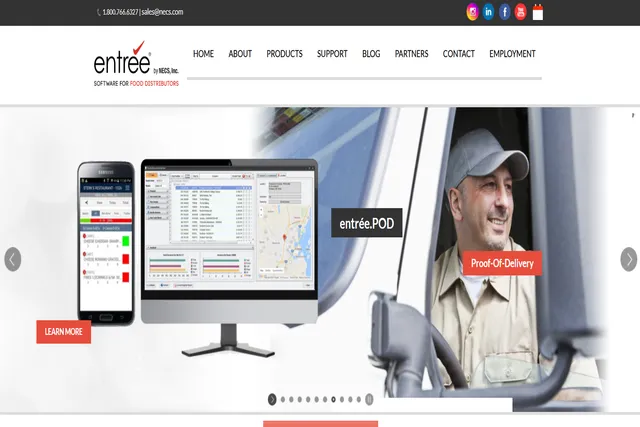
Specialist platforms cater to different parts of the distribution process. Fresho focuses on fresh food ordering and daily operations, on the other hand Choco emphasizes order intake and sales-related tools. Pepper and Cut+Dry support digital ordering and customer-facing functions, and NECS entrée serves distributors seeking food-focused ERP capabilities.
These companies do not all compete in exactly the same category. Some provide systems that manage wide-ranging business operations, while others supply tools that connect to an existing ERP or accounting application. Comparing their capabilities requires attention to operational coverage, integration options, implementation effort, and the needs of the target distributor.
Conclusion
The food service distribution software market is developing around the need to manage orders, stock, deliveries, invoices, and payments with fewer disconnected processes. Automated order capture can help lower manual work, cloud systems can make information more accessible, and accounting integrations can improve the flow of records between operational and finance teams.
Market estimates point to continued expansion, at the same time segment-level forecasts suggest different adoption patterns for software and cloud deployment. For distributors, the practical decision is to select systems that fit their product categories, order volumes, accounting requirements, and existing infrastructure.

