Not only do ABA billing denials slow down your cash flow, that speaks to the larger issue of how a practice sets up its billing. Having the right ABA billing software can be the difference between a 95% first pass acceptance rate and a backlog of rejected claims stacking up week after week. There’s never really a let up in the administrative pressure between tracking prior authorizations, managing CPT codes like 97151 through 97158 and category III codes, and dealing with Medicaid rules that change state by state. This guide goes over the best platforms designed for behavioral health billing. The best behavioral health billing software on the market today.
The Real Impact of Top ABA Billing Software
Picking the wrong billing platform in ABA therapy is a slow-burn problem. You don't always notice it right away, but over time, your denial rate climbs, your average days in accounts receivable stretches out, and your billing staff starts spending more time correcting claims than submitting them.
That’s a real challenge. There are varying rules for ABA specific CPT codes such as 97151, 97153, and 0362T for different payers, and an automatic denial can be made if even one modifier is missing. Add in prior authorization tracking across multiple insurance types and the margin for error shrinks fast.
Practices that choose software built for this billing environment tend to see cleaner claim submissions from the start. That matters because first-pass claim acceptance rate is the single most telling metric for billing health. When your software understands ABA-specific billing rules natively, rather than requiring workarounds, you spend less time chasing denials by payer and reason code. The right platform won't just process claims faster. It will help your team catch authorization mismatches before they become write-offs.
ABA Billing Software and the Broader Revenue Cycle Management Market
Challenges facing ABA practice fall under the broader issue of revenue cycle management in the healthcare industry. The revenue cycle management process ranges from registration and billing to claims adjudication, payment recovery, and follow-up processes. With increasing volume of claims and complexity of reimbursement requirements, there is increased focus on automation, accurate claims, and revenue recovery.
According to Coherent Market Insights, the global Revenue Cycle Management Market is estimated to be valued at US$ 196.91 Billion in 2026 and is anticipated to attain a value of US$ 440.78 Billion by 2033, registering a CAGR of 12.2% between 2026-2033. Growth drivers include healthcare digitization, rising claims volume, regulatory requirements, and cost reduction.
Three trends are particularly relevant to ABA billing:
- Automation and AI technologies continue advancing within claims management processes. Automatic coding, claims scrubbing, denial detection, and payment posting can decrease the amount of repetitive paperwork.
- Cloud solutions for RCM are gaining more popularity. The cloud makes it possible for healthcare providers to perform their billing processes remotely and expand their infrastructure due to rising patient numbers and locations.
- Unified solutions are replacing inefficient workflows. Consolidation of clinical, administrative, and financial data can eliminate duplication of entries.
These developments go some way to explaining why there is an increasing trend for ABA billing software to be used not only for billing but to incorporate other elements.
-
Theralytics - Best for Clinical Quality and Behavioral Health Practice Management
What Services Does Theralytics Provide?
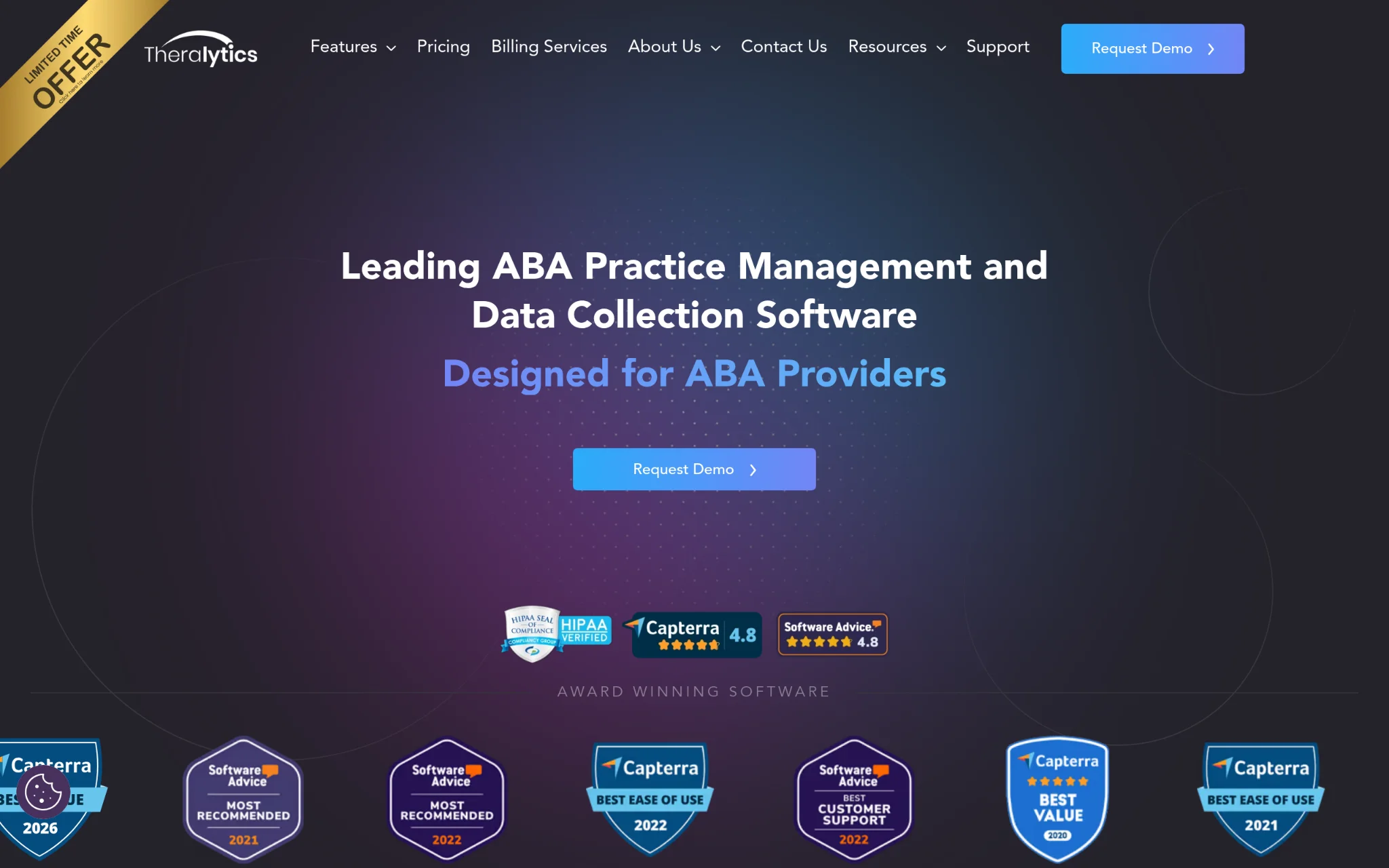
Theralytics is a practice management and clinical data collection platform built for behavioral health. It brings scheduling, billing, and real-time data synchronization together into one system, so BCBAs, supervisors, and clinicians always work from the same up-to-date information and provides instant visibility into client progress without the manual work.
The platform includes automated graphing for progress monitoring, parent and caregiver portals, and enterprise-grade security with SOC 2 Type II certification and AES-256 encryption. For practices that need clinical and operational systems to actually talk to each other, this is one of the cleaner builds out there.
What Sets Theralytics Apart for Top ABA Billing Software?
Theralytics cuts out the data silos that typically cause billing errors and treatment delays by syncing clinical and administrative workflows in real time. This kind of tight connection is rare in behavioral health software, and it directly reduces the authorization mismatches and CPT coding errors that drag down first-pass acceptance rates.
Real User Sentiment
From what the reviews show, users consistently point to fast data entry and instant automated graphing as standout features. Practices also mention that the pricing structure works well as caseloads grow, without the steep per-seat costs that tend to hurt expanding teams. The combination of clinical usability and billing accuracy puts Theralytics in a category of its own for ABA-specific practice management.
-
TherapyPMS - Best for Multi-Discipline Therapy Practices and Behavioral Health Clinics
What Services Does TherapyPMS Provide?
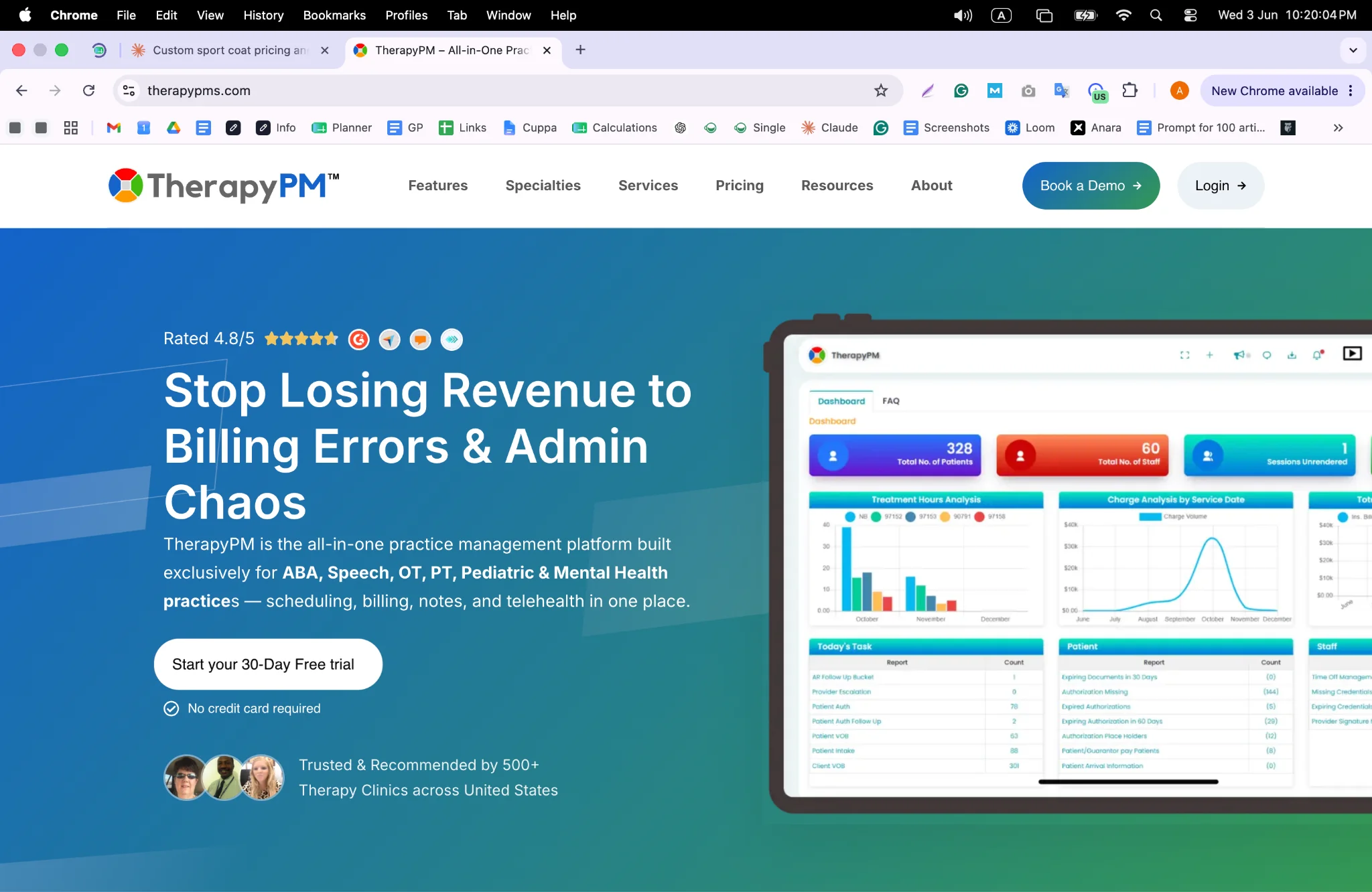
TherapyPMS is a practice management platform built to serve ABA, occupational therapy, speech therapy, mental health, pediatric therapy, and physical therapy practices from a single system. It covers credentialing, billing, accounts receivable, and telehealth tools, all customized to the specific needs of therapy providers. The platform is used by over 500 clinics across the U.S. and Canada, and their accounts receivable services reportedly achieve a 99% success rate in maximizing reimbursements. For practices running multiple therapy disciplines under one roof, the multi-specialty billing capability is a genuine strength.
What Sets TherapyPMS Apart for Top ABA Billing Software?
TherapyPMS addresses one of the more difficult challenges in behavioral health billing — managing revenue cycle performance across multiple therapy disciplines without fracturing workflow. They have a compliance stack for HIPAA, SOC-2, and GDPR, which indicates they’ve thought carefully about the requirements for handling data that comes with sensitive behavioral health records.
Real User Sentiment
Users have said the platform has been embraced by practices both big and small, suggesting it holds up beyond the startup phase. The most consistent feedback is about the reliability of billing and the success rate of accounts receivable. Formal third-party ratings are not available publicly. That number of 500 clinics adoption does carry weight.
-
Raven Health - Best for ABA Therapy Practices and Behavioral Health Clinics
What Services Does Raven Health Provide?
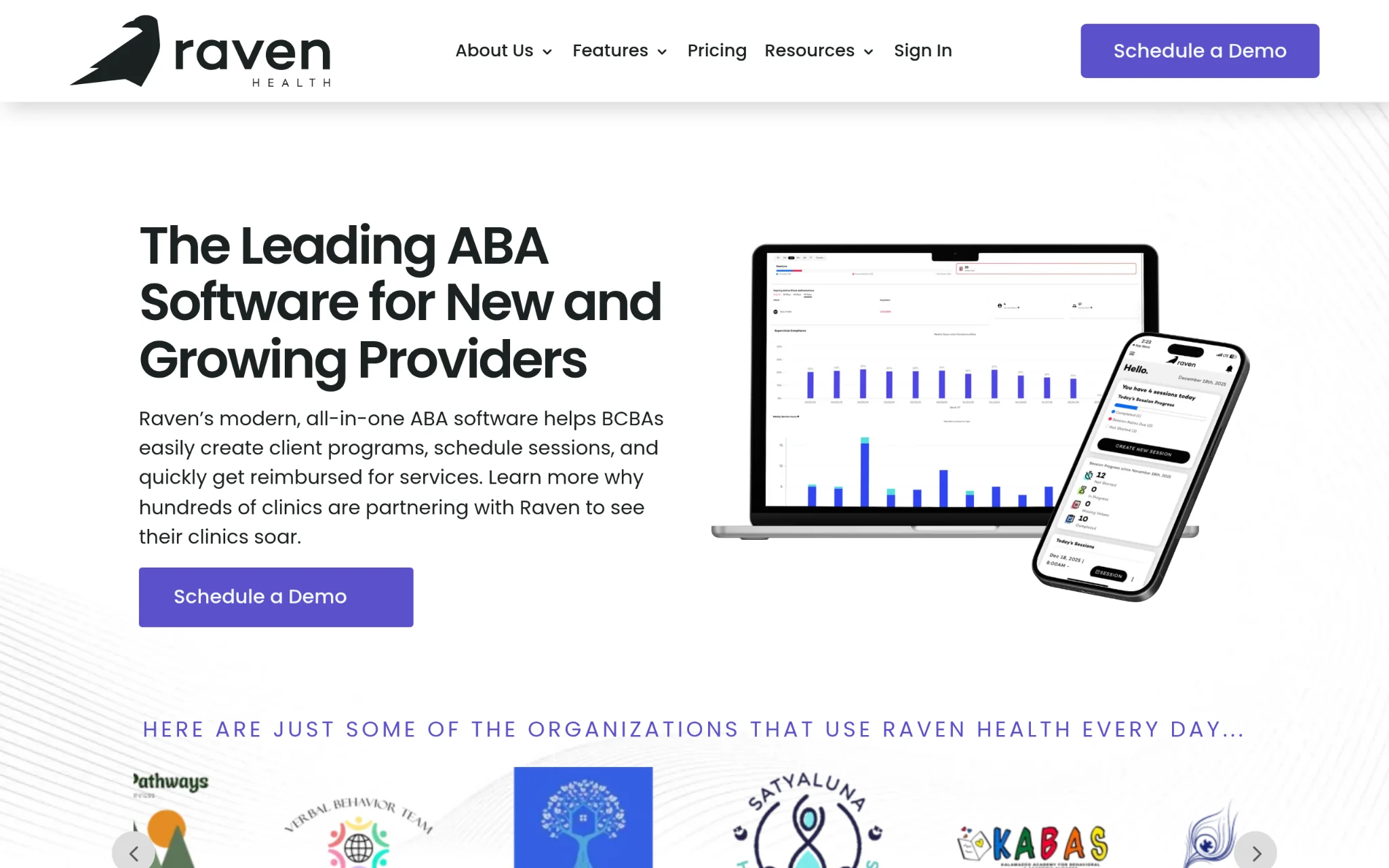
Raven Health provides ABA data collection and practice management software purpose-built for behavioral health clinicians and administrators. Its platform covers data synchronization, offline data collection, treatment plans, progress tracking, and billing, and it's designed with a mobile- and tablet-first approach.
The thing that stands out about their design philosophy is that clinicians reportedly get comfortable with the system in under 15 minutes, which is genuinely impressive for a platform covering this much clinical ground. Founded in 2020 in Wilmington, Delaware, the team of 51 to 200 employees has built something that puts the clinician experience first without sacrificing billing depth.
What Makes Raven Health Relevant to Revenue Cycle Management?
Raven Health operates under a unique pricing structure, offering free software and earning a percentage of the claims they collect, thus directly linking their success to your reimbursement success. That approach connects the software model directly with revenue cycle performance, particularly claims collection and reimbursement turnaround.
Real User Reviews
Organizations like Crescent Bloom and Pair Tree Autism Services have documented actual workflow improvements and improved revenue cycle results after being set up on the platform. The usability first design continues to be praised especially from clinical staff that didn’t expect to adapt quickly. No major third-party awards were found in available sources, but the client stories fill in some of that credibility gap.
-
ABA Matrix - Best for ABA Therapy Practices and Behavioral Analysis Clinics
What Services Does ABA Matrix Provide?
ABA Matrix is a complete ABA data collection and practice management platform for behavior therapists working in solo practices, startup clinics and large private practices. The platform integrates data collection, scheduling, billing, progress notes, graphing, reporting, compliance alerts and payroll management all under one roof. The nice thing about their approach is the bootstrapped, independent nature of it. So, they’re building for long-term reliability, not chasing acquisition-driven growth. The platform is designed around the daily regulatory requirements ABA providers face, built with HIPAA compliance and CASP Guidelines.
What Sets ABA Matrix Apart as Top ABA Billing Software?
ABA Matrix addresses the fragmentation problem, which especially impacts smaller ABA practices, where clinical data, billing, and compliance tracking are dispersed among various disconnected tools. Their recent selection as the Top ABA Therapy Data Collection and Practice Management Platform 2026 by Healthcare Tech Outlook Magazine (and the Legacy Builder Award from the Ausome Foundation Gala) shows the real-world impact of the platform, not just its features.
Real User Sentiment
Case studies tied to ABA Matrix show practices achieving more accurate assessments, improved behavior intervention planning, and better staff satisfaction over time. The awards and case study documentation give this platform more credibility than many newer entrants in the space. From what the reviews show, practices value the full toolset and the stability that comes with working with an independent, long-term-focused vendor.
-
Rethink Behavioral Health - Best for ABA Clinics, Behavioral Health Agencies, and Pediatric Therapy Providers
What Services Does Rethink Behavioral Health Provide?
Rethink Behavioral Health is an all-in-one ABA platform serving ABA, speech, OT, and PT practitioners, built with a content library of over 1,500 customizable care plans and mobile data collection for both online and offline use. The platform brings clinical programming, data collection, scheduling, billing, compliance, and staff training together into one workflow.
Their Medical Necessity Assessment tool has been used in over 23,000 assessments, with 87% clinician agreement on outcomes. Established in 2007 and based in New York, Rethink serves over 2,000 customers worldwide, from startups to large enterprises.
What Sets Rethink Behavioral Health Apart for Top ABA Billing Software?
Rethink addresses the operational challenge of running multi-discipline behavioral health organizations at scale, where billing, compliance, and staff training have to move in sync. The platform is backed by K1 Investment Management's strategic investment in parent company RethinkFirst, which adds a layer of stability that matters when a practice is building long-term infrastructure.
Real User Feedback
More than 500 ABA organizations have adopted it, and that fact probably says more than most summaries of reviews. The platform’s depth, especially the care plan library and Medical Necessity Assessment tool, is most meaningful for larger practices that require clinical rigor baked into their administrative workflows. That sort of validated adoption at scale is tough to beat.
How We Selected and Verified These
The objective of this research was to find platforms that are built for ABA and behavioral health billing, not practice management tools that were later retrofitted with billing.
Data Collection Strategy
The initial step was to create a comprehensive list of platforms that are referenced in behavioral health directories, therapy review sites, and professional forums where ABA clinicians and billing managers discuss their tools. The official website of each platform was reviewed for documented features, pricing signals and depth of their ABA-specific billing capabilities. Case studies and testimonials on company sites were identified as a baseline for later verification work.
The Shortlisting Pass
We removed platforms that had no evidence of activity in behavioral health billing, platforms that had no documented features specific to ABA, and platforms that appeared to have no actual clients using them. The review patterns were analyzed across the sources available, focusing on the recurring themes around claim submission accuracy, denial management, and handling of ABA CPT codes. Platforms with insufficient review volume to extract any meaningful signal were discarded.
Verification Pass
Site claims were compared to what users actually reported in review environments and case study documentation. We weighed those claims against the context and specificity of the supporting evidence when a platform claimed a particular success rate or outcome metric. We flagged and deprioritized platforms whose marketing claims were significantly ahead of documented real-world results.
Industry Authority & Recognition
Authority signals included awards, publication in behavioral health publications, and original research published by these platforms. Industry bodies or health technology publications’ recognition added credibility to a platform’s standing. The award from Healthcare Tech Outlook Magazine was recorded for platforms like ABA Matrix and Rethink Behavioral Health had a large published dataset for ASD. Therefore, both platforms had stronger authority signals.
Best ABA Billing Software Evidence
We looked at dedicated service pages on ABA billing, prior authorization tracking, and CPT code management to verify that each platform’s billing capabilities were built for purpose and not simply adapted from general medical billing tools. Verified case studies demonstrating ABA-specific billing outcomes such as faster reimbursement turnaround and lower denial rates were perceived as stronger proof than generic testimonials about therapy management. The final list only included platforms with meaningful documented evidence for ABA billing workflows.
What to Look For When Choosing Top ABA Billing Software
Choosing ABA billing software is more about whether the software understands the unique billing environment in which you operate than simply processing claims. Consider these things before you make your decision.
- Industry/Domain Experience: Seek out platforms that are built for ABA or behavioral health, not general medical billing tools that have been adapted to the space. Native built-in ABA specific CPT codes, modifier requirements and Medicaid billing rules.
- Features and Services: Prior authorization tracking, claim scrubbing, automated denial management, and real-time data sync between clinical and billing workflows all are features that actually move the needle on first-pass acceptance rates.
- Pricing structure: Some platforms charge per claim, some per seat, and some (like Raven Health) take a percentage of collections. Align the pricing model to your practice’s claim volume and growth trajectory.
- Results Assessment: Your platform should provide transparency into denial rate by payer, average days in accounts receivable and authorization utilization rate. If a system cannot tell you these things, you are flying blind.
- Industry Knowledge & Compliance: HIPAA, CASP Guidelines & State-specific Medicaid billing requirements are a must. Ensure that any platform you are considering has documented compliance certifications and a track record of keeping up with payer rule changes.
Revenue Cycle Management Market Segmentation and ABA Billing
However, RCM as a larger market is divided based on type, deployment, component, function, and end user. By type, CMI includes standalone and integrated types of solutions; by deployment – cloud and on-premise; by component – software and services; by function – appointment scheduling, claims and denial management, medical coding and billing, network management, and others; and by end user – hospitals, clinics, ambulatory surgical centers, diagnostics and imaging centers, and others.
For ABA organizations, the most important functions are claims and denial management and medical coding and billing since they solve the same problems that arise due to payers' policies, CPT codes, authorizations, and claim denials. According to CMI, claims and denial management will be the biggest segment of RCM functions in 2026 due to financial consequences of denied claims.
In addition, there is a tendency to develop integrated solutions and use cloud platforms for RCM systems. Integrated RCM is expected to take 59.7% of the market in 2026; cloud deployment is expected to take 70.6% of the market; and software takes 85.3% of the market by component. These tendencies are relevant for ABA organizations in terms of integrating clinical information, billing, authorizations, claims, and financial reporting.
U.S. Revenue Cycle Management Market and ABA Billing
The U.S. is particularly important to ABA billing because of its complex private insurance and Medicaid reimbursement environment. CMI estimates North America to account for 40.2% of the global RCM market in 2026, with the U.S. representing the largest share within the region. High healthcare spending, established healthcare IT infrastructure, regulatory requirements, and the need for accurate revenue capture support continued adoption of RCM solutions.
For ABA practices, this environment makes payer-specific billing rules, authorization tracking, coding accuracy, and denial prevention important considerations when selecting software. Platforms that can connect these activities with clinical workflows can address some of the administrative complexity that smaller and multi-location behavioral health practices face.
Market Participants and Competitive Landscape
There are well-known healthcare technology and revenue-cycle players within the overall RCM market, including Athenahealth, Experian Health, Cerner, GE HealthCare, Epic Systems, Conifer Health Solutions, eClinicalWorks, Change Healthcare, Optum, Waystar, McKesson Corporation, R1, Veradigm, CareCloud, Access Healthcare, and AdvantEdge Healthcare Solutions.
Also, there is increasing focus on AI and automation within the RCM market. Recent examples include Omega Healthcare's partnership extension with Microsoft to launch generative and agentic AI solutions in the revenue cycle space, as well as New Mountain Capital's creation of Smarter Technologies through consolidation of healthcare technology companies specializing in such areas as RCM and clinical data. The examples illustrate how automation becomes an increasingly important trend within the overall revenue cycle technology space.
In terms of ABA billing software, the same trend can be observed with regards to claims automation, authorization tracking, coding assistance, denials management, and integration of clinical and administrative systems in real time.
Final Take
ABA billing is really complicated and the right software makes a measurable difference in how your practice performs financially. Theralytics is unique in the practices that need clinical and billing workflows running in sync. TherapyPMS works well in multi discipline settings. Depending on the size of your practice and your billing-priorities, Raven Health, ABA matrix and rethink all have unique strengths. As ABA caseloads grow and payer requirements tighten, the investment in purpose-built billing software transactions from optional to foundational.

