What Do AI Humanizer Tools Change?
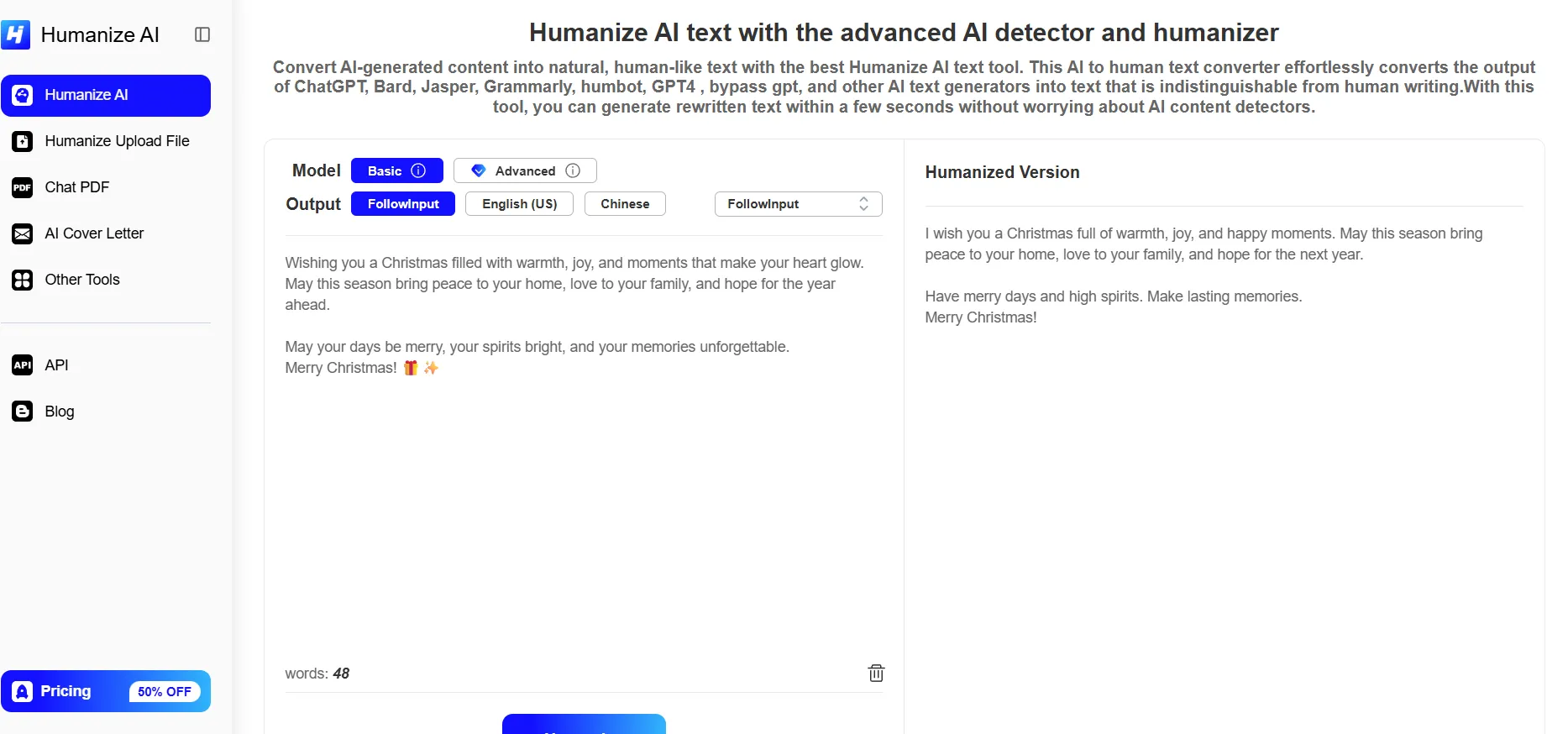
AI humanizers tend to rewrite the existing text, adjust the tone, vary the sentence structure, or trim the repetitive language. These features can help polish a draft, but the users still have to check factual accuracy, preserve the original meaning, as well as verify the citations.
Three outcomes need to be kept apart: readability, originality, and authorship detection. A smoother passage isn’t necessarily original, and a detector score isn’t definitive proof of who wrote the text.
A systematic review of 90 studies published in Discover Education in October 2026 found that the false-positive outcomes tend to be varied across detection tools as well as evaluation settings. The findings support treating detectors results as a reason for further review, and they are not a final verdict on the authorship.
Which Five AI Humanizer Tools Are Worth Reviewing?
The following tools appeared in the original listicle. Their features are summarized as the source describes them. This isn’t an independently tested ranking of performance.
Humanize AI is presented as a text-refinement tool for blog posts, product descriptions, marketing emails, and professional writing. Its stated functions include the adjusting of sentence structure, smoothening the transitions, as well as adapting tone.
These features may be useful when a draft sounds repetitive or generic. However, the product’s bypass AI detection positioning should be treated as a vendor claim, not independent proof that the tool consistently evades detection systems. Output quality, preserved meaning, and the amount of editing needed are more practical yardsticks.
Humanizer Pro is described as offering academic, professional, conversational, as well as informal writing styles. Those options may help users tailor reports, essays, as well as business communications to different audiences.
The key question is whether the rewritten passage keeps the source’s argument, technical terminology, and factual details. The original description gives no independently verified accuracy or comparative performance data.
HideMyAI is described as pairing automated rewriting with a feature that estimates whether content may be flagged by an AI detector. A prediction like that can give an indication, but it can’t establish how other detectors will classify the same passage. Detection systems rely on different models and evaluation methods, and their results can shift with updates.
Users should also check whether rewriting has changed important claims, qualifications, or citations. A prediction score is no guarantee of what external detectors will say.
Undetectable.ai is presented as a tool for marketing copy, search engine optimization (SEO) articles, web pages, and business communications. These uses call for a consistent brand voice, accurate product information, and the right terminology across large volumes of content.
Automated rewriting may help with sentence-level editing, but it cannot guarantee content accuracy or SEO performance on its own. The businesses should weigh data privacy, confidentiality, workflow integration, as well as the time that human review will take.
Smodin AI Rewriting Tool is described as supporting multilingual rewriting and the generation of multiple text versions. Those features may suit users who need to revise large volumes of descriptions, draft variations, or other repetitive content.
The main challenge is keeping meaning intact across versions and languages. Users should compare the rewritten output with the source and check technical terms, context, and factual statements before publishing.
How Is the AI Content Detection Software Market Segmented?
The AI Content Detection Software Market has two main segmentation dimensions:
- By Content Type
- Text
- Image & Video
- Multimodal
- Audio
- By Detection Type
- Plagiarism & Academic Integrity
- Deepfake & Synthetic Media Detection
- Toxicity & Hate Speech Moderation
- Misinformation & Disinformation Detection
Geographical coverage is analyzed separately across North America, Latin America, Europe, Middle East & Africa, and Asia Pacific.
Why Does Text Lead the Market by Content Type?
Text is projected to account for 38.3% of market revenue in 2026. Its lead reflects how central written digital content, including articles, social posts, assignments, and business documents, is to AI-content verification.
Organizations may need to assess possible AI-generated passages, spot copied material, or check compliance with internal AI-use policies. These needs are related but distinct. Detection providers therefore have to deliver results users can interpret sensibly, along with processes for reviewing potential flags.
Why Is Plagiarism and Academic Integrity the Leading Detection Type?
The Plagiarism & Academic Integrity segment is projected to account for 36.6% of market revenue in 2026. Opportunities are rising rapidly in this segment due to the growing demand to maintain plagiarism as well as academic integrity in education and research institutions.
Education institutions have to tell the copied material apart, inadequate attribution, permitted AI assistance, as well as the breaches of assessment rules. The 2026 systematic review highlights what false positives can cost, especially when the detection results influence academic decisions. Human review, clear policies, as well as a chance to challenge findings are important safeguards. Rewriting text doesn’t on its own establish originality, proper attribution, or compliance with an institution’s rules.
What Three Trends Are Shaping the AI Content Detection Software Market?
The market’s development reflects growing AI use, ongoing doubts about detection reliability, and a wider need to verify different kinds of digital content. Three shifts matter most to providers and buyers.
-
AI Adoption Expanding Verification Needs
The market’s projected 21.6% CAGR from 2026 to 2033 points to rising demand for content-verification solutions. In a June 2026 survey, 49% of U.S. adults said they had used AI chatbots, while 38% of employed adults reported using them for work-related tasks.
These figures don’t measure demand for detection software directly. They do show AI tools becoming a regular part of everyday and workplace activity. For publishers, educators, and businesses, the task is to define acceptable AI use and set up sensible checks without treating every AI-assisted passage as misconduct.
-
False Positives Emerging as a Major Detection Challenge
The 2026 systematic review found substantial variation in false-positive outcomes across tools and testing conditions. Detection performance can depend on language, context, text length, and evaluation methods.
For software buyers, a headline accuracy claim isn’t enough. Testing methodology, false-positive rates, transparency, and the ability to interpret results are important selection criteria. Cutting classification errors can help providers earn trust, particularly in academic and other high-stakes settings.
-
Detection is Expanding Beyond Written Text
The market’s segmentation includes image and video, multimodal, and audio content, reflecting the need to assess synthetic media as well as writing. Verification needs now stretch past the question of whether a passage resembles AI-generated text.
That opens opportunities for providers who can analyze multiple content formats and spot potentially manipulated material. It also makes context and interpretability important. Users need to understand what a system flagged and why, instead of leaning on an unexplained classification.
What Is Driving the U.S. AI Content Detection Software Market?
North America is projected to account for 43.4% of global market revenue in 2026. The U.S. AI Content Detection Software market offers ample opportunities to the stakeholders involved. For instance, a 2026 survey found that 49% of U.S. adults had used AI chatbots and 38% of employed adults used them for work tasks. Wider AI adoption is a relevant backdrop for content verification, and highlights the upward demand trajectory for detection software.
Additionally, the demand is also rising from the U.S. educational institutions as they intensify focus on academic-integrity procedures, while publishers as well as businesses care more about originality, source validation, and internal AI-use policies. Solutions that pair interpretable results with human review suit these needs better than tools treated as definitive authorship judges.
Who Are the Key Players in the AI Content Detection Software Market?
Some of the key companies in the AI content detection software market are:
- Microsoft
- Google
- Amazon
- IBM
- Clarifai
- Accenture
- Alibaba Cloud
- HCL Technologies
- Huawei Cloud
- Wipro
- Turnitin
- Copyleaks
- GPTZero
- PlagiarismCheck.org
- Verimatrix
Recent developments show how the market is competing:
- Turnitin — simplifying AI writing reports. In August 2026, Turnitin announced a unified blue highlight for text identified as potentially AI-generated or AI-modified, replacing its previous two-color system. The change aims to reduce misreading of the distinction between generated and AI-paraphrased text.
- GPTZero — introducing GPTZero 4o. In September 2026, GPTZero introduced a model designed to handle mixed and modified AI text, along with features meant to make results easier to interpret. Its performance claims are company-reported and shouldn’t be taken as independently verified comparisons.
- Copyleaks — expanding into video verification. In June 2026, Copyleaks announced an AI Video Detector that analyzes video and audio together to find segments containing potentially AI-generated or manipulated material. The release shows detection providers moving into formats beyond written text.
What Should Users Prioritize When Choosing AI Humanizer Tools?
AI humanizers can support editing and improve readability, but they cannot guarantee detector evasion, prove human authorship, or establish originality. Their practical value is dependent on whether they preserve meaning and produce text that fits the intended use.