The interesting part of the enterprise AI data market sits between what companies store and what they can license.
Understanding the Growing Value of Business Data for AI Training Businesses collect large amounts of information through customer support systems, sales platforms, internal communications, financial records, and daily operations. At the same time, these records are useful for running a business, they are also becoming valuable resources for artificial intelligence (AI) development. AI companies need reliable information to train their models, improve their responses, as well as test how well their systems perform.
However, not every business record can be shared or sold. Some information belongs to customers, some is covered by existing agreements, and other records may be incomplete or unsuitable for AI development. This build a growing need for services that help companies identify usable information, confirm ownership, and arrange legal access for AI developers.
The AI Training Data Licensing and Royalty Brokerage Services Market is developing around this need, creating new opportunities for data monetization through the licensing of business information. It connects businesses with other data owners with AI companies that require approved information for model training and evaluation. The value of this market depends not only on how much information exists but also on whether that information can be legally accessed, prepared, and commercially shared.
Market Outlook and Growing Demand for Licensed AI Data
The expansion of AI applications is changing how technology companies obtain training material. Publicly available information remains useful, but AI developers are also looking for private business records, specialist content, as well as other information that may require permission from its owners.
According to Coherent Market Insights, The AI Training Data Licensing and Royalty Brokerage Services Market is estimated to reach USD 3.0 billion in 2026 and is projected to grow to approximately USD 23.6 billion by 2033, registering a CAGR of 31.1% during 2026–2033.
These figures shows the growing importance of paid access to information used in AI development. Businesses are becoming aware that their internal records may have value beyond their original purpose. At the same time, AI developers need clearer agreements that explain where information comes from along with how it can be used.
This changing relationship between data owners and AI developers is creating several important market trends.
AI Data Licensing: Market Trends Driving the Growth
Growing demand for consent-based data access
AI developers are paying a lot of attention to the source of the training information. Using information without clear permission can have legal concerns, disagreements with content owners, even delays in product development.
As a result, companies are exploring licensing agreements that allow them to access information under agreed conditions. These arrangements can cover business records, published material, images, other forms of content, etc.
For data owners, this builds an opportunity to earn money from information they already hold. For AI developers, licensed access helps them know what they can do. This trend is supporting demand for businesses that manage data agreements as well as connect buyers with suitable suppliers.
Greater Interest in Enterprise-Owned Information
Public information is not always enough to cater to the needs of specialised AI systems. Businesses hold records that give actual customer questions, sales activities, technical problems, as well as service outcomes.
An engineering record may connect a technical issue with the solution that worked. Such information can aid AI developers understanding real business situations.
However, these records usually require ownership checks, removal of sensitive details, quality reviews, etc., before they can be shared. This is increasing demand for services that prepare enterprise information for approved commercial use.
Increasing Focus on Royalty Tracking and Fair Payments
As more companies enter data licensing agreements, payment management is becoming an important part of the market.Some agreements involve a fixed payment, at the same time others allow the data owner to receive money based on usage or other agreed conditions. These arrangements require clear records of the content being licensed, the payment terms, along with the parties entitled to receive compensation.
Royalty management services help organise these activities even reduce confusion between data owners and AI developers. Better payment records can also encourage more publishers, businesses, and content creators to consider licensing their information.
Together, these trends are creating demand for both data licensing services and the systems needed to manage commercial relationships.
Market Segmentation: Transaction Models and End Users
The market covers different services and business arrangements. Its main segmentation categories include service type, rights source, transaction model, end user, and revenue model.
- By Service Type: Publisher Content Licensing Brokerage, Image and Media Dataset Licensing, User-Generated Content Licensing, Royalty Attribution Services
- By Rights Source: Publisher Archives, Stock Media Libraries, User Communities, Creator-Owned Datasets
- By Transaction Model: Direct Enterprise Licensing, Marketplace-Based Licensing, Revenue Share Agreements, Royalty Brokerage
- By End User: AI Labs, Enterprise AI Teams, Media Companies, Data Vendors
- By Revenue Model: Upfront Licensing Fees, Usage-Based Royalties, Subscription Access, Hybrid Contracts
For understanding the enterprise data licensing business, two areas are particularly important: how data is licensed and who purchases access to it.
Transaction Model: Direct Enterprise Licensing
The transaction model includes direct enterprise licensing, marketplace-based licensing, revenue-share agreements, with royalty brokerage.
Direct enterprise licensing is expected to account for 48.0% of the market in 2026.
This model enable a data owner and an AI developer to negotiate an agreement directly or through a licensing intermediary. The parties can discuss which information will be shared, how it may be used, what preparation is required, as well as how payment will be handled.
Its growing adoption is linked to the need for clear ownership records with greater control over sensitive business information. Large AI developers may prefer direct agreements when they require specific datasets or want to establish long-term relationships with data suppliers.
Common applications include licensing company records for AI training, providing historical business information for model evaluation, and arranging access to specialist datasets.
Direct licensing is important to the overall market because it creates a structured way for organisations to convert suitable business information into commercial assets without treating all stored records as automatically available.
End User: AI Labs
The end-user segment includes AI labs, enterprise AI teams, media companies, and data vendors.
AI labs are expected to represent 55.0% of the market in 2026. Their leading position reflects the demand from organisations developing and improving large AI models.
These companies need different types of data to train models, to test how well they perform, or to improve their ability to handle practical tasks. Public text can be useful for general learning, but specialized business records can provide better context regarding industries, customer interactions, technical processes, etc.
AI labs may obtain information from publishers, businesses, media organisations, and other approved data owners. They also need to check whether the information is suitable for the intended purpose and whether the licensing terms allow the planned use.
This segment contributes significantly to the market because AI developers are among the main buyers of licensed training information. Their demand also creates opportunities for data owners and brokerage services that can arrange suitable commercial agreements.
From Stored Records to Commercially Usable Data
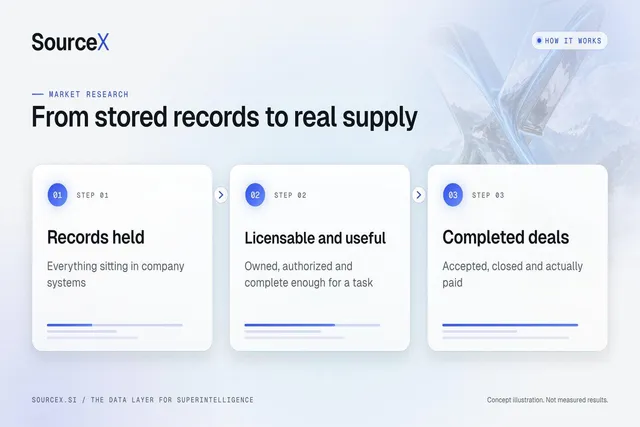
Although businesses hold large amounts of information, only a portion may be suitable for licensing. The process usually begins with an examination of the records available in company systems.
The next step is to set who owns the information and whether existing agreements allow it to be shared. Customer records, third-party material, jointly created information, etc., may have different restrictions.
After ownership is reviewed, the information needs to be verified for quality. Duplicate records, missing details, outdated files, and incomplete customer interactions can reduce its usefulness.
Privacy protection is another important part of preparation. Personal or sensitive information may need to be removed or changed prior to the dataset is delivered. Even after these steps, organisations should understand that removing identifying details cannot guarantee that information will never be linked back to an individual.
These activities influence the commercial value of a dataset. Two companies may hold similar amounts of information, but the one with better organised records and clearer ownership documents may be in a stronger position to complete a licensing agreement.
This explains why market research should distinguish between stored information, approved data, prepared datasets, and completed commercial transactions.
U.S. Market Analysis
The United States AI training data licensing market is driven by strong base of AI developers, technology companies, publishers, and digital content platforms. These organisations create demand for information that can support model development and evaluation.
The U.S. market is projected to grow at a CAGR of 35.8% through 2036. Growing investment in AI development and the increasing use of licensed content are expected to support this growth.
Another important factor is the presence of large companies that own valuable business records, media collections, as well as online communities. Their information may provide useful material for AI systems, provided the required permissions are at place.
U.S. companies are also paying greater attention to data ownership, privacy protection, and commercial agreements. These developments are encouraging interest in licensing services that connect information owners with AI developers. As the market develops, clear contracts and reliable payment arrangements are likely to remain important adoption factors.
Competitive Landscape and Key Market Participants
The market includes companies working in data licensing, content access, rights management, and commercial data distribution. Their approaches differ according to the type of information they control and the services they provide.
Some notable participants include Human Native AI, TollBit, ProRata.ai, Shutterstock, Defined.ai, and Reddit.
Human Native AI and TollBit are related with efforts to build commercial arrangements between content owners and AI developers. Their activities show the escalating need for permission-based access to digital information.
ProRata.ai focuses on content attribution and fair compensation, connecting the use of information with payment considerations. Shutterstock brings experience in licensing images and other creative assets, at the same time Defined.ai operates in the wider data supply industry, including datasets used in AI development.
Reddit represents another important part of this market through direct data licensing arrangements. Its commercial agreements show how online platforms can make controlled access to user-generated information part of their business activities.
These participants illustrate the different ways companies are approaching the commercial use of information. Some focus on connecting buyers and sellers, on the other hand some provide datasets, licensing arrangements, or systems that support attribution and compensation.
The Role of Licensing Platforms in Enterprise Data Supply
With the expanding market, businesses need ways to understand if their information is suitable for licensing without exposing confidential records too early.
This is where licensing platforms and intermediaries come in role. They aid in recognizing suitable data suppliers, review basic requirements, organise agreements, as well as manage the steps in preparing or even delivering information.
For example, the business model followed by SourceX focuses on licensing business data directly from companies for AI training and evaluation. This approach shows the role of enterprise data owners in the growing market and the importance of separating ownership checks, dataset selection, preparation, and payment.

