

Telecom operators evaluating AI use cases in telecom are often faced with several promising proposals at the same time. Network optimization may offer significant efficiency gains, predictive maintenance may reduce equipment failures, and customer analytics may improve retention and service quality. Yet the largest theoretical benefit is not always the best investment. A project built on fragmented data, complex legacy-system changes, or poorly defined outcomes can take longer and cost more than expected.
This creates a practical challenge for telecom operators: how do you identify the AI project that is most likely to deliver measurable value without taking on unnecessary implementation and operational risk?
The answer is not simply to choose the most sophisticated technology. Operators need a consistent decision model that evaluates business value, data readiness, implementation feasibility, risk, and time to measurable results.
The growing adoption of AI across telecom operations management is also supporting rapid expansion of the AI in Telecommunication Market. The market is being shaped by increasing use of machine learning, analytics, automation, and AI-enabled network management as telecom operators seek to manage increasingly complex networks and large volumes of customer and operational data. Market research also identifies AI-driven network management, machine learning, 5G, and data-intensive telecom environments as important factors supporting adoption.
AI in Telecommunication Market Size, Growth, and AI Use-Case Adoption
The increasing use of AI across network operations, customer analytics, automation, and security is creating broader demand for AI-enabled telecom solutions. As operators move from individual AI experiments toward wider deployment, investment in AI technologies and supporting infrastructure is expected to increase. This expanding adoption provides the broader market context for the growth of the AI in Telecommunication Market, which is estimated to grow from USD 5.78 billion in 2026 to approximately USD 55.76 billion by 2033, registering an estimated CAGR of 38.23% during 2026–2033.
This rapid growth also means telecom operators will face a wider range of AI investment opportunities. As the number of potential applications increases, the challenge is increasingly about prioritizing the use cases that can deliver measurable business value with manageable data, implementation, and operational risks, rather than simply identifying where AI can be applied.
AI in Telecommunication Market Trends Shaping Use-Case Adoption
Three major trends are influencing how telecom operators evaluate and deploy AI.
1. Growing Adoption of AI for Network Optimization and Automation
Telecom networks are becoming more complex as operators expand 5G infrastructure, connected devices, cloud-native networks, as well as software-defined architectures. AI can analyze network data, identify congestion, detect anomalies, with supporting automated resource allocation.
This trend increases the potential value of network optimization and automation, but at the same time raises implementation and operational risks. Use cases that can demonstrate measurable improvements in network performance with limited deployment scope may therefore rank higher than projects requiring immediate autonomous control of live networks. Controlled pilots, human oversight, and clear performance measures become important when comparing network AI investments.
However, the market impact depends heavily on implementation readiness. AI that recommends network changes to engineers presents a different risk profile from AI that automatically changes live network parameters. As a result, operators increasingly need controlled pilots and human oversight before moving toward autonomous network operations.
2. Increasing Use of AI for Customer Analytics
Telecom companies has large amounts of customer, network, billing, and usage data. Machine learning can aid identify churn patterns, understand customer behavior, personalize offers, as well as improve service interactions.
The high use of customer analytics expands AI opportunities apart from network operations and creates additional use cases across customer experience, retention, fraud management, and revenue protection. These applications can usually be tested on defined customer groups, making their financial and operational outcomes simple to measure. Hence, data availability, measurable customer outcomes, as well as the ability to run contained pilots become important factors when ranking customer centric AI projects.
3. Rising Demand for AI-Enabled Cloud and Data Infrastructure
AI applications needs reliable access to large volumes of data and sufficient computing infrastructure. Telecom operators therefore need cloud platforms, data pipelines, system integration, security controls, as well as real-time data access alongside AI models.
This trend means the feasibility of an AI project depends not only on the model but also on the infrastructure required to deploy it. A use case with strong projected returns may rank below a smaller project if it requires extensive legacy-system integration, data engineering, or infrastructure upgrades. Operators therefore need to include data readiness, implementation cost, system complexity, and deployment time when determining which AI use cases should move into pilot or production.
AI in Telecommunication Market Segmentation and Telecom AI Use-Case Analysis
For evaluating telecom AI use cases, the market can be viewed through two major classifications: technology and application. These segments provide context for the types of AI capabilities available to telecom operators and the business areas in which those capabilities are being deployed. However, segment size alone does not determine which use case should receive investment priority.
By Technology
Machine Learning
Natural Language Processing
Others
Machine learning held 44.2% of the AI in telecommunication market size in 2026, making it the leading technology segment. Its adoption is being fueled by growing network complexity, increasing volumes of customer and operational data, 5G deployment, as well as the need for predictive decision-making. Machine learning is used across applications such as customer analytics, predictive maintenance, fraud detection, network optimization, forecasting, etc., giving it high relevance in telecom operations.
Despite its leading market position, machine learning adoption does not automatically make every machine-learning application a priority for telecom operators. Investment decisions also depend on data availability, accountable business outcomes, execution of requirements, and operational risk. This distinction highlights how strong market adoption can create a broad pool of opportunities at the same time requiring operators to prioritize individual use cases based on their ability to deliver measurable value.
By Application
Customer Analytics
Network Security
Others
Customer analytics accounted for 27.98% of the AI in telecommunication market size in 2026, reflecting the growing use of AI to understand customer behavior, improve customer experience, support retention, and identify commercially relevant patterns.
Network optimization and predictive maintenance focus more heavily on network and asset operations, while fraud detection, billing automation, and customer support address commercial, financial, and customer-facing processes. Telecom operators have access to extensive customer interaction, usage, billing, and service data, creating opportunities to apply AI across these areas.
Customer analytics provides a useful example of how an AI application can be evaluated through a controlled business case. For example, an operator could test an AI-driven churn model within a defined customer group and measure retention outcomes before expanding deployment. This makes data availability, measurable financial impact, pilot scope, and implementation feasibility important considerations when ranking customer-focused AI projects. A use case with a smaller market opportunity but stronger evidence and lower implementation complexity may therefore be a more practical first investment than a larger but harder-to-validate project.
Define the Decision Before Comparing AI Projects
Translate each proposal into an operational problem
"Deploy AI in customer service" is too vague to score. Draw the workflow boundary first. Name the affected process and population, document the current baseline, spell out the proposed intervention, and put a business owner on the hook for the operating outcome.
- Network optimization: Reduce congestion-related degradation in chosen cells.
- Predictive maintenance: Flag equipment at risk of failing within a set maintenance window.
- Fraud detection: Catch suspicious subscriptions or transactions before money moves.
- Billing automation: Cut invoice exceptions and reconciliation work.
- Customer support: Improve first-contact resolution for a defined set of inquiries.
Kevin Dam and the team at Circles maintain a telecom-focused educational guide to AI use cases in telecom that maps each common application to the operational considerations behind it. The guide ties network optimization, predictive maintenance, fraud detection, billing automation, and intelligent customer support to data infrastructure and implementation cost, and it takes on privacy and legacy constraints directly. Circles CTO Kannan Alagappan puts the legacy problem plainly: "Telcos have had to rely on legacy systems to process data in batch modes, which introduces latency and inefficiencies." Read it to build a shortlist, then apply the scoring method below.
Rank AI Use Cases in Telecom With a Six-Step Process
Rank candidates by stating one measurable problem per use case and checking data readiness. Price the full implementation before scoring expected value, apply risk penalties, then fund the highest-scoring project that can show value in a controlled pilot.
1. Establish the baseline and business owner
Name an accountable executive and an operating owner who can authorize workflow changes. Build the baseline on a defined population and observation period. A fraud proposal might use confirmed losses; a support proposal might use cost per contact. Keep the evidence comparable. An incomplete baseline or calculations that shift between business units undermine any credible claim of incremental value.
2. Test data readiness before estimating model performance
Check that the required records exist and are complete enough. Confirm permitted use and access at the latency you need. Historical data feeds training and validation; live data supplies predictions and actions; outcome data shows whether those actions worked; these are three separate requirements. Archived support conversations do not, by themselves, carry reliable resolution labels.
Score readiness low when essential labels are missing or customer identifiers cannot be reconciled. Batch-oriented records earn a low score too when the intervention needs immediate decisions. Demand a tested data sample, not a promise of future access.
3. Calculate the full implementation cost
Split one-time deployment costs from recurring operating expenses. Deployment covers data engineering and cleansing plus connections to operational and business support systems. Fund the security and privacy reviews, the process redesign, and the training before production use.
Recurring expenses cover cloud infrastructure and compute, storage, and licensing. Add monitoring and ongoing model governance. False positives cost money too: investigators burn hours reviewing legitimate activity. Fold missed detections and incorrect automated actions into the estimate, with explicit frequency assumptions.
4. Score expected business value
Evaluate each use case on expected financial value, operational impact, data readiness, feasibility, risk, and time to a measurable result. Every score needs an operating baseline or a documented assumption. Measurability earns its own grade, because a plausible benefit can still resist attribution.
Estimate revenue protected or generated, then subtract recurring delivery costs. Assess avoided operating expense and outage costs without double-counting overlaps. Record customer impact separately. Shared capabilities may seed later AI use cases for telecom operations, but speculative reuse should never outweigh measurable pilot value.
5. Apply feasibility and risk penalties
Weigh privacy exposure and cybersecurity alongside model error. Look at regulatory consequences, vendor dependence, interface complexity, and automation scope. A high-value proposal can rank below a smaller project when failure could interrupt service or wrongly alter customer accounts.
Use a five-point scale: 1 means weak or unacceptable evidence, 3 means workable with material remediation, 5 means strong and validated. Reverse-score risk so greater danger lowers priority: a raw risk rating of 4 becomes a readiness score of 2.
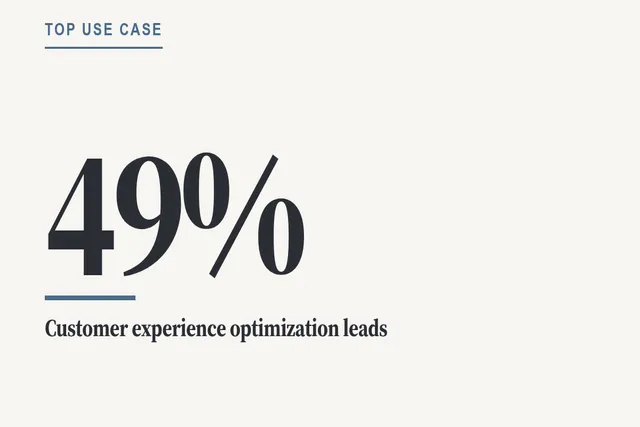 Nearly half of telecom respondents named customer experience optimization the most popular AI use case.
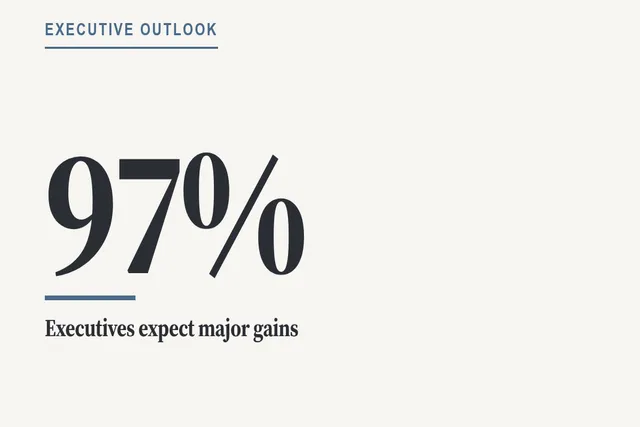 Most telecom executives expected major productivity and operational gains within five years.