When an application lags just a little, users may not be able to explain it, but they know that something is not right. A few seconds late? No thinking, no patience—click, closed tab, goodbye.
Today, speed is not measured by seconds but by reflexes. And that's exactly why infrastructure is no longer some "technical background" that no one notices but the dividing line between a product that seems powerful and one that annoys.
Bare metal servers are here! No shared physical resources, fewer virtualization layers, and more control over the hardware. There is no hypervisor between the operating system and physical hardware in a typical bare metal setup. This can reduce overhead and help avoid performance changes caused by other customers sharing the same server. This is exactly why bare metal server hosting can make a difference when every millisecond counts.
Three Key Trends in the Bare Metal Server Hosting Service Market
1. Growing Demand for Low-Latency Applications
Online gaming, fintech applications, video streaming, VoIP, and real-time analytics all depend on quick responses. Even a small delay can affect user experience, interrupt communication as well as slow down an important process.
This is increasing interest in dedicated infrastructure that offers direct access to computing resources. Bare metal servers can provide more predictable performance for applications that need consistent processing power and fast data access. As more services become interactive and data-intensive, low-latency hosting is becoming an important consideration for businesses.
2. Rising Adoption of Managed Hosting Services
Managing physical servers requires technical knowledge, regular maintenance, and continuous monitoring. Not every business has a dedicated team to handle these tasks.
Managed bare metal hosting helps address this problem. Depending on the service agreement, providers can handle server setup, hardware maintenance, monitoring, security updates, and technical support. This allows businesses to focus more on applications while reducing the burden of infrastructure management.
The trend is also creating opportunities for hosting providers that combine dedicated hardware with technical support and managed services.
3. Growth in High-Performance Computing and AI Workloads
AI processing, complex data analysis, and high-performance computing (HPC) require substantial computing power. Some workloads also need direct access to specialized hardware and consistent performance over long processing periods.
Bare metal servers can support these requirements by providing dedicated CPU, memory, storage, and, where available, GPU resources. Hardware can be selected according to the application, making the setup useful for demanding workloads.
This trend is expanding the role of bare metal hosting beyond traditional websites and enterprise servers. It is also increasing the need for hosting providers that can offer suitable configurations for different workloads.
Bare Metal Server Hosting Service Market Outlook
These trends are part of a wider shift towards infrastructure that offers greater control, predictable performance, and flexible hardware configurations.
According to Coherent Market Insights (CMI) market intelligence, the Bare Metal Server Hosting Service Market is projected to reach USD 7.4 Billion in 2026 and USD 12.4 Billion by 2033, growing at a CAGR of 7.6% during the forecast period.
The market is supported by demand for dedicated computing resources, growing data volumes, and applications that require reliable performance. While virtualized and cloud environments remain important, some businesses prefer dedicated hardware for workloads that need greater control over computing resources.
Market segmentation also shows how hosting requirements vary by service model, application, operating system, deployment, pricing model, processor architecture, end-user industry, and region. Managed services and high-performance computing are particularly relevant to latency-sensitive applications because they address infrastructure management and processing requirements.
Bare Metal Server Hosting Service Market Segmentation
The bare metal server hosting service market covers several segments based on how servers are provided, configured, deployed, and used.
The market categories covered in the linked Coherent Market Insights report include:
- By end-user industry: IT and telecommunications and other industries.
- By service model: Managed and other service models.
- By operating system: Linux and other operating systems.
- By application: High-performance computing and other applications.
- By deployment: Off-premises and other deployment models.
- By off-premises deployment: Managed data centers and other deployment options.
- By pricing model: Subscription and other pricing models.
- By processor architecture: x86 and other architectures.
- By region: North America, Europe, Asia-Pacific, and other regions covered by the report.
These segments reflect different business needs. Some organizations need direct access to hardware for demanding applications, while others prefer managed services to reduce daily maintenance work. Deployment location and pricing also affect the choice of hosting provider.
Managed Services Segment
As per CMI, managed services are slated to account for a market share of 58% in 2026, making it the leading service-model segment.
Managing a bare metal server involves more than choosing the right processor and memory. Hardware monitoring, maintenance, operating system updates, security as well as troubleshooting also need attention. Managed services help businesses handle these responsibilities without requiring every task to be completed internally.
This model is useful for e-commerce platforms, financial applications, gaming services as well as business-critical databases that need reliable infrastructure. A managed provider can also help identify hardware or configuration problems that may affect performance.
The segment contributes to the overall market by making dedicated infrastructure easier to operate for businesses with limited IT resources. For latency-sensitive applications, the combination of dedicated hardware and suitable technical support can help maintain stable performance.
High-Performance Computing Segment
According to Coherent Market Insights, high-performance computing is projected to hold a market share of 30% in 2026. HPC workloads include scientific simulations, engineering calculations, complex data analysis as well as some AI-related tasks. These applications may process large amounts of data or perform calculations that require substantial CPU, memory, storage, and network capacity.
Bare metal servers can support these workloads by providing dedicated resources and allowing hardware configurations to match the task. Some deployments also use specialized accelerators for particular types of processing.
The segment contributes to the wider market because organizations across research, technology, finance as well as industry need more computing power for increasingly complex tasks. Bare metal is not the only option for HPC, but it can be useful where hardware control, consistent performance, and workload-specific configuration are priorities.
U.S. Bare Metal Server Hosting Service Market Analysis
The United States is an important market for bare metal server hosting because of its large technology sector, data center infrastructure as well as rising demand for enterprise computing services. Businesses in IT and telecommunications, financial services, healthcare, gaming, and e-commerce need reliable infrastructure to support data-intensive and time-sensitive applications.
Adoption is being supported by AI workloads, real-time analytics, online services, and the need for dedicated computing resources. Managed hosting can also help organizations that need high-performance infrastructure but have limited internal IT resources.
CMI estimated North America to account for 38% of the global market in 2026. The region's established data center networks and connectivity options make it an important location for hosting providers and customers serving North American audiences.
Server location, network quality, hardware availability, data protection as well as technical support remain key factors for U.S. businesses choosing a provider. As demand for AI and other demanding workloads grows, bare metal hosting can remain a useful option for applications that require dedicated computing resources and predictable performance.
Key Players in the Bare Metal Server Hosting Market
The market includes infrastructure manufacturers, cloud providers, hosting companies, and data center operators. Their services differ in hardware choices, managed support, deployment locations, and pricing models.
Key participants in the wider market include:
- IBM
- Oracle
- Alibaba Group
- OVHcloud
- Equinix
- Rackspace Technology
- Hewlett Packard Enterprise (HPE)
- Dell Technologies
- NTT
- Digital Realty
These companies operate across different parts of the hosting and infrastructure ecosystem. Some provide dedicated server and cloud services, while others focus on hardware, data center facilities, or managed infrastructure.
For businesses choosing a bare metal provider, the main considerations include server specifications, network availability, data center location, support quality, security features as well as pricing. The lowest price is not always the best choice when an application needs consistent response times or specialist technical support.
What are Bare Metal Servers?
A physical server that is dedicated to a single customer. No sharing of the server's main physical resources with other customers, as happens in many multi-tenant virtualized environments.
Unlike virtual machines, a dedicated bare metal server gives direct access to CPU, RAM, disk and well as network resources. Everything that happens on that server depends on the workloads and configurations running on it.
Why is this important for latency?
Because every additional layer can introduce some overhead. Hypervisors, shared storage, and network configurations can all affect response times, depending on how they are set up. In real-time systems, that small delay can quickly turn into a problem.
What Is Latency?
That's how fast the system reacts. Online gaming, fintech applications, video streaming, AI inference, VoIP, IoT… they all have one thing in common: they can't stand waiting.
And that's not just a subjective impression. The FCC clearly states in its reports that increased latency directly affects the quality of user experience, especially with interactive and real-time services such as cloud applications, online platforms as well as communication systems. In other words, the longer the delay, the more pronounced the feeling of "slowness".
Where Do Experts Fit In?
The real question: who will set it all up? Because poorly tuned bare metal is like a sports car in first gear. That's why many rely on the experts at Atlantic, who help maximize the potential of a bare metal server hosting environment—from hardware selection to network and system optimization. Less guesswork, more concrete results.
Why Are Bare Metal Servers Faster?
They remove everything that slows down the application, leaving only what it really needs. With latency-sensitive systems, there is no room for improvisation—performance must be stable, predictable, and constant.
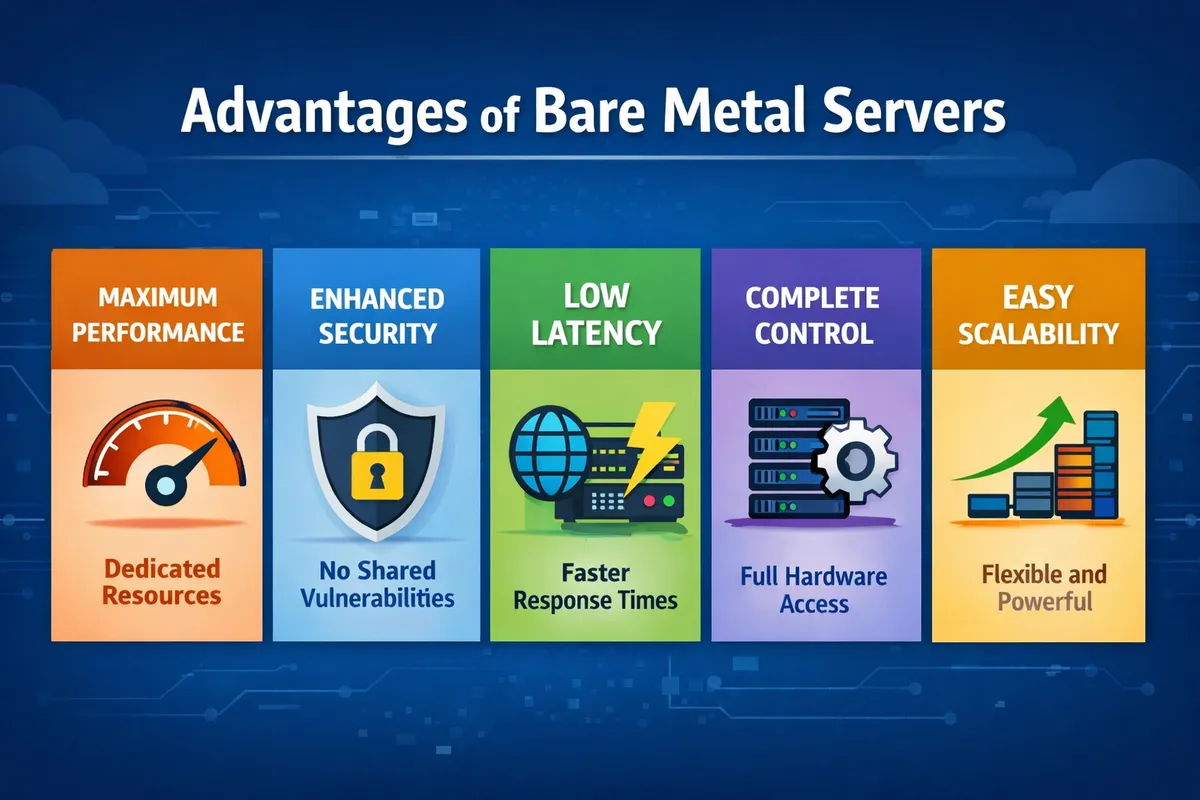
- No "noisy neighbor" effect: No sharing of CPU, memory or I/O resources; no one else can "steal" your server power at the worst possible moment, which means stable performance without unpleasant surprises.
- Direct access to hardware: Without a hypervisor, there is no additional layer that introduces latency. Less overhead means faster task execution, lower latency as well as more reliable application behavior—especially important for real-time workloads.
- Predictability: The power of bare metal servers is precisely that consistency: you know what you're getting today, tomorrow, and a month from now. And every time.
When Configuration Makes a Difference
Not all workloads are the same. Some need raw CPU power, others require memory, and others need ultra-fast storage. That's why custom bare metal servers are so popular.
-
36-Core Bare Metal Server
If complex analyses, AI models, or intensive real-time processing are involved, a 36-core bare metal server can provide more parallel processing capacity. More cores can help run multiple tasks at once, provided the application can use them effectively.
Whether the choice is Intel bare metal servers for workloads that benefit from specific processor features or AMD bare metal servers for configurations with high core counts and competitive price-to-performance, the point is the same: hardware should match the use case.
Core count alone does not determine performance. Processor generation, memory, storage, and application design also matter.
Server Location
Strong hardware and a perfectly tuned system cannot fully overcome the effects of a server located far from its users. Data still needs to travel across networks, and distance can add latency.
That's why server location plays a huge role in performance. The closer the server is to users, the faster the responses and the more stable the application. This is especially important for real-time and latency-sensitive systems, where even small differences in latency become noticeable.
In this context, USA Bare Metal Server Hosting makes sense for applications targeting the North American market. When you use a dedicated bare metal server close to your audience, you get predictable performance, lower latency as well as a more reliable user experience.
Security and Performance
At first glance, security and speed seem like a compromise. However, this is not the case with bare metal servers. When there are no shared resources, there are no typical problems of a multi-tenant environment, such as side-channel attacks that exploit shared hardware.
Vulnerabilities like Specter and Meltdown have just shown how risky shared CPU and memory can be. Researchers explain in detail why shared hardware increases security risks.
This is why a dedicated bare metal server is often used in regulated industries. Isolated hardware means a smaller attack surface but also more stable performance—no extra layers to slow down the system.
Scaling
At first, it sounds illogical: how can something that is a physical server scale easily? Cloud platforms and virtual machines are often associated with quick expansion. But buying bare metal server hosting today does not mean being stuck with one machine forever.
When an application starts to grow, there are several options. Additional dedicated bare metal servers can be added and workloads distributed through a load balancer. An existing server can be replaced with a stronger configuration with more cores or RAM. A specialized server can also be used for a database, cache as well as real-time processing.
The key here is control. With a bare metal environment, the organization can identify where an application is running, what resources it uses, and how it behaves under load. When capacity is added, additional physical resources can be configured for specific needs. This helps keep performance more predictable, although scaling speed and costs depend on the provider and available hardware.
Conclusion
Latency is unforgiving. Users don't wait. Applications that respond quickly can provide a better experience, especially when real-time interaction matters.
This is exactly where the benefits of bare metal servers can be seen. Dedicated hardware, direct resource access as well as greater control can help reduce some sources of delay and improve performance consistency.
The Bare Metal Server Hosting Service Market is supported by demand for dedicated infrastructure, managed services, and high-performance computing. Managed hosting can reduce the burden of server maintenance, while HPC workloads continue to create a need for powerful and configurable systems.
Bare metal is not the right choice for every application. Shared and virtualized infrastructure may suit workloads that need rapid provisioning or flexible resource sharing. But when latency, hardware control, and consistent performance are priorities, bare metal hosting is worth considering.

