Most wholesale distributors still rely on spreadsheets that ignore backorders, inbound stock, and supplier lead times. This is becoming harder to justify as the industrial distribution business grows more complex and digitally connected. The global industrial distribution market is estimated to be valued at USD 7,811.72 billion in 2026 and is expected to reach USD 10,771.13 billion by 2033, exhibiting a CAGR of 5.5% from 2026 to 2033. Increasing industrialization, manufacturing activity, automation, and the need for greater supply-chain efficiency are all adding pressure on distributors to know exactly what they have, what is already committed, and what is arriving.
That makes inventory software less about simply counting boxes and more about making the next purchasing decision at the right time. This guide compares the 10 best inventory software options for wholesale distributors on how each calculates available-to-sell stock and automates replenishment.
What an available-stock reorder point means
The textbook formula is
Reorder point = average demand during lead time + safety stock
Some units are already promised and others are still on the truck, so the number that should trigger a purchase is:
Available stock = on-hand − allocated + inbound
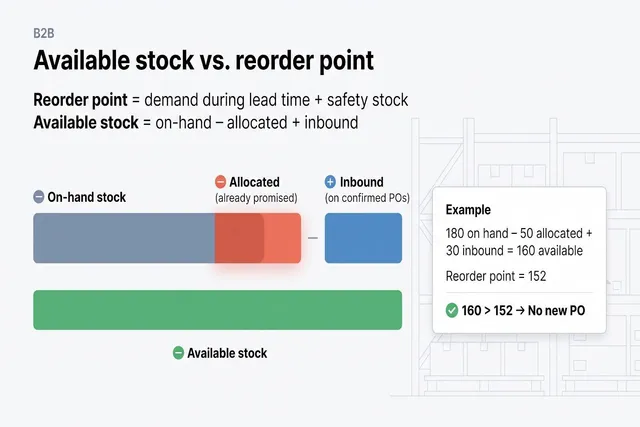
Counting on-hand stock alone leads to double-buying.
The challenge becomes even more obvious in industrial distribution, where inventory can span everything from electrical components and fasteners to HVAC equipment and safety supplies. By product type, Electrical Supplies are expected to contribute 30.0% of the industrial distribution market in 2026, supported by their widespread use across industrial operations for power distribution and control. The broader product landscape includes Electrical Supplies, Fasteners, Tools and Hardware, HVAC Equipment, Safety Supplies, and Others.
For software buyers, that diversity matters. A distributor handling cables, switchgear, tools, or HVAC components may have completely different demand patterns, lead times, and stocking requirements. The right inventory platform therefore needs to understand more than a simple minimum-stock number.
The 10 best platforms for wholesale distributors
Organizely: best for distributors that also manufacture
Website: https://organizely.io
Organizely works differently from the inventory systems below. Instead of a stock ledger with reorder rules, it deploys AI agents for manufacturing that connect materials, equipment, and labor. When an order arrives, an agent maps the materials, machines, and people it needs, flags shortages and conflicts before work starts, and drafts purchasing, production, and staffing plans for the team to review and approve. When conditions on the floor change, it reworks the plan and flags what moved.
For a distributor that also assembles, kits, or manufactures part of what it sells, this puts the reorder decision in context: a purchase is timed against production requirements, current stock, and incoming deliveries rather than a fixed threshold. The agents coordinate work across the team and the systems already in place.
Limitation: it is built for manufacturing operations, not pure resale. Distributors that only buy and resell finished goods will get more from the inventory-first tools below.
Zoho Inventory: best for simple multi-warehouse reorder rules
Zoho Inventory sets item- and warehouse-level reorder points and maximum stock caps. A low-stock report turns suggestions into purchase orders with one click.
Limitation: the Enterprise tier caps usage at huge orders per month, and Zia’s forecasts are lighter than Cin7 or Fishbowl’s planning modules.
inFlow Inventory: best for straightforward reorder-point management
inFlow Inventory keeps the math visible. Its Reorder Point screen shows on hand, available, and current anticipated stock (on hand minus reserved plus open POs), and one click turns a suggestion into a purchase order or transfer.
Limitation: demand forecasting needs the StockTrim integration, and the Small Business plan still applies monthly sales-order caps.
Cin7 Core: best for multichannel wholesale distribution
Cin7 Core tracks on-hand, allocated, and on-order quantities per location, so low-stock rules fire only when your net position drops below target. The Inventory Velocity report suggests reorder quantities, and the ForesightAI add-on drafts purchasing for approval.
Limitation: EDI for big-box retailers runs through partners such as SPS Commerce.
Unleashed: best for traceability and light manufacturing
Unleashed captures lot and serial numbers, expiry dates, and landed costs on every receipt. Advanced Inventory Manager weighs sales velocity, lead times, and buffer targets before drafting purchase orders you approve, and kits and assemblies are native.
Limitation: no built-in EDI, and every tier carries a monthly sales-order cap.
Fishbowl: best for QuickBooks-centered distributors
Fishbowl adds barcode-driven warehouse control while keeping the general ledger in QuickBooks. Two-way sync updates item masters, costs, and vendor bills, and Auto PO raises purchase orders from reorder points for review.
Limitation: pick-pack workflows, automated reordering, and multichannel selling start at the Growth tier.
Odoo Inventory: best customizable ERP and replenishment engine
Odoo is an ERP toolkit. Its Inventory app runs barcode receipts, put-away rules, and min/max reordering rules that launch purchase orders, transfers, or manufacturing orders when projected stock drops below minimum.
Limitation: rules must be configured per product with no guided setup. Small wholesalers wanting plug-and-play inventory control will deploy faster on Zoho or inFlow.
Acumatica Distribution Edition: best mid-market distribution ERP
Acumatica Distribution Edition unifies inventory, finance, and customer data for multi-entity firms. Set min/max, days-of-supply, MRP, or DRP policies per item or warehouse; the 2026 R1 release counts in-transit stock toward available balance before proposing a transfer or PO.
Limitation: marketplace connectors beyond the native Shopify and BigCommerce links come from partners, and setup needs a skilled VAR.
NetSuite: best enterprise cloud ERP
NetSuite gives distributors with dozens of subsidiaries and currencies one system for demand planning, multi-location inventory, purchasing, WMS, and financials. Pick time-phased, reorder point, min/max, or full MRP replenishment per item and location, and NetSuite generates purchase, work, or transfer orders in one scheduled run.
Limitation: rollout is a large project, so single-entity distributors may find Acumatica or Cin7 Core a lighter fit.
Epicor Prophet 21: best for industrial branch networks
Epicor Prophet 21 was built for pipe, wire, HVAC, and MRO distributors running dozens of walk-in branches. Its purchasing engine weighs branch demand, inter-branch transfers, and vendor lead times before suggesting buys, and merged POs aggregate requirements across locations.
Limitation: rollouts need an implementation partner, so ecommerce-first wholesalers should look at Cin7 Core or Fishbowl.
The way products reach customers matters almost as much as what is being stocked. By distribution channel, Direct Sales is expected to account for 42.7% of the industrial distribution market in 2026, with the wider channel mix covering Direct Sales, Online Sales, Distributors, and Retail Stores. Direct relationships remain important for industrial buyers because bulk orders, specialized requirements, delivery coordination, and after-sales support can make a simple online transaction insufficient.
That has a direct implication for inventory software. When a distributor works closely with industrial customers through direct sales, the inventory system has to keep purchasing, customer commitments, warehouse availability, and delivery schedules aligned. A reorder recommendation that ignores those relationships can create as many problems as it solves.
The same dynamic is visible in the U.S. Industrial Distribution Market, where established distributors serve manufacturers, contractors, and other industrial buyers through extensive product and logistics networks. Industrial distributors in the region are also investing in technical expertise, product customization, inventory management, and digital capabilities to meet increasingly specific customer requirements.
How to choose wholesale inventory software
- Map every inventory event from PO creation to customer delivery.
- Give every vendor the same scenario (100 on hand, 40 reserved, 20 allocated, 50 inbound, 8 units a day, 14-day lead time) and ask for the reorder suggestion.
- Check whether the tool only alerts or can draft and approve POs and transfers with an audit trail.
- Project three-year total cost, including users, locations, integrations, and onboarding.
The competitive landscape also reflects how broad industrial distribution has become. Major players include Grainger, Inc., Fastenal Company, MSC Industrial Direct Co., Inc., W.W. Grainger, Inc., McMaster-Carr Supply Co., Rexel Holdings USA Corp., Ferguson Enterprises, LLC, Sonepar Group, Lawson Products, Inc., Anixter International Inc., Amazon Business, HD Supply Holdings, Inc., Arrow Electronics, Inc., Motion Industries, Inc., and Kaman Corporation. Their presence across different industrial product categories and customer channels illustrates why distributors increasingly need inventory systems that can handle more than basic stock counts.
Conclusion
Choosing wholesale inventory software comes down to reorder-point accuracy, workflow fit, and total cost. Run the available-stock scenario above with every vendor and the field narrows to two or three platforms.

