

Global 3D Printed Battery Market Size and Forecast – 2026 To 2033
The global 3D printed battery market is expected to grow from USD 98 Mn in 2026 to USD 612 Mn by 2033, registering a compound annual growth rate (CAGR) of 21% from 2026 to 2033. The global 3D printed battery market is driven by increasing investments in solid-state battery technologies. On September 15, 2025, SK On opened its all-solid-state battery pilot plant in Daejeon, South Korea, significantly increasing investment in commercialization of sulfide- and polymer-based solid-state battery technologies with commercialization targeted before the end of the decade.
Key Takeaways of the Global 3D Printed Battery Market
- The lithium-ion batteries segment is expected to account for 37.0 % of the global 3D printed battery market share in 2026. Rapid advancements in additive manufacturing materials is driving the growth of the segment. On April 9, 2026, Stratasys Ltd. unveiled a slate of new application-driven capabilities, materials, and platform enhancements designed to empower manufacturers to push additive manufacturing beyond concept models and into production parts faster than ever.
- The electrodes segment is estimated to capture 41.0 % of the market share in 2026. Rising defense and aerospace demand for lightweight batteries is majorly driving the growth of the segment. On July 8, 2025, OKI Electric Cable launched custom long flexible printed circuits (FPCs) for the New Space industry, enabling small-lot production of lightweight and thin flexible circuits for rockets and satellites.
- The inkjet printing segment is estimated to capture 36.0 % of the market share in 2026. Expansion of flexible and printed electronics manufacturing is driving the growth of the segment. On September 8, 2025, TracXon, a deep-tech spin-off from TNO, secured USD 5.50 million in seed funding to accelerate the industrialization of hybrid printed electronics (HPE)
- North America is expected to dominate the 3D printed battery market in 2026 with a market share of 39.0 %. Growing electric vehicle battery prototyping applications in North America is driving the growth of the regional market. On October 30, 2025, Solid Power, Inc, a leading U.S.-based developer of solid-state battery technology, announced a strategic collaboration with Samsung SDI and BMW to pursue development and validation of a demonstration vehicle powered by all-solid-state battery (ASSB) technology.
- Asia Pacific is expected to account for 28.0 % of the market share in 2026 and is projected to record the fastest growth over the forecast period. Expansion of smart packaging with embedded power sources across Asia Pacific is driving the growth of the regional market. On September 25, 2025, Strategic Elements announced the advancement of its Energy Ink printable energy technology in Australia, targeting self-powered electronics and smart packaging applications.
- Rapid commercialization of solid-state 3D printed batteries: Battery developers are increasingly looking to additive manufacturing of solid-state batteries to deliver increased energy density, improved safety and compact cell topologies. Advanced ceramic electrolytes and printable solid electrolytes are driving next-generation battery designs for electric vehicles, aircraft and medical equipment.
- AI-driven battery design integrated with additive manufacturing: AI and simulation platforms are being paired with 3D printing to improve the electrode geometry, material distribution and electrochemical performance before manufacture. This method reduces the time it takes to produce products, but also makes the batteries more efficient and wastes less material.
Segmental Insights
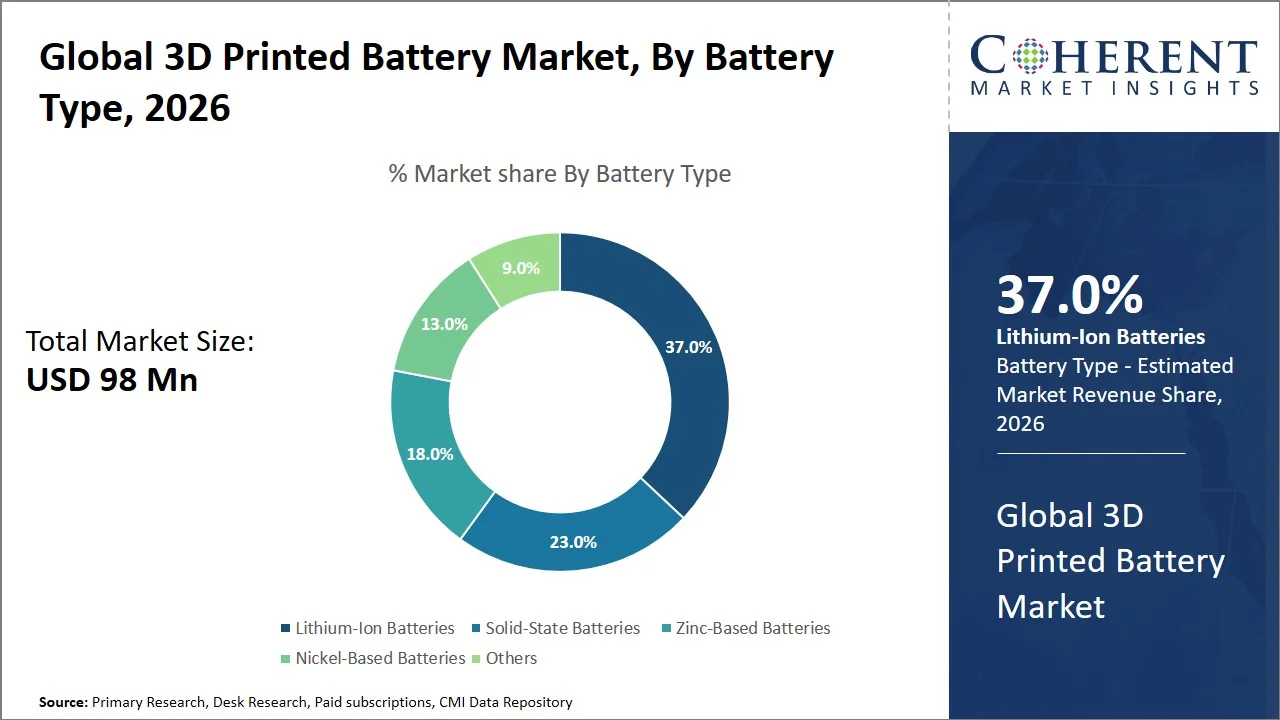
Why Does Lithium-Ion Batteries Dominate the Global 3D Printed Battery Market?
The lithium-ion batteries segment is expected to account for 37.0% of the global 3D printed battery market share in 2026. Lithium-ion batteries are still the most common form of battery due to their high energy density, allowing for small and light-weight 3D printed batteries with high power output. This feature makes them ideal for advanced applications such as wearable electronics, medical devices, electric vehicles, aerospace systems and industrial IoT devices, where optimal energy storage in limited space is critical. Furthermore, the prevalence of lithium-ion materials, combined with proven manufacturing skills and compatibility with sophisticated additive manufacturing techniques, supports their broad acceptance in commercial and research applications. On October 29, 2025, Sakuu verified lithium-ion battery cells made using its Kavian additive manufacturing technology, as it displayed a dry-printed nickel manganese cobalt (NMC) cathode that held 83% of capacity after 4,000 cycles.
- Current Industry Events of 2026
- Market Size Estimation
- Regional Breakdown
- Competitive Landscape
- Customer Intelligence
- Segmental Analysis
- Pricing Analysis
- Key Market Drivers, Challenges & Future Trends
- Customized Insights Section
Why are Electrodes the Most Crucial Component?
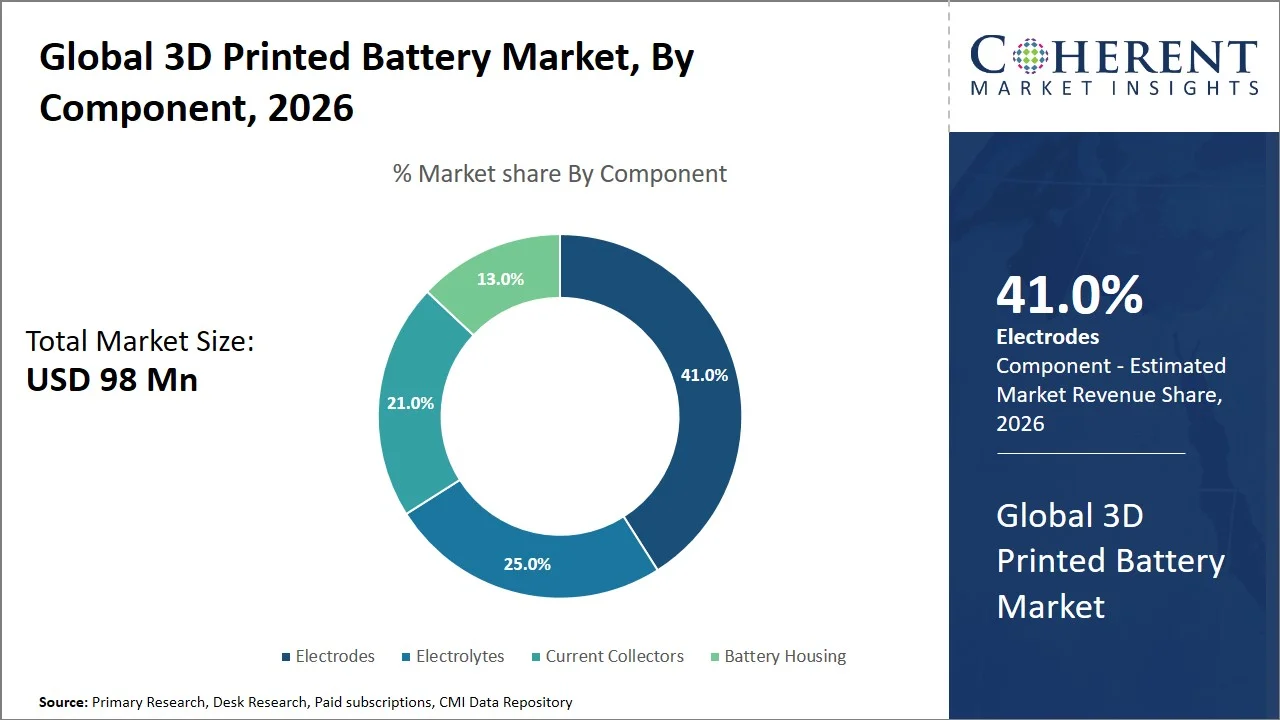
The electrodes segment is expected to account for 41.0% of the global 3D printed battery market share in 2026. The most important elements are electrodes, which directly define the energy storage capacity, charging speed, power output, and the overall electrochemical performance of batteries. The ability to create highly tailored electrode geometries with enhanced surface area and optimized interior structures that promote ion transport and electron flow is made possible by improved additive manufacturing in 3D printed batteries. This ability increases battery efficiency and reduces material consumption . The use of printed electrodes is crucial for the development of small, light, and high-performance batteries for applications in electric vehicles, medical devices, aerospace systems, and wearable electronics . On March 23, 2026, Ateios Systems and Kodak announced the expansion of the Ateios RaiCore battery electrode platform to three of the world’s most widely used cathode chemistries, Lithium Cobalt Oxide (LCO), Lithium Iron Phosphate (LFP), and Nickel Manganese Cobalt (NMC), while earning third-party verifications for eliminating perfluoralkoxy alkane (PFA) forever chemicals.
Inkjet Printing Dominates the Global 3D Printed Battery Market
The inkjet printing segment is expected to account for 36.0% of the global 3D printed battery market share in 2026. Due to the very small material loss and high precision of depositing functional battery materials, inkjet printing is the most recommended method for the manufacture of complicated electrode patterns as well as thin film battery structures. This method enables the printing of conductive inks and active materials with high resolution onto diverse surfaces. It is ideally suited for producing small, light and customizable batteries. It is still a significant manufacturing method for wearable electronics, medical devices, sensors, and other small electronic applications due to its scalability to production, reduced material use, and capability to create complex battery structures. On June 3, 2025, Xaar teamed with Sokan New Materials Group to develop battery coating technology based on inkjet for electric car applications. Xaar’s eX and Nitrox eX printheads are enabling the deposition of new coating fluids with increased layer uniformity, dielectric strength and endurance, aiding the move from traditional coating techniques to precision inkjet manufacturing in next generation battery manufacture.
Current Events and their Impact
Current Events | Description and its Impact |
European Union - Batteries Regulation (EU) 2023/1542 (Implementation Phase 2024–2026) |
|
United States – Inflation Reduction Act Battery Manufacturing Incentives (Implementation 2024–2026) |
|
Global 3D Printed Battery Market Dynamics
Market Drivers
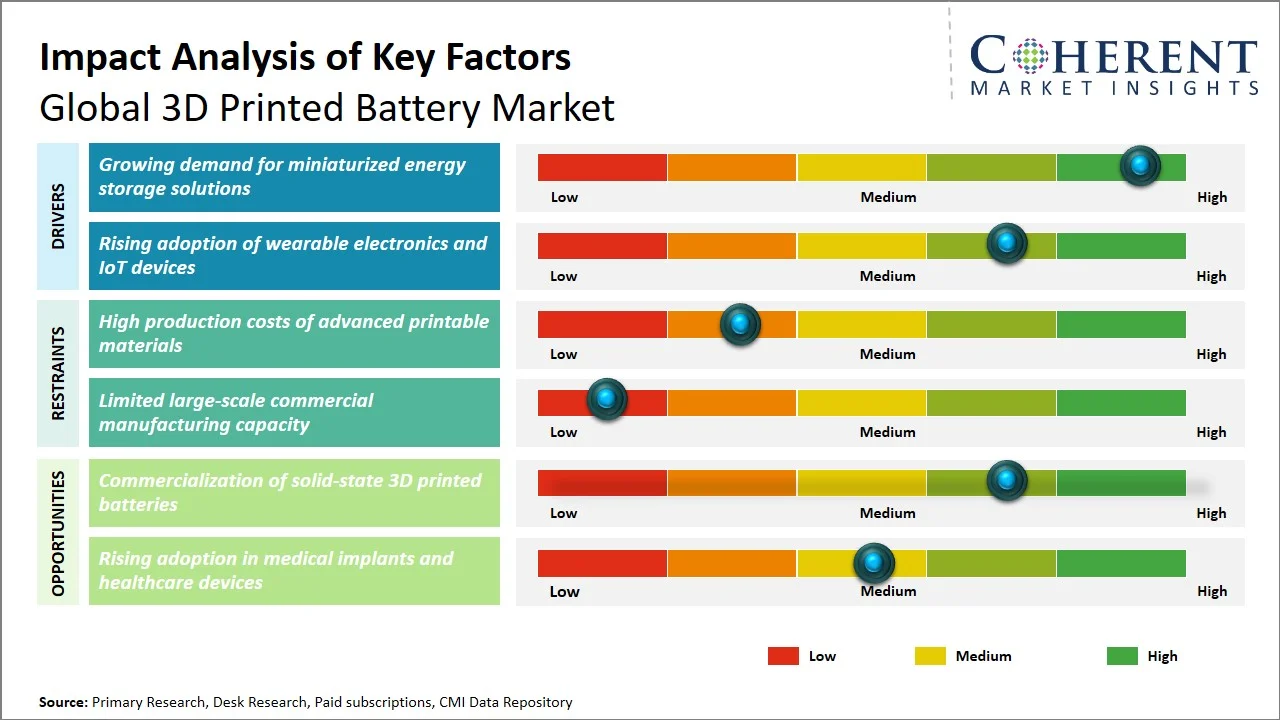
- Growing demand for miniaturized energy storage solutions: The growing need for smaller, lighter and more efficient electronic devices is driving the demand for miniaturized energy storage solutions, presenting considerable prospects for 3D printed batteries. Additive manufacturing enables the fabrication of small battery designs with complex internal structures, which optimizes energy density and minimizes overall size and weight. This feature is particularly useful for the applications in medical implants, smart sensors, microelectronics, aerospace components and future generation portable devices, where conventional battery designs can be limited in shape and space usage. On November 26, 2024, ITEN, a pioneer in the development and production of solid-state batteries for electronics markets, announced the production launch of its new Powency family of rechargeable Li-ion batteries. The new family consists of high-power density batteries, including for now the PWY0150S battery, available in pre-production, and the PWY0250S battery, available as engineering samples.
- Rising adoption of wearable electronics and IoT devices: The increasing adoption of wearable electronics and Internet of Things devices is increasing the demand for customized batteries that can match the different product designs and provide reliable performance. The use of three-dimensional printing enables the manufacturing of flexible, lightweight, and application-specific batteries, which can be easily integrated into smartwatches, fitness trackers, health monitoring devices, industrial sensors, and connected consumer gadgets. As the number of connected devices increases, the demand for high-performance 3D printed batteries with customized form factors is likely to expand significantly. On October 27, 2025, IDO announced its IDR01 smart ring, driven by Nordic Semiconductor’s ultra-low-power nRF54L15 SoC and including integrated PPG, accelerometer and skin temperature sensors to provide continuous health monitoring. The device highlights the increasing need of compact wearable platforms demanding very efficient power management, which in turn leads to the attention on miniature batteries and innovative printed energy storage technologies.
Emerging Trends
- Expansion of multi-material and micro-scale battery printing technologies: Manufacturers are using multi-material additive manufacturing that can print electrodes, electrolytes, and current collectors in a single manufacturing process. This trend is boosting the development of tiny batteries for wearables, implantable medical devices, IoT sensors and MEMS applications.
- Growing adoption of decentralized and on-demand battery manufacturing: Industries are progressively adopting 3D printing to manufacture customized batteries closer towards end-use locations, decreasing supply chain dependency and inventory expenses. The trend is especially picking up in defense, space exploration, industrial automation, and specialty electronics, where you need to make batteries in low volumes yet with great performance.
Regional Insights
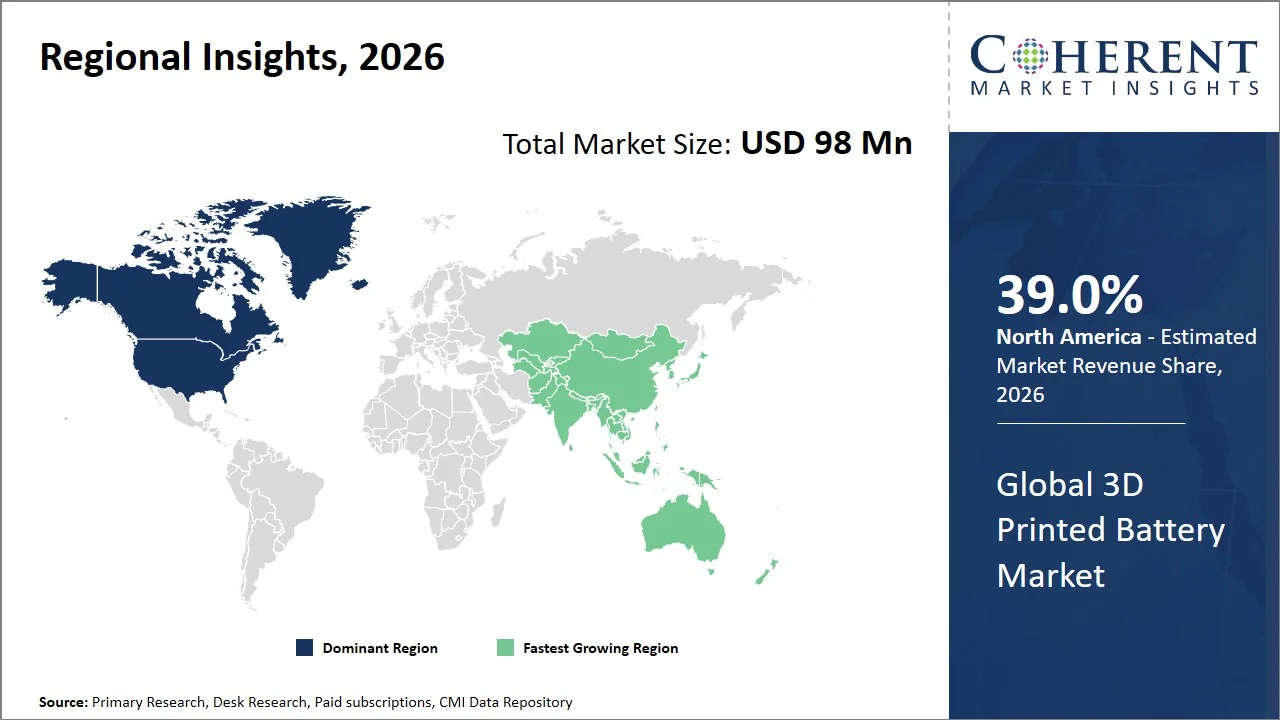
Why is North America a Strong Market for 3D Printed Battery?
North America is expected to account for a market share of 39.0% in 2026. North America continues to lead the way in 3D printed batteries with robust government-backed research programs, excellent additive manufacturing capabilities and several pioneering battery firms. And the U.S. Department of Energy continues to support research into additively manufactured lithium-ion and solid-state batteries, through programs led by the Advanced Research Projects Agency-Energy (ARPA-E), Oak Ridge National Laboratory and Argonne National Laboratory.
Sakuu has built prototype production facilities for its Kavian platform that will make customized 3D printed batteries for electric vehicles and industrial uses, while Nano Dimension has improved its additive electronics capabilities to enable the integration of printed energy storage. Universities including Harvard University, Carnegie Mellon University and the Massachusetts Institute of Technology are actively working on architected microbattery designs with improved energy density using sophisticated printing techniques. The area also benefits from collaboration between aerospace businesses, defense agencies and medical device makers on lightweight batteries with bespoke shapes for mission specific uses.
Why Does the Asia Pacific 3D Printed Battery Market Exhibit High Growth?
Asia Pacific is projected to account for 28.0% of the global 3D Printed Battery market in 2026 and expected to register the fastest growth. Battery producers in the Asia Pacific are rapidly adopting additive manufacturing at a fast pace to accelerate the development and pilot-scale production of innovative batteries. China, Japan and South Korea together account for the bulk of global lithium-ion battery manufacturing capacity, providing a perfect ecosystem for the commercialization of 3D printed battery technologies. China’s national advanced manufacturing programs encourage research into printable electrodes and solid-state battery architectures, while Japanese organizations such as the National Institute for Materials Science and RIKEN are still working on next-generation battery materials that are compatible with additive manufacturing. The leaders of South Korea’s battery industry are spending substantially in digital manufacturing technology to speed up the creation of prototypes for electric vehicles and consumer devices. Regional universities and research institutes are increasingly producing printable ceramic electrolytes, graphene-based electrodes, and flexible battery components designed for wearable electronics, robotics, and smart industrial sensors.
Global 3D Printed Battery Market Outlook for Key Countries
Why is the U.S. Emerging as a Major Hub in the 3D Printed Battery Market?
The US is the leader in technology development due to a combination of federal financing, private investment, and high-end manufacturing infrastructure. Sakuu is a leader among firms commercializing multi-material battery printing platforms that can produce lithium-metal batteries with less material waste and more manufacturing efficiency. Additive manufacturing for military and aerospace applications Oak Ridge National Laboratory has exhibited sophisticated 3D printed battery topologies. Argonne National Laboratory is still developing printable cathode materials and next-generation battery chemistries. Grants from the Department of Energy for battery manufacturing and recycling have bolstered domestic partnerships for research among universities, national laboratories, and industrial businesses. Other companies, such as Nano Dimension, are developing printable electronics capabilities that allow batteries to be seamlessly integrated with printed circuits for tiny electronic devices.
Is China the Next Growth Engine for the 3D Printed Battery Market?
China has been one of the most active countries in 3D printed battery development, with its leading battery production ecosystem and strong investment in sophisticated manufacturing technology. Leading universities such as Tsinghua University, Shanghai Jiao Tong University and the Chinese Academy of Sciences are working on printable lithium ion electrodes, microbatteries and solid-state battery materials for next-generation devices. Government initiatives promoting smart manufacturing and enhanced energy storage have fast-tracked the commercialization of additive manufacturing processes for battery components. The large battery makers are still considering additive manufacturing for rapid prototyping, unique cell designs and material optimization, especially for electric vehicles, drones, robots and renewable energy storage systems. In addition, China’s robust local supply chain for lithium minerals and battery components also allows for a more rapid scale-up of new battery production technologies.
Germany 3D Printed Battery Market Analysis and Trends
Germany is a leading European center of sophisticated battery engineering, underpinned by a strong industrial automation know-how and world-class additive manufacturing capabilities. Research institutions such as the Fraunhofer Society, the Karlsruhe Institute of Technology and RWTH Aachen University are working on printable electrodes, solid electrolytes and high-performance battery architectures for use in electric mobility and industry. Blackstone Resources has announced the launch of one of the largest 3D printed battery production ventures in Europe, based on thick-layer battery technology that cuts manufacturing stages and increases energy density. German automotive suppliers and engineering businesses are increasingly teaming up with specialists in additive manufacturing to produce specialized batteries for premium electric vehicles and aerospace applications. Government-supported funding through the country’s battery innovation programs continues to support pilot-scale production and advanced manufacturing research.
Japan 3D Printed Battery Market Analysis and Trends
Japan’s strength comes from its expertise in battery materials, precision manufacturing and sophisticated ceramics. The National Institute for Materials Science, RIKEN and top universities are developing printable solid-state electrolytes, lithium materials and microbattery technologies for next-generation devices. Companies such as Panasonic Energy and Murata Manufacturing are developing innovative manufacturing methods to enhance battery downsizing and performance for consumer electronics and medical equipment. Researchers in Japan have shown that high-resolution additive manufacturing methods can be used to create complicated battery structures with superior ion transport properties. The government’s focus on building resilient supply chains for batteries and sophisticated manufacturing is also fostering collaboration between research institutes and industrial enterprises.
South Korea 3D Printed Battery Market Analysis and Trends
The commercialization of solid-state 3D printed batteries is gaining momentum as firms shift from lab size prototypes to pilot production, using additive manufacturing technologies that can build electrodes and solid electrolytes in one single integrated structure. Sakuu has scaled its Kavian platform to manufacture lithium-metal semi-solid and solid-state battery cells with reduced manufacturing steps and less material waste, and Blackstone Resources has validated thick-layer 3D printed battery technology that cuts solvent-heavy manufacturing and facilitates higher active material loading. Research institutions including Oak Ridge National Laboratory, the National Institute for Materials Science in Japan, and the Fraunhofer Society in Germany are verifying printable ceramic electrolytes and architected electrode designs that increase ionic conductivity and thermal stability.
Global 3D Printed Battery Market - Advancement of Solvent-Free Electrode Manufacturing Processes By Region
Country/Region | Major Companies / Institutions | Solvent-Free Electrode Manufacturing Development (2025) | Technology Focus |
North America | Ateios Systems, Kodak, Sakuu Corporation, AM Batteries, Oak Ridge National Laboratory | Commercial-scale solvent-free electrode production demonstration | Dry electrode coating |
Europe | Blackstone Technology, Fraunhofer Institutes, Imperial College London, University of Warwick | Pilot manufacturing validation | Solvent-free cathode manufacturing |
China | CATL, BYD, Chinese Academy of Sciences, battery equipment manufacturers | Dry electrode research commercialization | Solvent-free anode manufacturing |
Japan | Panasonic Energy, Toyota, National Institute for Materials Science (NIMS) | High-loading electrode development | Binder fibrillation technology |
South Korea | Samsung SDI, LG Energy Solution, SK On, research institutes | Sustainable battery manufacturing initiatives | 3D printed electrode structures |
India | BHEL, Exide Energy, Amara Raja Energy & Mobility, research institutions | EV battery production optimization | Thick electrode manufacturing |
How is the Growing Demand for Reusable Launch Vehicles Creating New Growth Opportunities in the Global 3D Printed Battery Market?
The commercialization of solid-state 3D printed batteries is gaining momentum as firms shift from lab size prototypes to pilot production, using additive manufacturing technologies that can build electrodes and solid electrolytes in one single integrated structure. Sakuu has scaled its Kavian platform to manufacture lithium-metal semi-solid and solid-state battery cells with reduced manufacturing steps and less material waste, and Blackstone Resources has validated thick-layer 3D printed battery technology that cuts solvent-heavy manufacturing and facilitates higher active material loading. Research institutions including Oak Ridge National Laboratory, the National Institute for Materials Science in Japan, and the Fraunhofer Society in Germany are verifying printable ceramic electrolytes and architected electrode designs that increase ionic conductivity and thermal stability. These developments are enabling customized battery geometries for electric vehicles, aerospace systems, medical implants, and defense electronics, where conventional roll-to-roll battery manufacturing cannot efficiently produce application-specific cell designs.
On November 13, 2025, Blue Origin announced that the New Glenn orbital launch vehicle successfully completed its second mission, deploying NASA’s Escape and Plasma Acceleration and Dynamics Explorers (ESCAPADE) twin-spacecraft into the designated loiter orbit, and landing the fully reusable first stage on Jacklyn in the Atlantic Ocean.
Market Players, Key Development, and Competitive Landscape
Key Developments
- On October 15, 2024, Lyten, the supermaterial applications company and global leader in Lithium-Sulfur batteries, announced plans to invest more than USD 1 billion to build the world’s first Lithium-Sulfur battery gigafactory. The facility will be located near Reno, Nevada, and will have the capability to produce up to 10 GWh of batteries annually at full scale.
- On July 8, 2024, Sakuu, a leading provider of commercial-scale equipment and technologies to the battery manufacturing industry, announced a joint development agreement (JDA) with global manufacturer SK On, one of the world’s leading suppliers of EV batteries.
Competitive Landscape
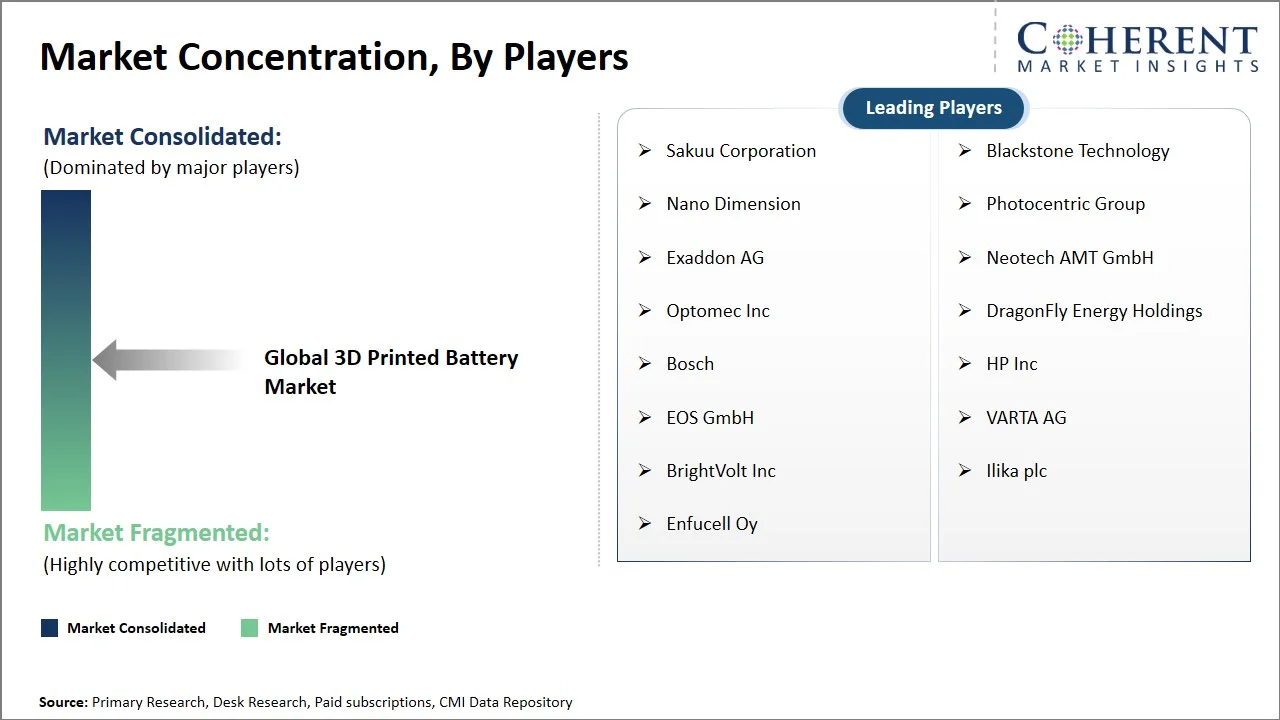
The global 3D printed battery market is led by Sakuu Corporation, which has differentiated itself through its proprietary Kavian additive manufacturing platform capable of producing lithium-metal and semi-solid-state batteries using multi-material printing. Sakuu Corporation is focused on scaling commercial production for electric mobility, industrial equipment, and specialty electronics while reducing manufacturing steps and material waste compared to conventional battery production. Blackstone Resources AG has concentrated on thick-layer 3D printed battery technology, enabling higher active material loading and solvent-free electrode production to improve manufacturing efficiency. Nano Dimension is expanding beyond printed electronics by integrating additive manufacturing technologies for compact energy storage solutions used in aerospace, defense, and advanced electronic systems. Research-driven organizations such as Oak Ridge National Laboratory continue to collaborate with industrial partners to develop architected battery structures that improve electrochemical performance through optimized printed geometries.
Market Report Scope
3D Printed Battery Market Report Coverage
| Report Coverage | Details | ||
|---|---|---|---|
| Base Year: | 2025 | Market Size in 2026: | USD 98 Mn |
| Historical Data for: | 2020 To 2024 | Forecast Period: | 2026 To 2033 |
| Forecast Period 2026 to 2033 CAGR: | 21% | 2033 Value Projection: | USD 612 Mn |
| Geographies covered: |
| ||
| Segments covered: |
| ||
| Companies covered: | Sakuu Corporation, Blackstone Technology, Nano Dimension, Photocentric Group, Exaddon AG, Neotech AMT GmbH, Optomec Inc, DragonFly Energy Holdings, Bosch, HP Inc, EOS GmbH, VARTA AG, BrightVolt Inc, Ilika plc, and Enfucell Oy | ||
| Growth Drivers: |
| ||
| Restraints & Challenges: |
| ||
Analyst Opinion (Expert Opinion)
- The industry is expected to evolve from prototype-oriented manufacturing toward commercial production of customized batteries for high-value applications rather than mass-market commodity cells. The strongest technological progress is likely to occur in printable solid-state batteries, lithium-metal chemistries, and multi-material additive manufacturing platforms capable of producing complete battery architectures with fewer manufacturing steps.
- The most attractive opportunity is expected to emerge in solid-state batteries for medical devices and aerospace applications in the United States, followed by customized lithium-ion batteries for industrial IoT and robotics in Germany, and miniaturized batteries for consumer electronics and wearable devices in Japan and South Korea. These application areas are demanding in terms of complex battery geometries, light-weighted designs, and low-volume customized production, where additive manufacturing offers distinct advantages over conventional manufacturing processes.
- To win long-term commercial contracts, market participants should focus on proprietary printable battery materials, high-speed multi-material printing platforms, and collaborations with automotive, aerospace and medical device makers. Commercial adoption will increase the competitive advantage of companies that develop scalable pilot manufacturing, show stable electrochemical performance, obtain industry certifications and develop integrated battery design software together with additive manufacturing capabilities.
Speak to the analyst
Want personalized insights?
Take the findings above to one of our principal consultants, or have the report rebuilt around the segments, geographies and competitors you actually track.
Market Segmentation
- Battery Type Insights (Revenue, USD Million, 2021 - 2033)
- Lithium-Ion Batteries
- Solid-State Batteries
- Zinc-Based Batteries
- Nickel-Based Batteries
- Others
- Component Insights (Revenue, USD Million, 2021 - 2033)
- Electrodes
- Electrolytes
- Current Collectors
- Battery Housing
- Printing Technology Insights (Revenue, USD Million, 2021 - 2033)
- Inkjet Printing
- Aerosol Jet Printing
- Fused Deposition Modeling
- Stereolithography
- Direct Ink Writing
- Others
- Application Insights (Revenue, USD Million, 2021 - 2033)
- Consumer Electronics
- Medical Devices
- Electric Vehicles
- Aerospace and Defense
- Industrial IoT
- Smart Packaging
- Others
- End User Insights (Revenue, USD Million, 2021 - 2033)
- Electronics Manufacturers
- Automotive Companies
- Healthcare Industry
- Aerospace and Defense Organizations
- Research Institutes
- Regional Insights (Revenue, USD Million, 2021 - 2033)
- North America
- U.S.
- Canada
- Latin America
- Brazil
- Argentina
- Mexico
- Rest of Latin America
- Europe
- Germany
- U.K.
- Spain
- France
- Italy
- Russia
- Rest of Europe
- Asia Pacific
- China
- India
- Japan
- Australia
- South Korea
- ASEAN
- Rest of Asia Pacific
- Middle East
- GCC Countries
- Israel
- Rest of Middle East
- Africa
- South Africa
- North Africa
- Central Africa
- North America
- Key Players Insights
- Sakuu Corporation
- Blackstone Technology
- Nano Dimension
- Photocentric Group
- Exaddon AG
- Neotech AMT GmbH
- Optomec Inc
- DragonFly Energy Holdings
- Bosch
- HP Inc
- EOS GmbH
- VARTA AG
- BrightVolt Inc
- Ilika plc
- Enfucell Oy
Sources
Primary Research Interviews
- Battery manufacturers and 3D printed battery developers
- Additive manufacturing technology providers
- Battery material suppliers
- Electric vehicle manufacturers and battery cell producers
Magazines
- Battery Power Online
- Charged Electric Vehicles Magazine
- 3D Printing Industry
- Additive Manufacturing Media
Journals
- Journal of Power Sources
- Chemical Science
- Materials Science and Engineering: R: Reports
- ACS Energy Letters
Associations
- The Electrochemical Society (ECS)
- International Battery Association (IBA)
- Battery Association of Japan (BAJ)
- European Battery Alliance (EBA)
- International Energy Agency (IEA)
Public Domain Sources
- U.S. Department of Energy (DOE)
- Advanced Research Projects Agency-Energy (ARPA-E)
- Oak Ridge National Laboratory (ORNL)
- Argonne National Laboratory
Proprietary Elements
- CMI Data Analytics Tool
- Proprietary CMI Existing Repository of Information for the Last 10 Years
Get access to 250+ pages report
Every segment, forecast, competitor profile and data table behind the analysis above — available for instant download.
- ESOMAR Member
- ISO 9001:2015 Certified
- D-U-N-S Registered
- GDPR & CCPA Compliant
Missing comfort of reading report in your local language? Find your preferred language:
Transform your Strategy with Exclusive Trending Reports
Frequently Asked Questions
The global 3D printed battery market is expected to stand at USD 98 Mn in 2026 and is expected to reach USD 612 Mn by 2033.
The CAGR of the global 3D printed battery market is projected to be 21% from 2026 to 2033.
Growing demand for miniaturized energy storage solutions and rising adoption of wearable electronics and IoT devices are the major factors driving the growth of the global 3D printed battery market.
High production costs of advanced printable materials and limited large-scale commercial manufacturing capacity are the major factors hampering the growth of the global 3D printed battery market.
In terms of battery type, the lithium-ion batteries segment is estimated to dominate the market revenue share in 2026.
Yes, they can be manufactured in compact and complex geometries suitable for implantable and wearable medical devices.
It deposits materials only where required, significantly minimizing excess material consumption.