

Global 5D Hard Gold and Electroform Hollow Gold Market Forecast – 2026 To 2033
The Global 5D Hard Gold and Electroform Hollow Gold Market is estimated to be valued at USD 8.62 Bn in 2026 and is expected to reach USD 15.86 Bn by 2033, growing at a compound annual growth rate (CAGR) of 9.10% from 2026 to 2033. Growth is supported by the jewellery industry’s shift toward lightweight high-purity gold products that offer larger visual volume, improved hardness, intricate designs, and greater wearing comfort while limiting gold weight per piece.
Electroforming and related hard-gold processes are therefore becoming increasingly important for manufacturers seeking to balance premium appearance with affordability amid elevated gold prices. In September 2025, the World Gold Council brought together 14 Chinese gold jewellery manufacturers at Jewellery & Gem WORLD Hong Kong to internationally showcase Hard Pure Gold jewellery produced using technologies including electroforming, connecting suppliers with buyers from Southeast Asia, India, and the Middle East.
Key takeaways of the Global 5D Hard Gold and Electroform Hollow Gold Market
- Pendants and Charms is estimated to register a 9.6% CAGR during 2026–2033 and account for 31.8% of the global 5D hard gold and electroform hollow gold market in 2026, reflecting the format’s suitability for lightweight high-relief designs personalization and frequent collection refreshes. In August 2025, Lukfook Jewellery launched its Fun Nut Collection with playful 5D hard gold charms, showing how brands are commercializing compact high-detail pieces for everyday styling and gifting.
- 999.9 and Above is projected to expand at an estimated CAGR of 9.4% during 2026–2033, while holding 61.8% of the global 5D hard gold and electroform hollow gold market in 2026 because electroforming can preserve near-pure gold positioning while improving hardness detail and wearable volume. In May 2026, LBMA highlighted that innovative 3D and 5D hard-gold products helped 24-carat products exceed 90% of jewellery retail-store revenue in China in 2025.
- Self Wear is expected to grow at an estimated CAGR of 9.5% during 2026–2033 and represent 57.8% of the global 5D hard gold and electroform hollow gold market in 2026, supported by smaller-ticket pieces fashion-led styling and the ability of lightweight hard gold to suit everyday use. In July 2025, World Gold Council consumer research found that self-purchase was the main gold-jewellery buying occasion in China, reinforcing demand for daily-wear formats.
- Asia Pacific is forecast to post an estimated CAGR of 8.9% during 2026–2033 and command 63.8% of the global 5D hard gold and electroform hollow gold market in 2026, underpinned by China’s manufacturing depth advanced electroforming know-how broad retail networks and strong consumer familiarity with hard pure gold. In September 2026, Jinchuan Group began trial production on a new jewellery line using electroforming technology, producing more than 2,000 qualifying pieces during trials.
- Middle East is expected to record an estimated CAGR of 10.8% during 2026–2033 and hold 12.4% of the global 5D hard gold and electroform hollow gold market in 2026, with premium gold consumption tourism-linked jewellery retail and Dubai’s trading infrastructure supporting faster commercialization of lightweight gold formats. In January 2026, Dubai officially launched the Gold District, bringing together retail bullion wholesale and investment activities and housing more than 1,000 retailers across jewellery and related categories.
Segmental Insights
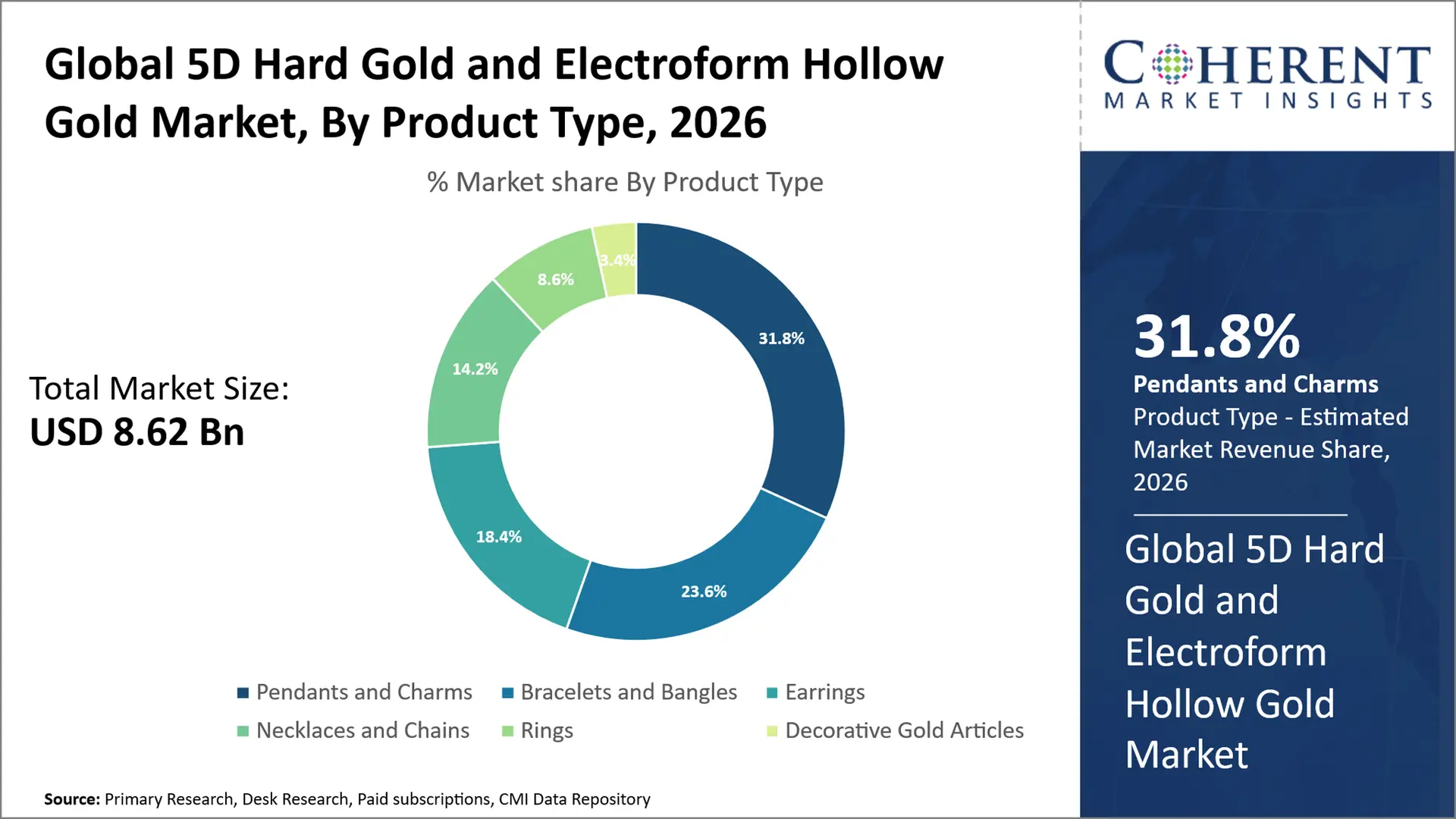
Why Do Pendants and Charms Dominate the Global 5D Hard Gold and Electroform Hollow Gold Market?
Pendants and Charms are expected to account for 31.8% of the global 5D hard gold and electroform hollow gold market in 2026, primarily because their modular format lets buyers add gold progressively rather than committing to a complete jewellery set. They can be combined with chains cords and bracelets which broadens styling options and allows retailers to generate repeat purchases from the same customer relationship. For manufacturers smaller independent components also support wider SKU creation seasonal themes and faster assortment rotation without redesigning an entire jewellery structure. Electroforming is commercially useful here because detailed motifs can be produced while controlling the gold required per unit. In January 2025, CRD introduced its Wishing Tower pendant using 5D hard gold and enamel and specifically positioned the piece for pairing with plain chains bracelets or braided cords. This demonstrates the cross-merchandising flexibility that strengthens the commercial role of pendants and charms.
- Current Industry Events of 2026
- Market Size Estimation
- Regional Breakdown
- Competitive Landscape
- Customer Intelligence
- Segmental Analysis
- Pricing Analysis
- Key Market Drivers, Challenges & Future Trends
- Customized Insights Section
Why Does 999.9 and Above Represent the Largest Gold Purity Segment in the Global 5D Hard Gold and Electroform Hollow Gold Market?
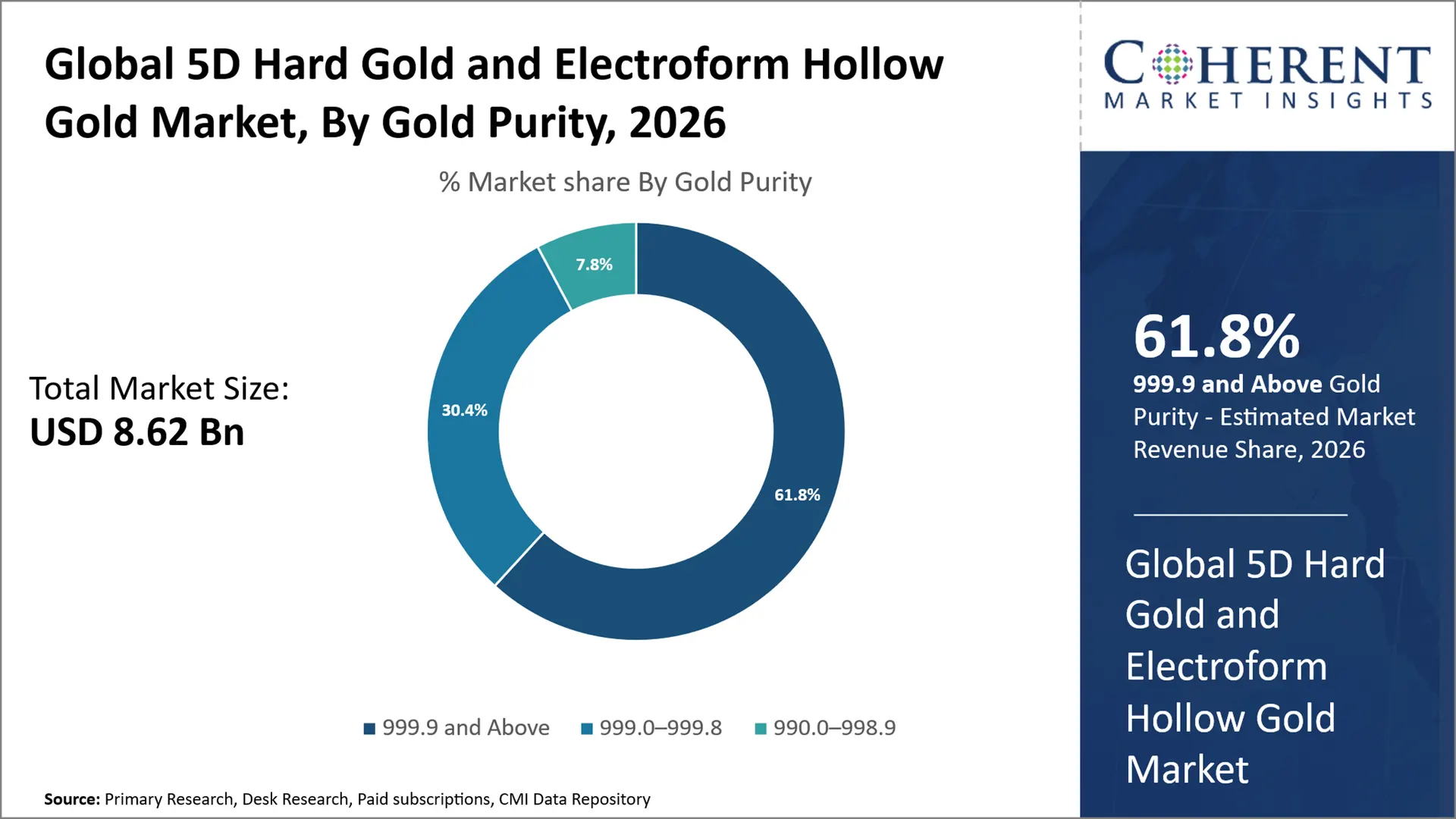
999.9 and Above is projected to represent 61.8% of the global 5D hard gold and electroform hollow gold market in 2026 because high fineness preserves the familiar value proposition of pure gold while manufacturers increasingly solve the processing limitations traditionally associated with very soft metal. This matters commercially because purity remains easy for consumers retailers and trade-in channels to understand while advanced hard-gold processes allow suppliers to differentiate through workmanship rather than reducing fineness. Maintaining this purity requires tighter control of electroforming chemistry joining methods and quality testing which favors technically capable producers. In April 2026, MoKingRan’s 2025 Annual Report confirmed its cyanide-free hard-gold process with 999.9 gold content and disclosed gold jewellery series developed at 999.9 999.99 and 999.999 purity levels. The disclosure shows that ultra-high-purity jewellery is being supported by dedicated manufacturing R&D rather than purity dilution.
Why Does Self Wear Dominate the End User Category of the Global 5D Hard Gold and Electroform Hollow Gold Market?
Self Wear is expected to hold 57.8% of the global 5D hard gold and electroform hollow gold market in 2026 because it converts gold jewellery purchasing from an event-dependent transaction into an ongoing wardrobe and personal-style decision. Unlike wedding purchases self-directed buying can occur throughout the year and supports multiple smaller additions across pendants earrings bracelets and rings. Retailers therefore gain opportunities for continuous customer engagement digital discovery and frequent assortment renewal rather than depending mainly on ceremonial purchasing cycles. Suppliers also benefit from designs optimized around versatility comfort and compatibility with different outfits. In July 2025, Titan Company’s FY2024-25 Annual Report highlighted Tanishq’s Glam-Days collection as introducing youthful and accessible everyday gold jewellery within its product-innovation program. The initiative illustrates how a major organized jeweller is building dedicated everyday-gold assortments around personal consumption rather than reserving gold primarily for major occasions.
Current Events and their Impact
Current Event | Description and Its Impact |
May 2025 – China implemented QB/T 5793-2024 Hard Pure Gold Jewellery standard |
|
November 2025 – China introduced revised tax rules for exchange-sourced gold |
|
March 2026 – India expanded mandatory gold jewellery hallmarking |
|
Global 5D Hard Gold and Electroform Hollow Gold Market Dynamics
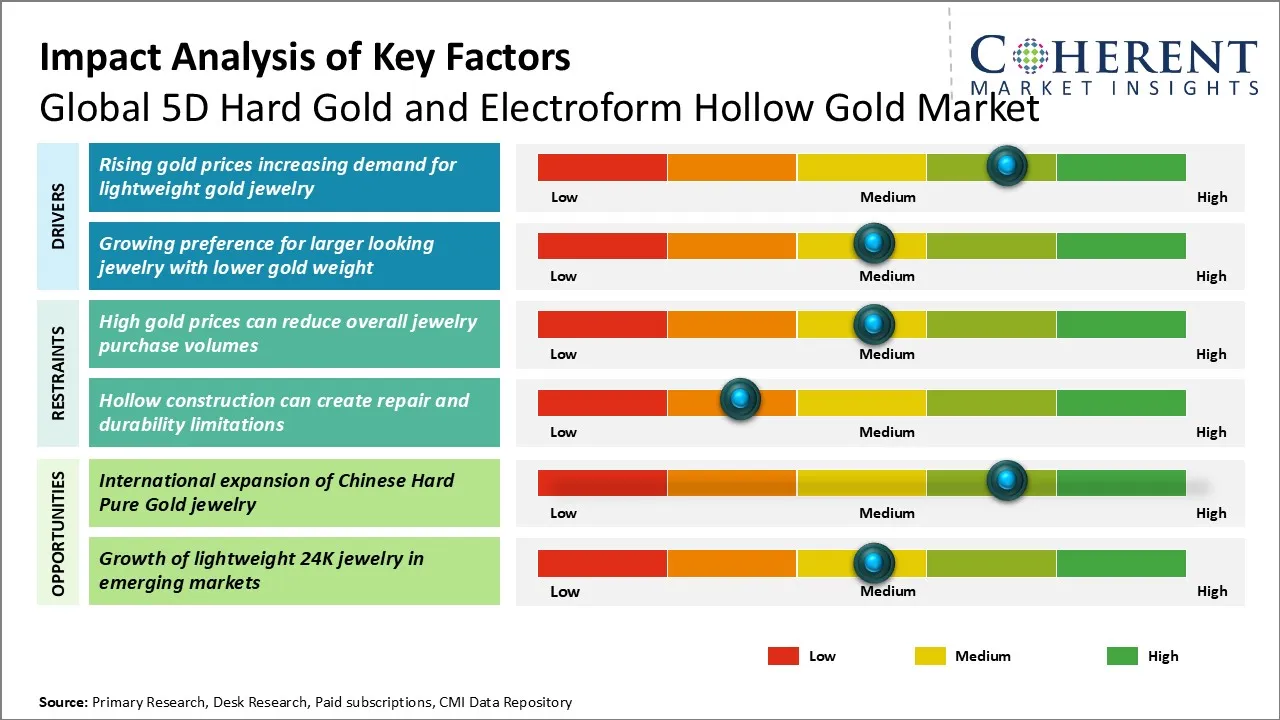
Key Market Drivers
- Rising gold prices increasing demand for lightweight gold jewelry: Gold prices increase the cash outlay attached to every gram of jewellery making metal efficiency a direct purchasing consideration. Lightweight 5D hard gold and electroform hollow construction helps manufacturers preserve visual size design detail and perceived presence while reducing gold content per piece. This supports more accessible ticket values and gives retailers greater scope to protect design and making-charge margins. B2B manufacturers electroforming specialists and chain jewellers benefit most. In July 2025, Sky Gold and Diamonds reported that its 18KT lightweight jewellery addition was proving effective as high gold prices shifted customers toward lighter products.
- Growing preference for larger looking jewelry with lower gold weight: Consumers increasingly want jewellery that looks substantial without carrying the weight cost and wearing discomfort of comparable solid-gold pieces. Electroforming answers this by building thin gold walls around complex forms allowing wider silhouettes raised relief and sculptural geometry while controlling metal use. The commercial benefit extends to designers seeking statement aesthetics and retailers selling design value rather than simply gram weight. In September 2025, Chow Sang Sang featured 999 gold butterfly earrings produced with 3D printing to create hollowed wings illustrating how hollow architecture is being translated into visually expressive fine-gold products.
Emerging Market Trends
- Fixed-Price Merchandising Shifting Value from Gold Weight to Craftsmanship: Fixed-price merchandising is becoming more strategically important as hard-gold products move away from purely weight-led selling. By separating the consumer proposition from daily bullion fluctuations, retailers can place greater emphasis on design finishing craftsmanship convenience and emotional value. This model can improve assortment planning and make gifting or impulse purchase decisions easier but it also raises the importance of disciplined cost control. Manufacturers with predictable gold usage low rejection rates and repeatable process yields are likely to gain greater negotiating power with branded retail chains.
- Men’s and Unisex Hard Gold Expanding the Addressable Consumer Base: Men’s and unisex hard-gold jewellery is emerging as a broader product-development route beyond traditionally female-oriented assortments. Higher hardness and hollow construction allow bolder bracelets pendants rings geometric forms and symbolic pieces to remain wearable without requiring proportionately heavier gold content. This shift can widen addressable buyer groups and encourage retailers to merchandise hard gold through lifestyle self-expression and occasion-led collections rather than gender-restricted showcases. Manufacturers that can adapt surface finishes proportions clasps and motifs for neutral styling should gain more opportunities with multi-category jewellery chains.
Regional Insights
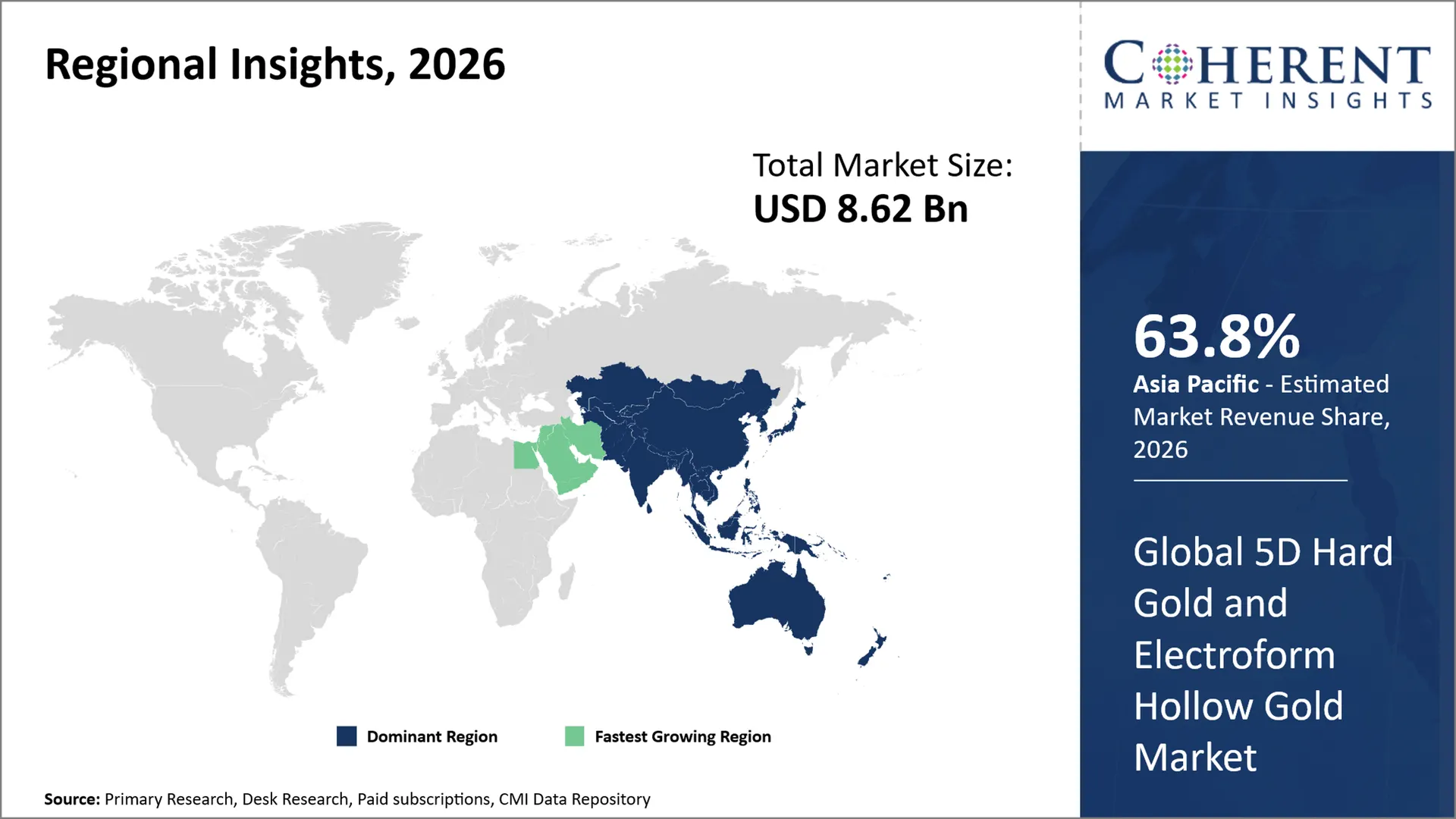
Why Does Asia Pacific Dominate the Global 5D Hard Gold and Electroform Hollow Gold Market?
Asia Pacific is expected to account for 63.8% of the global 5D hard gold and electroform hollow gold market in 2026 because the region combines the industry’s strongest manufacturing base with large high-purity gold jewellery consumption. Shenzhen and other Chinese jewellery clusters support electroforming chemistry, tooling, digital design, finishing, and contract manufacturing, while India and East Asia provide deep retail demand for lightweight gold formats. This concentration shortens product-development cycles and allows suppliers to commercialize intricate hollow pieces at scale. In September 2025, Jewellery World Awards recognized Shenzhen Kinghood Jewelry Manufacturing for technology supporting sustainable jewellery production; the company operates a dedicated 5D hard gold cyanide-free electroforming factory alongside 3D intelligent manufacturing facilities. The development illustrates why Asia Pacific retains a structural production advantage rather than relying only on consumer demand.
Why Is the Middle East Emerging as the Fastest-Growing Region in the Global 5D Hard Gold and Electroform Hollow Gold Market?
Middle East is expected to hold 12.4% of the global 5D hard gold and electroform hollow gold market in 2026 and emerge as the fastest-growing region as high gold prices reshape jewellery purchasing toward lower-weight, higher-design-value pieces. The region’s jewellery trade is concentrated around the UAE, where international tourists, South Asian expatriates, Arab consumers, and wholesale buyers create demand across 18K, 22K, and high-purity gold categories. Lightweight hollow construction helps retailers preserve visual impact while reducing the gram-weight burden on buyers. Dubai also functions as a redistribution hub for jewellery moving across the GCC, Africa, and South Asia. In April 2025, Visit Dubai reported that lightweight Singaporean, Malaysian, and Turkish gold jewellery was becoming increasingly popular and that lower-weight pieces were gaining attention, supporting a retail environment favorable to electroform and hollow-gold formats.
Global 5D Hard Gold and Electroform Hollow Gold Market Outlook for Key Countries
Why Is the U.S. a Key Market for the Global 5D Hard Gold and Electroform Hollow Gold Market?
The U.S. is a key market because electroform and hollow-gold techniques address a clear gap between American preferences for bold jewellery silhouettes and the need to keep finished pieces wearable and commercially accessible. Unlike Asian markets, U.S. demand is less dependent on 24K purity and more influenced by design, comfort, fashion cycles, and retailer margin. This gives suppliers an opportunity to position hollow construction as a product-engineering solution rather than only a gold-saving process. Large jewellery distributors can accelerate adoption by making these designs available to independent retailers nationwide. In November 2025, Stuller introduced lightweight gold designs using both electroform and hollow construction to create high-volume sculptural forms without additional weight. The launch provides direct evidence that these manufacturing approaches are entering mainstream U.S. jewellery merchandising rather than remaining confined to specialist Asian product lines.
Why Is China Important in the Global 5D Hard Gold and Electroform Hollow Gold Market?
China supports the global 5D hard gold and electroforms hollow gold market because it combines high-purity gold purchasing with one of the world’s most developed jewellery-processing ecosystems. Chinese manufacturers have commercialized 3D, 5D, and 5G processes to overcome the softness and design limitations of conventional pure gold, enabling more sculptural products, thinner structures, and greater craftsmanship differentiation. This gives domestic brands a wider product ladder between traditional gram-weight jewellery and design-led fashion gold. In June 2025, Zhou Liu Fu’s Hong Kong listing prospectus described its Boundless Gold series as integrating advanced 5G and 5D gold crafting techniques within its established jewellery portfolio. Such formal commercial disclosure demonstrates that advanced hard-gold technology has moved beyond experimental production and is embedded in branded product ranges distributed through organized jewellery channels.
Why Is Japan a Strategic Country in the Global 5D Hard Gold and Electroform Hollow Gold Market?
Japan is strategically relevant because jewellery buyers place strong emphasis on workmanship, material authenticity, precise finishing, and compact wearable design. The country is unlikely to match China in 5D hard-gold manufacturing scale, but it provides an attractive premium outlet for high-purity products combining pure-gold value with refined styling. This is particularly relevant for lightweight chains, pendants, and smaller self-wear pieces where engineering can limit bulk while retaining the visual identity of pure gold. In August 2026, Wako’s official online boutique updated its web-exclusive 24K chain necklace offering, including a 9-gram pure-gold design intended for contemporary styling. The product does not itself establish 5D manufacturing, but it confirms current Japanese retail acceptance of wearable 24K jewellery, supporting the addressable market for advanced high-purity hollow and hard-gold products.
Why Is India Important in the Global 5D Hard Gold and Electroform Hollow Gold Market?
India is important because consumers retain a strong preference for high-carat gold while elevated bullion prices make weight efficiency increasingly important to purchasing decisions. The commercial opportunity is strongest in everyday earrings, pendants, bangles, and necklaces where buyers still seek visible gold presence but are more sensitive to the final ticket value. Domestic jewellery manufacturing, dense wholesale networks, skilled fabrication clusters, and expanding organized retail make lightweight formats easier to scale across metropolitan and tier-two markets. In September 2025, Arjun Jewellers launched a lightweight gold jewellery collection positioned around affordability, everyday wear, and reduced metal weight. The launch reflects the direction of Indian product development toward designs that retain perceived richness without requiring heavy gold content, providing a clear commercial opening for electroform hollow and hard-gold manufacturing technologies.
Why Is the UAE an Important Growth Market for the Global 5D Hard Gold and Electroform Hollow Gold Market?
The UAE is an important growth market because it connects consumer jewellery demand with regional wholesale trade, tourism, and a highly developed gold-retail ecosystem. Buyers span resident South Asian communities, Arab consumers, tourists, and professional traders, creating demand for both traditional high-carat jewellery and lighter everyday designs. Elevated gold prices strengthen the commercial case for products that maintain visible size while reducing metal weight, directly matching the value proposition of electroform hollow construction. Dubai’s dense jewellery network also allows emerging formats to move rapidly from wholesalers into consumer-facing collections. In April 2025, UAE retailers reported expanding lightweight jewellery assortments and placing greater emphasis on design as bullion prices increased. This response indicates that the UAE can serve as both an adoption market and a redistribution point for lightweight hard-gold formats across the wider Middle East.
Innovation Production & Manufacturing Landscape in the Global 5D Hard Gold and Electroform Hollow Gold Market
Technology / Process | Adoption Position | Role in 5D Hard Gold and Electroform Hollow Gold | Commercial Implication |
Hard-Gold Electroforming Bath Chemistry | Scaling | Controls gold deposition characteristics required to create high-purity hard thin-wall structures while cyanide-free alternatives are increasingly relevant for safer production systems | Suppliers with stable chemistry and repeatable deposition performance can reduce process variability and strengthen retailer confidence |
Sacrificial-Core Hollow Electroforming | Core | Deposits gold around a removable wax polymer or other engineered mandrel to form hollow three-dimensional jewellery | Enables visually larger pieces with lower metal consumption and supports complex relief forms that would be costly to manufacture as solid gold |
Closed-Loop Current and Bath Parameter Control | Scaling | Digitally manages current density temperature chemistry concentration deposition time and related process variables | Improves wall-thickness consistency yield predictability and batch-to-batch repeatability while limiting excess precious-metal deposition |
CAD and 3D-Printed Masters or Mandrels | Scaling | Converts digital jewellery designs into intricate production models suitable for electroforming and hollow structures | Shortens sampling cycles expands geometric design freedom and supports quicker retailer-specific collection development |
Precision Laser Joining and Micro-Welding | Selective but Growing | Joins thin electroformed components findings and closures with localized heat input and high positional accuracy | Supports multipart hollow products while reducing distortion and enabling more sophisticated functional jewellery construction |
XRF Purity Microhardness and Thickness Quality Control | Core to Scaling | Confirms gold fineness hardness and dimensional conformity during development and final quality assurance | Strengthens specification compliance reduces batch rejection and becomes increasingly important when supplying branded retailers and regulated export markets |
How Are Repairable Hollow-Gold Architectures Creating New Growth Opportunities in the Global 5D Hard Gold and Electroform Hollow Gold Market?
Repairable and serviceable hollow-gold construction represents an underdeveloped opportunity in the global 5D hard gold and electroform hollow gold market. Thin-wall jewellery can deliver strong visual impact but repair complexity can discourage retailers that must manage warranties exchanges and customer expectations after purchase. Suppliers can address this gap by engineering replaceable subcomponents standardized joining points controlled wall-thickness zones repair protocols and product-specific service documentation. Retailers could then support longer warranty periods refurbishment trade-in and certified repair programs without treating damaged hollow pieces as automatic scrap. Capturing this opportunity requires collaboration between electroforming engineers jewellery designers quality laboratories and after-sales teams from the product-development stage. It is likely to favor vertically integrated manufacturers and specialist process houses that can combine manufacturing repeatability with repair know-how while smaller design-led brands could participate through qualified service partners. The commercial payoff is stronger retailer confidence lower after-sales friction and more defensible long-term product differentiation.
Market Players, Key Development, and Competitive Intelligence
Key Developments
- In May 2026, Swiky Jewellery unveiled its Ink Rhyme Gold Collection · Xu Beihong Art Series incorporating 5D hard-gold techniques alongside other gold crafts. This is important for the global 5D hard gold and electroform hollow gold market because it extends hard gold into culture-led IP-oriented premium design positioning.
- In April 2026, Umicore Metal Deposition Solutions announced electroforming as a service for decorative precious-metal applications including jewellery with series-production ramp-up planned. This is important for the global 5D hard gold and electroform hollow gold market because brands can access industrial electroforming capability without building complete in-house infrastructure.
- In March 2026, Delmer Group introduced a turnkey gold-jewellery electroforming plant covering mandrel preparation plating electroforming cleaning and finishing for lightweight hollow-gold production. This is important for the global 5D hard gold and electroform hollow gold market because integrated equipment lowers the technical barrier to establishing scalable controlled manufacturing lines.
Competitive Landscape
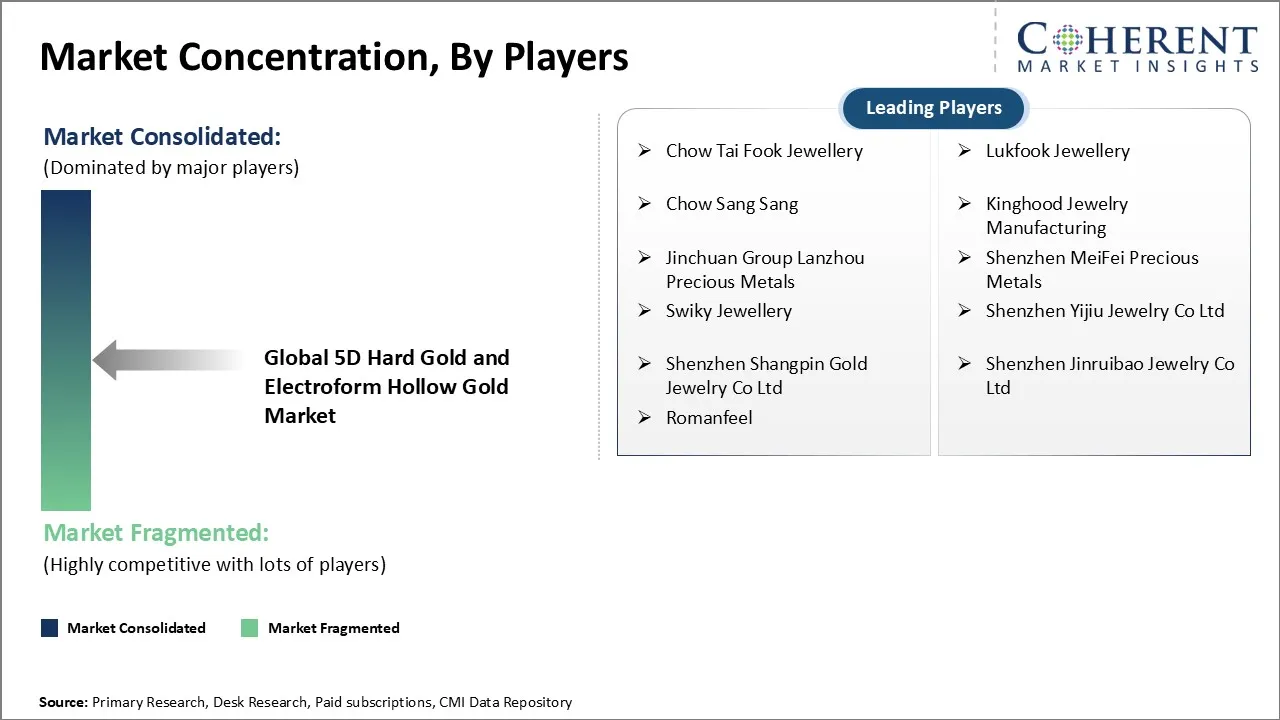
The global 5D hard gold and electroform hollow gold market is fragmented combining large jewellery groups specialist electroforming manufacturers contract producers process-chemistry suppliers and regional design houses. Competition centers on purity consistency wall-thickness control product durability design complexity production yield and speed to market. Regional specialists remain influential where local styling hallmarking familiarity and retailer relationships determine assortment acceptance.
Key focus areas include
- Weight-to-volume engineering: Ability to maximize visual presence while maintaining commercially attractive gold consumption per piece.
- Process yield and gold recovery: Efficient precious-metal utilization directly influences manufacturing margin and pricing flexibility.
- Purity and hardness consistency: Stable production specifications are critical for retailer acceptance and repeat B2B orders.
- Design customization: Private-label manufacturers compete through rapid translation of retailer concepts into manufacturable hollow-gold collections.
- Environmental process capability: Safer electroforming chemistry wastewater treatment and responsible production practices are becoming important supplier-screening considerations.
- Quality and compliance readiness: Hallmarking testing documentation and export-market conformity can determine access to organized jewellery channels.
- Delivery and customer responsiveness: Short sampling cycles dependable replenishment and close retailer relationships can outweigh pure manufacturing scale for specialist suppliers.
Market Report Scope
Global 5D Hard Gold and Electroform Hollow Gold Market Report Coverage | |||
Report Coverage | Details | ||
Base Year | 2025 | Market Size in 2026: | USD 8.62 Bn |
Historical Data For: | 2020 To 2024 | Forecast Period: | 2026 To 2033 |
Forecast Period 2026 To 2033 CAGR: | 9.10% | 2033 Value Projection: | USD 15.86 Bn |
Geographies covered: |
| ||
Segments covered: |
| ||
Companies covered: | Chow Tai Fook Jewellery, Lukfook Jewellery, Chow Sang Sang, Kinghood Jewelry Manufacturing, Jinchuan Group Lanzhou Precious Metals, Shenzhen MeiFei Precious Metals, Swiky Jewellery, Shenzhen Yijiu Jewelry Co Ltd, Shenzhen Shangpin Gold Jewelry Co Ltd, Shenzhen Jinruibao Jewelry Co Ltd, Romanfeel | ||
Growth Drivers: |
| ||
Restraints & Challenges: |
| ||
Analyst Opinion (Expert Opinion)
- The global 5D hard gold and electroform hollow gold market leadership is likely to shift from ownership of electroforming capacity toward control of the complete commercialization system spanning design engineering process recipes quality assurance assortment development and retailer integration. Manufacturing capacity can increasingly be replicated whereas the ability to translate a merchandising brief into a reliable production-ready collection quickly is harder to reproduce. Suppliers that institutionalize this capability should command deeper and more durable B2B relationships.
- Piece-level digital identity could materially change how hollow hard-gold jewellery is authenticated serviced traded and valued. Connecting each item to production-batch information fineness verification care instructions warranty history and authorized service records would make product provenance more useful after the initial sale. This could weaken purely anonymous commodity-style selling and favor participants capable of integrating manufacturing quality data with retailer and after-sales systems.
- Manufacturers should prioritize precise gold inventory control metal recovery process-yield improvement resilient chemistry sourcing and market-specific compliance capability because small efficiency losses can materially weaken margins in precious-metal manufacturing. Retailers should demand clearer product specifications and supplier quality records before scaling new collections. Participants should avoid overinvesting in highly complex low-repeat designs unless expected making charges and sell-through can compensate for slower production and greater rejection exposure.
Speak to the analyst
Want personalized insights?
Take the findings above to one of our principal consultants, or have the report rebuilt around the segments, geographies and competitors you actually track.
Market Segmentation
- Product Type Insights (Revenue, USD Bn, 2021 - 2033)
- Pendants and Charms
- Bracelets and Bangles
- Earrings
- Necklaces and Chains
- Rings
- Decorative Gold Articles
- Gold Purity Insights (Revenue, USD Bn, 2021 - 2033)
- 999.9 and Above
- 999.0–999.8
- 990.0–998.9
- End User Insights (Revenue, USD Bn, 2021 - 2033)
- Self Wear
- Gifting
- Wedding and Ceremonial
- Distribution Channel Insights (Revenue, USD Bn, 2021 - 2033)
- Brand Owned and Chain Jewelry Stores
- Independent and Specialty Jewelry Stores
- Online Retail
- Wholesale and Export
- Regional Insights (Revenue, USD Bn, 2021 - 2033)
- North America
- U.S.
- Canada
- Latin America
- Brazil
- Argentina
- Mexico
- Rest of Latin America
- Europe
- Germany
- U.K.
- Spain
- France
- Italy
- Russia
- Rest of Europe
- Asia Pacific
- China
- India
- Japan
- Australia
- South Korea
- ASEAN
- Rest of Asia Pacific
- Middle East
- GCC Countries
- Israel
- Rest of Middle East
- Africa
- South Africa
- North Africa
- Central Africa
- North America
Sources
Primary Research Interviews
- 5D hard gold manufacturers, electroforming jewellery producers, gold jewellery brands, contract jewellery manufacturers, and precious metal processing companies
- Jewellery designers, product development managers, sourcing managers, retailers, wholesalers, and distributors
- Goldsmiths, manufacturing specialists, technology providers, and quality control professionals involved in high-purity gold jewellery production
Stakeholders
- 5D hard gold and electroform hollow gold jewellery manufacturers
- Precious metal refiners, gold suppliers, electroforming equipment providers, and surface treatment solution suppliers
- Jewellery brands, organized retail chains, independent jewellery stores, and e-commerce jewellery platforms
- Exporters, importers, trade houses, and private-label jewellery manufacturers
- Consumers purchasing self-wear jewellery, gifting jewellery, wedding jewellery, and premium gold ornaments
End-use Sectors
- Lightweight gold jewellery
- Premium and designer jewellery
- Self-wear gold jewellery
- Gifting and ceremonial jewellery
- Customized and fashion-oriented gold accessories
Regulatory and Industry Bodies
- World Gold Council WGC
- London Bullion Market Association LBMA
- International Organization for Standardization ISO
- Gemological Institute of America GIA
- Bureau of Indian Standards BIS
- China Gold Association
- National gold hallmarking and jewellery regulatory authorities
Databases
- Company annual reports and investor presentations
- Jewellery brand product portfolio databases
- Gold jewellery import and export trade datasets
- Precious metal pricing databases
- Gold demand and consumption databases
- Jewellery manufacturing and retail channel databases
- Product catalogues and technology specification databases
Magazines and Journals
- Jewellery Focus
- Rapaport
- JCK Magazine
- The Jewellery Editor
- Gold Bulletin
- Precious Metals Review
Associations
- World Gold Council WGC
- Responsible Jewellery Council RJC
- International Jewellery Confederation CIBJO
- Jewellers and Goldsmiths Associations
- Regional jewellery manufacturing and retail associations
Public Domain Sources
- Gold demand and consumption statistics
- Jewellery trade flow data
- Gold price movement and market updates
- Jewellery manufacturing technology developments
- Hallmarking and purity regulation updates
- Consumer jewellery preference studies
- Precious metal industry reports and trade publications
Key Standards and Regulations
- Gold purity and fineness standards
- Jewellery hallmarking and certification requirements
- Precious metal testing and quality assurance standards
- Responsible gold sourcing and supply-chain compliance requirements
- Import export regulations for gold jewellery
- Environmental and workplace safety requirements for jewellery manufacturing processes
Proprietary Elements
- CMI Data Analytics Tool
- Proprietary CMI repository containing 10+ years of precious metals jewellery, gold manufacturing, consumer trends, trade flow, and luxury goods market intelligence.
Get access to 250+ pages report
Every segment, forecast, competitor profile and data table behind the analysis above — available for instant download.
- ESOMAR Member
- ISO 9001:2015 Certified
- D-U-N-S Registered
- GDPR & CCPA Compliant
Frequently Asked Questions
The CAGR of global 5D hard gold and electroform hollow gold market is projected to be 9.10% from 2026 to 2033.
The global 5D hard gold and electroform hollow gold market is estimated to be valued at USD 8.62 Bn in 2026 and is expected to reach USD 15.86 Bn by 2033.
Rising gold prices are increasing the preference for lightweight gold jewellery, while growing consumer demand for larger-looking designs with lower gold weight is supporting the adoption of 5D hard gold and electroform hollow gold products. These factors enable manufacturers to offer visually appealing, detailed jewellery pieces with improved affordability and design flexibility.
High gold prices can reduce overall jewelry purchase volumes and Hollow construction can create repair and durability limitations are the major factor hampering the growth of global 5D hard gold and electroform hollow gold market.
In terms of product type, pendants and charms is estimated to dominate the market revenue share in 2026.
Chow Tai Fook Jewellery, Lukfook Jewellery, Chow Sang Sang, Kinghood Jewelry Manufacturing, Jinchuan Group Lanzhou Precious Metals, Shenzhen MeiFei Precious Metals, Swiky Jewellery, Shenzhen Yijiu Jewelry Co Ltd, Shenzhen Shangpin Gold Jewelry Co Ltd, Shenzhen Jinruibao Jewelry Co Ltd, Romanfeel are the major players.
Asia Pacific is expected to lead the global 5D hard gold and electroform hollow gold market in 2026.