
Flat 45% off this market research report
Nov 26 – 29 · Direct purchase only · Not applicable to customized reports
Global 6PPD Alternative Antiozonants Market Size and Forecast – 2026 To 2033
The Global 6PPD Alternative Antiozonants Market is estimated to be valued at USD 4.1 Mn in 2026 and is expected to reach USD 102.5 Mn by 2033, growing at a compound annual growth rate (CAGR) of 58.38% from 2026 to 2033. New environmental regulations, growing concerns about 6PPD-quinone's toxicity to aquatic life, and the requirement to continue improving tire durability and ozone resistance with the use of different chemical compounds drive market growth.
Specialty chemical manufacturers have more investment in renewables, non-PPD chemistries, and advanced rubber stabilization systems to support the expansion of commercialization opportunities. Tetramer Technologies LLC was awarded USD 100,000 in Phase I Small Business Innovation Research (SBIR) funding by the U.S. Environmental Protection Agency (EPA) in January 2025 to create bio-renewable rubber additives that will help replace the use of conventional 6PPD. The programme emphasises the increase in public sector support for the development of alternatives to ozone-depleting materials, which will enable early development and help to speed up future industrial use.
Key Takeaways of the Global 6PPD Alternative Antiozonants Market
- CCPD-Based Antiozonants are projected to register a CAGR of 56.5% during 2026–2033, capturing 54.5% of the global 6PPD alternative antiozonants market in 2026, given their structural similarity to the conventional antiozonants and ability to preserve the performance of existing rubber compounds. In September 2026, LANXESS registered Vulkanox 4060, an alternative based on CCPD, which is eligible for commercial use based on its European registration.
- Granules & Pastilles are anticipated to expand at a CAGR of 57.4% during 2026–2033 and secure a 48.4% share of the global 6PPD alternative antiozonants market in 2026. They can be integrated with automatic weighing systems, accurate dosing, and minimal dust emissions to facilitate efficient rubber compounding operations. In December 2024 Sovereign Chemical Company released new safety papers to support Dusantox IPPD Pastille as a new antiozonant product that has been used on the industry since that date.
- Tire Tread & Shoulder Components are forecast to achieve a CAGR of 59.2% during 2026–2033, representing 48.9% of the global 6PPD alternative antiozonants market revenue in 2026. Constant road contact, mechanical damage and environmental exposure place significant demands on long lasting rubber protection. In December 2025, Sennics announced that it has made advances with its SA6000 alternative, noting that its surface compound blooming characteristics are improved and that the dynamic performance is comparable to that of traditional 6PPD formulations.
- Passenger Car & Light Truck Tires, with an anticipated CAGR of 60.1% during 2026–2033, are expected to command a 56.6% share of the global 6PPD alternative antiozonants market in 2026. High production volumes and recurring replacement requirements provide substantial commercialization opportunities for alternative additives. In July 2024, the U.S. Tire Manufacturers Association confirmed widespread 6PPD usage across its members’ passenger and light truck tire portfolios during congressional testimony.
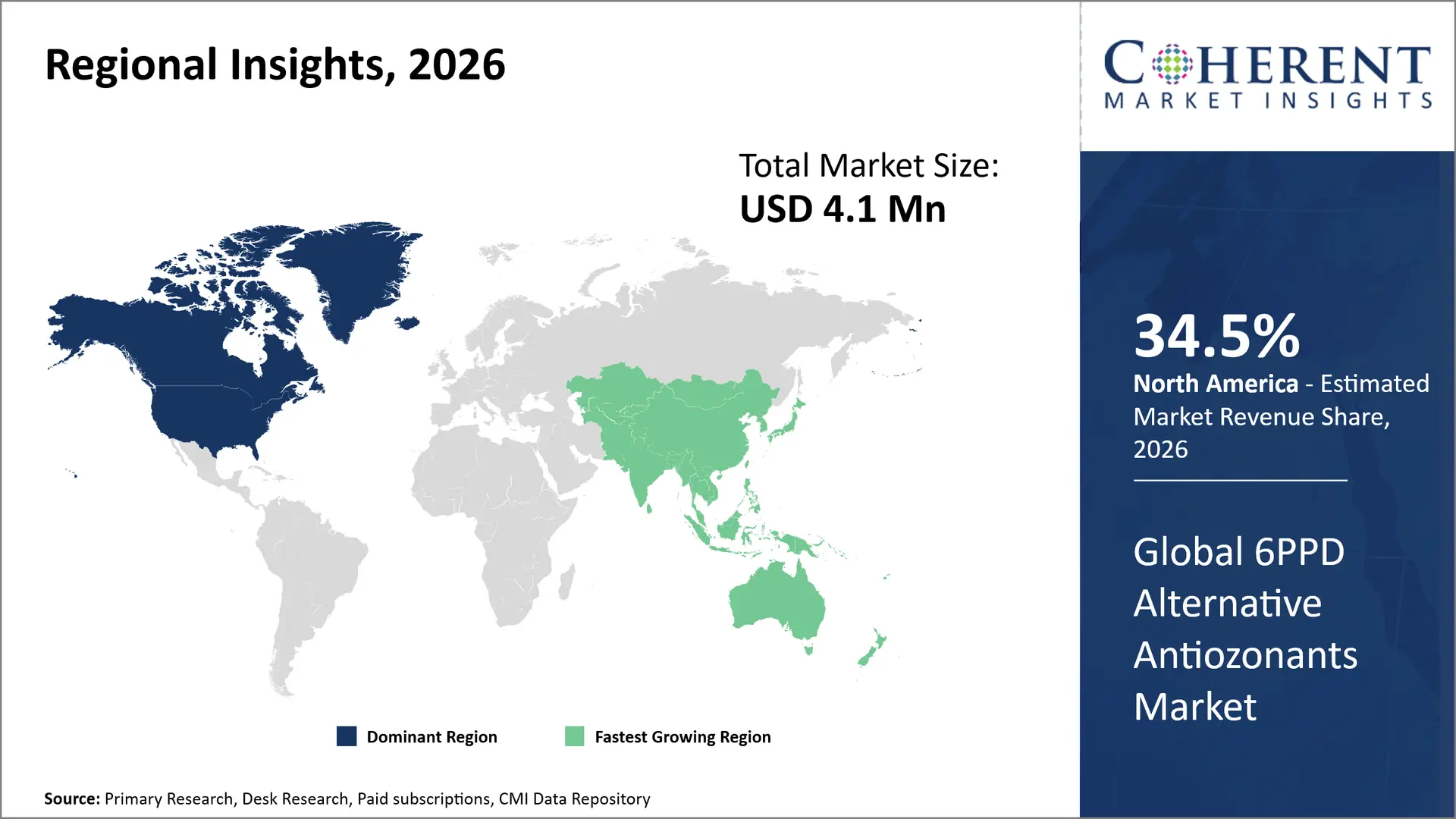
- North America is estimated to record a CAGR of 58.8% during 2026–2033, accounting for 34.5% of the global 6PPD alternative antiozonants market in 2026. Regional leadership represents regulatory oversight on the issue of chemical contamination in tires and protecting aquatic ecosystems. The U.S. Environmental Protection Act (EPA) launched an advance rulemaking under the Toxic Substances Control Act (TSCA) to examine environmental risks and alternatives related to 6PPD in November 2024.
- Europe is poised to emerge as the fastest-growing region, exhibiting a CAGR of 62.3% during 2026–2033 and holding 31.2% of the global 6PPD alternative antiozonants market in 2026. Potential chemical limitations are spurring manufacturers to reengineer current formulations. The European Chemicals Agency (ECHA) began a consultation in December 2025 to gather evidence on potential restrictions on PPD substances, such as 6PPD, under the European REACH framework.
Segmental Insights
Why Do CCPD-Based Antiozonants Dominate the Global 6PPD Alternative Antiozonants Market?
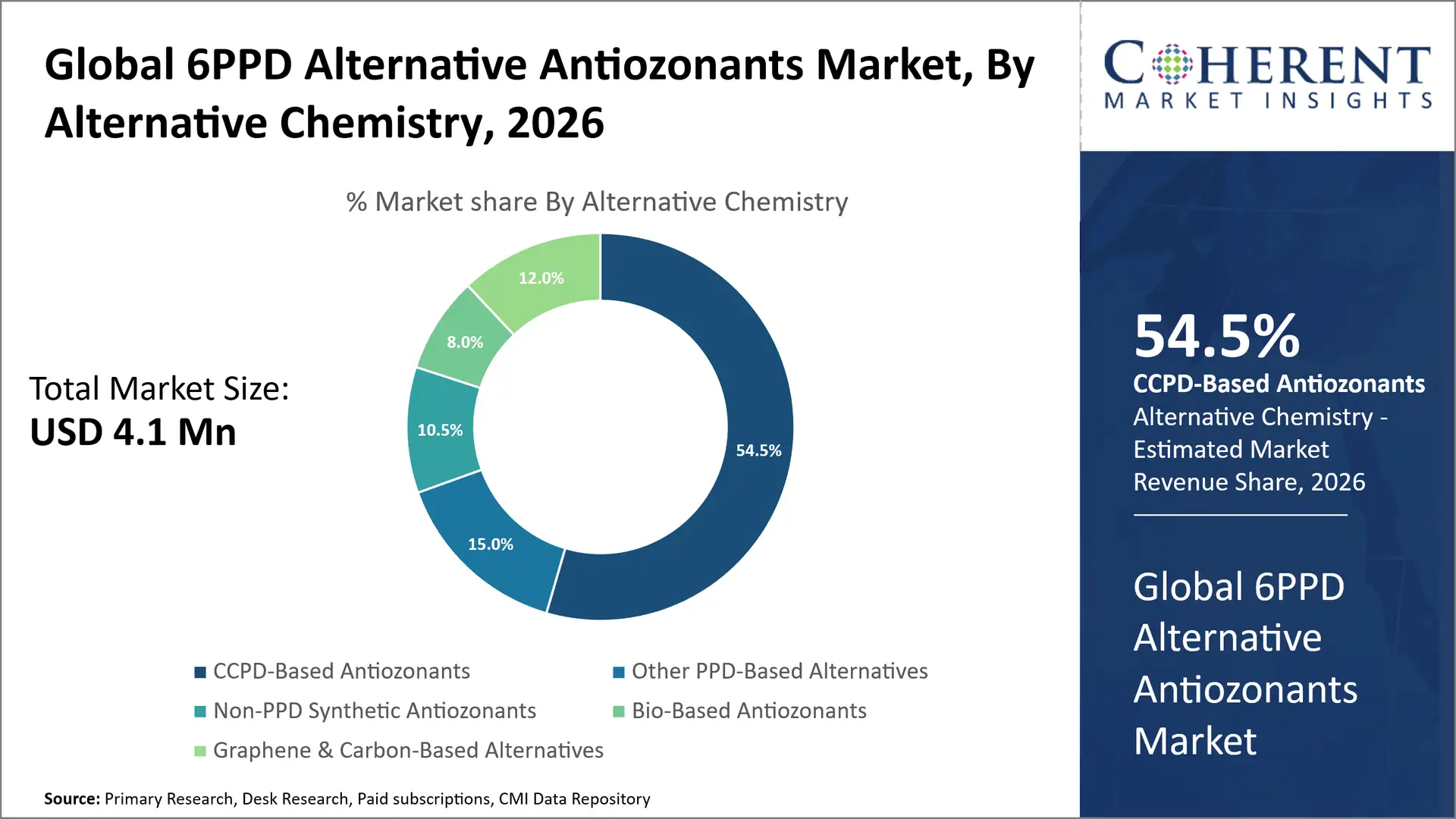
CCPD-Based Antiozonants are expected to account for 54.5% of the global 6PPD alternative antiozonants market in 2026, owing to the advantage they provide of providing a different pathway for the chemical reaction during the exposure to ozone. The cyclohexyl substituted molecular structure of CCPD opens the door for the modification of the environmental transformation properties of traditional rubber protection additives. Tire companies are testing out this chemistry to achieve a compromise between antidegradation and environment. Supply-wise, existing specialty chemical synthesis experience may help to scale up production after successful customer qualification. Suppliers who can prove their application specific performance and chemical purity can get contracts early. In March 2026, LANXESS presented an antiozonant based on CCPD, Vulkanox 4060, at the Tire Technology Expo in Hannover, Germany. Laboratory and application tests were performed and found that they provided the same level of protection against oxidative aging as 6PPD in rubber compounds and finished tires. The development supports the commercial opportunities of CCPD-based antiozonants in next generation tyre formulations.
- Current Industry Events of 2026
- Market Size Estimation
- Regional Breakdown
- Competitive Landscape
- Customer Intelligence
- Segmental Analysis
- Pricing Analysis
- Key Market Drivers, Challenges & Future Trends
- Customized Insights Section
Why Do Granules & Pastilles Represent the Largest Product Form in the Global 6PPD Alternative Antiozonants Market?
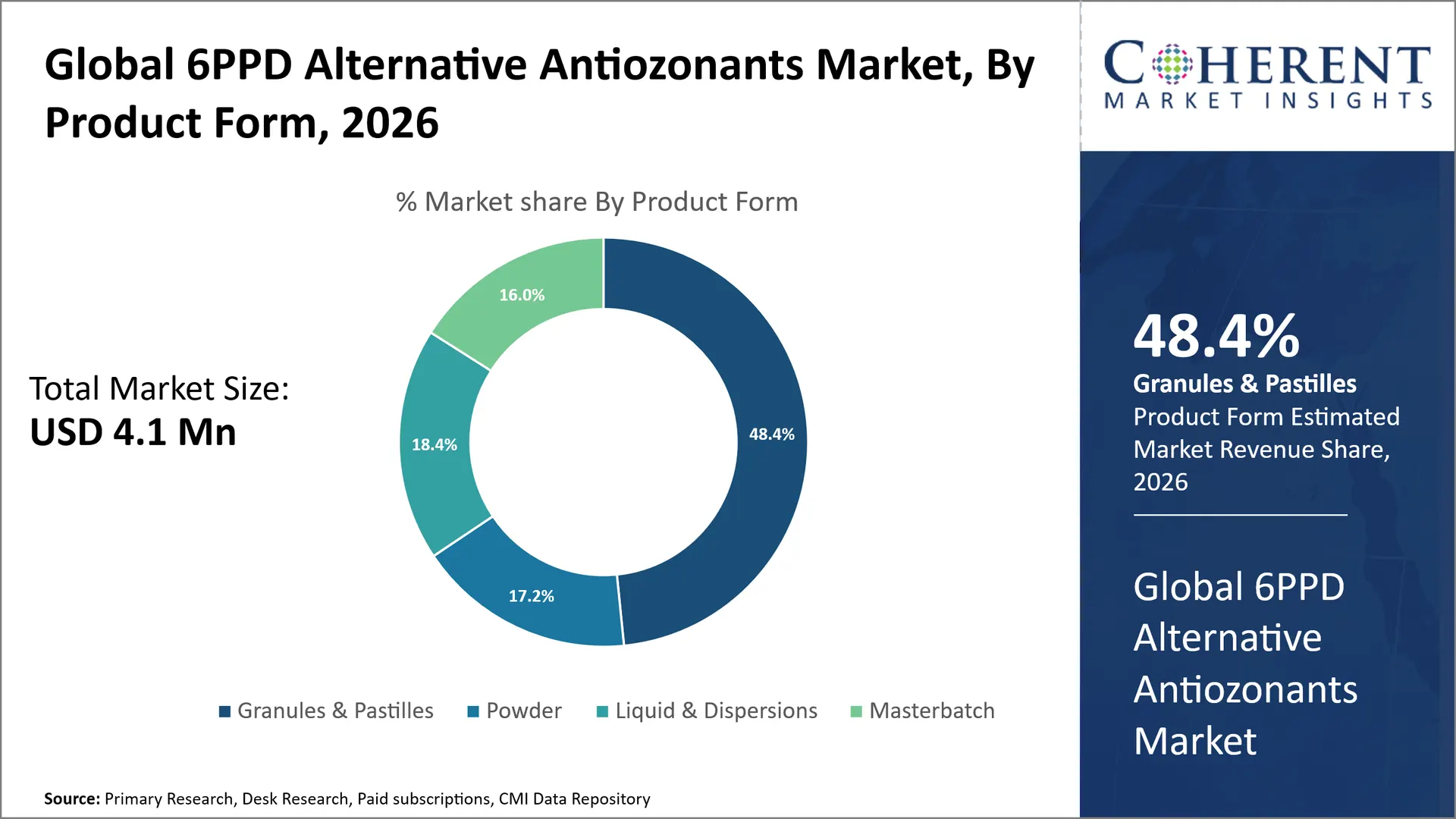
Granules & Pastilles are anticipated to represent 48.4% of the global 6PPD alternative antiozonants market in 2026, reflecting their practical advantages in bulk material transportation, storage, and industrial handling. With careful design, granular additives may be used to reduce material losses during transfer within the system, and contamination of nearby production facilities, when compared to fine powders. They are also relatively concentrated, which eliminates the need for some of the carrier materials used with some masterbatch formulations. Simplified inventory management and reduced material preparation requirements can benefit tire manufacturers and rubber compounders. Chemical suppliers can offer consistency of particle size, mechanical strength, storage stability, etc. as a means of differentiating their product. Safety documents for Shandong Sunsine Chemical Co., Ltd.'s product IPPD were obtained in August 2025, and it was revealed that the product is available in granular and pastille form. It confirms proven supply capabilities for prospective alternative PPD chemistries, but not the physical format itself proves environmental safety.
Why Do Tire Tread & Shoulder Components Lead the Application Segment of the Global 6PPD Alternative Antiozonants Market?
Tire Tread & Shoulder Components are projected to capture 48.9% of the global 6PPD alternative antiozonants market in 2026, reflecting the strategic importance of reducing environmentally concerning chemicals released through tire abrasion. Over time, the additives in the tread compound dissipate into the environment through wear. The additives in the tread compound can be released into the environment over time as the compound wears. The reformulation of these components thus offers a targeted way for tire manufacturers to deal with chemical substitution. Alternative antiozonants need to be compatible with reinforcing fillers, vulcanization systems and rubber formulations without having an adverse effect on traction or abrasion resistance. This opens the door for suppliers to create protective additives that are specific to particular treads. In July 2025, Toyo Tire Corporation, reported in its Integrated Report 2025 that it is pursuing alternatives to 6PPD and is working to enhance the formulation of tires' tread compounds in order to lower the number of particles emitted from these products. The programs reflect the increasing potential for other suppliers of antiozonants to be able to provide materials which meet environmental goals while maintaining the durability and driving performance of tyres.
Current Events and their Impact
Current Event | Description and Its Impact |
California Revises Final Alternatives Analysis Deadline – June 2026 |
|
Washington Proposes Reporting Requirements for 6PPD in Motor Vehicle Tires – November 2026 |
|
Global 6PPD Alternative Antiozonants Market Dynamics
Key Market Drivers
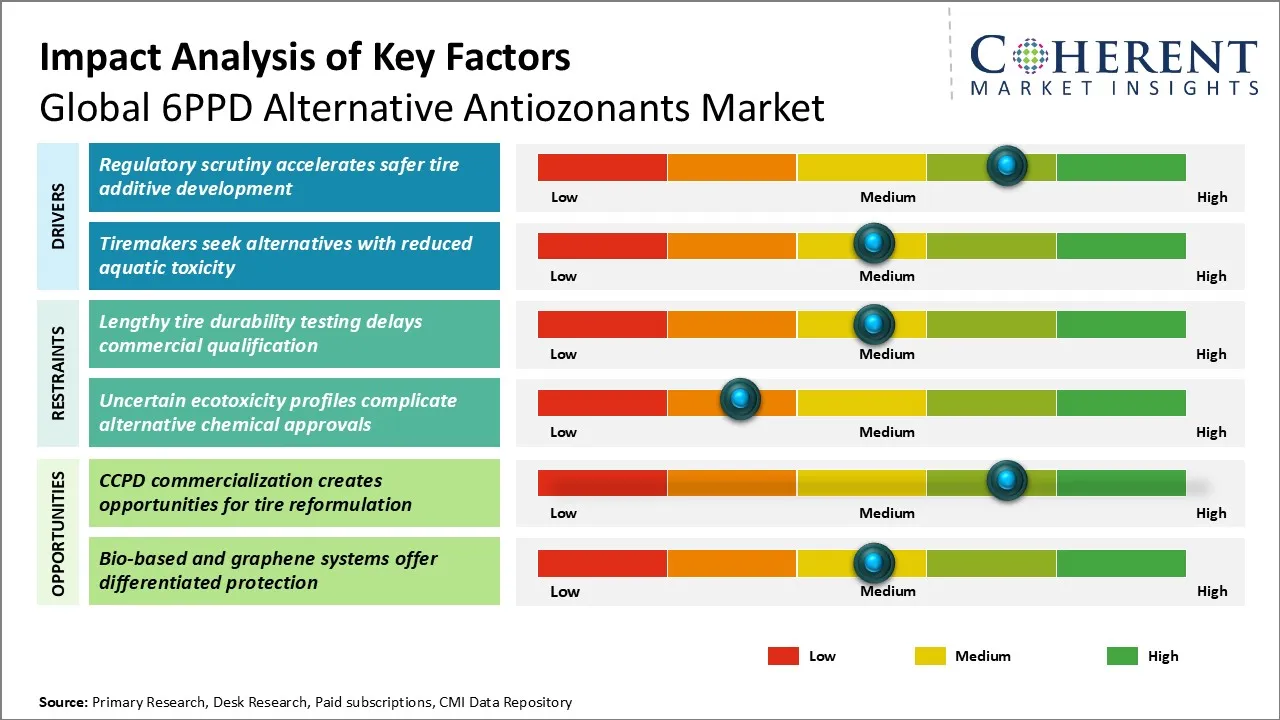
- Regulatory Scrutiny Accelerates Safer Tire Additive Development: Expanding chemical assessment frameworks are pushing rubber additive suppliers to invest in alternative molecular frameworks ahead of possible restrictions on existing antiozonant portfolios. Tire manufacturers are increasingly incorporating chemical risk assessments into their material procurement decisions to protect future market access and minimize exposure to costly reformulation requirements. This opens up commercial opportunities for specialty chemical manufacturers who can offer alternatives with full environmental documentation. In July 2025, the Government of Canada added 6PPD, its transformation products and related p-phenylenediamines to the list of substances to be prioritized for assessment under the Canadian Environmental Protection Act, extending the regulatory scope beyond traditional 6PPD.
- Tiremakers Seek Alternatives with Reduced Aquatic Toxicity: Environmental liability related to chemicals leaching from tire wear particles is changing additive selection criteria across tire manufacturing. Toxicity of original additives and their environmental transformation products are being incorporated gradually into procurement decisions. Chemical suppliers demonstrating good aquatic safety profiles may be preferred in supplier qualification, and tire manufacturers could reduce environmental risks in the long term. In January 2026, the U.S. Geological Survey published research on the toxicity of proposed antiozonant alternatives using cell lines from three salmonid species, adding additional scientific evidence for screening potential replacements.
Emerging Market Trends
- Transition Toward Multi-Component Antiozonant Formulations: Rubber compound development is slowly moving toward combinations of protective additives instead of depending on a single antiozonant molecule. These formulations distribute oxidation resistance, ozone protection and additive migration functions across complementary ingredients.
- Impact: Specialty chemical suppliers offering integrated additive packages can capture more formulation value. Single product manufacturers may be forced to broaden their portfolios and improve their application engineering capabilities.
- Relevance of Market: Opportunities for multi-component systems are expected to rise during the forecast period due to customized antiozonant blends. Their use could also increase the demand for application-specific rubber protection packages.
- Integration of Computational Chemistry into Additive Discovery: Molecular modeling and predictive screening are emerging tools for the identification of antiozonant candidates prior to resource-intense laboratory testing. These approaches help researchers to identify molecular frameworks with suitable chemical reactivity and rubber compatibility.
- Impact: Computational screening can both save money on unsuccessful synthesis programs and increase research productivity. Chemical developers with proprietary molecular data bases and experimental validation capabilities are in a good position to benefit.
- Relevance of Market: Digital discovery methods are expected to create a pipeline for novel antiozonant chemistries. This could shorten early-stage development cycles and enhance the commercial efficiency of additive innovation.
Regional Insights
Why Does North America Dominate the Global 6PPD Alternative Antiozonants Market?
North America is expected to account for 34.5% of the global 6PPD alternative antiozonants market in 2026, supported by its established environmental research infrastructure and close interaction between rubber chemical suppliers, tire manufacturers, and scientific institutions. Regional efforts to address contamination from both newly manufactured tires and recycled rubber are expanding the commercial relevance of alternative antiozonants. Chemical manufacturers can benefit from access to specialized testing facilities and technically experienced industrial customers. In September 2026, the Canada Water Agency announced funding of CAD 189,000 for the University of Toronto to develop a treatment system targeting 6PPD removal from recycled rubber. The project is remediation focused but highlights downstream contamination issues and strengthens the commercial case for the use of alternative protective additives at the manufacturing stage.
Why Is Europe Emerging as the Fastest-Growing Region in the Global 6PPD Alternative Antiozonants Market?
Europe is expected to capture 31.2% of the global 6PPD alternative antiozonants market in 2026, supported by the integration of environmental monitoring into industrial sustainability and product development strategies. European tire manufacturers face rising demands to prove environmental performance throughout the product life cycle. - This gives an incentive to the chemical suppliers to develop additives with more desirable degradation and exposure characteristics. In August 2026, According to the latest findings of the D4RUNOFF research project, led by the European Commission, prototype sensors have been developed to monitor 6PPD-quinone in urban runoff. Improved access to environmental exposure information could affect future criteria for material selection and hasten investment in alternative antiozonant chemistries. Suppliers showing measurable environmental improvements may be better positioned in European tire manufacturing networks.
Global 6PPD Alternative Antiozonants Market Outlook for Key Countries
Why Is the U.S. a Key Market for 6PPD Alternative Antiozonants?
The U.S. 6PPD alternative antiozonants market is bolstered by tire manufacturers’ direct investment in proprietary antiozonant chemistry rather than relying solely on external chemical suppliers. The domestic research potential in the areas of rubber engineering and polymer science provides a good basis for the development of special protective additives. Also, tire makers could handle different chemical formulations for long-term procurement flexibility and to lessen reliance on individual suppliers. In June 2025, The Goodyear Tire & Rubber Company published a patent application for antiozonant compounds that would inhibit the formation of 6PPD-quinone upon exposure to ozone. The study shows the growing strategic importance of owning intellectual property in the development of tire additives, and points to potential opportunities in contract synthesis, chemical licensing and specialized manufacturing partnerships.
Why Is Germany a Strategic Country in the Global 6PPD Alternative Antiozonants Market?
Germany’s strong position in the development of premium tires and advanced automotive engineering is also driving demand for technically sophisticated antiozonant alternatives. Global 6PPD alternative antiozonants market manufacturers concentrate on chemical compatibility, surface appearance and durability of materials while developing protective systems for demanding automotive applications. This creates opportunities for specialty additive suppliers that can meet the needs of many rubber formulations. A patent application from Continental Reifen Deutschland GmbH, published in March 2025, described a protective compound designed to minimize chemical hazards while resisting environmental degradation, limiting surface blooming and promoting polymer compatibility. This research could allow for the development of differentiated rubber protection systems for premium vehicle platforms as the long-term performance and quality of material warrant the investment in specialized additive chemistry.
Why Does China Support Growth in the Global 6PPD Alternative Antiozonants Market?
China’s many rubber processing factories and the chemical production clusters that feed them are an opportunity to take experimental antiozonant recipes and turn them into industrial-scale production. Domestic tire makers supplying international tire markets have commercial incentives to develop alternatives that can be used in conventional compounding processes. Research partnerships between multinational chemical firms and their Chinese units may enhance local technical capabilities. In February 2025, a patent application was published jointly attributed to BASF China Co., Ltd. and BASF SE, which describes stabilized rubber compositions for providing ozone resistance without the inclusion of conventional 6PPD. This development illustrates the Chinese interest in the most advanced research into additive formulation. Successful industrial validation could improve the competitiveness of Chinese tire exporters, bolster local chemical production and reduce reliance on imported specialty ingredients.
Why Is India an Important Growth Market for 6PPD Alternative Antiozonants?
India has a unique growth path by developing renewable protective additives from domestically available agricultural feedstocks. Collaboration between natural ingredient developers, specialty chemical manufacturers and tire makers may accelerate the development of alternative materials with competitive sourcing economics. In addition, export oriented tire manufacturers are motivated to explore formulations that are consistent with the changing environmental standards of the international community. In October 2024, Apollo Tyres Limited filed an international patent application for use of turmeric oleoresin as a bio-based antioxidant. The application seeks to substitute conventional antioxidants such as 6PPD, partially or fully, in tire rubber compositions. This research demonstrates opportunities to develop locally sourced protective additives, although further ozone resistance, environmental safety, and commercial-scale performance validation would be necessary.
Commercial Adoption and Market Entry Landscape in the global 6PPD alternative antiozonants market
Market Adoption Parameter | Current Market Scenario | Key Commercial Requirement | Market Impact |
Tire Manufacturer Qualification | Alternative antiozonants undergo extensive evaluation before integration into commercial tire formulations. | Demonstrated ozone resistance, fatigue performance, and long-term durability. | Extends sales cycles, but increases supplier retention once the supplier is successfully qualified. |
Environmental Safety Compliance | More and more buyers are evaluating the environmental impact of additives and their transformation products. | Full ecotoxicity, chemical safety and environmental exposure documentation. | Offers suppliers competitive differentiation with robust safety data. |
Production Scalability and Supply Reliability | Emerging alternative chemistries have limited commercial production capacity compared to conventional 6PPD. | Reliable feedstock sourcing, consistent product quality and scalable manufacturing capacity. | Supports capacity investments and long-term supplier agreements. |
Pricing and Substitution Economics | Higher production and procurement costs for alternative antiozonants may be incurred in early commercialization. | Competitive formulation costs not sacrificing tire performance. | Impacts adoption rate, pricing strategy and manufacturer profitability. |
Customer Procurement and Supplier Partnerships | Tire manufacturers work with specialty chemical suppliers to test and tailor alternative formulations. | Joint product development, technical support and reliable delivery promise. | Supports direct manufacturer sales and recurring procurement opportunities. |
Product Portfolio Transition | Rubber chemical manufacturers are slowly developing alternative additives in parallel with their traditional antiozonant portfolios. | Application-specific product lines and phased replacement strategies. | Creates new revenue opportunities while reducing dependence on conventional 6PPD sales. |
How Are Application-Specific Protective Additives for Industrial Rubber Products Creating New Growth Opportunities in the Global 6PPD Alternative Antiozonants Market?
Non-tire industrial rubber products are an untapped commercial opportunity for manufacturers of the global 6PPD alternative antiozonants market. Applications exposed to a variety of service conditions, such as conveyor belts, industrial hoses, sealing systems, vibration isolation components and outdoor rubber equipment, require protection against environmental aging. For certain industrial rubber applications, the path to qualification might be more manageable than for full tire systems, depending on the performance and safety requirements.
This enables chemical manufacturers to develop custom additive formulations for specific elastomer compositions, exposure conditions, and product lifetimes. Working with industrial rubber compounders can help establish recurring supply relationships and facilitate controlled production trials. Where alternative formulations can maintain equipment reliability and meet customer environmental procurement objectives, premium pricing may be possible.
Participation calls for application laboratories, formulation knowledge, dependable infrastructure for small-scale production, and accelerated aging capacity. Specialty chemical producers and technically savvy masterbatch producers will benefit from tailored solutions to this opportunity. Industrial applications could also provide similar diversified sources of income as large scale tire substitution moves through extended qualification programs.
Market Players, Key Developments, and Competitive Landscape
Key Developments
- In July 2026, Jiangsu General Science Technology Co., Ltd. unveiled an innovative off-the-road tire technology incorporating complete 6PPD substitution alongside improved thermal management. This development demonstrates a potential commercial pathway for alternative antiozonants in mining tires, extending substitution opportunities beyond conventional on-road automotive applications.
- In January 2026, Perpetuus Advanced Materials strengthened its graphene elastomer development program in India by appointing a chief scientist to advance its amine-functionalized graphene masterbatch technology. This development supports specialized research capabilities and localized formulation development for introducing alternative rubber protection systems into industrial manufacturing environments.
- In November 2025, Flexsys announced the development of a non-PPD replacement candidate designed for tire protection using substantially similar chemical intermediates to existing production processes. This development is commercially important because it could support future manufacturing scale-up while limiting investment requirements for dedicated chemical production infrastructure.
Competitive Landscape
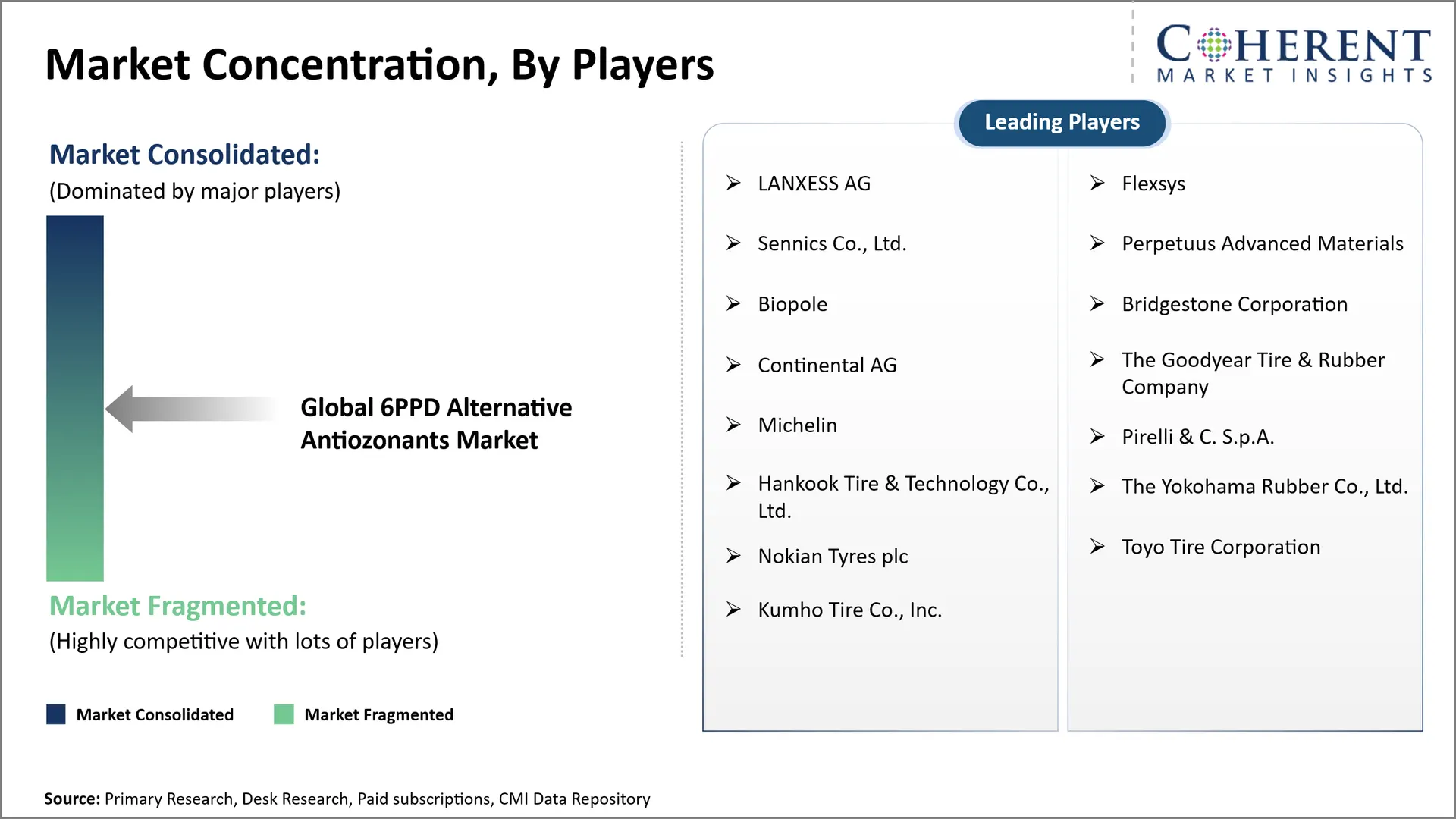
The global 6PPD alternative antiozonants market is assessed as moderately consolidated at its early commercial stage, comprising established rubber chemical manufacturers, emerging material developers, and specialty formulation companies. Competitive positioning depends on intellectual property, production consistency, formulation flexibility, and delivered additive costs. Regional suppliers can strengthen their market presence through localized manufacturing, responsive technical support, dependable distribution, and established relationships with rubber processors.
Key Competitive Focus Areas
- Proprietary molecular structures and patent portfolio development.
- Batch consistency and chemical impurity control.
- Competitive additive pricing per kilogram of rubber.
- Flexible manufacturing capacity and intermediate sourcing.
- Compatibility with existing rubber curing systems.
- Regional inventory management and supply continuity.
- Long-term procurement agreements with industrial customers.
- Customer-specific formulation and technical troubleshooting capabilities.
Market Report Scope
6PPD Alternative Antiozonants Market | |||
Report Coverage | Details | ||
Base Year | 2025 | Market Size in 2026: | USD 4.1 Mn |
Historical Data For: | 2020 to 2024 | Forecast Period: | 2026 to 2033 |
Forecast Period 2026 To 2033 CAGR: | 58.38% | 2033 Value Projection: | USD 102.5 Mn |
Geographies covered: |
| ||
Segments covered: |
| ||
Companies covered: | LANXESS AG, Flexsys, Sennics Co., Ltd., Perpetuus Advanced Materials, Biopole, Bridgestone Corporation, Continental AG, The Goodyear Tire & Rubber Company, Michelin, Pirelli & C. S.p.A., Hankook Tire & Technology Co., Ltd., The Yokohama Rubber Co., Ltd., Nokian Tyres plc, Toyo Tire Corporation, Kumho Tire Co., Inc. | ||
Growth Drivers: |
| ||
Restraints & Challenges: |
| ||
Analyst Opinion (Expert Opinion)
- Future Market Direction: The leadership of the global 6PPD alternative antiozonants market is likely to move toward suppliers who are able to gain early material specifications on next-generation tire platforms. Once an alternative is locked into an approved formulation, subsequent supplier switches may be commercially disruptive, increasing the potential for customer retention and recurring revenue.
- Transformative Market Disruption: Licensing-based chemical commercialization can change the economics of the industry. Research-intensive developers may monetize proprietary antiozonant chemistry through established manufacturing partners rather than building independent production facilities, lowering capital intensity and challenging conventional vertically integrated business models.
- Strategic Priorities and Recommendations: Manufacturers should link capacity investments to confirmed customer qualification milestones, protect margins with performance-based pricing and diversify critical intermediate sourcing. Early engagement with rubber compounders and contractual risk-sharing arrangements can improve commercialization prospects while limiting exposure to early production expansion.
Speak to the analyst
Want personalized insights?
Take the findings above to one of our principal consultants, or have the report rebuilt around the segments, geographies and competitors you actually track.
Market Segmentation
- Alternative Chemistry Insights (Revenue, USD Mn, 2021 - 2033)
- CCPD-Based Antiozonants
- Other PPD-Based Alternatives
- Non-PPD Synthetic Antiozonants
- Bio-Based Antiozonants
- Graphene & Carbon-Based Alternatives
- Product Form Insights (Revenue, USD Mn, 2021 - 2033)
- Granules & Pastilles
- Powder
- Liquid & Dispersions
- Masterbatch
- Application Insights (Revenue, USD Mn, 2021 - 2033)
- Tire Tread & Shoulder Components
- Tire Sidewalls
- Other Tire Components
- Non-Tire Industrial Rubber Products
- Tire Type Insights (Revenue, USD Mn, 2021 - 2033)
- Passenger Car & Light Truck Tires
- Truck & Bus Tires
- Two-Wheeler Tires
- Off-the-Road & Agricultural Tires
- Other Specialty Tires
- End User Insights (Revenue, USD Mn, 2021 - 2033)
- Tire Manufacturers
- Industrial Rubber Product Manufacturers
- Rubber Compounders & Converters
- Sales Channel Insights (Revenue, USD Mn, 2021 - 2033)
- Direct Manufacturer Sales
- Specialty Chemical Distributors
- Regional Insights (Revenue, USD Mn, 2021 - 2033)
- North America
- U.S.
- Canada
- Latin America
- Brazil
- Argentina
- Mexico
- Rest of Latin America
- Europe
- Germany
- U.K.
- Spain
- France
- Italy
- Russia
- Rest of Europe
- Asia Pacific
- China
- India
- Japan
- Australia
- South Korea
- ASEAN
- Rest of Asia Pacific
- Middle East
- GCC Countries
- Israel
- Rest of Middle East
- Africa
- South Africa
- North Africa
- Central Africa
- North America
- Key Players Insights
- LANXESS AG
- Flexsys
- Sennics Co., Ltd.
- Perpetuus Advanced Materials
- Biopole
- Bridgestone Corporation
- Continental AG
- The Goodyear Tire & Rubber Company
- Michelin
- Pirelli & C. S.p.A.
- Hankook Tire & Technology Co., Ltd.
- The Yokohama Rubber Co., Ltd.
- Nokian Tyres plc
- Toyo Tire Corporation
- Kumho Tire Co., Inc.
Sources
Primary Research Interviews
- Alternative antiozonant and rubber chemical manufacturers
- Tire manufacturers, OEMs, and rubber compounders
- Polymer scientists and rubber formulation specialists
- Environmental toxicologists and chemical safety experts
- Specialty chemical distributors and procurement professionals
Stakeholders
- CCPD-based and other PPD-based antiozonant manufacturers
- Non-PPD and bio-based chemical developers
- Graphene and carbon-based additive suppliers
- Tire and industrial rubber product manufacturers
- Specialty chemical distributors and raw material suppliers
End-use Sectors
- Tire Manufacturing: Passenger, commercial, and specialty tires
- Automotive Components: Rubber seals, hoses, and protective components
- Industrial Rubber Products: Conveyor belts, gaskets, and industrial hoses
- Rubber Compounding: Customized protective additive formulations
Product Applications
- Tire tread and shoulder protection
- Tire sidewall ozone resistance
- Rubber oxidation and environmental aging protection
- Dynamic fatigue and crack resistance
- Industrial elastomer durability enhancement
Regulatory and Industry Bodies
- U.S. Environmental Protection Agency (EPA)
- California Department of Toxic Substances Control (DTSC)
- European Chemicals Agency (ECHA)
- European Commission
- Environment and Climate Change Canada (ECCC)
- Organisation for Economic Co-operation and Development (OECD)
- National Highway Traffic Safety Administration (NHTSA)
Databases
- UN Comtrade and ITC Trade Map – Rubber Chemical Trade Statistics
- California DTSC – Alternatives Database
- ECHA Chemical Substance Database
- OECD eChemPortal – Chemical Safety Information
- PubChem – Chemical Properties and Toxicity Data
- WIPO PATENTSCOPE and European Patent Office Espacenet
- Company Annual Reports and Investor Presentations
Magazines and Journals
- European Rubber Journal
- Rubber World
- Tire Technology International
- Rubber Chemistry and Technology
- Environmental Science & Technology
- Science of the Total Environment
- Journal of Hazardous Materials
Associations
- U.S. Tire Manufacturers Association (USTMA)
- Tyres Europe (formerly ETRMA)
- China Rubber Industry Association (CRIA)
- Automotive Tyre Manufacturers' Association (ATMA)
- International Rubber Study Group (IRSG)
- WBCSD – Tire Industry Project (TIP)
- International Institute of Synthetic Rubber Producers (IISRP)
Public Domain Sources
- Alternative antiozonant product catalogs and technical datasheets
- Chemical safety data sheets and ecotoxicity assessments
- 6PPD Alternatives Analysis Reports
- Rubber formulation patents and performance studies
- Tire manufacturer sustainability and substitution initiatives
- Chemical manufacturing capacity and commercialization disclosures
- Product launches, financial reports, and trade statistics
Key Standards and Regulations
- EU REACH Regulation (EC) No. 1907/2006 – Chemical Registration and Restrictions
- EU CLP Regulation (EC) No. 1272/2008 – Chemical Classification and Labeling
- U.S. Toxic Substances Control Act (TSCA) – Chemical Safety Requirements
- California Safer Consumer Products Regulations – Motor Vehicle Tires Containing 6PPD
- ISO 1431-1:2024 – Static and Dynamic Ozone Cracking Resistance
- ASTM D1149 – Rubber Ozone Cracking Testing
- ASTM D573 – Rubber Accelerated Heat Aging Testing
- OECD Test Guideline 203 – Fish Acute Toxicity Assessment
- OECD Test Guidelines 301 – Ready Biodegradability Assessment
- FMVSS No. 139 – New Radial Tire Safety and Performance Requirements, Where Applicable
Proprietary Elements
- CMI Data Analytics Tool and proprietary research repository, supported by primary interviews, alternative antiozonant chemistry benchmarking, product form analysis, rubber formulation assessment, environmental toxicity evaluation, tire application analysis, end-user demand assessment, commercialization readiness tracking, sales channel analysis, country-level market sizing, chemical pricing evaluation, regulatory compliance assessment, manufacturer profiling, patent analysis, product development tracking, and competitive intelligence.
Get access to 250+ pages report
Every segment, forecast, competitor profile and data table behind the analysis above — available for instant download.
- ESOMAR Member
- ISO 9001:2015 Certified
- D-U-N-S Registered
- GDPR & CCPA Compliant
Frequently Asked Questions
The CAGR of the global 6PPD alternative antiozonants market is projected to be 58.38% from 2026 to 2033.
The global 6PPD alternative antiozonants market is estimated to be valued at USD 4.1 million in 2026 and is expected to reach USD 102.5 million by 2033.
6PPD is a rubber additive used to protect tires from ozone-induced cracking and degradation. Manufacturers are exploring alternatives to address environmental concerns associated with its transformation product, 6PPD-quinone.
Certain alternative antiozonants have entered early commercialization, while others are undergoing performance testing, environmental safety assessments, and tire manufacturer qualification.
Complete substitution remains under evaluation, as alternatives must demonstrate comparable ozone resistance, fatigue protection, durability, and compatibility with existing rubber formulations.
Manufacturers should evaluate chemical safety, ozone protection efficiency, rubber compatibility, regulatory compliance, supplier reliability, formulation costs, and commercial production scalability.
Increasing regulatory scrutiny of tire additives and growing demand for alternatives with lower aquatic toxicity are the key factors driving the growth of the global 6PPD alternative antiozonants market.