

Global Adaptive Robotics Market Size and Forecast – 2026 To 2033
The global adaptive robotics market is expected to grow from USD 14.00 Bn in 2026 to USD 68.00 Bn by 2033, registering a compound annual growth rate (CAGR) of 17.4% from 2026 to 2033. The global adaptive robotics market is driven by advancements in artificial intelligence and machine learning. On March 16, 2026, FANUC announced it is collaborating with NVIDIA to advance physical AI, a new paradigm that merges artificial intelligence with physical robotics to enable machines that see, reason, and act in dynamic environments.
Key Takeaways of the Global Adaptive Robotics Market
- The Industrial Robots segment is expected to account for 37.0% of the global adaptive robotics market share in 2026. Rising adoption of industrial robots in manufacturing is driving the growth of the segment. On April 16, 2026, Siemens and Humanoid announced testing of the HMND 01 Alpha wheeled humanoid robot at Siemens' electronics factory in Erlangen, Germany.
- The Fixed Robotic Systems segment is estimated to capture 52.0% of the market share in 2026. Growing demand for adaptive manufacturing systems is majorly driving the growth of the segment. On March 18, 2025, Vention unveiled an AI-powered bin-picking solution using an ABB GoFa collaborative robot, vision technology, and finger grippers. The system was demonstrated sorting plumbing components from McAlpine's product range.
- The AI-Based Robotics segment is estimated to capture 41.0% of the market share in 2026. Expansion of warehouse automation is driving the growth of the segment. On May 7, 2025, Amazon introduced Vulcan, its first warehouse robot with a sense of touch. The technology combines computer vision with haptic feedback for picking and stowing products in fulfillment centers, including those that are placed in hard-to-reach places.
- North America is expected to dominate the adaptive robotics market in 2026 with a market share of 43.0%. Increasing use of machine vision and sensors in North America is driving the growth of the regional market. On May 5, 2026, Cognex Corporation launched the In-Sight 3900, an embedded AI vision system powered by Qualcomm Dragonwing platforms. It supports resolutions up to 25 megapixels and processes inspections up to four times faster than previous-generation Cognex systems.
- Asia Pacific is expected to account for 31.0% share in 2026. Growing need for rapid production changeovers in Asia Pacific is driving the growth of the regional market. On October 1, 2025, Panasonic Connect launched Robo Sync in Japan to simplify robot operation and production changeovers. The platform controls robots from different manufacturers through a unified interface, with visual programming, image recognition, and reusable setup templates.
Segmental Insights
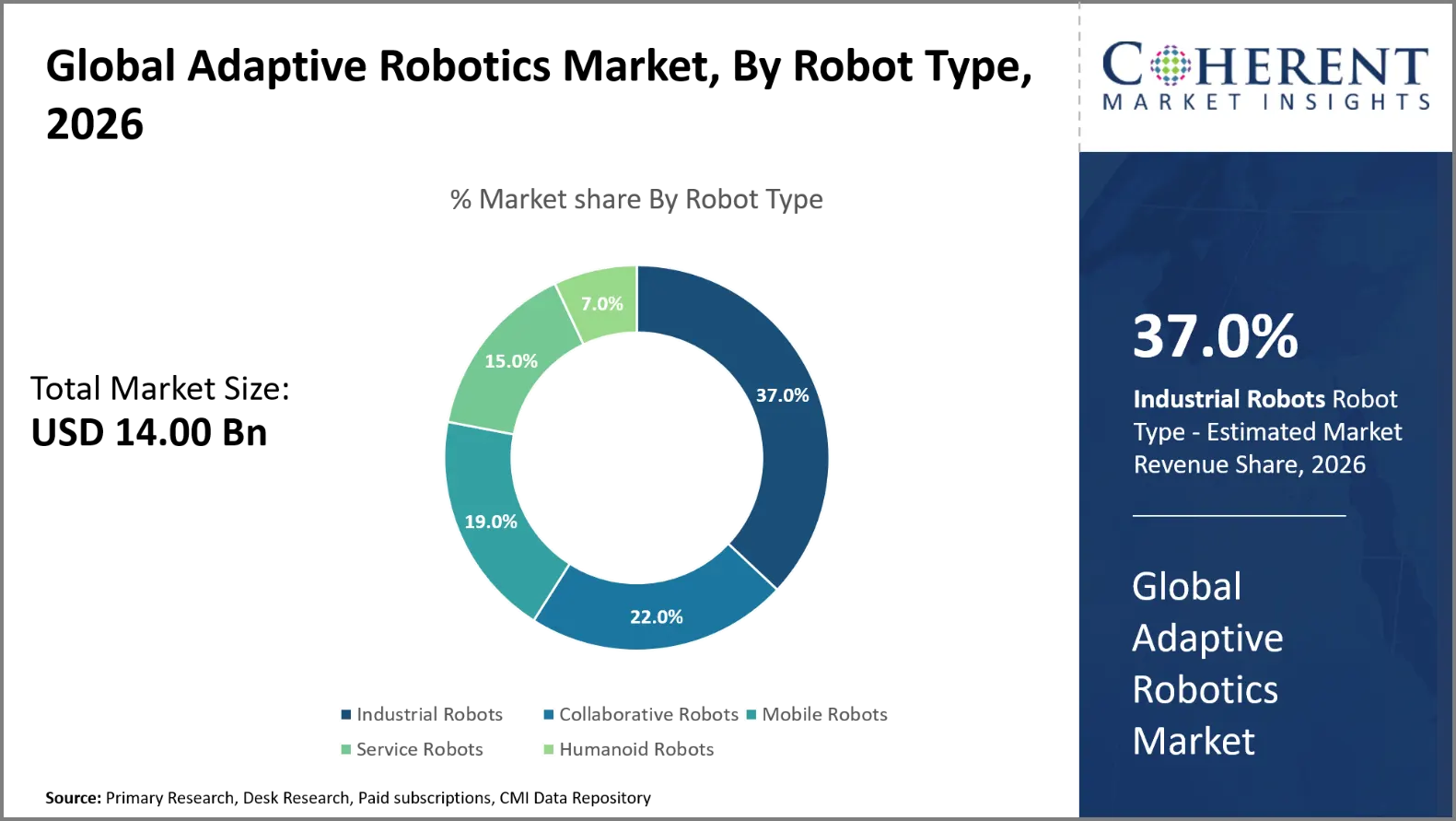
Why Does Industrial Robots Dominate the Global Adaptive Robotics Market?
The industrial robots segment is expected to account for 37.0% of the global adaptive robotics market share in 2026. Industrial robots dominate because manufacturers need flexible automation for increasingly complex production environments. Adaptive robots are robots that change their motion and operations based on sensor feedback, machine vision, and intelligent control systems. These competencies assist Assembly, Welding, Material Handling, Inspection and Precision Manufacturing. Adaptive robots are employed in industrial settings to increase output, ensure consistent quality, and limit workers' exposure to dangerous jobs. Manufacturers can connect with current production lines to automate repetitive procedures and variations in product. Industrial adoption is driven by the desire for customized manufacturing and rising labor costs.
On April 20, 2026, FANUC America unveiled the CRX-3iA, an 11-kilogram collaborative robot,, for rapid setup and redeployment on a range of production jobs. Uses include welding, screw driving, small-part assembly, inspection and material handling. Its portability enables enterprises to automate short production runs and move robotic equipment without requiring extensive permanent installations.
- Current Industry Events of 2026
- Market Size Estimation
- Regional Breakdown
- Competitive Landscape
- Customer Intelligence
- Segmental Analysis
- Pricing Analysis
- Key Market Drivers, Challenges & Future Trends
- Customized Insights Section
Why is Fixed Robotic Systems the Most Preferred Deployment Type?
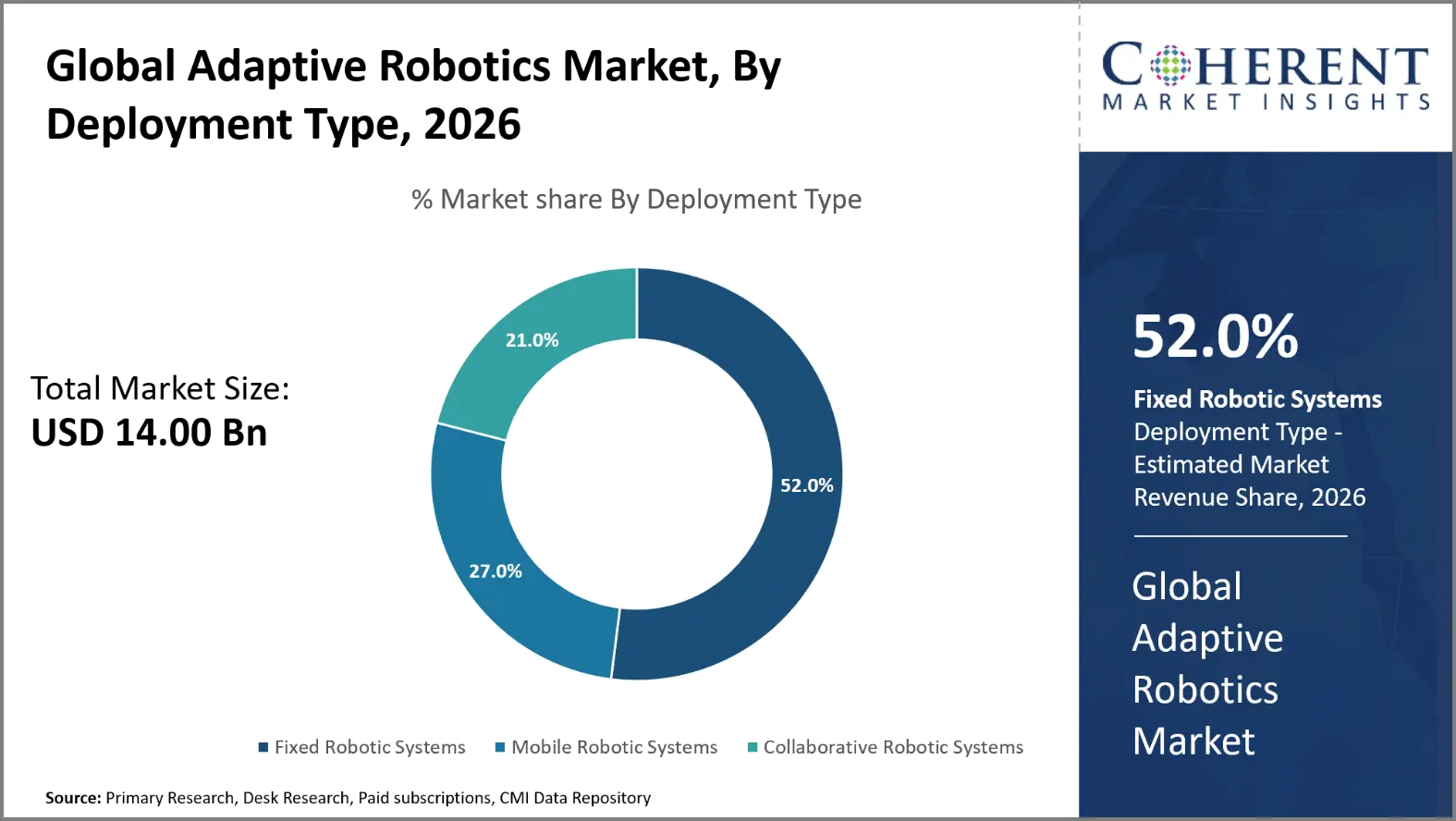
The fixed robotic systems segment is expected to account for 52.0% of the global adaptive robotics market share in 2026. Fixed robotic systems continue to be a preferred deployment option since they offer steady repeatable automation for established industrial workflows. These systems can be integrated into production lines, conveyors, inspection stations, and specialized industrial equipment. They are fixed in place for precise positioning, repeatable cycle times and safe handling of heavy or fragile parts. Fixed systems also ease space planning, safety management and integration with programmable logic controllers.” Manufacturers may upgrade them with adaptive software, machine vision and force sensors without having to replace the whole system.
On August 19, 2026, the International Federation of Robotics highlighted ABB Robotics’ welding cells at Italian manufacturer Fedegari Group. Two gantry-mounted robots weld large autoclave pressure vessels used in pharmaceutical production. RobotStudio offline programming allows engineers to prepare upcoming jobs while current production continues.
AI-Based Robotics Dominates the Global Adaptive Robotics Market
The AI-based robotics segment is expected to account for 41.0% of the global adaptive robotics market share in 2026. Adaptive robotics adoption is driven by artificial intelligence-based robotics that allows machines to understand sensor information, identify objects, and adapt their behavior to changing situations. Machine learning, computer vision and intelligent motion planning assist robots cope with changeable parts, detect flaws and optimize task execution. These skills take automation out of the world of monotonous preprogrammed motions. Artificial intelligence can be used by manufacturers to improve inspection accuracy, allow more flexible assembly, and coordinate robots with other manufacturing equipment. AI-based solutions also can evaluate operational data to find inefficiencies and help with predictive maintenance.
On September 23, 2025, ABB Robotics launched OmniCore EyeMotion for real-time robot perception and adaption. It enables compatible robots to read inputs from third-party cameras and sensors. Integration with RobotStudio provides faster configuration and deployment.
Current Events and their Impact
Current Events | Description and its Impact |
European Union Machinery Regulation (EU) 2023/1230, amended by Regulation (EU) 2026/1744 |
|
European Union Artificial Intelligence Act Regulation (EU) 2024/1689, amended by Regulation (EU) 2026/1744 |
|
Adaptive Robotics Market Dynamics
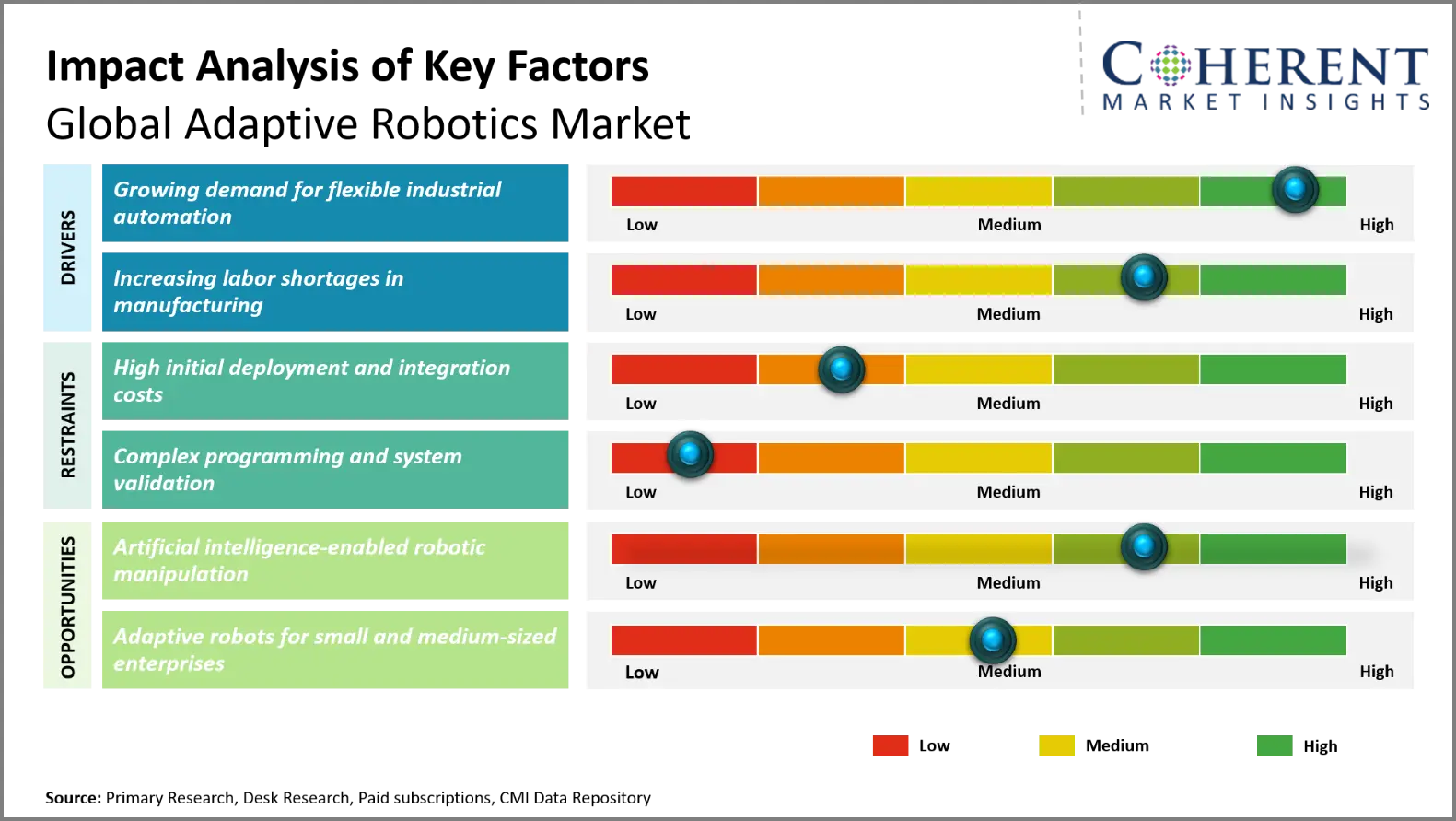
Market Drivers
Growing demand for flexible industrial automation
The global adaptive robotics market is being fueled by the rising demand for flexible industrial automation as firms seek adaptable production solutions. Adaptive robots have sensors, machine vision and artificial intelligence to adjust to changes in manufacturing requirements. Such capabilities enable product customization, fast changeovers and efficient management of heterogeneous components. In industries including automotive, electronics, food processing and shipping there is a growing need for automation that can handle frequent product changes. Adaptive systems are capable of changing operations in response to the environment, unlike conventional robots that perform predetermined sequences of motions. This type of flexibility allows producers to better use their equipment, deliver consistent product quality, and reduce production disruptions. Increasingly, smart factories are being implemented, which is driving the demand for adaptable robotic systems.
On June 23, 2025, Siemens announced plans to incorporate its Operations Copilot with driverless transport systems and mobility robotics. Operations Copilot is an industrial copilot for the operation and maintenance of machines. Mobile transport robots will gradually become autonomous physical agents driven by artificial intelligence (AI) and Operations Copilot will be a user interface for humans.
Increasing labor shortages in manufacturing
Growing labor shortages in manufacturing are increasing demand for adaptive robots as organizations seek reliable automation for repetitive and complex operations. Many manufacturing plants have difficulty finding and maintaining competent people who can accomplish things like assembly, inspection, material handling and working in hazardous conditions. Adaptive robots can conduct these functions while being able to adapt to variations of components and working situations. Sensor based control and machine vision allow robots to execute tasks that require more flexibility than conventional automation systems. The features enable manufacturers to keep production going, minimize reliance on manual labor and increase workplace safety. Adaptive robots also enable the existing workforce to focus on monitoring, maintenance and more valuable tasks. This move bolsters investments in smart manufacturing technologies.
On September 2, 2026, Caterpillar Inc. announced it is collaborating with FieldAI to improve physical AI, autonomy and robotics that enable jobsites and factories function safer and more efficiently. Physical AI transforms live observations into useful insights that make people safer, increase decision-making and maximize the effectiveness of every person and equipment.
Emerging Trends
- Artificial Intelligence Integration in Adaptive Robotics: Adaptive robots equipped with AI capabilities may evaluate sensor data, identify objects, and adjust their actions based on varying production scenarios, allowing for adaptable automation within manufacturing settings.
- Impact: This improves accuracy, minimizes operational downtime, and enables robots to do complicated jobs with minimal human intervention. This intelligent decision-making enhances production efficiency and consistency
- Relevance to the market: The increasing demand for intelligent automation is pushing firms to invest in adaptive robotic systems, thus extending applications in the electronics, automotive, logistics, and precision manufacturing sectors.
- Human-Robot Collaboration in Industrial Workspaces: Collaborative adaptive robots combine sensors, visual systems and intelligent controls to collaborate with workers, providing flexible task execution in shared industrial environments.
- Impact: Human-robot collaboration enhances worker allocation, decreases exposure to hazardous tasks, and allows manufacturers to automate repetitive operations without a major redesign of current manufacturing facilities.
- Relevance to the market: Increasing interest in flexible production and worker safety bodes well for the acceptance of collaborative adaptive robots, particularly for manufacturers wanting to upgrade existing facilities with smart automation capabilities.
Regional Insights
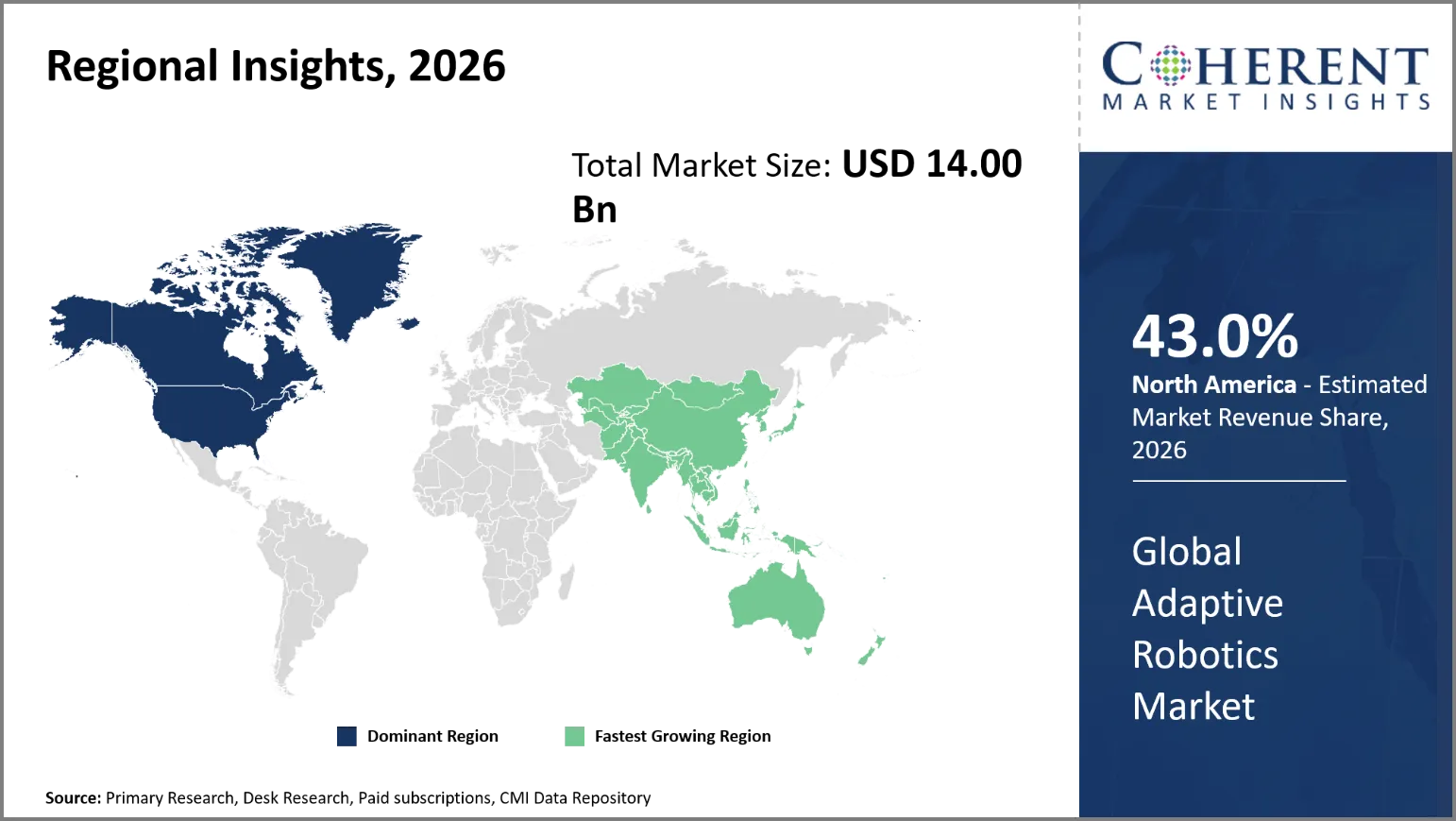
Why is North America a Strong Market for Adaptive Robotics?
North America is expected to account for a market share of 43.0% in 2026. Adaptive robotics is being adopted in North America, owing to reshoring, aerospace production and advanced warehouse automation. In Ontario, Canada, suppliers to the automotive industry are using robotic systems to handle components, check and assemble them with precision. Flexible automation is increasingly required for mixed-model car production in automotive manufacturing clusters. U.S. aerospace manufacturers are using adaptive robotic technologies to drill, fasten and process composite materials. Warehouse personnel also utilize vision-guided robots for handling a variety of goods and altering inventory layouts. The need for traceability in production, fast changeovers of products and constant quality drive the regional demand. Collaboration between robotics developers, universities, and manufacturers supports specialized solutions for demanding industrial applications.
Why Does Asia Pacific Adaptive Robotics Market Exhibit High Growth?
Asia Pacific is expected to register the fastest growth with a CAGR of 17.2% over the forecast period and is projected to account for 31.0% of the global adaptive robotics market in 2026. The Asia Pacific region is a key market for adaptive robotics due to the need for accurate handling, quick product changeover and small scale assembly processes in its electronics supply chains. The International Federation of Robotics says Asia made up 74% of new industrial robot deployments in 2024. In 2025, India added over 10,500 industrial robots, indicating a growing desire for automation. For Singapore’s advanced electronics, semiconductor and biomedical production facilities, robots are needed that can handle and operate under control as well. The semiconductor ecosystem in Taiwan drives need for automation in wafer handling, cleanroom logistics, and equipment service. These specialized production environments encourage development of robots that combine sensing, repeatability, and tightly controlled movement.
Global Adaptive Robotics Market Outlook for Key Countries
Why is U.S. Emerging as a Major Hub in the Adaptive Robotics Market?
The U.S. adaptive robotics market is driven by food processing automation, aerospace production and industrial technology investment. In 2025, about 38,000 industrial robots were installed, 11% more, according to the International Federation of Robotics. Food industry installations increased 30% as demand for automation in packaging, handling and processing operations increased. The car industry remains a major user, with the sector reporting 13,500 installations. In March 2026, FANUC America announced a new Michigan facility with an expenditure of USD 90 million, with completion targeted for late 2027. The building is built to enable future robot production capacity and advanced automation technologies, including physical artificial intelligence.
Is China the Next Growth Engine for the Adaptive Robotics Market?
Mass electronics production, domestic robotics development and fast-paced warehouse automation are driving China’s adaptive robotics market. 354,000 industrial robot installations and 20% year-on-year growth was reported in 2025 by the International Federation of Robotics. In 2024, there were 83,000 installations in electrical and electronics manufacturing and 57,200 in automobile manufacturing. In 2025, 55% of China’s industrial robot deployments were from domestic suppliers. Companies such as Estun Automation and Siasun Robot and Automation are boosting local capabilities. In China, the large e-commerce networks promote autonomous mobile robots for sorting, picking and internal transit. Such applications benefit from robots that are able to adjust to fluctuating stocks and product combinations.
Germany Adaptive Robotics Market Analysis and Trends
Adaptive robots will benefit from Germany’s precision engineering, automotive production and the automation requirements of specialist machinery makers. The International Federation of Robotics stated Germany had 449 industrial robots per 10,000 manufacturing employees. The country installed less than 25,000 industrial robots in 2025, following lower investment in the automobile sector. Automotive manufacturers employ robotics for body-in-white production, welding, painting and precise assembly. Germany Trade and Invest has identified more than 450 robotics and automation investment projects from 2019 to 2024. Small and medium manufacturers also need adaptable robotic cells for changing product batches. These requirements support demand for adaptable gripping, machine vision, and production-line reconfiguration technologies.
Japan Adaptive Robotics Market Analysis and Trends
Precision component production, improved robot engineering, and automation for an aging workforce are key drivers for the Japanese adaptive robotics market. In 2025, the country installed 36,219 industrial robots, according to the International Federation of Robotics. FANUC, Yaskawa Electric and Kawasaki Heavy Industries are among the Japanese businesses that produce robotic arms, motion controllers and integrated automation systems. In electronics manufacturers, robotics are employed to put, check and handle components with precision. Japanese auto suppliers likewise need repeatable operations for complicated components and variable assembly activities. The country’s existing robotics technical capabilities underpin advances in force sensing, motion control and small robot design. These technologies generate more opportunities for adaptive systems in precise manufacturing and specialized industrial processes.
South Korea Adaptive Robotics Market Analysis and Trends
South Korea’s adaptive robotics market is mostly driven by semiconductor manufacturing, battery manufacturing and highly automated electronics plants. 30,000 industrial robots were installed in 2025, according to the International Federation of Robotics. South Korea also had the highest density of industrial robots in the world with 1,220 robots per 10,000 manufacturing personnel. Handling wafers and closely controlling movement are critical in semiconductor manufacture, while automated processing of electrodes, assembling cells and inspection are required in battery plants. Both Samsung Electronics and SK hynix run high-tech semiconductor factories that require process uniformity. The government’s Fourth Basic Plan for Intelligent Robots promotes the growth of robotics technology, labor capacities and industrial competitiveness through 2028. These priorities encourage advanced sensing and intelligent robotic control.
Global Adaptive Robotics Market - Robotics-as-a-Service Business Models
Company | Robotic Solution | Pricing Model | Included Services | Target Applications |
Quasi Robotics | Model C2 autonomous mobile robot delivery cart | Monthly subscription | Software updates, support, maintenance, optional analytics and fleet management | Internal delivery, material transport |
Chef Robotics | Artificial intelligence-enabled food assembly robots | Flat annual service fee | Hardware, software, deployment, training, monitoring, maintenance, parts replacement and upgrades | Food processing, meal assembly, portioning |
Formic | Industrial robots for manufacturing and palletizing | Full-service rental and usage-based options | Robot sourcing, integration, installation, maintenance and support depending on plan | Packaging, palletizing, machine tending |
Locus Robotics | Autonomous mobile robots and warehouse fulfillment platform | Recurring service subscription | Robotic fleet, software, maintenance and support subject to contract | Order picking, warehouse fulfillment, distribution |
RBOT | Managed robotic automation solutions | Fixed monthly subscription | Hardware, software, deployment, integration, training, monitoring, maintenance and updates | Warehousing, manufacturing, material handling |
How is Artificial Intelligence-Enabled Robotic Manipulation Creating New Growth Opportunities in the Adaptive Robotics Market?
Artificial intelligence-enabled robotic manipulation is creating new growth opportunities in the Adaptive Robotics Market by allowing robots to handle unfamiliar objects, deformable materials, and mixed product batches without extensive reprogramming. Vision-language-action models can help robots read instructions, recognize objects and pick appropriate gripping tactics. For example, Amazon’s robotic systems combine computer vision and enhanced manipulation to handle a variety of packages in fulfillment processes. In automotive manufacturing, adaptive manipulation is applied to assist in the placement of irregular parts and to alter the grip force in assembly. Electronics makers can use these skills for precision placement on sensitive connectors and circuit boards. These improvements bring automation to low-volume production, returns handling and intricate picking, where typical fixed-program robots struggle with rapid changes.
On August 6, 2026, Festo launched GripperAI, an artificial intelligence-based software solution that enables robots to pick up mixed, unknown and randomly positioned objects without considerable programming, template loading or expert vision integration. GripperAI determines the best spot to grab each object and chooses the suitable gripper from the end-of-arm tools available for the job.
Market Players, Key Development, and Competitive Landscape
Key Developments
- On April 22, 2026, ABB Robotics announced the launch of its new PoWa cobot family. PoWa extends ABB Robotics’ comprehensive cobot offer with industrial-grade performance including six different payload categories, from 7kg to 30kg, the longest reach and highest arm load on the market and best-in-class top speed of up to 5.8 m/s.
- On April 16, 2026, Path Robotics announced the launch of Rove, a mobile robotic welding system that pairs the company's Obsidian physical AI model with a quadruped robot. The launch marks a major expansion for Path Robotics, where Obsidian already delivers autonomous, adaptive welding inside fixed cells, Rove extends that capability to the field, bringing intelligent welding to the part rather than the part to the workpiece.
- On February 11, 2026, Apptronik announced a USD 520 million Series A-X funding round, with participation from existing investors. With this fresh capital, Apptronik will ramp up production of its award-winning humanoid robot, Apollo, and expand its global network of commercial and pilot deployments.
Competitive Landscape
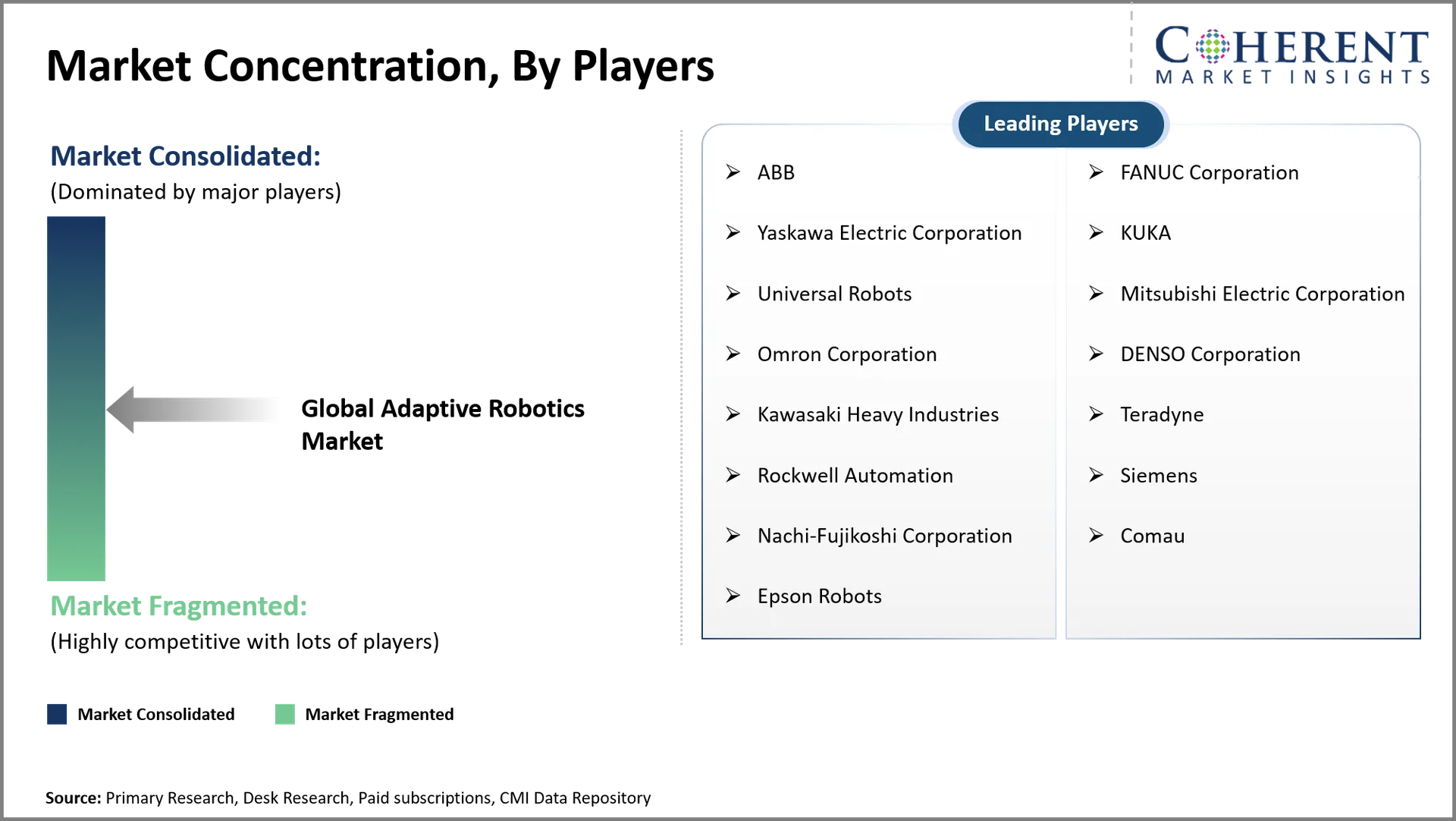
The adaptive robotics market is competing with artificial intelligence platform developers as well as existing industrial automation enterprises. ABB Robotics, FANUC, KUKA, and Yaskawa Electric are all pushing toward intelligent automation using robot control, digital simulation, and integration capabilities. In March 2026, NVIDIA announced partnerships with Omniverse technologies and Jetson computing systems to accelerate physical artificial intelligence with its Isaac simulation frameworks. The collaborations focus on virtual commissioning, high-precision electronics assembly and real-time factory automation. Universal Robots is a collaborative robot company that enables flexible industrial activities. NVIDIA focuses on enabling software, simulation, and computing infrastructure rather than manufacturing complete industrial robot portfolios.
Top Manufacturers and Notable Products in the Adaptive Robotics Market
Manufacturer | Notable Product | Key features |
ABB Robotics | OmniCore EyeMotion | AI-powered vision, real-time environmental perception, third-party camera and sensor compatibility, collision-free path planning |
FANUC | CRX Collaborative Robot Series | Easy setup, flexible installation, force-sensitive operation options, multiple payload choices, manufacturing workflow integration |
Yaskawa Electric | MOTOMAN NEXT | Sensor-based decision-making, adaptive task execution, intelligent motion control, flexible manufacturing support |
KUKA | LBR iisy Collaborative Robot | Sensitive interaction, intuitive programming, flexible deployment, human-robot collaboration |
Universal Robots | UR Series Collaborative Robots | Flexible deployment, intuitive programming, modular end-effectors, vision system integration, automation software compatibility |
Adaptive Robotics Market Report Coverage | |||
Report Coverage | Details | ||
Base Year | 2025 | Market Size in 2026: | USD 14.00 Bn |
Historical Data For: | 2020 To 2024 | Forecast Period: | 2026 To 2033 |
Forecast Period 2026 To 2033 CAGR: | 17.4% | 2033 Value Projection: | USD 68.00 Bn |
Geographies covered: |
| ||
Segments covered: |
| ||
Companies covered: | ABB, FANUC Corporation, Yaskawa Electric Corporation, KUKA, Universal Robots, Mitsubishi Electric Corporation, Omron Corporation, DENSO Corporation, Kawasaki Heavy Industries, Teradyne, Rockwell Automation, Siemens, Nachi-Fujikoshi Corporation, Comau, Epson Robots | ||
Growth Drivers: |
| ||
Restraints & Challenges: |
| ||
Analyst Opinion (Expert Opinion)
- The future of adaptive robotics will depend on robots learning unfamiliar tasks while maintaining industrial precision and predictable safety. Vision-language-action models, force-sensitive manipulation, and simulation-trained control will become important differentiators. Manufacturers should prioritize systems that handle product variation without repeated manual reprogramming. Adoption will depend on demonstrated reliability, integration costs, and measurable improvements in production performance.
- The strongest prospects are in AI-enabled industrial robots, collaborative robots and autonomous mobile manipulation systems. Electronics assembly provides for sensitive component handling and accurate inspection Mixed-model assembly and irregular parts require adaptive handling in automotive manufacturing. China provides scale for industrial deployment and Japan offers opportunity for advanced robot engineering. In the U.S., potential include aerospace automation, warehousing operations, and intelligent manufacturing.
- Market participants should create application-specific solutions, not just general-purpose market intelligence. Robot manufacturers should embed machine vision, force sensing, simulation and safety controls into deployable systems. Software developers need to partner with existing robotics manufacturers and industrial integrators. Companies must validate performance using client pilots monitoring cycle time, defect rates, changeover requirements, and recovery from handling errors. Competitive advantage will increasingly depend on reliable deployment, compatibility with existing equipment, and transparent returns on investment.
Speak to the analyst
Want personalized insights?
Take the findings above to one of our principal consultants, or have the report rebuilt around the segments, geographies and competitors you actually track.
Market Segmentation
- Robot Type Insights (Revenue, USD Billion, 2021 - 2033)
- Industrial Robots
- Collaborative Robots
- Mobile Robots
- Service Robots
- Humanoid Robots
- Deployment Type Insights (Revenue, USD Billion, 2021 - 2033)
- Fixed Robotic Systems
- Mobile Robotic Systems
- Collaborative Robotic Systems
- Technology Type Insights (Revenue, USD Billion, 2021 - 2033)
- AI-Based Robotics
- Machine Vision-Based Robotics
- Sensor-Based Adaptive Robotics
- Learning-Based Robotics
- Motion Planning and Control Systems
- Application Insights (Revenue, USD Billion, 2021 - 2033)
- Material Handling
- Inspection and Quality Control
- Picking and Sorting
- Healthcare and Laboratory Automation
- End User Insights (Revenue, USD Billion, 2021 - 2033)
- Automotive
- Electronics and Semiconductors
- Food and Beverage
- Healthcare
- Logistics and Warehousing
- Others
- Regional Insights (Revenue, USD Billion, 2021 - 2033)
- North America
- U.S.
- Canada
- Latin America
- Brazil
- Argentina
- Mexico
- Rest of Latin America
- Europe
- Germany
- U.K.
- Spain
- France
- Italy
- Russia
- Rest of Europe
- Asia Pacific
- China
- India
- Japan
- Australia
- South Korea
- ASEAN
- Rest of Asia Pacific
- Middle East
- GCC Countries
- Israel
- Rest of Middle East
- Africa
- South Africa
- North Africa
- Central Africa
- North America
- Key Players Insights
- ABB
- FANUC Corporation
- Yaskawa Electric Corporation
- KUKA
- Universal Robots
- Mitsubishi Electric Corporation
- Omron Corporation
- DENSO Corporation
- Kawasaki Heavy Industries
- Teradyne
- Rockwell Automation
- Siemens
- Nachi-Fujikoshi Corporation
- Comau
- Epson Robots
Sources
Primary Research Interviews
- Adaptive Robotics Manufacturers & OEMs
- Industrial Automation Integrators & Solution Providers
- End-User Industry Representatives (Automotive, Healthcare, Electronics)
- Research & Development Scientists and Robotics Engineers
Magazines
- Robotics Business Review Magazine
- Automation World Magazine
- IEEE Spectrum Magazine
- Robotics Trends Magazine
Journals
- Journal of Field Robotics (Wiley)
- International Journal of Robotics Research (SAGE Publications)
- Robotics and Autonomous Systems (Elsevier)
Associations
- International Federation of Robotics (IFR)
- Robotic Industries Association (RIA) - A Division of A3
- Association for Advancing Automation (A3)
- European Robotics Association (euRobotics)
Public Domain Sources
- U.S. Bureau of Labor Statistics - Automation & Robotics Data
- European Commission - Digital Industry & Robotics Policy Reports
- World Economic Forum (WEF) - Future of Jobs & Automation Reports
- NASA Technical Reports Server (NTRS) - Adaptive Robotics R&D Publications
Proprietary Elements
- CMI Data Analytics Tool
- Proprietary CMI Existing Repository of Information for Last 10 Years
Get access to 250+ pages report
Every segment, forecast, competitor profile and data table behind the analysis above — available for instant download.
- ESOMAR Member
- ISO 9001:2015 Certified
- D-U-N-S Registered
- GDPR & CCPA Compliant
Frequently Asked Questions
The global adaptive robotics market is expected to stand at USD 14.00 Bn in 2026 and is expected to reach USD 68.00 Bn by 2033.
The CAGR of the global adaptive robotics market is projected to be 17.4% from 2026 to 2033.
Growing demand for flexible industrial automation and Increasing labor shortages in manufacturing are the major factors driving the growth of the global adaptive robotics market.
High initial deployment and integration costs and Complex programming and system validation are the major factors hampering the growth of the global adaptive robotics market.
In terms of robot type, industrial robots segment is estimated to dominate the market revenue share in 2026.
Artificial intelligence enables robots to recognize objects, interpret sensor information, and modify movements when operating conditions change.
Machine vision helps robots identify objects, locate components, detect defects, and adjust movements according to visual information.