

Global Advanced Glass Market Size and Forecast – 2026 To 2033
The Global Advanced Glass Market is estimated to be valued at USD 83.35 Bn in 2026 and is expected to reach USD 132.97 Bn by 2033, growing at a compound annual growth rate (CAGR) of 6.90% from 2026 to 2033. This growth reflects increasing demand across construction, automotive, and electronics industries, supported by the greater use of energy-efficient glazing, high-strength glass, and advanced light-control technologies. Manufacturers are increasingly developing multifunctional glass solutions that improve thermal comfort, safety, and product performance while meeting specialized industrial requirements.
In July 2025, Gauzy Ltd announced the first customer deliveries of General Motors' Cadillac CELESTIQ vehicles featuring a serially produced Suspended Particle Device (SPD) smart-glass panoramic roof from Gauzy, equipped with four independently controlled tint zones. This development highlights the growing commercial application of intelligent glazing technologies in premium electric vehicles, creating opportunities for advanced glass manufacturers to supply higher-value products with adjustable shading, enhanced passenger comfort, and improved thermal management.
Key takeaways of the Global Advanced Glass Market
- Coated Glass is projected to register an estimated CAGR of 7.3% during 2026–2033 and command 34.3% of the global advanced glass market in 2026. Its commercial advantage lies in controlling solar heat gain while preserving daylight and architectural color consistency, supporting premium façade specifications. In September 2025, Guardian Glass introduced SunGuard SNX 60+ triple-silver low-emissivity coated glass for North American buildings.
- Safety and Security is expected to advance at an estimated CAGR of 6.8% from 2026 to 2033 and capture 33.7% of global advanced glass market value in 2026. Specifiers prioritize toughened and laminated glazing because impact containment, occupant protection, and liability reduction are essential in public and commercial spaces. In January 2025, AGC Glass Europe acquired Germany's SGT, a manufacturer of toughened and laminated safety glass.
- Passive High Performance Glass is forecast to grow at an estimated CAGR of 6.5% over 2026–2033 while retaining 85.8% of the global advanced glass market in 2026. Unlike electrically switchable systems, its insulation benefits require no active controls, helping contractors meet performance targets without additional integration complexity. In September 2025, Saint-Gobain Glass partnered with LuxWall to introduce INSIO vacuum glazing to Europe.
- Asia Pacific is projected to post an estimated CAGR of 6.8% during 2026–2033 and represent 39.1% of global advanced glass market in 2026. Regional scale reflects an established mix of building-glass processing, electronics supply chains and manufacturing investment across China and India. In August 2025, India's Ministry of Electronics and Information Technology inaugurated a tempered-glass manufacturing facility for mobile devices in Noida.
- Europe is anticipated to achieve an estimated CAGR of 8.2% from 2026 to 2033, the fastest regional pace, while accounting for 25.3% of global advanced glass market revenue in 2026. Renovation-led procurement favors high-insulation glazing compatible with existing building envelopes and increasingly stringent efficiency requirements. In May 2024, the revised EU Energy Performance of Buildings Directive entered into force, strengthening the framework for building upgrades.
Segmental Insights
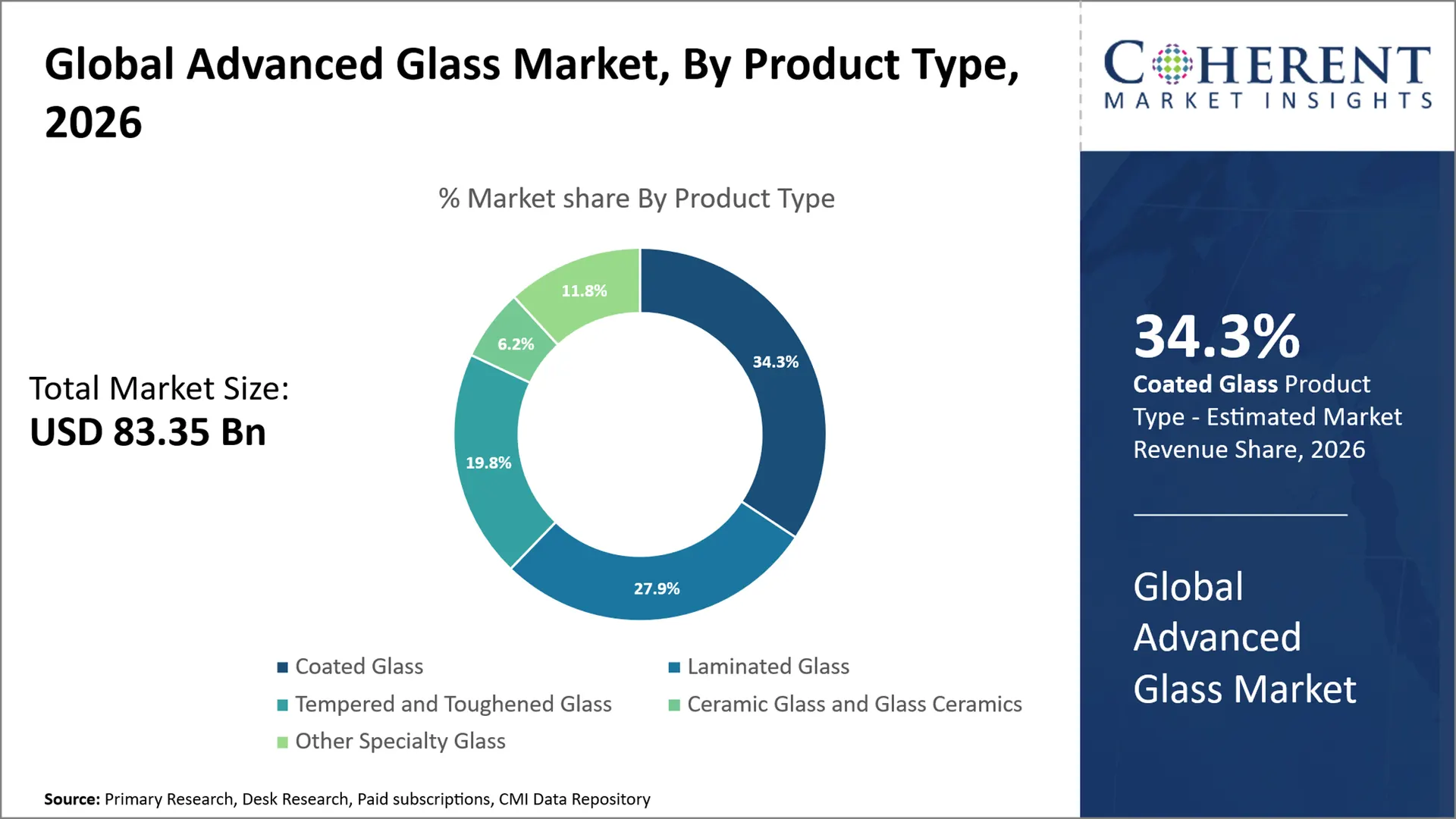
Why Does Coated Glass Dominate the Global Advanced Glass Market?
Coated Glass is expected to account for 34.3% of the global advanced glass market by product type in 2026. Its leading position reflects the ability of coating operations to differentiate large batches of standardized float glass for multiple specifications, including façade appearance, solar selectivity, and downstream tempering. Property developers and façade engineers value consistent color and performance across extensive curtain walls, while manufacturers benefit from production-scale efficiencies and regional stock availability. Coating lines also support flexible product portfolios, improving inventory economics for processors and glass merchants. In January 2026, Şişecam commissioned an additional coated glass line at its Bulgarian manufacturing facility, adding 6 million square meters of annual production capacity. This investment illustrates how producers are expanding coating throughput to serve specification-intensive building projects.
- Current Industry Events of 2026
- Market Size Estimation
- Regional Breakdown
- Competitive Landscape
- Customer Intelligence
- Segmental Analysis
- Pricing Analysis
- Key Market Drivers, Challenges & Future Trends
- Customized Insights Section
Why Do Safety and Security Represent the Largest Functional Segment in the Global Advanced Glass Market?
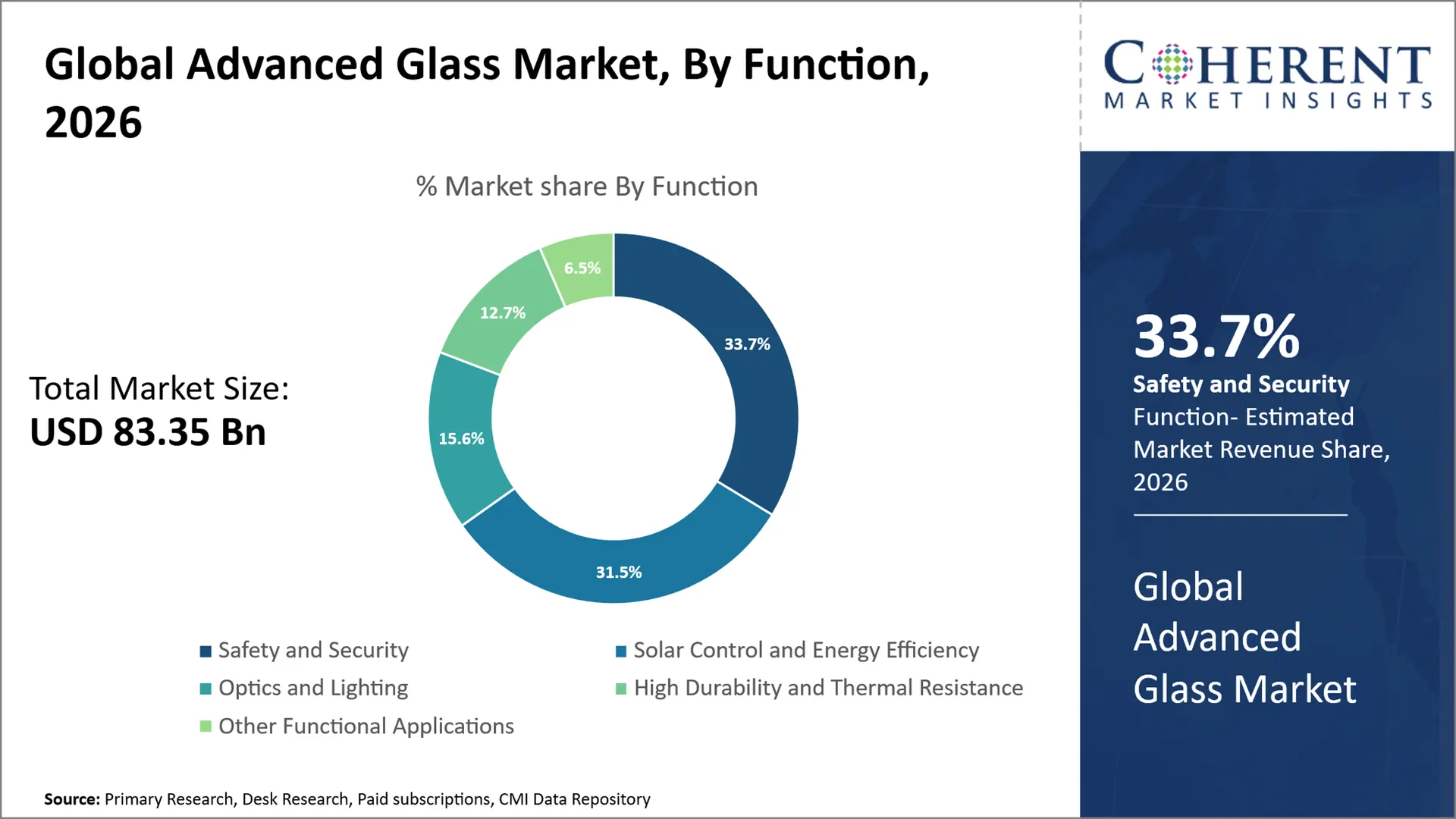
Safety and Security is expected to account for 33.7% of the global advanced glass market by function in 2026. This position reflects a purchasing requirement that cannot easily be deferred wherever glazing forms part of a building's protective boundary. For transport hubs, government premises, and financial facilities, buyers specify tested resistance levels according to distinct threat scenarios. Rather than purchasing glass on thickness alone, they assess certified assemblies, edge detailing, and compatibility with framing systems, creating opportunities for specialist processors and qualified installers. Such contracts often reward documented testing capability and engineering support more than commodity pricing. In January 2025, sedak introduced ballistic glass HMG, an insulating security-glass construction tested against armor-piercing ammunition beyond the EN 1063 BR7 reference level. This development illustrates the technical specialization required for high-risk installations.
Why Does Passive High Performance Glass Dominate the Technology Segment of the Global Advanced Glass Market?
Passive High Performance Glass is projected to hold 85.8% of the global advanced glass market by technology in 2026. Its broad position rests on compatibility with established glass-processing and installation workflows, allowing fabricators to offer performance upgrades without reconfiguring entire window and façade supply chains. Standardized insulating units, engineered laminates, and treated glass can reach residential replacement contractors and commercial builders through familiar procurement channels. Renovation customers particularly favor solutions that satisfy dimensional and weight limits imposed by existing frames, while producers prioritize predictable manufacturing yields and reliable sealing quality. In February 2025, Glaston described its patented manufacturing process for triple insulating glass with an ultrathin center pane measuring as little as 0.5 mm. The technology's suitability for thinner window assemblies illustrates how process engineering can widen the addressable retrofit market.
Current Events and their Impact
Current Event | Description and Its Impact |
December 2024 – European Union Revised Construction Products Regulation |
|
July 2025 – European Commission Initiates Solar Glass Anti-Dumping Review |
|
January 2026 – California Implements Updated Building Energy Efficiency Standards |
|
Global Advanced Glass Market Dynamics
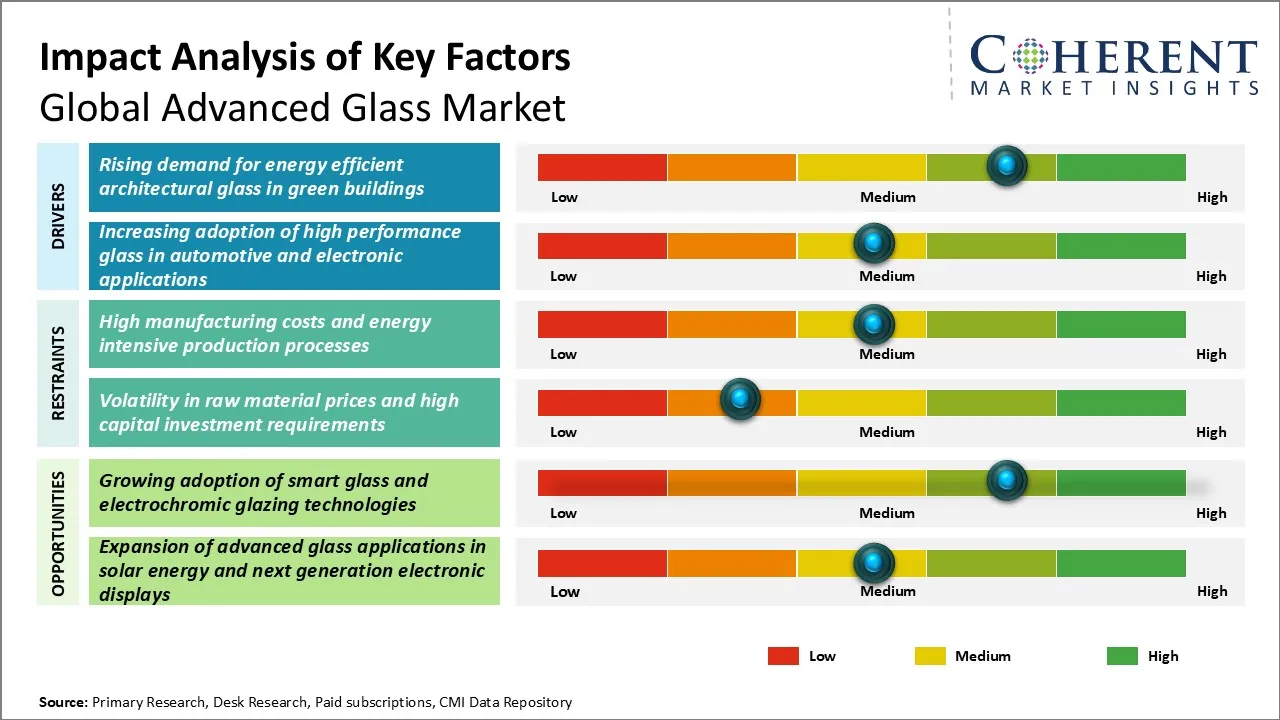
Key Market Drivers
- Rising demand for energy efficient architectural glass in green buildings: Energy-efficient building design is shifting glazing procurement from appearance-led selection toward measurable thermal performance. Solar-control coatings reduce unwanted heat gain, while low-emissivity layers limit heat transfer without compromising daylight. This makes performance documentation and fabrication quality commercially important for glass producers, insulating-glass manufacturers, and façade contractors seeking higher-value specifications. In March 2025, Vitro Architectural Glass introduced BirdSmart glass, combining a Solarban low-emissivity coating with laser-etched bird-visible patterns on a single pane. The product illustrates how energy efficiency is increasingly specified alongside other architectural requirements.
- Increasing adoption of high performance glass in automotive and electronic applications: Automotive and electronics buyers increasingly seek thinner, lighter surfaces that still withstand impacts, abrasion, and demanding operating conditions. Advanced glass suppliers therefore need specialized strengthening processes, uniform optical properties, and early collaboration with original equipment manufacturers. These requirements reward producers able to secure design approvals and sustain consistent production yields, making qualification expertise a competitive advantage. In March 2026, Corning Incorporated launched Gorilla Glass Ceramic 3 and identified Motorola's forthcoming razr fold as its first smartphone application. The announcement demonstrates the commercial value of durability-engineered glass within premium device designs.
Emerging Market Trends
- Shift Toward Factory-Prepared and Application-Specific Glazing Assemblies: Glass procurement is moving toward project-specific, factory-prepared assemblies rather than loosely coordinated deliveries of basic sheets and components. Buyers increasingly favor units supplied with verified dimensions, traceable batch records, installation sequencing, and compatibility information for framing systems. This approach reduces onsite cutting, handling damage, and schedule uncertainty, but increases the responsibility placed on fabricators. Regional processors capable of digital order integration and dependable short production runs stand to gain. Over the forecast period, manufacturing responsiveness and documentation quality could become decisive differentiators in complex architectural contracts.
- Growing Integration of Closed-Loop Glass Recycling into Manufacturing Operations: Closed-loop glass recovery is becoming a manufacturing strategy rather than simply a waste-management activity. Producing high-quality architectural and specialty glass from recovered material depends on sorting coatings, separating laminated interlayers, and controlling contamination in furnace feedstock. Suppliers able to secure clean cullet streams may improve input resilience, while processors lacking separation capabilities could face disposal costs and weaker contract economics. This shift should encourage closer coordination among demolition contractors, fabricators, recyclers, and float-glass producers. Commercial success will depend on collection logistics, material traceability, and repeatable optical quality.
Regional Insights
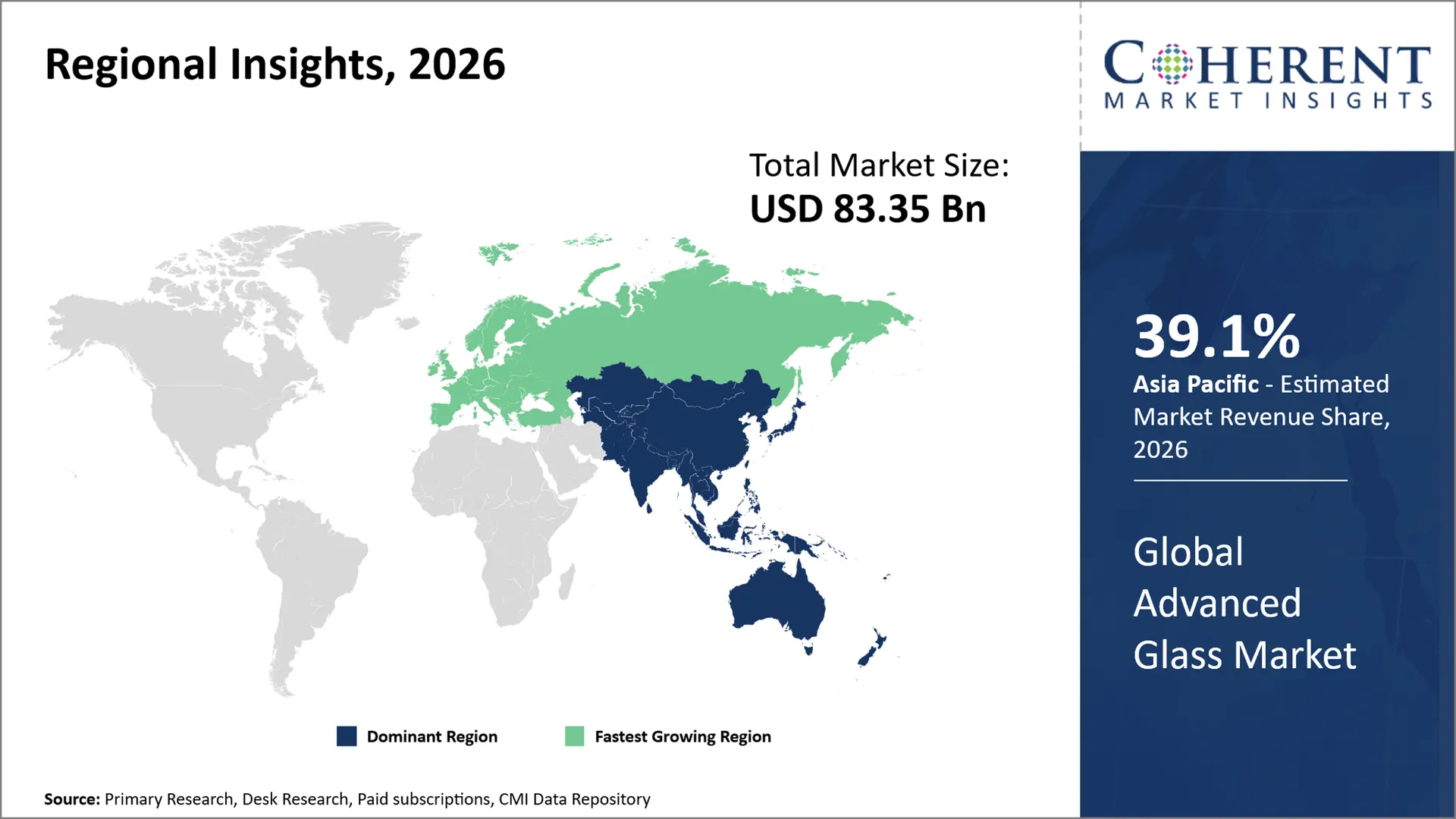
Why Does Asia Pacific Dominate the Global Advanced Glass Market?
Asia Pacific is expected to account for 39.1% of the global advanced glass market in 2026, supported by its concentration of precision glass processing, electronics manufacturing, and architectural glazing production. Established industrial clusters in Japan, China, and Southeast Asia enable manufacturers to serve specialized applications through integrated supply chains and advanced fabrication capabilities. In September 2025, Japan-based Nippon Electric Glass established a mass-production process for cover glass incorporating proprietary nano-texturing technology, enabling consistent surface functionality for tablet devices and other specialized applications. This development highlights the region's ability to commercialize advanced glass technologies while addressing evolving requirements for durability, optical performance, and surface customization. Continued investment in precision manufacturing, product engineering, and electronics supply chains is expected to strengthen Asia Pacific's competitive position in high-value glass applications.
Why Is Europe Emerging as the Fastest-Growing Region in the Global Advanced Glass Market?
Europe is expected to be the fastest-growing region in the global advanced glass market, accounting for 25.3% of revenue in 2026. Its acceleration reflects opportunities to replace energy-intensive manufacturing assets with processes that can deliver better output quality while reducing exposure to volatile fuel costs. For producers, the ability to trial new furnace technologies before full-scale capital commitments could improve investment decisions and strengthen competitiveness against imported material. In September 2025, UK-based Glass Futures successfully produced its first glass from an experimental multi-fuel furnace, opening the way for industrial trials of alternative heating approaches. The initiative provides a practical testing platform rather than evidence of completed commercial conversion. European manufacturers that translate these trials into reliable production methods could improve access to customers who place greater scrutiny on manufacturing practices and supply-chain resilience.
Global Advanced Glass Market Outlook for Key Countries
Why Is the U.S. a Key Market for the Global Advanced Glass Market?
The U.S. remains a strategically important advanced glass market because architectural buyers increasingly require custom surface treatments and precise fabrication rather than interchangeable sheet products. Corporate interiors, educational facilities, transit buildings, and hospitality developments create opportunities for digitally printed, etched, and laminated glass with project-specific aesthetics. Domestic fabricators gain value by translating architectural designs into repeatable production runs and coordinating deliveries with glazing contractors. In October 2025, New Jersey-based General Glass International announced it would showcase its enhanced Alice GEN 3.0 direct-to-glass printing capabilities and expanded specialty glass portfolio at GlassBuild America. The announcement demonstrates continuing investment in highly customized architectural offerings. Suppliers that combine design consultation, short-run flexibility, and consistent finishing quality could secure contracts where imported standard glass offers limited differentiation.
Why Is China Important in the Global Advanced Glass Market?
China is central to the global advanced glass market through its integration of automotive engineering, specialist glass processing, and high-volume vehicle manufacturing. Domestic automakers increasingly treat glazing as an active cabin component, creating demand for switchable roof panels and windows with tightly controlled optical properties. This requires glass suppliers to coordinate electrical integration, curved-glass forming, and production reliability with original equipment manufacturers. In April 2025, Fuyao Group introduced a black electrochromic glazing solution for vehicle side windows and panoramic roofs, offering electronically adjustable shading and privacy. The development highlights opportunities to move from conventional automotive glass toward electronically functional assemblies. Suppliers with dependable automotive qualification and integrated control expertise may capture higher product value, although complex manufacturing and price-sensitive model programs could constrain adoption.
Why Is Germany a Strategic Country in the Global Advanced Glass Market?
Germany plays a specialized role in the global advanced glass market by connecting glass engineering with high-performance building components and precision industrial production. Rather than relying on commodity glass volume, its innovation ecosystem supports applications requiring stringent durability, dimensional consistency, and integration into existing structures. Building-integrated photovoltaics present an especially distinctive route because glazing must satisfy electrical, mechanical, and architectural considerations simultaneously. In May 2025, Fraunhofer ISE announced a pilot line in Freiburg for photovoltaic roof tiles built as glass-glass modules using matrix-shingled solar cells. The pilot targeted manufacturing validation before mass production and included applications for existing buildings. Such work benefits engineering-intensive glass suppliers capable of supplying customized materials and demonstrating compatibility with module assembly, although qualification costs may restrict rapid commercialization.
Why Is India an Important Growth Market for the Global Advanced Glass Market?
India is becoming an important advanced glass market as domestic processors seek a more dependable supply of float-glass substrates for architectural and automotive applications. Indian construction buyers need locally available sizes and reliable deliveries, while fabricators require consistent substrate quality before adding lamination, tempering, or specialty coatings. Expanding upstream production can therefore reduce logistical challenges for downstream processors without automatically guaranteeing growth in every advanced product category. In March 2025, Asahi India Glass Limited commenced commercial operations at its float-glass facility in Soniyana, Rajasthan, according to its stock-exchange filing. The development adds domestic upstream capability supporting further processing and distribution. Manufacturers able to combine local sourcing with certified finishing and responsive customer service should be better placed to supply projects outside the largest metropolitan markets.
Why Is the UAE an Important Growth Market for the Global Advanced Glass Market?
The UAE offers a distinct growth avenue in the global advanced glass market through its role as a regional manufacturing and distribution hub serving demanding building designs. Large glazed façades and premium commercial developments favor low-iron substrates where transparency and color neutrality matter to architects. Local processing and reliable export logistics can also improve responsiveness to buyers throughout the Gulf and adjacent markets. In October 2025, Dubai Investments announced a second float-glass line for Emirates Float Glass, with plans to introduce ultra-clear, low-iron products and double nominal capacity. The line is scheduled to begin operations between late 2027 and early 2028, so the expansion should not be treated as current output. Its strategic significance lies in the potential to expand locally available premium substrates and reduce dependence on imported specialty glass.
Innovation, Production and Manufacturing Landscape in the Global Advanced Glass Market
Technology | Primary Application | Adoption Landscape | Commercial and Manufacturing Implications |
Magnetron Sputtering and Low-Emissivity Coating | Architectural façades and insulating glass | Commercially established | Enables precise control of solar transmission and thermal radiation. Coating uniformity, deposition efficiency, and production yield influence pricing and quality differentiation. |
Advanced Interlayer Lamination Technology | Automotive windshields and protective glazing | Widely commercialized | Uses materials such as PVB and ionoplast interlayers to produce composite glass structures. Bonding consistency and interlayer selection affect optical quality, impact performance, and fabrication costs. |
Chemical Strengthening and Glass-Ceramic Processing | Consumer electronics and specialty protective glass | Established with continuing material innovation | Improves mechanical performance through ion exchange or controlled crystallization. Specialized formulations create opportunities for higher-value supply contracts with device manufacturers. |
Vacuum Insulating Glass Technology | Space-constrained windows and specialized building glazing | Commercialized with selective adoption | Uses a low-pressure cavity to restrict heat transfer. Greater processing complexity and sealing requirements can limit adoption despite its compact insulation potential. |
Transparent Conductive Oxide Coating Technology | Thin-film solar modules and functional electronic glass | Commercially established in specialized applications | Creates conductive transparent surfaces for photovoltaic and electronic applications. Coating conductivity, optical transmission, and manufacturing throughput influence customer qualification. |
Electrochromic and Polymer-Dispersed Liquid Crystal Technology | Switchable automotive and architectural glazing | Commercially available with selective adoption | Enables variable light transmission or privacy control. Integration costs, electrical systems, switching characteristics, and long-term reliability influence commercialization. |
How Are Precision Glass Substrates for Advanced Semiconductor Packaging Creating New Growth Opportunities in the Global Advanced Glass Market?
Precision glass-core substrates for advanced semiconductor packaging represent an underdeveloped opportunity within the global advanced glass market. As chip designers seek denser interconnections and more demanding thermal performance, engineered glass could offer an alternative substrate platform for selected high-performance computing and photonic assemblies.
Potential customers include semiconductor manufacturers, outsourced assembly and testing companies, substrate specialists, and suppliers of advanced data-processing hardware. Commercial entry requires exceptional flatness, controlled thermal expansion, defect inspection, precision via formation, and compatibility with downstream metallization processes.
Glass producers could initially enter through pilot-scale development agreements rather than immediate commodity-volume expansion, allowing customers to validate yield and reliability before committing to production. Successful suppliers may differentiate through co-designed materials, engineering support, and process intellectual property rather than competing solely on sheet-glass pricing.
Established specialty-glass manufacturers and precision-processing specialists appear best positioned, although focused entrants could participate through niche process equipment and integration services. Qualification expense and long customer approval cycles remain central barriers to scaling.
Market Players, Key Development, and Competitive Intelligence
Key Developments
- In September 2025, SCHOTT AG announced that it had reached serial production of geometric reflective optical waveguides for augmented reality eyewear. The development signals manufacturing readiness for precision glass components that require sophisticated coatings and tight optical tolerances, potentially expanding supply opportunities beyond conventional display cover glass.
- In January 2025, Nippon Sheet Glass Co., Ltd announced the warm-up of a converted transparent conductive oxide glass production line in Rossford, Ohio, with manufacturing planned to begin in March. The investment supports domestic thin-film photovoltaic supply chains and strengthens the market for specialized electrically conductive glass.
- In January 2025, Gentex Corporation showcased its new film-based electrochromic technology for large panoramic vehicle sunroofs at CES. The demonstration matters because automakers can consider electronically controlled solar shading as an integrated comfort feature, creating a potential premium application for active switchable glazing rather than conventional fixed-tint solutions.
Competitive Landscape
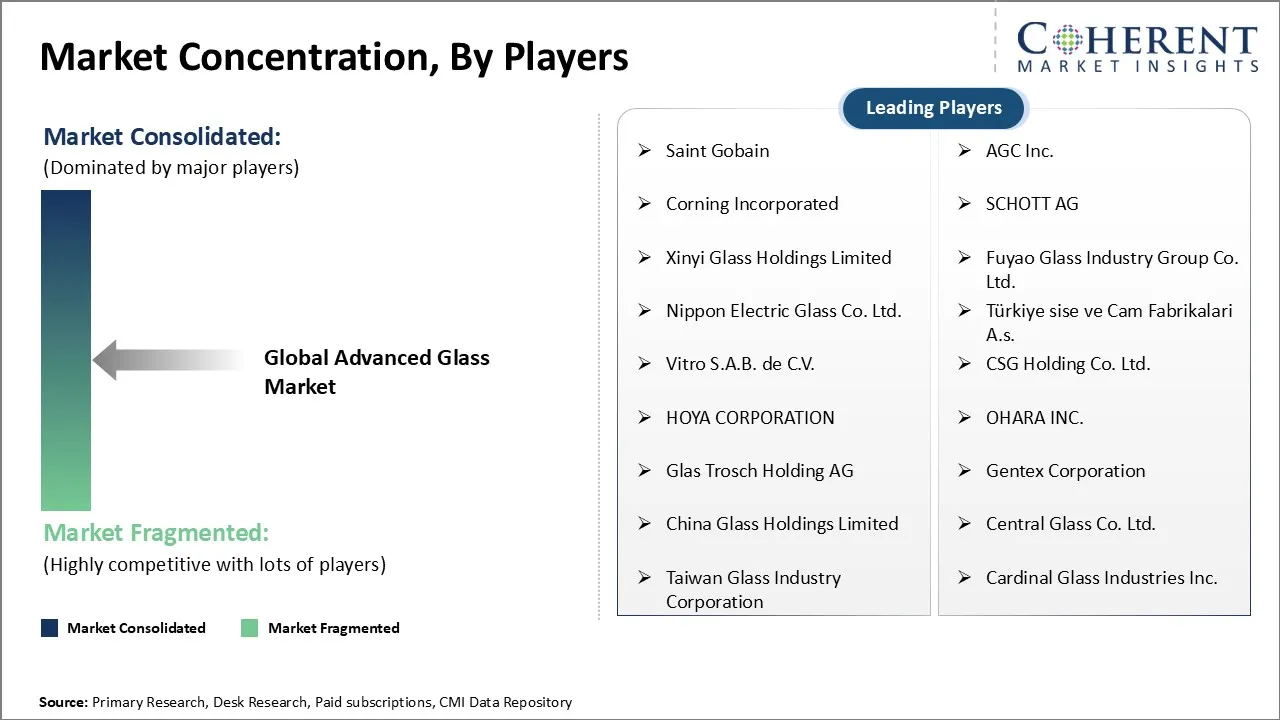
The global advanced glass market is moderately consolidated at the upstream glass manufacturing level, while downstream fabrication and processing remain comparatively fragmented. Integrated manufacturers compete through production capabilities, technology portfolios, and international customer relationships. Regional specialists differentiate through customization, shorter delivery cycles, and application expertise. Quality certification, manufacturing efficiency, pricing discipline, technical support, and reliable supply remain important factors influencing supplier selection.
Key competitive focus areas include
- Product Performance Differentiation: Maintaining consistent optical clarity, surface quality, mechanical strength, and specialized functional properties.
- Manufacturing Process Efficiency: Improving glass melting operations, processing yields, and coating consistency to control production costs.
- Pricing and Margin Management: Balancing premium product positioning against energy expenses, raw material volatility, and customer price sensitivity.
- Manufacturing Capacity and Supply Reliability: Maintaining production continuity, sufficient processing capacity, and dependable delivery schedules for industrial customers.
- Certification and Quality Assurance: Demonstrating compliance with applicable ASTM, EN, ISO, and other product-specific technical standards.
- Customer-Specific Customization: Offering specialized thicknesses, dimensions, surface finishes, and processing configurations for demanding applications.
- Distribution and Technical Support: Strengthening relationships with glass merchants, architectural consultants, fabricators, and industrial procurement teams.
Market Report Scope
Global Advanced Glass Market Report Coverage | |||
Report Coverage | Details | ||
Base Year | 2025 | Market Size in 2026: | USD 83.35 Bn |
Historical Data For: | 2020 To 2024 | Forecast Period: | 2026 To 2033 |
Forecast Period 2026 To 2033 CAGR: | 6.90% | 2033 Value Projection: | USD 132.97 Bn |
Geographies covered: |
| ||
Segments covered: |
| ||
Companies covered: | Saint Gobain, AGC Inc., Corning Incorporated, SCHOTT AG, Xinyi Glass Holdings Limited, Fuyao Glass Industry Group Co. Ltd., Nippon Electric Glass Co. Ltd., Türkiye sise ve Cam Fabrikalari A.s., Vitro S.A.B. de C.V., CSG Holding Co. Ltd., HOYA CORPORATION, OHARA INC., Glas Trosch Holding AG, Gentex Corporation, China Glass Holdings Limited, Central Glass Co. Ltd., Taiwan Glass Industry Corporation, Cardinal Glass Industries Inc. | ||
Growth Drivers: |
| ||
Restraints & Challenges: |
| ||
Analyst Opinion (Expert Opinion)
- Competitive positioning in the global advanced glass market is likely to shift toward application-specific engineering capabilities and customer qualification expertise. Manufacturers offering consistent optical distortion control, coating adhesion, and dimensional precision could secure stronger positions in automotive, electronics, and specialized architectural supply chains. Long-term competitiveness may increasingly depend on technical differentiation and repeatable product performance rather than on production capacity alone.
- Integration of transparent heating elements, embedded antennas, and conductive functional layers could transform advanced glass from a structural material into an integrated electronic component. This transition may challenge conventional glass processors lacking electrical integration and functional testing capabilities. Manufacturers combining precision coating, specialized lamination, and electronic component compatibility could gain greater influence over product design, particularly in automotive glazing and connected electronic systems.
- Advanced glass manufacturers should prioritize coating durability, precision processing, and high-value customized products while strengthening relationships with automotive OEMs, architectural fabricators, and electronics manufacturers. Energy-intensive production, fluctuating raw material costs, and complex product qualification requirements remain important commercial risks. Investment decisions should emphasize manufacturing yields, technical reliability, and secured customer contracts, while avoiding excessive capacity expansion in standardized glass categories with limited differentiation.
Speak to the analyst
Want personalized insights?
Take the findings above to one of our principal consultants, or have the report rebuilt around the segments, geographies and competitors you actually track.
Market Segmentation
- Product Type Insights (Revenue, USD Bn, 2021 - 2033)
- Coated Glass
- Laminated Glass
- Tempered and Toughened Glass
- Ceramic Glass and Glass Ceramics
- Other Specialty Glass
- Function Insights (Revenue, USD Bn, 2021 - 2033)
- Safety and Security
- Solar Control and Energy Efficiency
- Optics and Lighting
- High Durability and Thermal Resistance
- Other Functional Applications
- Technology Insights (Revenue, USD Bn, 2021 - 2033)
- Passive High Performance Glass
- Active Smart and Switchable Glass
- End Use Industry Insights (Revenue, USD Bn, 2021 - 2033)
- Building and Construction
- Automotive and Transportation
- Electronics and Displays
- Solar Energy and Renewables
- Aerospace and Defense
- Healthcare and Medical Devices
- Industrial and Other Applications
- Distribution Channel Insights (Revenue, USD Bn, 2021 - 2033)
- Direct Manufacturer Sales
- Distributors and Glass Merchants
- Regional Insights (Revenue, USD Bn, 2021 - 2033)
- North America
- U.S.
- Canada
- Latin America
- Brazil
- Argentina
- Mexico
- Rest of Latin America
- Europe
- Germany
- U.K.
- Spain
- France
- Italy
- Russia
- Rest of Europe
- Asia Pacific
- China
- India
- Japan
- Australia
- South Korea
- ASEAN
- Rest of Asia Pacific
- Middle East
- GCC Countries
- Israel
- Rest of Middle East
- Africa
- South Africa
- North Africa
- Central Africa
- North America
Sources
Primary Research Interviews
- Advanced glass manufacturers, glass processors, and OEMs
- Architectural glazing specialists, automotive glass suppliers, and electronics manufacturers
- Glass distributors, procurement managers, and industry experts
Stakeholders
- Coated, laminated, tempered, and specialty glass manufacturers
- Raw material, coating technology, and glass processing equipment suppliers
- Automotive OEMs, construction contractors, electronics manufacturers, and distributors
End-use Sectors
- Building and construction
- Automotive and transportation
- Electronics, displays, and solar energy
- Aerospace, defense, healthcare, and industrial applications
Regulatory and Industry Bodies
- U.S. Department of Energy (DOE)
- European Commission
- International Organization for Standardization (ISO)
- ASTM International
- Bureau of Indian Standards (BIS)
Databases
- Company annual reports and investor presentations
- UN Comtrade and Eurostat glass trade datasets
- USGS industrial minerals and raw material statistics
- WIPO patent databases and national manufacturing statistics
Magazines and Journals
- Glass International
- Journal of Non-Crystalline Solids
- Glass Structures & Engineering
- Solar Energy Materials and Solar Cells
- International Journal of Applied Glass Science
Associations
- National Glass Association (NGA)
- Glass for Europe
- Glass and Glazing Federation (GGF)
- Glass Alliance Europe
- International Commission on Glass (ICG)
Public Domain Sources
- Advanced glass production, consumption, and pricing statistics
- Architectural glazing and automotive glass manufacturing data
- Glass import, export, and production capacity information
- Smart glass, functional coatings, and specialty glass developments
- Energy efficiency, recycling, and industrial emission data
Key Standards and Regulations
- ASTM C1048 – Heat-strengthened and fully tempered flat glass
- ASTM C1172 – Laminated architectural flat glass
- ASTM C1376 – Coatings on flat glass
- ISO 9050 – Luminous and solar characteristics of glazing
- EN 1279 – Insulating glass units
- EU Energy Performance of Buildings Directive (EPBD)
Proprietary Elements
- CMI Data Analytics Tool
- Proprietary CMI repository containing 10+ years of industry intelligence covering advanced glass manufacturing, market demand, product pricing, coating technologies, end-use applications, regulatory developments, and competitive intelligence.
Get access to 250+ pages report
Every segment, forecast, competitor profile and data table behind the analysis above — available for instant download.
- ESOMAR Member
- ISO 9001:2015 Certified
- D-U-N-S Registered
- GDPR & CCPA Compliant
Frequently Asked Questions
The CAGR of global advanced glass market is projected to be 6.90% from 2026 to 2033.
The global advanced glass market is estimated to be valued at USD 83.35 Bn in 2026 and is expected to reach USD 132.97 Bn by 2033.
Supply chain developments are encouraging manufacturers to strengthen regional production networks, secure raw material availability, improve inventory management, and establish reliable relationships with industrial customers.
Investment interest is supported by opportunities in specialized materials, precision manufacturing, proprietary processing technologies, and higher-value glass solutions requiring advanced engineering capabilities.
Purchasing decisions depend on product performance, technical specifications, certification requirements, manufacturing quality, supplier reliability, total procurement costs, and long-term application compatibility.
The report provides market dynamics, growth opportunities, technological developments, competitive intelligence, regulatory analysis, regional outlook, manufacturing trends, and strategic insights to support business and investment decisions.
The major factors driving growth in the global advanced glass market are the rising demand for energy-efficient architectural glass in green buildings and the increasing use of high-performance glass in automotive and electronic applications.