

Global AI Content Provenance Verification Market Size and Forecast – 2026 To 2033
The global AI content provenance verification market is expected to grow from USD 0.90 Bn in 2026 to USD 6.10 Bn by 2033, registering a compound annual growth rate (CAGR) of 31.4% from 2026 to 2033. The global AI content provenance verification market is driven by rising adoption of Content Credentials and C2PA standards. On February 23, 2026, Vbrick announced it has been recognized as an official Content Credentials Generator under the Coalition for Content Provenance and Authenticity (C2PA) Conformance Program. This milestone puts Vbrick on top of the industry’s efforts to prevent misinformation and defend content integrity.
Key Takeaways of the Global AI Content Provenance Verification Market
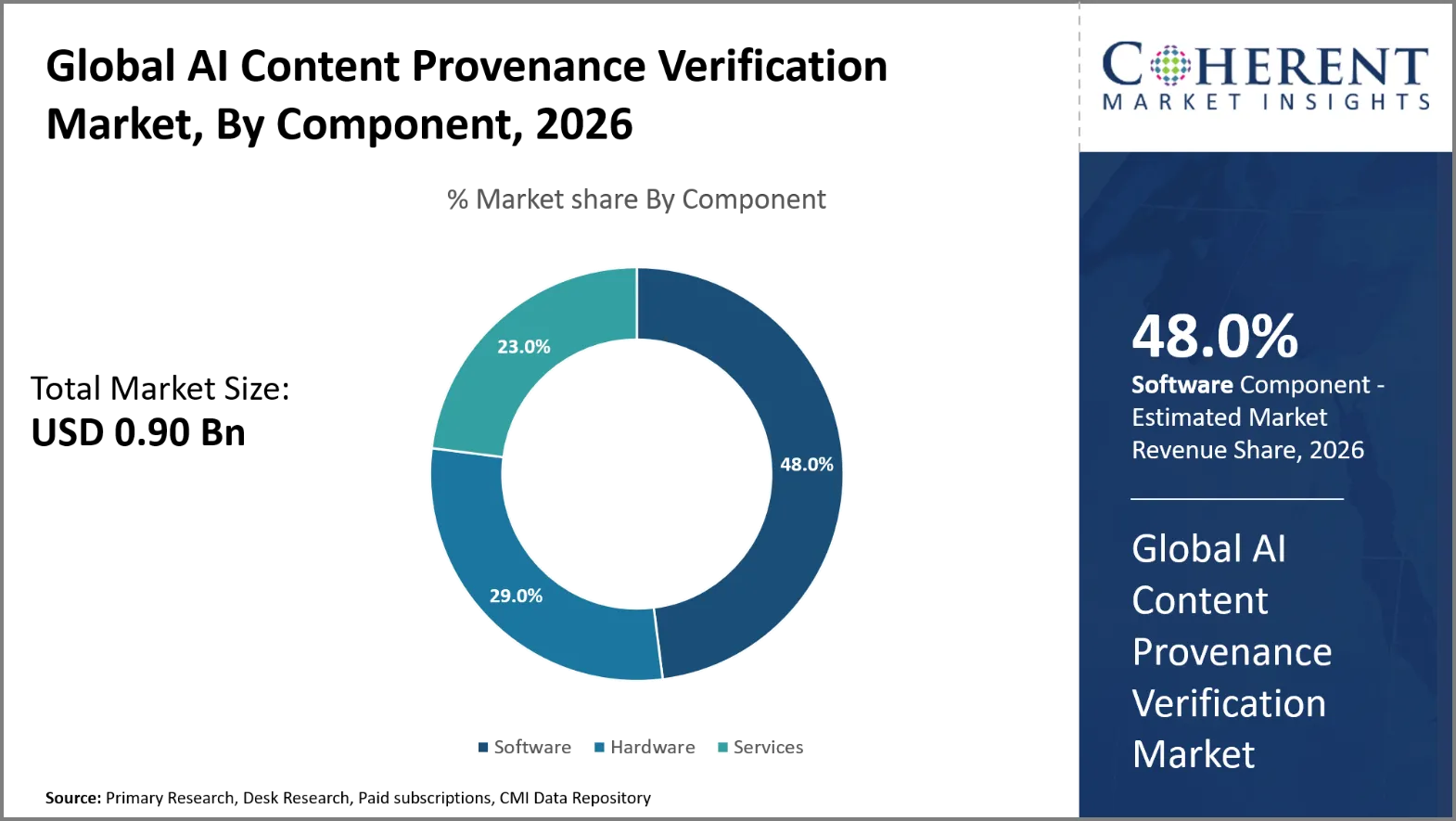
- The Software segment is expected to account for 48.0% of the global AI content provenance verification market share in 2026. Increasing concerns regarding deepfakes and digital misinformation is driving the growth of the segment. On June 3, 2025, Paravision launched Deepfake Detection 2.0 to identify manipulated faces and entirely synthetic facial images.
- The Cloud-Based segment is estimated to capture 52.0% of the market share in 2026. Growing regulatory requirements for AI content transparency is majorly driving the growth of the segment. On August 25, 2026, Dentsu became the first global marketing and advertising holding company to sign the European Union Code of Practice on Transparency of AI-Generated Content.
- The Digital Watermarking segment is estimated to capture 34.0% of the market share in 2026. Increasing demand for copyright protection and digital content traceability is driving the growth of the segment. On January 24, 2025, Deezer deployed an AI music detection tool to identify fully AI-generated tracks uploaded to its streaming platform. The technology initially identified approximately 10,000 synthetic tracks daily.
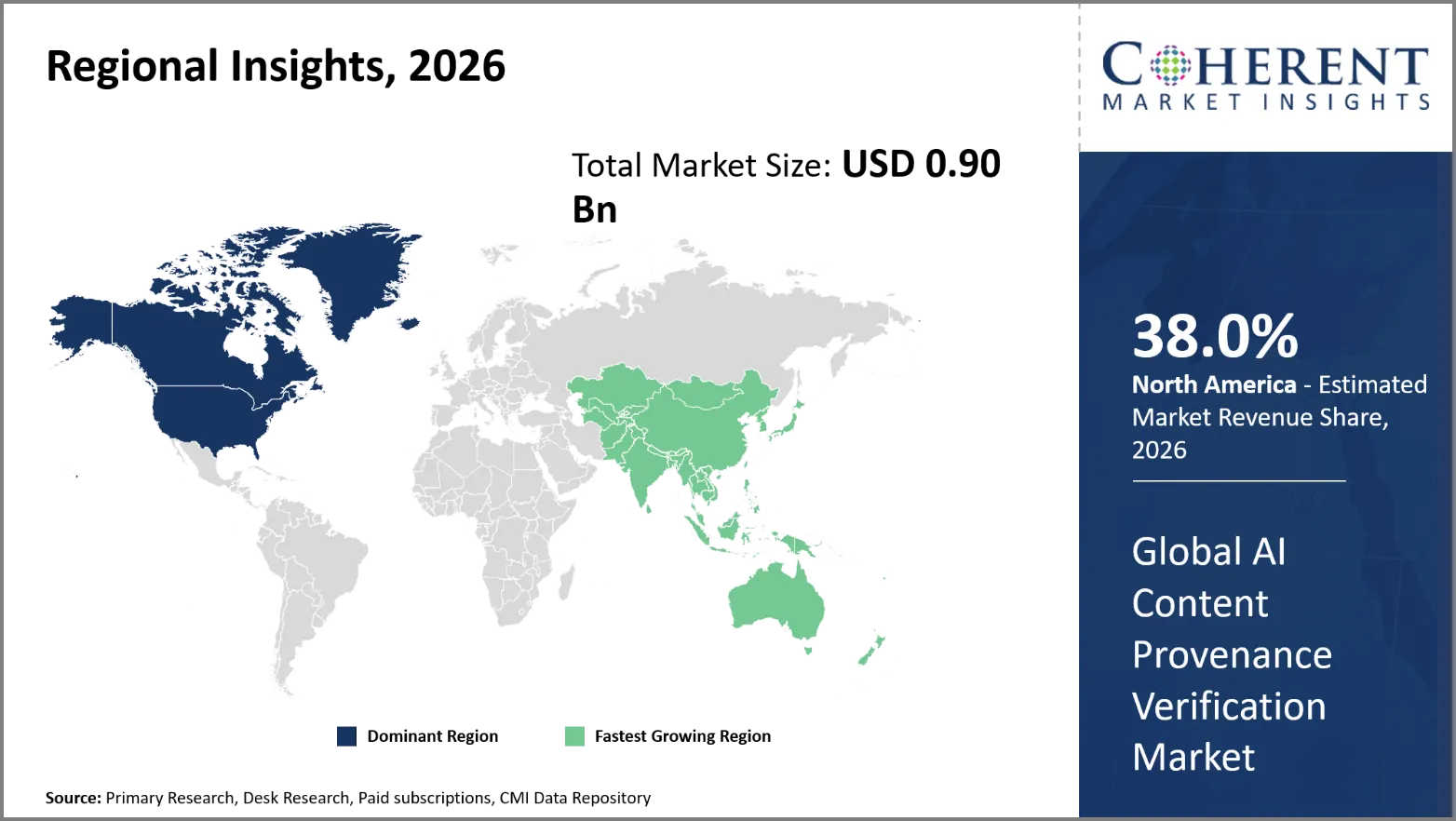
- North America is expected to dominate the AI content provenance verification market in 2026 with a market share of 38.0%. Expansion of digital watermarking technologies in North America is driving the growth of the regional market. On February 11, 2025, EchoMark launched a new application programming interface for invisible forensic watermarking. The API allows software providers to embed individualized watermarks directly into their applications and workflows.
- Asia Pacific is expected to account for 27.0% share in 2026. Increasing adoption of automated verification across news organizations in Asia Pacific is driving the growth of the regional market. On September 30, 2025, Zee News partnered with Neural Defend to launch an AI-powered deepfake verification system. The platform enables audiences to submit suspicious videos, images, and audio recordings.
Segmental Insights
Why Does Software Dominate the Global AI Content Provenance Verification Market?
The software segment is expected to account for 48.0% of the global AI content provenance verification market share in 2026. Software prevails because enterprises need automated content authentication and traceability. Verification software recognizes information produced by AI using metadata analysis, electronic signatures, and embedded provenance markers. These platforms connect to content management systems, publishing tools and artificial intelligence applications. Software technologies also provide continuous surveillance over photos, videos, audio and text. As generative artificial intelligence (AI) technology improves, companies will be able to improve detection algorithms.
On January 28, 2026, Tauth Labs Inc. announced that it has been certified by the Coalition for Content Provenance and Authenticity (C2PA) as a Certificate Authority (CA) for the issuance of content authentication credentials. Supported by the world’s largest technology and media companies, the C2PA content authentication standard embeds provenance into digital content so its authenticity, and changes that may have been made to it, can be verified in the AI Era.
- Current Industry Events of 2026
- Market Size Estimation
- Regional Breakdown
- Competitive Landscape
- Customer Intelligence
- Segmental Analysis
- Pricing Analysis
- Key Market Drivers, Challenges & Future Trends
- Customized Insights Section
Why is Cloud-Based the Most Preferred Deployment Type?
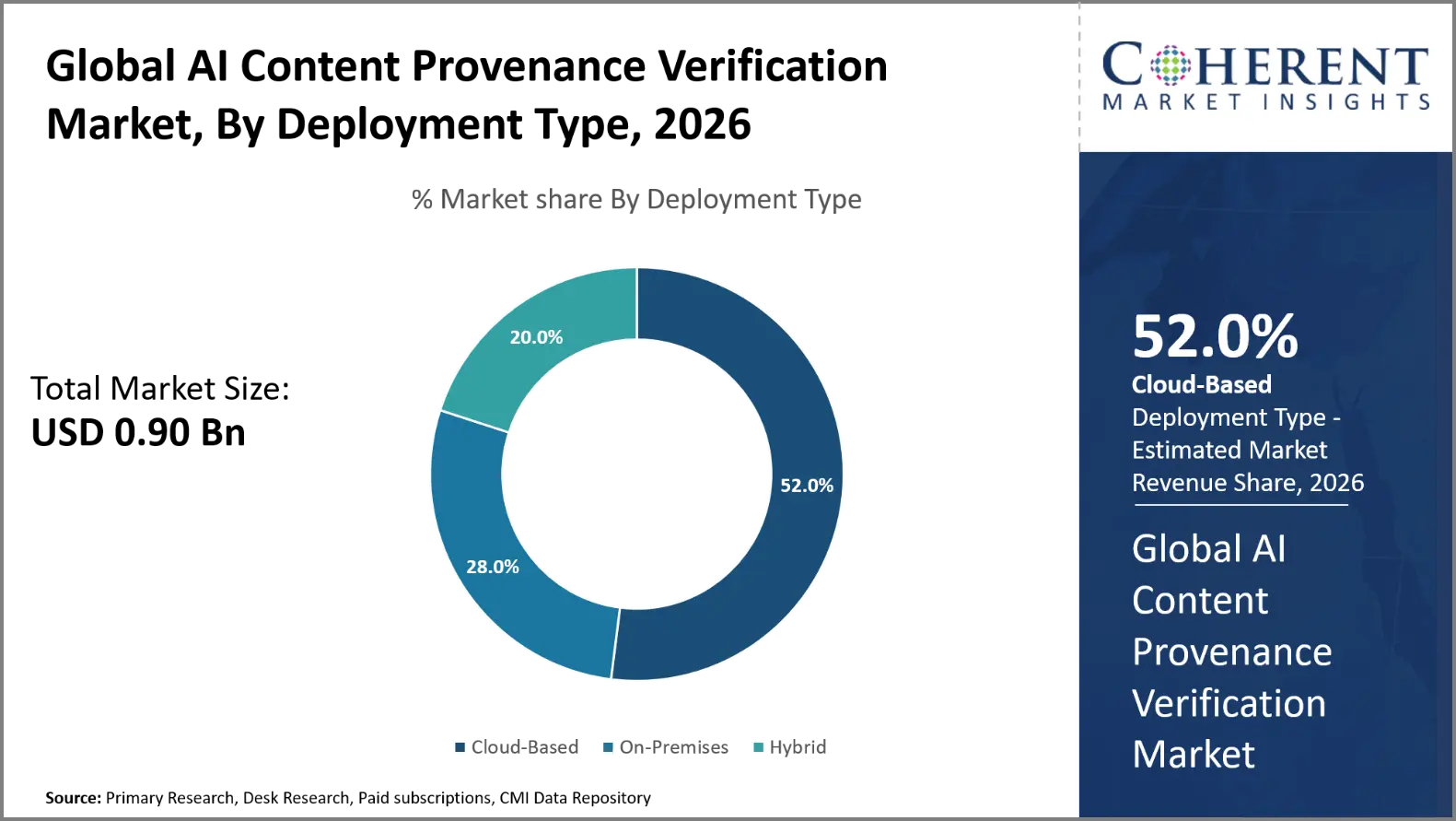
The cloud-based segment is expected to account for 52.0% of the global AI content provenance verification market share in 2026. Cloud-based deployment is preferred because organizations require scalable verification infrastructure across distributed content environments. Cloud platforms process massive numbers of photos, video, audio recordings and documents. They reduce the need for large investments in dedicated verification infrastructure. Authentication services are available for organizations to use through application programming interfaces and integrated processes. Cloud deployment also means centralized policy administration and software updates that are always current. Media platforms can quickly verify uploaded high-volume content. Providers can deploy updated detection models without separate infrastructure updates.
On December 15, 2025, the Associated Press launched AP Verify, a web-based verification dashboard for newsrooms. The platform mixes AI tools with reverse image search, video analysis, transcription and social listening. Journalists can save investigations and share verification results with distributed editorial teams.
Digital Watermarking Dominates the Global AI Content Provenance Verification Market
The digital watermarking segment is expected to account for 34.0% of the global AI content provenance verification market share in 2026. The most popular is digital watermarking, in which identifying information is embedded directly into the digital document. Those identifiers help identify artificial intelligence-generated material from real information created by humans. Watermarks may be observable following typical transformations, depending on their implementation. Invisible watermarking also maintains the original look and listening experience. This feature means that the technology can be used on commercial photos, movies and audio recordings. Increasingly, developers of generative AI are integrating watermarking into their content generation workflows.
On July 2, 2025, DoveRunner launched Distributor Watermarking 2.0 to secure unreleased entertainment content. Its technology detects invisible forensic watermarks in 30-second video samples. Previous versions needed 5-minute-long clips to detect.
Current Events and their Impact
Current Events | Description and its Impact |
European Union - Artificial Intelligence Act, Regulation (EU) 2024/1689 |
|
China - Measures for Labeling AI-Generated Synthetic Content, 2025 |
|
AI Content Provenance Verification Market Dynamics
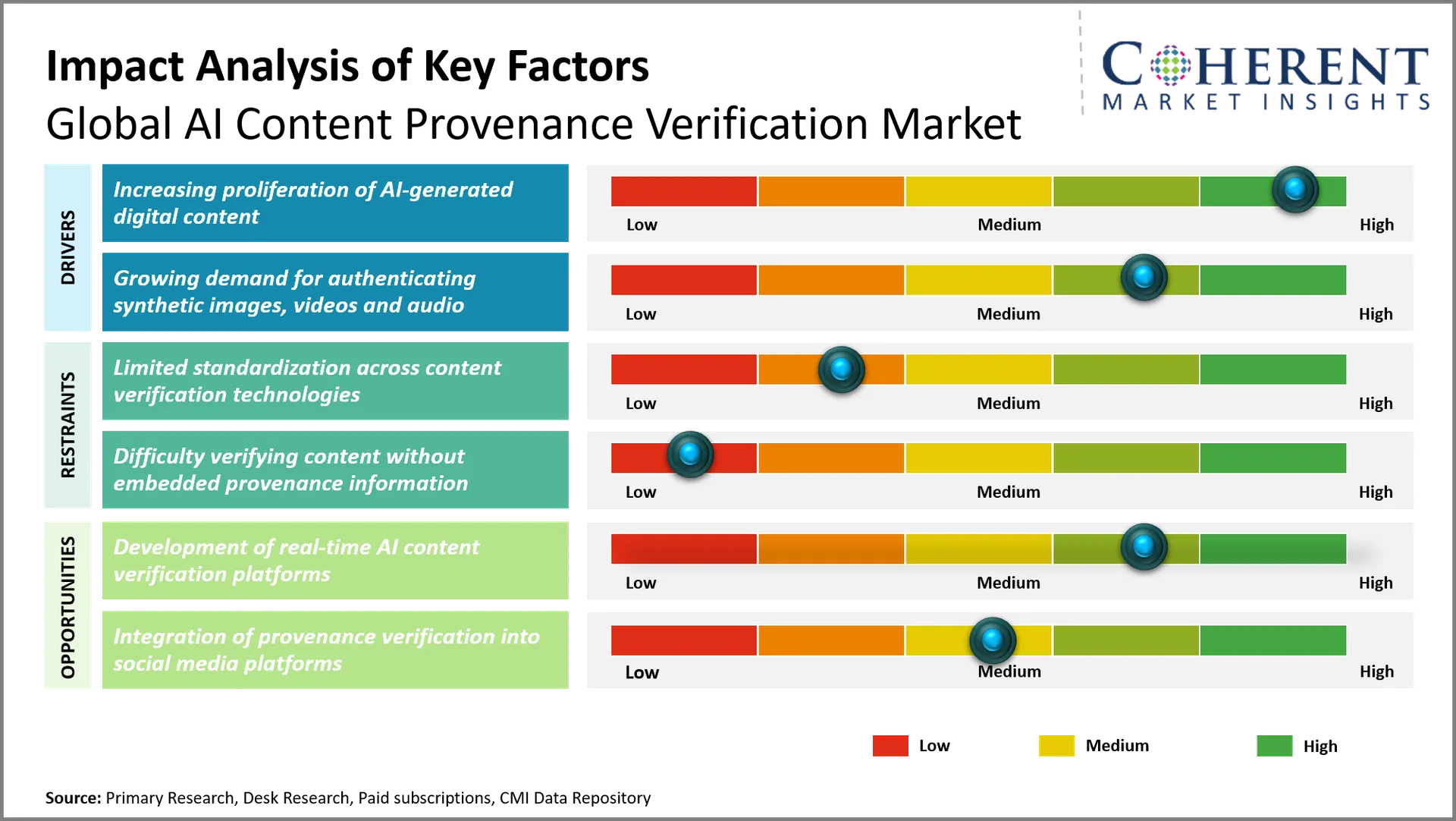
Market Drivers
Increasing proliferation of AI-generated digital content
The swift adoption of generative AI is driving synthetic content across digital platforms. Companies utilize AI to create marketing graphics, product videos, audio and written material. OpenAI’s ChatGPT, Google’s Gemini and Adobe’s Firefly make it easy for anybody to scale content creation. Also inundating social media sites are AI-generated content and audiovisual materials. This explosion in volume makes it difficult to distinguish between original human-generated material and synthetic stuff. Organizations are increasingly in need of provenance verification tools, embedded metadata and digital watermarking. These technologies assist create content provenance and transparency in digital publication environments.
On February 5, 2026, Kuaishou Technology announced the debut of its Kling AI 3.0 models, Video 3.0, Video 3.0 Omni, Image 3.0 and Image 3.0 Omni, allowing creators greater control over narratives and more consistency in AI video output. The model series provides considerable improvements in consistency, photorealistic output, longer video duration of up to 15 seconds, and native audio synthesis in numerous languages, dialects and accents.
Growing demand for authenticating synthetic images, videos and audio
The expanding use of synthetic images, movies and audio is creating the necessity for robust authentication methods. Deepfakes, cloned voices and altered recordings threaten journalism, financial services, advertising and public communications. Verification systems are needed by organizations to identify altered media and to establish the original sources of content. Authenticity can be assessed using technologies like cryptographic signatures, invisible watermarking, and Content Credentials. Google DeepMind has created SynthID to spot AI-generated visuals, audio, video and text. Adobe-backed information Credentials is a standard for documenting the sources of and editing history of digital information. Such advancements are spurring publishers, companies and digital platforms to embrace automated solutions for provenance verification.
On February 26, 2025, OmniSpeech introduced its deepfake AI audio detection technology to recognize synthetic and altered voices. The system examines speech features and patterns in vocal signals to differentiate real recordings from AI-generated ones.
Emerging Trends
- Integration of C2PA-Based Content Credentials: Broader adoption of Coalition for Content Provenance and Authenticity standards across creative tools, cameras and publishing platforms. These standards allow for consistent recording of where content came from, how it was edited, and who created it.
- Impact: Standardized provenance will increase interoperability between platforms that create and distribute content. It improves digital authenticity verification and minimizes the need for isolated detection systems.
- Relevance to the market: Commercial use is evidenced by Adobe Content Credentials and Microsoft integrations. These advances open the door for software suppliers of C2PA-compatible verification, metadata inspection and cryptographic authentication.
- Development of Invisible AI Watermarking Technologies: Technology companies are developing invisible watermarking systems that can identify synthetic content without using visual alterations of images, videos, audio or text. Such technologies make it possible to identify after typical content changes.
- Impact: Invisible watermarking enhances traceability of synthetic material across digital distribution platforms. It enables automated identification without compromising on the quality of the original content or user satisfaction.
- Relevance to the market: Google DeepMind’s SynthID marks AI-generated media with recognizable indicators. OpenAI also embeds C2PA metadata in the photos it creates, which is driving need for supplementary provenance verification tools.
Regional Insights
Why is North America a Strong Market for AI Content Provenance Verification?
North America is expected to account for a market share of 38.0% in 2026. North America has a robust media authentication infrastructure and is actively contributing to the development of content provenance standards. The Canadian Broadcasting Corporation and Radio-Canada are members of the International Press Telecommunications Council’s Verified News Publishers program. Reuters held a provenance meeting in Toronto on April 16, 2026. More than 100 experts representing 67 organizations attended. Discussions addressed practical adoption of Coalition for Content Provenance and Authenticity technologies. The region also benefits from specialist authentication providers and advanced newsroom verification workflows. These developments strengthen demand for cryptographic signing, trusted publisher certificates, and automated media verification.
Why Does Asia Pacific AI Content Provenance Verification Market Exhibit High Growth?
Asia Pacific is expected to register the fastest growth with a CAGR of 33.4% over the forecast period. It is projected to account for 27.0% of the global AI content provenance verification market in 2026. In the Asia Pacific, a unique provenance ecosystem is being created through partnership with broadcasters and government-led initiatives for digital authenticity. On January 30, 2025, Australia’s national cybersecurity agency released practical Content Credentials recommendations. This advice relates to digital media lineage and changes. Japan is cementing regional collaboration through Media Provenance Summit in Tokyo. The Asia Pacific Broadcasting Union is leading this project, with the backing of international media standards groups. Mediacorp in Singapore is also part of talks on regional provenance. These developments encourage broadcasters to integrate authentication into production, editorial review, and multimedia distribution workflows.
Global AI Content Provenance Verification Market Outlook for Key Countries
Why is U.S. Emerging as a Major Hub in the AI Content Provenance Verification Market?
The U.S. profits from commercial innovation in camera authentication, publishing infrastructure, and forensic verification. February 3, 2025 Cloudflare launches one-click Content Credentials Its solution maintains image production histories across its global network. Sony Electronics announces camera authenticity solution for video October 30, 2025 It initially supported five cameras, with four more models due in 2026. These advancements respond to the needs of newsrooms to validate original photos and footage. They also promote the use of signed capture records, provenance-preserving image transmission and enterprise verification interfaces.
Is China the Next Growth Engine for the AI Content Provenance Verification Market?
China’s advantage is in large-scale digital platform operations, and the need for organized synthetic-media identification. The Cyberspace Administration of China has introduced detailed labeling rules for text, graphics, audio, video and virtual environments. Platforms should scan for possible synthetic material in embedded metadata. The framework also requires content identifiers and platform-related information in relevant metadata. Major distribution services consequently need automated inspection and labeling infrastructure. These requirements create opportunities for domestic providers specializing in metadata extraction, watermark recognition, content classification, and verification APIs. China's extensive short-video ecosystem provides an important commercial application environment.
Germany AI Content Provenance Verification Market Analysis and Trends
Germany benefits from specialized media forensics research and collaboration between broadcasters, engineering institutes, and technology developers. Fraunhofer Institute for Digital Media Technology develops audio and visual manipulation detection technologies. Its research includes synthetic speech identification and forensic analysis. Deutsche Welle and Fraunhofer partners previously developed the Truly.Media verification platform. In April 2026, Fraunhofer Institute for Open Communication Systems launched CleanFeed with Deutsche Welle, castlabs, and G&L. The project focuses on traceable audiovisual provenance throughout production and distribution. These initiatives support demand for multimodal verification and newsroom-integrated authentication software.
South Korea AI Content Provenance Verification Market Analysis and Trends
South Korea is developing specialized provenance technologies for protecting entertainment, music, and digital publishing assets. Domestic company MuseBlossom offers invisible watermarking, synthetic audio verification, and content authentication products. Its approach blends watermark detection with Coalition for Content Provenance and Authenticity credentials. The company got the formal certification of C2PA compliance in June 2026. It has Image Defense technology that can track leaked webtoon content and identify distribution pathways. This application provides demand beyond traditional deepfake detection. South Korea’s strong webtoon, gaming, music and entertainment sectors create demand for specialized copyright authentication and synthetic-media verification platforms.
India AI Content Provenance Verification Market Analysis and Trends
The massive digital publishing activity and significant institutional investments in deepfake detection bolster the possibilities for India. In July 2026, the Ministry of Electronics and Information Technology announced approval of 13 responsible artificial intelligence projects for deepfake detection. The ministry also stated that over 11.37 lakh people were covered in 6,650 cyber awareness sessions. These activities indicate growing institutional interest in synthetic-media verification. Indian IT developers are able to solve for multi-lingual voice authentication, regional language video verification and imposter detection. Demand also extends to election monitoring, digital journalism, financial fraud investigation, and platform moderation.
Global AI Content Provenance Verification Market - AI-Generated Content Identification Rates across Leading Verification Models
Verification model | AI identification rate - Original (%) | AI identification rate - Compressed / Transmitted (%) | AI identification rate - Re-digitized (%) | Real image identification - Original (%) | Overall accuracy (%) |
GPT-4o latest | 96.30 | 79.41 | 69.23 | 92.68 | 84.09 |
Claude 3.7 Sonnet | 85.12 | 71.26 | 62.34 | 94.57 | 82.48 |
Gemini 2 Flash | 72.10 | 52.19 | 46.11 | 98.43 | 77.28 |
Grok 2 Vision | 46.15 | 52.12 | 48.01 | 91.84 | 68.96 |
Gemini 1.5 Pro | 36.12 | 36.36 | 22.22 | 97.78 | 62.83 |
How is Development of Real-Time AI Content Verification Platforms Creating New Growth Opportunities in the AI Content Provenance Verification Market?
The emergence of real-time AI content verification platforms provides growth potential as they enable real-time verification of content authenticity during the generation, upload and distribution of content. They can be used to detect corrupted media, verify cryptographic signatures and analyze provenance metadata before publication. For instance, Truepic’s secure capture technology offers certification of image authenticity at the time of production. This ability solves delays in verification of insurance claims, digital evidence collection, and remote inspection. Real-time application programming interfaces also enable newsrooms and social platforms to pre-screen incoming multimedia. Vendors can monetize continuous verification services through enterprise subscriptions, high volume API usage and platform licensing.
On June 12, 2025, Truth Scan introduced a multimodal AI content verification tool for consumers and companies. The system analyzes photos, videos, audio and text for signs of synthetic modification. The company also rolled out a verification API, online platform and browser extension.
Market Players, Key Development, and Competitive Landscape
Key Developments
- On May 28, 2026, Digimarc Corporation, a pioneer in digital identification and authentication solutions, unveiled new provenance and verification infrastructure to safeguard developing autonomous and AI-enabled processes.
- On May 20, 2026, Kakao announced that it has signed a technical cooperation with Google DeepMind to assist create transparency in material produced by AI. Under the cooperation, Kakao will use SynthID on its proprietary AI model Kanana, providing a technological foundation for watermarking and identifying content created by AI.
- On May 11, 2026, Canon Inc. announced that it will roll out its Authenticity Imaging System for supported models, initially in Europe, the Middle East, and Africa. This system is a comprehensive solution based on the C2PA2 (Coalition for Content Provenance and Authenticity) standard to manage image provenance records, issue certificates, apply trusted timestamps and verify content history.
Competitive Landscape
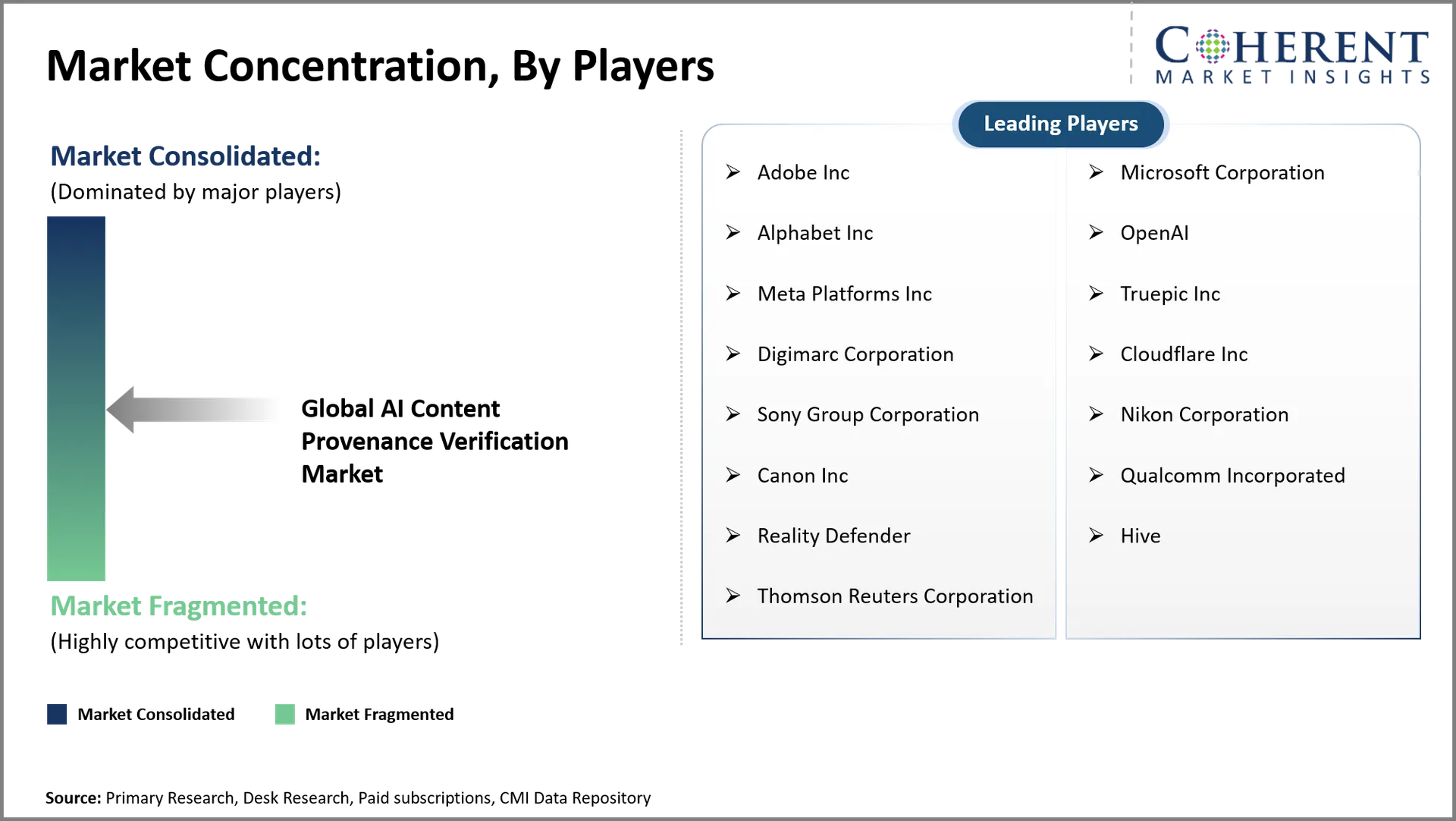
The competitive landscape features technology companies, authentication specialists, cloud providers, and digital media software developers. Adobe leads through its Content Authenticity Initiative and Content Credentials ecosystem. Its objective is to embed provenance verification into creative workflows and publishing tools. Microsoft has media authentication activities supporting C2PA standards and provenance infrastructure. Google is focusing on watermarking with SynthID and automatic detection of synthetic material. C2PA credentials, watermarking, and public verification capabilities are combined by OpenAI. Truepic is a secure picture capture & cryptographic authentication company. Digimarc is a leader in digital watermarking and content identification. Pindrop specializes in voice deepfake detection and contact center security. Competitive strategies increasingly emphasize cross-platform interoperability, multimodal authentication, secure capture, and enterprise integration.
Top Companies/Manufacturers and Notable Products/Solutions in the AI Content Provenance Verification Market
Company/Manufacturer | Notable Product/Solutions | Key features |
Adobe Inc. | Adobe Content Authenticity | C2PA Content Credentials, creator attribution, editing history, provenance inspection, AI-use disclosures |
Google LLC | SynthID and SynthID Detector | Invisible watermarking, AI-generated image identification, supported audio and video watermark detection |
Truepic, Inc. | Truepic Lens | Secure image and video capture, cryptographic signing, tamper-evident provenance, verification workflows |
Digimarc Corporation | Digimarc Validate | Digital watermark detection, asset identification, provenance retrieval, media authentication |
Microsoft Corporation | Microsoft Azure AI Content Safety and C2PA ecosystem integrations | AI-generated content transparency, content credentials support, enterprise integration, provenance verification capabilities |
AI Content Provenance Verification Market | |||
Report Coverage | Details | ||
Base Year | 2025 | Market Size in 2026: | USD 0.90 Bn |
Historical Data For: | 2020 To 2024 | Forecast Period: | 2026 To 2033 |
Forecast Period 2026 To 2033 CAGR: | 31.4% | 2033 Value Projection: | USD 6.10 Bn |
Geographies covered: |
| ||
Segments covered: |
| ||
Companies covered: | Adobe Inc, Microsoft Corporation, Alphabet Inc, OpenAI, Meta Platforms Inc, Truepic Inc, Digimarc Corporation, Cloudflare Inc, Sony Group Corporation, Nikon Corporation, Canon Inc, Qualcomm Incorporated, Reality Defender, Hive, Thomson Reuters Corporation | ||
Growth Drivers: |
| ||
Restraints & Challenges: |
| ||
Analyst Opinion (Expert Opinion)
- The industry will transition from standalone AI detection toward integrated content authenticity infrastructure. Verification systems will combine cryptographic credentials, invisible watermarking, metadata analysis, and forensic detection. Real-time verification will become important for publishing platforms and enterprise content workflows. Video provenance will gain importance as synthetic advertising and manipulated recordings become increasingly sophisticated. Cross-platform credential preservation will determine technology adoption. Vendors supporting images, audio, video, and text within unified verification environments will gain stronger commercial positioning.
- The strongest opportunities will emerge in Software, Cloud-Based deployment, and Digital Watermarking. Enterprise media authentication, financial fraud prevention, digital journalism, and advertising verification offer attractive applications. The U.S. offers prospects from existing AI developers and commercial authentication suppliers. China’s required synthetic-content labeling rules offer opportunities. India has potential in multilingual deepfake detection, and digital identity protection. Germany has prospects in media forensics and enterprise provenance integration. South Korea provides specialist services for checking entertainment copyrights and synthetic audio.
- Companies should create multimodal verification engines that combine watermark detection, electronic signatures, and metadata analysis. Collaborate with camera makers, cloud service providers and content management systems to broaden distribution. Vendors should focus on APIs that provide real-time verification in publishing and advertising workflows. They should also build verification tools that keep provenance after compression, cropping and format conversion. Targeted solutions for banking fraud, newsroom authentication and intellectual property security might be differentiated sources of revenue. Building consumer trust through support for C2PA interoperability and transparent confidence reporting.
Speak to the analyst
Want personalized insights?
Take the findings above to one of our principal consultants, or have the report rebuilt around the segments, geographies and competitors you actually track.
Market Segmentation
- Component Insights (Revenue, USD Billion, 2021 - 2033)
- Software
- Hardware
- Services
- Deployment Type Insights (Revenue, USD Billion, 2021 - 2033)
- Cloud-Based
- On-Premises
- Hybrid
- Technology Type Insights (Revenue, USD Billion, 2021 - 2033)
- Digital Watermarking
- Cryptographic Content Credentials
- Blockchain-Based Verification
- Metadata-Based Verification
- Digital Fingerprinting
- AI-Based Content Detection
- Content Type Insights (Revenue, USD Billion, 2021 - 2033)
- Images
- Videos
- Audio
- Text
- Documents
- Application Insights (Revenue, USD Billion, 2021 - 2033)
- Digital Media Authentication
- Artificial Intelligence-Generated Content Detection
- Copyright Protection
- News and Journalism Verification
- Brand Protection
- Digital Evidence Verification
- Regulatory Compliance
- End User Insights (Revenue, USD Billion, 2021 - 2033)
- Media and Entertainment
- BFSI
- Government and Defense
- Healthcare
- Education
- Retail and E-Commerce
- IT and Telecommunications
- Regional Insights (Revenue, USD Billion, 2021 - 2033)
- North America
- U.S.
- Canada
- Latin America
- Brazil
- Argentina
- Mexico
- Rest of Latin America
- Europe
- Germany
- U.K.
- Spain
- France
- Italy
- Russia
- Rest of Europe
- Asia Pacific
- China
- India
- Japan
- Australia
- South Korea
- ASEAN
- Rest of Asia Pacific
- Middle East
- GCC Countries
- Israel
- Rest of Middle East
- Africa
- South Africa
- North Africa
- Central Africa
- North America
- Key Players Insights
- Adobe Inc
- Microsoft Corporation
- Alphabet Inc
- OpenAI
- Meta Platforms Inc
- Truepic Inc
- Digimarc Corporation
- Cloudflare Inc
- Sony Group Corporation
- Nikon Corporation
- Canon Inc
- Qualcomm Incorporated
- Reality Defender
- Hive
- Thomson Reuters Corporation
Sources
Primary Research Interviews
- AI Content Technology Developers & Solution Providers
- Digital Media & Publishing Platform Executives
- Cybersecurity & Digital Authentication Specialists
- Enterprise Content Management Decision Makers
Magazines
- MIT Technology Review
- AI Magazine
- Wired (AI & Digital Media Edition)
- IEEE Spectrum
Journals
- Journal of Artificial Intelligence Research (JAIR)
- IEEE Transactions on Information Forensics and Security
- ACM Digital Library – Computing & AI Journal
Associations
- Partnership on AI (PAI)
- Content Authenticity Initiative (CAI)
- Coalition for Content Provenance and Authenticity (C2PA)
- IEEE Standards Association
Public Domain Sources
- U.S. National Institute of Standards and Technology (NIST) – AI Risk Management Framework
- European Commission – AI Act & Digital Policy Publications
- World Economic Forum (WEF) – AI Governance Reports
- United Nations Educational, Scientific and Cultural Organization (UNESCO) – AI Ethics Reports
Proprietary Elements
- CMI Data Analytics Tool
- Proprietary CMI Existing Repository of Information for Last 10 Years
Get access to 250+ pages report
Every segment, forecast, competitor profile and data table behind the analysis above — available for instant download.
- ESOMAR Member
- ISO 9001:2015 Certified
- D-U-N-S Registered
- GDPR & CCPA Compliant
Frequently Asked Questions
The global AI content provenance verification market is expected to stand at USD 0.90 Bn in 2026 and is expected to reach USD 6.10 Bn by 2033.
The CAGR of the global AI content provenance verification market is projected to be 31.4% from 2026 to 2033.
Increasing proliferation of AI-generated digital content and Growing demand for authenticating synthetic images, videos and audio are the major factors driving the growth of the global AI content provenance verification market.
Limited standardization across content verification technologies and Difficulty verifying content without embedded provenance information are the major factors hampering the growth of the global AI content provenance verification market.
In terms of component, software segment is estimated to dominate the market revenue share in 2026.
It establishes the origin, creation process, and subsequent modifications of digital content.
Cryptographic signatures establish content integrity and authenticate information about its source.