

Global AI Data Center Market Size and Forecast – 2026 To 2033
The global AI data center market is expected to grow from USD 180.00 Bn in 2026 to USD 810.00 Bn by 2033, registering a compound annual growth rate (CAGR) of 23.0% from 2026 to 2033. The global AI data center market is driven by growing demand for high-performance graphics processing units and AI accelerators. On October 14, 2025, Intel announced a new Intel Data Center GPU code-named Crescent Island, designed to meet the growing demands of AI inference workloads and will offer high memory capacity and energy-efficient performance.
Key Takeaways of the Global AI Data Center Market
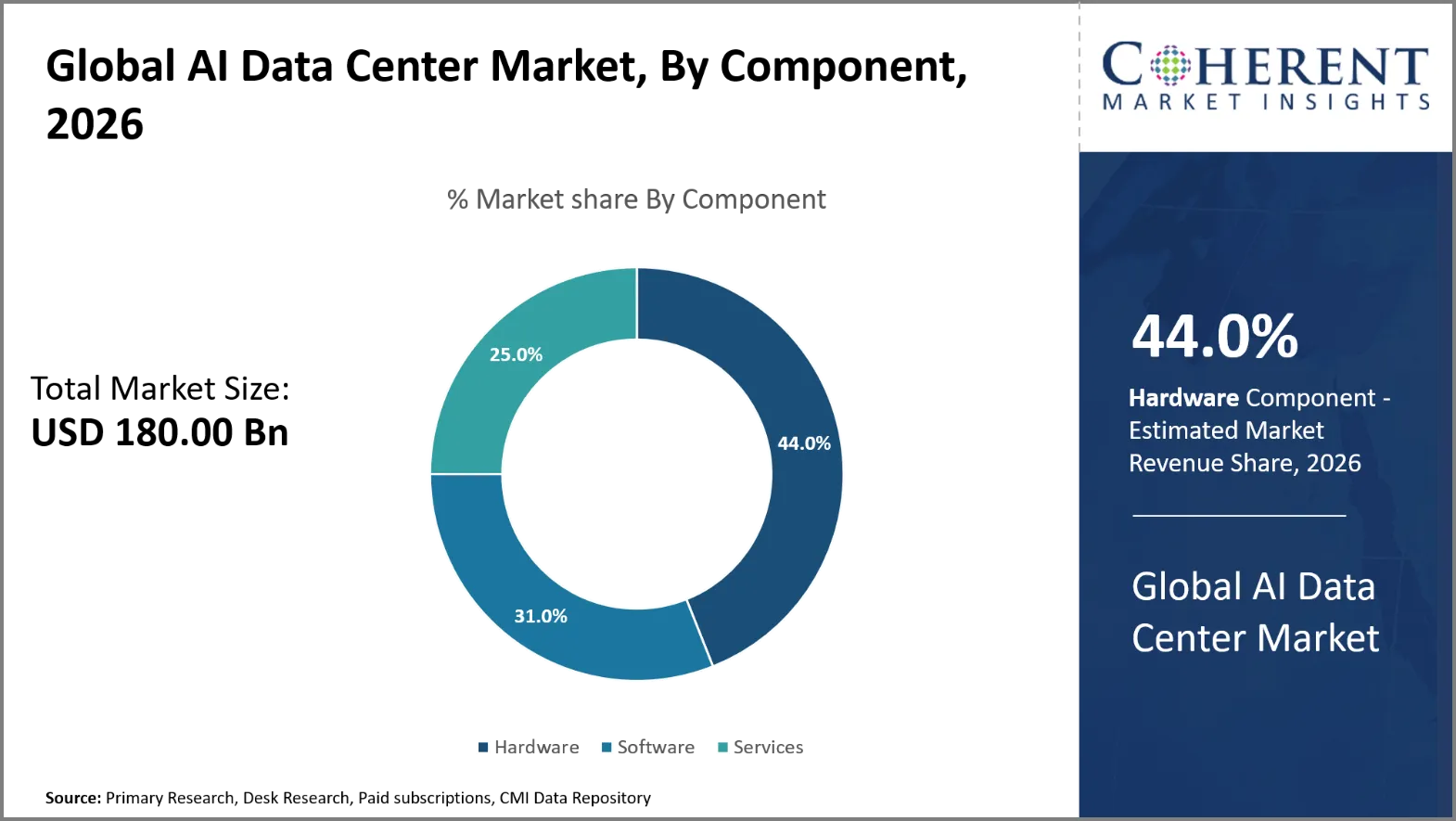
- The Hardware segment is expected to account for 44.0% of the global AI data center market share in 2026. Rising adoption of secure document workflows is driving the growth of the segment. On February 10, 2026, DXC Technology completed an enterprise-wide Amazon Quick deployment supporting 115,000 employees across 70 countries.
- The Hyperscale Data Centers segment is estimated to capture 41.0% of the market share in 2026. Rising demand for high-bandwidth memory and high-speed networking is majorly driving the growth of the segment. On February 12, 2026, Samsung Electronics announced that it has begun mass manufacturing and commercial shipments of its fourth-generation high-bandwidth memory called HBM4. The memory delivers a transfer speed of 11.7 gigabits per second, with capabilities reaching 13 gigabits per second.
- The AI Servers segment is estimated to capture 47.0% of the market share in 2026. Expansion of modular AI data center infrastructure is driving the growth of the segment. On June 26, 2025, Crusoe introduced Crusoe Spark, a modular, pre-built AI data center for edge computing that can be deployed quickly.
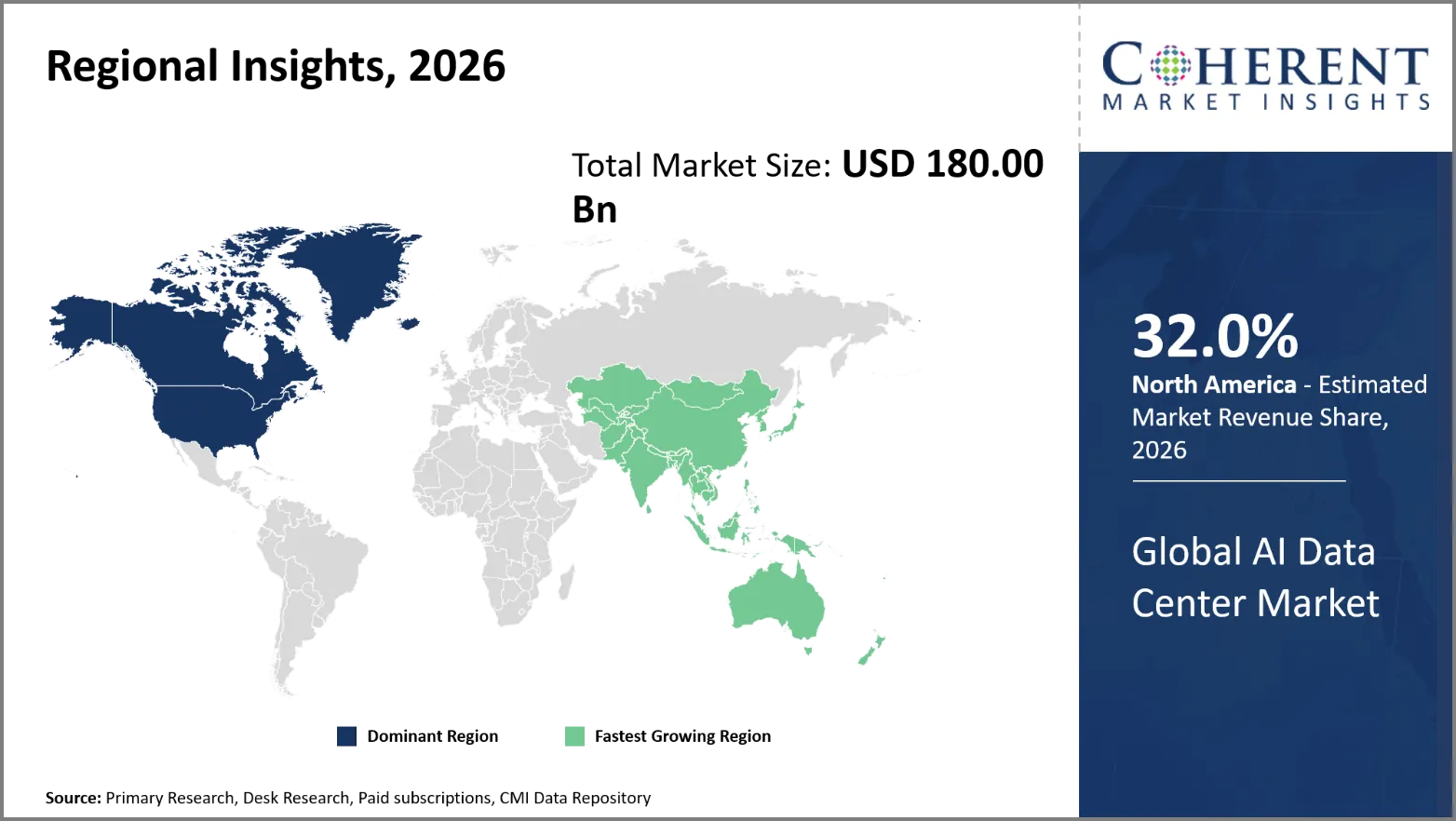
- North America is expected to dominate the AI data center market in 2026 with a market share of 32.0%. Increasing adoption of custom AI accelerators in North America is driving the growth of the regional market. On October 13, 2025, Broadcom and OpenAI announced a strategic partnership to build 10 gigawatts of AI accelerators created by OpenAI. Broadcom will help build and deploy accelerator and networking systems while OpenAI will design the accelerators.
- Asia Pacific is expected to account for 21.0% share in 2026. Growing demand for edge AI computing facilities in Asia Pacific is driving the growth of the regional market. On November 17, 2025, Groq carried out its first deployment of AI infrastructure in the Asia Pacific, at Equinix in Sydney, Australia. The intended facility will have 4.5 MW of specialized AI inference capacity.
Segmental Insights
Why Does Hardware Dominate the Global AI Data Center Market?
The hardware segment is expected to account for 44.0% of the global AI data center market share in 2026. Artificial intelligence workloads require a lot of computational power, memory capacity and fast data transport, hence hardware is the dominant component. AI infrastructure is built on a physical basis comprising graphics processing units, central processing units, high-bandwidth memory, networking equipment, and storage systems. Training big language models demands parallel processing capabilities and faster compute systems. Reliable hardware is also key to delivering low-latency responses at scale for inference workloads. More investment in artificial intelligence servers, liquid cooling systems and high-speed interconnects also drives demand for hardware.
On March 12, 2026, Broadcom Inc., a worldwide technology company that designs, develops and distributes semiconductor and infrastructure software solutions, announced the Tomahawk 6 family switch series is in production and shipping. Unprecedented for a chip of its scale, Tomahawk 6 moved rapidly from initial samples to production deployment.
- Current Industry Events of 2026
- Market Size Estimation
- Regional Breakdown
- Competitive Landscape
- Customer Intelligence
- Segmental Analysis
- Pricing Analysis
- Key Market Drivers, Challenges & Future Trends
- Customized Insights Section
Why is Hyperscale Data Centers the Most Crucial Data Center Type?
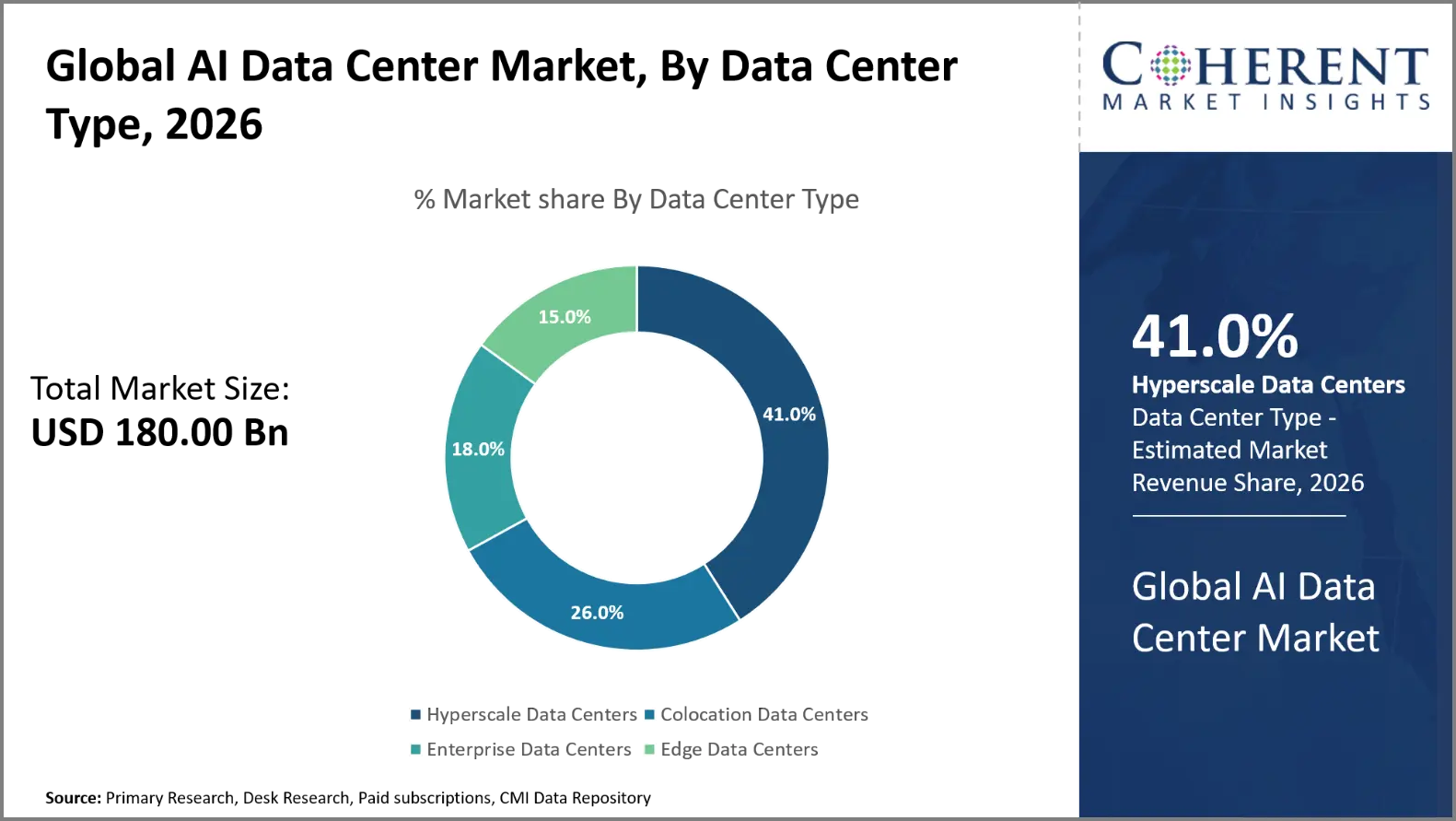
The hyperscale data centers segment is expected to account for 41.0% of the global AI data center market share in 2026. Hyperscale data centers are important because they house huge computing workloads on a geographically spread-out infrastructure. The centers are packed with thousands of interconnected servers, high-capacity networking systems and AI-focused accelerators. These scalable architectures enable technology organizations to scale up processing resources as model complexity and number of users grow. Hyperscale facilities also enable centralized artificial intelligence training, large scale inference and cloud-based artificial intelligence services. Operators can also handle severe workloads with advanced power management, liquid cooling and automated infrastructure monitoring.
On February 17, 2026, Meta announced a multiyear infrastructure agreement with NVDIA. The agreement supports hyperscale data centers optimized for artificial intelligence training and inference. Meta plans large-scale deployment of NVIDIA central processing units and millions of Blackwell and Rubin graphics processing units.
AI Servers Dominates the Global AI Data Center Market
The AI servers segment is expected to account for 47.0% of the global AI data center market share in 2026. AI servers are the go-to choice, offering the dedicated processing infrastructure needed to train, fine-tune and deploy artificial intelligence models. These systems combine graphics processing units, high-bandwidth memory, modern networking and optimized power delivery components. Their parallel processing capabilities expedite difficult computations in generative artificial intelligence, computer vision, natural language processing and predictive analytics. As the popularity of large language models increases, the demand for servers with higher accelerator density and quicker interconnects also increases. Hyperscale cloud providers, academic institutes and companies are investing in AI server deployments to boost computing performance.
On August 11, 2025, NVIDIA announced that its RTX PRO 6000 Blackwell Server Edition graphics processing units would enter enterprise server systems. Cisco, Dell Technologies, Hewlett Packard Enterprise, Lenovo, and Supermicro announced compatible systems.
Current Events and their Impact
Current Events | Description and its Impact |
U.S. Executive Order 14318, Accelerating Federal Permitting of Data Center Infrastructure |
|
European Union Energy Efficiency Directive (EU) 2023/1791 |
|
AI Data Center Market Dynamics
Market Drivers
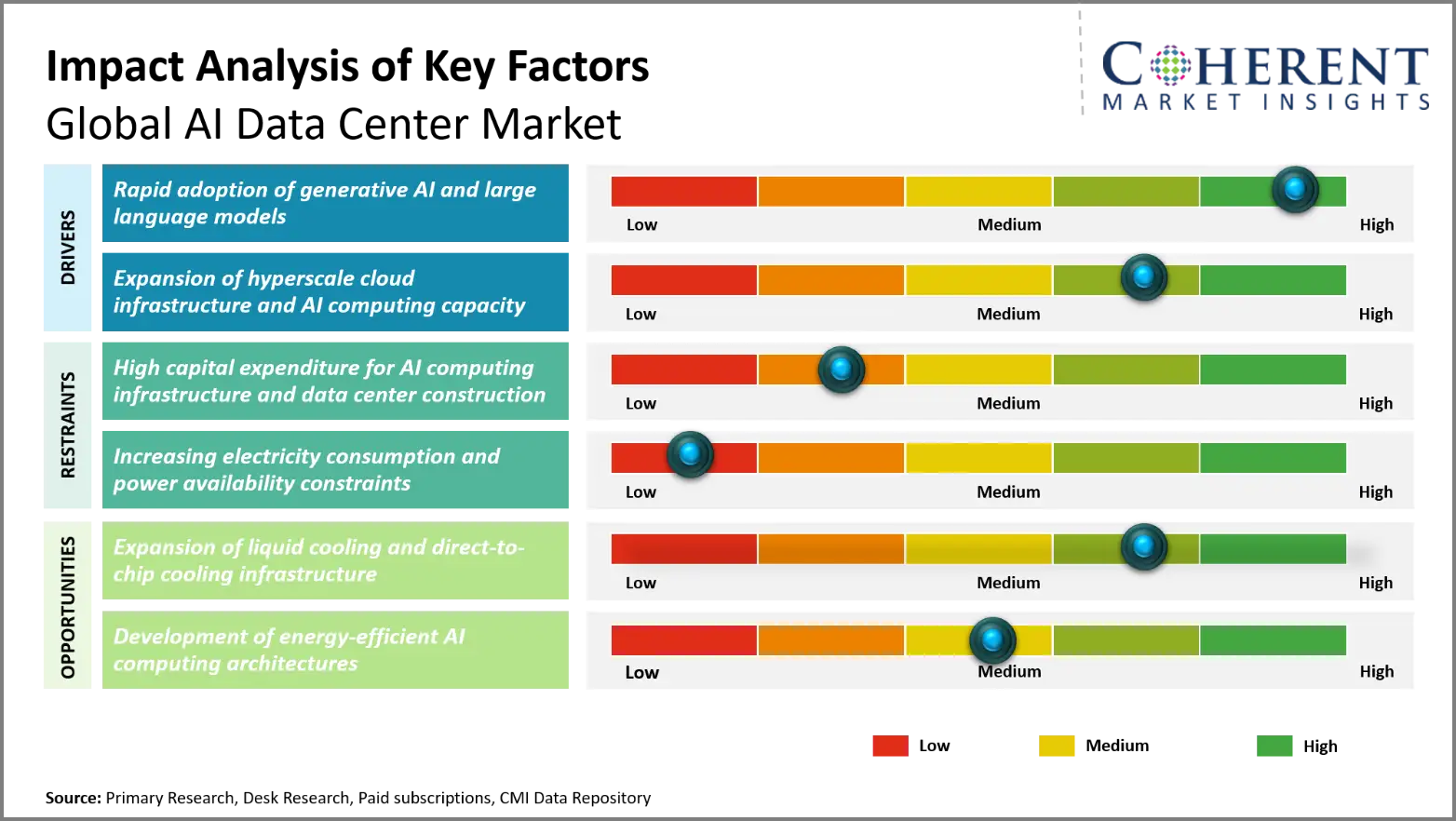
- Rapid adoption of generative AI and large language models: Rapid adoption of generative artificial intelligence and large language models is driving the demand in the global AI data center market. Companies use these technologies to generate content, build software, provide customer assistance, and automate business operations. Training complicated models demands high-performance graphics processing units, high bandwidth memory and high-speed networking infrastructure. The rise in inference workloads also drives the need for low-latency computation and scalability server capacity. Companies are developing improved cooling systems in response to increasing power densities. Corporate usage, ongoing model development, and the growth of dedicated AI data centers worldwide are fueling the need.
- On January 7, 2026, Infosys announced its strategic collaboration with Amazon Web Services (AWS) to accelerate enterprise adoption of generative AI. The initiative focuses on combining Infosys Topaz, an AI-first set of services, solutions, and platforms using generative AI technologies, and Amazon Q Developer, AWS’s generative AI-powered assistant, to enhance Infosys’ internal operations and drive innovation for customers.
- Expansion of hyperscale cloud infrastructure and AI computing capacity: Growth in hyperscale cloud infrastructure and AI computing capacity is accelerating growth in the global AI data center market. Major cloud providers are ramping up investment in specialized servers, powerful accelerators, high-speed networking and dedicated power infrastructure. These resources power the training of huge models, AI inference and cloud corporate applications. Operators are looking to extend existing campuses and build new data center facilities as the demand for computing resources continues to grow. Liquid cooling and energy-efficient infrastructure are advanced to support increased rack density. Investment in hyperscale infrastructure in major technology markets continues to grow with increasing cloud adoption and demand for scalable artificial intelligence services.
- On September 23, 2025, OpenAI, Oracle, and SoftBank Group announced five additional U.S. data center sites under the Stargate initiative. The new sites, alongside existing projects, brought planned capacity to nearly seven gigawatts. The companies projected more than USD 400 billion in investment over three years.
Emerging Trends
- Increasing Adoption of Liquid Cooling Technologies: Direct-to-chip liquid cooling and immersion cooling are gaining more traction in AI data centers for cooling the heat generated by high-density graphics processing units and powerful accelerators.
- Impact: Liquid cooling offers improved thermal control, enabling higher rack densities and lower cooling energy requirements than conventional air-based systems.
- Relevance to the market: This trend drives need for specialist cooling equipment, heat exchangers, coolant distribution units, and integrated thermal management solutions for AI data centers.
- Growing Deployment of High-Bandwidth Memory and Advanced Networking: AI data centers are increasingly adopting high-bandwidth memory, high-speed interconnects, and advanced networking technologies to speed up communication between processors and distributed computing systems.
- Impact: These technologies increase data flow, decrease communication bottlenecks, and speed up training and inference for increasingly complex artificial intelligence workloads.
- Relevance to the market: As adoption grows, demand is increasing for powerful AI servers, networking switches, optical interconnects and dedicated infrastructure to install large-scale models.
Regional Insights
Why is North America a Strong Market for AI Data Center?
North America is expected to account for a market share of 32.0% in 2026. Hyperscale cloud investment, sophisticated accelerator ecosystems and demand for large-scale artificial intelligence training infrastructure are benefiting North America. Canada contributes with the establishment of data centers in Quebec where hydroelectric power supports electricity-intensive computing. Northern Virginia is a leading U.S. data center cluster, featuring strong fiber connection and closeness to cloud customers. Texas is drawing projects seeking huge sites and access to growing electrical infrastructure. Canada also has prospects in artificial intelligence computing with research universities and cloud infrastructure development. Regional growth increasingly depends on securing reliable electricity, expanding transmission capacity, and integrating high-density computing systems with efficient cooling technologies.
Why Does Asia Pacific AI Data Center Market Exhibit High Growth?
Asia Pacific, with a growth rate of 21.7% over the forecast period, is projected to account for 21.0% of the global AI data center market in 2026. This growth reflects the relocation of AI infrastructure toward markets offering developable land and accessible electricity. Cushman & Wakefield reported its regional development pipeline in 2025 was 19.4 gigawatts, which included active construction and planned projects. Johor in Malaysia is drawing hyperscale campuses on account of its closeness to Singapore and improved regional connections. India is building its domestic computing infrastructure, with Microsoft making a USD 17.5 billion investment commitment for the period of 2026-2029. There is further development potential in Australia’s renewable energy resources and existing cloud environment. These varied market conditions are driving operators to spread AI computer resources throughout different sites in Asia Pacific.
Global AI Data Center Market Outlook for Key Countries
Why is U.S. Emerging as a Major Hub in the AI Data Center Market?
The U.S. market benefits from focused AI research, hyperscale cloud investment and access to sophisticated accelerator environments. Google reported it will invest another USD 9 billion in Virginia through 2026, including a data center in Chesterfield County. Microsoft announced a new campus in Pecos, Texas, expected to add approximately two gigawatts of capacity. Google and Intersect also announced a Texas data center alongside dedicated energy generation. These projects reflect an increasing desire for power-integrated campuses, not stand-alone computing facilities. Access to vast locations, energy connections and existing tech supply chains enable sustained development across Virginia and Texas.
Is China the Next Growth Engine for the AI Data Center Market?
The Chinese market for AI data centers is being boosted by domestic semiconductor growth, coordinated computing infrastructure and initiatives to achieve more technical self-reliance. In June 2026, China’s Ministry of Industry and Information Technology announced a three-year strategy to deepen the integration of AI into information and communications networks. The proposal aims for enhanced autonomy for network operations and greater availability of low-latency computing by 2028. China is also building domestic technological supply chains for its strategic computing infrastructure. These aims are driving demand for locally built accelerators, server systems, network equipment and computer clusters. The use of AI in homes in manufacturing, telecommunications and public services creates increased demand for data center capacity.
Germany AI Data Center Market Analysis and Trends
Germany’s AI data center market is gaining traction with industrial AI use, sovereign computing efforts and demand for locally managed infrastructure. Deutsche Telekom debuted its Industrial AI Cloud in Munich in February 2026 with roughly 10,000 NVIDIA Blackwell graphics processing units. The infrastructure supports corporations, research institutions and public-sector users with advanced computing needs. Microsoft also revealed another proposed data center facility in Grevenbroich, North Rhine-Westphalia in July 2026. These trends are driven by the needs of the automotive engineering, manufacturing automation, industrial simulation, and research applications. Germany values data safety and local data center operations and wants investment in AI compute that is purpose-built.
U.K. AI Data Center Market Analysis and Trends
UK Demand for financial services boosts local AI development and investment in computer infrastructure available to the local market. In October 2024, CloudHQ announced an investment of USD 2.50 billion to build a data center campus in Didcot, Oxfordshire. The project was planned to provide 1,500 construction jobs and about 100 permanent employments. Also, that year, CoreWeave declared it was investing another USD 999.0 million in British AI cloud infrastructure. The government issued its Data Center Covenant in October 2026, covering resilience, energy costs, water efficiency and community benefit. These efforts complement the country’s objective to support AI services and key digital infrastructure.
Japan AI Data Center Market Analysis and Trends
Japan AI data center market is driven by industrial robotics, local AI development and strategic investment in computing infrastructure. Microsoft announced it will invest US$ 10 billion in Japan over the next three years through 2026-2029, including building out infrastructure and cybersecurity collaborations. In July 2026, NVIDIA launched an AI industrial project with Noetra Corporation including 27,500 NVIDIA Rubin graphics processing units and 13,750 Vera central processing units. The projected facility will be used for manufacturing, logistics, healthcare, robotics and physical AI applications. Japan's mature industrial automation ecosystem is driving the need for compute infrastructure to power digital twins and smart machines. Domestic AI infrastructure initiatives help build technical resilience and access to computing at the local level.
Global Data Center Market - Top AI Data Center Projects Pipeline
Project | Company | Location | Announcement Date | Announced Capacity |
Stargate United States program | OpenAI, Oracle, SoftBank Group | Multiple U.S. locations | September 23, 2025 | Nearly 7 GW planned |
Meta–Reliance AI data center | Meta, Reliance Industries | Jamnagar, Gujarat, India | June 9, 2026 | 168 MW initial capacity with expansion options |
CoreWeave Indonesia expansion | CoreWeave | Three locations in Indonesia | August 4, 2026 | 360 MW contracted IT power |
STT Jakarta campus expansion | ST Telemedia Global Data Centres | Jakarta, Indonesia | June 10, 2026 | More than 360 MW AI-ready IT capacity |
GAK Sejong AI factory expansion | NAVER, NVIDIA, Brookfield | Sejong, South Korea | July 24, 2026 | Expansion from 55 MW to 200 MW by 2028 |
Southwestern Korea AI data center | SK hynix / SK Group | Southwestern South Korea | June 30, 2026 | 1 GW AI data center within a wider 15 GW national blueprint |
Polaris Forge 3 | Applied Digital | Northern U.S. states | May 20, 2026 | 300 MW critical IT load |
How is Expansion of Liquid Cooling and Direct-To-Chip Cooling Infrastructure Creating New Growth Opportunities in the AI Data Center Market?
Expansion of liquid cooling and direct-to-chip cooling creates growth opportunities by enabling AI data centers to operate high-power graphics processing units without relying exclusively on conventional air cooling. NVIDIA's Blackwell platforms and increasingly dense accelerator racks are pushing operators toward cold plates, coolant distribution units, and facility-level heat rejection systems. Schneider Electric, Vertiv and CoolIT Systems are working on liquid cooling systems for such installations. Direct-to-chip systems move heat from processors to circulating coolant, allowing for larger rack density and more controlled thermal performance. This is driving demand for cooling retrofits, leak detection, coolant monitoring, heat exchangers and specialized maintenance services for both new and existing AI data centers.
A notable example is Vertiv's October 2026 deployment with CapitaLand India Trust in their Mumbai data center in October 2026, running 30 megawatts of AI workloads with direct-to-chip cooling. Schneider Electric also launched a liquid cooling production plant in Bengaluru in February 2026, increasing the local supply availability.
Market Players, Key Development, and Competitive Intelligence
Key Developments
- On October 6, 2026, CoreWeave, Inc. announced its entry into India. Through a collaboration with AdaniConneX, CoreWeave plans to expand its AI Cloud platform with 240 megawatts (MW) of data center capacity in Navi Mumbai. As part of the expansion, CoreWeave intends to invest in India by establishing an office and hiring locally, creating an on-the-ground presence to collaborate with customers and partners throughout India’s vibrant and growing AI ecosystem.
- On September 9, 2026, NVIDIA announced that it is collaborating with a growing ecosystem of Australian NVIDIA Cloud Partners (NCPs) and AI infrastructure partners to expand land, power and shell capacity designed to host multiple generations of NVIDIA DSX AI factories, supporting the nation’s growing demand for AI compute, with up to a 2-gigawatt buildout by 2027.
- On February 19, 2026, ST Telemedia Global Data Centers (India), a leading AI-ready colocation data centre services provider, announced the launch of its fourth data center in Chennai, marking the expansion of its second campus in the city at Siruseri.
Competitive Landscape
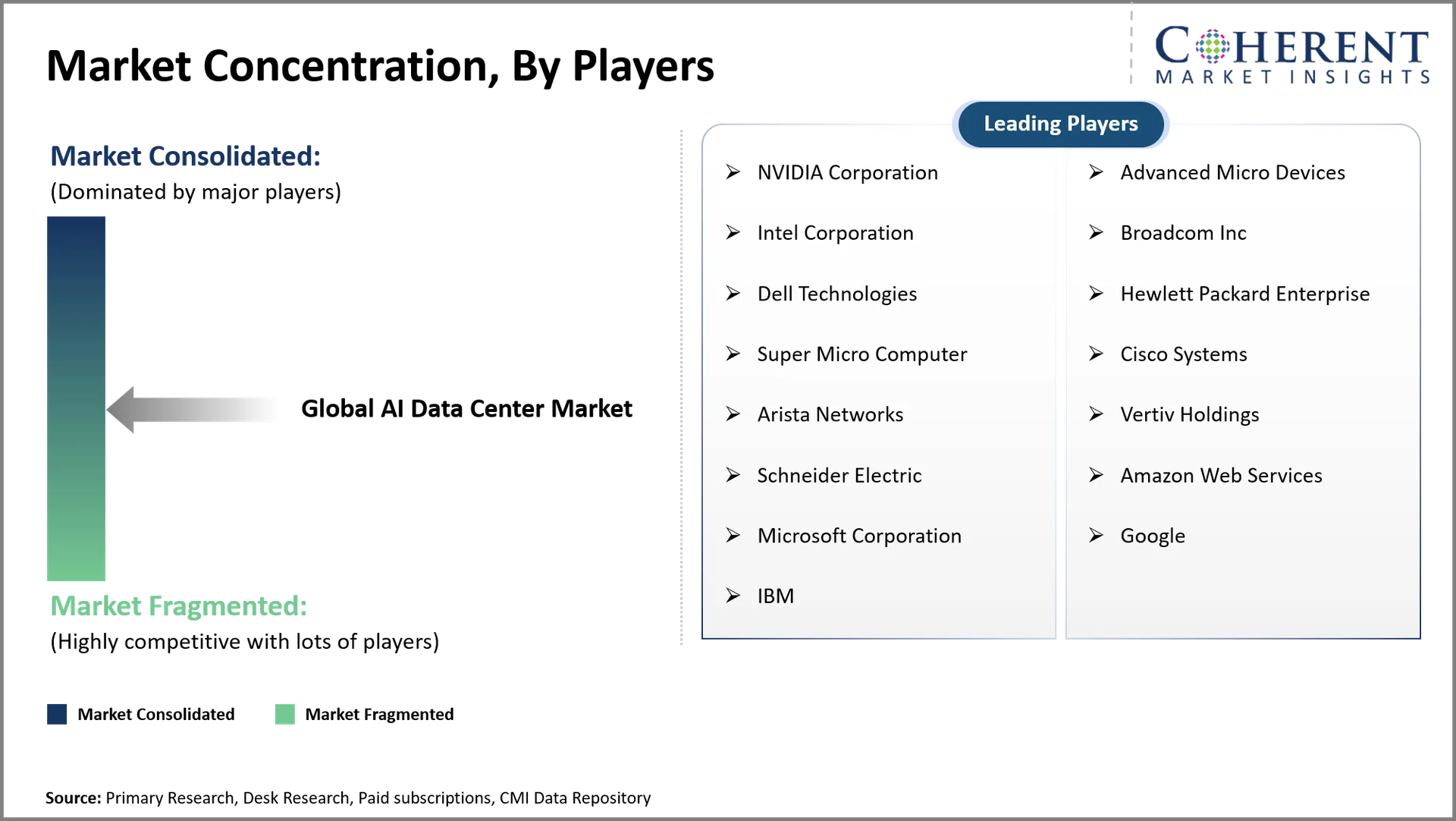
The global AI data center market is shaped by competition across accelerated computing, cloud infrastructure, server manufacturing, and facility management. NVIDIA strengthens its position through integrated graphics processing units, networking, and software platforms for rack-scale AI systems. Microsoft is designing proprietary Maia accelerators and adding hyperscale capacity to maximize inference performance and operating expenses. Amazon Web Services deepens relationship with NVIDIA, extending accelerator deployments and improved networking. Google pairs proprietary Tensor Processing Units with dedicated energy infrastructure, like its Texas experiment with Intersect. Dell Technologies, Hewlett Packard Enterprise, and Supermicro compete through integrated AI servers, rack systems, and liquid-cooled infrastructure.
Top Manufacturers and Notable Products in the AI Data Center Market
Company/Manufacturer | Notable Product | Key features |
NVIDIA | NVIDIA DGX B200 | Eight Blackwell GPUs, up to 144 petaflops of AI performance, 1.4 terabytes of GPU memory, 64 terabytes per second of memory bandwidth, integrated high-speed networking |
Dell Technologies | Dell PowerEdge XE9780 | Supports eight NVIDIA HGX B200 or B300 accelerators, high-density AI computing, scalable server configurations, large-scale model training and inference |
Hewlett Packard Enterprise | HPE Cray XD670 | GPU-accelerated computing, high-performance networking, scalable configurations, liquid-cooling options across compatible infrastructure, AI training and high-performance computing |
Supermicro | NVIDIA Blackwell GPU SuperServer platforms | High-density GPU configurations, rack-scale integration, direct liquid cooling options, high-speed interconnects, modular deployment |
Lenovo | Lenovo ThinkSystem SR675i | GPU-accelerated AI computing, support for large language models, scalable infrastructure, enterprise inference, data-intensive workloads |
Market Report Scope
Global AI Data Center Market Report Coverage | |||
Report Coverage | Details | ||
Base Year | 2025 | Market Size in 2026: | USD 180.00 Bn |
Historical Data For: | 2020 To 2024 | Forecast Period: | 2026 To 2033 |
Forecast Period 2026 To 2033 CAGR: | 23.00% | 2033 Value Projection: | USD 810.00 Bn |
Geographies covered: |
| ||
Segments covered: |
| ||
Companies covered: | NVIDIA Corporation, Advanced Micro Devices, Intel Corporation, Broadcom Inc, Dell Technologies, Hewlett Packard Enterprise, Super Micro Computer, Cisco Systems, Arista Networks, Vertiv Holdings, Schneider Electric, Amazon Web Services, Microsoft Corporation, Google, IBM | ||
Growth Drivers: |
| ||
Restraints & Challenges: |
| ||
Analyst Opinion (Expert Opinion)
- The future of the AI data center market will depend on delivering more computing performance while controlling electricity consumption, cooling requirements, and inference costs. Rack-scale systems integrating accelerators, high-bandwidth memory, and high-speed networking will become increasingly important. Microsoft's development of Maia accelerators illustrates how cloud providers are optimizing hardware for their own workloads. Demand is expected to diversify between large training clusters and inference infrastructure serving deployed AI applications. Operators that coordinate processor selection, cooling architecture, power delivery, and workload scheduling will be better positioned to improve utilization.
- The biggest potential will be in hyperscale AI data centers, inference-optimized facilities and liquid-cooled infrastructure. The U.S. has prospects in existing cloud ecosystems and large-scale campus construction, especially in Texas and Ohio. India has the potential for localized AI infrastructure, underpinned by investments in connectivity and digital infrastructure. Applications like enterprise AI assistants, industrial automation, scientific computing, and real-time inference will need distinct infrastructure setups. Investors must seek facilities with reliable power, scalable cooling, fiber connectivity and traceable customer contracts.
- Market participants should differentiate on demonstrable performance, predictable deployment schedules and lower operating costs, not just accelerator capacity. Data center developers should lock up power deals early and build facilities with future rack density expansions in mind. Equipment manufacturers should design cooling distribution, power management, monitoring, and maintenance into integrated infrastructure packages. Inference workloads of certain types should also consider custom accelerators in addition to graphics processing units from cloud providers. By validating numerous sources of components and enabling quick hardware changes, suppliers can increase their competitiveness. Operators also need to adopt transparent energy and water management methods to meet permitting requirements and consumer sustainability expectations.
Speak to the analyst
Want personalized insights?
Take the findings above to one of our principal consultants, or have the report rebuilt around the segments, geographies and competitors you actually track.
Market Segmentation
- Component Insights (Revenue, USD Billion, 2021 - 2033)
- Hardware
- Software
- Services
- Data Center Type Insights (Revenue, USD Billion, 2021 - 2033)
- Hyperscale Data Centers
- Colocation Data Centers
- Enterprise Data Centers
- Edge Data Centers
- Infrastructure Type Insights (Revenue, USD Billion, 2021 - 2033)
- AI Servers
- Networking Equipment
- Storage Systems
- Power and Cooling Systems
- Deployment Type Insights (Revenue, USD Billion, 2021 - 2033)
- Cloud-Based
- On-Premises
- Hybrid
- Application Insights (Revenue, USD Billion, 2021 - 2033)
- Generative AI
- Machine Learning
- Deep Learning
- Natural Language Processing
- Computer Vision
- End User Insights (Revenue, USD Billion, 2021 - 2033)
- IT and Telecommunications
- BFSI
- Healthcare
- Retail and E-Commerce
- Automotive
- Manufacturing
- Media and Entertainment
- Others
- Regional Insights (Revenue, USD Billion, 2021 - 2033)
- North America
- U.S.
- Canada
- Latin America
- Brazil
- Argentina
- Mexico
- Rest of Latin America
- Europe
- Germany
- U.K.
- Spain
- France
- Italy
- Russia
- Rest of Europe
- Asia Pacific
- China
- India
- Japan
- Australia
- South Korea
- ASEAN
- Rest of Asia Pacific
- Middle East
- GCC Countries
- Israel
- Rest of Middle East
- Africa
- South Africa
- North Africa
- Central Africa
- North America
Sources
Primary Research Interviews
- Data Center Infrastructure Providers
- AI Hardware & Chip Manufacturers
- Cloud Service Providers & Hyperscalers
- Colocation & Managed Service Providers
Magazines
- Data Center Dynamics Magazine
- AI Business Magazine
- IEEE Spectrum Magazine
- Data Economy Magazine
Journals
- Journal of Cloud Computing (Springer)
- IEEE Transactions on Cloud Computing
- Journal of Parallel and Distributed Computing
Associations
- Uptime Institute
- Green Grid Association
- Data Center Alliance (DCA)
- European Data Centre Association (EUDCA)
Public Domain Sources
- U.S. Department of Energy (DOE) - Data Center Reports
- International Energy Agency (IEA) - Data Center & Energy Reports
- U.S. Environmental Protection Agency (EPA) - Data Center Efficiency Reports
- European Commission - Digital Infrastructure Policy Documents
Proprietary Elements
- CMI Data Analytics Tool
- Proprietary CMI Existing Repository of Information for Last 10 Years
Get access to 250+ pages report
Every segment, forecast, competitor profile and data table behind the analysis above — available for instant download.
- ESOMAR Member
- ISO 9001:2015 Certified
- D-U-N-S Registered
- GDPR & CCPA Compliant
Frequently Asked Questions
The global AI data center market is expected to stand at USD 180.00 Bn in 2026 and is expected to reach USD 810.00 Bn by 2033.
The CAGR of the global AI data center market is projected to be 23.0% from 2026 to 2033.
Rapid adoption of generative AI and large language models and Expansion of hyperscale cloud infrastructure and AI computing capacity are the major factors driving the growth of the global AI data center market.
High capital expenditure for AI computing infrastructure and data center construction and Increasing electricity consumption and power availability constraints are the major factors hampering the growth of the global AI data center market.
In terms of component, hardware segment is estimated to dominate the market revenue share in 2026.
The global AI data center Market comprises specialized facilities housing computing, networking, storage, and cooling infrastructure for artificial intelligence workloads.
Direct-to-chip cooling circulates liquid through cold plates attached to processors, transferring heat away from critical electronic components.