

Global AI Image Recognition Market Size and Forecast – 2026 To 2033
The global AI image recognition market is expected to grow from USD 5.70 Bn in 2026 to USD 14.50 Bn by 2033, registering a compound annual growth rate (CAGR) of 8.5% from 2026 to 2033. The global AI image recognition market is driven by expansion of facial and object recognition applications. On December 3, 2025, NEC Corporation developed a groundbreaking walk-through face and iris multimodal biometric authentication technology, enabling verification of individuals who are in motion, even in scenarios requiring strict identity verification.
Key Takeaways of the Global AI Image Recognition Market
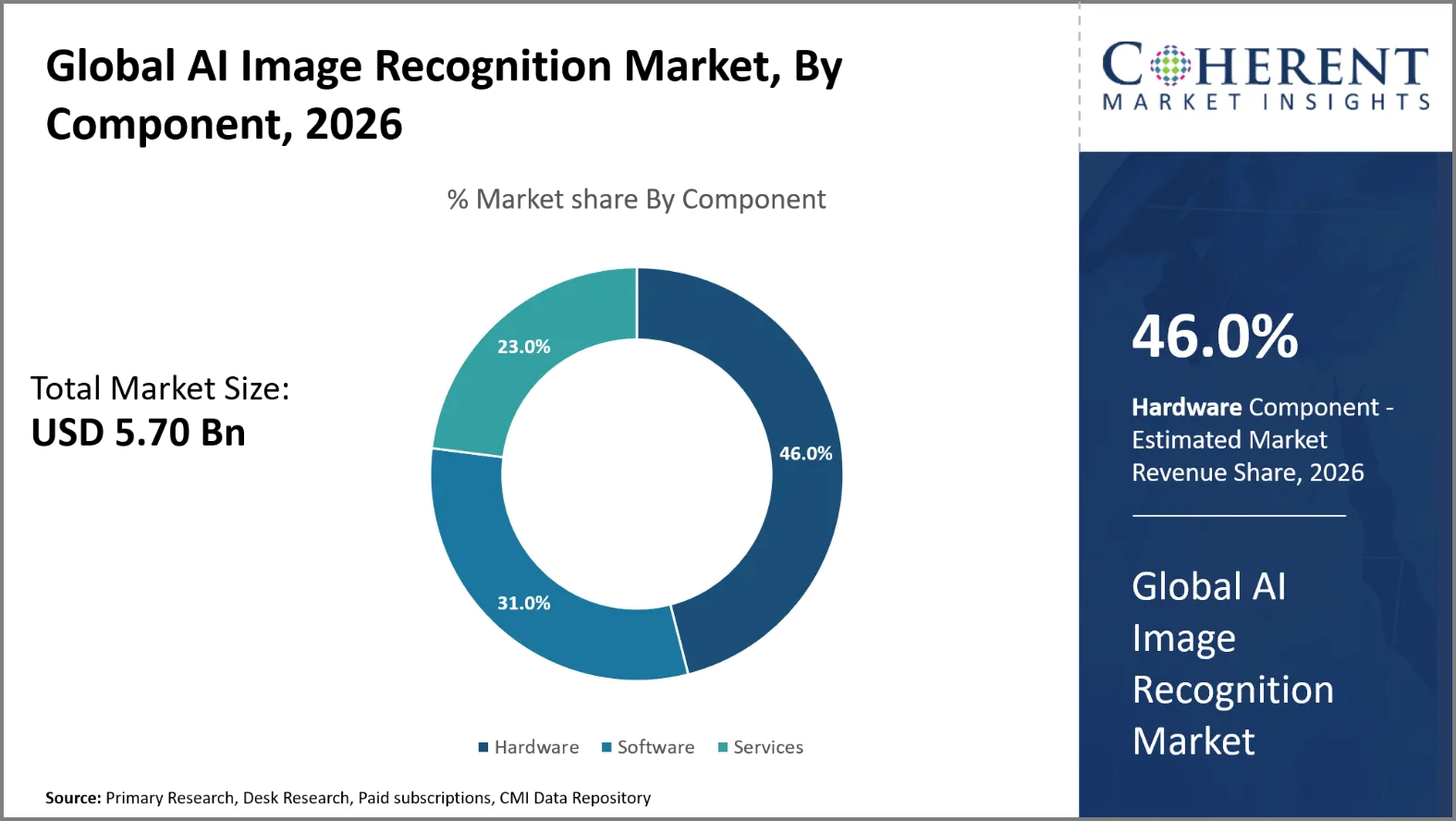
- The Hardware segment is expected to account for 46.0% of the global AI image recognition market share in 2026. Rising use of image recognition in healthcare is driving the growth of the segment. On April 2, 2026, GE HealthCare announced United States Food and Drug Administration clearance for True Definition DL. The deep learning technology enhances computed tomography image resolution and suppresses imaging artifacts.
- The Cloud-Based segment is estimated to capture 53.0% of the market share in 2026. Increasing adoption of autonomous vehicles is majorly driving the growth of the segment. On June 19, 2025, Helm.ai unveiled Helm.ai Vision, a camera-based system that interprets urban driving environments.
- The Object Recognition segment is estimated to capture 38.0% of the market share in 2026. Growth of visual search in e-commerce is driving the growth of the segment. On September 2, 2025, Amazon introduced Lens Live in its shopping application for iOS and Android. The feature identifies products through a smartphone camera and displays matching items in a live carousel.
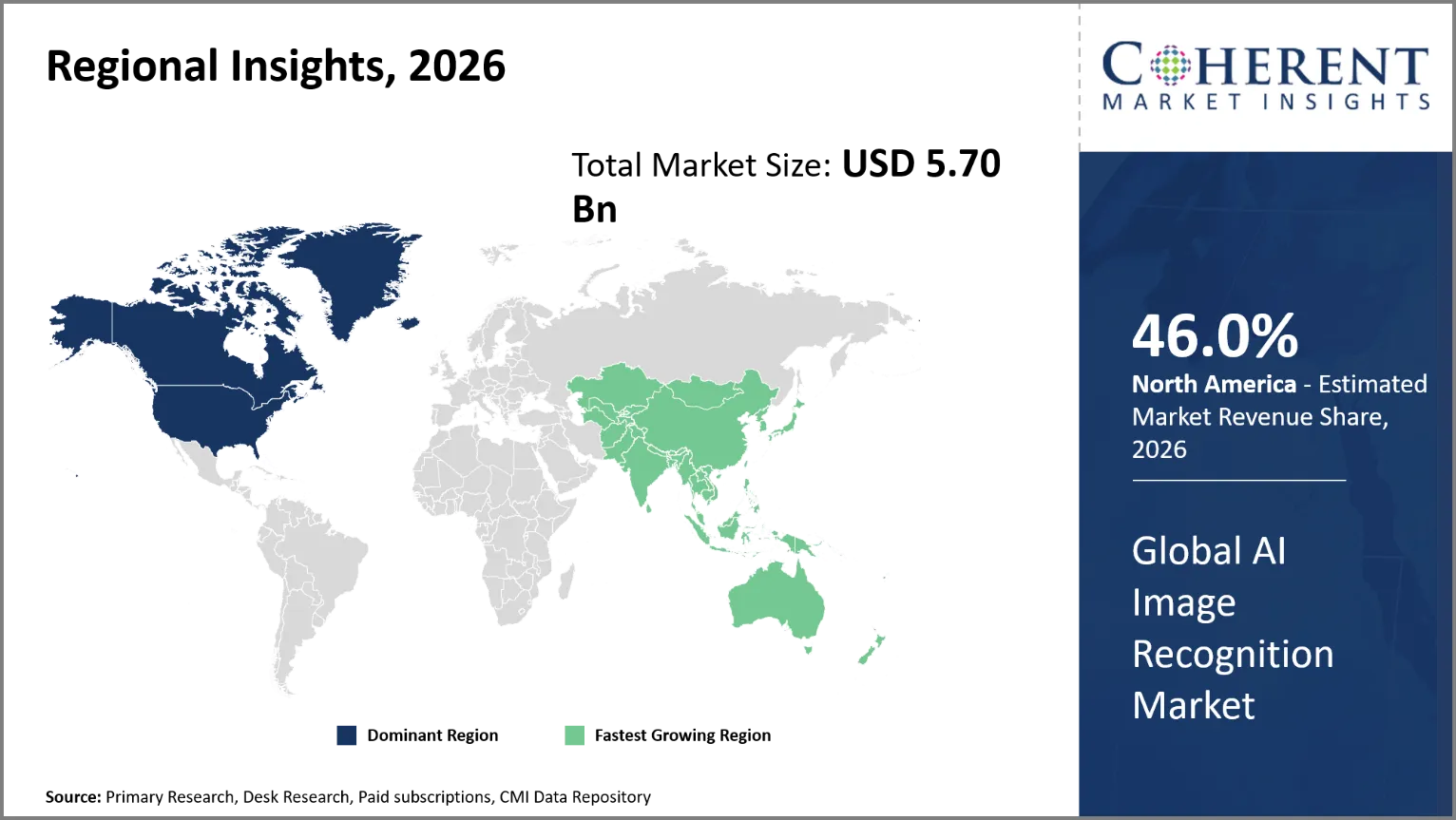
- North America is expected to dominate the AI image recognition market in 2026 with a market share of 46.0%. Advancements in deep learning and vision transformers in North America is driving the growth of the regional market. On April 2, 2025, Syntiant announced a multimodal vision transformer for security applications, running on Ambarella's CV75M system-on-chip platform. The model supports image and text-based searches across multiple camera feeds without requiring continuous cloud processing.
- Asia Pacific is expected to account for 28.0% share in 2026. Increasing deployment of edge AI devices in Asia Pacific is driving the growth of the regional market. On March 19, 2026, Japanese security technology company i-PRO announced its first cameras with generative artificial intelligence running entirely at the edge. The new X-Series fisheye cameras use Ambarella’s CV72 AI vision system-on-chip to interpret natural-language descriptions.
Segmental Insights
Why Does Hardware Dominate the Global AI Image Recognition Market?
The hardware segment is expected to account for 46.0% of the global AI image recognition market share in 2026. Image analysis is hardware intensive as it requires a lot of computing power, memory and efficient data processing. High-performance CPUs, dedicated artificial intelligence accelerators and graphics processing units provide faster inference and lower processing delays. They are used to recognize images in real-time in security cameras, driverless vehicles, industrial inspection systems, medical imaging equipment and smart phones. Edge computing technology also processes visual data locally, eliminating dependence on the network and speeding up response times. Increasing demand for high resolution imagery and continuous video monitoring is resulting in increasing use of hardware across commercial and industrial markets.
On January 5, 2026, Qualcomm Technologies, Inc. announced its extended IoT product portfolio, featuring the new Qualcomm Dragonwing Q-8750. The Dragonwing Q-8750 is Qualcomm Technologies’ most advanced IoT processor to date, engineered for high-performance edge computing and immersive experiences. Its AI engine achieves 77 TOPS with support for INT4/8/16 and FP16 precision, enabling real-time inference and even on-device large language models up to 11 billion parameters.
- Current Industry Events of 2026
- Market Size Estimation
- Regional Breakdown
- Competitive Landscape
- Customer Intelligence
- Segmental Analysis
- Pricing Analysis
- Key Market Drivers, Challenges & Future Trends
- Customized Insights Section
Why is Cloud-Based the Most Preferred Deployment Type?
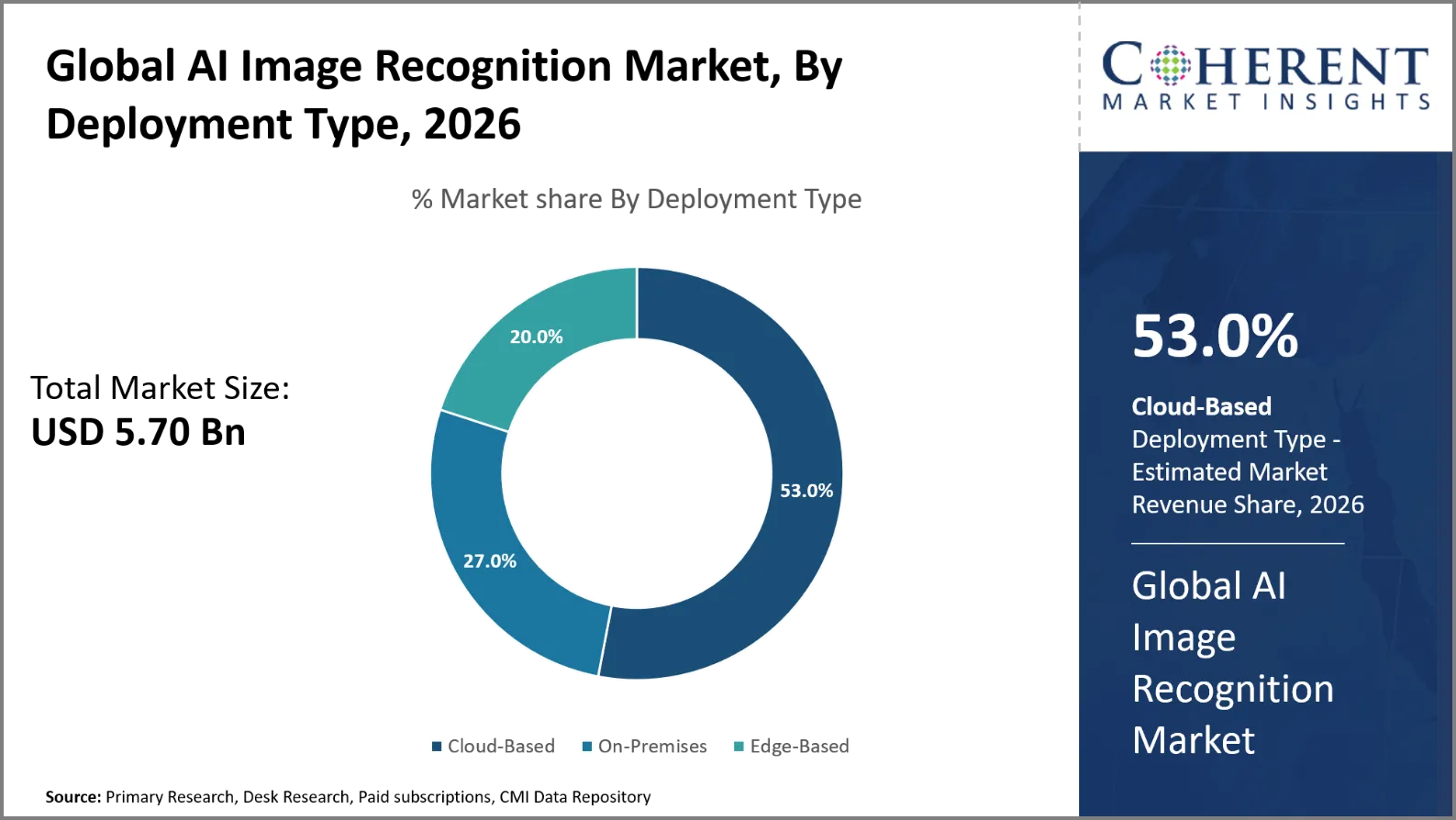
The cloud-based segment is expected to account for 53.0% of the global AI image recognition market share in 2026. Cloud installations are preferred because of their scalable computing resources and the centralized model administration. Organizations may handle large image collections without a large capital investment in on-premise equipment. Cloud systems also facilitate software updates, model training, application integration and operational access across widely distributed locations. And companies can scale computational capacity to the image processing workload, helping to manage infrastructure expenses. Recognition in the cloud powers retail analytics, digital content moderation, healthcare operations, security monitoring and manufacturing quality control.
On June 9, 2025, Cognex OneVision, a cloud-based platform for building, training and scaling artificial intelligence-powered machine vision applications. The platform offers a common ground for developing models and facilitates collaboration between manufacturing lines and facilities at different sites. Manufacturers can reduce additional hardware requirements while standardizing inspection workflows.
Object Recognition Dominates the Global AI Image Recognition Market
The object recognition segment is expected to account for 38.0% of the global AI image recognition market share in 2026. Object recognition is a dominant field, since businesses require automated item identification and localization in pictures and video streams. This capacity enables systems to identify cars, products, people, equipment and possible dangers in a variety of contexts. Object recognition is used by retailers for monitoring inventory and automating checkouts, and by manufacturers for detecting defects and inspecting production lines. It is used by transportation operators for vehicle identification, traffic analysis and driver assistance systems. Advances in deep learning models, image processing technology and real-time inference are broadening its practical use.
On August 11, 2025, Amazon Devices and Services unveiled a manufacturing system that leverages simulation and robotics technology from NVIDIA. The technology trains robotic arms to do product inspection and quality auditing on synthetic images from digital twins.
Current Events and their Impact
Current Events | Description and its Impact |
European Union Artificial Intelligence Act Regulation (EU) 2024/1689 |
|
European Union General Data Protection Regulation (EU) 2016/679 |
|
AI Image Recognition Market Dynamics
Market Drivers
Increasing adoption of artificial intelligence in visual analytics
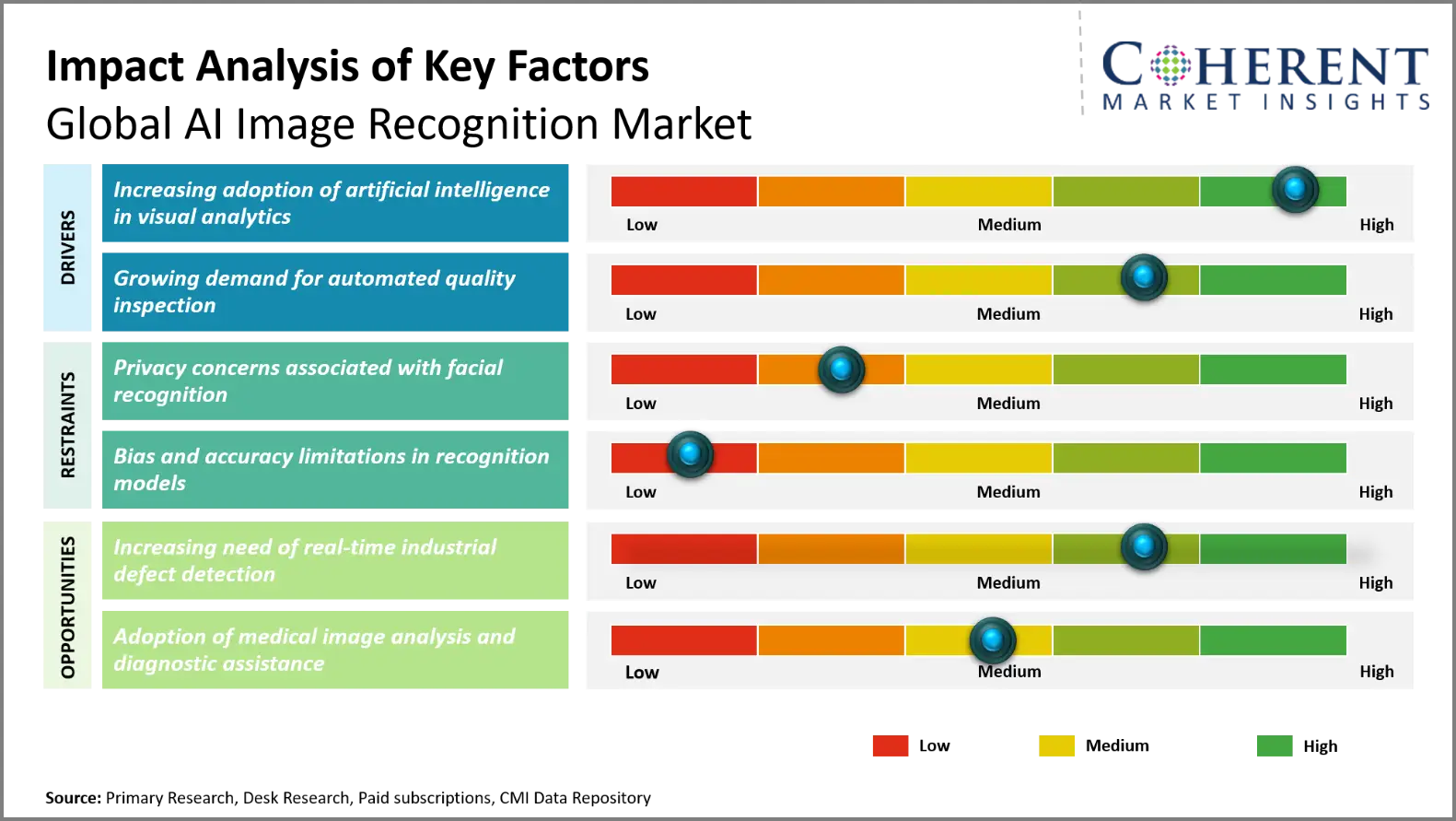
Growing uptake of artificial intelligence in visual analytics is driving growth in the global AI image recognition market. Businesses run image detection algorithms against photos, videos, surveillance feeds and operational imagery to derive useful information. Retailers monitor consumer movement and merchandise placement and traffic patterns and road conditions are monitored by traffic and transportation operators. Healthcare providers employ visual analysis to help understand medical images and carry out diagnostic procedures. Improvements in cloud computing, edge processing and deep learning provide increased accuracy and speed in recognition. These capabilities allow organizations to automate visual decisions, reduce manual analysis, and improve operational efficiency across industries.
On May 18, 2025, NVIDIA made its Metropolis Blueprint for Video Search and Summarization generally available. The platform allows developers to create artificial intelligence agents that can see and analyze live and recorded video. It uses computer vision, language models and video retrieval to find events and create actionable summaries.
Growing demand for automated quality inspection
Automated quality inspection demand is increasing, and this is speeding adoption in manufacturing and industrial production environments. Manual inspection alone is less consistent than AI recognition of images systems in detecting surface defects, dimensional irregularities, missing components and assembly faults. Car makers check parts of vehicles. Electronics manufacturers spot problems in circuit boards. Food processors detect damaged or mispackaged food. High-speed cameras and machine learning algorithms allow the continuous inspection without the disruption of production lines. These solutions help producers cut down on material waste, ensure product consistency and avoid costly recalls. As manufacturing becomes increasingly complex and quality requirements get tighter, there is a growing demand for automated visual inspection solutions.
On May 15, 2026, Nidec Advance Technology Corporation announced the launch of the AURCA series, an AI-based inspection & measurement solution for semiconductors and printed substrates. AURCA series is equipped with a unique AI-based algorithm that accurately detects faults and irregularities that have been difficult to identify with conventional inspection.
Emerging Trends
- Edge-Based AI Image Recognition: Edge-based recognition of images processes visual data directly on the camera, smartphone and industrial devices for faster detection, less dependency on the cloud and improved privacy for real-time applications.
- Impact: Local processing reduces latency and bandwidth utilization, and permits continued operation despite network outages, allowing for realistic recognition of images in industrial automation and intelligent surveillance.
- Relevance to the market: This advancement creates growth potential for embedded artificial intelligence processors, smart cameras and optimized recognition software for industrial, transportation, retail and security applications.
- Vision-Language Models and Multimodal Recognition: Vision-language models combine image detection and natural language processing, allowing systems to comprehend visual material, generate captions, answer questions about images, and identify objects in context.
- Impact: These features enhance visual search, automatic content moderation, document understanding and complex scene interpretation, allowing enterprises to get more information out of photographs and video.
- Relevance to the market: Multimodal recognition enables advanced analytics platforms, smart assistants, enterprise automation, and applications requiring contextual knowledge beyond simple item classification.
Regional Insights
Why is North America a Strong Market for AI Image Recognition?
North America is expected to account for a market share of 46.0% in 2026. North America's AI image recognition market is growing as enterprises across North America employ visual intelligence for retail execution, medical imaging and industrial inspection. Retail technology suppliers use recognition of photos to verify inventory, product placement on shelves and promotional compliance at various locations. In 2025, FORM Technologies said it researched more than one billion photo identification badges, demonstrating practical prospects in retail execution. Healthcare organizations use artificial intelligence to help interpret medical images, and manufacturers use computer vision to find faults. Strong regional demand is being underpinned by mature cloud infrastructure, enterprise software buying and investment in specialist artificial intelligence computing. Regional demand is supported by established cloud infrastructure, enterprise software procurement, and investment in specialized artificial intelligence computing.
Why Does Asia Pacific AI Image Recognition Market Exhibit High Growth?
Asia Pacific is expected to register the fastest growth with a CAGR of 9.0% over the forecast period. It is projected to account for 28.0% of the global AI image recognition market in 2026. Large-scale electronics manufacturing, automated logistics and digital commerce underpin the AI recognition of images market in Asia Pacific. Machine vision is used at factories in China, Japan, South Korea, and Taiwan for inspecting circuit boards, finding component flaws and verifying assembly quality. Visual search and product classification are vital for e-commerce systems to manage large product catalogs and improve shopping discovery. Singapore’s regional logistics infrastructure and digital tech ecosystem enable computer vision installations at warehouses and in transport operations. Microsoft’s 2025 AI diffusion statistics showed 60.9% adoption in Singapore in the second half, showing wider preparedness for AI applications across the region.
Global AI Image Recognition Market Outlook for Key Countries
Why is U.S. Emerging as a Major Hub in the AI Image Recognition Market?
The U.S. AI image recognition industry is supported by large-scale retail, advanced medical imaging and strong visual data infrastructure. The Federal Reserve estimated that about 18% of U.S. enterprises have implemented artificial intelligence by the end of 2025. FORM’s retail execution software analyzes shelf photos to quantify product availability, placement and promotional compliance. Healthcare professionals rely on image identification to assist with radiology procedures. Transportation businesses utilize computer vision for driver assistance and traffic monitoring. These apps draw upon existing cloud platforms, dedicated processors and enterprise software ecosystems.
Is China the Next Growth Engine for the AI Image Recognition Market?
Manufacturing automation, intelligent electronics manufacturing and government-supported industrial AI projects are the pillars of the AI recognition of images business in China. China’s main artificial intelligence business reached more than USD 170 billion by 2025, according to official government data. TCL has automated TV assembly with three-dimensional vision and artificial intelligence, reportedly obtaining a product pass rate of 99.8%. China's 2026 manufacturing push also aims at industrial artificial intelligence agents, high-quality data sets and machine-vision inspection. These advancements need the use of recognition of images in electronics assembly, component verification, production monitoring and automated defect identification.
Germany AI Image Recognition Market Analysis and Trends
In Germany, AI recognition of images is widely used in precision manufacturing, automobile production and industrial quality assurance. At Audi’s plant in Neckarsulm, Siemens’ AI system is being used to identify welding spatter on auto bodywork, replacing manual inspection, which is time-dependent. Siemens' electronics plant in Erlangen used vision artificial intelligence to check solder junctions and weed out spurious defect signals. Reported benefits of the system were an 80% decrease in deployment time and a 50% reduction in running costs. These applications signal a desire for recognition of images that maps directly to production equipment and industrial edge computer infrastructure.
Japan AI Image Recognition Market Analysis and Trends
Japan’s AI image recognition market is fueled by manufacturing manpower shortages, railroad safety and automation of specialist inspection duties. Toyota uses WiseImaging for automated, challenging visual inspection of forged automobile parts, decreasing reliance on skilled inspectors. An artificial-intelligence image analysis and edge computing initiative is being used by a Japanese railroad to monitor level crossings. Toyota Industries and Microsoft also announced a paint-shop analytics trial that cut faults by 25% and lowered analysis cycles from five days to less than four hours. Such applications increase demand for recognition of images in manufacturing, logistical facilities and transport infrastructure.
South Korea AI Image Recognition Market Analysis and Trends
South Korea’s AI image recognition market is supported by its semiconductor manufacture, electronics manufacturing and advanced factory automation. Samsung Electronics said in March 2026 that will shift its global manufacturing into artificial intelligence-guided facilities by 2030. The concept incorporates AI agents for quality control, production, logistics and simulation based on digital twins. The projects give possibilities for image identification systems inspecting electrical components, finding assembly faults, tracking materials, and verifying completed goods. South Korea’s deep-rooted semiconductor and display manufacturing ecosystem also underpins demand for precision visual inspection technologies and integrated industrial AI solutions.
Global AI Image Recognition Market - Edge AI Image Recognition Adoption by Region (2025)
Region/Country | Estimated Share of Global Edge-AI Image Recognition |
North America | 23.6% |
Asia Pacific | 24.8% |
China | 25.6% |
Europe and Middle East | 12.8% |
Japan | 13.2% |
How is Increasing Need of Real-Time Industrial Defect Detection Creating New Growth Opportunities in the AI Image Recognition Market?
Increasing demand for real-time industrial defect detection is creating growth opportunities in the AI Image Recognition Market by enabling manufacturers to identify production faults before defective products reach subsequent manufacturing stages. Siemens has applied artificial intelligence-based visual inspection at electronics production facilities to detect solder-joint defects and reduce false alerts. Automotive manufacturers also utilize camera-based systems to detect welding errors, paint blemishes and component misalignment directly on production lines. These applications drive demand for high-speed industrial cameras, graphics processing units, edge inference systems and specialist inspection software. Opportunities for suppliers can be enhanced by providing solutions for reflective metals, small semiconductor components and high-speed manufacturing lines.
On October 21, 2026, Siemens announced a new collaboration with NVIDIA to develop adaptive AI-powered manufacturing capabilities that combine industrial software, Siemens’ Digital Twin technology and NVIDIA Cosmos to accelerate production planning, inspection preparation and optimization.
Market Players, Key Development, and Competitive Landscape
Key Developments
- On July 9, 2026, Rockwell Automation, Inc. introduced its FactoryTalk Analytics VisionAI solution with new VisionStream and VisionLink capabilities, helping manufacturers simplify vision inspection deployment, improve quality control and extend the value of existing vision investments.
- On April 29, 2026, GFT Technologies launched its new AI-powered robotic arms designed for automotive manufacturing. Building on the company's existing work with Google on AI-powered visual inspection, the new technology can not only detect defective parts but also physically remove them from the assembly line.
- On June 10, 2025, Overview launched OV Auto-Defect Creator Studio, a generative AI tool that creates photorealistic synthetic defects on user-supplied images of real manufacturing parts. The tool addresses what has long been the largest bottleneck in deploying AI inspection systems on production lines: the time and cost of collecting enough labeled defect data to train a reliable model.
Competitive Landscape
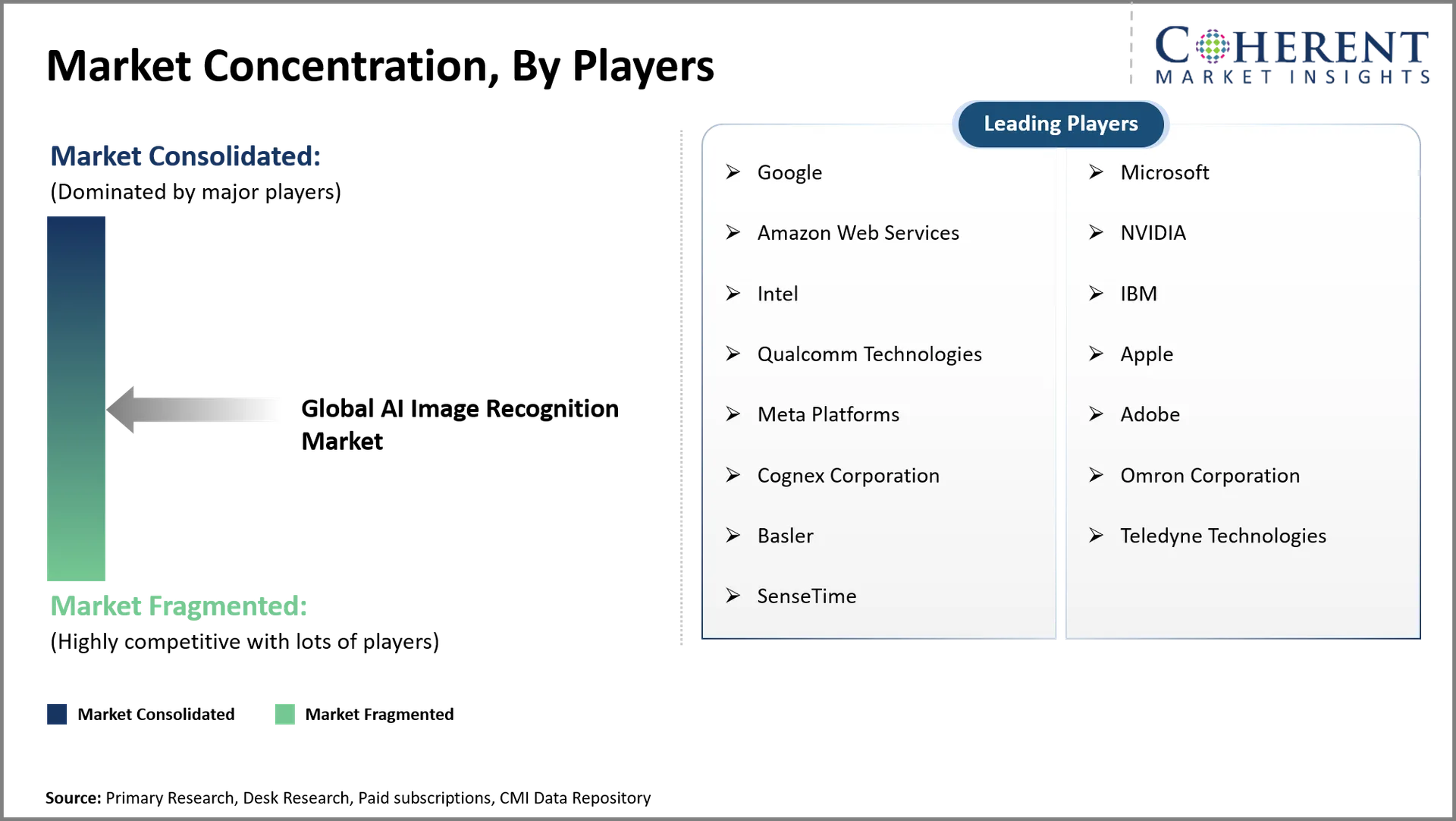
The global AI image recognition market features competition among cloud platform providers, artificial intelligence hardware companies, and specialized machine vision manufacturers. NVIDIA strengthens its position through accelerated computing, the Metropolis platform, and vision artificial intelligence tools for video analytics and industrial automation. Microsoft brings business apps and enterprise cloud services into Azure AI Vision. Google’s Cloud Vision can classify photos, detect objects and read optical characters. Amazon Rekognition is an Amazon Web Services service that is capable of analyzing images and videos. Cognex is a leader in factory automation, In-Sight vision systems and automated inspection. These companies differentiate themselves through processing performance, cloud integration, specialized hardware, and application-specific accuracy.
Top Manufacturers and Notable Products/Solutions in the AI Image Recognition Market
Manufacturer | Notable Product/Solution | Key features |
Google Cloud Vision API | Object and image labeling, optical character recognition, landmark detection, and image attribute analysis | |
Amazon Web Services | Amazon Rekognition | Object and scene detection, facial analysis, image moderation, and custom label recognition |
Microsoft | Azure AI Vision | Image analysis, optical character recognition, visual feature extraction, and image captioning |
NVIDIA | NVIDIA Metropolis | Video analytics, object detection, visual tracking, and accelerated AI inference |
Cognex Corporation | In-Sight Vision Systems | Industrial object recognition, defect detection, image classification, and automated quality inspection |
Market Report Scope
Report Coverage | Details | ||
Base Year | 2025 | Market Size in 2026: | USD 5.70 Bn |
Historical Data For: | 2020 To 2024 | Forecast Period: | 2026 To 2033 |
Forecast Period 2026 To 2033 CAGR: | 8.5% | 2033 Value Projection: | USD 14.50 Bn |
Geographies covered: |
| ||
Segments covered: |
| ||
Companies covered: | Google, Microsoft, Amazon Web Services, NVIDIA, Intel, IBM, Qualcomm Technologies, Apple, Meta Platforms, Adobe, Cognex Corporation, Omron Corporation, Basler, Teledyne Technologies, SenseTime | ||
Growth Drivers: |
| ||
Restraints & Challenges: |
| ||
Analyst Opinion (Expert Opinion)
- The future of the AI Image Recognition Market will increasingly depend on systems that interpret complex visual environments and support immediate operational decisions. Conventional image classification will remain useful, but manufacturers will require models that detect unfamiliar defects, distinguish harmless variations, and operate reliably under changing lighting conditions. Vision-language models will extend the range of applications that require contextual interpretation, and edge-based inference will help production lines and transport systems with stringent response-time requirements. The providers that are able to couple recognition accuracy with reliable deployments and traceable decisions will find themselves in a better position to secure long term industrial contracts.
- The most promising applications include industrial object recognition and automated defect detection, especially in the semiconductor manufacturing, electronics assembly, automotive production and pharmaceutical packaging industries. Japan, Germany, South Korea and the U.S. provide unique prospects due to their advanced manufacturing ecosystems and need for precise inspection. Companies should focus on systems that detect minuscule solder faults, surface fractures, component misalignment and package anomalies. Cloud-based platforms will still have a place for centralized image management and model training, but edge hardware will be important when production decisions need to be made on the fly.
- Competition should be among market participants on demonstrable performance on customer-specific imagery, not on broad promises of artificial intelligence capabilities. Hardware vendors should optimize inference latency, power consumption, camera compatibility, and integration with programmable logic controllers. Software providers should develop workflows that allow factory engineers to label defect images, retrain models, and validate changes without extensive specialist support. Companies should also provide explainable inspection results, secure image retention, and integration with manufacturing execution systems. By working together with camera manufacturers, automation integrators and industrial equipment providers, the time to roll out the solution can be reduced and ongoing income from maintenance and model upgrades can be generated.
Speak to the analyst
Want personalized insights?
Take the findings above to one of our principal consultants, or have the report rebuilt around the segments, geographies and competitors you actually track.
Market Segmentation
- Component Insights (Revenue, USD Billion, 2021 - 2033)
- Hardware
- Software
- Services
- Deployment Type Insights (Revenue, USD Billion, 2021 - 2033)
- Cloud-Based
- On-Premises
- Edge-Based
- Recognition Type Insights (Revenue, USD Billion, 2021 - 2033)
- Object Recognition
- Facial Recognition
- Image Classification
- Image Segmentation
- Others
- Technology Type Insights (Revenue, USD Billion, 2021 - 2033)
- Deep Learning
- Machine Learning
- Convolutional Neural Networks
- Vision Transformers
- Pattern Recognition
- Feature-Based Recognition
- Application Insights (Revenue, USD Billion, 2021 - 2033)
- Security and Surveillance
- Healthcare and Medical Imaging
- Automotive and Autonomous Driving
- Retail and Electronic Commerce
- Manufacturing and Quality Inspection
- Others
- Regional Insights (Revenue, USD Billion, 2021 - 2033)
- North America
- U.S.
- Canada
- Latin America
- Brazil
- Argentina
- Mexico
- Rest of Latin America
- Europe
- Germany
- U.K.
- Spain
- France
- Italy
- Russia
- Rest of Europe
- Asia Pacific
- China
- India
- Japan
- Australia
- South Korea
- ASEAN
- Rest of Asia Pacific
- Middle East
- GCC Countries
- Israel
- Rest of Middle East
- Africa
- South Africa
- North Africa
- Central Africa
- North America
- Key Players Insights
- Microsoft
- Amazon Web Services
- NVIDIA
- Intel
- IBM
- Qualcomm Technologies
- Apple
- Meta Platforms
- Adobe
- Cognex Corporation
- Omron Corporation
- Basler
- Teledyne Technologies
- SenseTime
Sources
Primary Research Interviews
- AI & Computer Vision Technology Specialists
- Image Recognition Software Developers & Solution Providers
- End-User Industry Representatives (Healthcare, Retail, Automotive)
- Enterprise AI Integration Consultants
Magazines
- AI Business Magazine
- MIT Technology Review
- IEEE Spectrum
- Wired (AI & Machine Learning Edition)
Journals
- IEEE Transactions on Pattern Analysis and Machine Intelligence
- Journal of Computer Vision and Image Understanding
- International Journal of Computer Vision (IJCV)
Associations
- Association for the Advancement of Artificial Intelligence (AAAI)
- Computer Vision Foundation (CVF)
- International Association of Pattern Recognition (IAPR)
- Alliance for Artificial Intelligence in Healthcare (AAIH)
Public Domain Sources
- U.S. National Institute of Standards and Technology (NIST) - AI Reports
- European Commission - Artificial Intelligence Policy Documents
- World Intellectual Property Organization (WIPO) - AI Patent Database
- U.S. Department of Commerce - AI & Technology Market Reports
Proprietary Elements
- CMI Data Analytics Tool
- Proprietary CMI Existing Repository of Information for Last 10 Years
Get access to 250+ pages report
Every segment, forecast, competitor profile and data table behind the analysis above — available for instant download.
- ESOMAR Member
- ISO 9001:2015 Certified
- D-U-N-S Registered
- GDPR & CCPA Compliant
Frequently Asked Questions
The global AI image recognition market is expected to stand at USD 5.70 Bn in 2026 and is expected to reach USD 14.50 Bn by 2033.
The CAGR of the global AI image recognition market is projected to be 8.5% from 2026 to 2033.
Increasing adoption of artificial intelligence in visual analytics and Growing demand for automated quality inspection are the major factors driving the growth of the global AI image recognition market.
Privacy concerns associated with facial recognition and Bias and accuracy limitations in recognition models are the major factors hampering the growth of the global AI image recognition market.
In terms of component, hardware segment is estimated to dominate the market revenue share in 2026.
AI image recognition uses trained machine learning models to detect patterns, identify objects, and extract meaningful information from digital images.
It detects surface defects, component misalignment, assembly errors, and product inconsistencies during production.