

Global AI Semiconductor Market Size and Forecast – 2026 To 2033
Global AI Semiconductor Market is projected to reach USD 228.92 Bn in 2026 to USD 1,079.41 Bn by 2033 at a CAGR of 24.80% during the forecast period 2026 to 2033. The market growth is driven by the increasing adoption of generative AI applications, growing investments in AI computing infrastructure and the development of dedicated processors primarily aimed at enhancing energy efficiency and computing performance.
Semiconductor foundries are adopting sophisticated accelerator architectures to meet the processing needs of complex AI workloads. In August 2026, Cerebras Systems introduced its CS-4 AI accelerator that includes three wafer-scale engines for improved efficiency in AI inference and processing. The move highlights the rising commercialization of specialized AI chips for large-scale computing applications.
Key Takeaways of Global AI Semiconductor Market
- Graphics Processing Units (GPUs) are projected to hold a share of 46.7% in the global AI semiconductor market by 2026, registering a CAGR of 23.9% from 2026 to 2033. Their programmable parallel architecture supports a variety of AI models without the need to engineer custom chip redesigns. In March 2026, NVIDIA said it began full production of its Rubin GPUs for the Vera Rubin AI computing platform.
- AI Training is expected to account for 60.4% of the global AI semiconductor market in 2026 and grow at a compound annual growth rate (CAGR) of 22.6% through 2033. The training of large-scale models requires a distributed processing infrastructure, high compute density and significant accelerator capacity. AMD announced its Instinct MI350 accelerators in June 2025, saying they are designed to be more efficient at training complex AI workloads.
- Data Center and Cloud AI are estimated to account for 78.6% of the global AI semiconductor market in 2026 and is expected to grow at a CAGR of 24.2% from 2026 to 2033. Centralized infrastructure allows for efficient use of accelerators across enterprise workloads and AI services. AWS has extended the capabilities of cloud-based AI computing with the general availability of its Trainium3-powered EC2 Trn3 UltraServers in December 2025.
- Asia Pacific is expected to maintain its dominant 40.1% share of the global AI semiconductor market in 2026 and a compound annual growth rate (CAGR) of 24.0% through 2033. Its existing semiconductor fabrication, advanced memory manufacturing and packaging capabilities enable it to build AI hardware. In September 2025, South Korea’s SK hynix finished the development of HBM4 and prepared the technology for mass production.
- North America is anticipated to command 37.2% of the global AI semiconductor market revenue in 2026, with a CAGR of 26.2% from 2023 to 2033. The region’s status as the fastest growing continues to be pushed by growth in AI infrastructure and hyperscaler investment. Microsoft said on Thursday it expects to spend USD 80 Bn on AI-powered data centers in fiscal 2025, with more than half of the investment going into the United States.
Segmental Insights
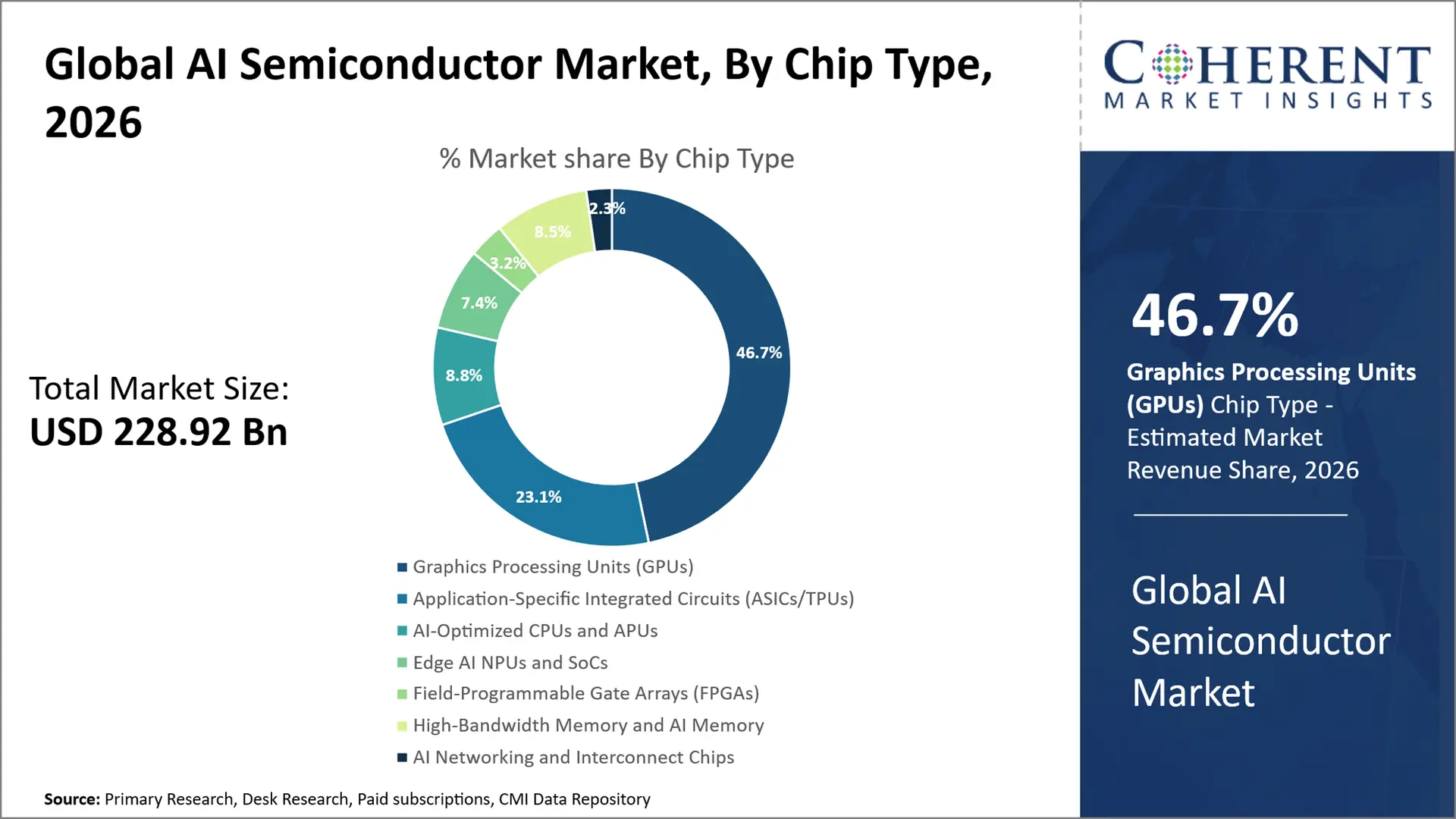
Why Do Graphics Processing Units (GPUs) Lead the Global AI Semiconductor Market?
Graphics Processing Units (GPUs) are expected to hold 46.7% of the global AI semiconductor market by chip type in 2026. Their lead reflects a purchasing advantage: operators can source accelerator capacity from established server configurations rather than commissioning application-specific silicon for each model generation. Validated system designs and broad deployment options also shorten qualification for AI laboratories and commercial service providers. The ability to coordinate many GPUs within one rack is especially valuable when model execution exceeds the memory and communication capacity of individual devices. In February 2025, CoreWeave made GB200 NVL72-based cloud instances generally available, incorporating rack-level high-speed GPU interconnection. This illustrates how integrated GPU systems are moving from individual-chip procurement toward deployable computing capacity, supporting accelerator vendors, server integrators, and cloud infrastructure suppliers.
- Current Industry Events of 2026
- Market Size Estimation
- Regional Breakdown
- Competitive Landscape
- Customer Intelligence
- Segmental Analysis
- Pricing Analysis
- Key Market Drivers, Challenges & Future Trends
- Customized Insights Section
Why Does AI Training Represent the Largest Function Segment in the Global AI Semiconductor Market?
AI Training is expected to account for 60.4% of the global AI semiconductor market by function in 2026. Unlike using a finished model, training requires many rounds of updating parameters on large data sets, and therefore consumes large amounts of processing power, memory bandwidth and fast communication between accelerators. These requirements are better fulfilled by large computing clusters outfitted with high-end interconnects and dedicated AI processors. Thus, large orders are expected to come from AI developers and research institutions to semiconductor companies that have scalable hardware solutions and efficient training architectures. In December 2025, Mistral AI announced Mistral Large 3, a mixture-of-experts model trained from scratch using 3,000 NVIDIA H200 GPUs. The progress underscores the massive semiconductor infrastructure required to train large AI models, and drives ongoing investment in high-performance AI accelerators.
Why Does Data Center and Cloud AI Dominate the Deployment Segment of the Global AI Semiconductor Market?
Data Center and Cloud AI is expected to represent 78.6% of the global AI semiconductor market by deployment in 2026. The commercial strength comes from operators being able to buy complete computing environments that include accelerators, networking processors, host CPUs and management systems, all under coordinated infrastructure contracts. Enterprises also opt for hosted access when ownership is difficult to achieve due to procurement lead times, specialist maintenance and high power rack demands. Despite difficult qualification and delivery schedules, large cloud deployments can spur repeat orders for chip suppliers across a number of semiconductor categories. In October 2025, Oracle unveiled OCI Zettascale10, designed to link AI computing clusters across data centers through its Acceleron RoCE networking architecture. The announcement highlights why deployment scale depends not only on accelerator performance but also on the interconnect infrastructure needed to operate linked computing facilities.
Current Events and their Impact
Current Event | Description and Its Impact |
January 2026 – U.S. BIS Revises AI Semiconductor Export Licensing |
|
June 2026 – European Commission Proposes Chips Act 2.0 |
|
July 2026 – India Approves Semicon 2.0 Programme |
|
Global AI Semiconductor Market Dynamics
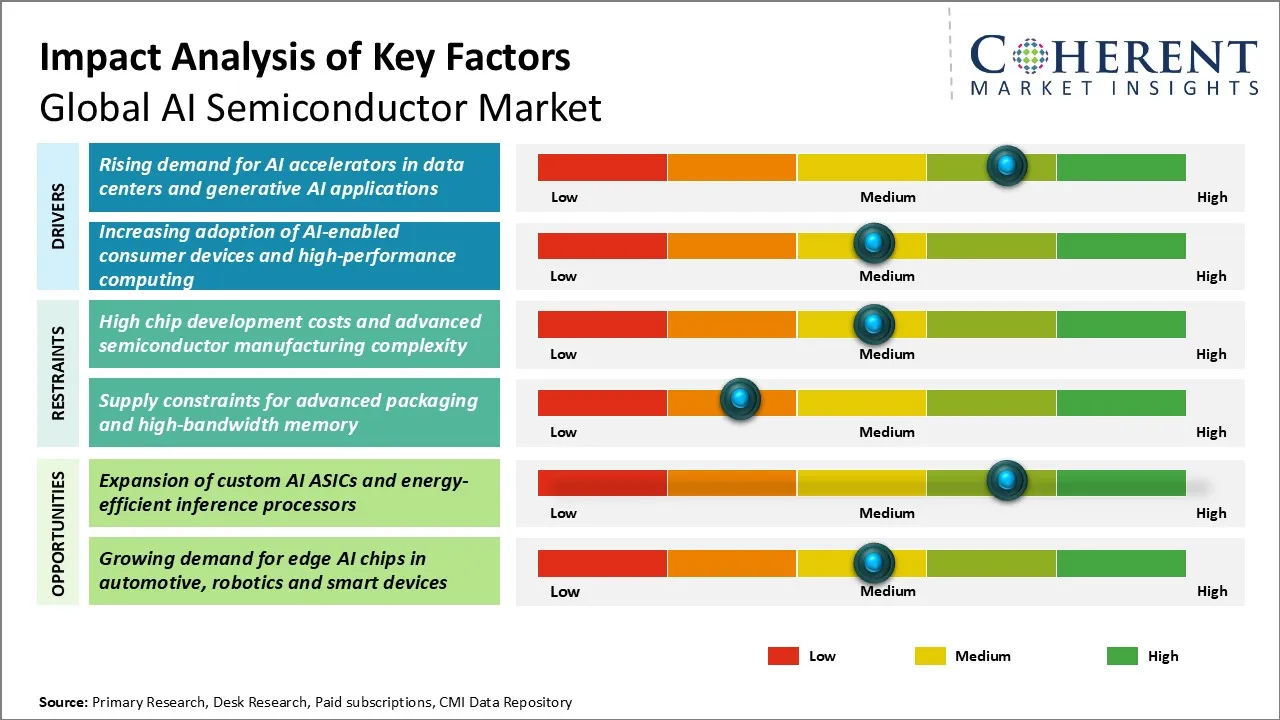
Key Market Drivers
- Rising demand for AI accelerators in data centers and generative AI applications: Generative AI operators require purpose-built accelerators because large multimodal models, longer context windows, and continuously available inference services strain general-purpose servers. Every additional compute cluster also entails demand for memory interfaces, AI networking silicon, and resilient power management. Long-term infrastructure commitments help chip designers and foundries see orders better, although project delays can change shipment schedules. In April 2026, OpenAI said its Stargate program had locked in more than its initial 10 GW U.S. AI infrastructure goal, though these are planned capacity commitments, not fully running data centers.
- Increasing adoption of AI-enabled consumer devices and high-performance computing: AI-enabled laptops, smartphones and professional computing systems are driving semiconductor demand as manufacturers allocate processing resources to local inference, graphics and productivity applications. By integrating CPU, GPU and neural processing capabilities in a single package, the system design effort can be reduced and equipment brands can compete on responsiveness and energy efficiency. This increases the addressable orders for integrated processor suppliers and manufacturing partners. Intel launched its Core Ultra Series 3 processors in January 2026, a family intended to power more than 200 partner PC designs and other embedded applications.
Emerging Market Trends
- Shift Toward Workload-Based AI Computing Economics: AI semiconductor customers are placing more emphasis on real-world workload performance, rather than peak accelerator benchmarks. More and more, procurement decisions are being made on the basis of inference latency, sustained throughput, memory efficiency and total computing costs.
Impact: Semiconductor suppliers need to show consistent system-level performance and cost efficiency. Those vendors that are more focused on peak processing specs may see a bigger impact on pricing.
Relevance to the Market: This evolution is impacting buying criteria for AI accelerators, driving chipmakers to optimize hardware and software integration for specific workloads.
- Chiplet Integration Reshaping Semiconductor Design and Manufacturing: AI chip designers are increasingly turning to chiplet architectures to bring together specialized processing, memory, and connectivity components into a single package. This allows for flexibility in designing semiconductors without requiring a complete redesign of monolithic chips.
Impact: Advanced packaging capabilities, interconnect efficiency and manufacturing yields are becoming major competitive factors. Qualified integration technologies can add stronger positions to foundries and packaging specialists.
Relevance to the Market: Chiplet integration supports scalable development of AI processors, as well as opportunities for semiconductor manufacturers with a focus on heterogeneous integration and advanced packaging.
Regional Insights
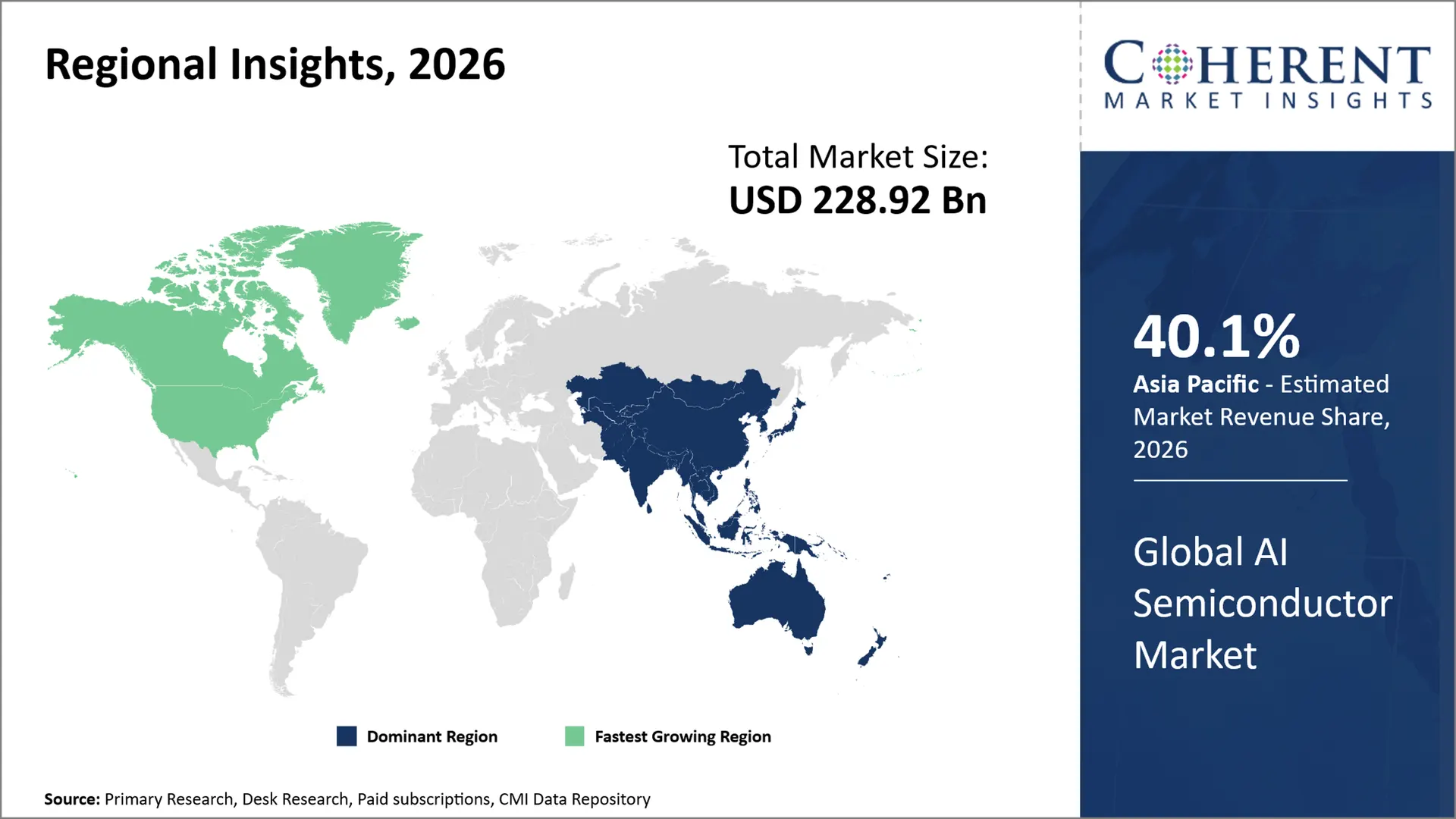
Why Does Asia Pacific Dominate the Global AI Semiconductor Market?
Asia Pacific is anticipated to represent 40.1% of the global AI semiconductor market by 2026, due to the region’s concentration of advanced foundries, memory manufacturers, packaging facilities, and chip designers. The close proximity helps suppliers coordinate wafer fabrication, high-bandwidth memory integration and complex package assembly, lowering the qualification risks for large AI processors. In August 2026, Taiwan-based TSMC approved approximately USD 29.44 billion in capital appropriations for advanced technology capacity, packaging upgrades, and fabrication infrastructure. The decision speaks to ongoing investment in critical manufacturing capabilities, but the spending is not solely focused on Asia Pacific. The region offers a mature production ecosystem to semiconductor buyers, but suppliers face limitations on advanced packaging and competition for leading-edge manufacturing capacity.
Why Is North America the Fastest-Growing Region in the Global AI Semiconductor Market?
North America is expected to account for 37.2% of the global AI semiconductor market in 2026 and is identified as the fastest-growing region. The growth outlook is indicative of large cloud operators rolling out AI services at commercial scale and with purchasing requirements that extend to accelerators, networking chips and host processors. Financing structures for new data centers also enable operators to commit to multiyear hardware platforms before facilities are operational. In July 2026, Meta announced plans to expand the Richland Parish, Louisiana data center to 5 GW of compute capacity. This planned expansion indicates a massive potential market for AI computing equipment, provided the projects take off and there’s enough power. These capital commitments will be beneficial to semiconductor vendors with reliable delivery schedules and system integration support.
Global AI Semiconductor Market Outlook for Key Countries
Why Is the U.S. a Key Market for the Global AI Semiconductor Market?
The U.S. is a key global AI semiconductor market because its fabless design ecosystem increasingly addresses the economics of running deployed models, not only training them. Domestic chip companies can work directly with cloud operators and enterprise software developers to tune inference hardware for memory capacity, latency, and power consumption. This collaboration creates opportunities for specialized AI ASICs and accelerator platforms, although customers will assess software maturity alongside processor specifications. In October 2025, Qualcomm announced its AI200 and AI250 rack-scale inference solutions, targeting commercial availability in 2026 and 2027, respectively. The roadmap illustrates how U.S. semiconductor suppliers are diversifying processor architectures to address the operating costs of production AI services.
Why Is China Important in the Global AI Semiconductor Market?
The AI semiconductor market is commercially significant to China because large domestic customers in cloud, telecom and enterprise computing require accelerators that can operate within locally supported technology ecosystems. Some foreign chip access restrictions further reinforce the incentives to develop domestic processors, interconnects and software compatibility layers. But chip production capacity and ecosystem maturity are still significant constraints to wider deployment. In September 2025, Huawei introduced new cluster designs based on Ascend neural processing units, the Atlas 950 and Atlas 960 SuperPoD systems. The announcement reflects China's efforts to develop domestic AI computing architectures through coordinated development of processors and networking. Suppliers who can support local integration and reliable delivery are well placed for procurement opportunities.
Why Is Taiwan a Strategic Country in the Global AI Semiconductor Market?
Taiwan plays a strategic role in AI semiconductor market beyond contract chip manufacturing, particularly through its expertise in designing highly integrated processors for consumer devices. Here in the local design community, companies are integrating neural processing, graphics, connectivity and memory controls into small systems-on-chip (SoCs) so device makers can embed AI features within tight battery and heat constraints. This helps meet demand from smartphone brands looking to deliver differentiated on-device experiences without relying on constant cloud connectivity. In September 2025, MediaTek launched its Dimensity 9500 mobile platform with the NPU 990 and a continuous local AI processing architecture. The development shows Taiwan’s capacity for commercializing purpose-built neural processing into mass-market chip platforms, enabling design possibilities across premium consumer electronics.
Why Does Japan Support Growth in the Global AI Semiconductor Market?
Japan is taking on the AI semiconductor market with processor engineering aimed at delivering reliable computing for enterprises, research institutions and public sector infrastructure. The need for secure and energy efficient systems creates opportunities for architectures in the model inference space that do not require the highest density GPU deployments. Japan’s server integration, thermal management and industrial computing engineering strengths also contribute to the commercialization of processors designed in Japan. In September 2026, Fujitsu announced its FUJITSU-MONAKA processor and server and plans to bring them to market in November 2026. The processor blends advanced chip integration with hardware support for matrix calculations. This strategy may help Japanese suppliers to bid for sovereignty-sensitive AI deployments where traceability, maintenance and local technical supports influence the procurement decisions.
Why Is South Korea an Important Market for the Global AI Semiconductor Market?
South Korea’s role in the global AI semiconductor market is critical because of its ability to produce advanced memory to support accelerator processors. The performance of memory, qualification and manufacturing yields are of commercial importance for AI computing systems as they rely on continuous data movement between memory stacks and processing dies. Processor designers can get the high-capacity memory they need for future computing platforms from Korean suppliers who have DRAM fabrication capabilities. Samsung Electronics said in February 2026 it started mass producing and shipping HBM4 using advanced DRAM and logic base-die processes. The development solidifies South Korea’s position as a memory components supplier for AI servers, but pace of further orders will be determined by customer qualification and consistency of production.
Market Players, Key Development, and Competitive Intelligence
Key Developments
- In October 2026, Marvell Technology introduced second-generation Structera X CXL 3.2 memory expansion controllers, with customer sampling expected in early 2027. The proposed architecture supports multi-host memory sharing and larger external memory capacity, potentially improving inference server utilization while extending semiconductor revenue opportunities beyond processors and memory chips.
- In March 2026, Micron Technology announced high-volume production and shipments of its 36 GB, 12-high HBM4 memory. The milestone expands qualified supply of bandwidth-intensive AI memory, an important purchasing consideration for accelerator system manufacturers seeking to balance compute throughput, thermal constraints, and platform delivery schedules.
- In February 2026, Broadcom announced that it had begun shipping a 2 nm custom compute system-on-chip using its 3.5D XDSiP packaging platform. This commercial shipment strengthens the case for modular silicon integration, giving large chip customers another route to higher density without relying solely on monolithic processor designs.
Competitive Landscape
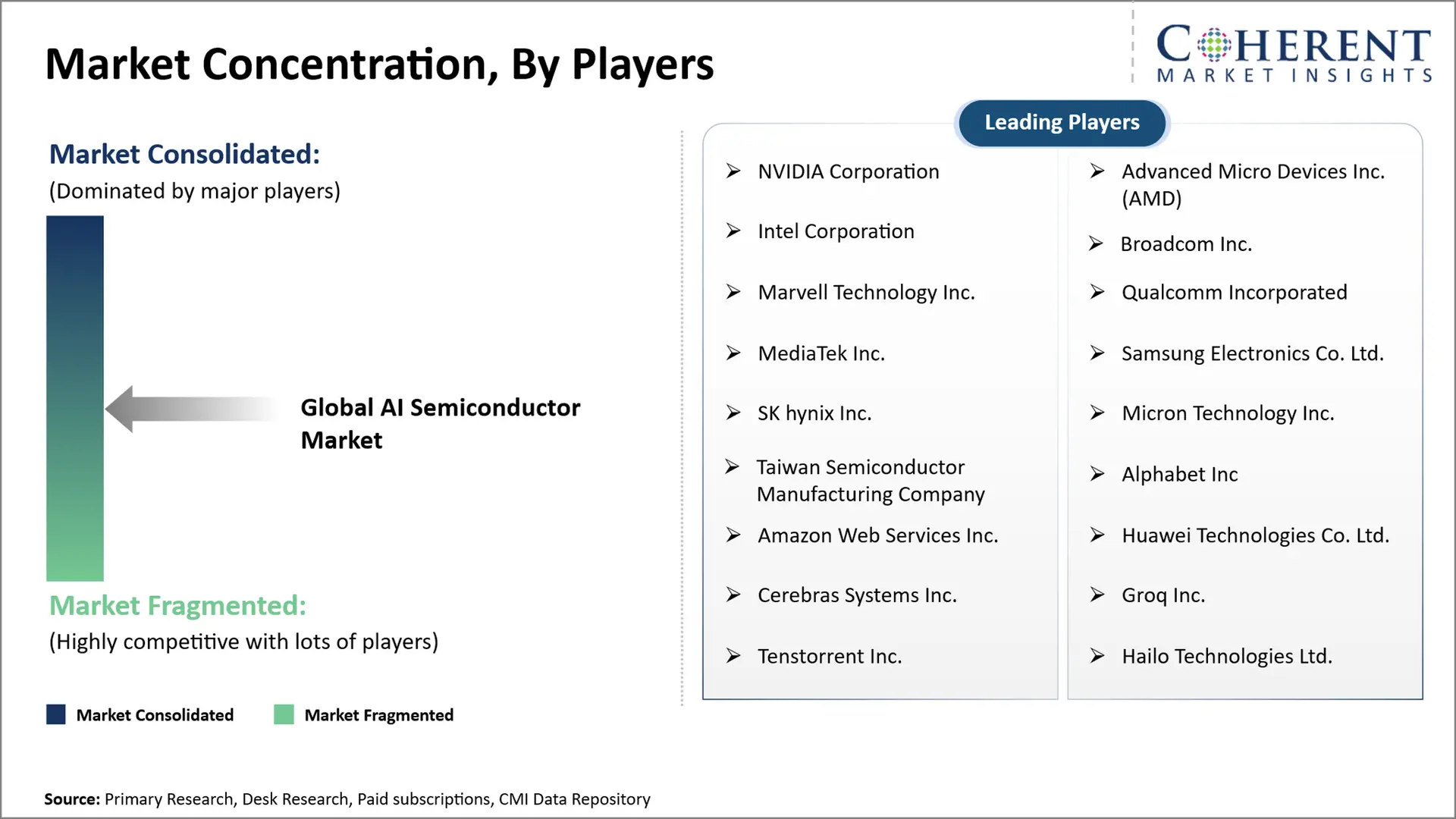
The global AI semiconductor market is moderately consolidated in high-end accelerators but more diverse across memory, networking, design intellectual property, and embedded processors. Large fabless suppliers and integrated chipmakers compete alongside cloud-linked custom silicon developers, foundries, packaging houses, and specialist connectivity firms. Performance consistency, ecosystem compatibility, manufacturing yields, export compliance, supply reliability, and direct customer relationships influence competitive positioning more than unit pricing alone.
Key Competitive Factors
- AI Computing Performance: Product differentiation comes from sustained throughput, memory efficiency, and workload-specific performance.
- Software Ecosystem: The maturity of the compiler, the development tools and the compatibility of the framework all affect the customer adoption and switching costs.
- Manufacturing Capability: Access to higher-node, wafer yields and production scheduling affect delivery commitments.
- Packaging and Testing: Complex chip integration requires strong assembly processes, thermal validation and high manufacturing yields.
- Supply Reliability: Long-term wafer and memory supply agreements strengthen semiconductor procurement relationships.
- Regulatory Compliance: Export licensing, product classification and customer verification impact the markets available.
- Customer Integration: Direct design collaboration, reference architectures, and engineering support improve long-term OEM relationships.
Market Report Scope
Global AI Semiconductor Market Report Coverage | |||
Report Coverage | Details | ||
Base Year | 2025 | Market Size in 2026: | USD 228.92 Bn |
Historical Data For: | 2020 To 2024 | Forecast Period: | 2026 To 2033 |
Forecast Period 2026 To 2033 CAGR: | 24.80% | 2033 Value Projection: | USD 1,079.41 Bn |
Geographies covered: |
| ||
Segments covered: |
| ||
Companies covered: | NVIDIA Corporation, Advanced Micro Devices Inc. (AMD), Intel Corporation, Broadcom Inc., Marvell Technology Inc., Qualcomm Incorporated, MediaTek Inc., Samsung Electronics Co. Ltd., SK hynix Inc., Micron Technology Inc., Taiwan Semiconductor Manufacturing Company, Alphabet Inc, Amazon Web Services Inc., Huawei Technologies Co. Ltd., Cerebras Systems Inc., Groq Inc., Tenstorrent Inc., Hailo Technologies Ltd. | ||
Growth Drivers: |
| ||
Restraints & Challenges: |
| ||
Analyst Opinion (Expert Opinion)
- The global AI semiconductor market leadership is likely to depend increasingly on how reliably a supplier coordinates design, wafer allocation, packaging, testing, and platform support across successive product generations. Companies able to contract for delivery certainty and offer predictable upgrade paths may retain customers even when rivals announce faster individual chips. This favors disciplined ecosystem management over isolated product launches.
- A meaningful disruption could emerge if model compression and inference algorithms improve faster than hardware replacement economics. Customers may extend accelerator service lives or redirect budgets toward memory and deployment software, undermining supplier plans based on frequent premium-chip upgrades. Vendors with adaptable architectures, efficient toolchains, and flexible licensing would be better positioned than businesses dependent on a narrow refresh cycle.
- Suppliers should prioritize yield improvement, validated software releases, diversified packaging inputs, and disciplined customer qualification. Enterprise and industrial buyers merit attention where reliability can justify pricing premiums, but manufacturers should avoid speculative capacity additions without contracted demand. Export-control screening, thermal constraints, and supply concentration warrant scenario planning; regional partnerships should be selected for executable engineering and logistics benefits rather than publicity.
Speak to the analyst
Want personalized insights?
Take the findings above to one of our principal consultants, or have the report rebuilt around the segments, geographies and competitors you actually track.
Market Segmentation
- Chip Type Insights (Revenue, USD Bn, 2021 - 2033)
- Graphics Processing Units (GPUs)
- Application-Specific Integrated Circuits (ASICs/TPUs)
- AI-Optimized CPUs and APUs
- Edge AI NPUs and SoCs
- Field-Programmable Gate Arrays (FPGAs)
- High-Bandwidth Memory and AI Memory
- AI Networking and Interconnect Chips
- Function Insights (Revenue, USD Bn, 2021 - 2033)
- AI Training
- AI Inference
- Deployment (Revenue, USD Bn, 2021 - 2033)
- Data Center and Cloud AI
- Edge and On-Device AI
- End User Insights (Revenue, USD Bn, 2021 - 2033)
- Cloud and Hyperscale Data Centers
- Enterprise IT and High-Performance Computing
- Consumer Electronics
- Automotive and Mobility
- Industrial Automation and Robotics
- Healthcare and Other Applications
- Sales Channel Insights (Revenue, USD Bn, 2021 - 2033)
- Direct Manufacturer Sales
- Distributors and Semiconductor Suppliers
- Regional Insights (Revenue, USD Bn, 2021 - 2033)
- North America
- U.S.
- Canada
- Latin America
- Brazil
- Argentina
- Mexico
- Rest of Latin America
- Europe
- Germany
- U.K.
- Spain
- France
- Italy
- Russia
- Rest of Europe
- Asia Pacific
- China
- India
- Japan
- Australia
- South Korea
- ASEAN
- Rest of Asia Pacific
- Middle East
- GCC Countries
- Israel
- Rest of Middle East
- Africa
- South Africa
- North Africa
- Central Africa
- North America
Sources
Primary Research Interviews
- AI chip manufacturers, fabless semiconductor designers, foundries, and advanced packaging specialists
- Data center operators, hyperscalers, semiconductor suppliers, and AI hardware experts
Stakeholders
- GPU, ASIC, NPU, HBM, and AI networking chip manufacturers
- Cloud service providers, semiconductor foundries, OEMs, and system integrators
End-use Sectors
- Cloud and hyperscale data centers, enterprise IT, and high-performance computing
- Consumer electronics, automotive, industrial automation, and healthcare
Regulatory and Industry Bodies
- U.S. Bureau of Industry and Security (BIS)
- U.S. Department of Commerce
- European Commission
- Ministry of Economy, Trade and Industry (METI), Japan
Databases
- World Semiconductor Trade Statistics (WSTS)
- UN Comtrade, USITC DataWeb, and U.S. Census Bureau
- SEMI industry statistics and Semiconductor Industry Association (SIA) data
- SEC EDGAR filings and semiconductor company financial reports
Magazines and Journals
- IEEE Micro
- IEEE Transactions on Semiconductor Manufacturing
- Nature Electronics
- Semiconductor Engineering
Associations
- Semiconductor Industry Association (SIA)
- SEMI
- Global Semiconductor Alliance (GSA)
- JEDEC Solid State Technology Association
Public Domain Sources
- AI chip production, semiconductor shipments, and trade statistics
- Data center investments, AI accelerator deployments, and manufacturing capacity
- Semiconductor technology roadmaps, government funding, and company announcements
Key Standards and Regulations
- U.S. Export Administration Regulations (EAR) – Advanced Computing Semiconductors
- European Chips Act – Regulation (EU) 2023/1781
- JEDEC Standards – High-Bandwidth Memory (HBM)
- EU RoHS Directive 2011/65/EU and REACH Regulation (EC) No. 1907/2006
Proprietary Elements
- CMI Data Analytics Tool
- Proprietary research repository, supplemented by primary interviews, semiconductor shipment analysis, AI accelerator demand estimates, manufacturing capacity assessments, pricing analysis, and competitive intelligence.
Get access to 250+ pages report
Every segment, forecast, competitor profile and data table behind the analysis above — available for instant download.
- ESOMAR Member
- ISO 9001:2015 Certified
- D-U-N-S Registered
- GDPR & CCPA Compliant
Frequently Asked Questions
The CAGR of global AI semiconductor market is projected to be 24.80% from 2026 to 2033.
The global AI semiconductor market is valued at USD 228.92 Bn in 2026 and is projected to reach USD 1,079.41 Bn in 2033.
AI semiconductors are specialized chips that are designed to accelerate artificial intelligence workloads such as machine learning, neural network processing and complex mathematical computations.
AI semiconductors are built to do massive amounts of calculations at the same time, making them more efficient than traditional general purpose processors for AI workloads.
Advanced packaging permits closer integration of processing chips, memory, and interconnects, which leads to higher data transfer efficiency, computing performance, and power management.
AI semiconductor performance is quantified in terms of processing throughput, inference latency, memory bandwidth, power efficiency, and the ability to run AI workloads in real operating environments.
The major factors driving the growth of the global AI semiconductor market are the rising demand for AI accelerators in data centers and generative AI applications, along with the increasing adoption of AI-enabled consumer devices and high-performance computing systems.