

Global AI Server Market Size and Forecast – 2026 To 2033
The global AI server market is expected to grow from USD 157.00 Bn in 2026 to USD 598.00 Bn by 2033, registering a compound annual growth rate (CAGR) of 18% from 2026 to 2033. The global AI server market is driven by increasing demand for high-performance computing and accelerated processing. On May 19, 2026, Dell Technologies introduced a new generation of storage, compute, cyber resilience and automation innovations built to power the modern data center. Dell PowerStore Elite is an intelligent, open storage platform that combines AI-driven software, next generation hardware and non-disruptive modernization.
Key Takeaways of the Global AI Server Market
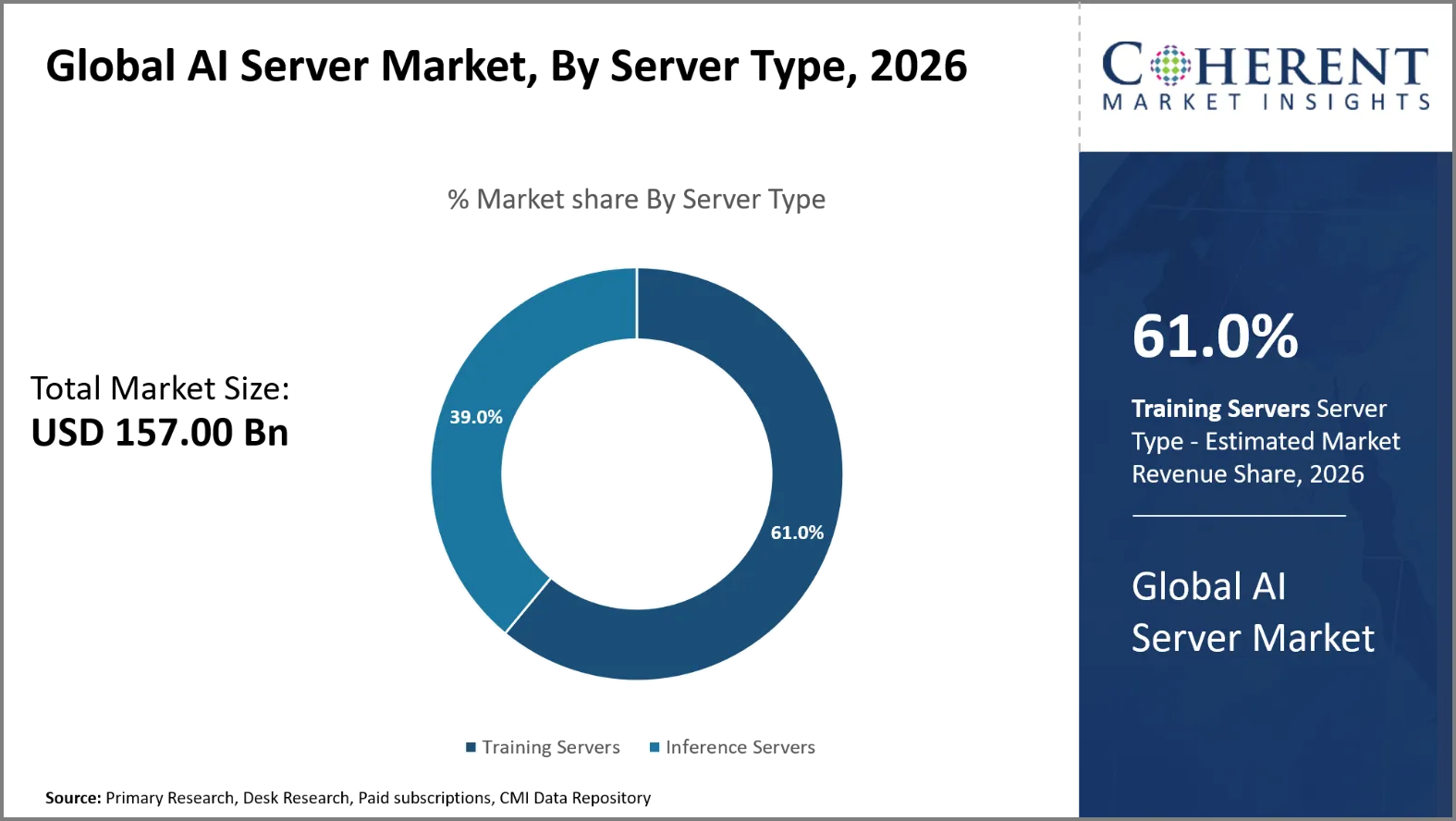
- The Training Servers segment is expected to account for 61.0% of the global AI server market share in 2026. Rising investment in large language model training infrastructure is driving the growth of the segment. In November 2025, OpenAI and Amazon Web Services announced a USD 38 billion partnership. The agreement provides OpenAI with access to Amazon Elastic Compute Cloud UltraServers containing hundreds of thousands of advanced NVIDIA graphics processing units.
- The Graphics Processing Unit-Based Servers segment is estimated to capture 42.0% of the market share in 2026. Growing adoption of artificial intelligence inference across enterprises is majorly driving the growth of the segment. On March 16, 2026, Akamai launched AI Grid orchestration capabilities. Its Inference Cloud integrates NVIDIA AI infrastructure across edge, regional, and core computing locations.
- The Rack Servers segment is estimated to capture 53.0% of the market share in 2026. Increasing demand for specialized graphics processing units and accelerators is driving the growth of the segment. On January 5, 2026, NVIDIA launched its Rubin platform. The platform integrates six chips, including Rubin graphics processing units, Vera central processing units, NVLink switches, networking processors, and data processing units.
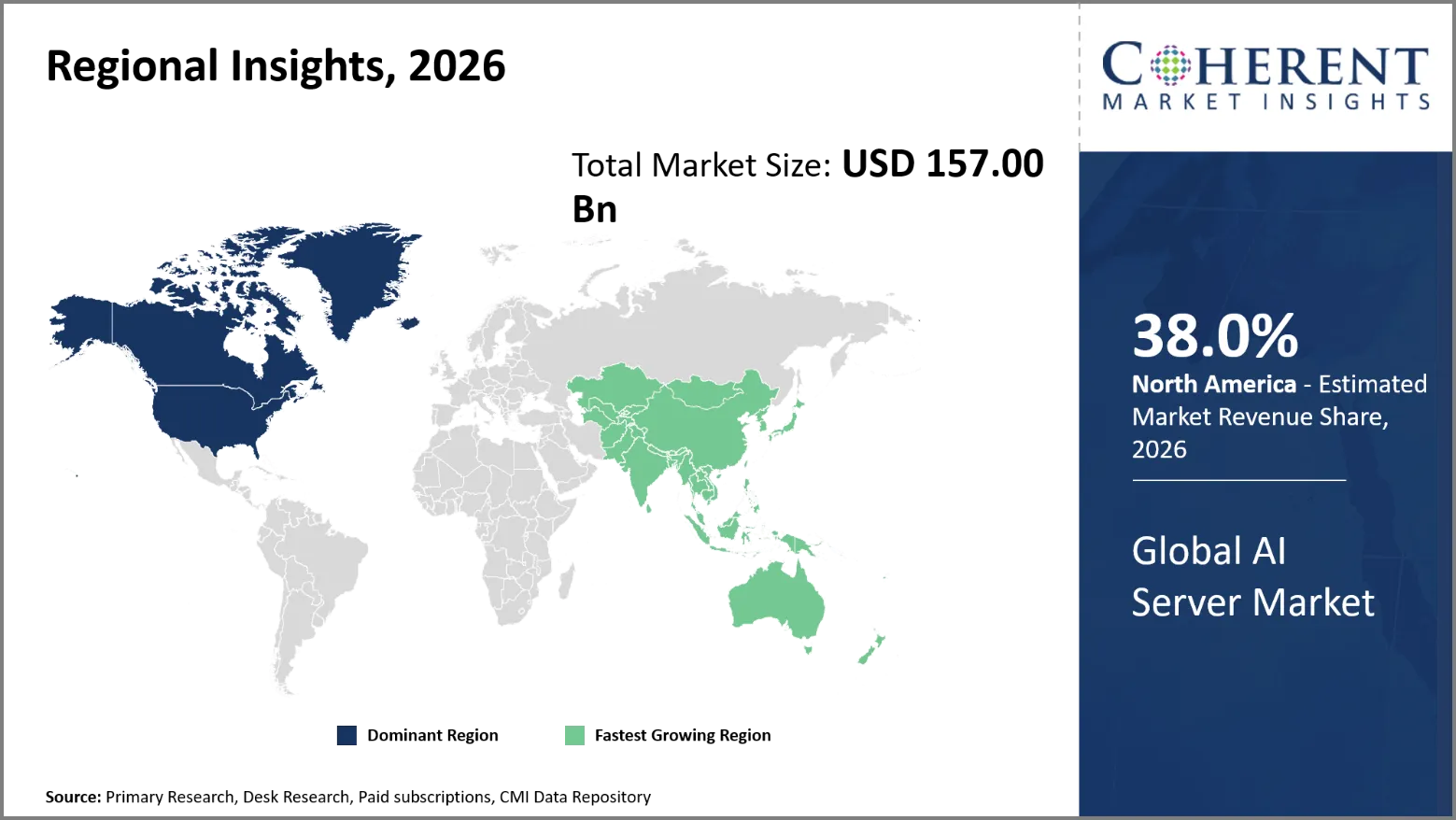
- North America is expected to dominate the AI server market in 2026 with a market share of 38.0%. Increasing demand for custom AI accelerators in North America is driving the growth of the regional market. On January 26, 2026, Microsoft introduced Maia 200 as a custom accelerator for large-scale inference workloads. Fabricated using Taiwan Semiconductor Manufacturing Company’s 3-nanometer process, the chip includes 216 gigabytes of High-Bandwidth Memory 3E.
- Asia Pacific is expected to account for 25.0% share in 2026. Development of energy-efficient server platforms in Asia Pacific is driving the growth of the regional market. In February 2026, Fujitsu announced that manufacturing of its Japan-built sovereign AI servers would begin in March, 2026. The systems feature NVIDIA HGX B300 and NVIDIA RTX PRO 6000 Blackwell Server Edition graphics processing units.
Segmental Insights
Why Does Training Servers Dominate the Global AI Server Market?
The training servers segment is expected to account for 61.0% of the global AI server market share in 2026. Training servers are leading the way since they handle huge amounts of data and develop complex artificial intelligence models. Such systems contain high-performance CPUs, accelerators, high bandwidth memory and fast interconnects to enable parallel computation. The generative artificial intelligence boom is creating demand for servers to train massive language models and multimodal systems. Cloud providers, academic labs, and large companies build training infrastructure to increase model accuracy and computing efficiency. Increasing expenditures in artificial intelligence infrastructure also drive the demand for specialized training servers.
On July 22, 2025, Oracle and OpenAI entered an agreement to develop 4.5 gigawatts of more Stargate data center capacity in the U.S. This investment will create new jobs, accelerate America’s reindustrialization, and help advance U.S. AI leadership. It also marks a major milestone for Stargate, OpenAI’s AI infrastructure platform and long-term vision to deliver the benefits of AI to everyone.
- Current Industry Events of 2026
- Market Size Estimation
- Regional Breakdown
- Competitive Landscape
- Customer Intelligence
- Segmental Analysis
- Pricing Analysis
- Key Market Drivers, Challenges & Future Trends
- Customized Insights Section
Why is Graphics Processing Unit-Based Servers the Most Preferred Processor Type?
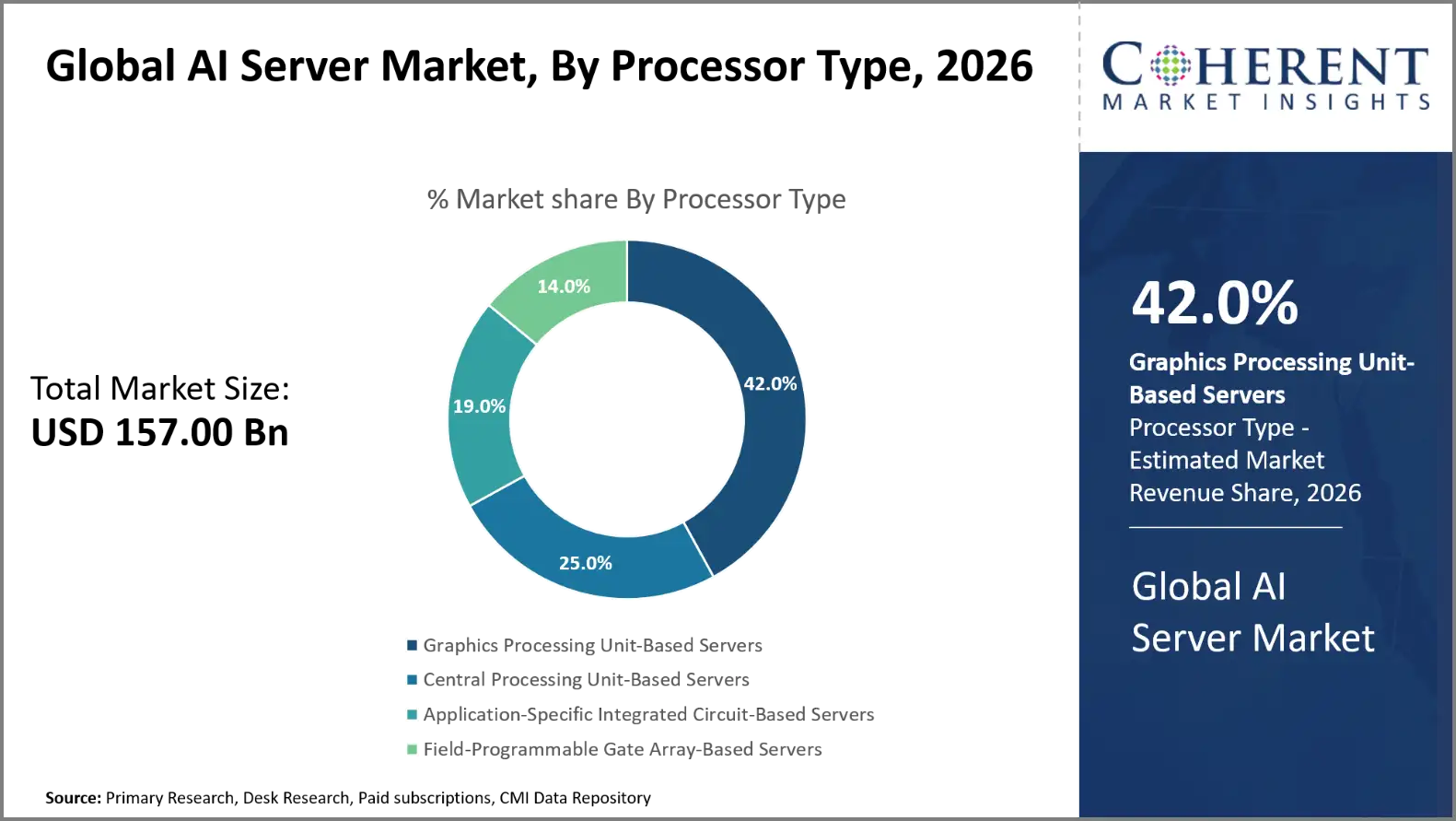
The graphics processing unit-based servers segment is expected to account for 42.0% of the global AI server market share in 2026. Graphics processing unit-based servers are preferred because they perform parallel computing efficiently for artificial intelligence applications. Their architecture accelerates matrix computations, deep learning, training neural networks and inference at scale. Leading processor vendors deliver optimized software ecosystems, high-bandwidth memory, and specialized interconnect technology for accelerated computation. Such skills can enable enterprises to minimize the time to train models and increase computing throughput. Growing adoption of generative artificial intelligence, autonomous systems, and advanced analytics continues to support demand for graphics processing unit-based servers.
On May 18, 2025, NVIDIA and Foxconn Hon Hai Technology Group announced they are deepening their longstanding partnership and are working with the Taiwan government to build an AI factory supercomputer that will deliver state-of-the-art NVIDIA Blackwell infrastructure to researchers, startups and industries.
Rack Servers Dominates the Global AI Server Market
The rack servers segment is expected to account for 53.0% of the global AI server market share in 2026. Rack servers dominate because they provide scalable computing capability within standardized data center infrastructure. With its modular nature, they are easier to deploy, maintain, network and upgrade hardware. Enterprises and cloud service providers can use them to build high-density clusters of numerous servers for AI training and inference. Rack-based designs also offer centralized power distribution, cooling management and operational monitoring. Demand for rack servers is driven by rising investment in hyperscale data centers and enterprise artificial intelligence infrastructure, especially when organizations require flexible expansion and efficient utilization of resources.
On December 2, 2025, HPE announced that it is speeding up the deployment of at-scale artificial intelligence (AI) training and inferencing for cloud service providers (CSPs), including neoclouds, by delivering the first AMD Helios AI rack-scale architecture with integrated scale-up Ethernet networking.
Current Events and their Impact
Current Events | Description and its Impact |
European Union Artificial Intelligence Act Regulation (EU) 2024/1689 |
|
European Union Energy Efficiency Directive (EU) 2023/1791 |
|
AI Server Market Dynamics
Market Drivers
Growing deployment of generative artificial intelligence models
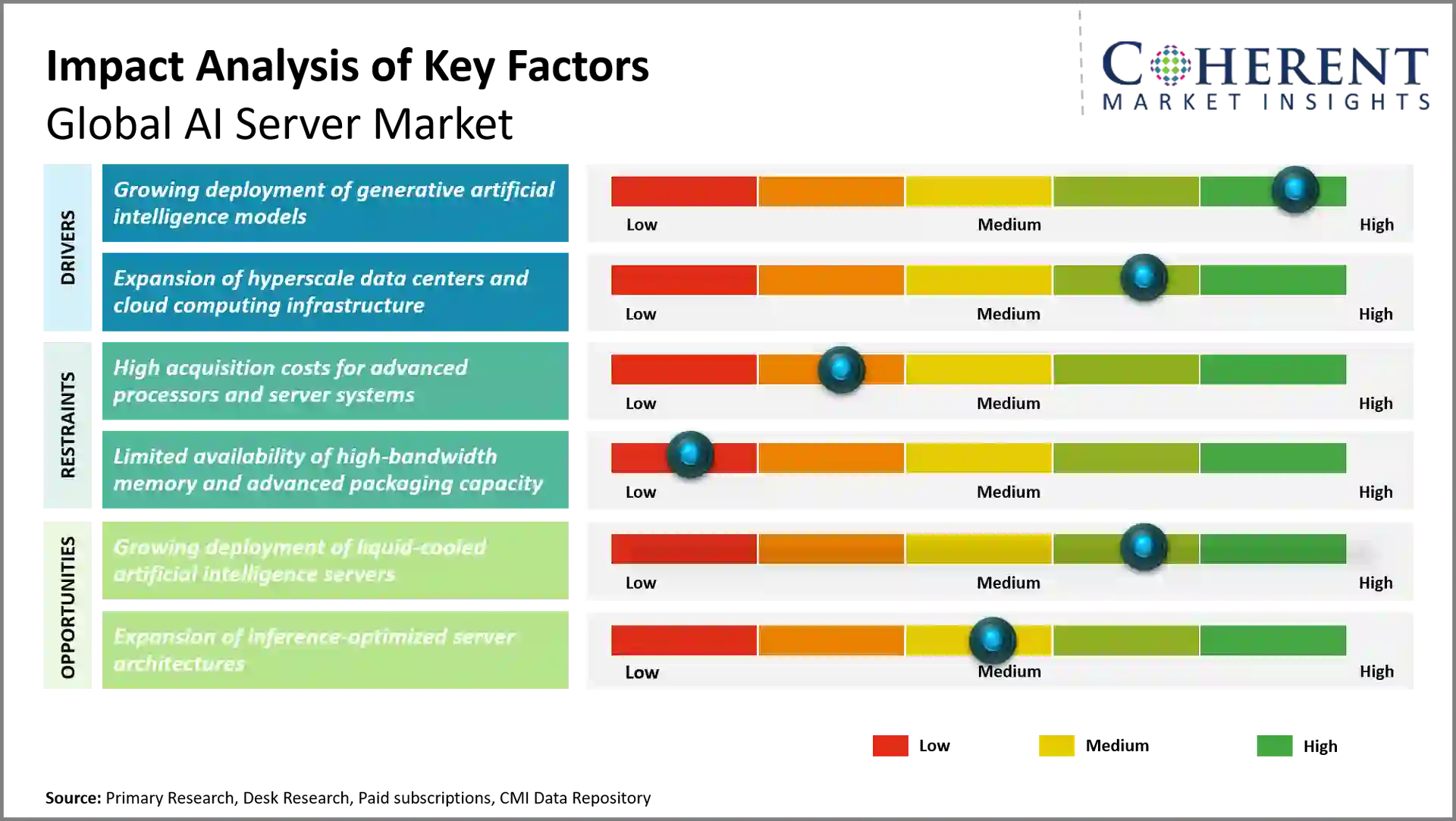
Increasing deployment of generative artificial intelligence models is driving demand for AI servers with high-performance accelerators, high-bandwidth memory, and advanced networking capabilities. Businesses are rolling out large language models, picture generating systems, coding assistants and multimodal applications across several industries. Training such models needs a lot of parallel computing power, while inference workloads need reliable processing and low latency responses. Hence, organizations are looking for customized server configurations to enhance computational throughput and handle the ever-increasing complicated workloads. The ongoing development of models and their integration into the organization further increase the requirement for scalable AI server infrastructure.
On October 14, 2024, Adobe announced the expansion of its Firefly family of creative generative AI models to video, in addition to new breakthroughs in its Image, Vector and Design models and significant momentum in Firefly’s adoption by leading brands and enterprises.
Expansion of hyperscale data centers and cloud computing infrastructure
The growth of hyperscale data centers and cloud computing infrastructure drives the demand for AI servers by providing more processing power for artificial intelligence workloads. Cloud companies are building dedicated server clusters to train models, do inference and give AI services to enterprise customers. These facilities demand high-density computing systems, innovative cooling methods, efficient power distribution and high-speed networking. With increasing acceptance of cloud-based artificial intelligence, fewer enterprises need specialized hardware. Therefore, investments in hyperscale infrastructure enable the procurement of large-scale AI servers and contribute to continuing improvements in server performance and energy efficiency.
On November 24, 2025, Amazon announced plans to invest an estimated USD 15 billion to build new data center campuses in Northern Indiana, US, to augment artificial intelligence (AI) and cloud computing technologies.
Market Restraints
- High Initial Investment and Operating Cost: AI servers need costly accelerators, high bandwidth memory, complicated networking components, and specialized cooling systems. In contrast, the increased rates of power consumption and the costs of infrastructure upgrades increase the costs of ownership, making it more difficult for small enterprises and organizations with limited means to bear the financial burden.
- Power Availability and Thermal Management Constraints: AI servers demand substantial electrical power and thermal management, especially within high-density data centers. Delays in installation, limits on computing capacity, and increased operational complexity for infrastructure operators can all be caused by grid limitations, the demands of cooling infrastructure, and sustainability objectives.
Emerging Trends
- Liquid Cooling and High-Density Server Architectures: AI server manufacturers are increasingly using direct-to-chip liquid cooling to dissipate heat generated by high-power accelerators. Such technologies increase rack density, enhance thermal management and enable data center operators cope with increasing computational needs.
- Increasing Adoption of Custom AI Accelerators: Technology companies are building application-specific integrated circuits and specialized processors to improve artificial intelligence workloads. Such accelerators can improve performance per watt and minimize operational costs and can provide alternatives to traditional graphics processing units.
- Integration of High-Speed Networking and Memory Technologies: High-bandwidth memory, advanced interconnects and high-speed networking are increasingly becoming integrated into AI server systems. These technologies remove data transport bottlenecks, improve accelerator utilization, and enable distributed training across large server clusters.
- Growing Demand for Inference-Optimized AI Servers: Enterprises are deploying trained artificial intelligence models on dedicated servers for customer services, industrial automation, healthcare applications and corporate software. This trend promotes the demand for low latency processing, efficient power usage, and flexible deployment configurations.
Regional Insights
Why is North America a Strong Market for AI Server?
North America is expected to account for a market share of 38.0% in 2026. North America draws advantage from dense hyperscale cloud infrastructure, leading-edge AI research and substantial demand for accelerated computing. Microsoft, Amazon Web applications and Google are developing computational infrastructure for generative artificial intelligence applications. Canada is contributing through artificial intelligence research clusters and investments in data centers, mainly around Toronto and Montreal. Regional demand also mirrors industry adoption of huge language models, cloud-based inference, and specialized computer platforms. Venture financing, sophisticated software ecosystems, and mature server integration skills enable rapid deployment. However, electricity availability and data center permitting increasingly influence where new AI server installations occur.
Why Does Asia Pacific AI Server Market Exhibit High Growth?
Asia Pacific is expected to register the fastest growth with a CAGR of 19.1% over the forecast period. The region is projected to account for 25.0% of the global AI server market in 2026. Asia Pacific’s AI server expansion is shaped by electronics manufacturing, semiconductor production, national AI programs, and rapidly growing digital services. Taiwan produces server systems and advanced semiconductor components, South Korea supplies high-bandwidth memory, Japan is building domestic computing infrastructure that is available domestically, and China is deploying regional data centers. India is drawing infrastructure investment, including Microsoft’s planned pledge of USD 17.5 billion between 2026 and 2029. These complementary roles strengthen regional supply chains, from processor packaging and memory integration to server assembly and cloud deployment.
Global AI Server Market Outlook for Key Countries
Why is U.S. Emerging as a Major Hub in the AI Server Market?
The U.S. AI server market is boosted by bespoke accelerator development, frontier model training, and huge cloud infrastructure programs. In September 2025, Microsoft announced its Fairwater AI data center in Wisconsin and other sites under construction. It is built for complex AI workloads needing tightly coupled server racks, accelerators and high-speed networking. In October 2026, Microsoft also launched its own AI processor, Maia 300, aimed at boosting efficiency for internal AI services. These purchases show the impact that domestic chip development and purpose-built computing facilities are having on server procurement.
Is China the Next Growth Engine for the AI Server Market?
The development of Chinese AI servers is bolstered by domestic technology development, large-scale computer clusters, and strategic initiatives to cut dependency on foreign processors. Among those establishing AI infrastructure and building computer platforms for domestic workloads are companies like Huawei, Alibaba and ByteDance. Ulanqab, in Inner Mongolia, has become a data center hotspot due of accessible electricity, relatively cheap land and good cooling conditions. Local governments are encouraging computing infrastructure in energy-rich regions. However, restrictions on advanced semiconductor access are increasing the importance of domestic accelerator development and server optimization.
Taiwan AI Server Market Analysis and Trends
Taiwan’s AI server industry benefits from original design manufacturing, advanced electronics integration, and close relationships with global accelerator suppliers. In May 2025, Hon Hai Technologies Group (Foxconn) teamed with NVIDIA to build an AI factory that will utilize Blackwell infrastructure. Its subsidiary, Big Innovation Company, also became Taiwan’s first NVIDIA Cloud Partner. Wiwynn and Wistron showcased next-generation AI servers and direct liquid cooling systems at COMPUTEX 2025. These capabilities make Taiwan particularly important for integrating accelerators, memory, networking, power delivery, and thermal management into complete AI server platforms.
Japan AI Server Market Analysis and Trends
Japan’s AI server market is gaining momentum through sovereign cloud development, domestic language models, and geographically distributed computing infrastructure. SoftBank announced plans to build its Hokkaido Tomakomai AI data center in April 2025 with the use of renewable energy and large-scale computing. The project is meant to scale up as demand increases from its initial deployment. SoftBank is also working on infrastructure in Sakai, Osaka, leveraging an existing industrial location to speed up deployment. The projects promote the development of Japanese-language models, enterprise AI services and GPU cloud products. The local infrastructure also supports data sovereignty and regional computing accessibility needs.
South Korea AI Server Market Analysis and Trends
South Korea's AI server ecosystem benefits from advanced memory manufacture, high-bandwidth memory development and strong semiconductor engineering capabilities. SK Hynix said it has finished developing HBM4 and would start mass producing it in September 2025. The manufacturer boasted of doubling the bandwidth of its predecessor, HBM3E, and improving power efficiency. These memory gains enable accelerator-heavy server architectures for training and inference. Samsung Electronics is also involved in semiconductor production and memory technology. South Korea’s established electronics industry provides an important foundation for developing higher-performance AI computing systems and strengthening domestic capabilities across the AI infrastructure supply chain.
Global AI Server Market - Rack-Scale Computing Adoption by Region (2025)
Region | 2025 Infrastructure Indicator | Rack-Scale Computing Adoption Assessment | Key Adoption Drivers |
North America | Data center inventory increased 43% year over year in Q1 2025 across four major markets | Very high | Hyperscale AI investments, large GPU clusters, cloud infrastructure expansion |
Asia Pacific | Data center inventory increased approximately 4.3% year over year in Q1 2025 across four major markets | High and accelerating | Cloud expansion, AI infrastructure investment, regional manufacturing |
Europe | Data center inventory increased 7.2% year over year in Q1 2025 across four major markets | High in major hubs | Enterprise AI, cloud modernization, sovereign computing |
Latin America | Data center inventory increased 13.7% year over year in Q1 2025 across four major markets | Emerging and expanding | Cloud migration, digital services, new data center investment |
Middle East and Africa | Sovereign AI infrastructure investment accelerated during 2025 | Emerging with rapid investment in selected markets | Government-backed AI programs, cloud expansion, digital transformation |
How is Growing Deployment of Liquid-Cooled Artificial Intelligence Servers Creating New Growth Opportunities in the AI Server Market?
Growing deployment of liquid-cooled artificial intelligence servers is creating new growth opportunities by enabling higher accelerator density within existing data center footprints. NVIDIA’s GB200 NVL72 rack-scale systems use liquid cooling to support 72 Blackwell graphics processing units and 36 Grace central processing units in an integrated architecture. This raises demand for cold plates, coolant distribution units, manifolds, leak detection systems and customized server racks. Manufacturers including Supermicro, Dell Technologies and Hewlett Packard Enterprise are increasing liquid-cooled infrastructure products for demanding workloads. Liquid cooling also helps operators meet thermal restrictions as power consumption increases, allowing for larger artificial intelligence training clusters and high-throughput inference deployments.
On July 3, 2025, Giga Computing, a subsidiary of GIGABYTE, introduced four new GIGABYTE servers based on the NVIDIA HGX B200 architecture. This addition to GIGABYTE’s GPU server range adds additional thermal design freedom and compatibility for the latest processors, including the new AI-optimized Intel Xeon 6 CPUs, providing more options to customers when customizing their systems for workloads and efficiency.
Market Players, Key Development, and Competitive Landscape
Key Developments
- On March 16, 2026, HPE announced significant innovations to the NVIDIA AI Computing by HPE portfolio focused on large-scale AI factories and supercomputers that enable customers to scale, deploy efficiently, and gain faster time-to-insight. The full-stack AI solutions with NVIDIA include tightly integrated compute, GPUs, networking, liquid cooling, software, and services designed for at-scale and sovereign environments.
- On March 16, 2026, Supermicro, Inc. announced seven fully integrated AI Data Platform solutions designed to accelerate enterprise AI adoption. Built on NVIDIA reference architectures and powered by Supermicro's high-performance GPU and storage systems, the platforms leverage NVIDIA RTX PRO 6000 Blackwell Server Edition GPUs and the new NVIDIA RTX PRO 4500 Blackwell Server Edition GPUs to enable advanced AI agents.
- On January 6, 2026, Lenovo announced a suite of purpose-built enterprise servers, solutions and services for AI inferencing workloads expanding the Lenovo Hybrid AI Advantage portfolio. Setting the stage for the next era of AI, Lenovo is advancing the field of inferencing and eliminating hurdles to power real-world AI use cases ranging from storefront customer transactions to advanced healthcare applications.
Competitive Landscape
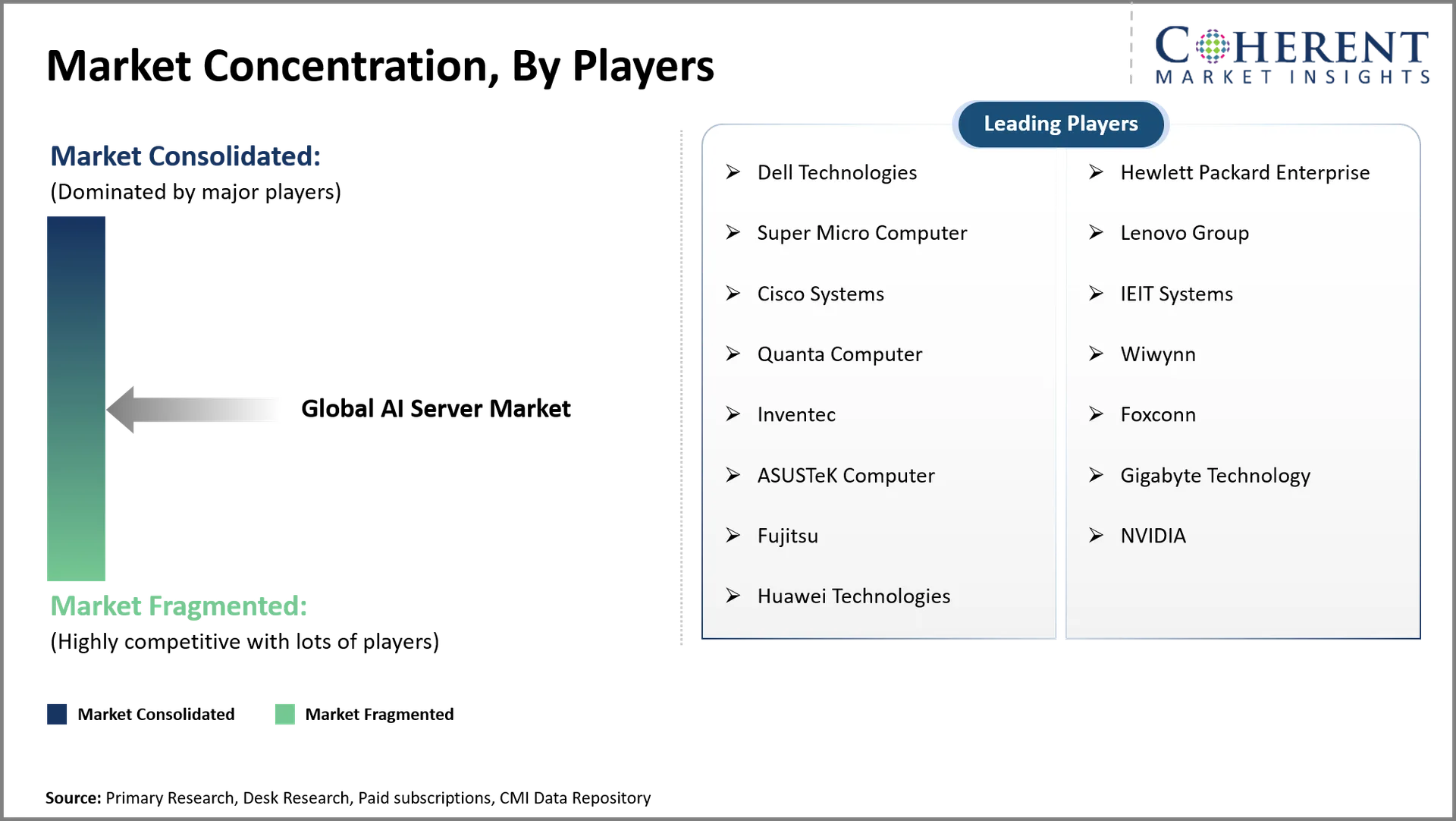
The global AI server market is led by NVIDIA, Dell Technologies, Supermicro, Hewlett Packard Enterprise, and Lenovo, with competition based on accelerated processing, integrated systems, and deployment speed. Blackwell processors and CUDA software, and agreements with server manufacturers, improve NVIDIA’s position. Dell Technologies is pairing its Dell AI Factory platform with PowerEdge XE9780L and XE9785L liquid-cooled servers. Supermicro is all about fast deployment with modular rack designs, direct-to-chip cooling, and high-density NVIDIA Blackwell systems. Hewlett Packard Enterprise emphasizes turnkey AI factories, private cloud deployments, and secure enterprise infrastructure. Lenovo targets enterprise and hyperscale workloads through validated AI server platforms.
Top Market Players and Notable Products/Offerings in the AI Server Market
Market Players | Notable Product/Offerings | Key features |
Dell Technologies | PowerEdge XE9680L | Eight NVIDIA HGX B200 GPUs, liquid cooling, high-speed GPU interconnects, AI training support |
Super Micro Computer | Supermicro SYS-821GE-TNHR | NVIDIA HGX GPU platform support, high-density computing, scalable configurations, demanding AI workload support |
Hewlett Packard Enterprise | HPE Cray XD670 | Eight NVIDIA H200 or H100 GPUs, optional direct liquid cooling, scalable AI training |
Lenovo Group | ThinkSystem SR680a V3 | Eight NVIDIA H100, H200, or B200 GPUs, NVLink interconnects, up to 4 terabytes of system memory |
Cisco Systems | Cisco UCS C885A M8 | NVIDIA HGX H100 or H200 support, enterprise management, high-performance networking, AI computing |
AI Server Market Report Coverage | |||
Report Coverage | Details | ||
Base Year | 2025 | Market Size in 2026: | USD 157.00 Bn |
Historical Data For: | 2020 To 2024 | Forecast Period: | 2026 To 2033 |
Forecast Period 2026 To 2033 CAGR: | 18% | 2033 Value Projection: | USD 598.00 Bn |
Geographies covered: |
| ||
Segments covered: |
| ||
Companies covered: | Dell Technologies, Hewlett Packard Enterprise, Super Micro Computer, Lenovo Group, Cisco Systems, IEIT Systems, Quanta Computer, Wiwynn, Inventec, Foxconn, ASUSTeK Computer, Gigabyte Technology, Fujitsu, NVIDIA, Huawei Technologies | ||
Growth Drivers: |
| ||
Restraints & Challenges: |
| ||
Analyst Opinion (Expert Opinion)
- The future of the AI server industry will depend on how effectively manufacturers balance accelerator performance, memory bandwidth, power consumption, and deployment complexity. Rack-scale architectures will become increasingly important as AI workloads require tightly integrated processors, networking, storage, and cooling. Companies should prepare for demand across both model training and inference, rather than concentrating exclusively on large training clusters. Modular designs that accommodate processor upgrades will help customers extend infrastructure lifecycles and reduce costly system replacements.
- The strongest opportunities lie in liquid-cooled rack servers, inference-optimized systems, and custom accelerator platforms. The U.S. offers substantial opportunities for hyperscale deployments and enterprise AI infrastructure, while Taiwan remains strategically important for server manufacturing and hardware integration. Japan and South Korea offer opportunities linked to domestic computing infrastructure, semiconductor expertise, and memory technologies. Manufacturers should also develop compact AI servers for hospitals, industrial facilities, financial institutions, and telecommunications networks that require local processing and tighter data control.
- To gain a competitive edge, manufacturers should differentiate through measurable performance per watt, validated cooling designs, supply-chain resilience, and application-specific configurations. Partnerships with accelerator suppliers, memory manufacturers, networking vendors, and data center operators can shorten deployment timelines. Companies should provide complete infrastructure packages that include server hardware, cooling systems, power management, remote monitoring, and lifecycle support. Suppliers can offer customizable configurations for varied workloads, enabling them to cater to customers with different budgets, infrastructure constraints, and security requirements.
Speak to the analyst
Want personalized insights?
Take the findings above to one of our principal consultants, or have the report rebuilt around the segments, geographies and competitors you actually track.
Market Segmentation
- Server Type Insights (Revenue, USD Billion, 2021 - 2033)
- Training Servers
- Inference Servers
- Processor Type Insights (Revenue, USD Billion, 2021 - 2033)
- Graphics Processing Unit-Based Servers
- Central Processing Unit-Based Servers
- Application-Specific Integrated Circuit-Based Servers
- Field-Programmable Gate Array-Based Servers
- Form Factor Insights (Revenue, USD Billion, 2021 - 2033)
- Rack Servers
- Blade Servers
- Tower Servers
- Technology Type Insights (Revenue, USD Billion, 2021 - 2033)
- Air-Cooled Servers
- Liquid-Cooled Servers
- Deployment Type Insights (Revenue, USD Billion, 2021 - 2033)
- Cloud Data Centers
- Enterprise Data Centers
- Edge Data Centers
- End User Insights (Revenue, USD Billion, 2021 - 2033)
- Cloud Service Providers
- IT and Telecommunications
- BFSI
- Healthcare
- Automotive
- Retail and E-commerce
- Government and Defense
- Research and Academic
- Regional Insights (Revenue, USD Billion, 2021 - 2033)
- North America
- U.S.
- Canada
- Latin America
- Brazil
- Argentina
- Mexico
- Rest of Latin America
- Europe
- Germany
- U.K.
- Spain
- France
- Italy
- Russia
- Rest of Europe
- Asia Pacific
- China
- India
- Japan
- Australia
- South Korea
- ASEAN
- Rest of Asia Pacific
- Middle East
- GCC Countries
- Israel
- Rest of Middle East
- Africa
- South Africa
- North Africa
- Central Africa
- North America
- Key Players Insights
- Dell Technologies
- Hewlett Packard Enterprise
- Super Micro Computer
- Lenovo Group
- Cisco Systems
- IEIT Systems
- Quanta Computer
- Wiwynn
- Inventec
- Foxconn
- ASUSTeK Computer
- Gigabyte Technology
- Fujitsu
- NVIDIA
- Huawei Technologies
Sources
Primary Research Interviews
- AI Server Manufacturers & OEMs
- Cloud Service Providers & Hyperscalers
- Data Center Operators & Infrastructure Managers
- AI Software & Application Developers
Magazines
- IEEE Spectrum
- Data Center Knowledge Magazine
- AI Business Magazine
- HPCwire Magazine
Journals
- Journal of Artificial Intelligence Research (JAIR)
- IEEE Transactions on Neural Networks and Learning Systems
- Journal of Parallel and Distributed Computing
Associations
- Open Compute Project (OCP)
- Green Grid Association
- Data Center World (DCW) Association
- AI Infrastructure Alliance (AIIA)
Public Domain Sources
- U.S. Department of Energy (DOE) – Data Center Reports
- European Commission – AI Strategy & Digital Reports
- National Institute of Standards and Technology (NIST)
- U.S. International Trade Commission (USITC) Reports
Proprietary Elements
- CMI Data Analytics Tool
- Proprietary CMI Existing Repository of Information for the Last 10 Years
Get access to 250+ pages report
Every segment, forecast, competitor profile and data table behind the analysis above — available for instant download.
- ESOMAR Member
- ISO 9001:2015 Certified
- D-U-N-S Registered
- GDPR & CCPA Compliant
Frequently Asked Questions
The global AI server market is expected to stand at USD 157.00 Bn in 2026 and is expected to reach USD 598.00 Bn by 2033.
The CAGR of the global AI server market is projected to be 18% from 2026 to 2033.
Growing deployment of generative artificial intelligence models and Expansion of hyperscale data centers and cloud computing infrastructure are the major factors driving the growth of the global AI server market.
High acquisition costs for advanced processors and server systems and Limited availability of high-bandwidth memory and advanced packaging capacity are the major factors hampering the growth of the global AI server market.
In terms of server type, training servers segment is estimated to dominate the market revenue share in 2026.
High-Bandwidth Memory increases data transfer capacity between memory and processors, helping accelerate computation-intensive artificial intelligence workloads.
Liquid cooling removes heat efficiently from high-power processors and supports greater computing density in advanced server racks.